Antikythera · Volume 9
Antikythera — Volume 9 — The Words on the Machine — Inscriptions and a User's Manual
Letters a millimetre high on bronze plates, read backwards from crusts of corrosion and sliced out of the fragments by X-rays: the cover texts, the star calendar, the dial labels, what the 2016 edition found, and what the lettering can and cannot say about date
9.1 About This Volume
Volumes 5 to 8 described the mechanism as gears and dials. This volume is about the other half of the evidence: the words. The machine was covered in text — month names, zodiac signs, festival names and eclipse symbols on the dials, a star calendar above and below the front dial, and long explanatory texts on plates at front and back. Much of what is known about its lost parts, the planets above all, comes from those texts rather than from the gears.
The sections below cover how the inscriptions survived and were read, from May 1902 to the full edition of 2016; the Back Cover Inscription, long called a “user’s manual”, and why its editors describe it differently; the Front Cover Inscription, a table of planetary cycles containing the numbers 462 and 442; the parapegma, a star calendar keyed to letters on the zodiac scale; the dial labels; the uncertain count of characters read; and what the letterforms say about date.
The primary source throughout is the Antikythera Mechanism Research Project’s edition, The Inscriptions of the Antikythera Mechanism, published as a special issue of Almagest 7.1 (2016) and cited here by paper number as IAM 1–6 (open-access PDFs at the NYU Faculty Digital Archive). The six papers are a general preface (IAM 1); A. Jones, “Historical Background and General Observations” (IAM 2); Y. Bitsakis and A. Jones, “The Front Dial and Parapegma Inscriptions” (IAM 3); M. Anastasiou and others, “The Back Dial and Back Plate Inscriptions” (IAM 4); Bitsakis and Jones, “The Back Cover Inscription” (IAM 5); and Anastasiou and others, “The Front Cover Inscription” (IAM 6).
9.2 Text on a Machine
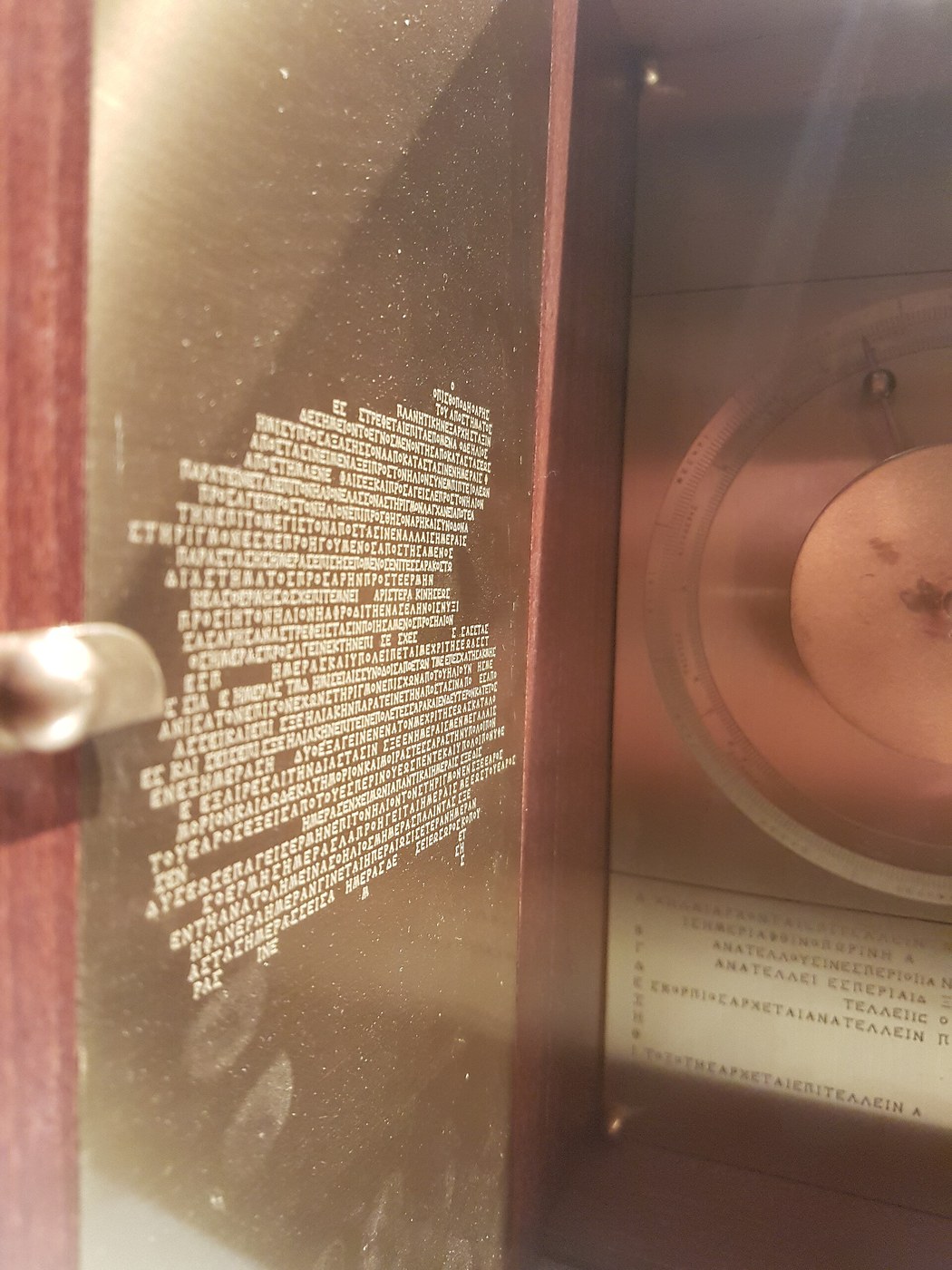
The inscriptions are engraved in capital letters of the kind used for Hellenistic inscriptions on stone, but very much smaller. Letter heights run from about 1.2 mm to about 3.0 mm (IAM 1); the largest lettering, on the parapegma plates, stays within 2.3–3.0 mm, and the smallest, on the dial scales, is barely more than 1 mm tall (IAM 2, n. 81). For comparison, the letters on an Athenian public decree are typically 5–9 mm high.
The engraver used a burin, a hand-pushed point that cuts a sliver of metal away; tomographic cross-sections show grooves with no raised ridges beside them, the burin’s signature (IAM 2). At normal distance the text looks neat. Under magnification the sizes, spacing and shapes vary, though the engraver clearly imitated serifed lettering on stone. There is no punctuation, and numbers are set off by small blank spaces.
Numbers are written in the Ionian alphabetic system, letters doubling as numerals (Α = 1, Ι = 10, Ρ = 100, Υ = 400); 6 is a form of the old letter digamma, an L-shaped sign means “year”, and no fractions appear (IAM 2).
There are at least two hands. In the Back Cover Inscription the letter theta is always a narrow oval with a cross-stroke; everywhere else it is a near-circle with a central dot. The editors find that consistent difference hard to explain unless the back cover was engraved by a different person from the rest (IAM 2).
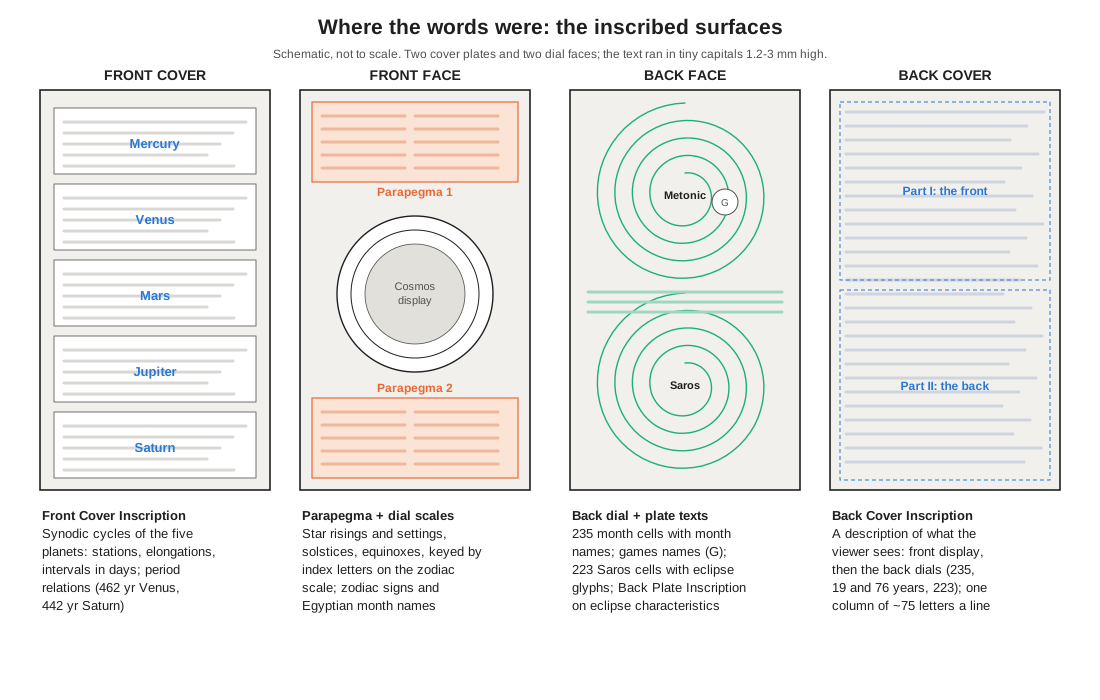
The texts fall into five groups, mapped in the figure below: the dial scales and labels; the Parapegma Inscription, a star calendar on plates above and below the front dial; the Back Plate Inscription, around the back dials, on the predicted eclipses; the Front Cover Inscription, on the planets; and the Back Cover Inscription, describing the whole machine.
9.3 Reading Text That Is Not There
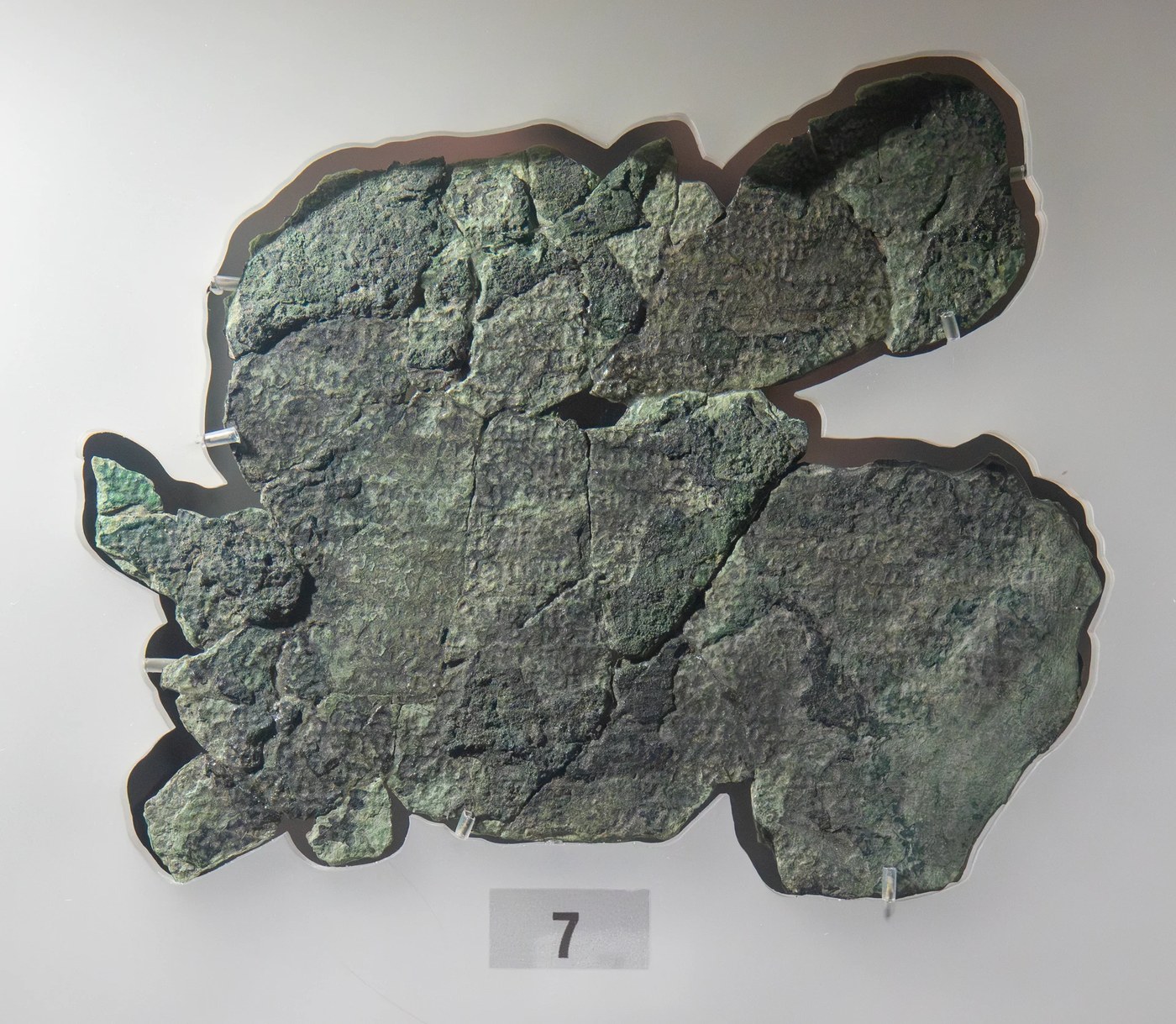
Most of the longer texts no longer exist as engraved bronze. What survives is their imprint. While the mechanism lay on the sea floor, each cover plate rested against the machine with its inscribed face turned inwards. A hard film of corrosion and sediment, generally less than a millimetre thick, built up against the engraved surface, and the letters were moulded into it as slightly raised, mirror-reversed offsets. Later the plates broke up and most of the bronze fell away, leaving patches of the crust stuck to the fragments with the text cast into it backwards (IAM 5).
In May 1902, days after Valerios Stais noticed the gear wheel (Volume 3), the epigrapher Adolf Wilhelm and the numismatist Ioannis Svoronos read a few words of the mirror text on Fragment B for the Athens newspapers. They took it for the back of an engraved plate; the correct explanation, offsets on accretion, first appeared in print in Ioannis Theofanidis’s work of the late 1920s (IAM 5, n. 1).
Conservation work around 1905 separated the layers. It freed Fragment 19, the largest surviving piece of the Back Cover plate itself, whose surface is in far better condition than anything seen before. Fragment 19 carries the numbers that first tied the machine to astronomical cycles — 19 years, 76 years and 223 — and it became the basis of the first detailed discussion of the letterforms (IAM 2; IAM 5). The same campaign removed the Front Cover plate from Fragment C in many small pieces, which is one reason the front text is so fragmentary (IAM 6).
Derek de Solla Price, working with the epigrapher George Stamires, raised the count of legible letters to 793 by 1958 (Volume 3). Then came the 2005 imaging campaign of the Antikythera Mechanism Research Project (AMRP; Volume 4). Polynomial texture mapping, which lets a surface be re-lit on screen from any direction, made faint surface letters readable. Microfocus X-ray computed tomography (CT) went further, isolating thin slices inside a fragment so that text buried within the lumps could be read. The 2016 preface credits CT with “several thousand additional text characters” (IAM 1). The 2006 Nature paper had already doubled the count of deciphered characters; the 2016 edition, built almost entirely on the 2005 data, turned scattered words into connected text.
9.4 The 2016 Edition
The six papers of Almagest 7.1 are the editio princeps, the first full critical edition: transcription with every doubtful letter described, translation, and commentary. It was presented in Piraeus on 9 June 2016 by Yanis Bitsakis, Alexander Jones, Agamemnon Tselikas, Xenophon Moussas, John Seiradakis and Mike Edmunds, the coordinating editor (Greek News Agenda, 17 June 2016). The preface also records that Tony Freeth, one of the original AMRP members, withdrew from the agreed plan for the publication in October 2012 and has published related material independently (IAM 1, n. 18); his later work on the planets is the subject of Volume 10.
9.4.1 How many characters?
The press coverage of June 2016 gave a single striking figure, but not the same one. The Greek News Agenda report of the Piraeus presentation says “scientists have already deciphered 3,400 characters, which is a quarter of the original.” Other coverage of the same week reported about 3,500 characters, “some just 1.2 millimetres tall” (archaeology.wiki, 13 June 2016). The difference is probably rounding, but the edition’s prefatory papers state no total and no primary count has been found. The honest figure is “roughly 3,400–3,500 characters”, and “a quarter of the original” is a press estimate, not a measurement. A widely repeated quotation in which the team had doubled a count of “over 1,000” characters predates the edition and is not its total.
The scale can be checked against one text. The Back Cover Inscription preserves parts of fifty-five lines, written in a single wide column averaging about 75 letters a line. Only the left-hand ends of the lines survive, so the preserved total is far below 55 × 75. The plate could have held about ninety lines, some twelve hundred words — four or five printed pages of Greek prose — and the text filled at least two-thirds of it (IAM 5).
9.5 The Back Cover Inscription: a Manual That Describes
9.5.1 The plate
The Back Cover was a bronze plate about two millimetres thick, inscribed on the face that lay against the machine’s back. It did not lie flush: the pointers of the back dials held it off the surface. Its remains are spread across Fragments A, B and E and the detached plate pieces 19 and 67 (IAM 5).
What the plate was is not certain. Price imagined a hinged door, even a two-leaved “diptych”, but no hinge has been found. The offsets on Fragment B are shifted sideways differently from those on A and E, so the plate was broken in two or was originally two plates; the editors suggest the front and back descriptions may have been separate plaques, perhaps fixed to a stand so that each could be read beside the face it described (IAM 5). They keep the neutral name “Back Cover” and say plainly that its function is unknown.
9.5.2 Part I: the front face
The part preserved on Fragment B describes the front dial, working outwards from the centre. Most lines are only a few words, but lines 15 to 26 are the most important passage of text on the machine. In the editors’ translation (IAM 5):
15 … the little sphere travels… 16 … little pointer projecting from it… 17 arcs, the one next to the… of the… 18 Stilbon(?), and the… travelling through it 19 of Aphrodite Phosphoros… 20 the arc of Phosphoros… 21 on the pointer lies a golden little sphere… 22 ray of the Sun, above the Sun is the circle(?)… 23 of Ares Pyroeis, and the… making its way through… 24 of [Zeus] Phaethon, and the… making its way through… 25 circle of [Kronos] Phainon, and the little sphere… 26 … of the cosmos lies…
The passage names the five planets outward from the centre — Mercury (Stilbon, “gleaming”), Venus (Phosphoros, “light-bringer”, with the goddess Aphrodite), the Sun, Mars (Pyroeis, “fiery”, with Ares), Jupiter (Phaethon, “shining”, with Zeus) and Saturn (Phainon, “bright”, with Kronos). That is the standard Greek geocentric order — Moon, Mercury, Venus, Sun, Mars, Jupiter, Saturn — and it describes a display: each body had a “little sphere” (sphairion) travelling through its own arc or circle, and the Sun’s was golden, on a pointer, with a “ray”. The editors tentatively restore Mars’s sphere as “fire-red” and infer that the spheres were coloured to tell the bodies apart. Line 26 contains the word kosmos, “of the cosmos”, which the editors take to mean the region of the front dial occupied by the spheres and pointers. Line 27 mentions “letters situated beside” something — almost certainly the index letters on the zodiac scale that key the parapegma (see below).
This one passage proves what no surviving gear can: the mechanism displayed all five planets known in antiquity, in cosmological order. Volume 10 follows the argument over whether that display used pointers, as the editors read it, or rings.
9.5.3 Part II: the back face
The part preserved on Fragments A, E, 19 and 67 describes the back. It begins with the upper spiral: “in the entire spiral 235 sectors”, then “the omitted days” — exairesimoi, the technical term for the days dropped from 30-day months to make a lunar calendar fit the Moon (Volume 8). Lines 5 to 16 describe hardware: two bearings around a disk, perforations, something “to be pulled through”, a pin “from whence it was pulled out”, and “the first space”. The editors read this as the mounting of the pointer-follower at the centre of the spiral and the procedure for resetting it to the start of the spiral when it reached the end — the one passage that may contain an actual operating instruction (IAM 5).
Lines 17 to 24 describe the subsidiary dials and the lower spiral: “two pointers whose tips travel”, “four… one of them indicates the…”, “the 19-year period of the 76-year period”, “into 223 equal (parts?)”, “times(?) of eclipses”. The first of these confirms that the upper spiral enclosed two small dials — the surviving four-year games dial and a lost dial for the 76-year Kallippic cycle — while the lower spiral enclosed only one. Without the inscription the second subsidiary dial inside the Metonic spiral would not be known.
9.5.4 Caption, not instructions
The name “user’s manual” goes back to 1902, when it seemed natural that a text attached to an instrument must explain how to work it. Bitsakis and Jones conclude that it “is not quite exact though it comes close to the truth”. The text “does not contain instructions for operating the Mechanism (except perhaps in part II.5-16), but it systematically describes the visible components.” Its relation to the machine “was like that of a caption to a drawing or picture, addressed to the viewer rather than to the operator” (IAM 5). Mike Edmunds put the same point more briefly at the 2016 presentation: “the instructions do not tell you how to use it; they describe what you see.”
The editors find parallels in Greek captions for public sundials — one, copied by Cyriacus of Ancona on Samothrace in 1444, tells the viewer that “when the shadow of the gnomon reaches the lines, it indicates the seasons of the year and the hours of the day” — and in the long captions to the maps of Ptolemy’s Geography. That makes the text evidence about the audience too: the makers expected a viewer who needed to be told that the golden sphere was the Sun and the outermost circle belonged to Kronos.
9.6 The Front Cover Inscription: an Almanac of the Planets
9.6.1 A plate on a plate
When recovered, the front of the machine carried two layers of inscribed bronze: the two parapegma plates, displaced from their positions, and on top of them the Front Cover, inscribed on its outer face, whose text survives partly as offsets (IAM 6). It is spread over Fragment G and minor fragments including 26 and 29, badly corroded, and read mostly by CT; the best specimen of its lettering is in offsets on Fragment 21 (IAM 2).
9.6.2 What it says
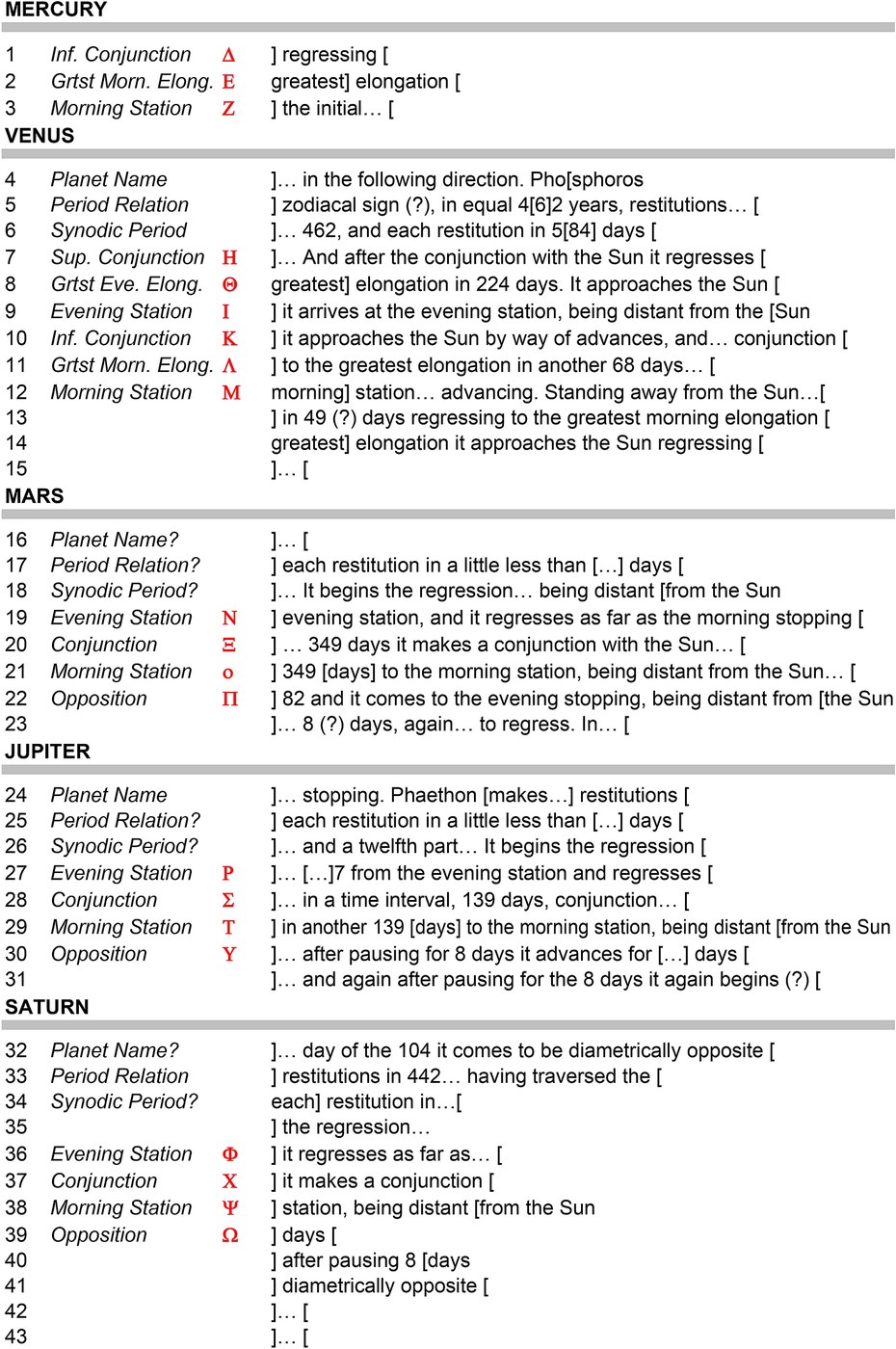
The Front Cover Inscription is not a description of the display. It is a reference text about the planets themselves: for each planet, a section setting out its synodic cycle — the cycle of its appearances relative to the Sun — stage by stage, with the number of days between stages. The sections run Mercury, Venus, Mars, Jupiter, Saturn, the same order as the Back Cover. The planets are named only by their descriptive names, Phosphoros for Venus and Phaethon for Jupiter among the legible ones. The editors conjecture that lost lines dealt with the Sun and Moon (IAM 6).
The Venus section is the best preserved. In translation (IAM 6, lines 4–13, square brackets marking restorations):
… in the following direction. Pho[sphoros … zodiacal sign (?), in equal 4[6]2 years, restitutions… … 462, and each restitution in 5[84] days … And after the conjunction with the Sun it regresses greatest] elongation in 224 days. It approaches the Sun … it arrives at the evening station, being distant from the [Sun … it approaches the Sun by way of advances, and… conjunction … to the greatest elongation in another 68 days… morning] station… advancing. Standing away from the Sun… … in 49 (?) days regressing to the greatest morning elongation
The vocabulary is technical Greek astronomy: apostēma for elongation from the Sun, stērigmos for a station, the point where a planet appears to stand still before reversing. The intervals — 224 days from superior conjunction to greatest evening elongation, 68 days on to inferior conjunction, about 584 days for the whole cycle — are the kind of numbers a simple geometric model of Venus would produce. The same pattern recurs for the outer planets: for Mars, 349 days from evening station to conjunction and 349 more to morning station; for Jupiter, 139 days and 139 days, with pauses of 8 days at the stations; and for Saturn “restitutions in 442”.
9.6.3 Two numbers
No complete period relation survives, but one number from each is enough, because the ratio between years and cycles is approximately known. Line 6 preserves ΥΞΒ, 462, in the Venus section; the Saturn section preserves ΥΜΒ, 442 (Υ = 400, Ξ = 60, Μ = 40, Β = 2). The editors reconstruct:
- Venus: 462 years = 289 synodic periods = 462 revolutions of the ecliptic;
- Saturn: 442 years = 427 synodic periods = 15 revolutions of the ecliptic.
Neither relation is attested in any other ancient source. Both are accurate — 462 years and a 365¼-day year give a Venus cycle of 583.89 days, against the true 583.92 — and both factor into numbers small enough for gear teeth: 462 : 289 = (2 × 3 × 7 × 11) : (17 × 17), and 442 : 427 = (2 × 13 × 17) : (7 × 61). The Venus relation is a continued-fraction approximation of the Babylonian relation of 720 cycles in 1,151 years, which no gear train could reproduce because 1,151 is prime. The Saturn relation cannot be explained that way, since the Babylonian 256 cycles in 265 years was already shorter and already factorable. The editors conclude that “for the planets, the designers of the Mechanism drew on otherwise unknown research in the Greek tradition”, probably building on Babylonian foundations (IAM 6).
Two further conclusions follow. Because the inscription gives fixed day counts for each stage, it rules out a display of mean planetary positions only: the planets on the dial must have gone forward and backward, as they do in the sky. And because the relations are factorable, they were very likely built into the gears, not merely quoted. Volume 10 follows what reconstructors did with them.
9.7 The Parapegma: a Star Calendar in Letters
9.7.1 How it worked
A parapegma is a Greek star calendar, named for the peg “fixed beside” a day-hole in the stone versions, with notes on which stars rose or set and what weather to expect. The best-known literary example is appended to Geminos’s Introduction to the Phenomena (mid-first century BC) and cites Euktemon, Eudoxos and Kallippos (IAM 3).
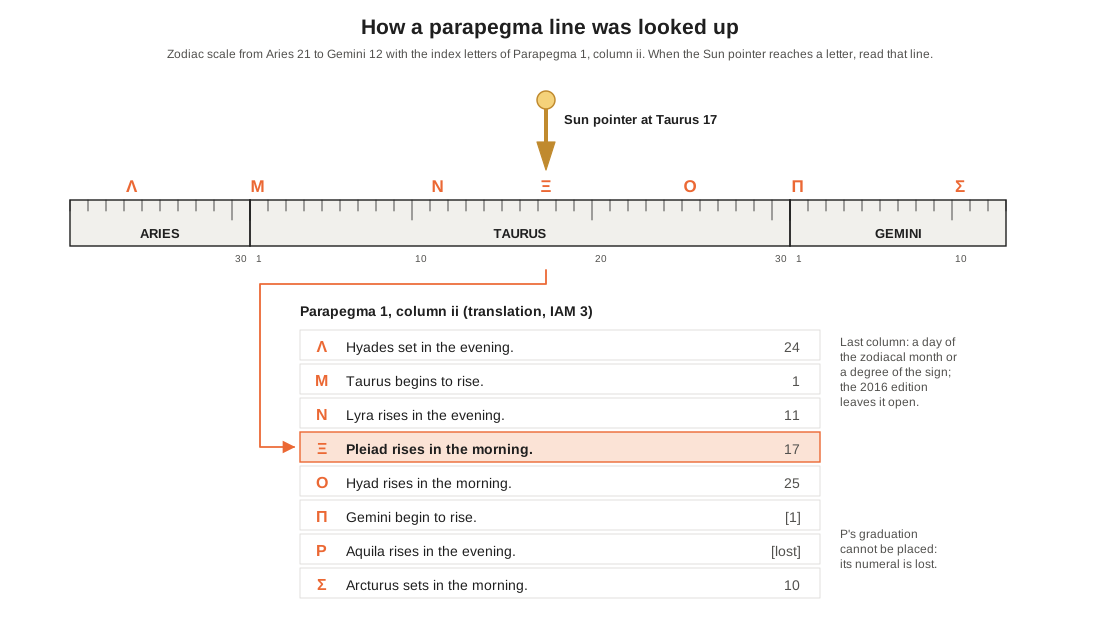
The mechanism replaces the peg with the Sun pointer. Beside certain degree marks of the zodiac scale, just clockwise of the mark, small index letters were engraved in alphabetical order. Each letter keyed a line of the Parapegma Inscription, engraved on two rectangular plates placed above and below the dial (PP1 and PP2) as Price had proposed. “Whenever the pointer on the front dial representing the position of the Sun in the zodiac pointed at a degree division bearing an index letter, the viewer could look up the corresponding line of the Parapegma Inscription and read off a prediction of a solar or stellar event predicted for the date in question” (IAM 3).
The entries list solstices and equinoxes, the Sun’s entry into each sign, and the first and last appearances of stars and constellations before dawn and after dusk. One well-preserved column of PP1 reads, in translation (IAM 3):
Table 1 — The entries list solstices and equinoxes, the Sun's entry into each sign, and the first and last appearances of stars and constellations before dawn and after dusk. One well-preserved column of PP1 reads, in translation (IAM 3)
| Letter | Entry | Numeral |
|---|---|---|
| Λ | Hyades set in the evening. | 24 |
| Μ | Taurus begins to rise. | 1 |
| Ν | Lyra rises in the evening. | 11 |
| Ξ | Pleiad rises in the morning. | 17 |
| Ο | Hyad rises in the morning. | 25 |
| Π | Gemini begin to rise. | [1] |
| Ρ | Aquila rises in the evening. | [lost] |
| Σ | Arcturus sets in the morning. | 10 |
The numerals at the ends of the lines were not noticed before the 2016 edition. They match the graduations where the letters stand on the dial — degrees 1, 11, 14 and 16 of Libra and 1 of Scorpio for another group of entries — and they could be either the degree of the sign the Sun occupied or a day count from the start of the zodiacal month, as in the Geminos parapegma. Because the Sun spends 30 ± 2 days in each sign, the two readings never differ by more than two; the editors call them “day/degree numerals” and leave the choice open.
9.7.2 Where the stars were watched
The dates on which a star first or last becomes visible depend on latitude, so a parapegma carries a faint record of where its observations were made. An analysis by Anastasiou and colleagues in 2013 found that one column fitted latitudes between 33.3° and 37.0° best. The 2016 edition repeated the test with the new numerals and found best fits near 33°–34°; correcting for a known bias in the visibility model brings the estimate to about 35°, “which suggests that its contents were based, directly or indirectly, on observations made at a mid-Mediterranean locality such as Rhodes or, at furthest north, southern Greece. Egypt … is much less likely, and Epirus (around 41°) more or less out of the question” (IAM 3). That is a statement about the source of the star data, not about where the machine was built, and Volume 11 shows why the distinction matters.
9.7.3 The front dial labels
Around the zodiac ran the movable Egyptian calendar ring, with twelve 30-day months and five extra days, each sector inscribed with the Greek name of an Egyptian month — Παχών (Pachon) is legible on Fragment C. Rehm took the Egyptian month name as evidence for the reformed calendar of Augustus, and dated the lettering accordingly; he did not know that the ring was designed to be moved to keep step with the solar year, which means the unreformed calendar was intended (IAM 2). The ring’s hole count, and the argument that it was lunar rather than 365-day, are covered in Volume 7.
9.8 Dial Labels, Glyphs and Numerals on the Back
The back dials are labelled as densely as the front. The 235 cells of the Metonic spiral carried month names — all twelve have been identified, and they belong to the Corinthian family of Greek calendars — with marks for the “omitted days” that the Back Cover Inscription also mentions (Volume 8). The four quadrants of the small games dial inside it named the festivals of each year of the four-year cycle; besides the great Panhellenic games — the Isthmia, Olympia, Nemea and Pythia — they include the Naa of Dodona and, very probably, the Halieia of Rhodes (IAM 4; the Halieia reading is Paul Iversen’s). The editors take the Metonic calendar to be a version of the calendar of Corinth “as it was practiced either at Corinth itself or in some locality of Epirus” (IAM 4). Those names, and the month names, are the strongest evidence for where the machine’s calendar came from, and Volume 11 weighs them.
The Saros spiral had 223 month cells, of which probably about 50 or 51 carried an eclipse prediction (IAM 4). Sixteen of these glyphs have been read; the rest are reconstructed from the eclipse sequences that match them (Freeth et al. 2006). Each glyph contains Σ (for Selēnē, the Moon) for a lunar eclipse or Η (for Hēlios, the Sun) for a solar one, a predicted time in hours, and an index letter. The times were equinoctial hours, calculated as the moment of true syzygy from solar and lunar models that both allowed for anomaly (IAM 4).
The index letters pointed into the Back Plate Inscription, text around the dials of which perhaps a quarter survives, from the lower right of the plate. It was grouped into paragraphs, lunar eclipses probably down one side and solar down the other. It mentions directions and wind names — Apēliōtēs (east), Lips (west), Notos (south) — which may mean that winds accompanying eclipses were predicted, and it makes five references to the colour and size of eclipses. The editors know of no other Greco-Roman source that suggests eclipse colours were predicted, and suggest the information might have had an astrological purpose (IAM 4). Earlier readings of “Pharos” and “Spain” in the text, from unclear CT images, are rejected by the 2016 edition.
The small Exeligmos dial inside the Saros spiral carried only three labels: a blank sector, Η (8) and ΙϚ (16) — the number of hours to add to the glyph times on the second and third turns of the triple Saros (Volume 8).
9.9 What the Letterforms Say About Date
9.9.1 A century of opinions
The first scholars were as interested in dating the letters as in reading them, because the wreck’s date was then hotly argued. Jones’s survey in IAM 2 is a sobering record:
- May 1902. Speaking to reporters, Vyzantinos, probably reflecting the view of most of the Greek archaeologists, put the wreck’s antiquities between 150 BC and AD 200 on archaeological grounds. Wilhelm thought the writing first century BC. Svoronos, who was convinced the ship sank in the time of Constantine, said the letterforms were second or first century BC but that the serifs pointed as late as the second or third century AD. All of this rested on fewer than fifty mirror-image letters.
- 1902–1906. Stais answered that the letterforms, typical of the third and second centuries BC, were “impossible, completely impossible” to put in the fourth century AD; with Fragment 19 in 1905 he pointed to the forms of alpha, epsilon, sigma, pi and omega. Rehm settled on the first century BC, citing sigmas whose top and bottom strokes are not quite parallel and pi with a shorter right leg. Svoronos held out for as late as AD 235–244.
- 1959. For Price, Benjamin Meritt judged from photographs that the writing “could hardly be older than 100 B.C. nor younger than the time of Christ”.
- 2006. With the new images, Charalambos Kritzas concluded: “the second half of the 2nd Century BC and the beginning of the 1st Century BC, with an uncertainty of about one generation (50 years). Dates around 150 BC to 100 BC are a plausible range.” This is the source of the “150–100 BC” date given in the 2006 Nature paper.
- Later. Charles Crowther widened the range to the late third through the early first century BC, “with a preference for the earlier half”. Paul Iversen allowed anything from slightly before 200 BC to slightly after AD 50.
9.9.2 Why letters cannot settle it
Every competent estimate, Jones notes, falls between the late third century BC and the first century AD, and the later part of that range is excluded because the machine cannot be younger than the wreck. “But when it comes to determining tighter bounds, there is no consensus” (IAM 2). Two reasons are given. Letterforms date an inscription reliably only when its place of origin is known and it can be compared with many dated inscriptions from the same place; neither condition holds here. And these are imitations of stone lettering made with a different tool, on a different material, at a fraction of the usual size, where an engraver’s hand slips more easily: the same inscription shows sigmas with parallel and with diverging strokes side by side. Jones quotes the epigrapher A. G. Woodhead: the criterion of letterforms, “so often used as a first resort, is much better left as a final refuge; its evidence is far less precise and secure than is popularly supposed.” The edition’s own conclusion is that the palaeography “establishes with high probability that they were inscribed at some point between the late 3rd century B.C. and the date of the wreck, [but] we cannot appeal to the letter forms to narrow this interval.”
The coins and pottery of the wreck — after 76 BC, probably 70–50 BC — date it far more precisely than the letters can date the machine (IAM 1).
Price’s own date of about 87 BC (earlier 82 BC) did not come from the lettering but from a supposed “fiducial mark” beside the calendar ring on Fragment C, which he took to mark an epoch alignment. A crack runs along the mark, and doubts have been raised that it was engraved at all; read differently, it would point to an epoch around 210 BC (IAM 2, n. 71). Volume 11 takes up the other dating arguments — the eclipse dial, the calendar and the games — and the important distinction between the date a dial was set to start and the date the machine was made.
9.10 What the Words Settled
The inscriptions fix several things the gears alone could not. The machine was astronomical. The back dials counted 235 months and 223 months, with two small dials inside the upper spiral and one inside the lower. The front showed the Sun as a golden sphere on a pointer and the five planets as little spheres in cosmological order. The planets’ cycles were set out in technical Greek, with two period relations accurate and factorable enough to have been built in. The star calendar drew on observations made near the latitude of Rhodes. And the long texts were written for a viewer watching the machine.
They leave as much open. The lettering dates the machine only to a window of a century and a half; the cover plates’ purpose is unknown; most of every long text is lost; and the description of the planetary display proves that it existed without saying how it was built.
Next — Volume 10: The Lost Planets — Reconstructing the Cosmos Display. Not one planetary gear survives, yet the inscriptions demand five planets in order, and two numbers on the front cover demand accurate cycles. From Michael Wright’s working brass model of 2002 to the University College London team’s “Model of the Cosmos” of 2021 — 69 gears, nested tubes, a Venus wheel recovered from Fragment D and a method for finding planetary cycles traced to Plato’s Academy — and why its authors still call it a model, not a replica.
Comments (0)