Antikythera · Volume 12
Antikythera — Volume 12 — A Thousand Years of Silence — From Byzantium to the Astronomical Clock
Odometers in Vitruvius and Heron, a Byzantine pocket sundial with a calendar gear train, al-Bīrūnī's geared Moon box and an astrolabe from Isfahan, Su Song's water-driven clock tower, Richard of Wallingford's clock and Giovanni de' Dondi's astrarium — why the tradition went quiet, and where the mechanism stands in the history of analog computing
12.1 About This Volume
When the Antikythera ship went down in the first century BC, it took with it the only geared astronomical machine to survive from the ancient world. Nothing of comparable complexity is known from the next fourteen centuries. The usual summary is that machines of similar intricacy did not reappear until the astronomical clocks of fourteenth-century Europe, and as a statement about surviving objects it is true.
As a statement about knowledge it is misleading. Gears did not vanish. They turn up in Roman descriptions of instruments for measuring distance, in a Byzantine pocket sundial of the fifth or sixth century AD, in an Arabic treatise of about AD 1000, on the back of a thirteenth-century Persian astrolabe, in an eleventh-century Chinese clock tower and in the great clocks of medieval England and Italy. This volume follows that thin line of gearing from the Antikythera wreck to the astronomical clock, considers why so little survives from the gap, and ends by placing the mechanism where it belongs in the history of computing machines: at the head of the line of analog computers.
12.2 Gears in Roman Hands: the Odometer
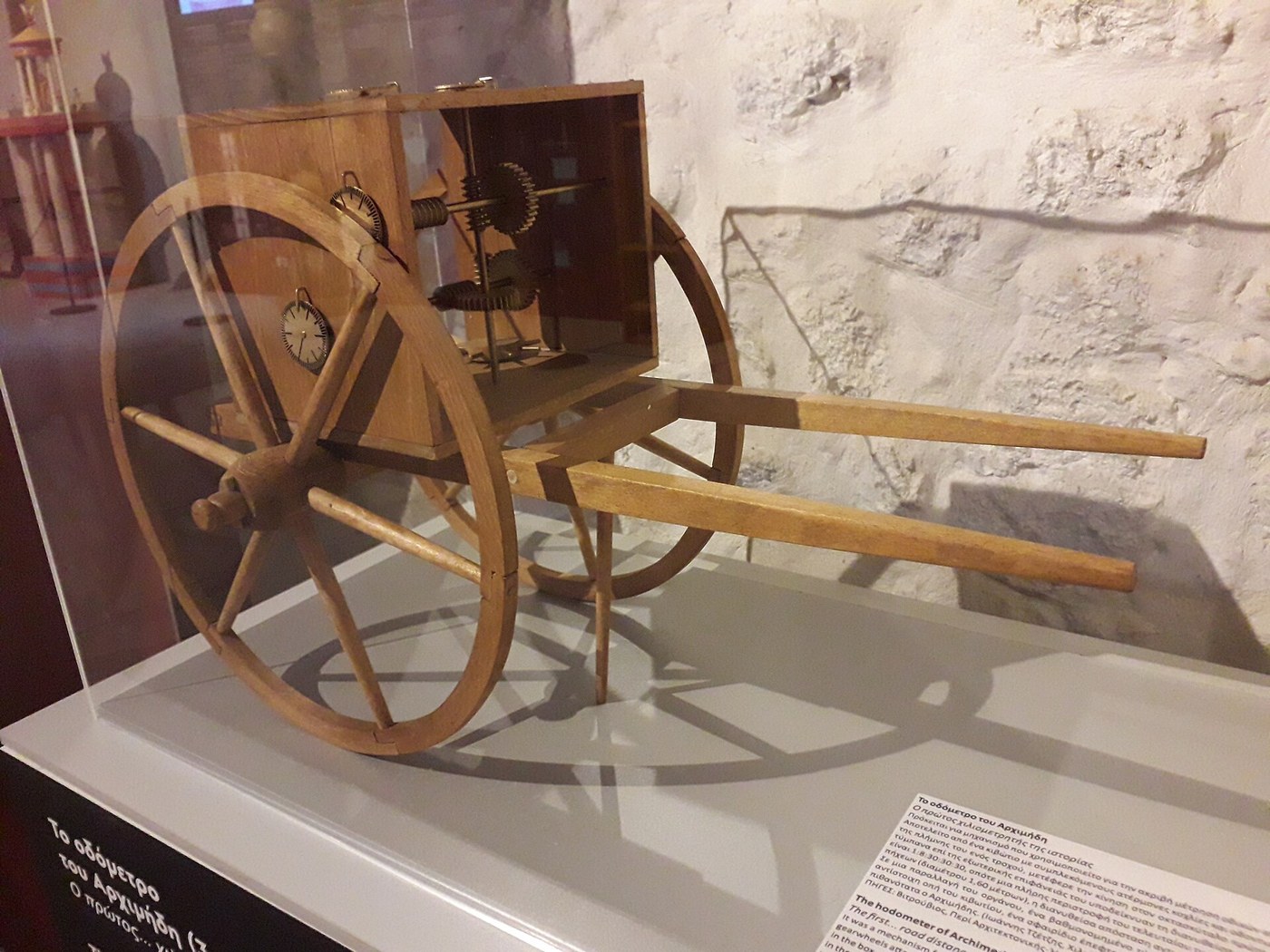
The nearest surviving descriptions of geared instruments after the mechanism are of a humbler device, the odometer. The Roman architect Vitruvius, writing in the late first century BC, describes in Book 10 of De architectura a carriage whose wheels, four Roman feet across, turn four hundred times in a Roman mile. A single pin on the hub advances a wheel of four hundred teeth by one tooth per revolution, so that it turns once a mile; that wheel drives a second, pierced with holes holding pebbles, which drop one at a time into a box. At the end of the journey the pebbles in the box give the miles travelled (Wikipedia, “Odometer”).
Heron of Alexandria, probably in the first century AD, describes a similar device in chapter 34 of his Dioptra, a treatise on surveying. Whether either was built in antiquity is disputed; modern attempts to build it with the square teeth of the traditional illustrations are reported to have failed, and to work when angled teeth are substituted. The suggestion that Archimedes invented the odometer has been made but rests on no evidence in his surviving works. The Kostas Kotsanas Museum of Ancient Greek Technology displays a working reconstruction.
The odometer matters here for two reasons. It shows that counting by gear reduction — a large ratio built from a pin and a many-toothed wheel — was ordinary engineering knowledge in the Roman world, written into a standard architectural handbook. And it shows how far apart the two uses of gearing were: the odometer counts, the Antikythera Mechanism computes. Nothing in the Roman texts approaches the mechanism’s epicyclic trains or its pin-and-slot.
China had its own geared odometer. By the third century AD the “li-recording drum carriage” (jì lǐ gǔ chē) is described, in which a wooden figure struck a drum at every li travelled and another struck a bell or gong at every ten; a Han-period stone rubbing and a tomb mural of around AD 125 already show the carriage. Like the Roman device, it is a counting train — evidence that gear reduction was invented or reinvented wherever wheeled vehicles and surveyors met, and a reminder that the Antikythera Mechanism’s distinction lies not in having gears but in what its gears compute.
12.3 The Literary Thread
Alongside the odometers runs a literary record of astronomical “spheres”. Cicero, in the first century BC, describes Archimedes’ geared sphere and the one “recently constructed by our friend Posidonius” (Volume 11). The record continues for centuries after the wreck. Ovid, in the early first century AD, mentions a globe “hung by Syracusan art” (Fasti 6.277–279). Pappus of Alexandria, around AD 320, knew that Archimedes had written a book On Sphere-Making. Lactantius in the early fourth century and the poet Claudian around 400 both wrote about Archimedes’ sphere; Proclus in the fifth century names “the art of making spheres imitating the revolutions of the heavens, such as was cultivated by Archimedes” as a branch of mechanics (NYU Archimedes sources).
Most of these later writers are retelling a famous story rather than describing machines they had seen. But the story kept the idea alive: educated readers in late antiquity knew that the heavens could be modelled in bronze and made to move, and knew it had been done.
12.4 A Byzantine Sundial with a Calendar Gear Train
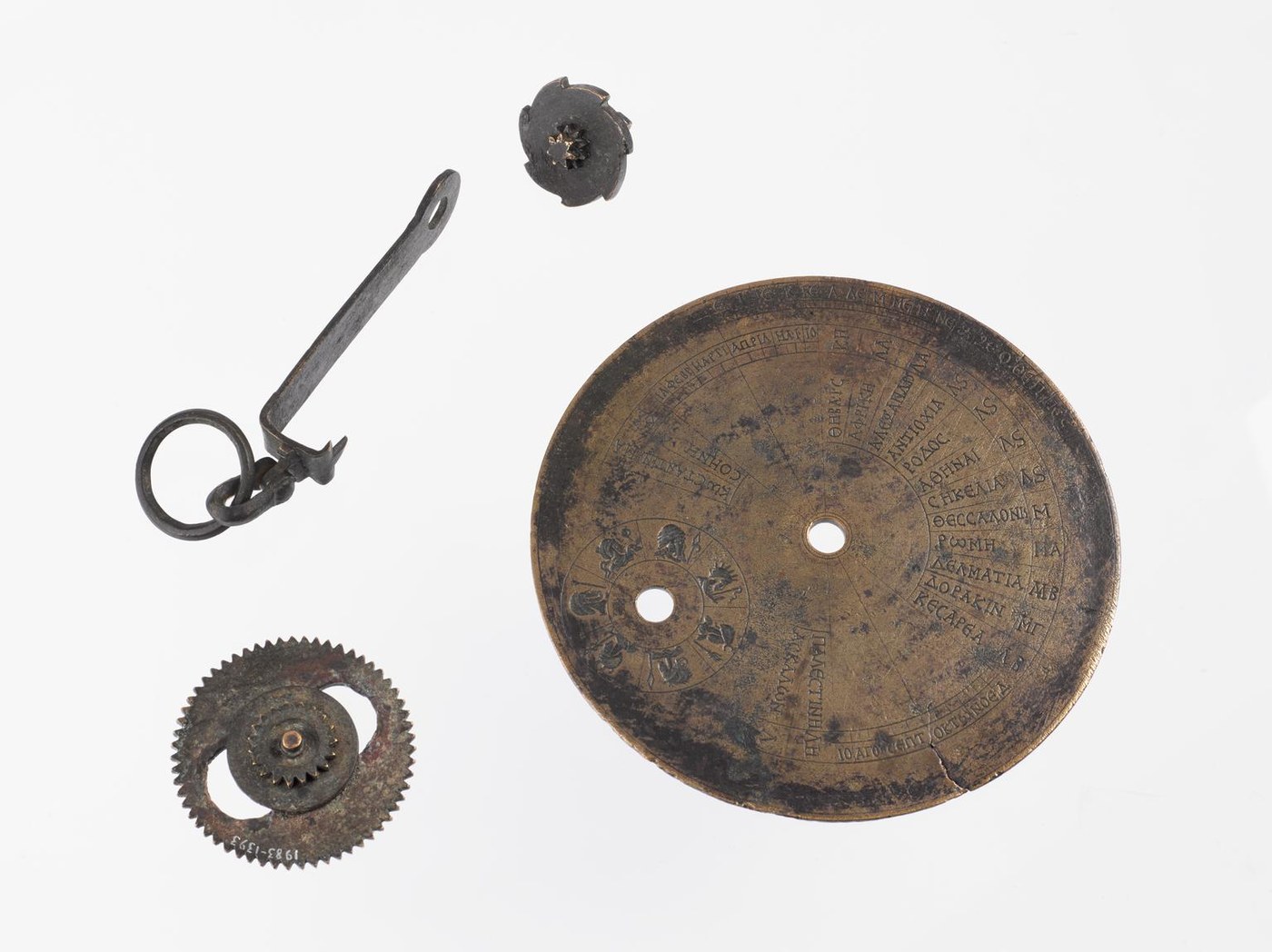
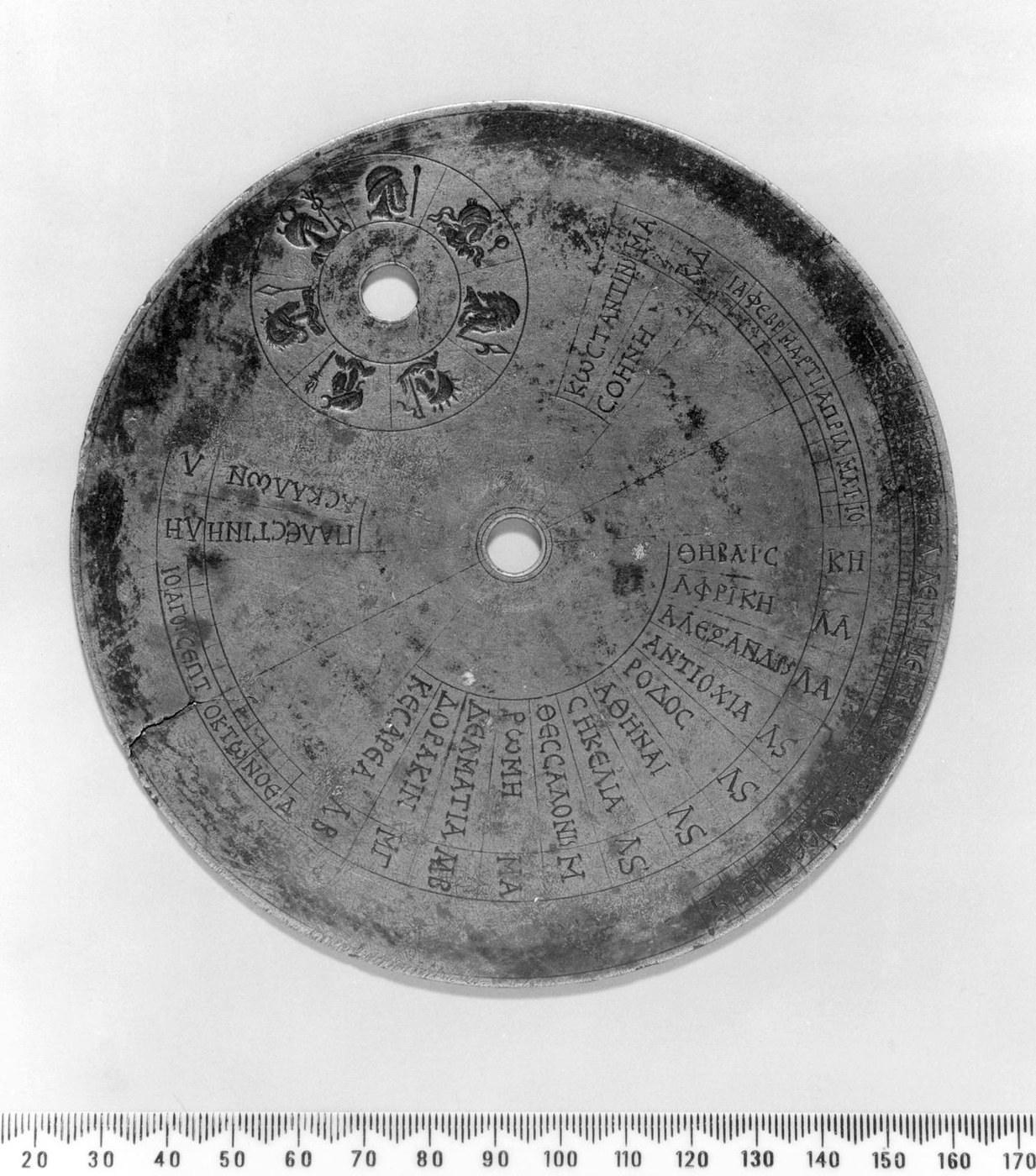
The first surviving geared object after the mechanism came to light in 1983, when the Science Museum in London bought four fragments of brass. Studied by J. V. Field and Michael Wright, they proved to be a portable sundial with calendrical gearing, made in the Byzantine Empire between about AD 400 and 600 (Field and Wright, “Gears from the Byzantines: a portable sundial with calendrical gearing”, Annals of Science 42, 1985, 87–138). The surviving parts are the front sundial plate, a suspension arm, a Moon disc with a gear, and an arbor carrying a ratchet and two gear wheels (Science Museum object 1983-1393).
The sundial plate is engraved in Greek with sixteen places, from Constantinople, Rome and Athens to Alexandria, Antioch, Rhodes, Thessaloniki, Caesarea and Ascalon, so that its owner could set it to tell the time in each. Behind the dial, the gear train turned discs that showed the positions of the Sun and Moon in the zodiac and the phase of the Moon — the core lunisolar functions of the Antikythera Mechanism’s front dial, shrunk to a pocket instrument (Science Museum Group collection). The ratchet on the arbor implies that the train was advanced by hand in steps rather than driven continuously.
The Science Museum calls it the second-oldest geared device of its kind, after the Antikythera Mechanism. Its importance is that it fills part of the gap with an object, not a text: five centuries after the wreck, a craftsman in the Greek-speaking world could still cut small gears to model the Sun and Moon, and could expect a customer to want them. Wright returned to it in a 1990 paper on how early geared mechanisms should be reconstructed (“Rational and irrational reconstruction: the London sundial-calendar and the early history of geared mechanisms”, History of Technology 12, 1990, 65–102).
12.5 The Islamic World: al-Bīrūnī and the Isfahan Astrolabe
12.5.1 Al-Bīrūnī’s geared calendar
Around AD 1000 the polymath Abū Rayḥān al-Bīrūnī, in a treatise on the construction of astrolabes (Istīʿāb al-wujūh al-mumkina fī ṣanʿat al-asṭurlāb), described a geared lunisolar calendar: a set of gears displaying the positions of the Sun and Moon in the zodiac, the day of the week, the day of the lunar month and the phase of the Moon. The text was edited and translated by Donald Hill (“Al-Bīrūnī’s mechanical calendar”, Annals of Science 42, 1985, 139–163), in the same issue as Field and Wright’s Byzantine sundial; the two devices are closely comparable, which suggests that the Byzantine tradition of small calendrical gearing passed into the Islamic world (archaeology.wiki).
The ninth-century Book of Ingenious Devices of the Banū Mūsā brothers in Baghdad, and al-Jazarī’s Book of Knowledge of Ingenious Mechanical Devices of 1206, show a rich Islamic tradition of automata and water clocks. But the line of astronomical gearing that runs from the Antikythera Mechanism to the Byzantine sundial continues most directly in the astrolabe.
12.5.2 The geared astrolabe of 1221/2
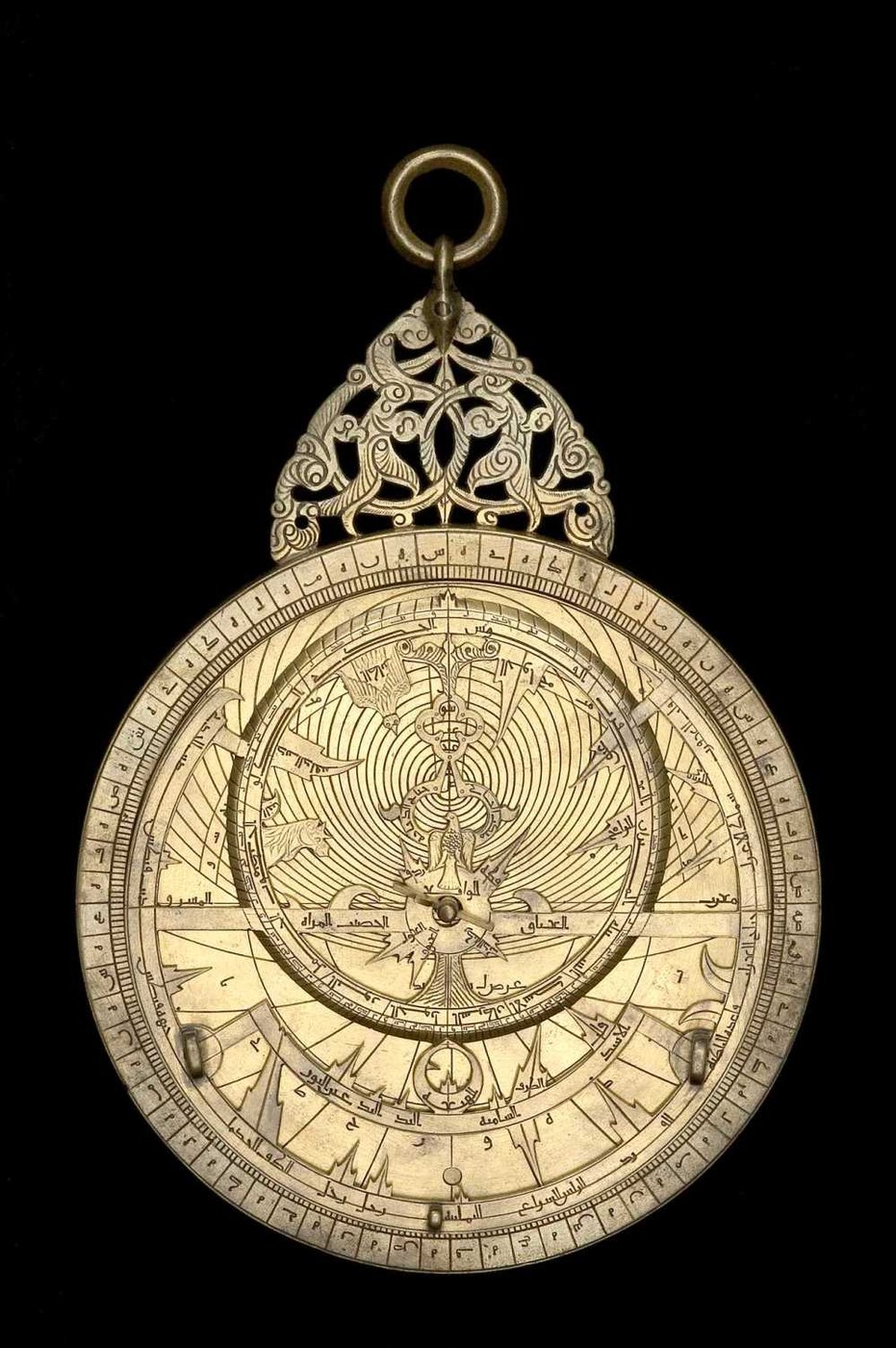
In the History of Science Museum at Oxford (inventory 48213) is a brass astrolabe signed by Muḥammad ibn Abī Bakr of Isfahan and dated AH 618, AD 1221/2. On its back, a small gear train turned by the rotation of the rete drives a lunar calendar: windows show the changing phase and age of the Moon over a month, and the motions of the Sun and Moon over a year. The museum’s catalogue notes that the maker chose a simplified design that required only one wheel with an odd number of teeth — the hardest kind to lay out by geometry. The museum describes it as the oldest geared machine to survive in a complete state (History of Science Museum, Oxford).
Between the Antikythera Mechanism and the Isfahan astrolabe lie some thirteen centuries, two empires and two languages. What links them is not a continuous line of surviving objects but a continuous set of functions: Sun and Moon in the zodiac, the phase and age of the Moon, a calendar — computed by gears.
12.6 What the Survivors Can and Cannot Do
Set side by side, the geared astronomical devices known from the fourteen centuries after the wreck show how much of the Antikythera Mechanism’s repertoire survived, and how much did not.
Table 1 — What the Survivors Can and Cannot Do
| Function | Antikythera Mechanism (2nd–1st c. BC) | Byzantine sundial-calendar (AD 400–600) | al-Bīrūnī’s calendar (c. AD 1000) | Isfahan astrolabe (AD 1221/2) | Dondi’s astrarium (1348–64) |
|---|---|---|---|---|---|
| Sun in the zodiac | Yes | Yes | Yes | Yes | Yes |
| Moon in the zodiac | Yes, with anomaly | Yes | Yes | Yes | Yes |
| Phase of the Moon | Yes | Yes | Yes | Yes, with age | not stated in sources used |
| Calendar | Egyptian and lunisolar, with games | not stated in sources used | Day of week, day of lunar month | Lunar month | Church calendar, movable feasts |
| Five planets | Yes (gearing lost; inscribed) | No | No | No | Yes |
| Eclipse prediction | Yes | No | No | No | not stated in sources used |
| Driven by | Hand crank | By hand, through a ratchet (inferred) | not stated in sources used | Turning the rete | Weight-driven clock |
The table summarises only the sources cited in this volume; “not stated” means those sources do not say, not that the device lacked the function. Its message is clear enough. The lunisolar core — the Sun, the Moon and its phase — persisted in small, portable form across late antiquity and the Islamic world. The planets, the anomalies built into gear trains and the eclipse dial did not reappear in any surviving or described machine until the fourteenth century, and when they did, it was in a weight-driven clock rather than a hand-turned calculator.
12.7 Su Song’s Clock Tower, Kaifeng
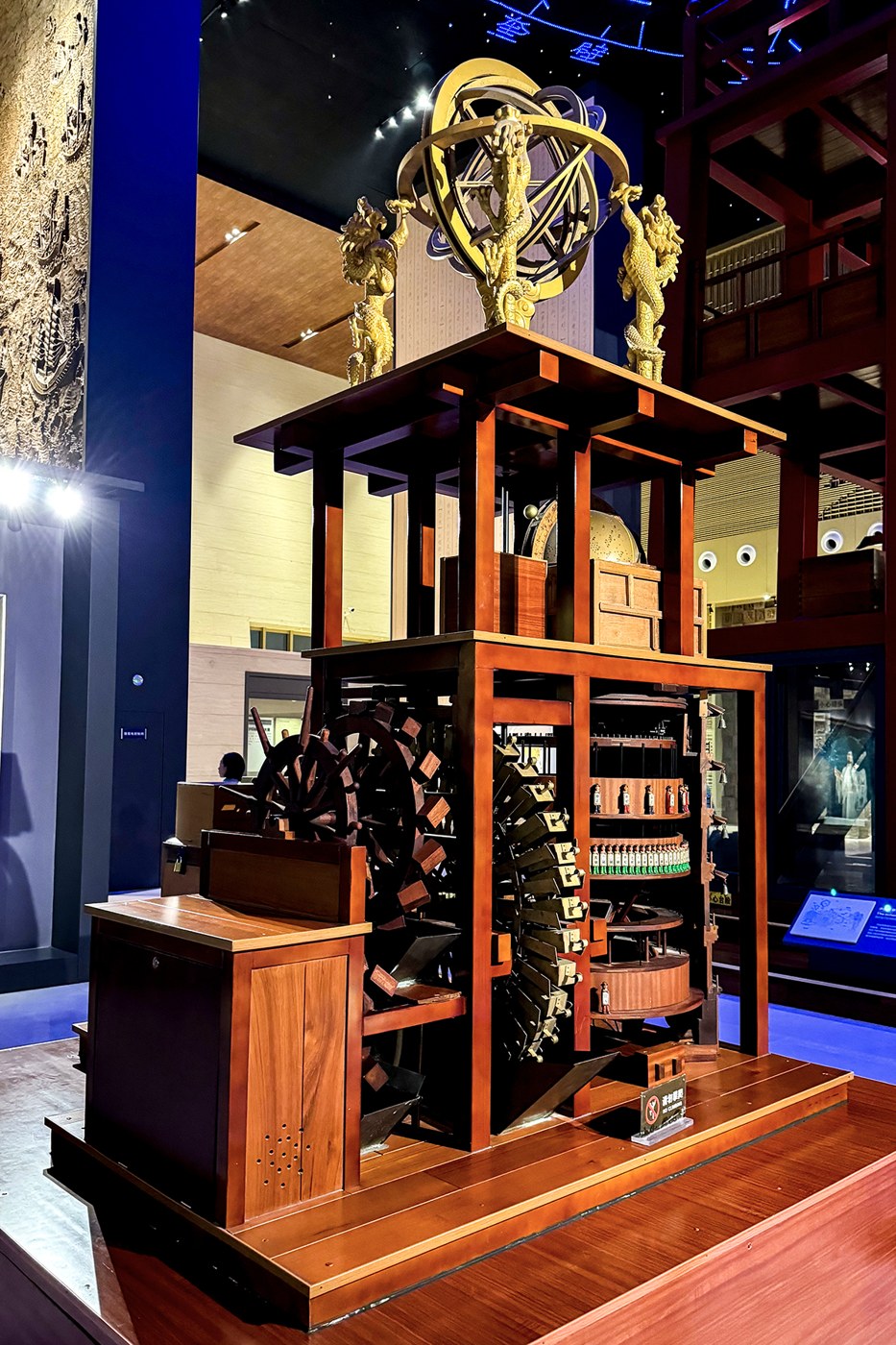
At the other end of Asia, a different tradition reached a peak of its own. In 1088 the Song-dynasty official Su Song and his team completed a wooden pilot model of an astronomical clock tower for the imperial capital at Kaifeng; bronze parts were cast by 1090, and the full tower, about 40 feet (12 m) tall, was finished by 1094. A water wheel with 36 scoops, filled at a steady rate from a constant-level tank and checked by an escapement, drove the whole machine. Through gearing and an endless chain drive — the “celestial ladder”, the oldest known chain drive — it turned a bronze armillary sphere on the roof for observation, a celestial globe inside, and a stack of rotating figures that announced the hours. Su Song described it in Xin Yixiang Fayao, written in 1092 and printed in 1094. When the Song court fled south after the fall of Kaifeng in 1127, the clock was dismantled and taken away, and it could not be reassembled (Wikipedia, “Su Song”).
Su Song’s tower belongs to a separate lineage — Chinese water-driven armillary spheres with escapements go back to Yi Xing and Liang Lingzan in AD 725 — and there is no evidence of contact with the Greek tradition. It is included here because it shows the same idea arising independently: a machine whose gears carry the heavens round at their own rates, driven continuously, so that the model and the sky stay in step.
12.8 Medieval Europe: the Astronomical Clock
12.8.1 Richard of Wallingford
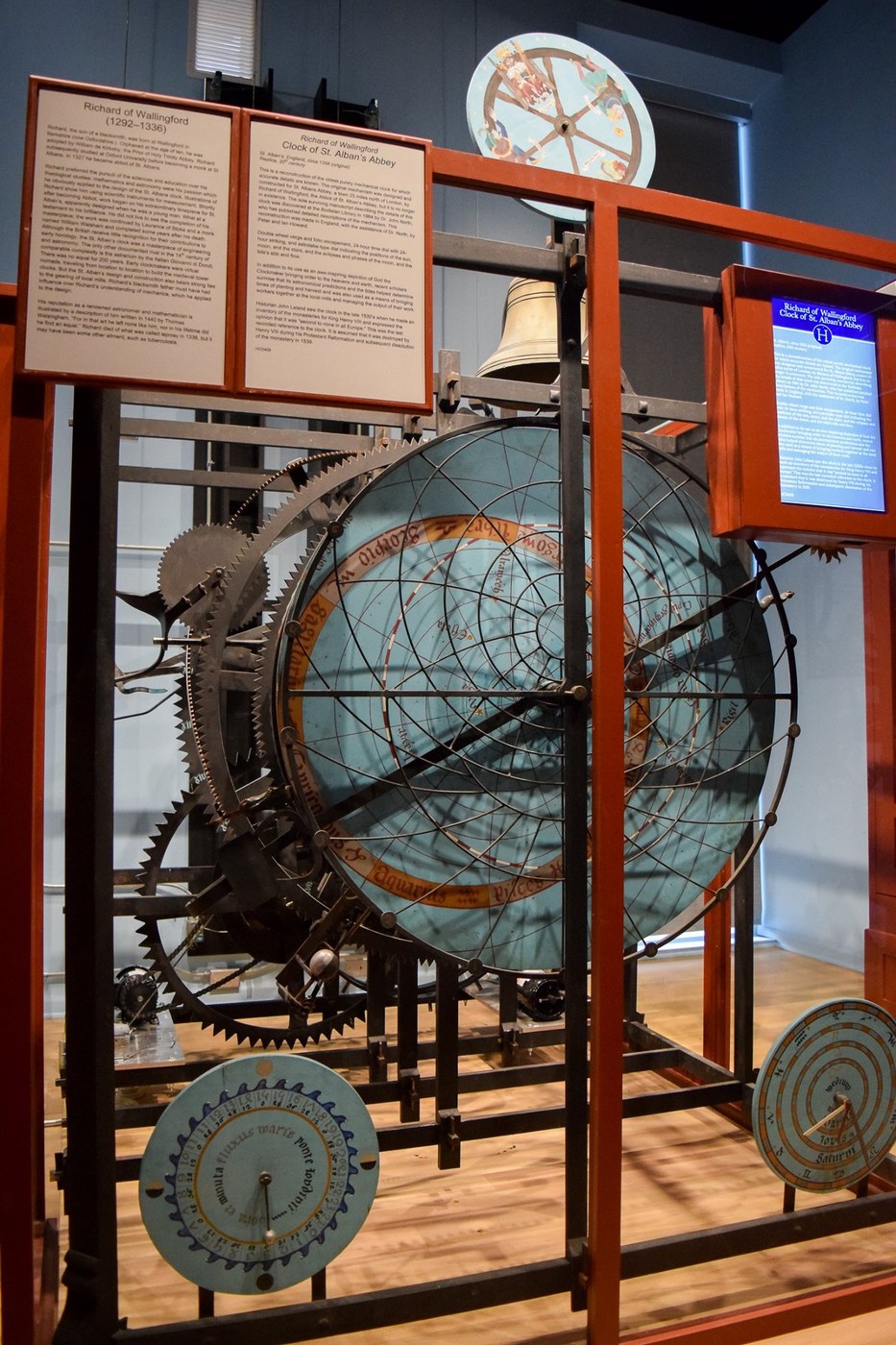
In fourteenth-century Europe geared astronomy returned on a monumental scale, now driven by weights and regulated by the new mechanical escapement. Richard of Wallingford (1292–1336), son of a blacksmith, Oxford mathematician and from 1327 abbot of St Albans, designed for his abbey an astronomical clock described in his Tractatus horologii astronomici. It showed the time, the Sun’s position, the phase of the Moon, the lunar nodes (and hence eclipses), and the state of the tide at London Bridge. Richard died in 1336, of a disease then thought to be leprosy, before it was finished; it was completed after his death, and is thought to have been destroyed when the abbey was dissolved in 1539. Modern reconstructions have been built from the treatise (Wikipedia, “Richard of Wallingford”).
Richard also designed the Albion, an equatorium described in his Tractatus Albionis: a set of engraved brass plates and scales with which an astronomer could work out the longitudes of the Sun, Moon and planets and predict eclipses without copying out long tables. It is the paper-and-brass counterpart of the clock — a geometrical calculator rather than a geared one — and an example of the kind of instrument that took over much of the computational work the Antikythera Mechanism had once done with gears.
12.8.2 Giovanni de’ Dondi’s astrarium
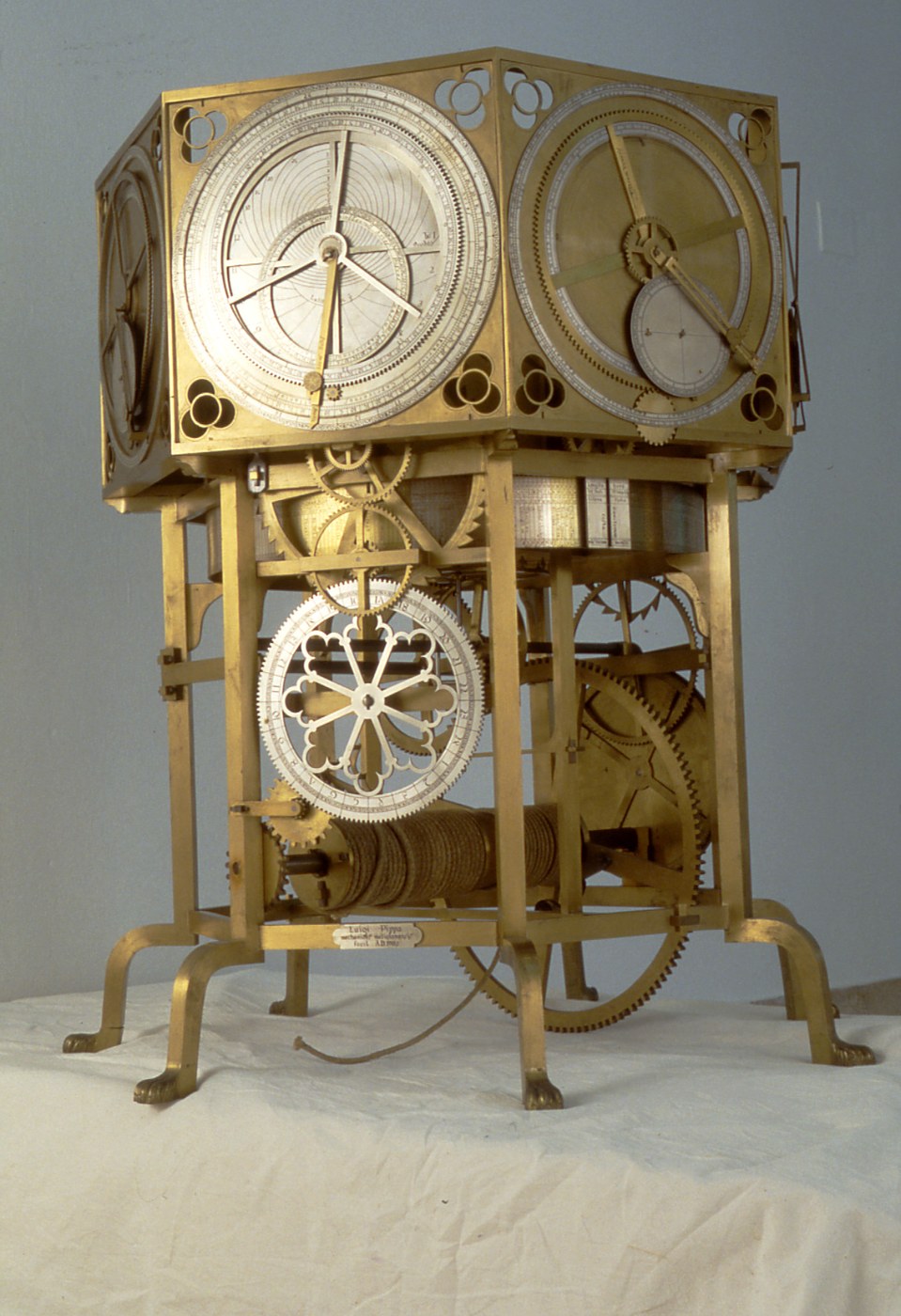
Between 1348 and 1364 the Paduan physician Giovanni de’ Dondi built the astrarium, the most complex astronomical machine of the European Middle Ages and the closest in spirit to the Antikythera Mechanism. A weight-driven clock in its lower section drove a 24-hour dial and a calendar drum showing the fixed and movable church feasts. Above it, seven dials, each about 30 cm across, showed the primum mobile — the daily rotation of the heavens, with the Sun’s position — and the motions of Venus, Mercury, the Moon, Saturn, Jupiter and Mars. The whole had 107 wheels and pinions, held together by more than 300 pins and wedges rather than screws.
Dondi described it in detail in his Tractatus astrarii, whose autograph survives in Padua; it is the earliest complete description of a machine of its kind. He gave the astrarium to Gian Galeazzo Visconti in 1381; it stood in the castle library at Pavia until at least 1485, and its later fate is unknown (Wikipedia, “Astrarium of Giovanni Dondi dall’Orologio”). Reconstructions made from the Tractatus in the twentieth century — by Luigi Pippa in Milan, and by Peter Haward of Thwaites and Reed in London, whose copies went to the Smithsonian and elsewhere — allow it to be seen again.
The Tractatus is detailed enough that the machine has been rebuilt from it several times, which is exactly what cannot be done for the Antikythera Mechanism. Its Back Cover Inscription describes what the viewer sees, not how the gears are arranged (Volume 9); Dondi’s treatise describes how to make the machine. Had a Greek equivalent of the Tractatus survived — the lost On Sphere-Making attributed to Archimedes would have been one — most of Volumes 6 to 10 of this series would be unnecessary.
The resemblance to the Antikythera Mechanism is functional, not genealogical: a geared display of the Sun, Moon and five planets, with a calendar, made to be read by a viewer. It is also a reminder of what survives and what does not. The astrarium is known from a book, the mechanism from the bronze; each is lost in the form the other preserves.
12.9 Why the Tradition Went Quiet
The silence between the first century BC and the fourteenth century AD is partly real and partly an illusion of survival.
The illusion of survival. Bronze is valuable. An instrument that broke, wore out or went out of fashion was melted down and its metal reused; very little ancient bronze of any kind survives except where it was buried or sunk. The Antikythera Mechanism exists because a ship went down with it. The Byzantine sundial-calendar survives in four pieces. The literary record shows that more such machines existed than survive: Archimedes’, Posidonius’s, and the ones that writers from Cicero to Proclus took for granted. The absence of objects is weak evidence for an absence of makers.
A real narrowing. Even allowing for loss, nothing suggests that machines as complex as the Antikythera Mechanism were made in the Roman imperial, late antique or early medieval periods. The geared devices that do survive or are described — the odometer, the Byzantine sundial, al-Bīrūnī’s calendar, the Isfahan astrolabe — are small, with a few gears and lunisolar functions only. The planetary trains, the pin-and-slot anomaly gearing and the eclipse prediction of the Antikythera Mechanism have no known successor until the astrarium. Several reasons have been suggested, none provable: the small number of people at any time who combined the astronomy, the mathematics and the metalworking skill; the patronage such work needed, which depended on wealthy and curious clients; and the shift of astronomical computation, from Ptolemy’s second-century tables onwards, towards written tables and geometrical instruments such as the astrolabe and the equatorium, which did the same work with far less metal and labour.
Continuity or reinvention? Derek de Solla Price, who first recognised the mechanism’s significance, argued that the medieval mechanical clock descended from astronomical models rather than the other way round — that clockwork began as a way of modelling the heavens and only later became a way of telling time (On the Origin of Clockwork, Perpetual Motion Devices, and the Compass, 1959). The Byzantine sundial-calendar, al-Bīrūnī’s treatise and the Isfahan astrolabe have since supplied the intermediate links his argument lacked, and the case for a continuous, if thin, tradition of astronomical gearing from Hellenistic Greece through Byzantium and Islam to medieval Europe is now strong for the lunisolar functions. Whether the advanced techniques of the Antikythera Mechanism itself survived in that tradition, or were lost and later reinvented, is unknown.
12.10 The First Analog Computer
Price’s 1959 article in Scientific American was titled “An Ancient Greek Computer”, and the phrase has stuck. It is worth being precise about what kind of computer.
The mechanism is an analog computer: it represents quantities by physical magnitudes — here, the angles of rotating shafts — and computes by making those magnitudes obey the same mathematical relations as the things they represent. A turn of the input crank stands for an interval of time. Gear ratios multiply it by the rates of the Sun, the Moon and the planets; the pin-and-slot and the pin-and-follower add the periodic irregularities of the Hipparchian and Apollonian models; a differential-like arrangement of the Moon-phase display subtracts the Sun’s motion from the Moon’s. The outputs are read off as positions on graduated scales. Nothing in the machine counts discrete steps in the way a digital computer does, although its gear ratios encode exact integer cycle relations, and its dials, once read, give whole numbers of months, years and festivals.
It is also a special-purpose computer, built to solve one family of problems — where the heavenly bodies are, and when the calendar’s and eclipses’ cycles fall — rather than to be programmed. In both respects it is the ancestor of a long line of machines: the astronomical clocks of medieval Europe; the clockmakers George Graham and Thomas Tompion’s tabletop planetary model of about 1710, copied around 1712 by John Rowley for Charles Boyle, Earl of Orrery, whose title gave all such models their English name; Lord Kelvin’s tide-predicting machine of 1872–73, which summed the tidal constituents with gears and pulleys, as the mechanism summed its circular motions; and the differential analyser that Vannevar Bush completed at MIT in 1931, which solved differential equations with shafts and wheel-and-disc integrators. The 2021 UCL team called it “the first known device that mechanized the predictions of scientific theories”, and the American Society of Mechanical Engineers lists it as a Historic Mechanical Engineering Landmark. The later history of electronic analog machines, which compute with voltages rather than angles, is the subject of this site’s Analog Computers collection; the Antikythera Mechanism stands at the head of the same line, two thousand years earlier and in bronze.
The computing analogy runs in both directions. In 2008 the software engineer Diomidis Spinellis built an emulator of the mechanism in the Squeak EToys environment, in which simulated gear teeth push one another rather than positions being calculated from ratios; running it exposed two errors in his own tooth counts that a paper calculation had missed (“The Antikythera mechanism: a computer science perspective”, IEEE Computer 41.5, 2008, 22–27). He compared the dual use of the large gear e3, which serves both the lunar and the eclipse trains, to the economy of a digital adder in which one signal feeds two outputs. The machine’s designers were optimising hardware under the same pressures, of space and material, that later computer engineers would know well.
What makes its place unusual is the gap that follows it. Most “firsts” in the history of technology are the earliest surviving members of a continuous series. The Antikythera Mechanism is an isolated survivor of a tradition whose other products are lost, and its successors had to rediscover much of what it already did. That is why, when Price and his successors began to understand it, it did not so much extend the known history of computing machines as rewrite its first chapter.
Next — Volume 13: Rebuilding It — Replicas from Price to Clickspring. Every serious attempt to understand the machine has ended in an attempt to build it: the first paper models of the 1900s, Price’s and the Bromley–Percival reconstructions, Michael Wright’s working brass model, Kostas Kotsanas’s museum replicas, a Swiss watch movement, a Lego machine of 1,500 parts, and a clockmaker in Australia cutting every tooth by hand with tools the ancients could have used.
Comments (0)