Antikythera · Volume 15
Antikythera — Volume 15 — My Open Antikythera — Building It and Learning to Read It
A FullMonty in clear acrylic, a reader's guide to what its needles and spirals say, eclipses to crank towards, and the brass build to come
15.1 About This Volume
I have built an Open Antikythera: the FullMonty edition, front and back, in clear acrylic. I chose the clear version so that I can see the inside — the main wheel, the trains of gears branching off it, the followers creeping along the back spirals. It is built. I am still learning to understand it.
This volume is about both halves of that. The first part is my build. The rest is a reader’s guide to operating the machine: what one turn of the crank means, how to set it to a date, how to read each needle on the front and each spiral on the back, how to reset the spiral followers, and how to crank forward to the next eclipse, with worked exercises using real dates from 2026 to 2028. Volume 14 described the kit and the reasons for thinking its displays follow the Wright and Freeth-and-Jones type of reconstruction; this volume assumes that description. The guide is written for any owner of an Open Antikythera, and for anyone reading the original’s dials in Volumes 7 and 8 who wants to know what using such a machine would actually involve.
S&T GeoTronics has not published a user’s manual for the Open Antikythera, and it has not documented details such as the crank ratio or the starting date of its dials. Where the guide depends on such details, it says so, and it gives a way to find them out on the machine itself. The volume ends with my next build: the brass edition S&T is preparing.
15.2 My Build
15.3 A Reader’s Guide to the Open Antikythera
The rest of this volume is written as reference for any owner. It uses the machine as S&T describes and photographs it (Volume 14): a crank on the right-hand side as seen from the front; a front dial with an engraved calendar ring and zodiac, seven labelled needles (Date, Sun, Mercury, Venus, Mars, Jupiter, Saturn) and a Moon indicator with a phase display; and, on the FullMonty, a back with the Metonic spiral and games dial above and the Saros spiral below. Where the original or the scholarly reconstructions are described, they are labelled as such.
15.3.1 Orientation
Stand the machine upright, front towards you. The crank is on the right-hand side. Everything is driven from it: one input, every display. On the original the crank turned a crown gear that drove the great four-spoked wheel b1, and from b1 the trains branched to every dial (Volume 6). The Open Antikythera keeps that principle — the large four-spoked wheel visible through the acrylic plays the part of b1 — although its tooth counts are its own.
S&T’s first rule of operation is about the crank: do not turn it until the machine is out of its box and standing upright (BackerKit update, 31 May 2025). Turned in the box or on its side, the needles and followers can be forced against the packing or out of their grooves.
Which way is forward? Forward is the direction that moves the Date needle onward through the calendar. The simplest way to establish it is by experiment: turn the crank a little and watch the Date needle and the Moon. The Moon needle moves far faster than any other front needle; the direction it travels round the zodiac is forward in time.
15.3.2 What one turn of the crank means
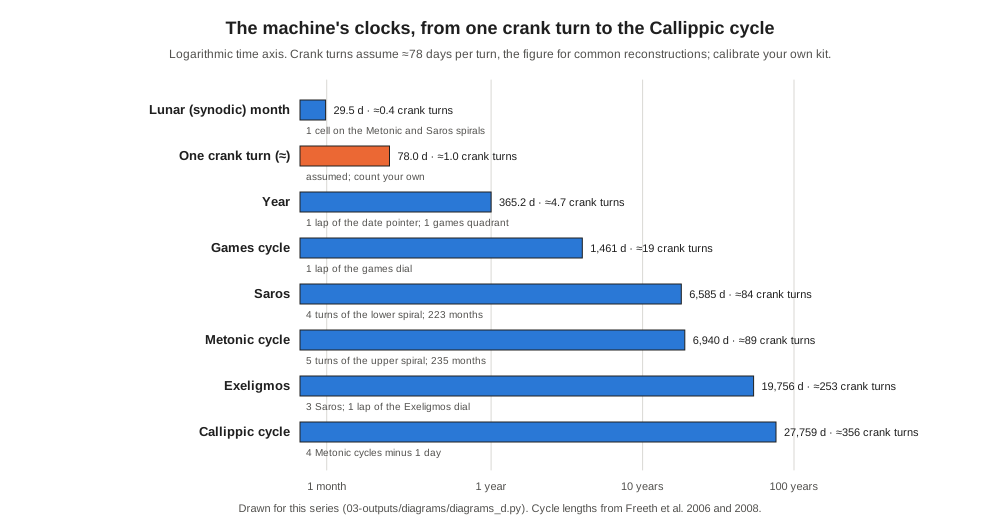
On the original, one full turn of b1 is one year. How many turns of the crank make one turn of b1 depends on the lost crown gear; reconstructions commonly give about 78 days per turn of the crank, so roughly 4.7 turns per year (Volume 6). On the Open Antikythera the ratio is not documented. It can be measured in a few minutes:
Exercise 1 — calibrate your crank. Note where the Date needle points. Turn the crank forward, counting turns, until the Date needle has made one full lap of the calendar ring and is back where it started. That count is the number of crank turns per year; 365.25 divided by it is the number of days per crank turn. For a quick cross-check, count the turns between two successive full moons on the phase display: that is one synodic month, 29.53 days.
Keep the result with the machine. Every question of how far to crank is that number multiplied by a time interval. In the examples that follow, the 78-day figure of the reconstructions is used as an illustration; substitute your own.
15.3.3 Setting it to a date
The machine has no date input other than the crank. To set it to today, crank until the displays agree with the sky. Because every display is geared to every other, matching two of them is usually enough to place the whole machine; matching a third is a check.
- Sun first. Find the Sun’s position in the zodiac for the target date from any almanac or planetarium program. On 26 October 2026 the Sun is about 3° into Scorpio (tropical ecliptic longitude about 213°, computed with the PyEphem library). Crank until the Sun needle points there. That fixes the time of year.
- Moon second. Within that time of year, the Moon’s phase picks out the right month. On 26 October 2026 the Moon is full (at 04:11 UT), about 7° into Taurus, opposite the Sun. Crank forward or back, in steps of about a month, until the phase display shows full and the Moon needle sits opposite the Sun needle. Now the year and the month agree.
- Date needle and calendar ring. On the original, the Egyptian calendar ring could be lifted and turned to correct for the quarter-day the 365-day calendar loses each year (Volume 7). If the Date needle does not point to the date you want on your machine’s calendar ring, check whether the ring can be rotated on your unit before forcing anything; S&T does not document this.
- Planets as a check. On 26 October 2026 the planets are, approximately: Mercury Scorpio 21°, Venus Libra 29°, Mars Leo 16°, Jupiter Leo 24°, Saturn Aries 10° (PyEphem, tropical). How closely the needles agree shows how good the machine’s planetary gearing is — and how the kit was set up at the factory. Ancient planetary theory, and gearing that models it with epicycles or with simple mean motion, will not match a modern ephemeris to the degree. Differences of several degrees are normal, and part of what the machine teaches.
The positions given here are in the tropical zodiac, measured from the spring equinox, the convention of modern almanacs. Whether the original’s zodiac ring was tropical or fixed to the stars is a question for Volume 7; for setting the replica, tropical positions are the practical choice.
15.3.4 Reading the front
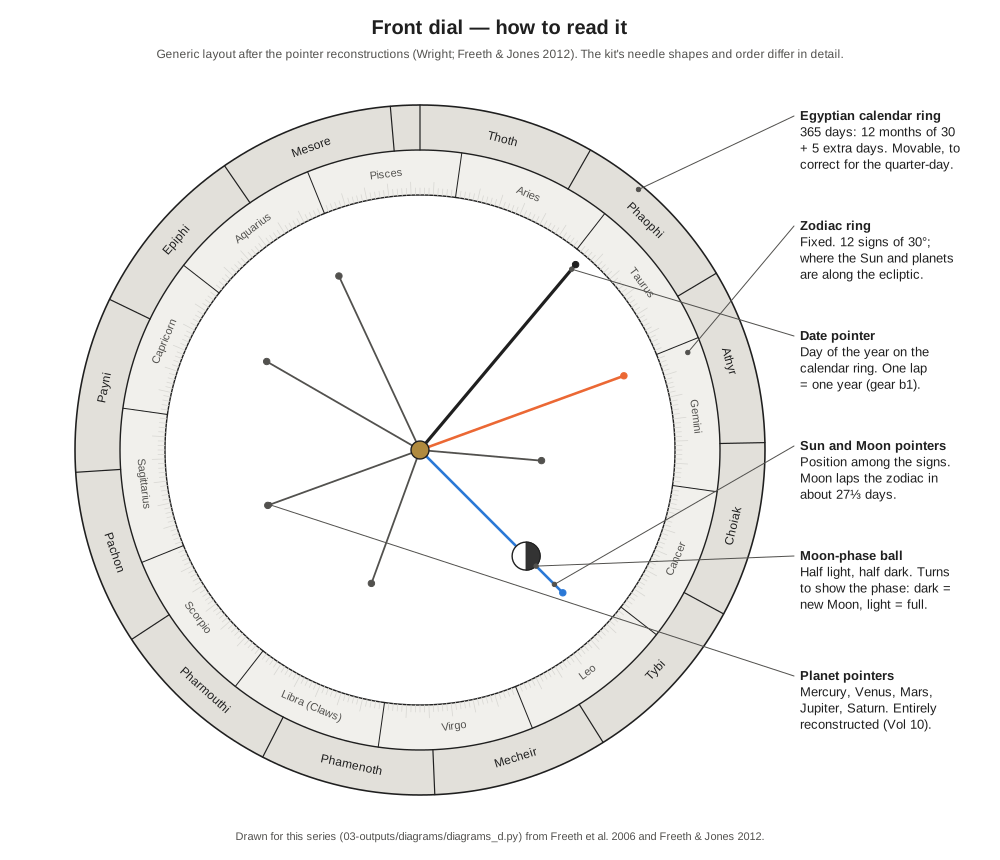
The Date needle points to the day of the year on the calendar ring. One full lap is one year.
The Sun needle points to the Sun’s position in the zodiac, the band of twelve constellations through which the Sun, Moon and planets move. It moves about 1° a day, one sign a month. On the original, whether a separate “true Sun” pointer existed, showing the Sun’s uneven motion through the year, is part of the reconstruction (Volume 7); on the Open Antikythera, Date and Sun are separate needles.
The Moon laps the zodiac in about 27⅓ days (the sidereal month). The original’s Moon pointer speeds up and slows down through each month, reproducing Hipparchos’s lunar anomaly with a pin-and-slot pair of gears (Volume 6). Whether the kit’s Moon train includes the pin-and-slot is not stated by S&T; watching the Moon needle over several crank turns against the steadily moving Sun shows whether its speed varies.
The phase display shows the Moon’s phase. On Wright’s reconstruction it is a small ball, half pale and half dark, turned by a small gear train so that the visible light part grows from new Moon to full and shrinks again. When the Moon needle lies on top of the Sun needle, the Moon is new; when it points opposite, the Moon is full. Those two moments are the only times an eclipse can happen — a solar eclipse at new Moon, a lunar eclipse at full Moon — which is why the phase display and the Saros dial on the back belong together.
The planet needles — Mercury, Venus, Mars, Jupiter and Saturn — are the most reconstructed part of any replica (Volume 10). Read each against the zodiac, as with the Sun.
Exercise 2 — watch for retrograde motion. In the sky, planets periodically appear to stop and move backwards against the stars. Using the dates below, set the machine just before each window and crank slowly through it. If a planet needle stops and reverses, the kit models that planet with epicyclic gearing (as the Wright and Freeth-and-Jones reconstructions do); if it marches steadily on, the needle shows only the planet’s average motion.
Table 1 — Reading the front
| Planet | Retrograde in the sky (approximate, from PyEphem) |
|---|---|
| Mercury | late Oct – mid-Nov 2026; mid-Feb – early Mar 2027; mid-Jun – early Jul 2027 |
| Venus | until mid-Nov 2026 |
| Mars | about 12 Jan – 3 Apr 2027 |
| Jupiter | about 14 Dec 2026 – 14 Apr 2027 |
| Saturn | until about 12 Dec 2026; again from about 11 Aug 2027 |
Mars is the best test: its backward loop lasts almost three months and is wide.
15.3.5 Reading the back
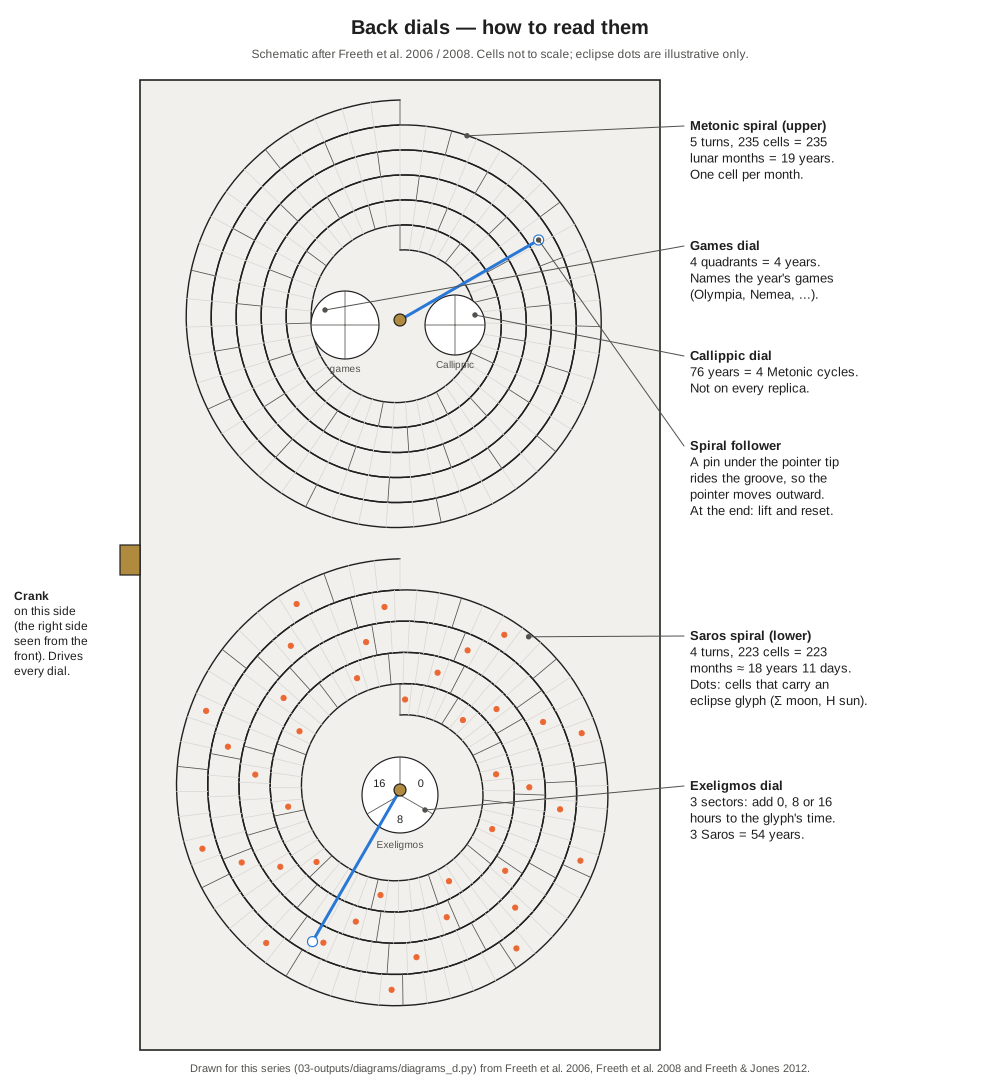
Turn the machine round. The back is two calendars of months, one above the other.
The Metonic spiral (upper). Five turns divided into 235 cells, one per lunar month: 235 months is almost exactly 19 years, the cycle in which the Moon’s phases return to the same calendar dates. On the original each cell was labelled with a month name of a Greek civil calendar (Corinthian or Epirote; Volume 9). The pointer advances one cell per lunar month; after 235 cells, 19 years have passed.
The Metonic cycle is easy to see in real dates. The Moon was full on 26 October 2007; it is full on 26 October 2026; it will be full again on 25–26 October 2045 (25 October at 21:30 UT, the 26th in eastern time zones). Nineteen years, 235 lunations, the same date.
The games dial, inside the Metonic spiral, is divided into four quarters, one per year of a four-year cycle. It names the Panhellenic and other games held in each year — on the original, the Olympia, Pythia, Isthmia and Nemea, with the Naa of Dodona and the Halieia of Rhodes (Volume 8). It turns one quarter per year. It is the original’s way of saying which year of the Olympiad it is.
The Saros spiral (lower). Four turns divided into 223 cells, one per lunar month: 223 months is the Saros, 18 years and 11⅓ days, after which the Sun, Moon and the Moon’s nodes return to almost the same arrangement, so eclipses repeat. On the original, 51 cells carry glyphs — Σ (for Selene, Moon) for a lunar eclipse, Η (for Helios, Sun) for a solar one — with the hour of the eclipse (Volume 8). The cells with glyphs are typically six months apart, sometimes five: the two “eclipse seasons” of each year, when the new and full Moons fall near the nodes.
The Exeligmos dial, inside the Saros spiral, has three sectors. Because a Saros is 6,585⅓ days, each repeat of an eclipse comes about 8 hours later in the day than the last. The Exeligmos pointer says how many hours to add to the time engraved in the glyph: 0, 8 or 16. After three Saros cycles — 54 years and about a month — the correction comes back to zero.
S&T’s descriptions of the FullMonty mention the Metonic and Saros spirals and the games dial; whether a particular unit has the Callippic and Exeligmos subsidiary dials, and what its Saros cells are engraved with, should be checked on the machine.
15.3.6 Resetting the spiral followers
A spiral pointer cannot simply go round and round. Its tip carries a pin that rides in the spiral groove, so as the pointer turns it is guided outward from one turn of the spiral to the next — five turns for the Metonic, four for the Saros. When the follower reaches the end of the spiral, the cycle is complete, and the pointer must be lifted out of the groove and set back to the start before the crank is turned further. On the original this was done by hand; there is no evidence of an automatic return.
On the Open Antikythera the back needles were one of the hardest parts to engineer: S&T tried spring-loaded designs and waterjet-cut needles before settling the design that shipped (Volume 14). In use:
- Watch the followers as you approach the end of a spiral. Do not crank past the end; a follower driven against the end of its groove can bend the needle or strip a gear.
- Lift, do not drag. Raise the needle’s pin clear of the groove, move it to the start of the spiral, and seat it again, checking that the pin is down in the groove.
- Re-synchronise with the front. If a follower has slipped out of its groove during cranking, its cell no longer matches the front dial. Reseat it at the cell matching the current month (for example, the cell after the last solar-eclipse cell if you have just cranked to a solar eclipse).
S&T’s repair video “Repairing Loose Needles” covers needles that work loose on their shafts (S&T blog, July 2025).
15.4 Cranking to the Next Eclipse
The Saros dial is the part of the machine that predicts something most people will see. The real eclipses of the next two years are listed below, computed for this series with PyEphem and checked against NASA’s eclipse tables (solar, lunar). The days-from-today column counts from 26 October 2026; the crank column uses the illustrative 78 days per turn.
Table 2 — Cranking to the Next Eclipse
| Date (UT) | Eclipse | Saros series | Where (solar: central path) | Days from 26 Oct 2026 | Crank turns at 78 d |
|---|---|---|---|---|---|
| 6 Feb 2027 | Annular solar | 131 | Chile, Argentina, Atlantic | 104 | ≈1.3 |
| 20 Feb 2027 | Penumbral lunar | 143 | — | 118 | ≈1.5 |
| 18 Jul 2027 | Penumbral lunar (very slight) | 110 | — | 266 | ≈3.4 |
| 2 Aug 2027 | Total solar | 136 | Morocco, Spain, Algeria, Libya, Egypt, Saudi Arabia, Yemen, Somalia | 280 | ≈3.6 |
| 17 Aug 2027 | Penumbral lunar | 148 | — | 295 | ≈3.8 |
| 12 Jan 2028 | Partial lunar | 115 | — | 443 | ≈5.7 |
| 26 Jan 2028 | Annular solar | 141 | Ecuador, Peru, Brazil, Suriname, Spain, Portugal | 458 | ≈5.9 |
| 6 Jul 2028 | Partial lunar | 120 | — | 620 | ≈7.9 |
| 22 Jul 2028 | Total solar | 146 | Australia, New Zealand | 635 | ≈8.1 |
| 31 Dec 2028 | Total lunar | 125 | — | 798 | ≈10.2 |
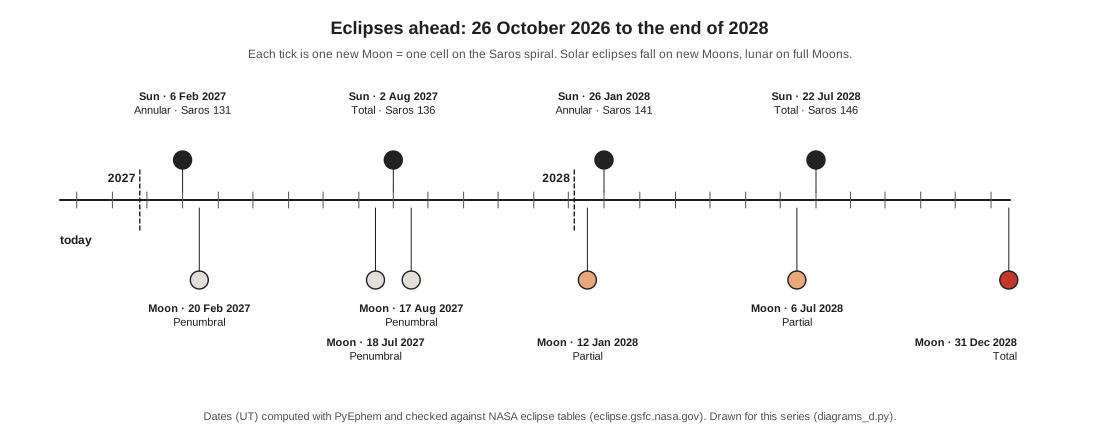
Two patterns in the table are exactly what the Saros dial encodes. First, the solar eclipses come six lunations apart — 6 February 2027, 2 August 2027, 26 January 2028, 22 July 2028 — and the lunar eclipses sit a fortnight to either side of them. On the dial, those are glyph cells six cells apart. Second, each eclipse belongs to a Saros series of eclipses spaced 223 months apart. The total solar eclipse of 2 August 2027 is in Saros series 136; 223 months earlier was the total eclipse of 22 July 2009, and 223 months before that the total eclipse of 11 July 1991. 223 months after it will be 12 August 2045. One full journey of the Saros pointer, four turns and 223 cells, carries the machine from one of these to the next.
15.4.1 Why the glyphs will not match 2027 exactly
The original’s glyphs recorded the eclipses of one particular 223-month span in the second century BC, derived from Babylonian records and calculation (Volume 8). Because the Saros repeats only approximately — each series drifts and eventually dies out after twelve to fifteen centuries — the same pattern of glyph cells, laid on the calendar of 2027, would be close but not exact; some ancient glyphs would fall on months with no eclipse now, and some modern eclipses would have no glyph. A replica’s Saros dial therefore predicts the rhythm of eclipses well and particular dates only after it is aligned to a known eclipse. That is how the dial would have been used in antiquity too: an operator who knew that an eclipse had happened in a given month could set the pointer to that cell, and the spiral then showed when to expect the next ones.
15.4.2 Worked exercises
Exercise 3 — crank from today to the next solar eclipse. Set the machine to 26 October 2026 (full Moon, Sun at Scorpio 3°). Watch the phase display and count new Moons as you crank forward: the eclipse of 6 February 2027 is at the fourth new Moon from today (9 November, 9 December, 7 January, 6 February). At that moment the Moon needle should lie on the Sun needle in Aquarius (the Sun is about Aquarius 18° on 6 February 2027), and the Saros pointer will have advanced four cells. Note what the Saros cell under the pointer shows. If it carries a solar glyph, the machine’s dial is aligned with the present; if not, count how many cells away the nearest solar glyph is — that is the offset of your machine’s eclipse dial from the modern calendar.
Exercise 4 — six cells to the big one. From 6 February 2027 crank on to the total eclipse of 2 August 2027, six new Moons later. The Sun and Moon needles should meet again, now in Leo (about Leo 10°). The Saros pointer moves six cells. On a correctly aligned dial both cells carry solar glyphs. The lunar eclipse of 20 February 2027 comes a fortnight after the first solar one; on the original, a lunar and a solar glyph a fortnight apart can share a cell or occupy neighbouring ones, so check how your dial places them.
Exercise 5 — one whole Saros. With the pointer on the cell for 2 August 2027, crank backwards 223 lunations — exactly the length of the spiral. Cranking backwards, the follower reaches the start of the spiral partway through; lift it to the far end and carry on until the pointer is back on the cell it started from. The machine should arrive at 22 July 2009, the previous member of Saros 136, with the Sun about 11 days earlier in the calendar than on 2 August. Note the Exeligmos pointer before and after: it should have moved one sector. The 2027 eclipse falls about 8 hours later in the day than the 2009 one (greatest eclipse about 02:35 UT in 2009, about 10:07 UT in 2027) — the third of a day by which a Saros exceeds a whole number of days.
Exercise 6 — one Metonic cycle. From 26 October 2026, crank forward 235 lunations — five turns of the upper spiral, with a follower reset at the end. The Date needle should come back to within about a day of 26 October, and the phase display should show full Moon: 25–26 October 2045. Then check the games dial: it will have advanced 19 quarters, four full laps and three quarters.
Exercise 7 — the eclipse season. Crank slowly from mid-July to mid-August 2027 and watch the three eclipses arrive: the faint penumbral lunar eclipse of 18 July (Moon opposite the Sun), the total solar eclipse of 2 August (Moon on the Sun), and the penumbral lunar eclipse of 17 August (opposite again). Three eclipses in one month is a typical season; the Saros dial shows the same cluster as neighbouring glyph cells.
15.5 Care
S&T’s care advice for the clear acrylic units is specific (BackerKit update, 31 May 2025):
- Clean the acrylic only with mild dish soap and water. Do not use window cleaner (such as Windex), acetone, ammonia or isopropyl alcohol: they cloud, craze or crack acrylic.
- Handle it in gloves. The kit includes cotton gloves; fingerprints on the inside faces of the plates are hard to reach once the machine is assembled.
- Crank only when it is upright and out of its box.
- Crank gently and evenly, especially near the ends of the spirals, and never force a binding train; find what is catching first. Many meshes lie between the crank and the farthest needle, and a small force at the crank can become a large one at a stalled gear.
- Repairs. S&T’s videos cover replacing a broken crank and repairing loose needles (July 2025).
- Dust. An open acetal-and-acrylic mechanism collects dust between the plates; a soft brush or a gentle puff of air is safer than wiping.
The golden “skin,” if fitted, slides under the needles; S&T warns it is harder to take off than to put on (Volume 14).
15.6 The Next Build: Brass
My next build will be a second Open Antikythera in metal: the brass edition S&T is preparing. It has not been released, and I have not built it yet.
The change of material matters more than appearance. Brass gears are machined rather than laser-cut, so their teeth can be finer and more accurate; a brass gear train is heavier and stiffer, and its friction and wear differ from acetal’s, which is self-lubricating. Brass tarnishes and will need cleaning of a different kind from acrylic. And it brings the replica closer to the original, whose gears were bronze — like brass, an alloy of copper, though bronze is copper with tin and brass is copper with zinc. S&T’s own plan, published in November 2025, is aluminium prototypes first, then at least one brass unit, with bronze possible; it estimates metal stock at 10 to 100 times the cost of the plastics (Volume 14). A metal build will also look far more like the bronze original than clear acrylic does, which makes the two builds a natural pair: one to see how it works, one to see how it might have looked.
15.7 Closing
The Antikythera Mechanism has been rebuilt in brass, Perspex, Lego, watch steel and laser-cut plastic, and every one of those rebuildings has been a way of asking the same question: what was this machine for, and how did its maker think? The fragments in Athens cannot be turned. A replica can. A crank turned on a desk sends a Moon needle round the zodiac in a few seconds, slides a follower one cell along a spiral that the Babylonians would have recognised as a list of months, and walks the machine forward to an eclipse that will actually darken the sky over Egypt on 2 August 2027. That is the oldest promise of the original, and on a clear-plated replica the reader can watch every gear that keeps it.
Comments (0)