Antikythera · Volume 1
Antikythera — Volume 1 — The Antikythera Mechanism — A Computer from the Sea
What the corroded bronze lumps in Athens turned out to be, how a hand crank once drove the Sun, the Moon and the calendar across two faces of a wooden box, and the long road from a sponge-divers' wreck to a laser-cut kit — the orientation volume for the fifteen-part series
1.1 About This Volume
This is the entry point to a fifteen-volume deep dive on the Antikythera mechanism: a hand-cranked bronze calculator of the heavens, made by a Greek workshop in the second or early first century BC, lost in a shipwreck soon after, raised by sponge divers in 1901, and recognised as a machine only in 1902. It is the oldest geared mechanism known from anywhere in the world, and nothing of comparable mechanical complexity survives from the following thousand years.
This volume explains in plain terms what the mechanism was, what it showed on its two faces, how its gears turned one input into a dozen astronomical outputs, and why a single object found in a Roman-era cargo has kept historians, astronomers, radiographers, clockmakers and machinists busy for more than a century. It then tours the whole story in miniature, volume by volume. Readers who want the history of discovery can go straight to Volumes 2–4; readers who want the astronomy and the gearing can start at Volume 5; readers who want to hold one in their hands can jump to Volumes 13–15. The series ends on a workbench, with an owner’s build of S&T GeoTronics’ Open Antikythera, a clear-acrylic, laser-cut reproduction of the front and back dials.
1.1.1 The Fifteen-Volume Series
Table 1 — The Fifteen-Volume Series
| Vol | Title | Focus |
|---|---|---|
| 1 | The Antikythera Mechanism — A Computer from the Sea (this volume) | Orientation: what it was, what it showed, the whole story in miniature |
| 2 | The Wreck — Sponge Divers, Statues and a Lump of Corroded Bronze | The 1900 discovery, the 1900–1901 salvage, the cargo, the dating, and every return to the site since |
| 3 | A Century of Looking — From Stais to Price | The 1902 recognition, Rehm, Theophanidis, Price, Stamires and Karakalos’s radiographs |
| 4 | Seeing Inside — Wright, Bromley and the Antikythera Mechanism Research Project | Linear tomography, the 2005 CT and surface imaging, the Nature papers of 2006 and 2008 |
| 5 | The Sky in Numbers — Babylonian Cycles and Greek Geometry | Metonic, Saros and Callippic cycles; epicycles; Hipparchos’s lunar theory |
| 6 | Gears from the Greeks — The Gear Train | The known gearing, tooth counts, the pin-and-slot lunar mechanism |
| 7 | The Front Face — Zodiac, Calendar, Sun and Moon | The front dial, the calendar ring, the Moon-phase ball, the parapegma |
| 8 | The Back Face — Spirals for Calendars, Games and Eclipses | Metonic and Saros spirals, the games dial, the eclipse glyphs |
| 9 | The Words on the Machine — Inscriptions and a User’s Manual | The cover inscriptions and what they reveal |
| 10 | The Lost Planets — Reconstructing the Cosmos Display | Pointer models, the 2021 ring model, the planetary period relations |
| 11 | Who, Where, When — and Did It Ever Work? | Corinth, Rhodes, Epirus; Archimedes, Hipparchos, Posidonius; date and accuracy debates |
| 12 | A Thousand Years of Silence — From Byzantium to the Astronomical Clock | Geared instruments after Antikythera, from the Byzantine sundial-calendar onward |
| 13 | Rebuilding It — Replicas from Price to Clickspring | Models and reconstructions, from brass to Lego |
| 14 | The Open Antikythera — S&T GeoTronics’ Kit | The kit that the series’ final volume builds |
| 15 | ⭐ My Open Antikythera — Building It and Learning to Read It | An owner’s build and a reader’s guide to the dials |
1.2 A Box of Bronze Gears
Imagine a wooden box about the size of a shoebox: the 2006 reconstruction gives it as roughly 315 × 190 × 100 mm, though every one of those numbers is uncertain. On its front is a large circular dial; on its back, two tall spiral dials, one above the other. A knob or crank sticks out of the right-hand side. Turn the crank, and pointers creep around both faces. Bronze cover plates, engraved edge to edge with tiny Greek capitals between about 1.2 and 3 mm tall, fit over the faces and explain what the dials mean.
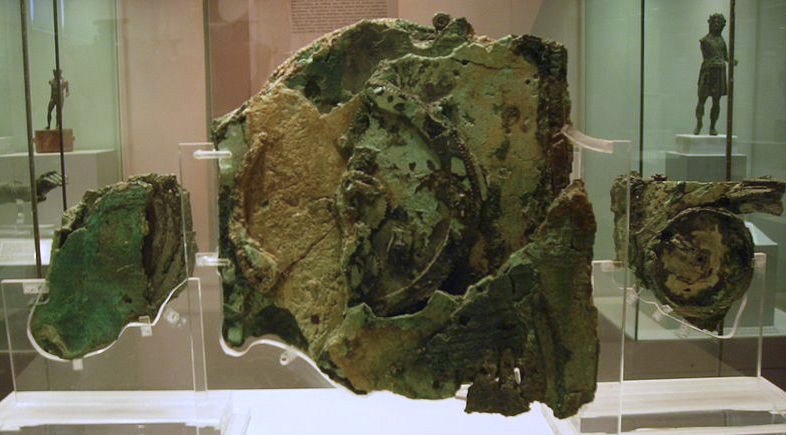
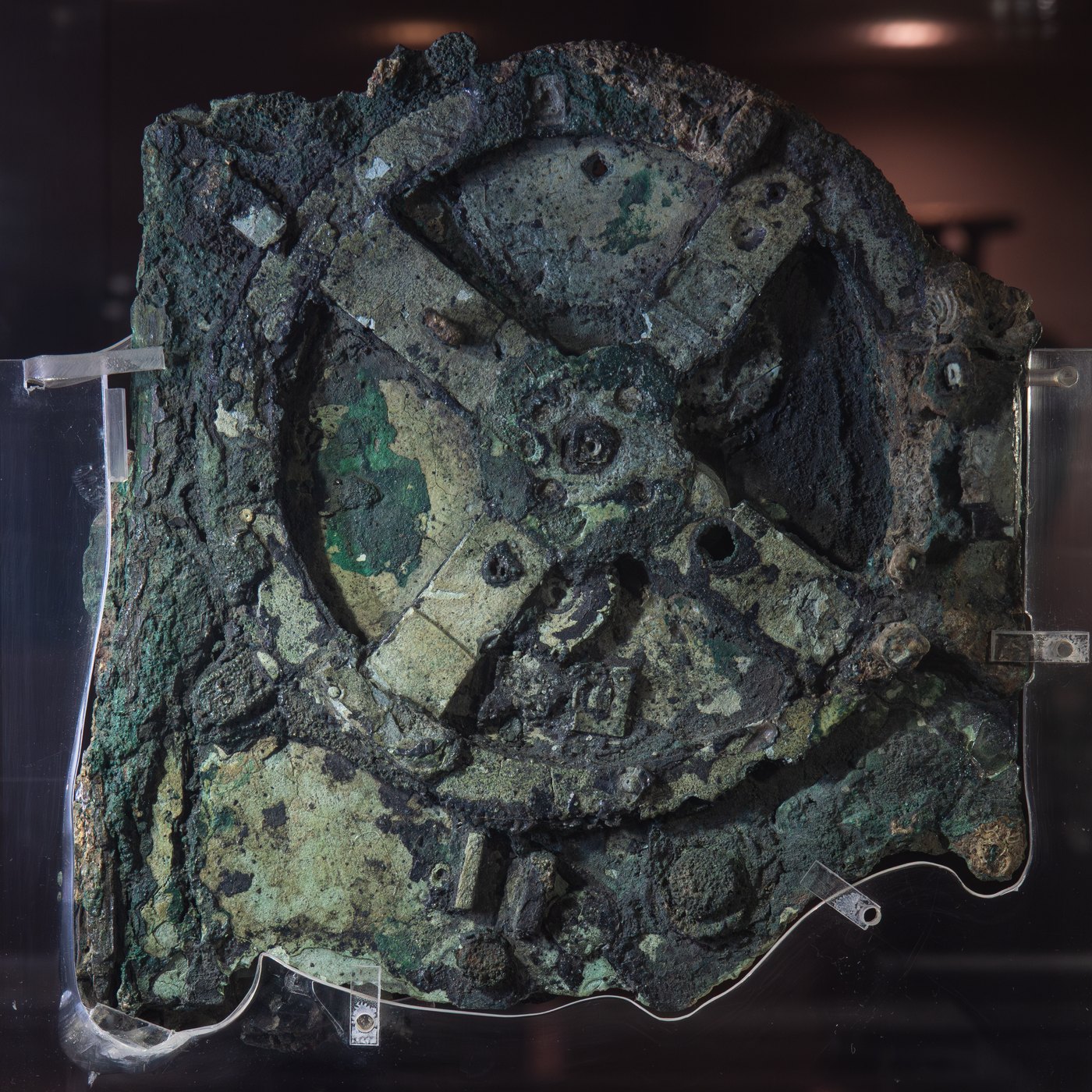
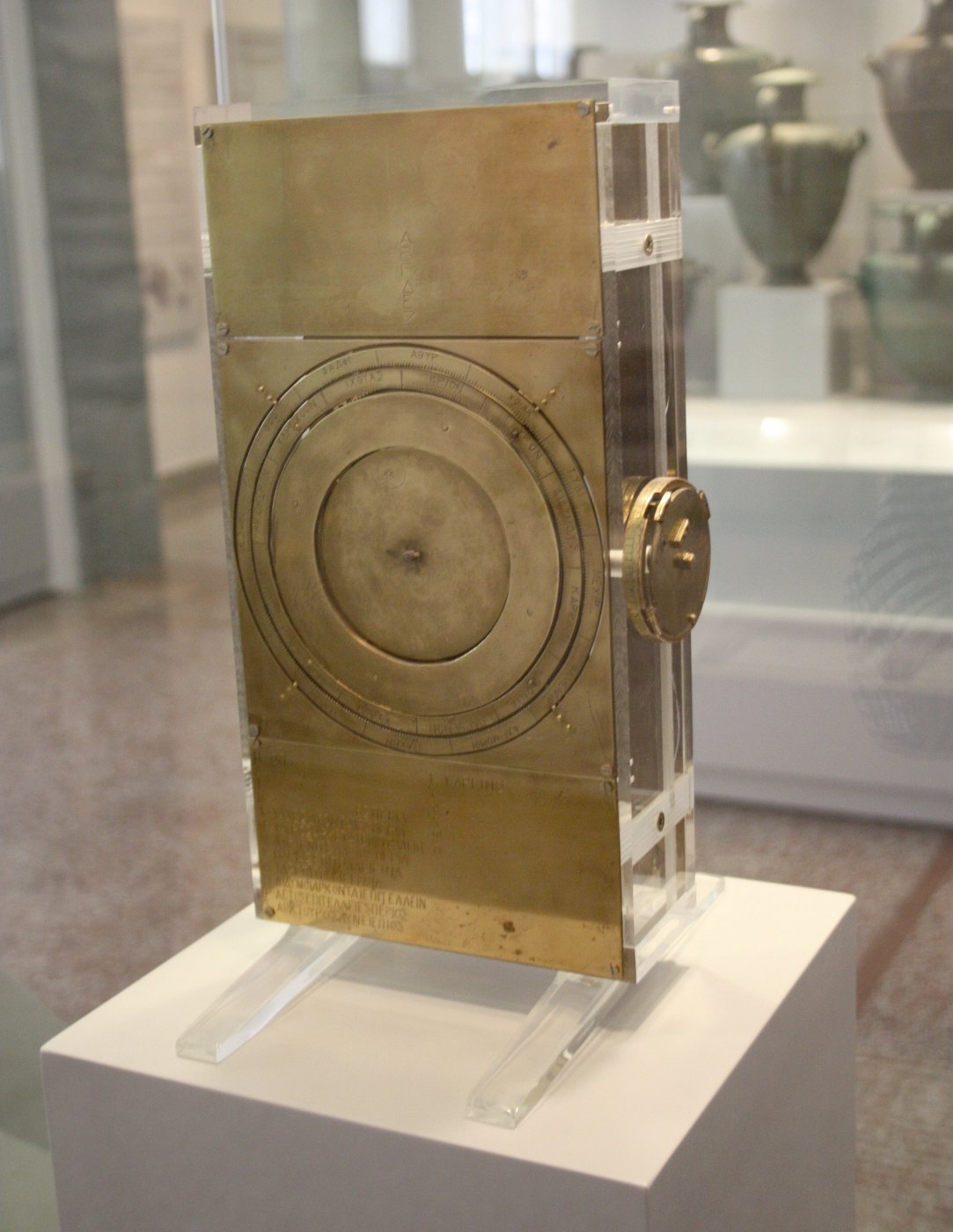
That is the Antikythera mechanism as it left its maker’s hands. What survives of it, in a climate-controlled case in the National Archaeological Museum in Athens, is 82 fragments of corroded bronze and a few traces of wood. The largest, Fragment A, is about the size of a hand and holds most of the surviving gears. The smallest are crumbs a few millimetres across. Seawater, pressure and two thousand years have turned most of the metal into corrosion minerals, chiefly the copper chloride atacamite, and fused gears, plates and inscriptions into layered lumps. Almost everything known about the machine has been recovered from those lumps by looking: with the naked eye, with conventional photographs, with X-rays, and since 2005 with three-dimensional X-ray computed tomography (CT) and a lighting technique that brings out faint surface relief.
What the looking has shown is this. The mechanism was a geared model of the sky and of time. Its input was a single rotation standing for the passage of days. Its outputs, through a train of hand-cut bronze gears with triangular teeth, were:
- the position of the Sun and the Moon among the twelve signs of the zodiac;
- the phase of the Moon, shown by a small ball, half pale and half dark, that turned as the Moon’s pointer went round;
- the day of the year in the 365-day Egyptian calendar used by Greek astronomers;
- the month in a 19-year lunisolar calendar (the Metonic cycle), with month names that point to a particular part of the Greek world;
- the four-year cycle of the great Panhellenic games, the Olympic games among them;
- the months in which eclipses of the Sun or Moon could be expected, across an 18-year eclipse cycle (the Saros), with notes on the time of day;
- very probably, the positions of the five planets known in antiquity (Mercury, Venus, Mars, Jupiter and Saturn), although the gears that drove them are lost.
1.2.1 Why “computer”?
Price’s 1959 article in Scientific American called the device “An Ancient Greek Computer”, and the word stuck. It is a fair word if it is read carefully. The mechanism did not store a program or make decisions; it was an analogue calculator, in which the ratio between two gears is the ratio between two astronomical periods. Turning one shaft through the right angle produces, automatically and without arithmetic, the angle that another body has moved through in the same time. The gear ratios themselves were the computation, and they were worked out from the best period relations of Babylonian and Greek astronomy. The Antikythera Mechanism Research Project, in the general preface to its 2016 edition of the inscriptions, preferred two older labels used together: Albert Rehm’s “planetarium” (1905) and Derek de Solla Price’s “calendar computer” (1974). Ancient writers had their own word for such things: σφαῖρα (sphaira), a “sphere”, because the devices were understood as working models of the cosmic sphere.
The analogue framing also explains why the mechanism belongs on the same shelf as the slide rule, the tide-predicting machine and the mechanical differential analyser. Each of them turns a physical quantity — a length, an angle, a shaft rotation — into the answer to a mathematical question. The Antikythera mechanism is simply the oldest known member of the family by about seventeen centuries.
1.3 How It Worked, in One Crank Turn
The input was a crank or knob on the side, driving through a crown gear to the large four-spoked wheel known as b1. The 2016 inscriptions preface puts it at roughly 4⅔ turns of the input for one turn of b1; one turn of b1 represented one solar year, so one turn of the crank advanced the machine by about 78 days. From b1, trains of gears ran forward to the front dial and backward to the two back dials.
Thirty gears survive: 27 in Fragment A and one each in Fragments B, C and D. The largest, b1, is about 13 cm across. The teeth are small, roughly equilateral triangles, filed by hand, with a mean pitch of about 1.6 mm, and the wheels are only about 1.4 mm thick. The tooth counts had to be inferred from incomplete, corroded wheels, by fitting regularly spaced teeth to measurements taken on CT slices; Volume 6 sets out the counts and the arithmetic, and how confidently each is known.
1.3.1 The front face
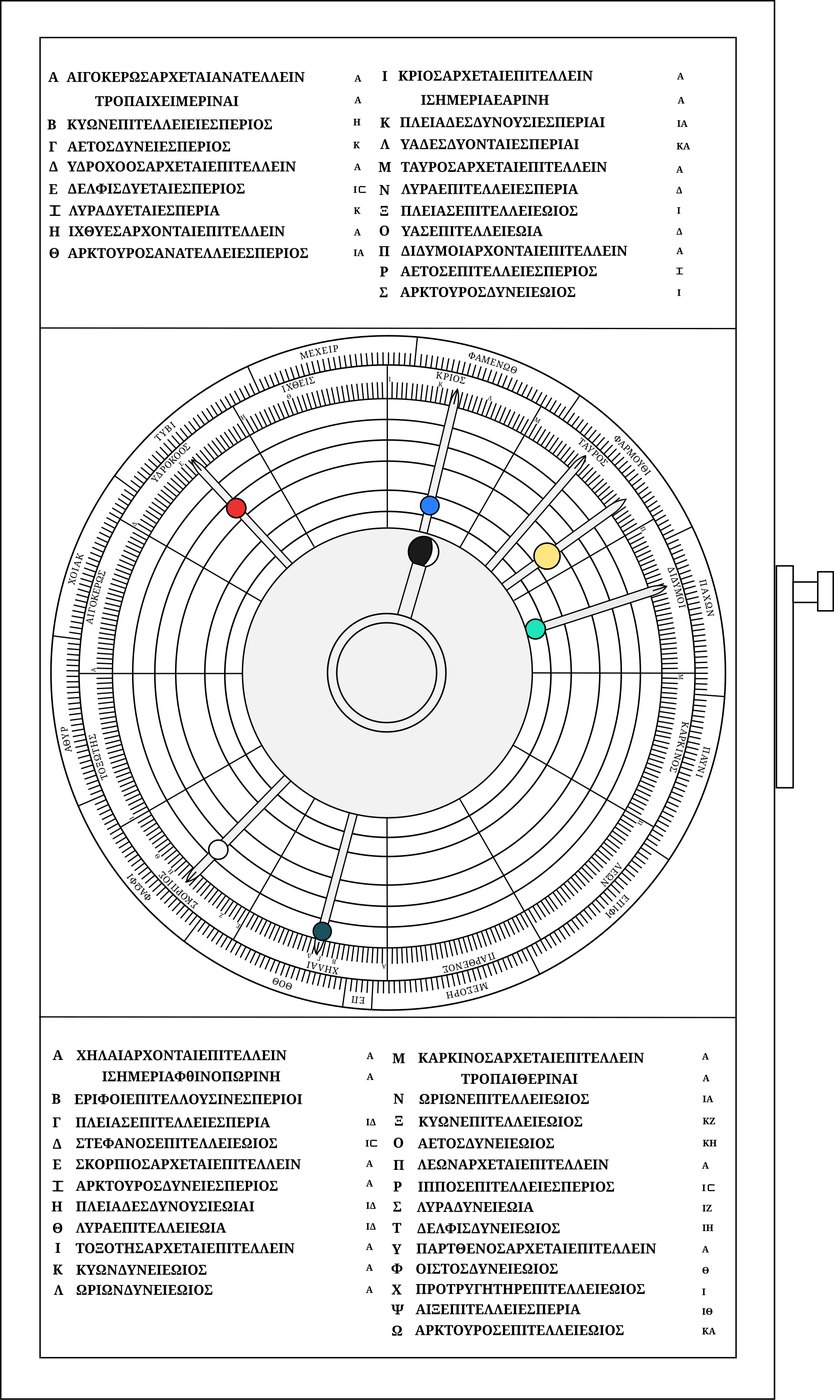
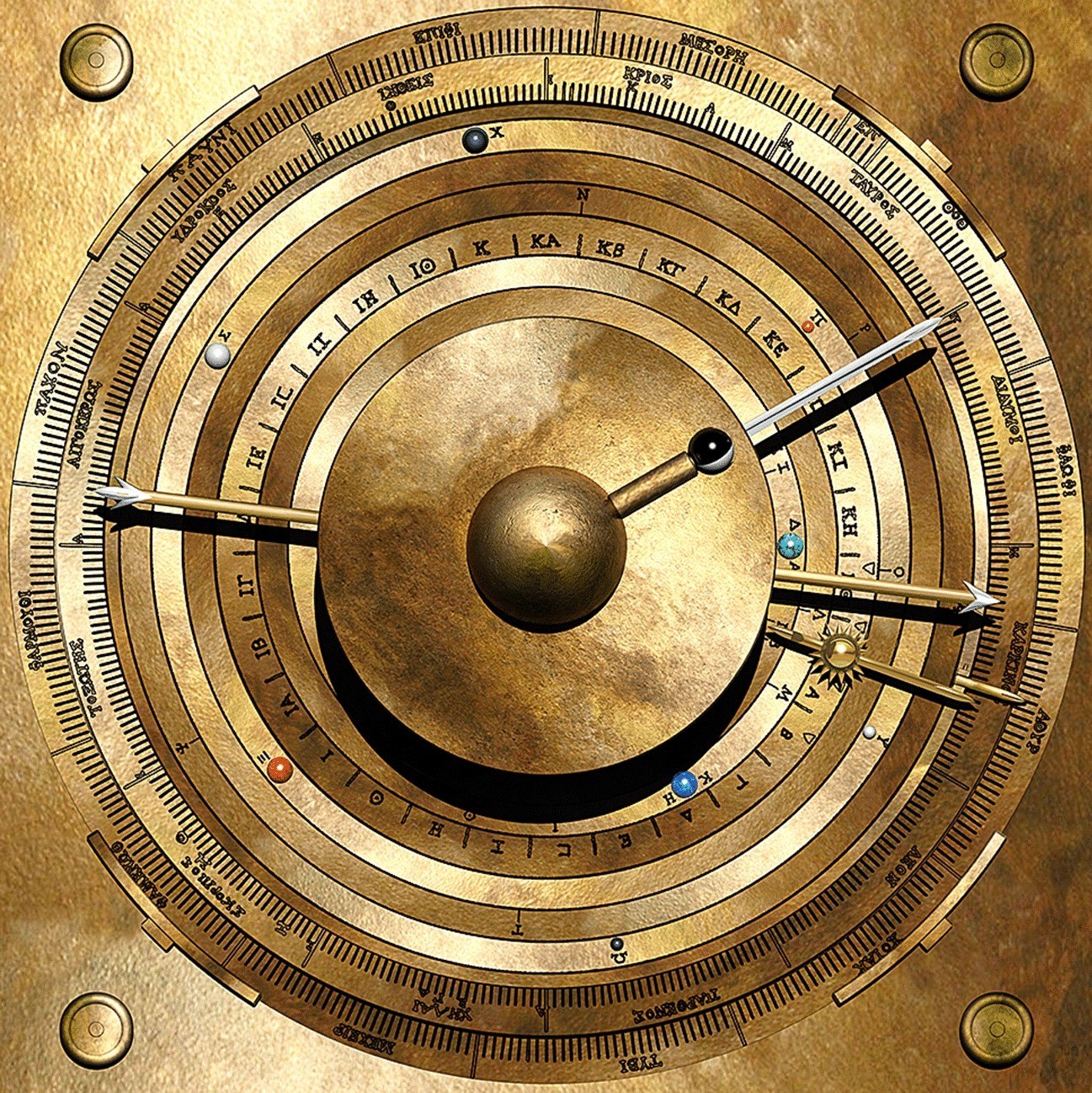
The front dial carried two concentric scales. The inner ring was the zodiac, twelve signs of 30° each. The outer ring was the Egyptian calendar: twelve months of 30 days plus five extra (epagomenal) days, with month names such as ΠΑΧΩΝ (Pachon) and ΠΑΥΝΙ (Payni) written in Greek letters. Because the real year is about a quarter-day longer than 365 days, the outer ring could be lifted and moved along a row of holes, secured by a pin. How many holes that row originally held — 365, as long assumed, or about 354, as recent statistical work on the surviving holes argues — is one of the live disputes of the field, taken up in Volume 7.
Pointers from the centre showed the Sun and the Moon against the zodiac. The Moon’s motion was not uniform: an ingenious pin-and-slot pair of gears, mounted on a rotating platform, sped the Moon up and slowed it down in the way described by the lunar theory of the astronomer Hipparchos (Ἵππαρχος), who worked in the second century BC. The phase ball turned with the difference between the Moon’s and the Sun’s motions. Around the dial, letters keyed the zodiac to a parapegma (παράπηγμα), a star calendar listing which stars rose or set at dawn or dusk on which days.
1.3.2 The back face
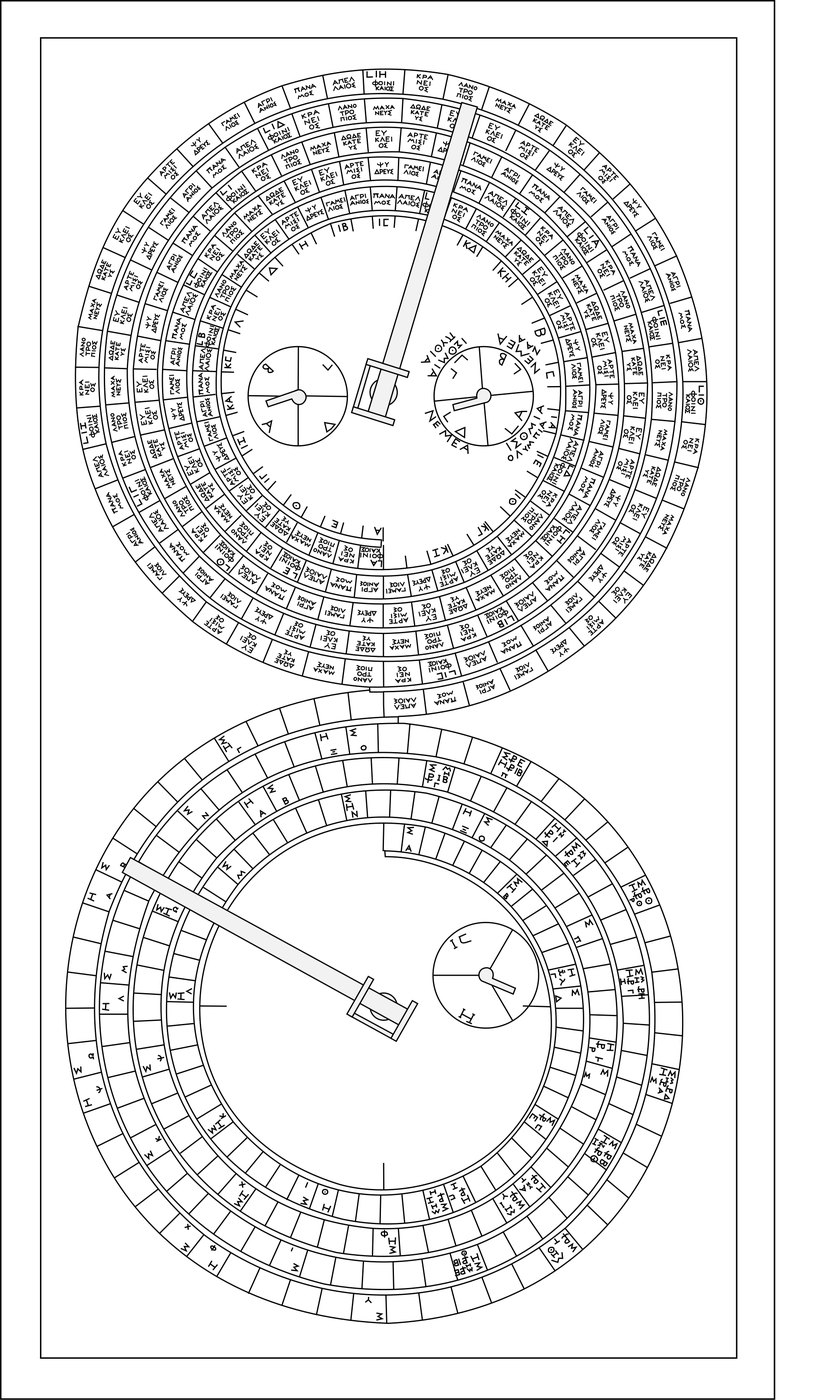
The back carried two spiral dials, a design found nowhere else in surviving ancient technology. A spiral packs a long cycle into a small space: instead of crowding hundreds of divisions into one circle, it winds them into several turns, and a little sliding follower on the pointer, riding in the groove, shows which turn is current.
The upper spiral has 235 cells in five turns: 235 lunar months, which equal 19 solar years to within about two hours. This is the Metonic cycle, the basis of most Greek lunisolar calendars, and the month names in its cells are the ones that have done most to place the mechanism geographically. Inside it sat two small subsidiary dials: one for the four-year cycle of the games — ΝΕΜΕΑ, ΙΣΘΜΙΑ, ΠΥΘΙΑ, ΟΛΥΜΠΙΑ and others — and one for the 76-year Callippic cycle, four Metonic cycles less one day.
The lower spiral has 223 cells in four turns: the Saros, the period of about 18 years and 11 days after which eclipses repeat in a very similar pattern. In some cells, engraved glyphs marked months in which an eclipse of the Sun (Η, for ἥλιος) or of the Moon (Σ, for σελήνη) was to be expected, with the hour and further notes. A small dial inside it, the Exeligmos, divided a triple Saros into three sectors, telling the user how many hours to add to the glyph times on the second and third passes.
1.3.3 The planets
The front cover inscription lists numbers that belong to the planets: 462 and 442, identified in CT scans of the inscription in 2016, match the synodic cycles of Venus and Saturn over those numbers of years, and the back cover inscription describes pointers carrying small spheres for the Sun and planets. None of the gearing that drove planetary displays survives except, possibly, one gear in Fragment D. Every published planetary display is therefore a reconstruction: Michael Wright’s of 2002 with pointers, Tony Freeth and Alexander Jones’s of 2012, and the University College London team’s of 2021 with concentric rings. Volume 10 compares them.
1.4 Babylon in Bronze
Everything the mechanism displayed rested on two traditions. From Babylonian astronomy came centuries of recorded observations and the great period relations: 19 years equal 235 lunar months; 223 lunar months bring eclipses back round; certain numbers of years bring each planet back to the same phase. These were arithmetic tools, tables and counting rules, with no picture of the sky behind them. From Greek astronomy came geometry: models in which the Sun, Moon and planets moved on circles carried by other circles (epicycles) or on circles whose centres were offset from the Earth (eccentrics), so that a varying speed in the sky could be explained by uniform motion in a hidden mechanism.
The Antikythera mechanism used both at once. The tooth counts encode Babylonian period relations — prime factors such as 19, 53 and 127 occur in them because the astronomical numbers contain them — while the pin-and-slot lunar gearing is a physical realisation of Greek geometric theory. The 2006 study in Nature observed that the Babylonian Saros canon is the only known source of eclipse data adequate to lay out the lower back dial. Volume 5 sets out the cycles and the geometry from first principles; Volume 6 shows how they were turned into gear trains.
1.5 The Story in Miniature
1.5.1 The wreck (Volume 2)
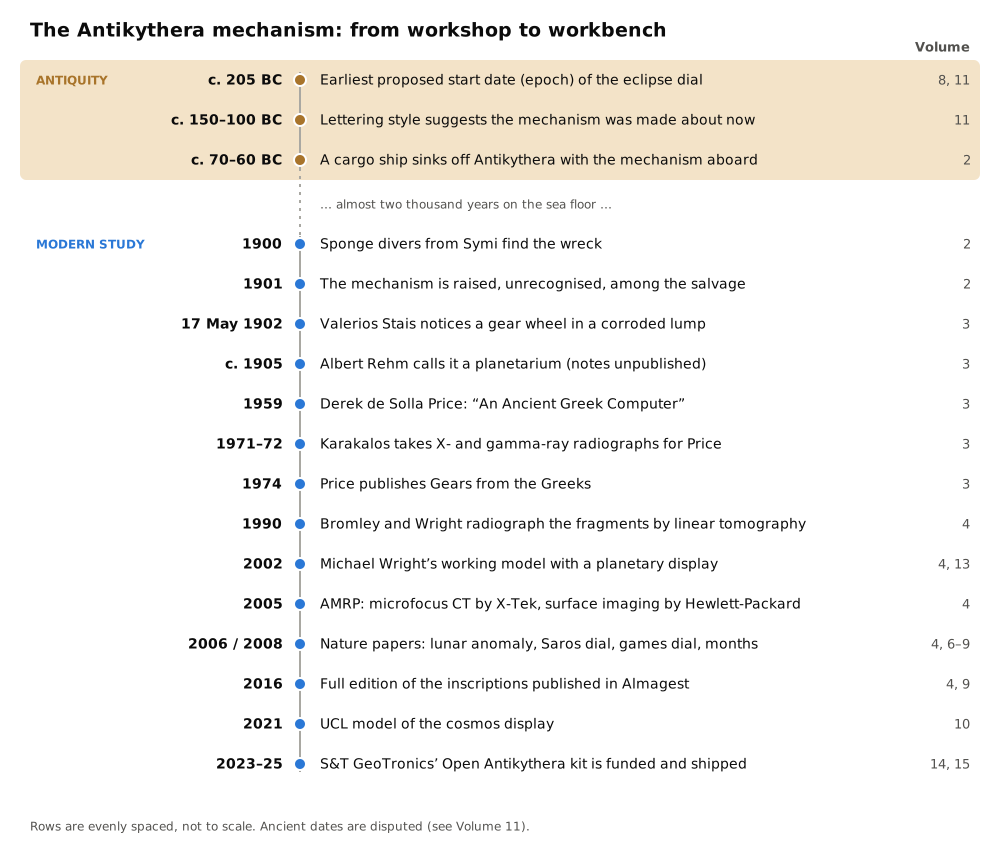
Around Easter 1900, sponge divers from the island of Symi, sailing home from the North African sponge grounds under Captain Dimitrios Kontos, sheltered from a storm off the small island of Antikythera (Ἀντικύθηρα), between Kythera and Crete. A diver, Elias Stadiatis, went down about 45 m and came back up reporting a heap of corpses and horses on the sea floor. They were bronze and marble statues. From November 1900 to the summer of 1901 the divers, supported by the Royal Hellenic Navy and supervised by archaeologists, raised bronzes, marbles, glass, pottery and furniture fittings from a large merchant ship of the early first century BC — the first large-scale, state-sponsored underwater archaeological operation in history. One diver died of decompression sickness and two were paralysed. Among the objects lifted, probably in July 1901, was a lump of corroded bronze and wood that nobody looked at twice.
The ship’s date is fixed by its coins and pottery to the second quarter of the first century BC, most often given as about 70–60 BC. Jacques Cousteau returned to the site in 1953 and 1976; Greek–American and then Greek–Swiss teams have dived it again in most years since 2012, with rebreathers, robots and a one-atmosphere diving suit, and they are still bringing up finds.
1.5.2 Recognition and a century of guessing (Volume 3)
On 17 May 1902, the archaeologist Valerios Stais, sorting the finds in the museum with his cousin, the politician Spyridon Stais, noticed that a broken lump had a gear wheel embedded in it. The next half-century produced more argument than progress. The numismatist Ioannis Svoronos published the fragments in 1903, with a technical description by the naval officer Periklis Rediadis, and the early consensus took the device for an astrolabe; the German philologist Albert Rehm concluded, in notes he never published, that it was an astronomical calculator, a “planetarium”. A Greek naval officer, Ioannis Theophanidis, built the first mechanical model between 1928 and 1934 and took it for a navigational instrument.
The modern understanding begins with Derek J. de Solla Price, a British-born historian of science at Yale. Price worked on the fragments from the 1950s, with the epigrapher George Stamires reading the inscriptions, and in 1971–1972 the Greek physicist Charalambos Karakalos made X-ray and gamma-ray radiographs of the fragments for him: the first look inside. Price’s 1974 monograph Gears from the Greeks gave the first comprehensive gearing scheme. Some of it was wrong, most famously a proposed differential gear, but the core claim — a geared calendar computer of astonishing sophistication — has held.
1.5.3 Seeing inside (Volume 4)
From the late 1980s the Sydney computer scientist Allan Bromley and the London Science Museum curator Michael T. Wright examined the fragments with linear X-ray tomography, a technique that brings a single plane inside an object into focus. Wright overturned much of Price’s scheme, showed that the back dials were spirals, and in 2002 built a working model with a full planetary display. In 2005 the Antikythera Mechanism Research Project (AMRP), led by the Cardiff astrophysicist Mike Edmunds with Tony Freeth and Greek colleagues from Athens and Thessaloniki, brought a high-powered microfocus CT scanner from X-Tek Systems and a reflectance-imaging rig from Hewlett-Packard to the museum. The results, published in Nature in 2006 and 2008, confirmed Hipparchos’s lunar theory in bronze, the 223-month eclipse spiral, the games dial and the Corinthian-family month names, and doubled the amount of readable text.
1.5.4 The sky, the gears and the dials (Volumes 5–8)
Volumes 5–8 are the technical core. Volume 5 sets out the astronomy that the mechanism embodied: the Metonic, Callippic, Saros and Exeligmos cycles; the difference between sidereal, synodic, anomalistic and draconitic months; and the geometric models that Hipparchos and his predecessors used to explain an uneven sky. Volume 6 walks the gear train shaft by shaft and checks its ratios. Volume 7 turns to the front face — zodiac, calendar ring, Sun, Moon, phase ball and parapegma — and Volume 8 to the back: the spiral dials, the pointer followers, the games dial and the eclipse glyphs.
1.5.5 The words on the machine (Volume 9)
The cover plates were a written guide to the dials. The AMRP’s 2016 edition of the inscriptions, the fullest yet, recovered text from surfaces hidden inside the fragments. Volume 9 reads them: what the back cover’s “user’s manual” says about the dials, and what the front cover’s planetary numbers imply.
1.5.6 The lost planets (Volume 10)
No planetary gears survive, so every planetary display is an argument from inscriptions, from holes and stubs on the surviving wheels, and from what a Greek mechanician could have known. Volume 10 follows the reconstructions from Wright’s to the 2021 UCL “Model of the Cosmos”.
1.5.7 Who, where, when — and did it work? (Volume 11)
The lettering suggests manufacture in the second half of the second century BC; arguments from the eclipse dial put its starting date as early as 205 BC; the month names point to the Corinthian family of calendars, which one line of argument connects to Syracuse and the tradition of Archimedes, and another to a workshop on Rhodes building for a client in Epirus. Cicero describes geared “spheres” made by Archimedes and by Posidonius of Rhodes. And there is a practical question: hand-filed triangular teeth and the manufacturing errors visible in the fragments may have made the machine stiff, inaccurate or prone to jamming. Volume 11 sets out each case and its evidence, and keeps the disputes as disputes.
1.5.8 A thousand years of silence (Volume 12)
Nothing of comparable complexity survives from the next millennium, but the craft did not vanish entirely. A Byzantine geared sundial-calendar of AD 400–600, now in the Science Museum in London, carries a small gear train for the Moon’s age; al-Bīrūnī described a geared lunisolar calendar around AD 1000; and the great astronomical clocks of fourteenth-century Europe brought the idea back on a monumental scale. Volume 12 traces that thin line.
1.5.9 Rebuilding it (Volume 13)
Every serious student of the mechanism has ended up building one. Volume 13 surveys the reconstructions: Price’s, the Bromley–Percival model in Sydney, Wright’s, the reconstructions of the Kotsanas Museum of Ancient Greek Technology, Andrew Carol’s 2010 Lego machine, the 2011 Hublot wristwatch movement, and the Australian machinist Chris Budiselic’s (Clickspring) reconstruction with period-appropriate tools, whose measurements of the calendar-ring holes reopened the calendar question.
1.5.10 The Open Antikythera (Volumes 14–15)
The final two volumes turn to a modern kit. S&T GeoTronics, the small Ohio firm of Marc Tessier and James Sanderson that earlier produced the Open Enigma and the Open DSKY, crowdfunded the Open Antikythera on Kickstarter between 28 July and 31 August 2023. Its production units use laser-cut clear acrylic plates engraved with the dial scales, laser-cut acetal (Delrin) gears and hand-turned brass axles, so that the whole gear train is visible through the faces. It comes in two editions: FullMonty, with both the front and back dials, and UpFront, with the front only. Volume 14 describes the kit, what it reproduces and which reconstructions it follows. Volume 15 is an owner’s account of building a clear-acrylic unit and learning to read its dials.
1.6 What Is Known, What Is Argued, What Is Lost
A deep dive on this machine has to keep three kinds of statement apart, and this series marks them throughout.
Established from the fragments. The mechanism had a large front dial with zodiac and Egyptian calendar scales; Sun and Moon pointers; a Moon-phase display; an upper back spiral of 235 months in five turns; a lower back spiral of 223 months in four turns with eclipse glyphs; a games dial; at least 30 gears with hand-cut triangular teeth; a pin-and-slot mechanism for the Moon’s variable speed; and extensive inscriptions describing all of this. These features are visible in the bronze or in CT slices, and independent research groups agree on them.
Argued from strong but indirect evidence. The Callippic and Exeligmos subsidiary dials; the planetary displays; most of the gearing behind the lost parts; the number of calendar-ring holes; the place of manufacture; the dates of manufacture and of the dials’ starting point. Each of these has a well-reasoned position and at least one serious alternative.
Lost. The crank, the case, most of the front plate, the planetary gearing, more than half of every long inscription, and the name of whoever designed it.
The numbers in circulation reflect this. The surviving gear count is 30; the CT suggests 35 or so originally meshing in the surviving region; reconstructions need from about 37 gears for the dials that are certain to 69 in the 2021 model with planets. Readers will meet all of these figures, and each volume says which one it means.
1.7 Why It Matters
The Antikythera mechanism changes the history of technology in three ways.
First, it shows that precision gearing existed in the Hellenistic world. Ancient texts describe geared devices — Heron’s and Vitruvius’s odometers, Cicero’s account of Archimedes’ planetary sphere — and it was always possible to read them as literary exaggeration. The fragments prove that a Greek workshop could cut dozens of small gears to specified tooth counts, mount them on concentric shafts and epicyclic platforms, and engrave dial scales finely enough to be read by a pointer. The 2006 Nature paper went as far as to note that if the scales were divided using the mechanism’s own gearing, that would pre-date the known dividing engines by many centuries.
Second, it shows theory turned into machinery. The pin-and-slot lunar gearing is not a crude approximation; it is a mechanical model of a specific geometric theory of the Moon, by a specific astronomer, within decades of that theory’s formulation. Ideas that survive in Ptolemy’s Almagest as diagrams and tables were, in at least one workshop, being cut in bronze.
Third, it shows what has been lost. A machine of this sophistication cannot have been the first or the only one. Its gearing is mature, its layout is confident, and its inscriptions read like the documentation of a known type of product. The silence that follows in the archaeological record is a silence of survival, not necessarily of practice: bronze was valuable and was melted down, and only the accident of a shipwreck preserved this one.
1.8 How to Read This Series
The volumes are written to be read in order, but each stands alone. Greek words appear in Greek letters where the inscriptions use them and in transliteration otherwise; month and game names are given as the mechanism spells them. Dates follow the convention of the sources: “BC” and “AD”, with “c.” for approximate dates. Measurements are metric, as in the scientific literature.
Three kinds of figure appear: photographs of the fragments and of the people and places in the story; reconstruction drawings from the research literature, always identified as reconstructions; and line diagrams drawn for this series, which are labelled as such and whose generating scripts are kept with the project.
1.9 The One-Paragraph Version
The Antikythera mechanism is a geared astronomical calculator made by a Greek workshop around the second century BC and lost with a cargo ship off the island of Antikythera in the early first century BC. Sponge divers raised it in 1901 among statues and luxury goods; a gear wheel was noticed in one corroded lump in 1902. Turning its crank moved pointers that showed the Sun and Moon in the zodiac, the Moon’s phase, the Egyptian calendar, a 19-year lunisolar calendar, the four-year cycle of the Panhellenic games and the months of coming eclipses, and probably the five known planets; a pin-and-slot gear pair reproduced Hipparchos’s theory of the Moon’s varying speed. A century of study — Stais, Rehm, Price and Karakalos, Bromley and Wright, the Antikythera Mechanism Research Project’s CT scans, and the UCL team’s 2021 model — has recovered most of how it worked, while its maker, its exact date and its planetary display remain argued. It is now reproduced by clockmakers, Lego builders and kit makers, one of whose clear-acrylic kits closes this series. The remaining fourteen volumes are the long version.
Next — Volume 2: The Wreck — Sponge Divers, Statues and a Lump of Corroded Bronze. Easter 1900, a storm, and a crew of Symi sponge divers sheltering under the cliffs of a nearly empty island; a diver who came up raving about corpses on the sea floor; a year of hard-hat salvage with Navy ships, a death and a cargo of bronze and marble masterpieces — and, among the leftovers, the lump that would become the most famous object in the National Archaeological Museum. Then a century of return visits, from Jacques Cousteau’s Calypso to rebreathers, robots and an atmospheric diving suit.
Comments (0)