Antikythera · Volume 4
Antikythera — Volume 4 — Seeing Inside — Wright, Bromley and the Antikythera Mechanism Research Project
How a Sydney computer scientist and a London curator brought one plane at a time into focus, how a 450-kilovolt CT scanner and a rig of flash lamps came to the museum in Athens in 2005, and what the Nature papers of 2006 and 2008 found inside the bronze
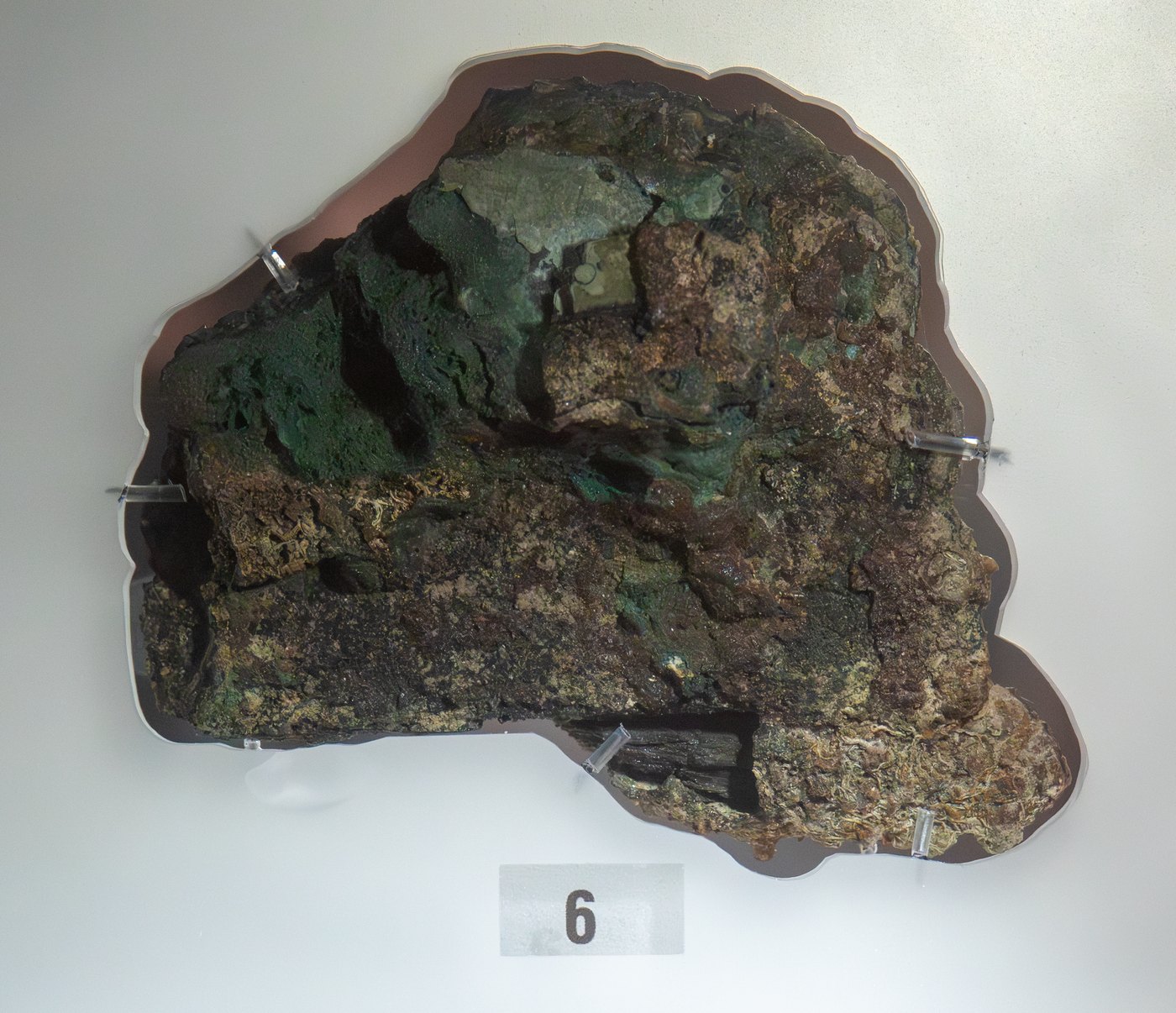
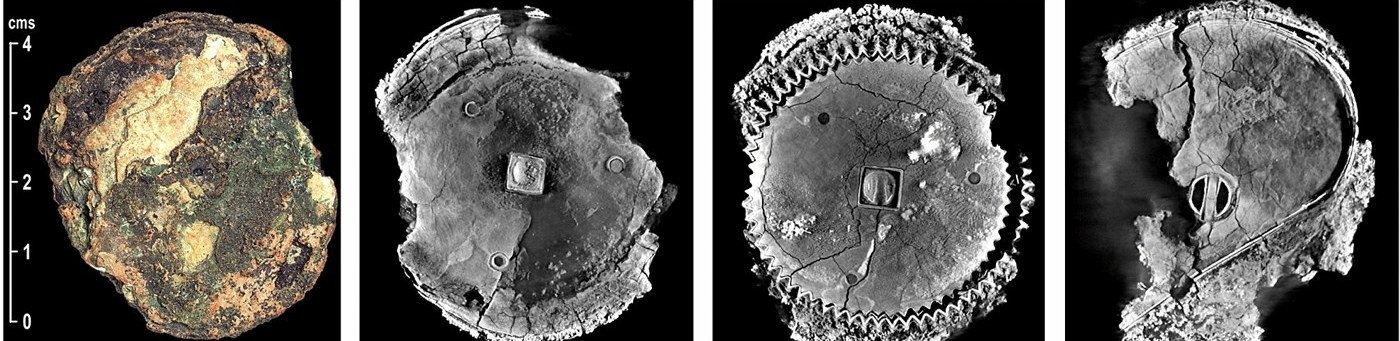
4.1 About This Volume
By 1974 Derek de Solla Price had shown that the Antikythera mechanism was a geared calendar computer (Volume 3), but he had done it with radiographs in which every layer of the fragments lay on top of every other. This volume follows the next thirty-five years, in which two successive imaging technologies made it possible to see the layers one at a time.
The first was linear X-ray tomography, brought to the fragments around 1990 by the Australian computer scientist Allan Bromley and the London Science Museum curator Michael T. Wright. Wright used it to dismantle much of Price’s scheme, to show that the back dials were spirals, and to build the first working model with a full planetary display. The second was microfocus X-ray computed tomography (CT), together with a computational lighting technique called polynomial texture mapping (PTM), brought to Athens in 2005 by the Antikythera Mechanism Research Project (AMRP). Its first results, published in Nature in 2006 and 2008, transformed the field: they recovered the gear tooth counts with statistical rigour, found Hipparchos’s lunar theory built into the gearing, identified the eclipse and games dials, read the month names, and doubled the amount of legible text.
The volume ends with the state of knowledge in 2008 and points forward to the later work — the 2016 edition of the inscriptions and the 2021 model of the cosmos display — treated in Volumes 9 and 10.
4.2 The Problem with Shadows
A radiograph is a shadow. X-rays or gamma rays pass through the object and darken a film, more where the object is thin or light, less where it is dense. Everything along the path of each ray, front to back, contributes to one point on the film. For a single flat object that is ideal. For a corroded block containing a dozen thin gears stacked in layers a few millimetres apart, it produces a tangle: rims, spokes and teeth of different wheels superimposed into one picture, with no direct way of telling which belongs to which layer.
Price’s radiographs of 1971–1972 were made in exactly that way. He could see that Fragment A was full of gears, count teeth where a rim stood clear of the others, and estimate the rest from the arc of the rim and the spacing of the visible teeth. Which gear lay on which arbor, and which meshed with which, he inferred from mechanical plausibility. Some of his inferences were right and some were not, and the radiographs could not tell the difference.
What was needed was a way to bring one plane of a fragment into focus and blur the others. Medical radiology had had such a technique since the 1930s.
4.3 Allan Bromley
Allan George Bromley (1947–2002) was a computer scientist and historian of computing, who lectured in the Basser Department of Computer Science at the University of Sydney from 1972 until his death. His best-known work was on Charles Babbage: he studied Babbage’s surviving drawings of his calculating engines more closely than anyone before him, argued that the Difference Engine No. 2 could have been built with the technology of Babbage’s own day, and initiated the project that built one at the Science Museum in London for the bicentenary of Babbage’s birth. A historian of calculating machinery from the mechanical age was well placed to see what the Antikythera mechanism was.
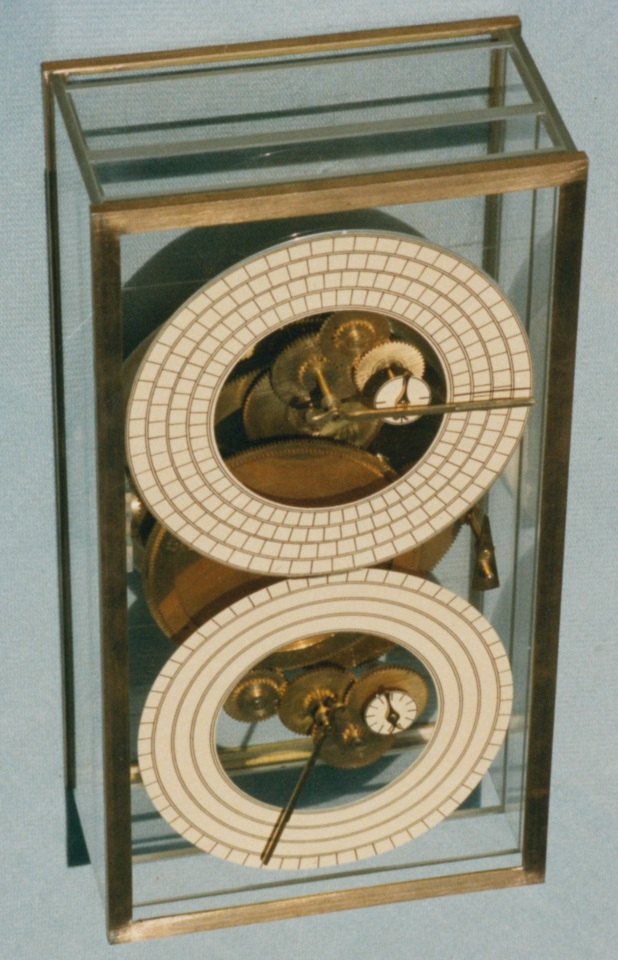
Bromley began to question Price’s reconstruction in 1985. Without having examined the original fragments, he worked from Price’s published data and his own corrections, and had the Sydney clockmaker Frank Percival build an improved model. In 1990 he published his critique in the Horological Journal. That year he went to Athens to look at the fragments for himself.
4.4 Michael Wright
Michael Thomas Wright was born in London in 1948, studied physics at Oxford and the history of technology at the University of London, and taught school before joining the Science Museum in London in 1971. He spent more than thirty years there, mainly as curator of mechanical engineering, retiring in 2004. He was a curator who made things: his interpretation of the mechanism was always tested by building it.
Wright and Bromley began a joint programme on the Antikythera mechanism in the late 1980s. In 1990, with Helen Mangou of the museum’s Department of Physical and Chemical Research, they made a new series of radiographs of the fragments in Athens, using two techniques that Price had not had: stereographic radiography, which gives depth from pairs of images taken at slightly different angles, and linear motion tomography.
4.4.1 Linear tomography
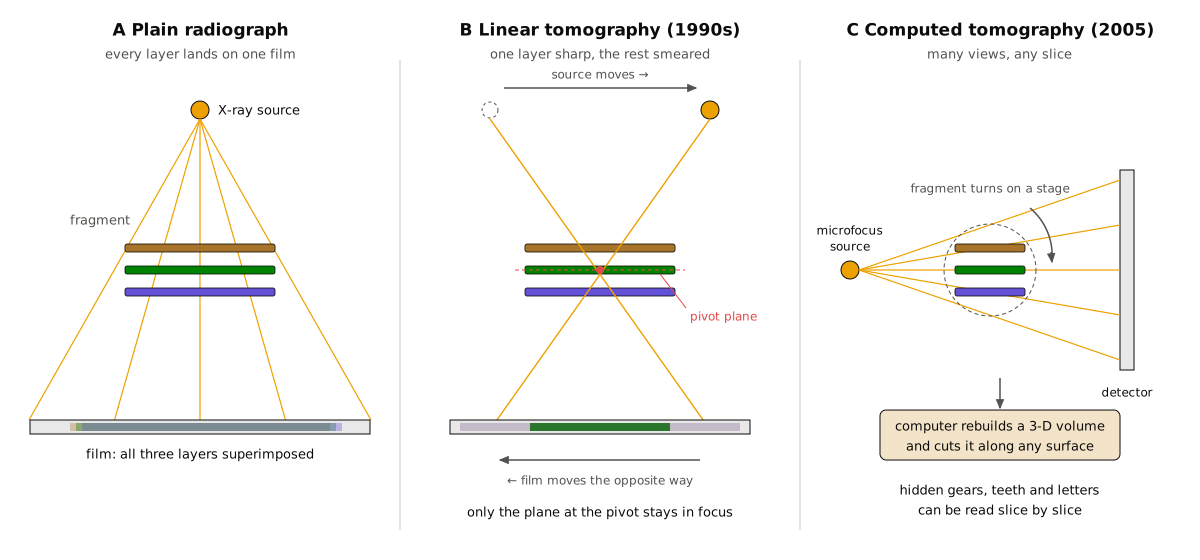
The technique was suggested to Wright by Alan Partridge, a retired radiologist. In the classic medical arrangement the X-ray source and the film move continuously in opposite directions during the exposure while the object stays still; as applied to the Antikythera fragments, it was the fragment and the film that were moved, to the same effect. The geometry is arranged so that one plane through the object — the plane about which the motion pivots — is always projected onto the same place on the film. Features in that plane stay sharp. Features above and below it move across the film during the exposure and smear into a blur. By changing the pivot height and repeating the exposure, a series of images can be made, each with a different layer in focus.
The images are not as clean as modern CT: the blurred layers still add a haze over the plane in focus. But for the first time a researcher could ask which gears lay in which layer and get an answer from the image rather than from inference. Wright, Bromley and Mangou published the method in 1995, noting a further result: the tomographs captured traces of inscriptions on surfaces buried inside the fragments. They could not read the hidden text, but they predicted that a refined technique would.
Wright presented his early results in 1997, and they showed that Price’s reconstruction was fundamentally flawed. He also gave the name Fragment E to a piece that had come to light in 1976.
4.4.2 What Wright found
Over the following decade, in a long series of papers in the Horological Journal, Antiquarian Horology and the Bulletin of the Scientific Instrument Society, Wright rebuilt the understanding of the mechanism almost from the ground up.
- The differential was wrong. The tomographs did not support Price’s differential gear. Wright later (2005–2006) demonstrated how the Moon-phase display could be driven: the small half-dark ball on the Moon’s pointer, turned by a little train of gears so that it showed the Moon’s phase.
- More gears. Wright raised Price’s count of surviving gears from 27 to 31, including a gear in Fragment C that belonged to the Moon-phase display.
- The back dials were spirals. Price’s five concentric rings on the upper back dial were in fact a five-turn spiral of 235 divisions, 47 to a turn — the 19-year Metonic cycle — with a pointer that followed the spiral outward. Wright proposed that the small subsidiary dial inside it showed the 76-year Callippic cycle of four Metonic cycles. He first read the lower back dial as a count of draconitic months, and later accepted the AMRP’s identification of it as a 223-month eclipse spiral.
- Epicyclic gearing and the planets. In 2001–2002 Wright proposed that the mechanism had been a full planetarium, showing the Sun, the Moon and all five planets known in antiquity on the front dial, and built a working model to show that the gearing for it could fit within the space available. He published the scheme in the Horological Journal in 2002. Its planetary gearing was necessarily hypothetical, but it established that a planetary display was mechanically feasible.
Wright completed a near-exact working replica in 2006, published a synthesis, “The Antikythera mechanism reconsidered”, in Interdisciplinary Science Reviews in 2007, and on 6 March 2007 presented his model at the National Hellenic Research Foundation in Athens. His models are displayed in the National Archaeological Museum alongside the fragments (Volume 13).
4.4.3 An interrupted partnership
Bromley died on 16 August 2002. Jo Marchant’s popular history Decoding the Heavens (2008) tells the story of the Bromley–Wright collaboration as one that ended in a bitter disagreement over access to the radiographs; that account has been disputed, and it is not followed here. What is not in dispute is that Wright continued the work alone after the early 1990s, and that the interpretation of the gearing that the AMRP confirmed and extended in 2006 rested heavily on his. Of the first nine references in the 2006 Nature paper, eight are papers by Wright or co-authored by him.
4.5 The Antikythera Mechanism Research Project
4.5.1 Origins
The AMRP grew out of a student exercise. In 1999 Mike Edmunds, an astrophysicist in the School of Physics and Astronomy at Cardiff University, supervised an undergraduate project reviewing what was known about the mechanism; it led to a 2000 article, “Antikythera: Still a Mystery of Greek Astronomy?”. The review concluded that the outstanding questions could be answered only by better imaging of the inside of the fragments. Tony Freeth, of the London film and media company Images First Ltd, joined Edmunds, and they assembled an international team.
On 15 November 2004 the Leverhulme Trust awarded a grant of £164,353 over two years for “New Investigations of the Antikythera Mechanism”, with Edmunds as principal investigator; Freeth worked on the project under contract from January 2005 to December 2006. Further support came from the Walter Hudson Bequest, the University of Athens Research Committee and the Cultural Foundation of the National Bank of Greece, and the work was done with the permission of the Greek government and in collaboration with the National Archaeological Museum.
4.5.2 The team
The authors of the project’s first paper show its breadth:
Table 1 — The authors of the project's first paper show its breadth
| Group | People | Role |
|---|---|---|
| Cardiff University | Mike Edmunds | Academic lead; statistical analysis |
| Images First Ltd, London | Tony Freeth | Most of the CT analysis and its interpretation; illustrations |
| University of Athens | Xenophon Moussas, Yanis Bitsakis | Reading and translating the inscriptions; liaison |
| Aristotle University of Thessaloniki | John H. Seiradakis | Measuring the fragments; liaison |
| Centre for History and Palaeography, National Bank of Greece Cultural Foundation | Agamemnon Tselikas, Yanis Bitsakis | Reading, transcribing and translating the inscriptions |
| National Archaeological Museum, Athens | Helen Mangou, Mary Zafeiropoulou | Cataloguing and measuring the fragments; guidance on X-ray examination |
| X-Tek Systems Ltd | Roger Hadland, with D. Bate, A. Ramsey, M. Allen, A. Crawley, P. Hockley | Built and operated the CT machine; reconstructions |
| Hewlett-Packard Laboratories | Tom Malzbender, Dan Gelb, with W. Ambrisco | Built and operated the PTM rig and its software |
Later papers added the historian of ancient science Alexander Jones of New York University’s Institute for the Study of the Ancient World, and the Assyriologist John Steele, among others.
4.6 Autumn 2005: Imaging in Athens
The fragments could not leave the museum. The instruments came to them.
4.6.1 Polynomial texture mapping
The first technique dealt with surfaces. Polynomial texture mapping, developed at Hewlett-Packard Laboratories by Tom Malzbender and Dan Gelb, records a fixed object under light from many different directions in turn, then fits, for every pixel, a simple mathematical function describing how its brightness changes with the direction of the light. The result is an image that can be relit interactively on a computer screen — the light swung round to rake across the surface at any angle — and enhanced so that faint relief is exaggerated. On the Antikythera fragments, where inscriptions survive as shallow scratches in a crusted and discoloured surface, the effect was dramatic: letters invisible in ordinary photographs stood out clearly. The HP team built and operated the imaging rig and its software in the museum.
4.6.2 Microfocus CT: “BladeRunner”
The second technique dealt with the interior. Computed tomography takes a large number of X-ray projections of an object from different angles — here, by turning the fragment on a stage between a fixed X-ray source and a detector — and reconstructs from them, by computer, a full three-dimensional map of the object’s density. That map can then be sliced in software along any plane or curved surface. Unlike linear tomography, there is no residual haze from other layers, and the slicing can follow a bent or tilted plate.
A microfocus X-ray tube produces its X-rays from a very small spot, so that shadows are sharp and fine detail is preserved even at high magnification. But the Antikythera fragments are thick and dense, full of corroded bronze, and X-ray power and focal spot size work against each other. X-Tek Systems, a small firm in Tring, Hertfordshire, led by Roger Hadland, upgraded its CT system for the project, doubling its operating voltage from 225 kV to 450 kV so that it could penetrate the whole mechanism. The 2006 paper calls the machine the Bladerunner CT. It became a commercial product: Cardiff’s later impact report records that X-Tek, by then part of Nikon Metrology, had sold nineteen BladeRunner systems, three of them to Rolls-Royce.
The CT data were analysed with commercial volume-visualisation software, VGStudio Max from Volume Graphics GmbH. Freeth carried out most of the structural analysis, following gears from layer to layer through the volumes.
4.6.3 Cataloguing the fragments, and a new one
The same year, Mary Zafeiropoulou of the museum catalogued the fragments that were not on public display. She extended the letter designations to F and G and gave numbers from 1 to 75 to the smaller pieces, bringing the total to 82. Fragment F, about 90 × 80 mm, was found in the museum’s stores in 2005; it carries sixteen inscriptions from the lower right of the Saros spiral and remnants of the mechanism’s wooden case.
4.7 Nature, 30 November 2006
The project’s first paper, “Decoding the ancient Greek astronomical calculator known as the Antikythera Mechanism”, by Freeth, Bitsakis, Moussas, Seiradakis, Tselikas, Mangou, Zafeiropoulou, Hadland, Bate, Ramsey, Allen, Crawley, Hockley, Malzbender, Gelb, Ambrisco and Edmunds, appeared in Nature on 30 November 2006. It opened with a sentence that has been quoted ever since: the mechanism “is technically more complex than any known device for at least a millennium afterwards”.
4.7.1 Tooth counts by statistics
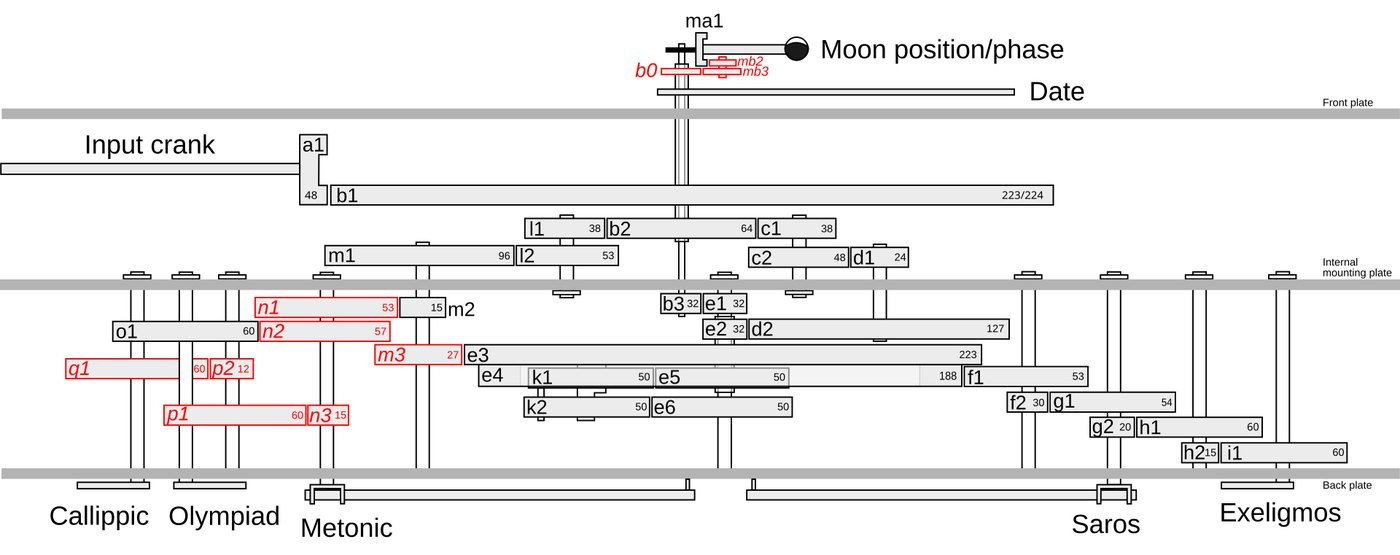
The paper put the gear tooth counts on a new footing. Few gears are complete; most survive as partial rims with broken and corroded teeth. The team measured, on CT slices, the angular positions of the remaining tooth tips around a nominal centre, then fitted models with regularly spaced teeth, varying the count (and, where it was unclear, the centre) to minimise the root-mean-square deviation from the measurements. The best fit gave the count, and the quality of fit gave a measure of confidence. The paper reported 27 hand-cut bronze gears in Fragment A and one in each of B, C and D: thirty in all.
4.7.2 Hipparchos in bronze
The most striking result was in the lunar gearing. The CT showed two 50-tooth gears (k1 and k2), mounted on a large gear (e3) so that they were carried round on it, with their arbors slightly offset — about 1.1 mm apart. A pin on one engaged a slot in the other — a feature Wright had already reported in 2005. Because the arbors were offset, the second gear turned at a rate that varied sinusoidally, faster for half a turn and slower for the other half, even though the first turned uniformly. That variation reproduces the Moon’s apparent change of speed across the sky — fast near perigee, slow near apogee — and because the whole assembly rode on e3, which turned at the rate of the Moon’s line of apsides (about once in nine years), the variation was correctly timed. The mechanism, the paper concluded, contained “a mechanical realization” of the lunar theory developed by Hipparchos in the second century BC. It added a characteristic caution: it was tempting to associate the mechanism’s conception with Hipparchos himself, but he was not the first to assume such models.
The same analysis explained a long-standing puzzle. Two gears in the train (f1 and l2) have 53 teeth, an awkward prime number to divide. Their effects cancel on the way to the Saros dial, and they are there because the factor 53 is needed to make e3 turn at the rate of the lunar apsides. The paper called the 53-tooth count “powerful confirmation” of the Hipparchos model. Volume 6 sets out the arithmetic.
4.7.3 The back dials
The paper confirmed Wright’s upper back dial — 235 divisions on a spiral, with 34 scale markings newly found — and his Callippic subsidiary dial divided into quadrants. It identified the lower back dial as a Saros eclipse dial of 223 divisions in four turns, with a subsidiary Exeligmos dial; showed that both spirals had a pointer-follower, a little slide with a pin riding in the spiral groove; and found eclipse glyphs in sixteen cells of the Saros dial, with a pattern consistent with Babylonian eclipse records, from which the positions of 35 more could be predicted.
4.7.4 Inscriptions and date
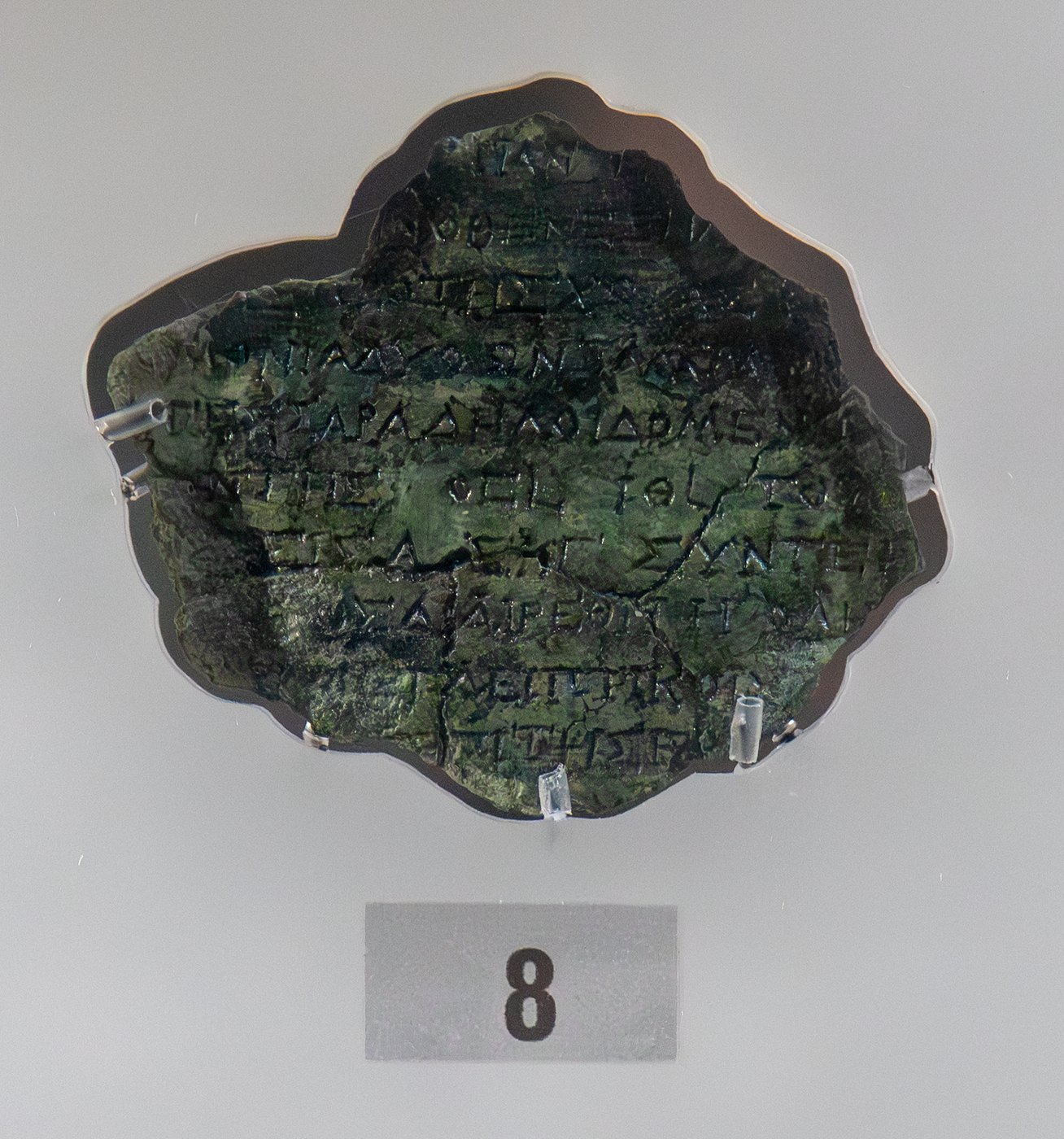
With CT and PTM together the team was able to double the number of deciphered inscriptions. The back door inscription turned out to mix mechanical terms — “trunnions”, “gnomon”, “perforations” — with astronomical periods; it included the phrase “spiral divided into 235 sections”, direct confirmation of the spiral dial. The front door carried numbers that might relate to planetary motions, and the word sterigmos (στηριγμός), a planet’s “station”, the point where its apparent motion reverses. References to a “golden little sphere” and a “little sphere” probably meant the Sun and Moon markers. The style of the lettering was dated to the second half of the second century BC, implying construction between 150 and 100 BC — earlier than Price had suggested.
The paper also commented on the dial scales. Their divisions showed small systematic irregularities, and if they had been marked out using the mechanism’s own gearing, that would “greatly pre-date known ‘dividing engines’” by many centuries. And it announced that the project’s data would be made available to other researchers from 2007.
4.8 Nature, 31 July 2008
The second paper, “Calendars with Olympiad display and eclipse prediction on the Antikythera Mechanism”, by Freeth, Alexander Jones, John Steele and Bitsakis, appeared on 31 July 2008. It concentrated on the back face.
The month names. For the first time all twelve month names on the Metonic spiral were read. They belonged not to the Athenian calendar but to the Corinthian family of calendars, used in Corinth’s colonies in north-western Greece; seven of them also matched a calendar attested in Sicily, in a city founded by settlers from Syracuse. The finding pointed the search for the mechanism’s origin towards that part of the Greek world, and towards the tradition of Archimedes of Syracuse (Volume 11).
The games dial. The small subsidiary dial inside the Metonic spiral, long assumed to be Callippic, turned out to show the four-year cycle of the Panhellenic games: ΝΕΜΕΑ was read first, then ΙΣΘΜΙΑ, ΠΥΘΙΑ and ΟΛΥΜΠΙΑ, each in its year. Jones’s comment summed up the surprise: “That’s something of no scientific interest. That’s of human, social interest.” The Callippic dial moved to another position inside the spiral.
Eclipse prediction. Reading more glyphs on the Saros dial, the team showed that their pattern matched the sequence of real eclipses in the last centuries BC, while noting that the times given could not be reproduced exactly. As Freeth put it, the dial could be started at several dates “and all the known glyphs would exactly match actual eclipses” — a problem, and an opportunity, for later attempts to date the mechanism’s epoch.
The paper also explained why the Metonic dial had five turns, and identified rules in the calendar for dropping days from particular months. Volumes 8 and 9 take up these details.
4.9 After 2008
The 2005 data proved to be a resource for years. Among the work it supported, in outline:
- 2010: James Evans, Christián Carman and Alan Thorndike argued for additional gearing for mean planetary positions and a Sun display with unequal zodiac divisions.
- 2012: Freeth and Jones published “The Cosmos in the Antikythera Mechanism” (ISAW Papers 4), a full reconstruction of the planetary display with pointers. The same year a documentary by Images First, The World’s First Computer, was broadcast on BBC Four as The 2000 Year Old Computer and on PBS’s NOVA.
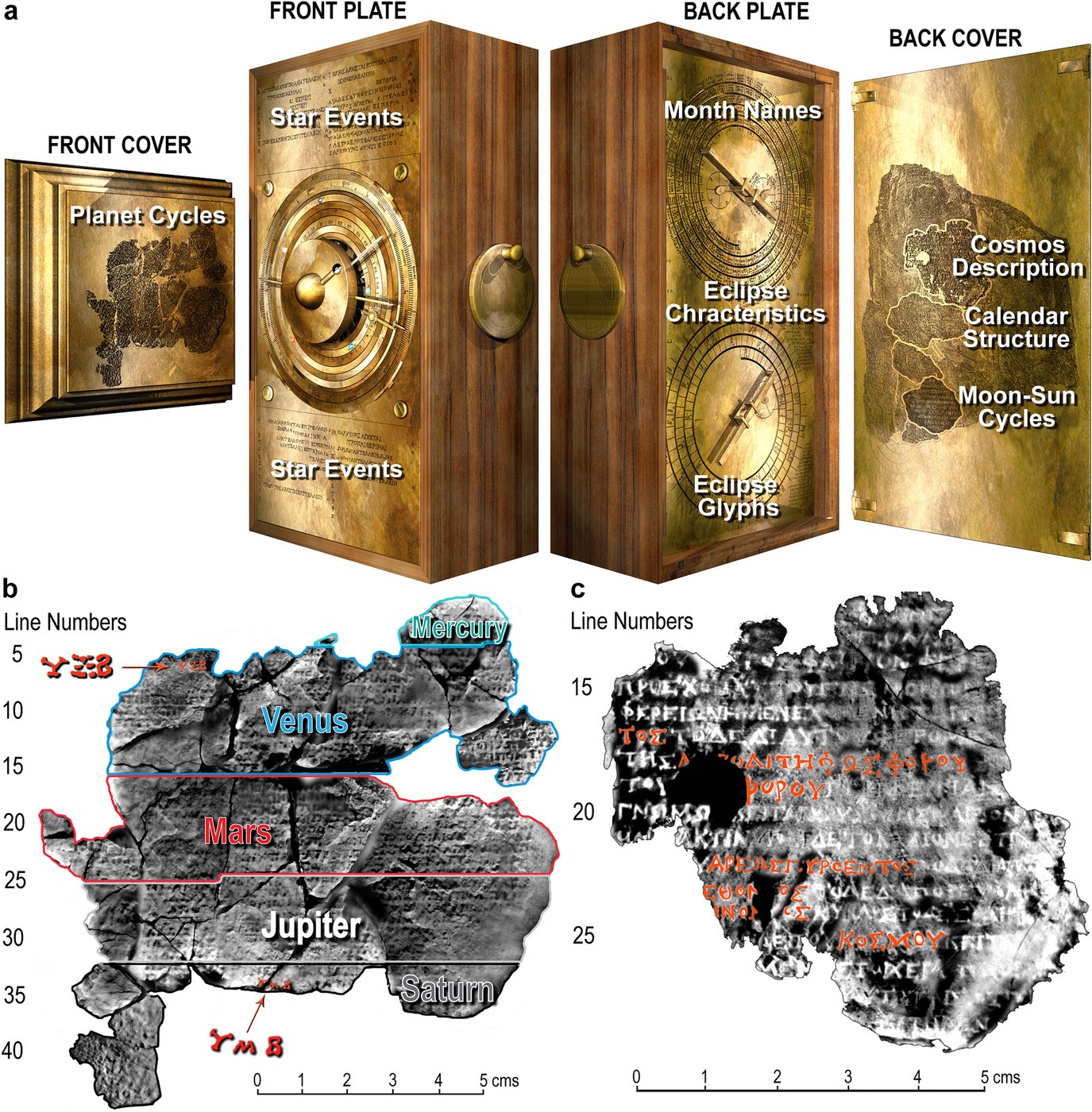
- 2016: The AMRP published the full edition of the inscriptions as a special issue of the journal Almagest (vol. 7, no. 1), based almost entirely on the 2005 CT and PTM data. In it, the back cover inscription emerged as a systematic description of the dials and pointers, including pointers carrying small spheres for the Sun and planets — widely reported as the machine’s “user’s manual” — and the front cover inscription yielded the numbers 462 and 442, synodic periods for Venus and Saturn. Volume 9 reads the inscriptions.
- 2021: The UCL Antikythera Research Team (Freeth, Higgon, Dacanalis, MacDonald, Georgakopoulou and Wojcik) published “A Model of the Cosmos” in Scientific Reports, using the front cover numbers to derive the planetary gear trains. Volume 10 describes it.
4.10 Three Ways of Seeing, Compared
Table 2 — Three Ways of Seeing, Compared
| Technique | Who, when | What it gave | Limits |
|---|---|---|---|
| Plain radiography (X-ray and gamma-ray) | Karakalos for Price, 1971–72 | First view of the internal gears; approximate tooth counts | All layers superimposed; layering inferred |
| Linear tomography and stereo radiography | Bromley, Wright and Mangou, 1990 onward | One plane at a time; arbors and layers sorted; hidden text detected | Residual blur; planes only; hidden text unreadable |
| Microfocus CT and PTM | AMRP with X-Tek and HP, 2005 | Full 3-D volumes; statistical tooth counts; hidden text read; faint surface text enhanced | Resolution limited by the fragments’ size and density; what is lost cannot be imaged |
The last limit is the one that matters most for the rest of the series. Imaging has now recovered most of what survives. The open questions — the planetary display, the exact calendar ring, the date and place of manufacture — concern parts of the mechanism that are not in the fragments at all. They are argued from what survives, as the following volumes show.
Next — Volume 5: The Sky in Numbers — Babylonian Cycles and Greek Geometry. Before a single gear can be understood, the sky it models has to be: why 235 months make 19 years, why eclipses come back after 223 months, what separates a sidereal month from a synodic, anomalistic or draconitic one, and how Babylonian arithmetic and Greek circles-on-circles came together in Hipparchos’s theory of the Moon.
Comments (0)