Antikythera · Volume 7
Antikythera — Volume 7 — The Front Face — Zodiac, Calendar, Sun and Moon
Two concentric rings, a star calendar above and below, a Sun pointer, a Moon pointer carrying a half-silvered ball, and a pin in a slot 1.1 millimetres off-centre: what the user saw on the front, and how much of it is known
7.1 About This Volume
The front of the Antikythera mechanism was its public face: a large circular dial on which pointers showed the Sun and the Moon moving through the zodiac, the date in a calendar, and the phase of the Moon, with a star calendar — a parapegma — inscribed above and below. This volume describes that face as far as the fragments and the CT allow: the two scale rings and what is written on them; the long argument, sharpened since 2020, about whether the outer ring counted the 365 days of the Egyptian year or the 354 days of twelve lunar months; the parapegma; the Sun and Moon pointers and the little rotating ball that showed the phase; and, in detail, the pin-and-slot device that makes the Moon pointer speed up and slow down.
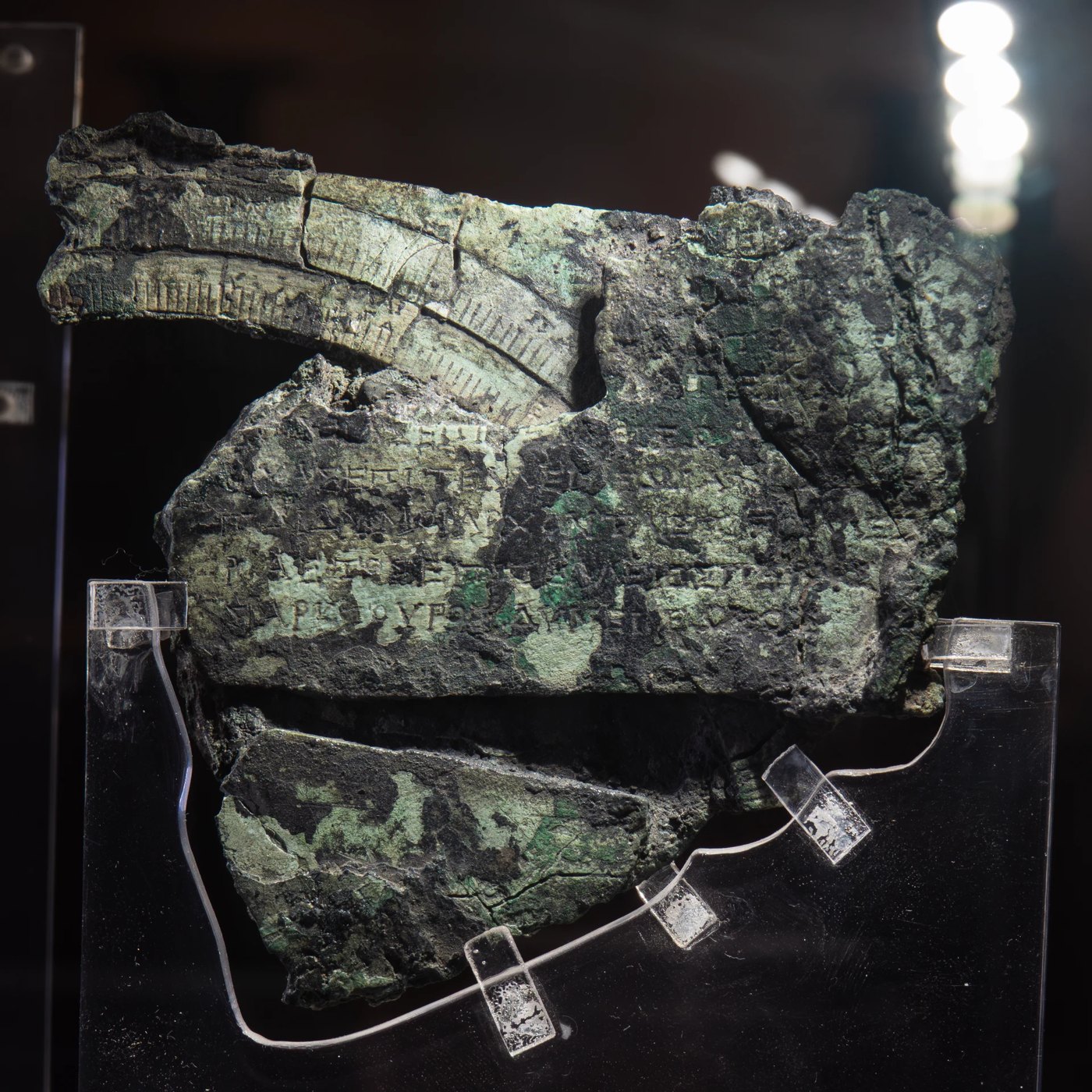
Most of the front is lost. What survives is concentrated in fragment C, which preserves part of both scale rings, some parapegma text and the Moon-phase assembly, and in fragment A, which holds the main wheel and the axes that once carried the pointers. Five planet pointers or rings were almost certainly displayed here too; their gearing has vanished, and they belong to Volume 10. The reconstruction followed is the one in T. Freeth et al., Nature 444 (2006) 587–591 (N06, doi:10.1038/nature05357), and T. Freeth and A. Jones, “The Cosmos in the Antikythera Mechanism”, ISAW Papers 4 (2012) (FJ12, online), with the hole-count studies of 2020 and 2024 set beside it.
7.2 The Layout
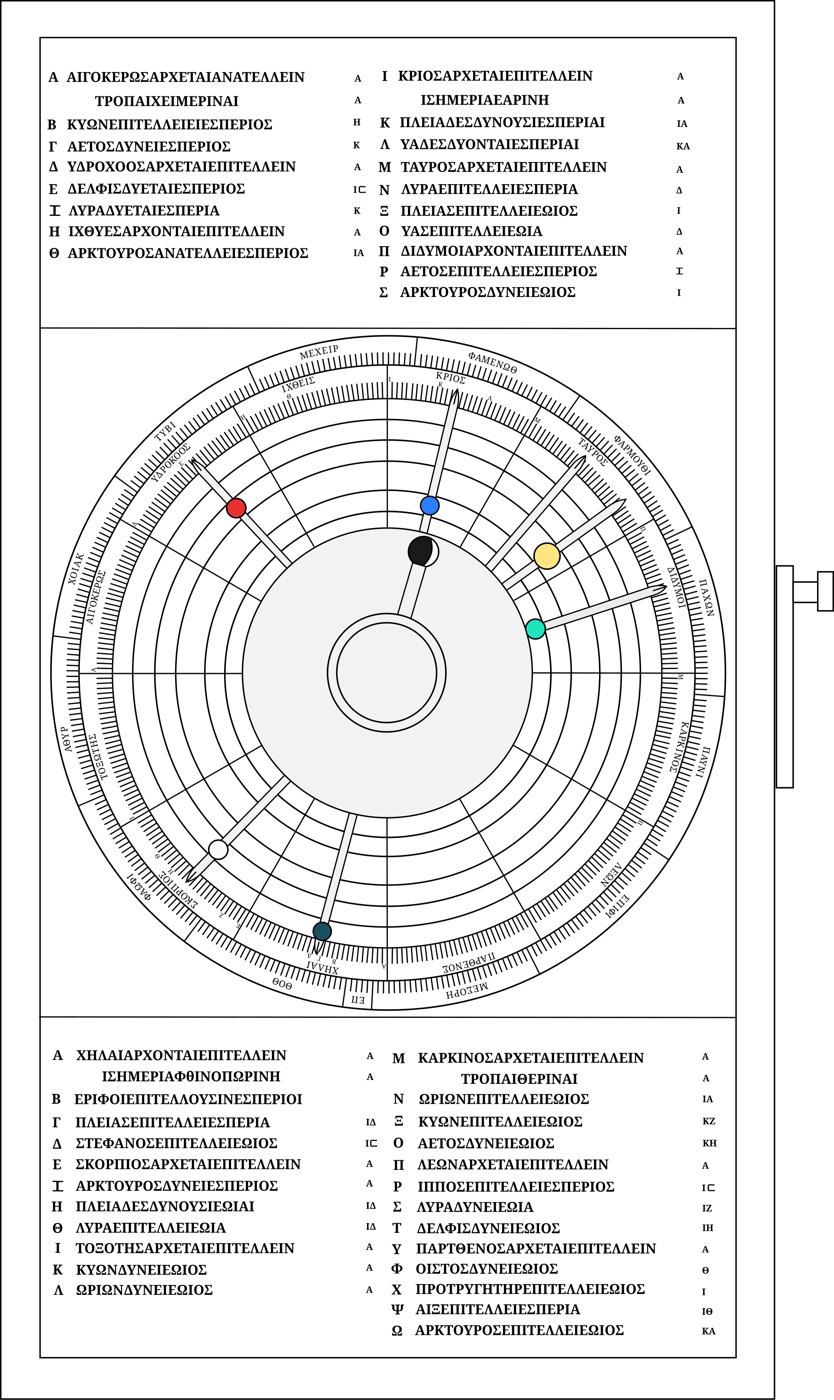
The front plate was divided into three zones. In the middle was the dial, two concentric scale rings with pointers turning about a common centre. Above and below it were plates covered with the parapegma inscription. On the right-hand side was the input for the crank (Volume 6). FJ12 summarises it: “A central dial system displayed outputs from the Mechanism on a Zodiac Dial, marked with 360º scale divisions and a Calendar Dial, marked with 365 days. The Calendar Dial was designed to be moveable … Above and below the dials, were plates covered in inscriptions in the form of a Parapegma (star calendar).“
7.3 The Zodiac Ring
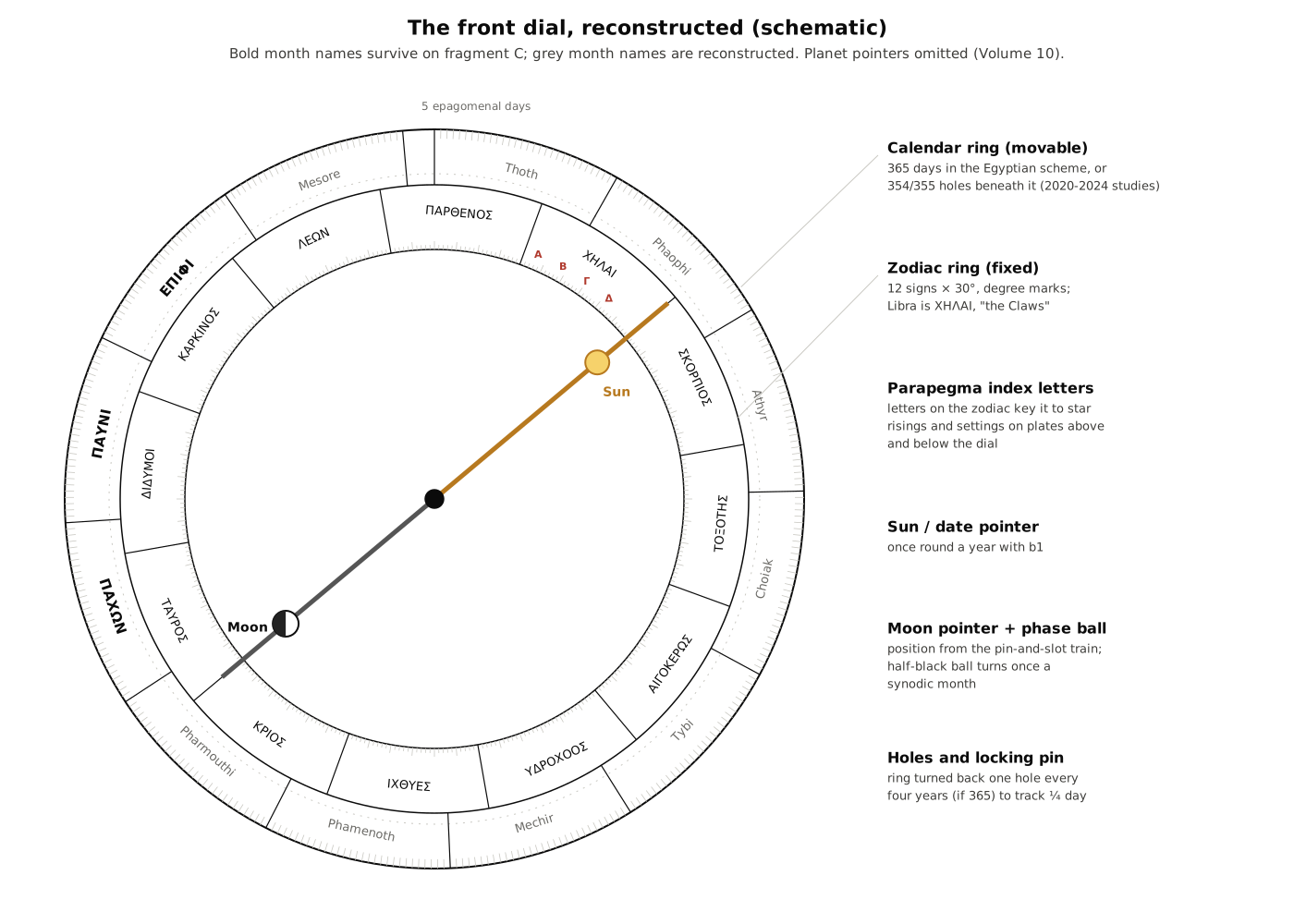
The inner ring is fixed to the front plate. It carries the twelve signs of the zodiac in Greek, each occupying 30°, and is divided into 360 degrees. N06 describes it as “the Greek zodiac with 360 divisions”. The names are those of Greek astronomy: ΚΡΙΟΣ (the Ram, Aries), ΤΑΥΡΟΣ, ΔΙΔΥΜΟΙ, ΚΑΡΚΙΝΟΣ, ΛΕΩΝ, ΠΑΡΘΕΝΟΣ, then ΧΗΛΑΙ, “the Claws” — the Scorpion’s claws, the older Greek name for the sign later called Libra, the Balance — ΣΚΟΡΠΙΟΣ, ΤΟΞΟΤΗΣ, ΑΙΓΟΚΕΡΩΣ, ΥΔΡΟΧΟΟΣ and ΙΧΘΥΕΣ (Wikipedia, “Antikythera mechanism”).
The signs here are not the constellations, which are unequal in size, but the twelve equal 30° divisions of the ecliptic used for calculation, a Babylonian convention adopted by the Greeks. A pointer over the zodiac ring therefore shows a body’s ecliptic longitude: the Sun’s at a given date, the Moon’s at a given moment, and, if the lost planetary display was there, the planets’.
7.3.1 Uniform or not?
A careful study by James Evans, Christián Carman and Alan Thorndike in 2010 found that the graduation of the surviving front rings is slightly non-uniform, and proposed that the zodiac had been divided unevenly on purpose: if the degrees were crowded in one part of the ring and spread in another, a pointer turning uniformly once a year would show both the date and the true (unevenly moving) Sun at once. FJ12 discusses the proposal at length and does not accept it, noting that “the division of circles into ostensibly equal arcs elsewhere in the Mechanism is sometimes evidently nonuniform, for example in the spacing of teeth on gears, the holes for mounting the Egyptian calendar dial, and the divisions of the Saros eclipse dial” — that is, the unevenness looks like workshop error, not design. Freeth and Jones reconstruct “all the pointers as radiating from the central axis”, with a separate geared true-Sun pointer. The question is open.
7.4 The Calendar Ring
Outside the zodiac, flush with the plate and running in a channel, is a second ring, divided into days and inscribed with month names. Three names survive in fragment C: ΠΑΧΩΝ, ΠΑΥΝΙ and ΕΠΙΦΙ — Pachon, Payni and Epiphi, the ninth, tenth and eleventh months of the Egyptian civil calendar, in Greek letters (Wikipedia, after A. Jones, A Portable Cosmos, 2017, p. 97). The Egyptian calendar, which Greek astronomers used for calculation because it was perfectly regular, had twelve months of 30 days and five extra (epagomenal) days at the end of the year, 365 days in all, with no leap day. N06 describes it as “the Egyptian calendar of 365 days, with twelve 30-day months and 5 extra (epagomenai) days”.
Because the real year is about a quarter of a day longer, a 365-day calendar slips against the seasons by one day every four years, and through a full zodiac sign in about 120 years. The ring was made movable to deal with that. Under it, in the channel, is a row of small holes, and a pin on the underside of the ring could engage any one of them to lock it in place. To keep the calendar aligned with the Sun, the user would lift the ring and move it back by one hole every four years. N08 points out that the four-year games dial on the back (Volume 8) would have told the user when (N08, Suppl. 3.5).
That reading assumes one hole per day — 365 holes. It is the assumption that has been challenged.
7.5 How Many Holes? 365 or 354
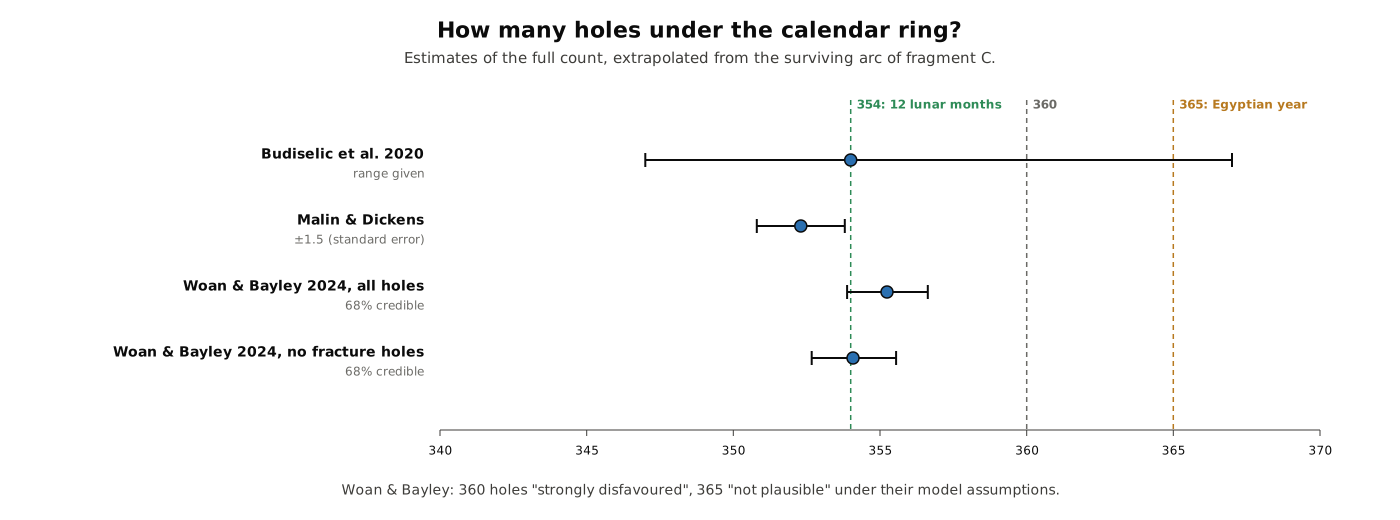
Only an arc of the ring and its holes survives, in fragment C, so the full count must be extrapolated from the spacing of the surviving holes. In 2006 the AMRP did this and found “spacing of the holes is indeed what would be expected for a total of 365 days, with a possible range 363–365” (N06, Fig. 2).
In 2020 Chris Budiselic — the clockmaker who makes the Clickspring videos — with Aaron Thoeni, Michael Dubno and Andrew Ramsey measured the surviving holes in the AMRP’s CT data, modelled the ring’s original centre and the displacement of its broken pieces, and concluded that the holes divide the circle into about 354 parts, with an estimated range of 347 to 367 (“The Antikythera Mechanism: Evidence of a Lunar Calendar”, British Horological Institute, 2020). Three hundred and fifty-four days is the length of twelve lunar months (12 × 29.53 = 354.4). An independent estimate by Malin and Dickens gave 352.3 ± 1.5, with “less than a 5% probability that N is not one of the six values in the range 350 to 355” and the chance of 365 “less than 1 in 10,000” (Wikipedia, citing Malin and Dickens).
In 2024 Graham Woan and Joseph Bayley, of the University of Glasgow’s gravitational-wave group, re-analysed Budiselic’s hole positions with Bayesian methods of the kind used on LIGO data. Their 68% credible estimate, using all the data, is 355.24 (+1.39/−1.36) holes; leaving out holes next to fractures, 354.08 (+1.47/−1.41). In their words, “a ring of 360 holes is strongly disfavoured, and one of 365 holes is not plausible, given our model assumptions” (G. Woan and J. Bayley, “An improved calendar ring hole-count for the Antikythera mechanism”, arXiv:2403.00040, 2024; also Horological Journal, July 2024).
7.5.1 What a 354-hole ring would mean
The statistics are now strongly against 365, but the interpretation is not settled, because the ring carries Egyptian month names, and the Egyptian civil year had 365 days. Several readings are possible:
- A lunar calendar under an Egyptian scale. The holes could serve a 354-day lunar year while the visible scale remained an Egyptian 365-day one, with the ring moved through the holes to track lunar months rather than the quarter-day. On this reading, as summarised on Wikipedia, undiscovered gearing synchronised with the Metonic train would have driven a pointer round the lunar scale.
- An Egyptian-style lunar calendar. Richard Parker proposed in 1950 that Egypt had a civil-based lunar calendar using the same month names; the mechanism might be its first physical example (Wikipedia).
- A lunisolar setting device. Movement of the ring against the holes could have helped with the 1-in-76-year Callippic correction and with intercalation, not only the leap-day correction.
What none of the hole-count studies can do is say what the scale above the holes was divided into, since that is a separate question of the inscribed day marks. The practical consequence is that the front dial of a replica built before 2020 — and of most replicas since — shows a 365-day ring that may not be what the maker built. Replicas are the subject of Volume 13.
7.6 The Parapegma
A parapegma is a star calendar: a list of the dates in the year when particular stars or constellations first become visible at dawn, or last set after sunset, often with weather signs attached. Greek parapegmata were originally stone slabs with holes for a peg moved daily; the mechanism’s version is inscribed on the plates above and below the dial, with each entry headed by a letter. The same letters appear on the zodiac ring at the points where the events fall, so a user could see, as the Sun pointer reached a letter, which event the parapegma predicted for that day. N06 noted three further reference letters beyond Price’s and described the form as “consistent with a date of late second century BC”.
Among the entries that survive or are confidently restored (Wikipedia, after Bitsakis and Jones):
- Α — ΑΙΓΟΚΕΡΩΣ ΑΡΧΕΤΑΙ ΑΝΑΤΕΛΛΕΙΝ, “Capricorn begins to rise”, and the winter solstice;
- Ι — ΚΡΙΟΣ ΑΡΧΕΤΑΙ ΕΠΙΤΕΛΛΕΙΝ, “Aries begins to rise”, and the spring equinox;
- Λ — ΥΑΔΕΣ ΔΥΝΟΥΣΙΝ ΕΣΠΕΡΙΑΙ, “the Hyades set in the evening”;
- Ξ — ΠΛΕΙΑΣ ΕΠΙΤΕΛΛΕΙ ΕΩΙΑ, “the Pleiades rise in the morning”;
- Σ — ΑΡΚΤΟΥΡΟΣ ΔΥΝΕΙ ΕΩΙΟΣ, “Arcturus sets in the morning”;
- and on the lower plate, Α — ΧΗΛΑΙ ΑΡΧΟΝΤΑ[Ι] ΕΠΙΤΕΛΛΕΙΝ, “the Claws begin to rise”, with the autumn equinox.
The dates on which stars first appear at dawn depend on latitude. Magdalini Anastasiou and colleagues found that the parapegma’s events fit latitudes between about 33.3° and 37.0° north, a band that includes Rhodes (about 35.9–36.5° N) (Wikipedia, citing Anastasiou et al., Journal for the History of Astronomy 44 (2013)). The band is broad. Corinth (about 37.9° N) and Syracuse (about 37.1° N) lie just north of it, which has been counted in favour of Rhodes, but a method based on the visibility of stars at dawn cannot fix a latitude to a fraction of a degree. Volume 11 sets this evidence beside the calendar and the games dial in the argument over where the machine was made.
7.7 The Sun and the Date
The main wheel b1 turns once a year, and the axis at its centre carries the pointer that shows the date on the calendar ring and the Sun’s mean position on the zodiac ring. N06 was cautious: “It is not clear whether the Sun position pointer would have been separated from a date pointer”. In a 365-day reading the two are the same pointer: the Egyptian date and the mean Sun advance together, one division a day.
The real Sun does not move at a steady pace; Hipparchus knew the seasons were unequal and modelled the Sun with an eccentre (Volume 5). Because the designer took such care over the Moon’s anomaly, most reconstructors think there was also a “true Sun” pointer driven through an epicyclic gear on b1 — a mechanism much simpler than the lunar one. N08 calls the solar mechanism “much easier to include mechanically than the Moon’s first anomaly”, and FJ12 reconstructs one on b1 with a fixed gear, an epicyclic gear and a pin-and-slotted follower. None of it survives, though the fittings on b1’s spokes show that something was mounted there.
7.8 The Moon Pointer
The Moon pointer is carried on a central arbor that comes all the way from the back of the mechanism, from b3 (Volume 6). It turns once per sidereal month on average, showing the Moon’s position in the zodiac. Because the motion has passed through the pin-and-slot on the k gears, the pointer does not move uniformly: it runs ahead of the mean Moon for half an anomalistic month and behind it for the other half, by up to about 6.5°.
7.8.1 The pin-and-slot in detail
The two gears k1 and k2 have 50 teeth each and sit face to face. They do not mesh with each other. k1 is driven by e5 and turns steadily. On k1’s face is a short pin, about 9.6 mm from its centre. In k2 is a radial slot, and the pin sits in it. k2 turns on an arbor whose axis is about 1.1 mm from k1’s (N06, Fig. 6); the CT shows a stepped arbor that makes this offset possible.
Because the axes differ, the pin is sometimes nearer to k2’s centre and sometimes farther. When it is nearer, a given angle of k1 swings k2 through a larger angle; when farther, a smaller one. Over a complete turn the two gears come out even, but within the turn k2 leads, then lags. The maximum difference is the angle whose sine is offset over pin radius: arcsin(1.1/9.6) ≈ 6.6°. N06 quotes “an angular variation of 6.5°”.
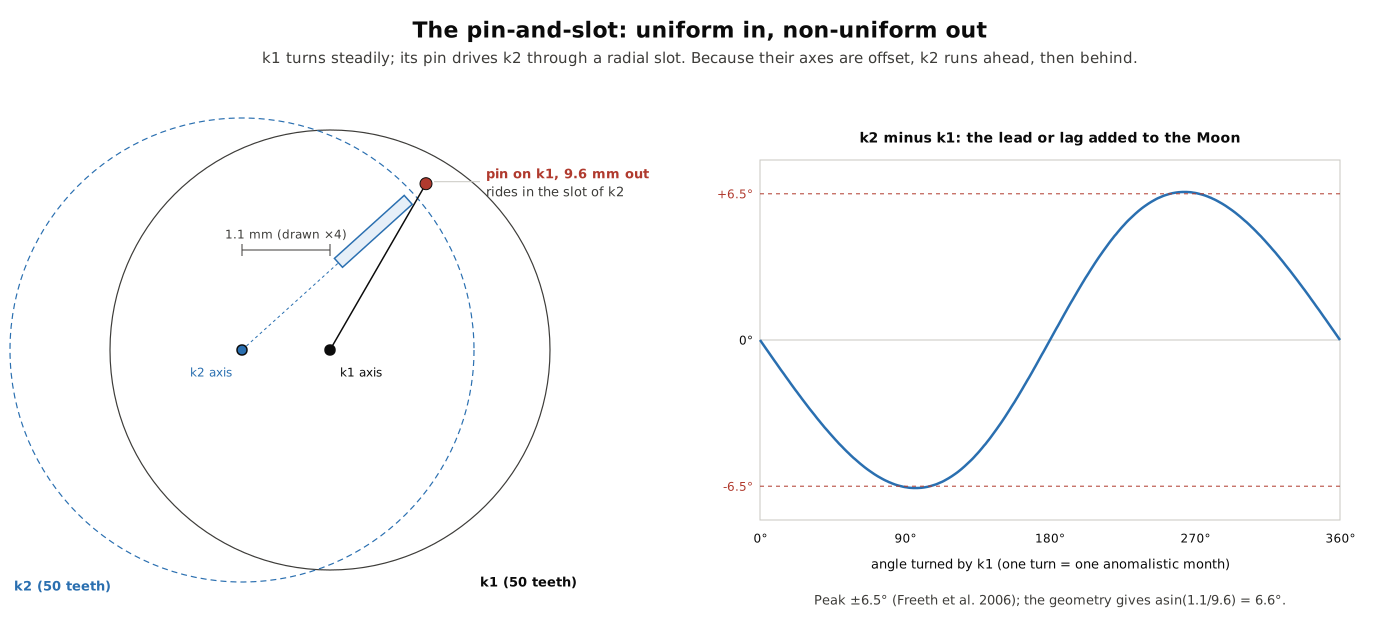
The variation is, for small offsets, very nearly sinusoidal — exactly the shape of the “equation of centre” that an epicycle or eccentre produces. That is no coincidence. The pin-and-slot is the eccentre model of Volume 5 built in metal. k2’s axis is the Earth; k1’s axis is the centre of the Moon’s eccentric circle; the pin is the Moon, moving uniformly about k1’s axis; and the slot measures the angle at which it is seen from k2’s axis. Apollonius’s theorem that eccentre and epicycle are equivalent guarantees that the same device models Hipparchus’s epicycle too. FJ12 calls it “the most remarkable part of the surviving gearing” and remarks that “it is difficult to understand how this superbly economical mechanical design was conceived. It is by no means the obvious way of modelling the deferent and epicycle theory of lunar motion.”
How large should the effect be? Hipparchus, by Ptolemy’s report, derived two values for the size of the lunar epicycle from two sets of eclipses, which correspond to maximum variations of about 4.5° and 5.9° at this point in the mechanism; N06 found 6.5° and judged the difference “probably not significant given the difficulty of precise measurement of the axes in the CT”, noting that Babylonian estimates of the anomaly “were generally larger”. The modern equation of centre is about 6.3°.
7.8.2 Riding on e3: the 8.88-year precession
On a fixed frame the lead-and-lag would repeat once per turn of k1, that is, once per sidereal month. But the Moon’s speed cycle repeats over the anomalistic month, because the perigee itself moves forward round the sky. The k gears are therefore mounted on a bridge fixed to e3, the 223-tooth wheel that turns once in 4,237/477 = 8.88 years — the mechanism’s period for the rotation of the Moon’s line of apsides (Volume 6). As e3 carries the pair round, the point of maximum speed advances with it, and the variation repeats once per anomalistic month, 27.554 days in the mechanism’s arithmetic.
The modern apsidal period is about 8.85 years, so the mechanism’s slow rotation is good to about a third of a percent. In the eccentre picture, the turning of e3 is the turning of the line from Earth to the eccentre’s centre: the apogee moving round the zodiac. N06 calls the mounting “the remarkable purpose” of the design: it converts a sidereal-month variation into an anomalistic-month one, exactly as Hipparchus’s model requires.
7.8.3 What the user would see
In practice the Moon pointer would hardly look irregular. A difference of a few degrees, spread over two weeks, is not visible as a jerk; it shows as a Moon pointer that, a week after a new Moon, is a little ahead of or behind where steady motion would have put it. What the anomaly changes, importantly, is the timing of syzygies: the moment the Moon pointer lines up with the Sun pointer, or opposes it, can shift by many hours. For an instrument concerned with eclipses, getting that moment right is the point.
7.9 The Moon’s Phase
Fragment C contains a small round housing in which sits a ball, half pale and half dark. Michael Wright showed that it was a phase display: the ball, carried in the Moon pointer, rotated once per synodic month, so that a viewer saw it go from dark (new Moon) through half-and-half (quarter) to pale (full) and back (M. T. Wright, “The Antikythera Mechanism and the early history of the moon-phase display”, Antiquarian Horology 29 (2006) 319–329, cited as ref. 7 in N06). N08 describes “a semi-silvered ball to display the phase of the Moon … calculated from the differential rotations of the Sun and Moon”. Fragment C also contains a small bevel or contrate gear from the assembly (Wikipedia).
The drive is a small differential. A gear fixed to the Sun’s tube — or to a true-Sun output, if there was one — meshes with a pinion carried on the Moon pointer. As long as the Moon and Sun pointers turn together, the pinion does not turn; as the Moon pointer gains on the Sun, the pinion rolls round the Sun’s gear, and through a short arbor along the pointer it turns the ball. The ball’s rate is therefore the Moon’s rate minus the Sun’s: 254/19 − 1 = 235/19 turns a year, one turn every 29.531 days, the synodic month. Since the Moon pointer already includes the anomaly, the ball shows the true phase, not the mean.
N08 adds a speculative refinement: a scale of days might have been attached to the Moon pointer or its cylindrical housing, so that the Sun pointer read off the age of the Moon in days — useful for a calendar whose months had “excluded” days (Volume 8). “We have not as yet found any evidence for this in the CT, possibly because the cylinder is covered in corrosion.”
7.10 What Else Was on the Front
The front dial almost certainly showed more. The back-cover inscription names the planets and orders them, and the front-cover inscription gives planetary periods; FJ12 and the 2021 UCL model place the five planets on the front, as pointers or as concentric rings. The 2021 model also adds a hypothetical “Dragon Hand” to show the lunar nodes. These are reconstructions on strong but indirect evidence, and Volume 10 treats them together.
What is certain is that the front face, as it survives, already combines three kinds of time: the Egyptian civil date (or a lunar count) on the outer ring; the seasonal sky of the parapegma; and the astronomical positions of the Sun and Moon on the zodiac. A user turning the crank to a date saw all three move together. The back of the box, the subject of the next volume, added a fourth kind: the civic calendar of a Greek city, its festivals, and its eclipses.
Next — Volume 8: The Back Face — Spirals for Calendars, Games and Eclipses. A five-turn spiral of 235 Corinthian months, read by a pointer whose follower rides the groove like a gramophone needle; the four-year dial of the Isthmian, Olympic, Nemean and Pythian games, plus the Naa of Dodona and the Halieia of Rhodes; and the four-turn Saros spiral with its glyphs for lunar and solar eclipses, hours, and index letters — and how an ancient user would have read one.
Comments (0)