Antikythera · Volume 14
Antikythera — Volume 14 — The Open Antikythera — S&T GeoTronics' Kit
Clear acrylic, laser-cut acetal and hand-turned brass: the third Kickstarter from the makers of the Open Enigma and the Open DSKY, what it shows, how it was made, and which reconstruction it resembles
14.1 About This Volume
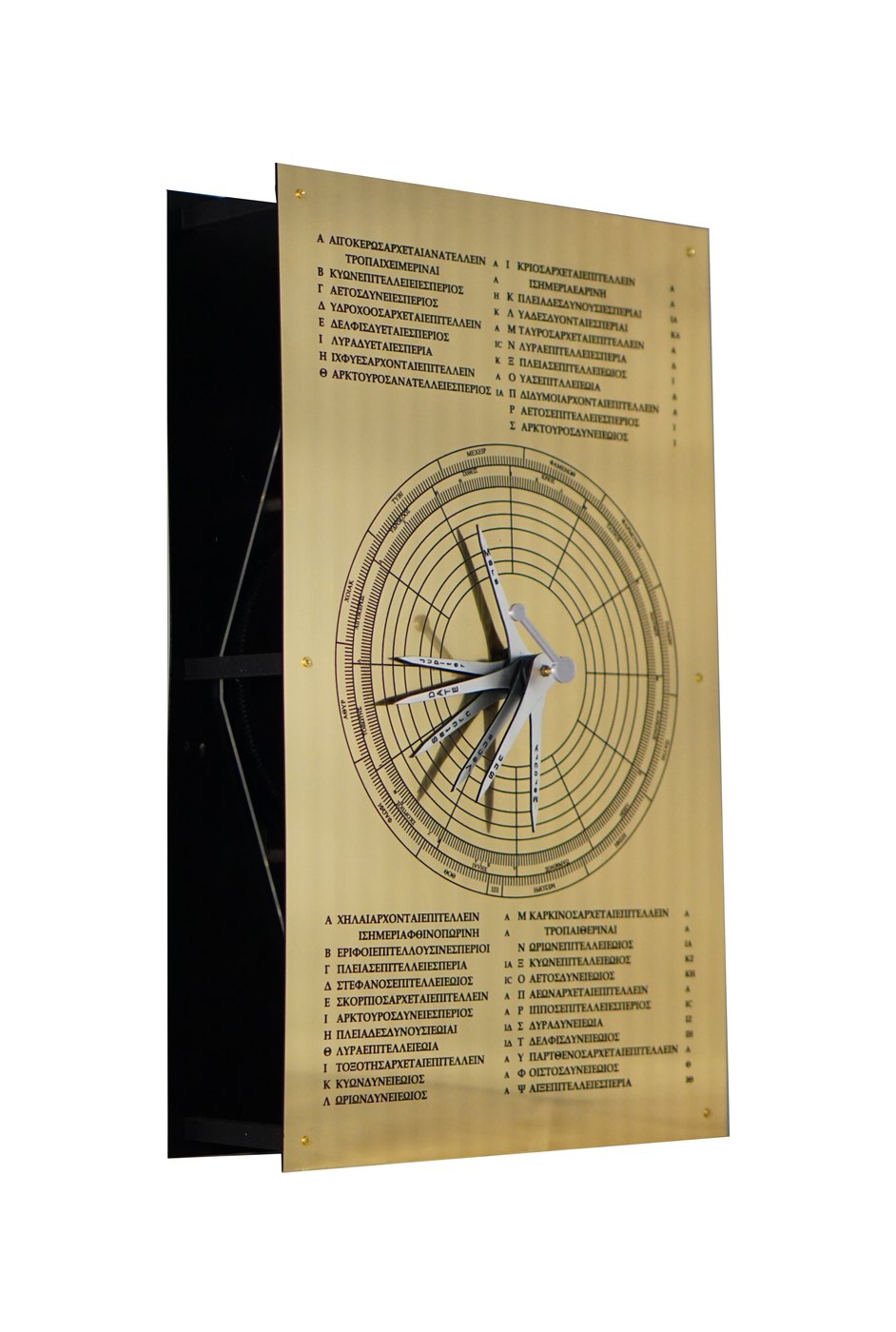
Volume 13 surveyed a century of replicas, from Price’s brass box to printable plastic. This volume looks closely at one of them: the Open Antikythera, a hand-cranked replica sold as laser-cut parts, as a complete kit, or assembled, by the small American company S&T GeoTronics. It is the same company, and the same two founders, behind the Open Enigma (the subject of the Enigma unit’s Volume 15) and the Open DSKY (DSKY unit, Volume 18), so it is the third S&T machine in this collection.
The volume covers the company and the 2023 Kickstarter; the two editions, FullMonty and UpFront; the materials and the contents of the kit; the production story from campaign to final delivery in 2025, including a gear one millimetre too short and a lathe that did not arrive; the metal versions in preparation; and the replica S&T gave to the island of Antikythera. It then asks the question S&T itself does not answer: which scholarly reconstruction does the Open Antikythera follow? Volume 15 turns from the kit to one finished example and to how to read it.
Sources are S&T’s own website and shop pages, its Kickstarter and BackerKit project updates (cited by date), and press coverage. Where they disagree, both figures are given.
14.2 The Company
S&T GeoTronics LLC is Marc Tessier (the “T”) and James Sanderson (the “S”). Its Kickstarter projects list it in Columbus, Georgia (Kicktraq project record); some press reports say only “Columbus.” In January 2025 the founders described the business as “a 2 guy operation, operating part time” (BackerKit update, 29 Jan 2025). Sanderson designed every component of the Antikythera in Corel CAD (update, 9 Oct 2024); Tessier signs most of the campaign updates. The company’s site still carries the slogans “Electronic design is what we do” and “Arduino at the heart of our projects,” which describe the Enigma and the DSKY. The Open Antikythera has no electronics: it is a purely mechanical, hand-cranked machine.
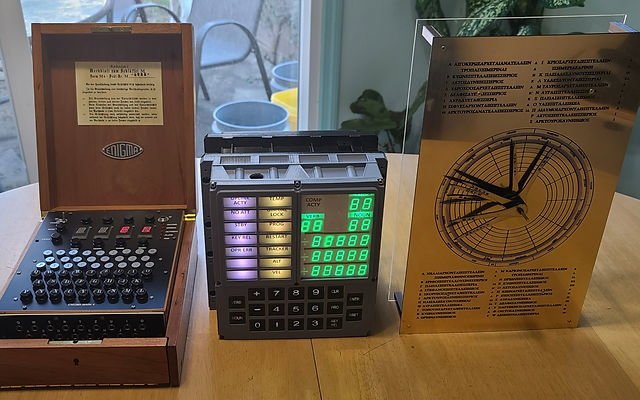
The Open Antikythera was S&T’s third Kickstarter, after the Open Enigma (2014) and the Open DSKY (2018) (i-programmer, 6 August 2023). The first two had shipped on schedule, a point the founders made in June 2024 when the third began to slip.
14.3 The Kickstarter (2023)
The “Open Antikythera Project” ran on Kickstarter from 28 July to 31 August 2023 (34 days) with a goal of $20,000 and a stretch target of $80,000. It reached its goal in six days (update, 9 Aug 2023), and on 9 September Tessier called it “triple fully funded.”
The final figure depends on which tally is used:
Table 1 — The final figure depends on which tally is used
| Source | Amount | Backers | Note |
|---|---|---|---|
| Kicktraq (Kickstarter campaign only) | $68,510 | 96 | 342% of goal |
| BackerKit project page (as reported by search) | about $80,320 | about 103 | Probably includes post-campaign pre-orders taken through BackerKit; not confirmed directly |
The Kickstarter figure is the campaign result; the BackerKit figure is the larger total once later pre-orders are counted. The founders, who used the crowdfunding marketing agency Jellop, later said they had expected 20–30 backers and got close to 100 (update, 29 Jan 2025).
Campaign pricing, as reported in August 2023, was $1,800 for a fully assembled FullMonty in a wood box and $1,000 for an assembled UpFront, with kit versions below those (i-programmer). Lower tiers offered a keychain and a poster in Walnut, 2Tone Acrylic, Cherry or Mahogany finishes.
14.4 Two Editions: FullMonty and UpFront
S&T sells the replica in two editions. Its own spelling varies between “FullMonty,” “Full Monty” and “Full Mechanism.”
- FullMonty — front and back. The front shows the Sun, the Moon and its phase, and the five planets known in antiquity; the back carries the Metonic and Saros spirals, with needles that follow a spiral groove, eclipse prediction, and the games (“Olympic”) dial (i-programmer; EFTM, 9 January 2025; update, 9 Oct 2024).
- UpFront — the front panel only. S&T calls it “a truncated version,” and says the FullMonty is about 2.5 times as complex (update, 30 Jul 2024).
S&T’s marketing page sums up the FullMonty in three lines: “7 needles indicate position of planets,” “52 interconnected gears,” and “laser-engraved front and back plates,” under the heading “Original Greek writing” (S&T GeoTronics, Open Antikythera).
The gear count does not agree with S&T’s own kit list. The FullMonty Complete Kit page lists 34 common laser-cut gears plus 28 FullMonty laser-cut gears — 62 — and the November 2024 update says the 100 W laser “cut the 62 gears needed for each FullMonty kit.” The difference may be that the kit count includes the separate halves of compound (“double”) gears and other toothed parts that the marketing figure counts once, but S&T does not explain it. Both numbers come from S&T; 62 is the count of laser-cut gear parts in the box.
14.4.1 Prices in October 2026
The shop page in October 2026 lists every version as a pre-order, except the UpFront kit, which is marked as live on BackerKit:
Table 2 — The shop page in October 2026 lists every version as a pre-order, except the UpFront kit, which is marked as live on BackerKit
| Product | Price (USD) |
|---|---|
| FullMonty Complete with Wood | 2,500 |
| FullMonty Assembled/Tested | 2,000 |
| FullMonty Complete Kit | 1,100 |
| FullMonty Lasercut Parts | 400 |
| UpFront Complete | 1,400 |
| UpFront Assembled/Tested | 1,100 |
| UpFront Kit | 700 |
| UpFront Lasercut | 200 |
| Wall Plaque (both plaques) | 50 |
14.5 Materials
The production units are made of four main materials (updates Apr 2024 – Nov 2025; product pages):
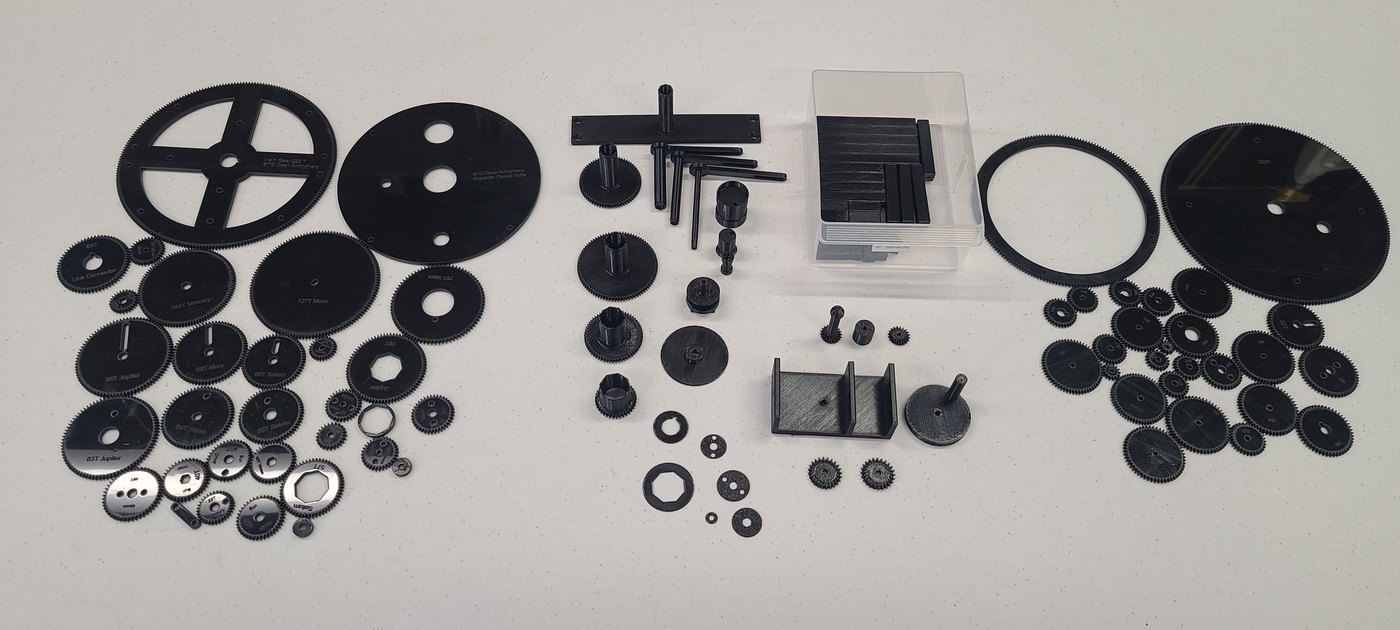
- Gears: laser-cut acetal (Delrin), the engineering plastic used for small gears in instruments and appliances. S&T’s final update calls the production machines “Delrin units.”
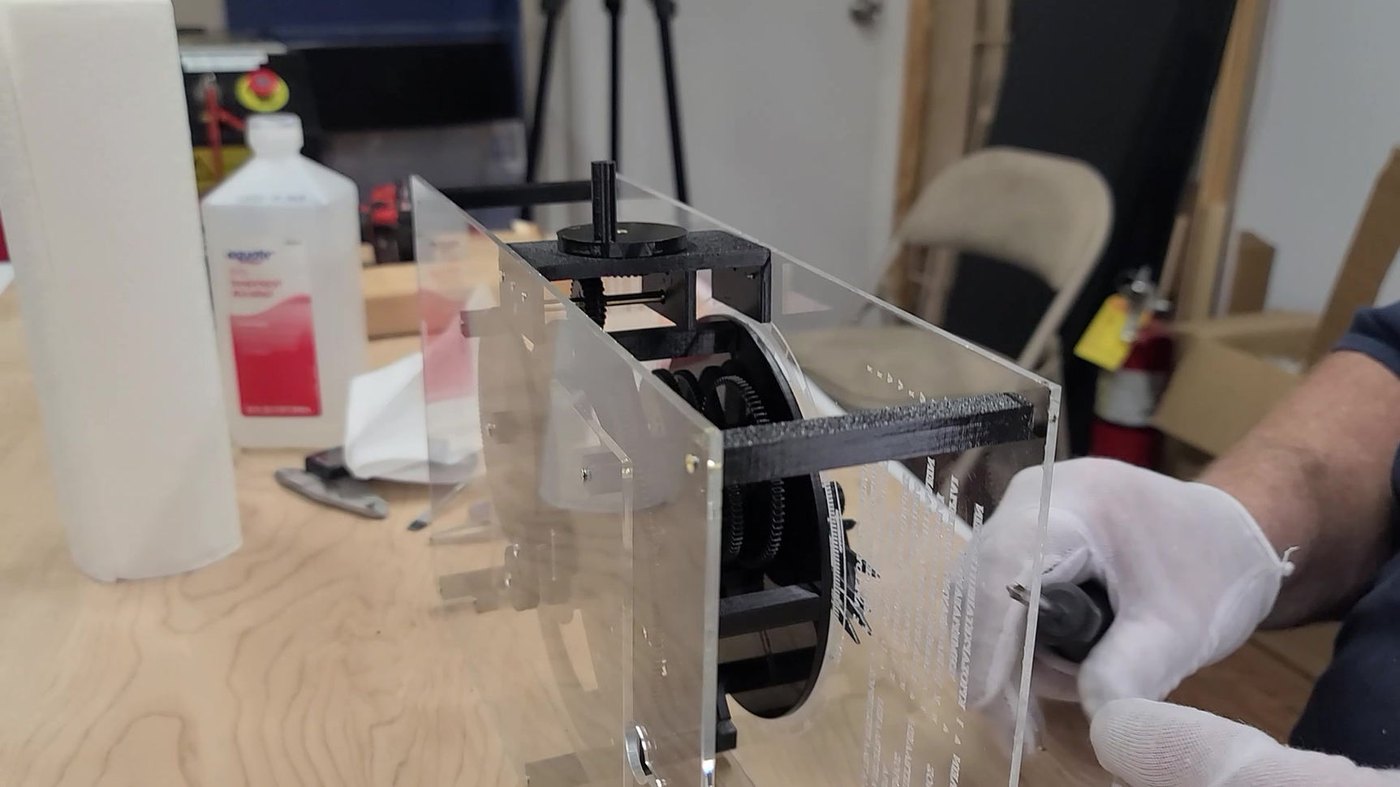
- Plates: clear acrylic front, back and mechanical (middle) plates, laser-cut and engraved. The front and back panels each take more than two hours on the laser (update, 15 Nov 2024).
- Axles, rods and dowels: brass, turned by hand on a manual mini lathe.
- Bearings: miniature flange ball bearings — MF52ZZ (2 × 5 × 2.3 mm) and F683ZZ (3 × 7 × 3 mm).
Around these sit 3D-printed standoffs, needles and brackets; optional 3/8-inch wood sides that make a case; and an optional cosmetic “skin” that gives the clear acrylic a golden look. The skin slides under the needles and the sides flex under the wooden edges to hold it; S&T warns that it can be harder to remove than to fit, and recommends installing it only if the golden look is wanted (update, 31 May 2025). Clear-sided versions, without the skin, were made from autumn 2024 and could be requested to show off the gearing (update, 9 Oct 2024).
The choice of clear acrylic turns the replica into something the original never was: a machine whose gear train is visible from every side. The original was enclosed in a wooden case with bronze plates (Volume 11). The acrylic version is a teaching object, and the golden skin is the option for those who want it to look more like the museum replicas of Volume 13.
14.6 What Is in the FullMonty Kit
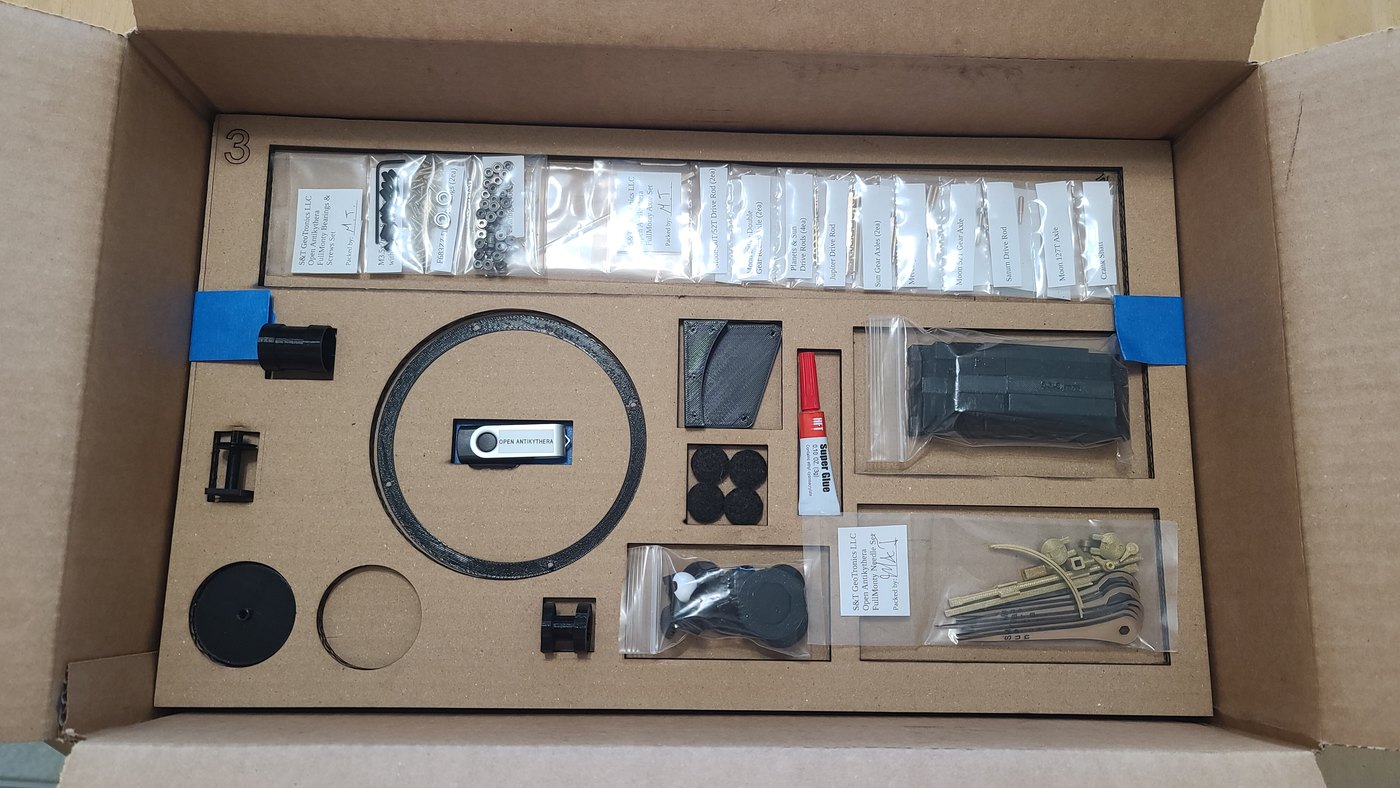
The FullMonty Complete Kit ($1,100) is described as “the kit for building the best complete fine plastic unit, with no wood,” with “over 300” parts packed in seven numbered trays (product page):
Table 3 — The FullMonty Complete Kit ($1,100) is described as "the kit for building the best complete fine plastic unit, with no wood," with "over 300" parts packed in seven numbered trays ([product page](https://www.stgeotronics.com/product-page/antikythera-front-back-full-kit))
| Item | Quantity |
|---|---|
| FullMonty 3D-printed items | 83 |
| Back 3D-printed needles | 11 |
| Front laser-cut needles | 7 |
| Common laser-cut gears | 34 |
| FullMonty laser-cut gears | 28 |
| Laser-cut panels and skin | 5 |
| Brass axles, rods and dowels | 34 |
| MF52ZZ flange bearings (2 × 5 × 2.3 mm) | 40 |
| F683ZZ flange bearings (3 × 7 × 3 mm) | 2 |
| #2 × 3/8 in screws (standoffs) | 50 |
| #2 × 1/2 in screws (beauty plates) | 7 |
| M3.5 × 7 mm (#6-40) set screws + 1/16 in Allen key | 12 |
| Cotton gloves | 2 |
| Super glue | 1 |
| Keychain | 1 |
| USB flash drive with bill of materials | 1 |
| Sides, screws and felt pads (if ordered) | 4 sides, 18 screws, 4 pads |
The bearing count differs again by source: 42 on the product list, 44 in the December 2024 update (“each Production kit uses 44 bearings and over 300 components”).
14.6.1 Documentation
The USB drive carries a ReadMeFirst file, a demonstration video with transcript, the bill of materials, reference material, schematics and photographs (updates, 29 Jan and 26 Feb 2025). Assembly videos are on S&T’s YouTube channel, with an alternative playlist; an Instructables guide was announced but was not finished when kits shipped, and was not found online for this series. In December 2023 S&T released the UpFront STL files, PDFs and the brass axle specification, and promised the FullMonty files later; its file-share page lists downloads. In 2025 James designed seven printable jigs for assembling the back-needle shafts and released the STL files free (update, 23 Mar 2025).
There is no user’s manual for operating the finished machine. In May 2025 S&T pointed to the precedents of its earlier kits — the Open Enigma for Dummies manual written by the backer B. J. Gleason and the Open DSKY command reference by Bill Walker — and invited backers to write one for the Antikythera. Volume 15 offers a reader’s guide in that spirit.
14.6.2 Build effort
By S&T’s figures, each unit takes about 10 hours of 3D printing and 10 hours of laser cutting and engraving to make (update, 23 Mar 2025). The unit built on camera took about 5 hours to assemble; home builders were told to expect several evenings. Every build, UpFront or FullMonty, starts with the rotating assembly (update, 26 Feb 2025).
A Danish backer who finished his FullMonty kit in May 2025 shared tips that S&T passed on: add extra spacers in the gear train to ease running, sand off the edges raised by the laser, ream the axle holes and dials, and tap threads for the grub screws. He left the golden skin off to keep the sides clear (update, 17 May 2025).
14.7 From Campaign to Delivery (2023–2025)
The production story is told in more than two years of updates, and it is a case study in how a small workshop scales from prototypes to a hundred machines.
Table 4 — From Campaign to Delivery (2023–2025)
| Date | Event |
|---|---|
| 28 Jul – 31 Aug 2023 | Kickstarter; goal reached in six days |
| Dec 2023 – Jan 2024 | UpFront STLs released; keychain and poster rewards all shipped by 26 Jan 2024 |
| Jan 2024 | More than 3,200 gears being laser-cut and 2,400 brass parts being turned |
| 7 Apr 2024 | A gear found to be 1 mm short just before shipping; the fix grows to nine parts, including a redesigned acrylic midplate, a longer brass axle and a new anti-wobble “moon” double-gear stabiliser |
| 12 Apr 2024 | All UpFront kits shipped |
| 29 Apr 2024 | Assembled UpFront units ship, on schedule; FullMonty slips |
| Jun–Jul 2024 | FullMonty redesigns: supports for the double-gear axles, larger bearings for the back-spiral pointer axle |
| 30 Jul 2024 | The CNC lathe backed on Kickstarter (from Rownd) has not arrived; every axle, rod and dowel is still turned by hand. The part estimate rises from 1,346 to 1,926; set screws are tested to replace 744 double-gear dowels |
| Sep 2024 | A Wazer Pro desktop waterjet installed, used for the Metonic and Saros back needles; a 1.0 mm spacer added between every gear |
| Oct 2024 | Third-generation production prototype; clear-sided versions offered; crank enlarged with a spinning handle |
| Nov 2024 | All 62 gears per FullMonty kit cut on the 100 W laser; the CNC lathe “not expected soon” |
| Jan 2025 | CES 2025, Las Vegas: all three S&T replicas shown, at no table cost, as a Jellop client. FullMonty kits begin shipping |
| 26 Feb 2025 | All kits shipped |
| Apr 2025 | Team decides to turn the whole run of axles before assembling more units; the Rownd lathe still “soon to be delivered” |
| May 2025 | Kickstarter shows 87% fulfilment; 13 assembled FullMonty units delivered |
| Jul 2025 | All domestic units shipped; international shipments arranged individually |
| mid-Aug 2025 | Last acetal unit assembled; Kickstarter fulfilment complete (update, 19 Nov 2025) |
Two threads run through the table. One is hand work: without the CNC lathe, more than a thousand brass parts were turned on a manual mini lathe, and the parts estimate kept rising as the design matured. The other is the back needles. The original’s back pointers carried a pin that rode in the spiral groove (Volume 8); reproducing that in plastic, so that a long needle follows five or four turns of spiral without jamming or springing out, took S&T from spring-loaded ideas in July 2024 through waterjet-cut versions in September to a design that shipped in 2025. US tariff changes and unreliable postal service in 2025 then complicated the last international deliveries.
S&T also published short repair videos — “Replacing a Broken Crank” and “Repairing Loose Needles” — in July 2025 (S&T blog, “Open Antikythera Basic Repairs”). Its care advice is in Volume 15.
14.8 The Metal Versions
In January 2024 the founders said that, once the Kickstarter was fulfilled, they would start on a solid brass unit, because many backers had asked for one even though none had been ordered in the campaign. On 22 July 2025 S&T’s blog announced a YouTube series on “Building a Metal Antikythera Replica,” the first fully functional metal version of its design (S&T blog). The November 2025 update gave the plan: aluminium prototypes first, then at least one brass unit, with bronze possible. It showed the first components of an aluminium prototype, a complete metal rotating assembly with most of the FullMonty’s gears, and sample brass gears. Metal stock costs roughly 10 to 100 times as much as the best engineering plastics, and S&T said it would buy material as finances allowed. Jewelled bearings instead of ball bearings were suggested by backers but are beyond the team’s expertise for now.
The same November 2025 update was candid about the company’s position: it was considering premium content on Patreon, and said that without financial support “we may simply have to close the business.”
14.9 A Replica for the Island
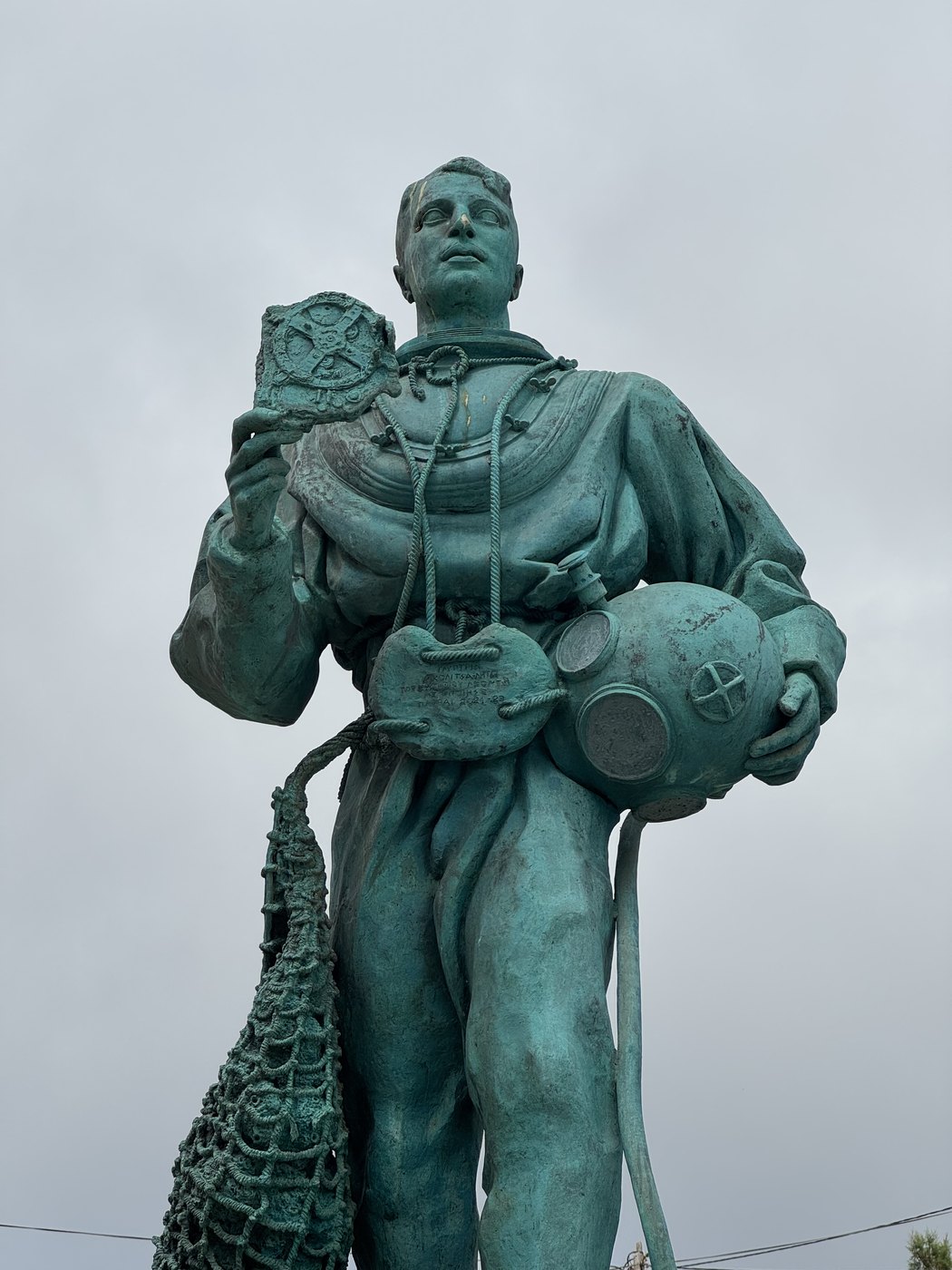
In July 2025 S&T announced that it was donating a replica to the island of Antikythera itself, “the first to exist on the island,” to be placed in the office of the local community (part of the Municipality of Kythira) for anyone to see. The donation is made in the name of Michalis Polychronakis, an associate professor at Stony Brook University who comes from Greece, spends his summers on Antikythera and Crete, and had ordered a unit of his own (S&T blog, 29 July 2025). The post illustrates the island’s new monument to its sponge divers, whose figure holds the mechanism.
14.10 Which Reconstruction Does It Follow?
S&T does not say. No page, update or blog post found for this series names a scholarly reconstruction — Price, Wright, Freeth and Jones, or the 2021 UCL model — as the basis of the Open Antikythera’s gearing or dials. Its blog has reported on research about the original, such as Szigety and Arenas’s 2025 paper on whether triangular teeth would have jammed (Volume 11), but not on its own design sources. What follows is a comparison of what the kit displays with the reconstructions described in Volumes 7, 8 and 10, made from S&T’s descriptions and photographs. It is an inference, not a statement by the makers.
14.10.1 Front
The kit’s front has seven labelled laser-cut needles — Date, Sun, Mercury, Venus, Mars, Jupiter and Saturn, as engraved on them in S&T’s product photograph — plus a separate Moon indicator with a moon-phase display, on a dial with the calendar ring and the zodiac. Greek star-calendar text is engraved on the plate above and below.
Table 5 — Front
| Feature | Original (surviving evidence, Vol 7) | Freeth & Jones 2012 (Vol 10) | UCL 2021 (Vol 10) | Open Antikythera |
|---|---|---|---|---|
| Zodiac and Egyptian calendar rings | Yes | Yes | Yes | Yes (engraved) |
| Date (mean-Sun) pointer | Yes | Yes | Date ring | Yes, labelled “Date” |
| True-Sun pointer | Hypothetical | Yes | Ring | Yes, labelled “Sun” |
| Moon + phase ball | Yes | Yes | Yes | Yes |
| Five planets | Named in inscriptions; gearing lost | Pointers | Concentric rings | Pointers |
| Lunar nodes (“Dragon Hand”) | Unknown | No | Yes (hypothetical) | Not mentioned |
The Open Antikythera’s front is a pointer display: one needle per planet, plus separate Date and Sun needles. That is the layout of Wright’s model and of Freeth and Jones’s 2012 reconstruction, which has eight pointers — date, true Sun, Moon and five planets — the same set the kit shows. It is not the 2021 UCL display, in which the planets are shown by concentric rotating rings carrying markers, together with a ring for the lunar nodes. The engraved front plate in S&T’s photograph does carry many concentric circles, which may suggest rings, but the moving indicators are needles.
14.10.2 Back
Table 6 — Back
| Feature | Original (Vol 8) | Open Antikythera FullMonty |
|---|---|---|
| Metonic spiral, 5 turns, 235 months | Yes | Metonic spiral with groove-following needle |
| Games dial, 4-year | Yes | Yes (“Olympic”) |
| Callippic dial, 76-year | Yes (subsidiary dial) | Not mentioned in S&T’s descriptions |
| Saros spiral, 4 turns, 223 months, eclipse glyphs | Yes | Saros spiral with groove-following needle; eclipse prediction |
| Exeligmos dial, 54-year | Yes | Not mentioned in S&T’s descriptions |
The back follows the arrangement that has been settled since the 2006 and 2008 Nature papers (Volume 8): two spirals with followers and a games dial. Whether the kit’s spirals carry exactly 235 and 223 cells, and whether the Callippic and Exeligmos subsidiary dials are present, is not stated in S&T’s public descriptions; the kit’s eleven back needles leave room for both.
The fair summary is that the Open Antikythera presents the consensus back and a pointer-style front of the Wright / Freeth-and-Jones-2012 type. It does not, on the evidence available, adopt the 2021 ring display. Its gear count — 52 by the marketing page, 62 laser-cut gears in the kit — is not the same as the 69 of the 2021 model or the 54 that Wikipedia attributes to Freeth and Jones’s 2012 proposal, and no one should expect its gear train to match any published reconstruction tooth for tooth. Like the Lego machine of Volume 13, it reproduces the displays of a reconstruction, built from gears that suit its own materials.
14.11 Where It Sits Among the Replicas
Among the machines of Volume 13, the Open Antikythera is closest in spirit to the printable hobby models — a buildable, affordable version of a published layout — and closest in finish to the museum replicas, especially with its golden skin and wood case. Its distinguishing feature is the one S&T emphasised from the start: clear acrylic. Most replicas hide the gear train behind brass plates, as the original did. This one lets the owner watch the main wheel turn, the trains branch, and the spiral followers creep outward with every turn of the crank. That makes it a better instrument for learning how the mechanism works than for imagining how it looked, and it is the reason a clear-plated unit was chosen for the build described in the final volume.
Next — Volume 15: My Open Antikythera — Building It and Learning to Read It. A FullMonty in clear acrylic, built and on the shelf, and the slower work of learning to read it: what one turn of the crank means, how to set it to a date, how to follow the Moon, the planets and the games, and how to crank forward to the next eclipse — plus the plan for a second, brass build.
Comments (0)