Antikythera · Volume 8
Antikythera — Volume 8 — The Back Face — Spirals for Calendars, Games and Eclipses
A five-turn spiral of 235 Corinthian months, a four-year dial of athletic festivals, a four-turn spiral of eclipse warnings, and the small dials that complete them: what the back of the mechanism said, and how it was read
8.1 About This Volume
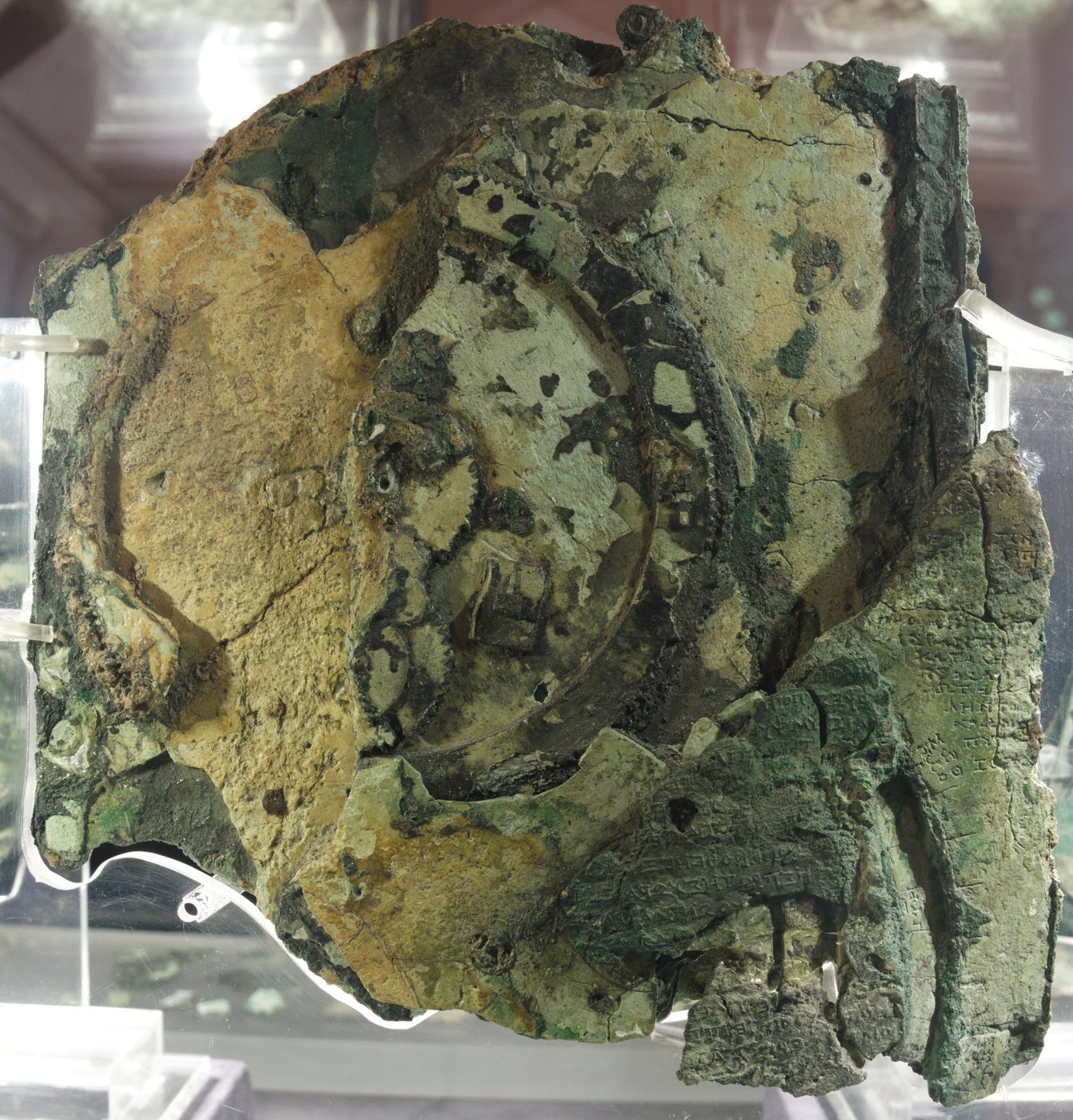
Behind a removable back cover, the Antikythera mechanism carried two large dials, one above the other, each laid out not as a circle but as a spiral. The upper spiral counted the 235 months of the 19-year Metonic cycle, each month named in the calendar of a Greek city; inside it, a small four-year dial named the great athletic festivals, and probably a second small dial counted the 76-year Callippic cycle. The lower spiral counted the 223 months of the Saros, and in some of its cells were small inscriptions — glyphs — that warned of eclipses of the Moon or the Sun and gave their hour; a small dial inside it told the user how to correct those hours.
This volume describes each of these displays: how it was laid out, what it was driven by, what was written on it, and how much of that writing survives. It ends with a worked example of how an ancient user would have read an eclipse prediction. The sources are T. Freeth et al., Nature 444 (2006) 587–591 (N06, doi:10.1038/nature05357), which established the spiral layout, the pointer-follower and the Saros glyphs; T. Freeth, A. Jones, J. M. Steele and Y. Bitsakis, Nature 454 (2008) 614–617, with its long Supplementary Notes (N08, supplementary PDF), which read the month names and the games dial and reconstructed the eclipse scheme; and P. Iversen, “The Calendar on the Antikythera Mechanism and the Corinthian Family of Calendars”, Hesperia 86 (2017) 129–203 (ASCSA), which refined the calendar and the games.
8.2 The Layout of the Back
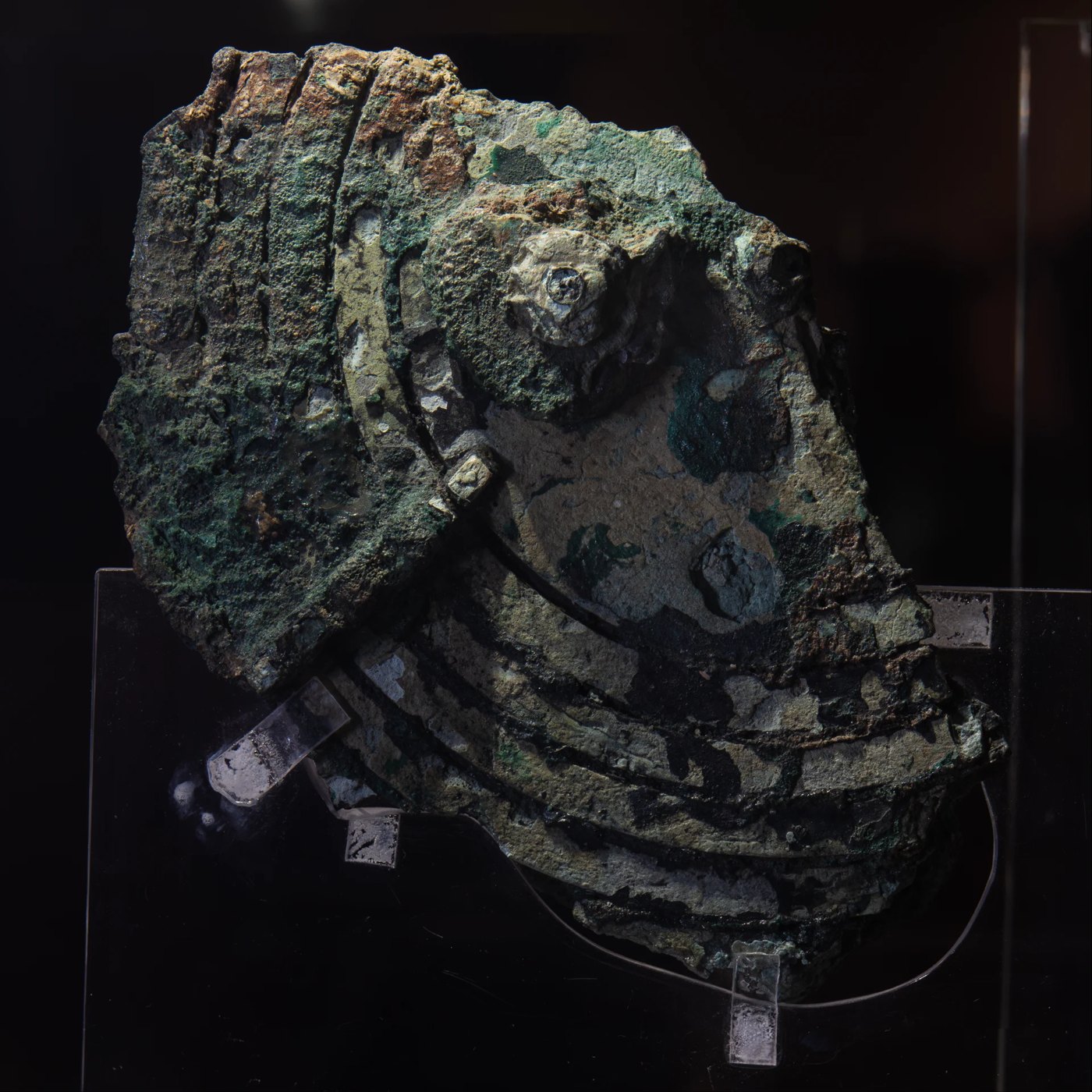
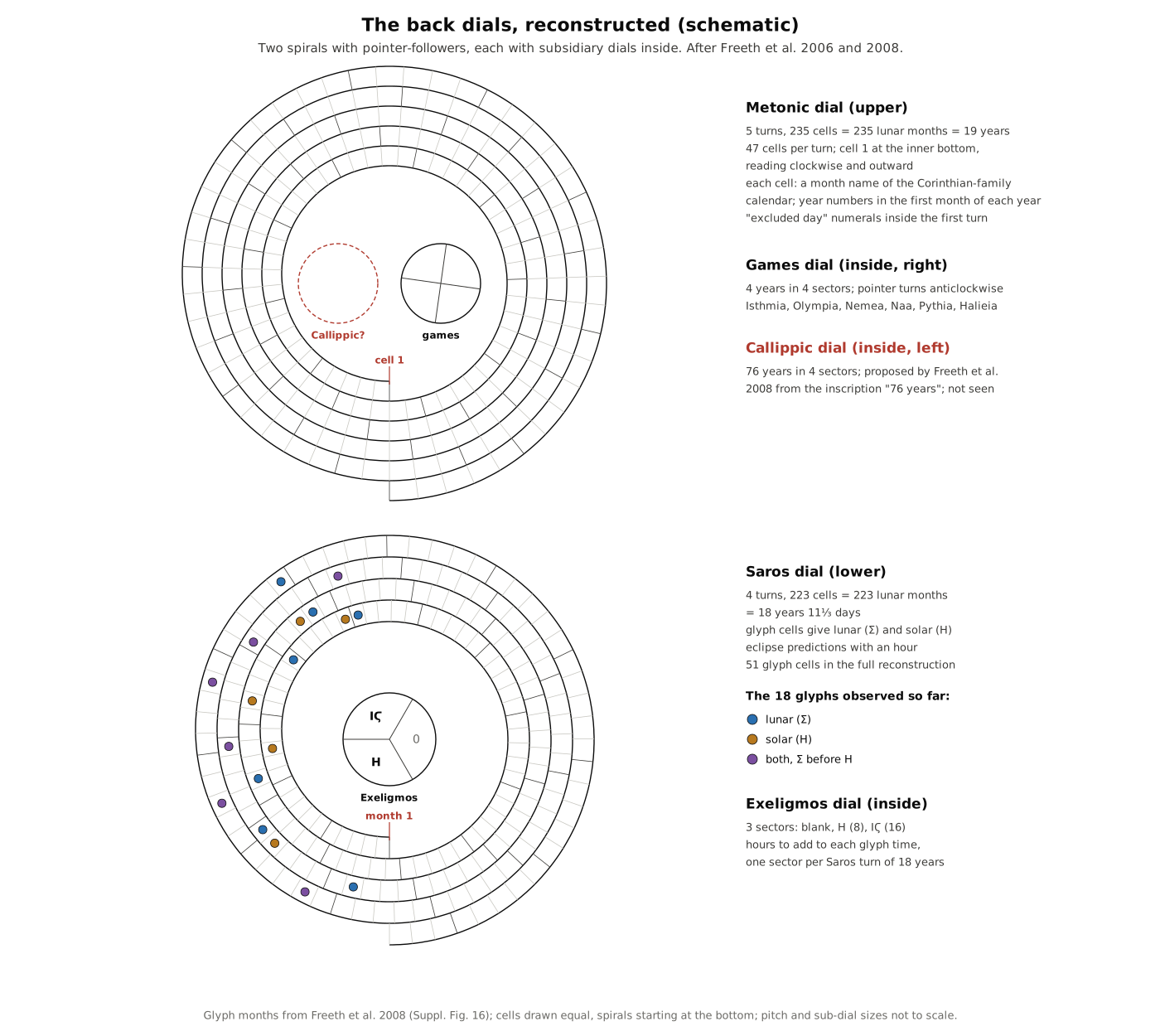
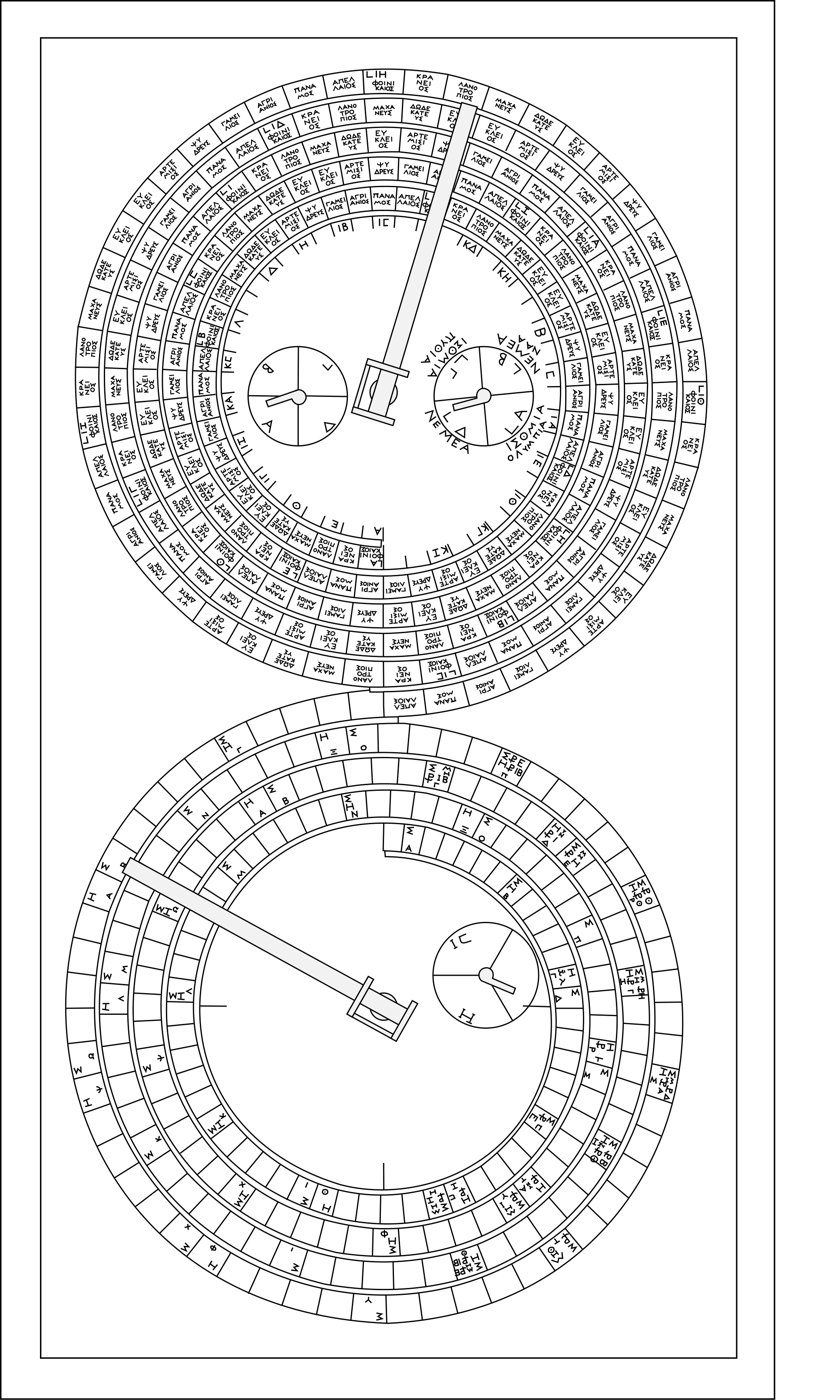
Most of the back plate was taken up by the two spiral dials, upper and lower, each with subsidiary dials inside it. N06 summarised the arrangement: “The spiral upper back dial displays the luni-solar Metonic sequence of 235 lunar months with a subsidiary dial showing the Callippic cycle, while the spiral lower back dial displays the 223-lunar-month Saros eclipse cycle with a subsidiary dial showing the Exeligmos cycle.” Two years later N08 showed that the subsidiary dial inside the Metonic spiral actually showed the four-year cycle of the games, and proposed that the Callippic dial sat beside it. The surviving evidence for the upper dials is mainly in fragment B; for the lower, in fragments A, E and F.
Over the dials was a back door, a plate covered on its inner face with a long inscription explaining the displays — the “user’s manual” of Volume 9. Parts of it survive only as mirror-image impressions on the corrosion layer of fragment B. Among its readable phrases are “on the spiral subdivisions 235” and “76 years, 19 years … 223” (Wikipedia, “Antikythera mechanism”).
8.3 Why Spirals
A single circle divided into 235 months would have cells about 1.5° wide — too narrow to hold a month name in legible letters on a dial of the size the case allowed. Spreading the months over five turns gives each cell five times the room. Price had imagined five concentric rings of 47 divisions; Michael Wright first saw that the scale was a continuous spiral, and N06 confirmed it, adding that the spiral was “made from semicircular arcs displaced to two centres on the vertical midline” — half-turns of slightly different radius joined end to end, a construction easy to lay out with compasses.
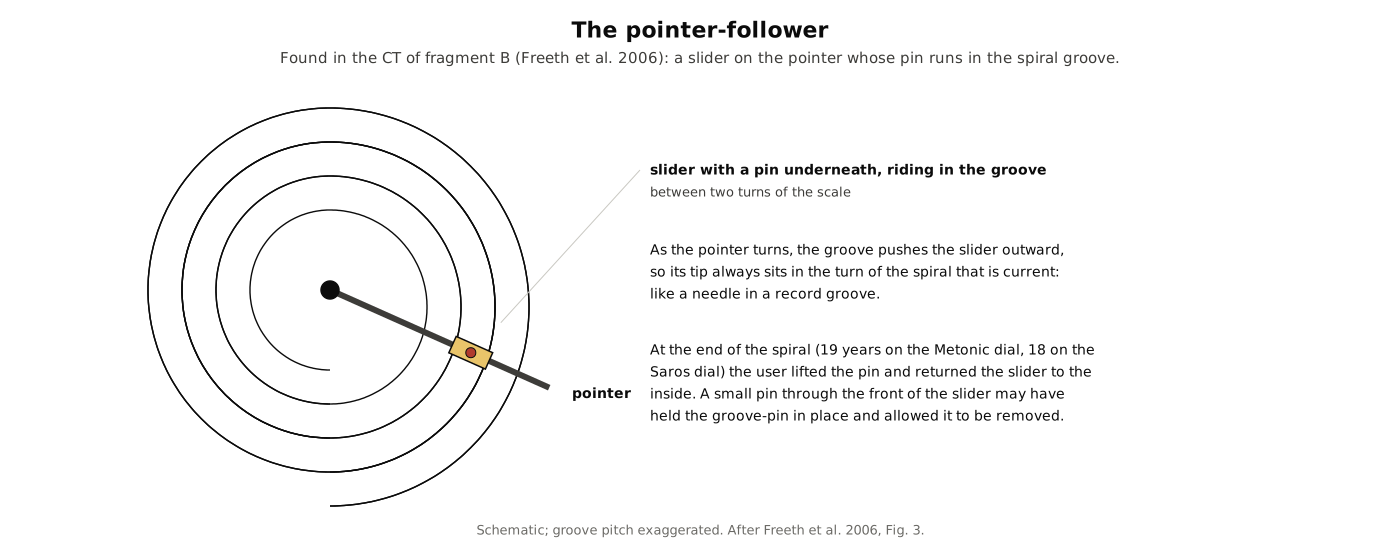
A spiral has one problem: a single pointer turning about the centre crosses all five turns at once, and the reader needs to know which turn is current. The CT of fragment B supplied the answer, a device that had never been suspected.
8.3.1 The pointer-follower
Riding on the Metonic pointer is a small slider. A pin on its underside runs in the groove between successive turns of the spiral scale. As the pointer goes round, the groove pushes the pin, and with it the slider, steadily outward, so that its tip always marks the current turn. N06 describes “a ‘pointer-follower’ device … [that] travelled around the spiral groove to indicate which month (across the five turns of the scale) should be read”. Spinellis compared it to “a needle tracking a gramophone record” (D. Spinellis, IEEE Computer 2008). A similar follower is assumed on the Saros pointer.
At the end of the spiral the follower has nowhere to go. N06 notes that “the Metonic dial would have required re-setting every 19 years, the Saros dial after 18 years”, and that the groove-pin “may have been held in place by the small pin through the front of the device, enabling its removal for re-setting”. The user lifted it out, moved it back to the inner turn, and carried on.
8.4 The Metonic Spiral
The upper dial is driven by the Metonic train, 5/19 turns a year (Volume 6): five turns in 19 years, during which the Moon goes through 235 cycles of phase. The scale is divided into 235 cells, 47 to a turn. N06 found 34 scale markings in the surviving fragments and, by a statistical analysis like the one used for tooth counts, confirmed 235 divisions in total; the back-cover inscription’s “on the spiral subdivisions 235” agrees.
N08 established the reading order: “When complete, the Metonic Spiral had 235 cells, one for each lunar month of a Metonic period, running clockwise and outward from a starting point at the inside bottom of the spiral.” Seen from the back, every dial turns clockwise except one (the games dial). Each cell carried a month name, written over two or three lines. In the first month of each of the 19 years the name was preceded by the L-shaped sign for etos, “year”, and the year’s number in Greek alphabetic numerals, 1 to 19.
8.4.1 The month names
Text survives in only 49 cells, roughly a third of the spiral centred on its lower right, and much of it only as faint traces in the CT, often deciphered by combining evidence from several cells that should hold the same month. In 2008 the team identified all twelve (N08, Suppl. 3.2). In order:
Table 1 — Text survives in only 49 cells, roughly a third of the spiral centred on its lower right, and much of it only as faint traces in the CT, often deciphered by combining evidence from several cells that should hold the same month. In 2008 the team identified all twelve ([N08, Suppl. 3.2](https://archive.nyu.edu/bitstream/2451/60882/2/FreethJonesSteeleBitsakis2008supplementary.pdf)). In order
| Month | Name | Month | Name | |
|---|---|---|---|---|
| 1 | ΦΟΙΝΙΚΑΙΟΣ, Phoinikaios | 7 | ΑΡΤΕΜΙΣΙΟΣ, Artemisios | |
| 2 | ΚΡΑΝΕΙΟΣ, Kraneios | 8 | ΨΥΔΡΕΥΣ, Psydreus | |
| 3 | ΛΑΝΟΤΡΟΠΙΟΣ, Lanotropios | 9 | ΓΑΜΕΙΛΙΟΣ, Gameilios | |
| 4 | ΜΑΧΑΝΕΥΣ, Machaneus | 10 | ΑΓΡΙΑΝΙΟΣ, Agrianios | |
| 5 | ΔΩΔΕΚΑΤΕΥΣ, Dodekateus | 11 | ΠΑΝΑΜΟΣ, Panamos | |
| 6 | ΕΥΚΛΕΙΟΣ, Eukleios | 12 | ΑΠΕΛΛΑΙΟΣ, Apellaios |
These are not Athenian months. Phoinikaios, Lanotropios, Dodekateus and Psydreus are known only from Corinth, its colonies and cities that adopted its calendar; ten of the twelve also appear in a calendar shared by cities of Epirus, southern Illyria and Corcyra (Corfu), and the calendar of Tauromenion in Sicily matches seven months in name and position. N08 concluded that the calendar “can be identified with certainty as a version of the calendar used in the Corinthian colonies of northwestern Greece, which was very probably the same as the calendar of Corinth itself and, with somewhat diminished probability, the calendar of Syracuse”. Iversen (2017) argued more specifically that it is the Epirote calendar, probably as used at a Corinthian colony such as Ambrakia. Machaneus is a striking name for a month on a machine: it is an epithet of Zeus as “contriver”.
Why does it matter? Because a local civic calendar “was of purely local significance and would almost certainly not have been used as a special ‘astronomical’ chronological framework” (N08). The upper back dial was made for someone who lived by that calendar. Volume 11 takes up what this implies for where the machine was made and for whom.
8.4.2 Thirteen-month years
A Metonic cycle must say which seven of its 19 years get a thirteenth month. The surviving cells constrain this: two intercalations fall between cells 2 and 37, one between 49 and 87, two between 96 and 133, one between 142 and 175, and one after 189. If the extra months are spread as evenly as possible — the rule the astronomer Geminos says Greek Metonic cycles followed — only one rotation of the standard pattern fits, putting the intercalary months in years 1, 3, 6, 9, 11, 14 and 17 (N08, Suppl. 3.3). Which month was doubled is not known; no two consecutive cells with the same name survive.
8.4.3 Excluded days, and why five turns
A lunar calendar needs months of 29 and 30 days in the right mix: 125 full and 110 hollow months make 6,940 days in 19 years (Volume 5). Geminos describes how Greek cycles did it: give every one of the 235 months a nominal 30 days (7,050 days), then strike out 110 days at regular intervals of 64 days. The struck-out day was simply skipped in the count — in one month the “9th” might follow the “7th”.
Inside the first turn of the Metonic spiral are numerals that N08 identified as these exairesimoi, excluded days: for example 23 and 27, written under cells of the innermost turn. And they explain the spiral’s five turns. If 110 days are excluded strictly every 64 days, the last of one cycle falls 74 days before the first of the next, an awkward jump. The mechanism’s scheme smooths this by lengthening ten of the 110 intervals to 65 days (100 × 64 + 10 × 65 = 7,050, exactly the nominal total). The 19-year cycle then divides into five sub-cycles of 47 months, each with an identical pattern of excluded days — so each turn of the spiral is one sub-cycle, and the excluded-day numerals need be written only once, inside the first turn, to serve all five. “This accounts for the fact that the Metonic spiral has five turns”, N08 concludes. One consequence is curious: the first excluded day falls on the first day of the first month, so in that year the calendar had no New Year’s Day.
The scheme also requires the user to know the day of the month, which the slow back dials cannot show. N08 suggests a scale of days on the front-dial Moon-phase device (Volume 7).
8.5 The Games Dial
Inside the Metonic spiral, on the right, is a small dial divided into four quadrants by two diameters, which lean about 8° anticlockwise from the vertical and horizontal. Earlier researchers, Michael Wright among them, had read it as the 76-year Callippic dial. N08 read its inscriptions and found something nobody had expected on an astronomical instrument: the names of athletic festivals. Its gear, o1, survives in fragment B, with 60 teeth; driven from the Metonic axis by a 57-tooth gear, it turns once in four years (Volume 6).
Inside the rim of the dial are the year numbers — the L-sign for “year” followed by the numerals Α, Β, Γ, Δ — running anticlockwise from the lower right quadrant. Outside the rim, each quadrant names the games held in that year, in the order they took place, reading outward (N08, Suppl. 3.5):
Table 2 — Inside the rim of the dial are the year numbers — the L-sign for "year" followed by the numerals Α, Β, Γ, Δ — running anticlockwise from the lower right quadrant. Outside the rim, each quadrant names the games held in that year, in the order they took place, reading outward ([N08, Suppl. 3.5](https://archive.nyu.edu/bitstream/2451/60882/2/FreethJonesSteeleBitsakis2008supplementary.pdf))
| Year | Inscription | Games |
|---|---|---|
| 1 | ΙΣΘΜΙΑ, ΟΛΥΜΠΙΑ | Isthmian games (spring), Olympic games (late summer) |
| 2 | ΝΕΜΕΑ, ΝΑΑ | Nemean games (early summer), Naa at Dodona |
| 3 | ΙΣΘΜΙΑ, ΠΥΘΙΑ | Isthmian games (spring), Pythian games at Delphi (late summer) |
| 4 | ΝΕΜΕΑ, ΑΛΙΕΙΑ | Nemean games (early summer), Halieia of Rhodes |
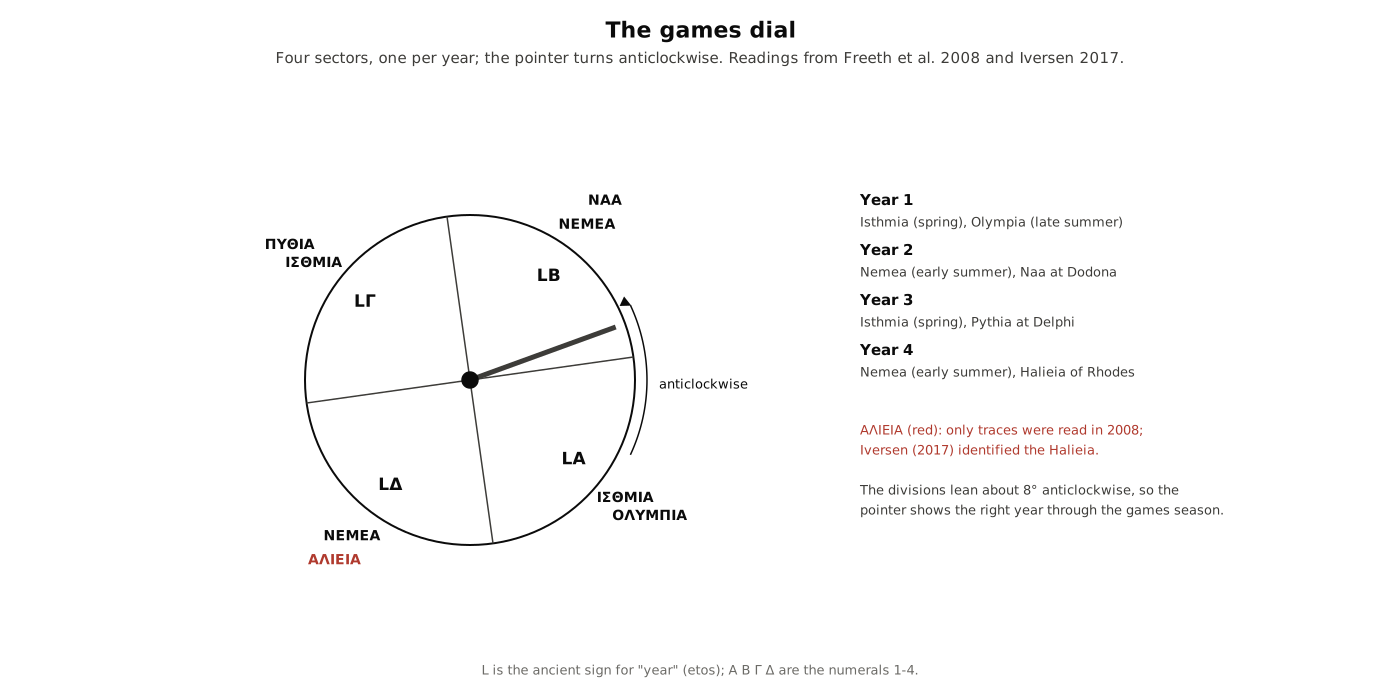
The four “crown” games — so called because the prize was a wreath — made up the panhellenic cycle: the Olympic and Pythian games every four years, the Isthmian and Nemean every two. The Naa at Dodona, in Epirus, was a lesser festival that claimed panhellenic status in the Hellenistic period; the dial supplied the first evidence of when in the four-year cycle it was held, at the end of summer in year 2, and an inscription from Dodona puts it in the month Apellaios, the last month of the Corinthian-family calendar. In 2008 the second entry for year 4 was only traces. Iversen read it as the Halieia, the festival of the Sun god at Rhodes (Iversen 2017); together with the Epirote calendar, it is part of his argument that the mechanism was made on Rhodes for a client in Epirus.
Three details show how carefully the dial was designed. Its pointer is the only one on the mechanism that turns anticlockwise: the simplest gearing reversed the direction, and the designer inscribed the dial to suit rather than add a gear. The year divisions are tilted about 8° — roughly a month’s travel of the pointer — and N08 explains why: the dial counts solar years, but the calendar years of the Metonic spiral start at varying points within the solar year, up to a month late. Tilting the divisions ensures that “the pointer would never indicate the wrong year during the part of the year when panhellenic competitions took place”. And a four-year dial also told the user when to move the Egyptian calendar ring on the front back by a day (Volume 7).
The dial’s significance is out of proportion to its size. Nobody needs a gear train to remember a four-year cycle; as N08 puts it, “the point of the Olympiad Dial is not the specific predictions that it makes, but the correlation of the cycles of human institutions with the celestial cycles on the other parts of the Mechanism”. The upper back dial, which had been taken for pure astronomy, turned out to be devoted entirely to social time: a city’s calendar and its festivals.
8.6 The Callippic Dial
The back-door inscription mentions “76 years”, and the Exeligmos dial shows that the designer cared about cycles longer than 19 years. N08 therefore proposed a second subsidiary dial inside the Metonic spiral, on the left, symmetrical with the games dial, divided into four quadrants for the four Metonic cycles of a Callippic period and driven by a train turning it once in 76 years (Volume 6). No part of this dial or its gearing has been found. It appears in most modern reconstructions, including FJ12’s and the drawing above, but it is a well-argued hypothesis, not an observation.
8.7 The Saros Spiral
The lower dial is the eclipse predictor. Its pointer is driven, through the great wheel e3, at 940/4,237 turns a year — four turns in 223 synodic months (Volume 6). From 48 scale divisions observed in fragments A, E and F, N06 established “223 divisions in the four-turn spiral on the lower back dial, the spiral starting at the bottom of the dial”. This is the Saros cycle of Volume 5, “whose number is on the back door inscription”: a fragment of that inscription shows ΣΚΓ, the Greek numeral 223.
Why four turns rather than five? The space needed is part of the answer, but N08 found a better one. In a Saros, 223 synodic months equal 239 anomalistic months, so there are 239 − 223 = 16 cycles of the full Moon’s apparent size (the “full Moon cycle”, Volume 5). With four turns, each quarter-turn of the pointer is one such cycle, and the pointer’s angle within a turn shows where the Moon is in its distance cycle — which governs, for example, whether a solar eclipse is total or annular. A possible scale mark at exactly the 3 o’clock position on the central plate supports the idea (N08, Suppl. 4.7).
8.7.1 The glyphs
Between the scale divisions, in certain cells, N06 identified “16 blocks of characters, or ‘glyphs’ … at intervals of one, five and six months”, and N08 raised the count of known glyphs to 18. Each glyph is a short, standardised inscription (N08, Suppl. 4.1):
- Σ, for ΣΕΛΗΝΗ, the Moon: a lunar eclipse is possible this month.
- Η, for ΗΛΙΟΣ, the Sun: a solar eclipse is possible this month.
- ω\ρ — the abbreviation for ὥρα, “hour” — followed by a numeral: the hour of the eclipse, on a 12-hour scale, with Ϛ standing for 6.
- Η\Μ, for ἡμέρας, “of the day”, before the hour of a lunar eclipse: it falls in daytime, when the Moon is below the horizon and the eclipse cannot be seen.
- Ν\Υ, for νυκτός, “of the night”, before the hour of a solar eclipse: it falls at night and cannot be seen.
- An index letter at the bottom of the glyph.
Months are counted from the first crescent, as in Greek and Babylonian civil calendars, so a full Moon falls mid-month and the next new Moon at the end of the month. Where a glyph predicts both kinds of eclipse, Σ always comes before Η: the lunar eclipse at the full Moon precedes the solar eclipse at the following new Moon. That ordering is itself evidence that the dial’s months began at first crescent, and N06 found that the glyph sequence matched real eclipse records only on that assumption.
The day and night markers are revealing. A lunar eclipse “of the day” or a solar eclipse “of the night” was invisible at the place of use, yet it was still marked. Seven, and possibly nine, of the lunar glyphs carry the day marker. The glyphs are therefore predictions of eclipse possibilities, in the Babylonian style, not forecasts of what would be seen.
8.7.2 The index letters
N08’s most surprising finding was that the letters at the foot of the glyphs are in alphabetical order round the dial: Α, Β, Γ … through Ω and then a second alphabet, some letters of which carry a bar. Every glyph has one, whether lunar, solar or both, so they index glyphs, not eclipses. Because two glyphs five months apart carry Ε and Ζ, nothing can lie between them, so the letters are true letters, not numerals. The index letters fix how many glyphs lay between any two surviving ones — and therefore how many were on the whole dial. They most probably keyed each glyph to fuller descriptions elsewhere on the instrument; inscriptions associated with the lower dial mention directions such as “towards the east” and “west-north-west”, of the kind recorded with ancient eclipse observations (N06).
8.7.3 Reconstructing the whole dial
With 18 glyphs known and the index letters as constraints, N08 asked what scheme produced them. Babylonian schemes, with 38 lunar and 38 solar possibilities in an 8-7-8-7-8 pattern (Volume 5), match the observed lunar glyphs but put too many solar predictions between the index letters. The team then modelled eclipse possibilities directly, from the elongation of each syzygy from the nearest node, and found that adding an asymmetry for solar eclipses — a wider limit when the new Moon is north of the node than south, the effect of parallax that Ptolemy later described — gave a near-perfect match. The best match reconstructs 51 glyphs, with 38 lunar and 27 solar predictions, 65 in all. Its lunar predictions are exactly the unique Babylonian scheme consistent with the surviving glyphs; its solar predictions are a sparser set of 27. Supplementary Figure 20 of N08 gives the full sequence, including reconstructed index letters.
The glyph hours resisted every model. N08 tested mean months, the lunar anomaly and actual eclipse times, and concluded: “We have not discovered a rational or plausible basis for the glyph times.” Some lunar times fit a mean-month model; others clearly do not.
Matching the glyph sequence against real eclipses — first with DNA-matching software, then by brute force — produced 121 possible start dates between 400 and 1 BC in 2006, and a hundred in the 2008 analysis. The sequence matched only if penumbral lunar eclipses, rarely noticed in antiquity, were included, which again suggests a predictive scheme rather than a list of observations. Later work used the glyph times and sequence to argue for a specific start: Christián Carman and James Evans (2014) put the dial’s first month just after the new Moon of 28 April 205 BC, and a 2022 preprint by Aristeidis Voulgaris and colleagues argued for December 178 BC. These are dates of the dial’s epoch, not of the machine’s construction; Volume 11 sets out the debate.
8.8 The Exeligmos Dial
Inside the Saros spiral is a small dial in three sectors. Part of it is visible on the surface of fragment A, where a prominent letter Η can be seen; the CT shows Η (8) at about the 7 o’clock position and ΙϚ (16) at about 11 o’clock, with a faint division between them (N08, Suppl. 4.8). The third sector is presumed blank, or 0.
The Saros is 6,585⅓ days, so every eclipse in the next Saros falls about 8 hours later in the day; after three Saros, an Exeligmos of 19,756 days, the shift returns to zero. Its pointer, geared 1/12 from the Saros pointer (Volume 6), turns once per three Saros cycles, moving one sector for each four-turn passage of the Saros spiral. N08: “We have now understood the purpose of this dial, which is to tell the user how many hours — 0, 8 or 16 — to add to the glyph time to get the time of the predicted eclipse.”
8.9 Reading an Eclipse Prediction
Suppose a user in the second century BC wants to know about eclipses in the coming months. The procedure, on the AMRP reconstruction, would be:
- Set the date. Turn the crank until the date pointer on the front shows today, with the Sun and Moon pointers in their observed positions. The whole machine moves with it: the Metonic pointer and its follower now indicate the current month in the city’s calendar, and the Saros pointer and its follower indicate the current month of the Saros cycle.
- Look ahead on the Saros spiral. Follow the spiral clockwise from the current cell. Most cells are empty. A cell with a glyph warns that in that month an eclipse is possible.
- Read the glyph. Σ or Η, or both, says which kind. The hour says when, on a twelve-hour day or night; a day mark on a lunar eclipse or a night mark on a solar one says it will not be visible here.
- Correct the hour. Check the Exeligmos pointer: add nothing, 8 hours or 16 hours, depending on which Saros of the three is running.
- Find the date. Turn the crank forward until the Saros pointer enters the glyph’s cell. The front dial now shows the date of that month, the position of the Sun and Moon in the zodiac, and the Moon’s phase — full for a lunar eclipse, new for a solar one. The Metonic dial shows the month’s name in the civic calendar, and the games dial shows whether a festival falls in that year.
- Look for more. The index letter would lead to whatever fuller description the instrument carried.
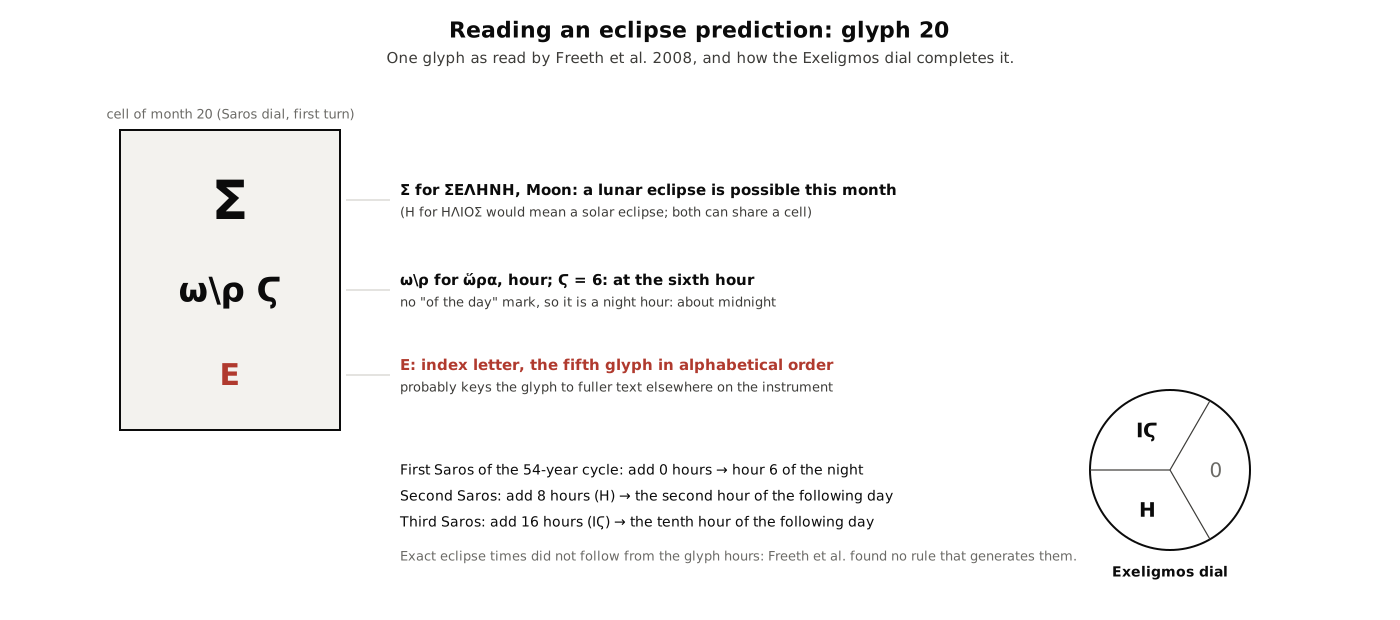
A worked example uses a glyph that survives. In month 20 of the Saros spiral, in fragment F, N08 reads: Σ; ω\ρ followed by Ϛ; and the index letter Ε. That is a lunar eclipse possibility in the twentieth month of the cycle, at the sixth hour; since there is no “of the day” mark, it is a night hour, and the sixth hour of the night, in the Greek system of twelve seasonal hours from sunset to sunrise, is around midnight. If the Exeligmos pointer shows its blank sector, that is the prediction. If it shows Η, the user adds 8 hours, and the eclipse falls around the second hour of the following day, with the Moon below the horizon. If it shows ΙϚ, add 16 hours: about the tenth hour of the day — again invisible.
Nothing in this procedure requires arithmetic beyond adding 8 or 16. That is the design’s real achievement. Behind the glyphs lie centuries of Babylonian records and a Greek eclipse model; in front of them is a user who needs only to turn a handle and read.
8.10 How Accurate Was It?
The spirals’ ratios are exact to the period relations: the Metonic pointer’s 19-year cycle and the Saros pointer’s 6,585⅓ days. The relations themselves are good — the Metonic to two hours in 19 years, the Saros to an hour or so in the position of the node. The weak points are elsewhere. The pointer only shows the month, not the day; eclipse times on a 12-hour scale are coarse; and the glyph hours, as N08 found, follow no discoverable rule. A Saros scheme also drifts slowly: over many cycles an eclipse series fades out at one end and new eclipses appear at the other, so a dial set up for one century would gradually miss eclipses in another. And there is the mechanical question of Volume 11: whether the gear trains, with their hand-filed teeth, ran freely enough to bring the pointers to the right cells at all.
As an object for understanding the sky, though, the back of the mechanism is complete. The upper dial ties the Moon’s months to a city’s calendar and its festivals; the lower ties the same months to the eclipses those festivals might see. The words that explained it all to the user are the subject of the next volume.
Next — Volume 9: The Words on the Machine — Inscriptions and a User’s Manual. Some 3,400 characters, most read only in X-ray CT: the back-door text that describes the dials and the order of the planets, the front-cover inscription with its planetary periods of 462 and 442 years, the parapegma and the eclipse glyphs, and what the letter forms say about when the machine was made.
Comments (0)