Antikythera · Volume 2
Antikythera — Volume 2 — The Wreck — Sponge Divers, Statues and a Lump of Corroded Bronze
How a storm, a crew from Symi and a frightened diver led to the first great underwater salvage, what the ship was carrying when it went down in the early first century BC, and every return to the site from Cousteau to the atmospheric diving suit
2.1 About This Volume
This volume follows the Antikythera mechanism from the moment it went to the bottom of the sea to the moment it reached a museum shelf in Athens, unrecognised. It describes the island and the waters where the ship sank; the sponge divers from Symi who found the wreck at Easter 1900 and the equipment they dived in; the salvage of 1900–1901, which was the first large-scale underwater archaeological operation ever mounted by a state; and the ship’s cargo of bronze and marble statues, glass and furniture, among which the mechanism was the least impressive item. It then sets out how the wreck is dated, why the date matters for the mechanism, and what has been learned on the site since — from Jacques Cousteau’s visits in 1953 and 1976 to the rebreather, robot and atmospheric-suit seasons that began in 2012 and are still running.
The recognition of the gear wheel in 1902, and the scholarly argument that followed, belong to Volume 3.
2.2 An Island in the Strait
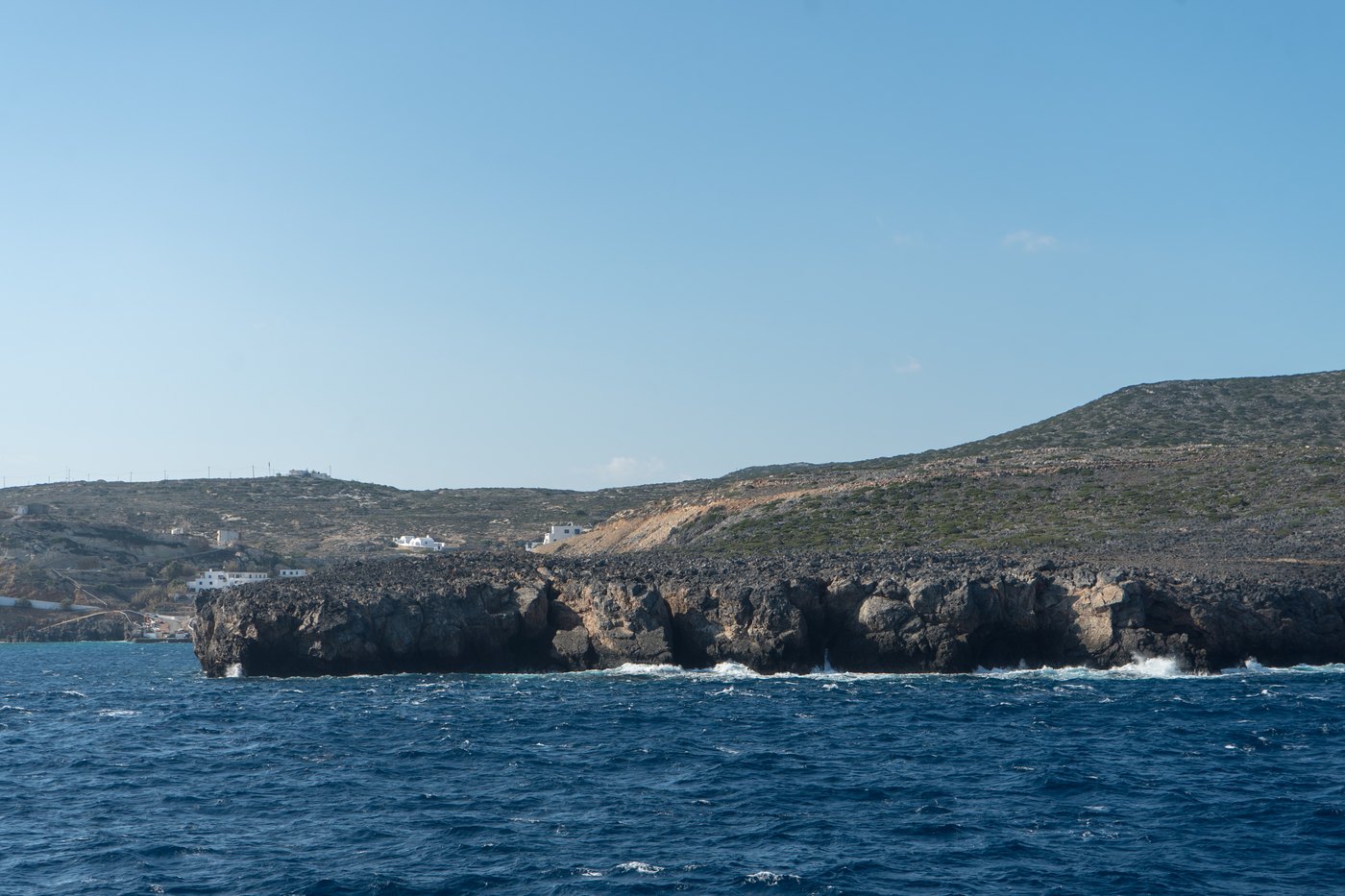
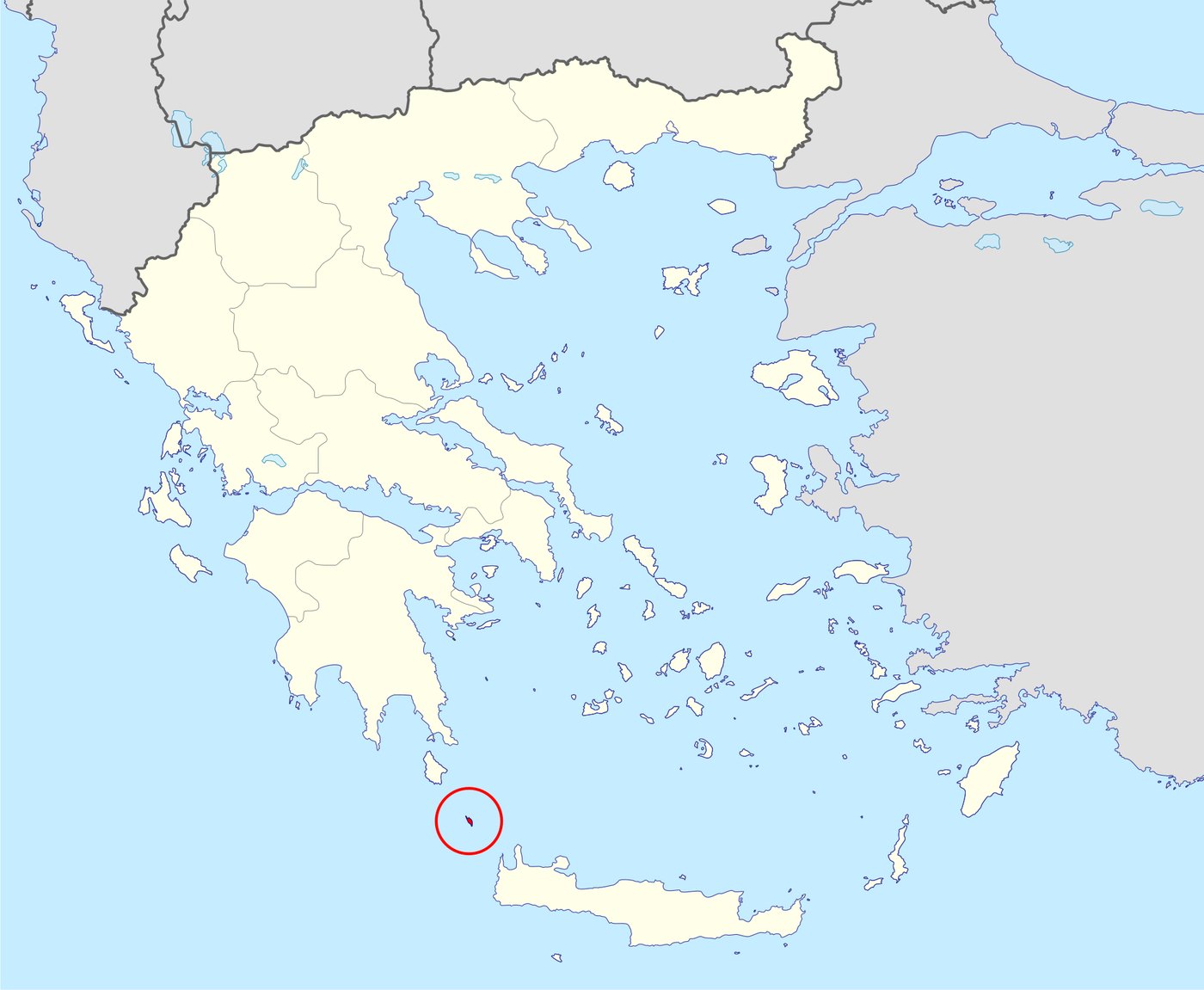
Antikythera (Ἀντικύθηρα, “opposite Kythera”) is a small, steep, dry island in the strait between Kythera, off the south-eastern tip of the Peloponnese, and the western end of Crete. It lies across one of the oldest shipping lanes in the Mediterranean: anything sailing between the Aegean and the central or western Mediterranean, east to west or west to east, has to pass through one of the channels on either side of Kythera and Antikythera, or go far to the south around Crete. In antiquity the island was called Aigilia (Αἰγιλία). Between the fourth and first centuries BC it served as a base for Cilician pirates, until Pompey the Great’s campaign against the pirates destroyed them. Today it covers about 20 km² and had 39 inhabitants at the 2021 census. Its coast falls steeply into deep water, with few safe anchorages.
The wreck lies off Point Glyphadia, at a depth of about 45 metres at the top of the debris field, on a slope that falls away into deeper water. The ship evidently struck or foundered close under the cliffs: a large vessel, heavily laden, caught by weather in a strait where the wind can turn quickly and the nearest shelter is not always reachable. How it came to grief is not known. No hull has survived in good enough condition to tell, and the ancient record is silent.
2.3 The Sponge Divers of Symi
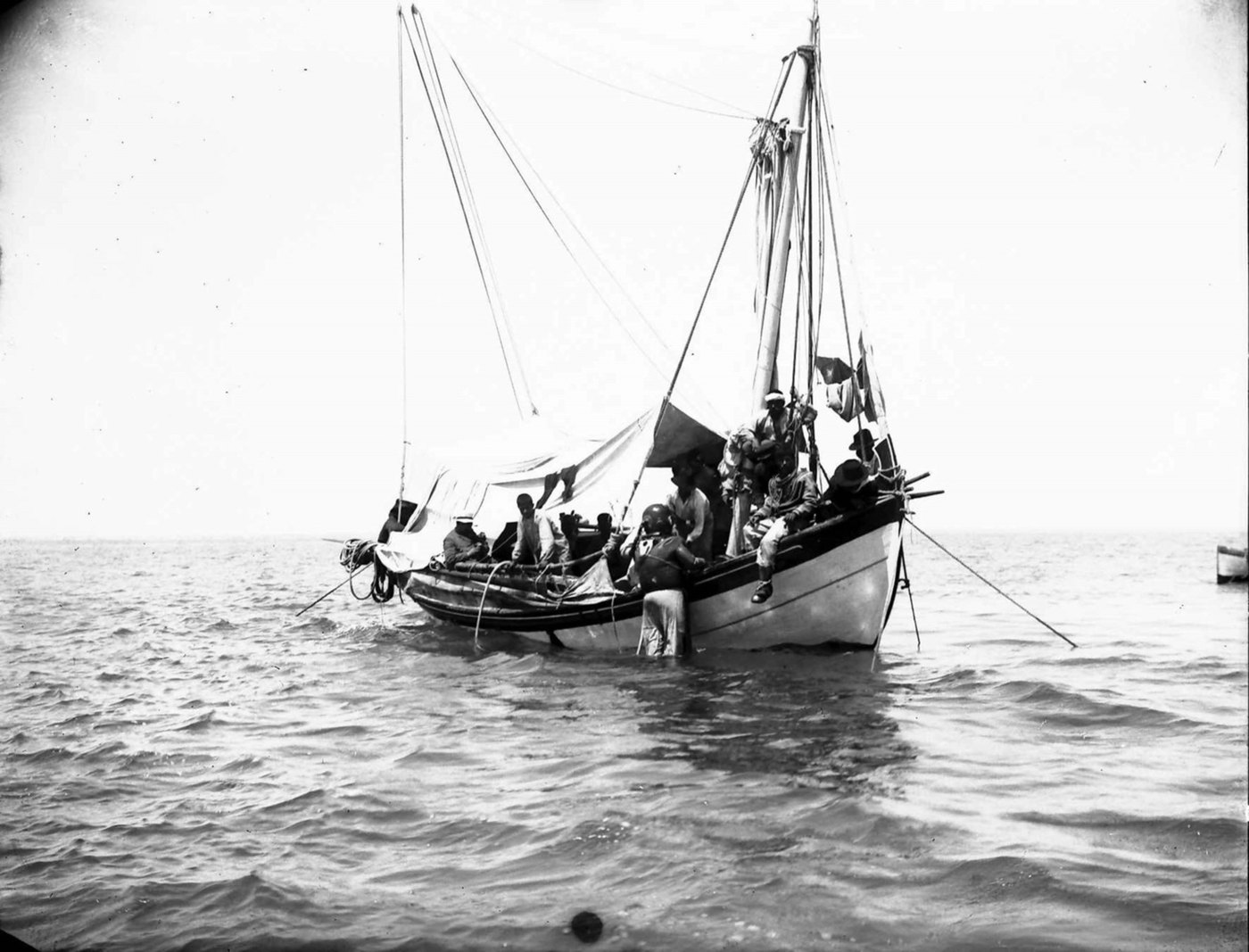
In 1900 the island of Symi, in the Dodecanese off the coast of Asia Minor, was under Ottoman rule, as it would be until 1912. Its Greek inhabitants lived largely by the sea, and above all by sponge diving. Every year the sponge boats of Symi and the neighbouring islands sailed for distant grounds, including the coasts of North Africa, and came home with their catch.
By the late nineteenth century many of the crews had abandoned naked breath-hold diving for standard diving dress: a waterproofed canvas suit, a copper helmet bolted to a breastplate, lead weights and boots, with air pumped down a hose from a hand pump on deck. The equipment let a man work at depths and for durations that breath-hold divers could not reach. It also killed and crippled divers in large numbers. Nobody in the sponge fleets understood decompression sickness — the bubbles of nitrogen that form in the blood and tissues when a diver who has been breathing compressed air comes up too fast — and sponge divers working at 40 or 50 metres and surfacing quickly were routinely paralysed or killed by it.
2.3.1 Easter 1900
Around Easter 1900 a Symi crew under Captain Dimitrios Kontos (also spelled Kondos) was sailing home from the North African grounds when a storm drove them to shelter in the lee of Antikythera. While they waited for the weather to change, they put a diver down to look for sponges. The man was Elias Stadiatis. He went down to about 45 metres, and almost at once signalled frantically to be hauled up. When his helmet came off he described a heap of rotting corpses and horses lying among the rocks on the sea floor.
Kontos assumed that his diver had been affected by the depth — nitrogen narcosis at 45 metres produces confusion and hallucinations — and went down himself. He came back up holding the bronze arm of a statue. The corpses Stadiatis had seen were sculptures: life-size bronze and marble figures, and marble horses, scattered among the boulders and half-buried in sediment.
Kontos and his divers took the bronze arm to the authorities in Athens and reported the find.
2.4 The First Underwater Excavation
The Greek government moved quickly by the standards of the time. The Minister of Education, Spyridon Stais, consulted the state’s archaeologists and agreed terms with the divers: they would raise the antiquities for the state and be paid for what they brought up. The Royal Hellenic Navy provided a transport, the Mykali, to support the work and to carry the finds; a professor from the University of Athens, the archaeologist Antonios Oikonomou (also written Economou), went out to supervise. According to one modern account, Kontos revealed the exact location only once the expedition was under way.
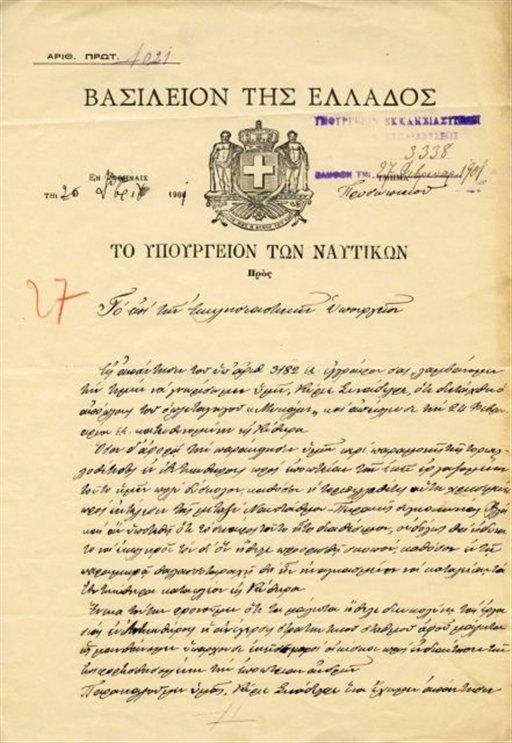
Work began in November 1900 and continued, with interruptions, into the summer of 1901. It was the first time any state had organised an underwater archaeological excavation, and the methods were improvised from scratch.
2.4.1 Working conditions
The divers worked from their own boats in standard dress, at the edge of what the equipment could do. Each descent to the wreck lasted only about five minutes on the bottom, and the weather in the strait allowed diving for only a few hours on many days. At that depth the divers were working at the limit of their equipment, and the work was largely a matter of slinging ropes around whatever they could reach and having it hauled to the surface.
Large marble statues, heavy and encrusted with growth, were lifted with ropes and the ships’ tackle. No systematic record appears to have been kept of where anything lay, and with the methods of the day it is hard to see how one could have been: nobody at the surface could see the site at all. The Athenian press accused the divers of mishandling and damaging the antiquities, and the ministry repeatedly had to deny the charges.
2.4.2 The cost
The salvage was paid for in the divers’ health. One diver, Giorgos Kritikos, died of decompression sickness, and two others were paralysed. By the summer of 1901 the remaining crews were unwilling to continue, the most obvious finds had been raised, and the latest lifts — pottery and timber — were judged of little value. The operation ended.
2.4.3 A template, and its limits
For all its crudeness, the Antikythera salvage set the pattern for the next half-century of underwater archaeology in the Mediterranean. Its essentials — a find by sponge divers, a government that hired them to raise the objects, a naval vessel for support, an archaeologist who stayed on the surface and received what came up — were repeated a few years later at Mahdia off Tunisia, where Greek sponge divers found another Hellenistic ship loaded with bronzes and marbles in 1907. In both cases the archaeologist could study the objects but never the site: the position of things on the sea floor, the structure of the hull, the stowage of the cargo, everything that would later be read from a wreck as carefully as from a land excavation, was lost in the lifting.
That changed only when archaeologists learned to dive themselves. The first excavation of an ancient wreck on the sea floor conducted by divers who were also archaeologists, recording as they went, was George Bass’s work at Cape Gelidonya, off the south coast of Turkey, in 1960. By then the Antikythera finds had been in Athens for nearly sixty years, and nobody could say where on the wreck any of them, the mechanism included, had lain.
That loss matters for the mechanism in a specific way. Had its position in the ship been recorded — in the hold among the cargo, or in the stern among the crew’s or passengers’ possessions — it would say something about whether it was merchandise, a passenger’s prized possession, or ship’s equipment. That question can now be answered, if at all, only from the mechanism itself.
2.5 The Cargo
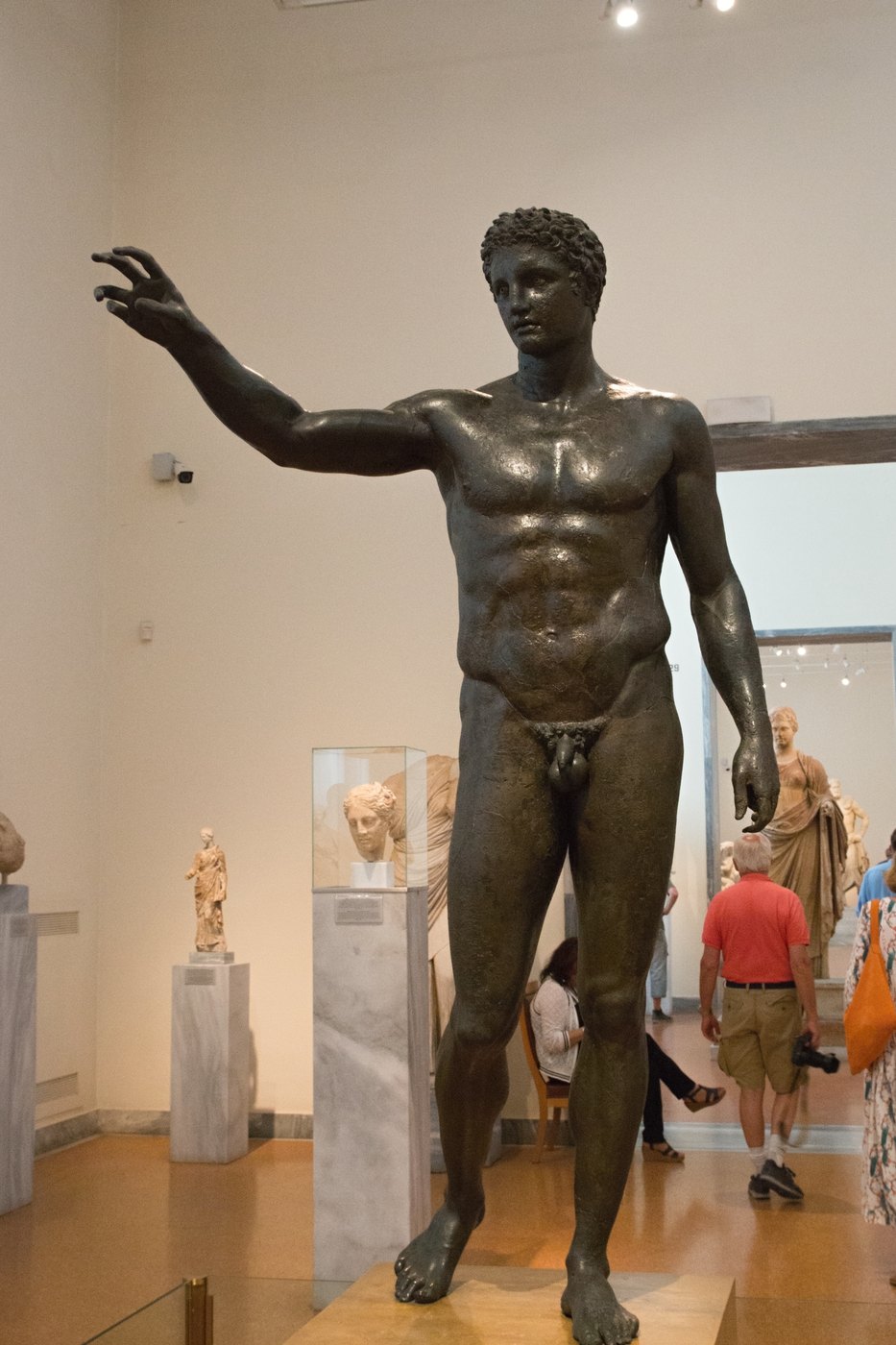
What came up was one of the richest collections of ancient art ever recovered from a single site.
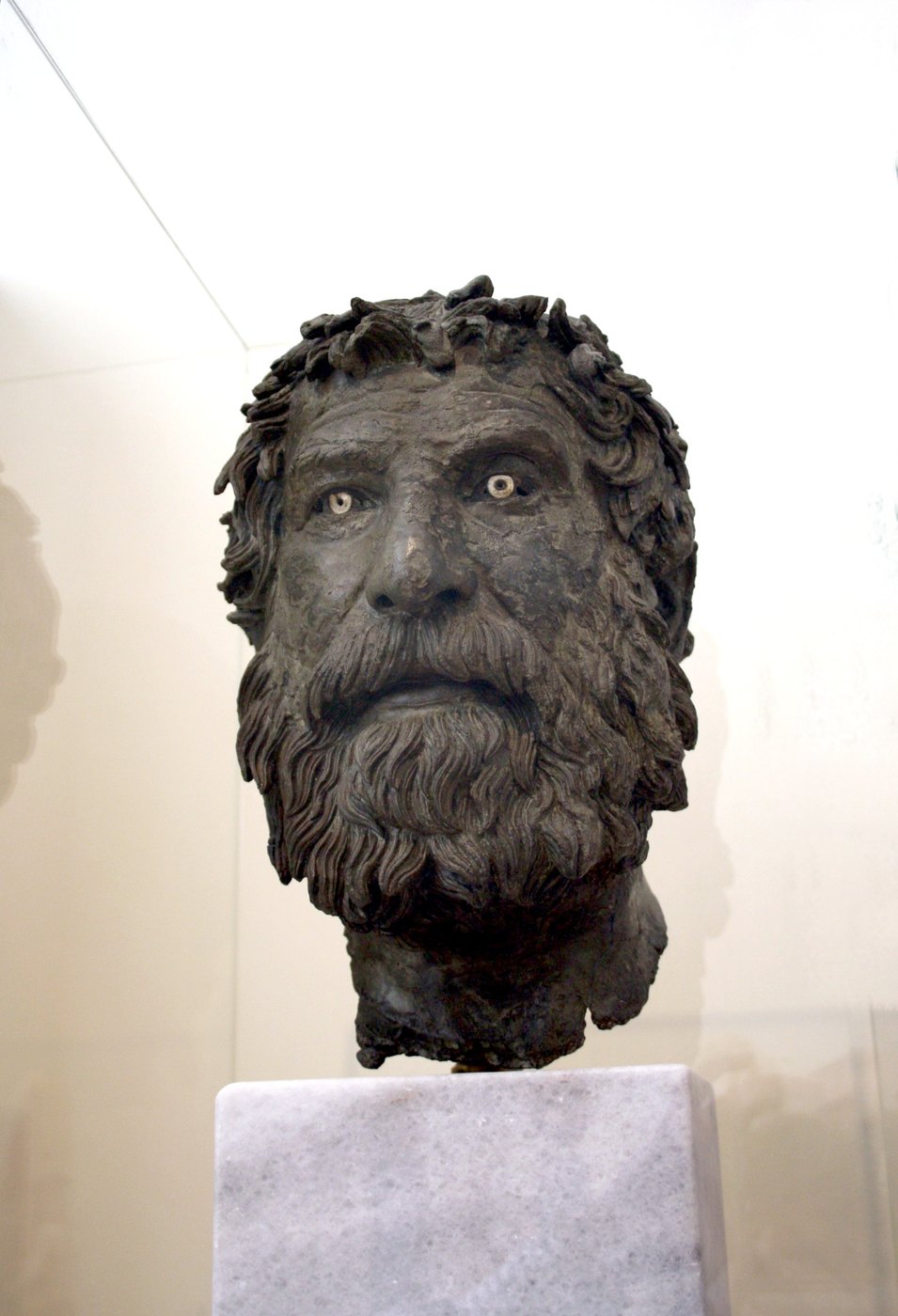
Bronzes. The finest is the Antikythera Youth or Ephebe, a bronze nude of about 340–330 BC, a little over life size, whose largest pieces were raised in December 1900. The second is the “Philosopher”, a bronze head with inlaid eyes, of a bearded, deeply lined old man, from a full-length statue of which fragments of the feet and drapery also survive; it is dated to around 240 BC and has been identified, tentatively, as the Cynic philosopher Bion of Borysthenes. A bronze arm — perhaps the one Kontos brought to Athens — a bronze lyre, bronze statuettes and many fragments of other bronze figures also came up.
Marbles. Thirty-six marble sculptures were recovered, among them figures of Herakles, Odysseus, Diomedes, Hermes and Apollo, and three marble horses (a fourth was lost on the sea floor). They are thought to be Hellenistic copies or variations of earlier works, made for buyers who wanted famous images. Many show a striking split: the side that lay buried in sediment is well preserved, while the side exposed to the sea for two thousand years has been eaten away by boring organisms into a pitted, almost unrecognisable surface.
Everything else. Glassware, including fine coloured bowls; bronze and other fittings from couches and furniture; pottery and amphorae; lead scupper pipes and sheathing from the hull; and two lead sounding weights of about 6 and 14 kg, used by the crew to measure depth. And, probably in July 1901, the item that would eventually outshine all of them: a lump of corroded bronze with fragments of wood around it, about the size of a shoebox.
2.5.1 What the cargo says
Taken together, the cargo is the stock of a luxury trade: statues, many of them already old, high-quality furniture, glass. The ship was most likely bound west, for Italy, where wealthy Romans of the first century BC were buying Greek art on a large scale to decorate their houses and villas. Two explanations are offered for how such a cargo was assembled. One is that it was loot, shipped to Rome after a military campaign in the Greek East, perhaps for display in a triumph. The other is that it was a commission or a commercial cargo, collected for one or more wealthy patrons. The coins and pottery (below) favour a cargo gathered in the eastern Aegean — the region of Pergamon, Ephesus and Rhodes. The mechanism fits either story. It was a valuable, sophisticated object of the kind a collector would want, and it need not have been new when it was loaded.
2.6 The Lump Nobody Looked At
When the salvage ended in the summer of 1901, the finds were carried to Athens aboard the Mykali. A story repeated in later accounts says that the naval officer Periklis Rediadis stopped a sailor from throwing the calcified lump overboard; it was relayed by Admiral Ioannis Theophanidis, but it cannot be confirmed, and Rediadis himself never mentioned it in his writings.
In Athens the finds went to the National Archaeological Museum, where the staff’s attention, quite reasonably, went to the statues. The Ephebe in particular had to be reassembled from many fragments, a task given to the conservator Alfred André. The corroded lump lay among the less important material in the museum’s stores.
It did not stay in one piece. Out of the sea, the wooden frame that had held the mechanism together dried, shrank and disintegrated, and the bronze — by now largely converted into atacamite and other corrosion minerals, with little metal left — cracked as it dried. The lump fell apart into several pieces, exposing surfaces that had been hidden. By the spring of 1902 at least one of them showed something that no sculpture fragment could explain: a cogwheel. Its recognition, on 17 May 1902, opens Volume 3.
2.7 Dating the Ship
The date of the wreck matters because it sets a firm upper limit — a terminus ante quem — on the date of the mechanism. Whatever the mechanism’s maker intended, the device existed and was on board when the ship sank.
Several kinds of evidence point to the same period.
Coins. Coins recovered in 1976 (below) include silver cistophori minted at Pergamon and Ephesus between about 76 and 67 BC, and Pergamene tetradrachms that set a terminus post quem of 76 BC: the ship cannot have sunk before the newest of its coins were struck.
Pottery and amphorae. The transport amphorae are typical of about 80–70 BC; the finer Hellenistic tableware of about 75–50 BC.
Radiocarbon. In 1964 a sample of the hull’s elm planking gave a radiocarbon date of 220 BC ± 43 years. That is too early for the coins, and the usual explanation is that the timber came from an old tree, or from an old ship: radiocarbon dates the growth of the wood, not the voyage.
Lettering. The style of the mechanism’s own inscriptions points to the second half of the second century BC, which is consistent with a device made a generation or more before the voyage.
The result is a ship that sank in the second quarter of the first century BC. The Antikythera Mechanism Research Project’s 2016 summary of the evidence puts the consensus at about 70–50 BC; the National Archaeological Museum’s own timeline gives about 70 BC; the 2006 Nature paper said “around 80–60 BC”; and the most common shorthand in the literature is c. 70–60 BC. These are differences of emphasis within one range, not competing theories.
One older idea is ruled out. Before the coins were found, the wreck was often connected with Sulla’s sack of Athens in 86 BC and the shipment of its plunder to Rome. The coins are a decade and more too late for that. In 1974 Derek de Solla Price argued that the mechanism itself had been made about 87 BC and lost a few years later; the wreck date stands, but Price’s construction date has since been pushed earlier (Volumes 3 and 11).
2.8 Return Visits
2.8.1 Cousteau, 1953 and 1976
After 1901 the wreck was left alone for half a century. In 1953 the French naval officer and diving pioneer Jacques-Yves Cousteau, aboard his research ship Calypso, made a brief visit to relocate the site. He returned in 1976, at the invitation of the Greek government, for a season in the summer and autumn under the direction of the Greek archaeologist Lazaros Kolonas. Working with scuba equipment, the team recovered nearly 300 objects: the coins that now date the wreck, ceramic jars, bronze statuettes, gold jewellery, and human remains, the first evidence of the people who died with the ship. The expedition was filmed for television as Diving for Roman Plunder.
A new fragment of the mechanism, now known as Fragment E, came to light in the same year, 1976; it carries six inscriptions from the Saros spiral on the back. A further piece, Fragment F, was identified in 2005 among material in the museum’s bronze stores, together with remnants of the mechanism’s wooden case (Volume 4).
2.8.2 Return to Antikythera, 2012–2019
In October 2012 a Greek–American team began a new survey under Brendan Foley, of the Woods Hole Oceanographic Institution, and Theotokis Theodoulou, of the Greek Ephorate of Underwater Antiquities. Using closed-circuit rebreathers, which allow longer and deeper dives with less risk of decompression sickness, they relocated the wreck, mapped it, and dived to about 70 metres. They also found a second ancient wreck a few hundred metres to the south.
In 2014 the project brought in the Exosuit, a one-atmosphere diving suit built by Phil Nuytten’s Nuytco Research and rated to about 300 metres. Inside it a diver breathes air at surface pressure, so decompression ceases to matter, and can stay down for hours. The same seasons used robotic vehicles to map the site in three dimensions. Excavations from 2014 to 2016 recovered lead anchor stocks, bronze rigging rings, bronze spears, a marble hand, glass bowls and a gold ring, and a lead “dolphin” of about 100 kg with an iron spike — a weapon meant to be dropped onto an enemy vessel to hole it, and the only example of such a weapon yet found. On 31 August 2016 the divers found a human skeleton, nicknamed “Pamphilos”, whose bones offered the first prospect of ancient DNA from the crew or passengers.
In 2017 the team raised a small bronze disk decorated with a bull, which some reports briefly hailed as a second astronomical mechanism. The object has four holes and no gearing; it is now usually interpreted as a decorative fitting from furniture.
2.8.3 The new programme, 2021–
A five-year programme began in 2021 under the Ephorate and the Swiss School of Archaeology in Greece, directed on the Swiss side by Lorenz Baumer of the University of Geneva. In 2022 the team moved three boulders of about 8.5 tonnes each, which had fallen onto part of the site, and raised a marble head that may belong to the headless Herakles recovered in 1901, together with human teeth. Baumer has called the site “an extremely rich site, the richest in the ancient world”. A large part of the cargo, on every estimate, is still under the sediment.
2.9 What the Wreck Gives the Mechanism
The wreck contributes three things to the study of the mechanism.
The first is a date: a firm terminus ante quem in the second quarter of the first century BC, and so a fixed point from which every argument about the mechanism’s construction must work backwards.
The second is a context: the mechanism travelled as part of a cargo of high-value Greek goods heading for the Roman market. It was a luxury object, and probably a second-hand one.
The third is a set of unanswered questions. Whether other pieces of the mechanism, or other mechanisms, lie in the unexcavated part of the wreck is unknown; the search for them was one of the stated aims of the 2014 Exosuit season, and nothing has been found. Whether the eastern-Aegean character of the coins means that the mechanism was loaded at Pergamon, Ephesus, Rhodes or somewhere else is unknown; Volume 11 sets out the competing cases for where it was made.
On the island today, a statue of a sponge diver holding the mechanism looks out over the strait.
Next — Volume 3: A Century of Looking — From Stais to Price. On 17 May 1902 an archaeologist sorting the museum’s leftovers sees a gear wheel in a broken lump of bronze. The next seventy years bring an astrolabe theory, a philologist’s unpublished notebook that got it right, a naval officer’s model, a Yale historian of science who spent two decades on the fragments, an epigrapher reading letters a millimetre high, and the first radiographs of the inside — culminating in 1974’s Gears from the Greeks.
Comments (0)