Antikythera · Volume 5
Antikythera — Volume 5 — The Sky in Numbers — Babylonian Cycles and Greek Geometry
Four kinds of month, two great coincidences of whole numbers, and the Greek circles that explained why the Moon speeds up: the astronomy the mechanism was built to compute
5.1 About This Volume
Every gear in the Antikythera mechanism exists because of a number, and every one of those numbers was learned by watching the sky. Before the gear train can make sense (Volume 6), the astronomy it encodes has to be clear: what a month is, why there are several different months, why 19 years and 223 months mattered so much to the people who designed the machine, and how a Greek astronomer of the second century BC explained the fact that the Moon does not move across the sky at a steady pace.
This volume sets out that astronomy in the order the mechanism uses it. It starts with the four lunar months and the year, then the Babylonian period relations — the Metonic cycle of 19 years, the Saros of 223 months, and their refinements, the Callippic cycle and the Exeligmos — and then the Greek geometrical models, deferent and epicycle, that let Hipparchus put a number on the Moon’s changing speed. It ends by showing how the two traditions, one arithmetical and one geometrical, meet in a single bronze box. The numbers are worked out in full, because the designer of the mechanism worked them out too: the tooth counts in the next volume are these cycles, factorised.
A modern reader needs one adjustment. The Greeks of the second century BC described the sky as it is seen from the Earth, with the Earth at rest in the middle. That description is not wrong for the purpose. The positions it predicts are positions on the sky, and the mechanism’s pointers point at the sky. This volume uses the geocentric language of its sources wherever it is simpler, and the modern picture wherever it explains why the numbers come out as they do.
Primary sources cited throughout are T. Freeth et al., “Decoding the ancient Greek astronomical calculator known as the Antikythera Mechanism”, Nature 444 (2006) 587–591 (N06, doi:10.1038/nature05357); T. Freeth, A. Jones, J. M. Steele and Y. Bitsakis, “Calendars with Olympiad display and eclipse prediction on the Antikythera Mechanism”, Nature 454 (2008) 614–617, with its Supplementary Notes (N08, supplementary PDF); and T. Freeth and A. Jones, “The Cosmos in the Antikythera Mechanism”, ISAW Papers 4 (2012) (FJ12, online). Modern mean values for the months and the year are the standard ones: synodic month 29.530589 days, sidereal 27.321662, anomalistic 27.554550, draconitic 27.212221, tropical year 365.242189 days.
5.2 The Problem of the Month
A calendar wants three things to fit together that do not. The day is fixed by the Earth’s rotation. The year — the cycle of the seasons, from one spring equinox to the next — is 365.2422 days. The month, in its oldest sense, is the cycle of the Moon’s phases, from one new Moon to the next, and lasts 29.5306 days on average. None of the three divides into another. Twelve lunar months make 354.37 days, about eleven days short of a year; thirteen make 383.90 days, nineteen too many.
Every ancient calendar that tried to keep its months in step with the Moon and its festivals in step with the seasons — and that was every Greek civic calendar, and the Babylonian calendar — had to add a thirteenth month from time to time. The question was when. An authority could simply declare an extra month when the harvest festival began to drift into the wrong season, and many did. A better answer was a cycle: a span of years that holds, as nearly as possible, a whole number of months, so that the pattern of 12- and 13-month years can be fixed once and repeated for ever. Finding such cycles is a problem in counting, and it was solved by counting — by keeping records long enough for small errors to add up to something visible.
The Antikythera mechanism shows the result of that solution on its back: a spiral of 235 months that is, at the same time, 19 years (Volume 8). But the mechanism needs more than one kind of month, because the Moon does more than one thing.
5.3 Four Ways to Count a Month
“The Moon returns” can mean four different things, and each return takes a different time.
The synodic month (29.5306 days) runs from new Moon to new Moon, or from any phase back to the same phase. The phase depends on the angle between the Moon and the Sun as seen from the Earth: at new Moon they are together, at full Moon opposite. This is the month of calendars and of the Moon-phase ball on the front of the mechanism (Volume 7). The Greek word synodos, “coming together”, names the meeting of Sun and Moon.
The sidereal month (27.3217 days) runs from the Moon’s passing a given star to its passing the same star again: one complete trip round the zodiac. It is shorter than the synodic month because the Sun is moving too. In 27.3 days the Earth carries the observer about 27° round its orbit, so the Sun appears to have moved 27° along the zodiac. The Moon, having completed its lap of the stars, must travel those extra degrees to catch up with the Sun, which takes about 2.2 days more. The Moon pointer on the mechanism’s front dial turns at the sidereal rate: it shows where the Moon is among the stars.
The anomalistic month (27.5546 days) runs from perigee to perigee — from the Moon’s closest approach to the Earth to the next closest approach. The Moon’s orbit is not a circle, and the Moon moves fastest when it is nearest. An observer without any notion of distance sees this as a change of speed: some days the Moon moves 15° among the stars, other days barely 12°. The anomalistic month is longer than the sidereal because the line joining perigee and apogee — the line of apsides — itself turns slowly forward, once in about 8.85 years, so the Moon has to go a little further than one lap of the stars to come round to perigee again. This month, and the slow turning of the line of apsides, are what the mechanism’s pin-and-slot gearing reproduces (Volumes 6 and 7).
The draconitic month (27.2122 days) runs from one node to the same node. The Moon’s path round the sky is tilted about 5° to the ecliptic, the Sun’s path. The two great circles cross at two points, the nodes; the Moon passes through each once a month, going north at one (the ascending node) and south at the other. The nodes slide slowly backwards along the ecliptic, once round in about 18.6 years, so the Moon meets a node a little before it completes a lap of the stars: the draconitic month is the shortest of the four. Its name comes from the medieval “dragon” whose head and tail were the nodes, the points where the dragon was imagined to swallow the Sun or Moon in an eclipse.
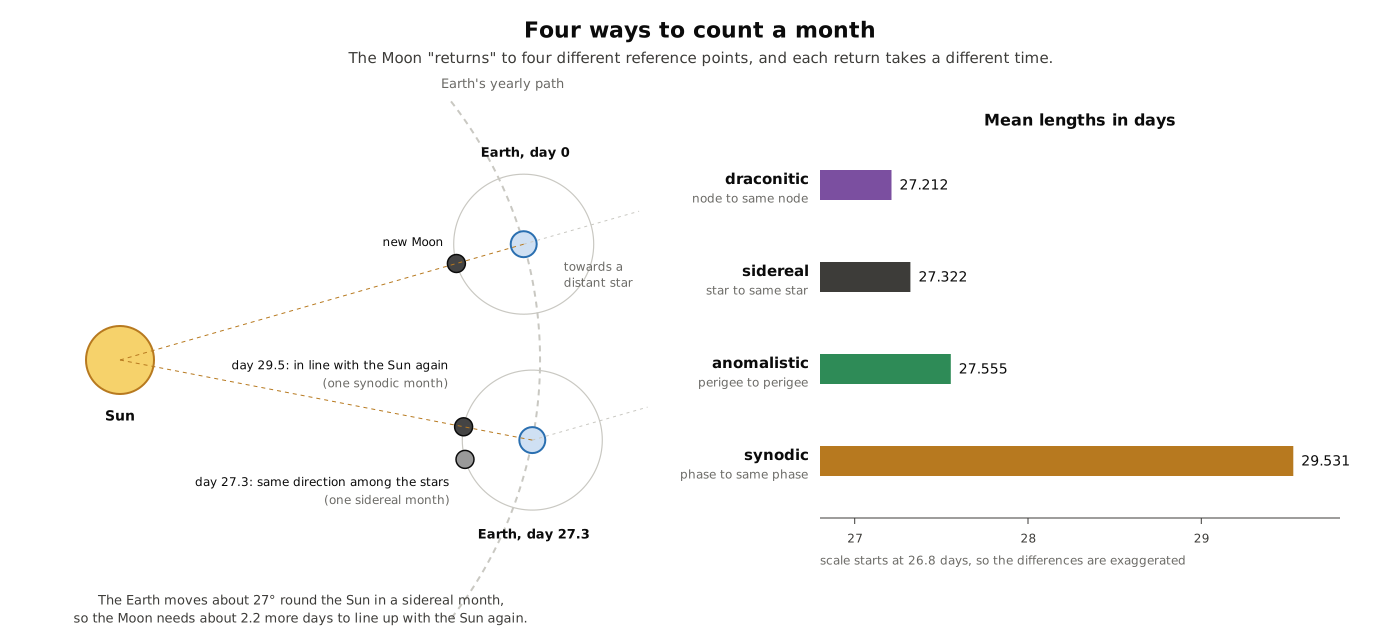
The differences are small — under two and a half days between the shortest and the longest — but they are not negligible over years. After a dozen months the draconitic and synodic counts are more than three weeks apart. A machine that tracks the Moon’s position, its phase, its speed and its eclipses must therefore carry several different lunar rates at once and keep them in their proper relation. The mechanism does exactly that, and it does it with whole numbers taken from two great coincidences.
5.4 Why Eclipses Need the Nodes
An eclipse of the Sun happens when the Moon passes in front of it; an eclipse of the Moon when the Moon passes through the Earth’s shadow. The first can happen only at new Moon, the second only at full Moon. But not every new or full Moon brings an eclipse, because the Moon’s path is tilted. Most months the new Moon passes a little north or south of the Sun, and the full Moon a little north or south of the shadow.
An eclipse needs a new or full Moon — the general term is a syzygy, from the Greek for “yoked together” — that falls close to a node. The Sun takes 346.6 days to come back to the same node (the “eclipse year”, shorter than the ordinary year because the nodes move backwards to meet it), so it passes one node or the other every 173.3 days. Around each passage there is a window, a few weeks wide, in which a syzygy can produce an eclipse. These windows are the eclipse seasons, and they come round about every five or six months. That is why eclipses cluster: two or three in a season, then nothing for nearly half a year (N08, Suppl. Box 2).
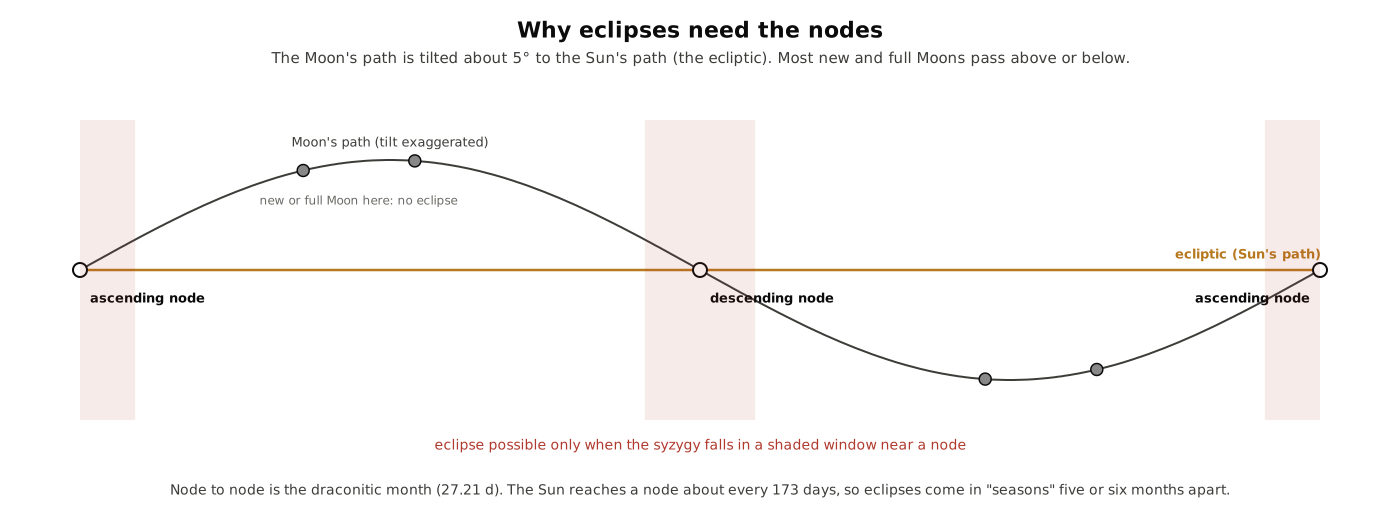
Predicting eclipses therefore needs two clocks running together: the synodic month, which says when the syzygies come, and the draconitic month, which says where the Moon is relative to the nodes at each one. A third clock, the anomalistic month, decides how big the Moon looks — its distance — and so whether a solar eclipse is total or annular and how long a lunar eclipse lasts. The Babylonian astronomers found a span of time in which all three clocks come back into step.
5.5 Babylon’s Records
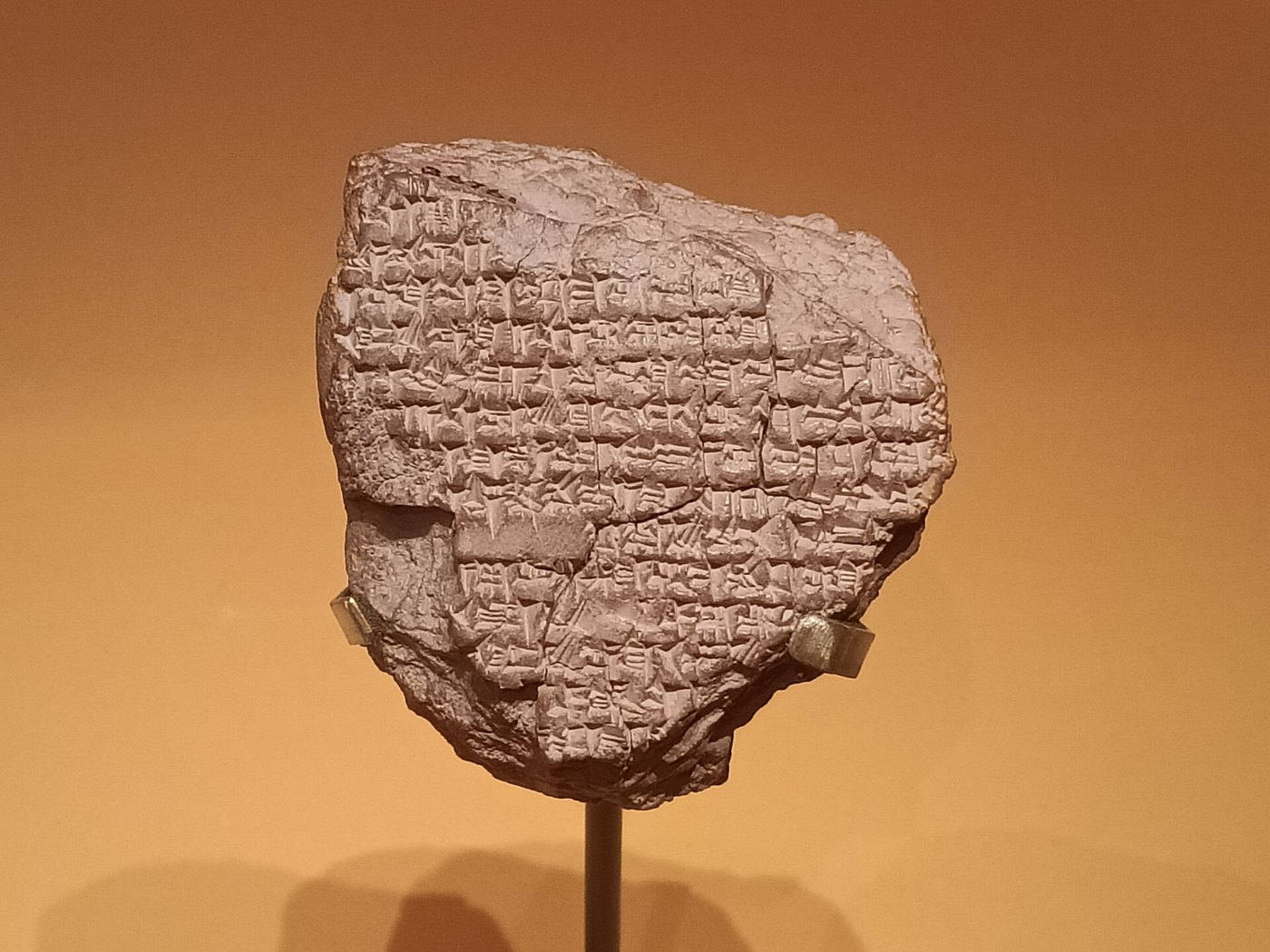
From at least the seventh century BC, astronomers at Babylon kept the observational records now called the Astronomical Diaries: for each month, night by night, the positions of the Moon and planets relative to bright stars, the times of moonrise and moonset, eclipses, weather, river levels, market prices and notable events. The tablet at the head of this volume is one month’s worth from 331 BC. The series runs for some six centuries, and from it and its successors the Babylonian scholars extracted periods: intervals after which a phenomenon recurs almost exactly.
Their methods were arithmetical. A Babylonian lunar theory does not draw circles; it tabulates numbers that rise and fall in regular steps — “zigzag functions” — and adds them up. It is extremely effective. The Babylonians could predict the dates of new Moons, the possibility of eclipses and the visibility of planets with an accuracy that Greek geometers took centuries to match, and Greek astronomers knew it: Hipparchus, the outstanding Greek astronomer of the second century BC, used the Babylonian planetary periods directly, as Ptolemy records (FJ12, §“Babylonian period relations”). The mechanism’s back dials are, in effect, Babylonian period relations cast in bronze.
5.6 The Metonic Cycle: 235 Months in 19 Years
The first coincidence is this:
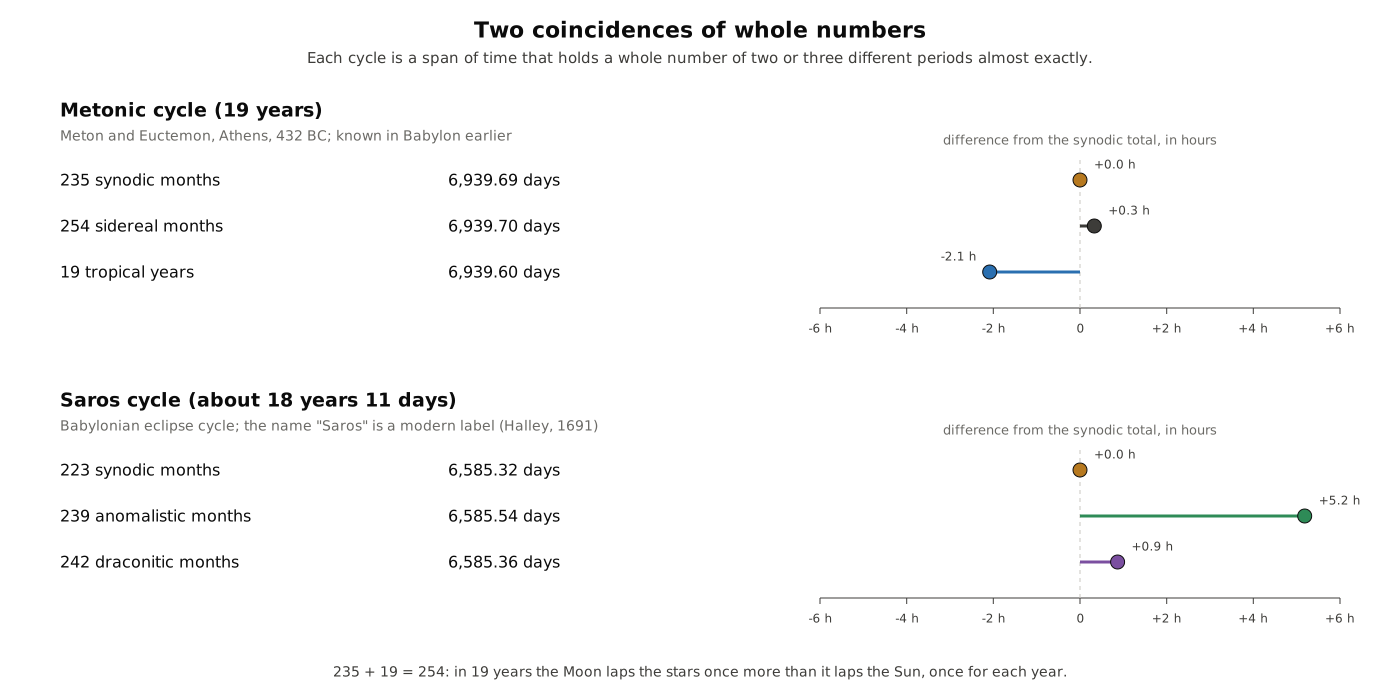
- 235 synodic months = 235 × 29.530589 = 6,939.69 days
- 19 tropical years = 19 × 365.242189 = 6,939.60 days
The two differ by about two hours. A calendar that puts seven 13-month years and twelve 12-month years into every 19 (7 × 13 + 12 × 12 = 235) stays in step with both the Moon and the seasons for centuries, drifting by only a day in about 220 years.
The Greek tradition attributes the cycle to Meton of Athens, who with Euctemon observed the summer solstice of 432 BC and proposed a 19-year cycle of 235 months containing 6,940 days, 125 “full” months of 30 days and 110 “hollow” months of 29 (N08, Suppl. Box 1). Check the arithmetic: 125 × 30 + 110 × 29 = 3,750 + 3,190 = 6,940. That makes the mean month 6,940 / 235 = 29.5319 days, too long by about 1.9 minutes, and the year 6,940 / 19 = 365.263 days, too long by about half an hour. The same 19-year intercalation pattern had been in regular use in the Babylonian calendar since the fifth century BC, where intercalary months fell in years 1, 4, 7, 9, 12 and 15 of the cycle (as a twelfth month repeated) and year 18 (as a repeated sixth month) (N08, Suppl. 3.3). Whether Meton learned the cycle from Babylon or found it himself is not known.
5.6.1 sidereal months
The Metonic cycle hides a second relation, and it is the one the mechanism’s lunar gearing is built on. In 19 years the Moon completes 235 cycles of phase. Each cycle of phase is one lap of the Moon relative to the Sun. Meanwhile the Sun itself goes round the zodiac 19 times. So the Moon’s laps relative to the stars number 235 + 19 = 254:
- 254 sidereal months = 254 × 27.321662 = 6,939.70 days
This is the relation N06 puts as “in 19 years there are 235 + 19 = 254 sidereal months”. It tells a gear designer that if one wheel turns once a year, a wheel driven from it at a ratio of 254 to 19 will turn once per sidereal month. Volume 6 shows the train that does it: 64/38 × 48/24 × 127/32 = 254/19.
5.6.2 The Callippic correction
A century after Meton, Callippus of Cyzicus noted that 6,940 days in 19 years makes the year 365 + 5/19 days, about 1/76 of a day longer than the 365¼ days then accepted. He therefore grouped four Metonic cycles together and removed one day:
- Callippic cycle = 4 × 6,940 − 1 = 27,759 days = 76 years = 940 months
That gives a year of exactly 365¼ days and a mean month of 27,759 / 940 = 29.53085 days, within about 23 seconds of the modern value (N08, Suppl. Box 1). Greek astronomers, Hipparchus and Ptolemy among them, used Callippic periods as a framework for dating observations. A fragment of the mechanism’s back-cover inscription reads “76 years, 19 years”, and the dial that once displayed the 76-year cycle is the subject of a long debate retold in Volume 8.
5.7 The Saros: 223 Months to the Same Eclipse
The second coincidence is the one that makes eclipse prediction possible:
- 223 synodic months = 6,585.32 days
- 242 draconitic months = 6,585.36 days
- 239 anomalistic months = 6,585.54 days
After 223 months the Moon is at the same phase (so a syzygy recurs), within about an hour of the same position relative to the node (so if there was an eclipse, there will be another), and within about five hours of the same point in its anomalistic cycle (so the Moon is at nearly the same distance, and the new eclipse is of nearly the same type and length). N06 sets out the three conditions in exactly this order. A record of one Saros of eclipses is therefore, with adjustments, a forecast for the next.
The cycle is about 18 years and 11⅓ days. The third of a day is crucial. 6,585.32 days is about 7.7 hours longer than a whole number of days; ancient authors took the excess as 8 hours (N08, Suppl. 4.8). Each eclipse in the next Saros therefore happens about 8 hours later in the day. For a lunar eclipse, which is visible from the whole night side of the Earth, that can move it from midnight into daylight, when it cannot be seen. For a solar eclipse, whose track crosses only part of the globe, the Earth has turned a third of a revolution further, so the track shifts about 120° of longitude west.
The Babylonian name for the period was simply the 18-year cycle. “Saros” is a modern label: Edmond Halley applied it in 1691, taking the word from a Byzantine lexicon in which the Babylonian šār, the number 3,600, had been misread as a period of years. The name stuck, and the mechanism’s lower spiral is now universally called the Saros dial.
5.7.1 Eclipse possibilities in a Saros
Babylonian astronomers knew that lunar eclipse possibilities — full Moons at which an eclipse can happen — are separated by six months or, less often, five. In one Saros of 223 months, if a gaps are six months and b are five, then 6a + 5b = 223, and the only sensible solution, with a somewhat larger than b, is a = 33 and b = 5. A Saros therefore holds 38 lunar eclipse possibilities. By distributing the five-month gaps as evenly as possible the Babylonians built prediction schemes with a characteristic pattern of 8, 7, 8, 7, 8 possibilities between five-month gaps, and repeated them indefinitely; cuneiform tablets laid out on this plan survive, as does a Demotic papyrus predicting lunar eclipses for 85–74 BC (N08, Suppl. 4.3). Volume 8 shows how closely, and where not, the glyphs on the mechanism follow that scheme.
Two more numbers fall out of the Saros relation. Since 242 − 223 = 19, the Sun passes the same node 19 times in a Saros (19 eclipse years), giving 38 node passages and 38 eclipse seasons. And since 239 − 223 = 16, there are 16 cycles of the full Moon’s apparent size — the “full Moon cycle” of about 13.9 months — in a Saros. That second figure turns out to explain why the mechanism’s Saros spiral has four turns (Volume 8).
5.7.2 The Exeligmos
Three Saros cycles bring the eight-hour shift back round to zero:
- Exeligmos = 3 × 223 = 669 months ≈ 3 × 6,585⅓ = 19,756 days, about 54 years and one month
After an Exeligmos — the Greek word means “turning of the wheel” — an eclipse recurs at nearly the same time of day. The mechanism carries a small Exeligmos dial whose three sectors tell the user whether to add 0, 8 or 16 hours to the time engraved on the Saros dial (Volume 8). The Greek astronomer Geminos, writing probably in the first century BC, describes the Exeligmos as a period of 19,756 days.
5.8 The Moon’s Uneven Pace
The cycles above deal in averages. The Moon’s real motion is not average. Over an anomalistic month it runs ahead of its mean position by up to about 6°, then falls behind by the same amount — the effect modern astronomy calls the equation of the centre, caused by the ellipticity of the orbit. To an observer who times the Moon against the stars this is obvious within a few weeks. The Babylonians modelled it with their zigzag functions. The Greeks wanted a picture.
5.8.1 Circles on circles
Greek astronomy from the fourth century BC onward held that the heavens should be described by uniform circular motion. To make uniform circles produce non-uniform motion, two devices were invented, and by the second century BC both were in use.
The first is the deferent and epicycle. A point — the centre of the epicycle — moves uniformly round a large circle, the deferent, centred on the Earth. The Moon moves uniformly round a small circle, the epicycle, centred on that point. When the Moon is on the outer side of its epicycle, moving in the same direction as the epicycle’s centre, the two motions add and the Moon appears fast; on the inner side they subtract and it appears slow.
The second is the eccentre. The Moon moves uniformly round a single circle whose centre is displaced from the Earth. Seen from the off-centre Earth, the Moon covers more degrees of sky per day when it is on the near side of the circle and fewer on the far side.
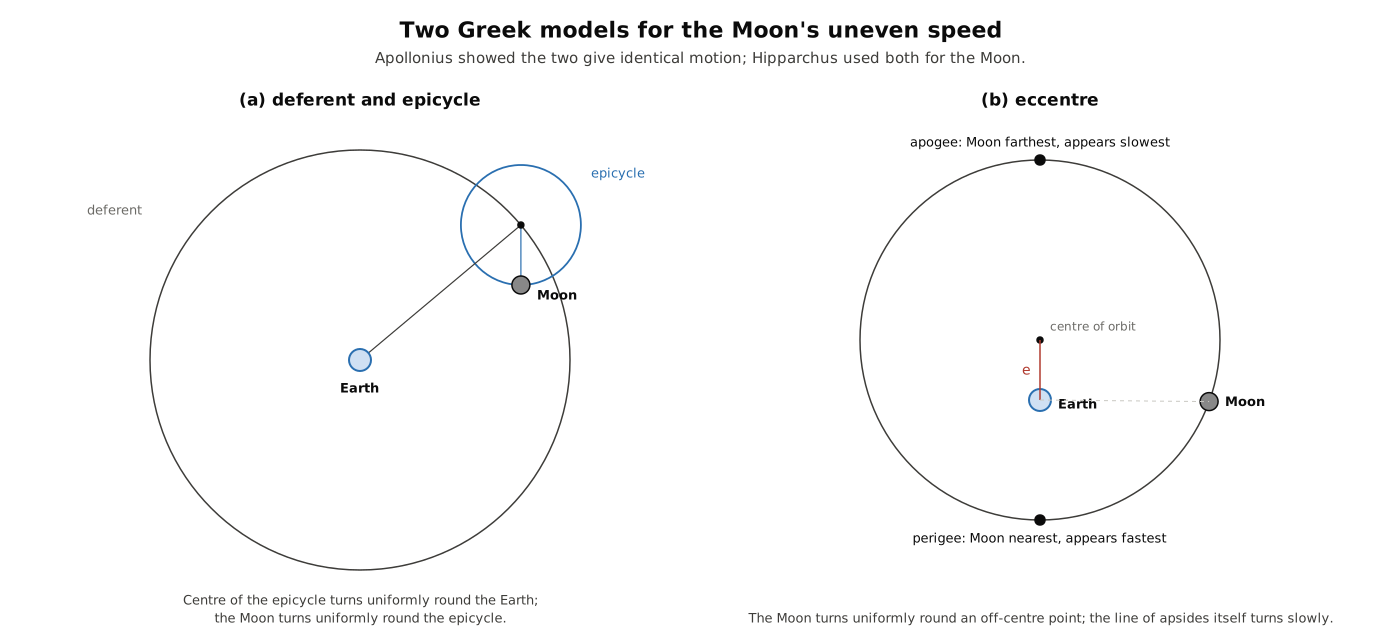
Apollonius of Perga, working around 200 BC, showed that the two models are geometrically equivalent: an epicycle of radius r gives exactly the same apparent motion as an eccentre displaced by r, provided the speeds are chosen to match. The equivalence is no curiosity. It is, as Volume 7 shows, the key to why a pin sliding in a slot can stand in for an epicycle.
5.8.2 Hipparchus and the lunar anomaly
Hipparchus worked on Rhodes and elsewhere in the middle of the second century BC; his recorded observations run from the 140s to the 120s BC. Ptolemy’s Almagest, written about AD 150, preserves much of what is known of his lunar theory, and N06 dates its development to “some time between 146 and 128 BC”.
Hipparchus used Babylonian period relations to fix the mean motions. Ptolemy reports (Almagest 4.2) that he took 126,007 days and one hour to contain 4,267 synodic months and 4,573 anomalistic months, and reduced this, dividing by 17, to 251 synodic months = 269 anomalistic months. Both check well against modern values: 4,267 synodic months are 126,007.02 days, and 4,573 anomalistic months are 126,006.96 days. He then used observed eclipses — moments when the Moon’s position is known exactly, because it must be opposite the Sun — to find the size of the epicycle. Ptolemy (Almagest 4.11) gives two results from two sets of eclipses, a ratio of epicycle to deferent of 247½ : 3,122½ from one set and 327⅔ : 3,144 from the other. The maximum lead or lag of the Moon these imply is the angle whose sine is the ratio: about 4.5° from the first, about 6.0° from the second. Those are the two figures against which N06 measured the mechanism, whose pin-and-slot gives about 6.5°; the authors judge the difference “probably not significant given the difficulty of precise measurement of the axes in the CT” (N06, Fig. 6). The modern value of the equation of the centre is about 6.3°.
A complete Greek lunar theory needs one more ingredient: the line of apsides is not fixed but turns slowly forward, once in about 8.85 years. In an eccentre model, this is the slow rotation of the eccentre’s centre round the Earth; in an epicycle model, it appears as the small difference between the rate at which the epicycle’s centre goes round (the sidereal month) and the rate at which the Moon goes round the epicycle (the anomalistic month). The two periods give it directly:
- 1/27.321662 − 1/27.554550 = 0.000309 turns per day, one turn in about 3,233 days, or 8.85 years
The mechanism’s designer derived the same rotation by a different route, from the Saros and Metonic numbers alone (Volume 6), and arrived at 8.88 years.
What the mechanism does not model is the Moon’s second anomaly, evection, which depends on the Moon’s position relative to the Sun and was discovered later. Ptolemy added it in the Almagest. Its absence is consistent with a design based on Hipparchan, not Ptolemaic, astronomy.
5.9 The Sun and the Planets, Briefly
The Sun has an anomaly of its own: the seasons are not equal in length, because the Earth’s orbit is slightly elliptical. Hipparchus measured it and modelled it with an eccentre about 1/24 of the radius off-centre. Whether the mechanism showed the true, uneven Sun as well as the mean Sun is not known; no gearing for it survives, and the question is taken up in Volume 7.
The five planets known in antiquity — Mercury, Venus, Mars, Jupiter and Saturn — were the hardest problem of all. Each moves round the zodiac, stops, goes backwards for a while (retrograde motion) and goes forwards again, in a cycle tied to its position relative to the Sun, the synodic cycle. Babylonian astronomers had period relations for each — for Venus, 5 synodic cycles in 8 years; for Saturn, 57 in 59 years — and the Greeks had epicycle models for them by the second century BC. The mechanism’s inscriptions name the planets, and its front-cover inscription records two planetary periods, 462 years for Venus and 442 years for Saturn. All the gearing that might have turned planet pointers is lost; Volume 10 treats the reconstructions.
5.10 Arithmetic Meets Geometry
What makes the Antikythera mechanism remarkable as astronomy, as distinct from engineering, is that it brings the two traditions together in one device. The back dials are Babylonian: they count months in the Metonic and Saros cycles and mark the eclipses that a Babylonian scheme predicts. The front dial is Greek: it shows the Moon moving through the zodiac with Hipparchus’s anomaly, turned by gearing that mimics an epicycle. N06 puts it plainly — the gearing is based on “the Metonic and Saros cycles, which are the bases for all the prime factors in the tooth counts of the gears”.
That sentence can be checked number by number, and the check is the best preparation for the next volume:
Table 1 — That sentence can be checked number by number, and the check is the best preparation for the next volume
| Quantity | Relation | Prime factors that appear on gears |
|---|---|---|
| Months in 19 years | 235 | 5 × 47 |
| Sidereal months in 19 years | 254 | 2 × 127 |
| Years | 19 | 19 |
| Months in a Saros | 223 | 223 (prime) |
| Turns of the Saros dial | 4 | 2 × 2 |
| Rotation of the lunar apsides | 9 × 53 / (19 × 223) turns a year | 3, 53, 19, 223 |
A gear with 127 teeth, a gear with 223 teeth and two with 53 teeth survive in the fragments, and the factor 47 appears in the 188-tooth gear (4 × 47). They are, in a sense, the most direct inscriptions on the machine: numbers taken from the sky, filed into bronze. How they are put together is the subject of Volume 6.
5.11 What a Second-Century Astronomer Would Have Needed
A designer setting out to build the mechanism around 150–100 BC would have needed:
- the Metonic relation, 235 months = 19 years, and its corollary 254 sidereal months = 19 years — both long familiar;
- the Saros relation, 223 synodic = 239 anomalistic = 242 draconitic months — Babylonian, and available to Greeks through the transmission that also gave Hipparchus his planetary periods;
- a Babylonian eclipse list or scheme to fill the Saros dial — N06 notes that “the Babylonian Saros canon is the only known source of sufficient data to construct the dial”;
- a Greek geometrical model of the lunar anomaly, with a size for the epicycle — Hipparchan in date and character;
- a local civic calendar and a list of athletic festivals — Corinthian in family, as Volume 8 shows;
- and, for the planets, Babylonian period relations refined by Greek methods (Volume 10).
None of this is exotic for a well-read Greek astronomer of the period. What is exotic is the decision to turn it all into a machine, and the skill to do it. The prime numbers in the table above had to become wheels of a size that would fit in a box about 30 centimetres across, and wheels with 223 and 127 teeth had to be divided by hand. The next volume follows the numbers into the bronze.
Next — Volume 6: Gears from the Greeks — The Gear Train. From the lost crank through the four-spoked year wheel to every surviving tooth count: the lunar train that multiplies 64/38 × 48/24 × 127/32 into exactly 254/19, why a 127-tooth wheel had to exist, the great wheel e3 that does two jobs at once, the 53-tooth gears that proved Hipparchus was in the machine, and the differential that Derek de Solla Price saw and the CT scans took away.
Comments (0)