Antikythera · Volume 11
Antikythera — Volume 11 — Who, Where, When — and Did It Ever Work?
Lettering, eclipse epochs and a rival day zero; Corinthian months, games at Dodona and Rhodes and a star calendar observed near 35° north; Archimedes, Hipparchus, Posidonius and the spheres Cicero described; and the 2025 simulation that asks whether the gears could ever have turned
11.1 About This Volume
Nothing on the Antikythera Mechanism names its maker, its owner or its workshop. Every answer to “who, where and when” is an inference from indirect evidence: the shapes of the letters, the start dates built into the dials, the calendar and festivals chosen for the back, the latitude implied by the star calendar, the astronomy embodied in the gears, and a handful of ancient texts that describe similar machines. Each kind of evidence points somewhere, and they do not all point to the same place or time.
This volume sets the evidence out in order. It separates three dates that are often confused — when the machine was made, when its dials were set to begin, and when it sank; weighs the cases for Corinth, Syracuse, Epirus and Rhodes; examines the three names most often attached to it — Archimedes, Hipparchus and Posidonius — against what Cicero actually wrote; and ends with the most basic question of all, raised sharply in 2025: whether, at the accuracy its gears were actually cut to, the machine could have worked.
11.2 Three Dates, Not One
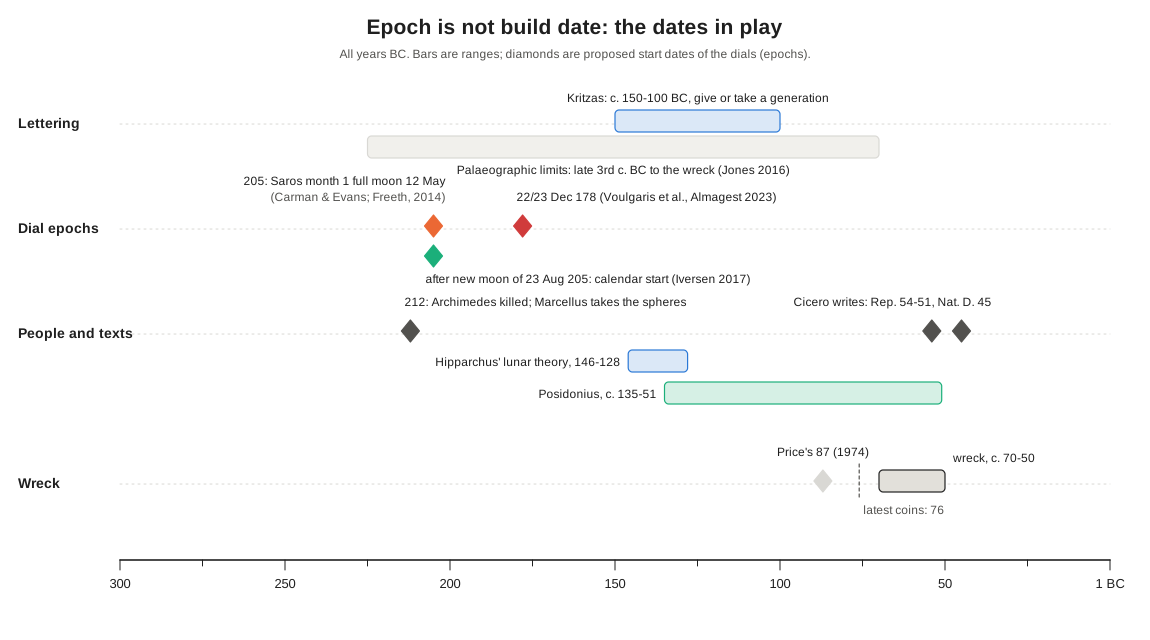
Discussion of the mechanism’s date often runs together three different things.
- The date it sank. The wreck gives a firm upper limit. Coins from the site, Pergamene tetradrachms among them, set a lower limit of 76 BC for the ship’s voyage, and its pottery belongs to the decades from the 80s to the 50s BC. The 2016 edition gives the consensus as about 70–50 BC; “c. 70–60 BC” is the common shorthand (IAM 1, n. 6; Volume 2). The mechanism cannot be younger than that.
- The date it was made. No direct evidence survives. The lettering gives a broad window (below), and arguments from style, wear and context narrow it in different directions.
- The date its dials begin — the epoch. A calendar dial or an eclipse dial has to start somewhere. The designer chose a moment at which the pointers read zero, and the dials’ cell markings encode it. That moment can be recovered by astronomy. But it is a choice of starting point, like the first page of a printed almanac, and it need not be the year the machine was built.
Keeping the three apart dissolves much of the apparent disagreement in the literature.
11.3 The Lettering
The letterforms are treated fully in Volume 9. In brief: the epigrapher Charalambos Kritzas, working from the 2005 images, put the inscriptions in “the second half of the 2nd Century BC and the beginning of the 1st Century BC, with an uncertainty of about one generation (50 years)”, giving the 150–100 BC construction date of the 2006 Nature paper. Charles Crowther preferred the late third to early first century BC; Paul Iversen allows “the end of the third to the middle of the first century bc”, written “just about anywhere in the Greek world” (Iversen 2020, below). The 2016 edition concludes that the letters establish “with high probability” a date between the late third century BC and the wreck, “[but] we cannot appeal to the letter forms to narrow this interval” (IAM 2).
The lettering therefore rules out nothing between about 225 and 65 BC. It cannot decide between the early and late dates that the other evidence suggests.
11.4 The Dial Epochs
11.4.1 BC: the eclipse dial
The Saros dial on the lower back predicts eclipses for 223 lunar months, and its glyphs mark the months in which eclipses were expected (Volume 8). The pattern of eclipse months repeats only approximately from one Saros to the next, so the sequence on the dial matches the real sky well only for start dates in particular years. Two independent studies published in 2014 used this to find the dial’s epoch.
Christián Carman and James Evans, in “On the epoch of the Antikythera mechanism and its eclipse predictor” (Archive for History of Exact Sciences 68, 2014, 693–774), applied a series of constraints — the eclipse sequence, the glyph times, the Exeligmos corrections — one after another, eliminating candidates in what they likened to a sieve of Eratosthenes. The dial works best if the full Moon of its first month fell on 12 May 205 BC, with the Exeligmos dial set to zero; that month began with the new Moon at the end of April. They also found that a Babylonian-style arithmetical scheme for eclipse times fits the inscribed hours somewhat better than a trigonometric model (ri.conicet.gov.ar record; Puget Sound news release).
Tony Freeth, in “Eclipse prediction on the ancient Greek astronomical calculating machine known as the Antikythera Mechanism” (PLoS ONE 9, 2014, e103275), worked from a new reading of the eclipse inscriptions and a reconstructed model of the glyph times. Of eight possible start dates between 250 and 1 BC that fit the sequence, only one fitted the times: the full Moon of 12 May 205 BC (−204 in astronomers’ numbering). “All the other dates are more than 10° wrong.” He was careful about what this means: the result “should be treated with due caution”, and “it should not necessarily be inferred that the date of the Antikythera Mechanism is the same … The Mechanism could, for example, have been made at a later date” (PLoS ONE).
Iversen has suggested why the designer might have chosen that month: at the full Moon of May 205 BC the Sun and Moon were both very close to their apogees — a configuration that, as Alexander Jones pointed out to him, “does not happen very often” — which makes an ideal origin for a scheme that models both their anomalies (Iversen 2020, n. 45). The 2016 edition of the back-plate texts is more reserved: its authors are “reluctant to base a firm construction date on interpretation of the eclipse cycles” (IAM 4).
11.4.2 BC: the calendar
Paul Iversen, in “The Calendar on the Antikythera Mechanism and the Corinthian Family of Calendars” (Hesperia 86, 2017, 129–203), worked from the other back dial. Reconstructing the month structure of the Metonic calendar, he concluded that “the start-up of the calendar began shortly after the astronomical new moon of August 23, 205 B.C.”, with the first month, Phoinikaios, ideally the month of the autumn equinox (abstract, ASCSA). Two independent lines of reasoning, from two different dials, therefore point to epochs in the same year.
11.4.3 BC: a rival day zero
A third proposal comes from Aristeidis Voulgaris, Christophoros Mouratidis and Andreas Vossinakis, “The Initial Calibration Date of the Antikythera Mechanism after the Saros spiral mechanical Apokatastasis”, first posted as a preprint in March 2022 (arXiv:2203.15045) and published in Almagest 14.1 (2023), 4–39. Working from Geminos’s statement that each Exeligmos cycle began on rare dates when the Moon was at the starting point of all three lunar cycles at once, they identify the start of the Saros dial’s cycle with the unusually long annular solar eclipse of 22 December 178 BC, the day before the winter solstice of 23 December, near the time of the Isia festival. They propose 22/23 December 178 BC as the ideal initial calibration date for the pointers (arXiv abstract). The proposal is theirs alone — it is sometimes misattributed to Iversen, whose date is 205 BC — and other workers continue to prefer 205 or 204 BC.
11.4.4 An epoch is not a build date
None of these epochs is a construction date. An almanac printed in one year may begin its tables in another; a perpetual calendar starts from whatever year its maker finds convenient. A designer who wanted the eclipse and calendar cycles to start cleanly would choose an astronomically clean moment, and might choose one in the past: the dials repeat — the Metonic calendar every 19 years, the Saros glyph sequence every 223 months and its times every 54 years — so a machine set to a 205 BC origin can be run forward to any later year. Iversen, whose own calendar epoch is 205 BC, argues that the machine itself was most likely made in the first half of the first century BC (Iversen 2020, below). Freeth notes that an epoch of 205 BC would bring the design “close to the life of Archimedes” and to Apollonios of Perga, who died around 190 BC, without claiming that it was built then.
11.5 Where: Corinth, Syracuse, Epirus or Rhodes?
11.5.1 The calendar
In 2008 the Antikythera Mechanism Research Project read all twelve month names on the Metonic spiral (Freeth, Jones, Steele and Bitsakis, Nature 454, 2008). They belong to the Corinthian family of Greek calendars, used by Corinth and its colonies. The authors suggested that the calendar pointed to Corinth itself or to one of its colonies — in northwestern Greece, or Syracuse in Sicily — and that a Syracusan origin might point to a connection with the school of Archimedes.
Iversen’s 2017 study narrowed the field. Several of the mechanism’s month names differ from the forms attested at Syracuse and its dependencies — the mechanism has Artemisios, Syracuse Artamitios — and “the calendar on the Antikythera Mechanism cannot be that of Syracuse”. It is “likely to be the Epirote calendar, possibly adopted from Corinthian Ambrakia” (Iversen 2017; spelling evidence as set out in Iversen 2020). The 2016 editors put it slightly more broadly: a version of the calendar of Corinth “as it was practiced either at Corinth itself or in some locality of Epirus” (IAM 4).
11.5.2 The games
The small games dial inside the Metonic spiral names a four-year cycle of festivals. Four are the great Panhellenic games — the Isthmia, Olympia, Nemea and Pythia. Two are local. One is the Naa of Dodona in Epirus, home of the oracle of Zeus, which fits an Epirote calendar. The other, whose name was undeciphered in 2008, Iversen read as the Halieia of Rhodes, games in honour of the sun-god Helios. The spelling on the mechanism, Ἁλίεια, is the Doric form: in Iversen’s count, 35 of its 37 known attestations come from Rhodes or the Rhodian mainland territory, the Peraia (Iversen 2020). A relatively minor festival of the Sun, from an island famous for its astronomers, on an astronomical machine, is a striking choice.
11.5.3 The stars
The parapegma on the front gives a third, independent pointer. The 2016 edition finds that its star risings and settings fit observations at about 35° north, “a mid-Mediterranean locality such as Rhodes or, at furthest north, southern Greece”, with Egypt much less likely and Epirus, at around 41°, “more or less out of the question” (IAM 3; Volume 9). That latitude describes where the star data came from, not necessarily where the machine was assembled, but it is consistent with Rhodes and inconsistent with an Epirote observer.
11.5.4 Rhodes for an Epirote client
Iversen’s synthesis reconciles the evidence: a machine built on Rhodes, possibly for a client from Epirus, carrying that client’s calendar and his local games alongside the Panhellenic ones and the maker’s own Halieia (Iversen 2017). In a later paper, “The Antikythera Mechanism, Rhodes, and Epeiros”, in the Festschrift for James Evans (Instruments – Observations – Theories, ed. A. Jones and C. Carman, 2020), he adds further strands: Rhodian material elsewhere in the wreck’s cargo; Rhodes as the home of Hipparchus and, later, of Geminos, whose Introduction to the Phenomena is the closest parallel to the machine’s astronomy; Posidonius’s sphere, the nearest literary parallel, made on Rhodes around the time of the wreck; the closest parallel to the machine’s planet names, an astronomical inscription from Rhodes; and Michael Wright’s estimate that such a machine had a working life of about thirty years. Taken together, he concludes, these make “the first half of the first century bc on Rhodes the most likely, if not the most attractive, candidate” — outweighing the 205 BC epoch, which he takes to be a deliberately chosen astronomical starting point (Iversen 2020, NYU Faculty Digital Archive copy).
The Rhodian hypothesis is now the most widely held, but not the only one. A minority view links the machine to Pergamon, through coins found by Cousteau’s 1976 expedition (Volume 2). And the Corinthian origin of the calendar keeps Corinth itself and its western colonies in the discussion: a machine could be built anywhere for anyone, and calendars travelled.
11.6 Who: Archimedes, Hipparchus, Posidonius
Three famous names recur in every account of the mechanism. None is attached to it by evidence on the object; each is attached by the written record of what such machines were, and who made them.
11.6.1 Archimedes and Cicero’s spheres
The fullest ancient description of a geared planetarium is in Cicero’s dialogue De re publica (On the Republic), written in the 50s BC and set in 129 BC. In Book 1, sections 21–22, the speaker Philus recalls a visit by Gaius Sulpicius Gallus — consul in 166 BC and a noted astronomer — to the house of Marcus Marcellus, whose grandfather had captured Syracuse in 212 BC. Out of all the plunder of that rich city, Cicero says, the elder Marcellus carried nothing home except a “sphere” made by Archimedes, which stayed in the family; a second, solid celestial globe by Archimedes he placed in the Temple of Virtue in Rome.
Gallus explained, as Cicero tells it, that the solid globe was an old invention — Thales had first made one, Eudoxus of Cnidus had marked the constellations on it, and Aratus had put them into verse — but that the second was different: Archimedes “had thought out a way to represent accurately”, in a single device, the unequal and different motions of the Sun, the Moon and the five planets. When Gallus set it moving, the Moon fell behind the Sun on the bronze by as many turns as it does by days in the sky, so that the device showed eclipses of the Sun, and the Moon entering the Earth’s shadow (Rep. 1.22, trans. C. W. Keyes, Loeb, 1928; NYU Archimedes sources). The 2021 UCL team modelled an “Age of the Moon” scale on the Sun’s ring of their reconstruction in deliberate echo of this passage (Volume 10).
Cicero mentions the device again in the Tusculan Disputations (1.63): Archimedes “fastened on a globe the movements of moon, sun and five wandering stars”. Later authors repeat the story — Ovid’s “globe hung by Syracusan art” (Fasti 6.277–279), Lactantius’s “likeness … of the universe in hollow brass”, Claudian’s poem on Archimedes’ sphere — and Pappus of Alexandria records that Archimedes wrote a book On Sphere-Making, which is lost.
The Archimedes connection rests on three things: these texts, the 2008 suggestion of a Syracusan calendar, and the early epoch of 205 BC, seven years after his death. The first shows that machines of this kind existed a century and a half before the wreck. The second has been answered by Iversen’s finding that the calendar is not Syracusan. The third is an epoch, not a build date. The most that can be said is that the mechanism belongs to a tradition of sphere-making that ancient writers traced to Archimedes.

11.6.2 Hipparchus
Hipparchus, the greatest astronomer of the second century BC, worked for much of his career on Rhodes. The mechanism’s pin-and-slot lunar gearing reproduces a theory of the Moon’s varying speed that Hipparchus developed “some time between 146 and 128 BC” (Freeth et al. 2006, Nature 444). The amplitude built into the gears, about 6.5°, is in the range of his parameters, though not equal to either of the two values Ptolemy attributes to him. The 2006 authors were careful: “It is tempting to associate the conception of the mechanism with Hipparchos himself, but he was not the first to assume eccentric or epicyclic models.” The lunar theory places the design in the world of Rhodian astronomy in or after the mid-second century BC — or, if the epoch of 205 BC reflects the design date, shows that a comparable lunar model existed before Hipparchus. It does not place Hipparchus at the workbench.
11.6.3 Posidonius
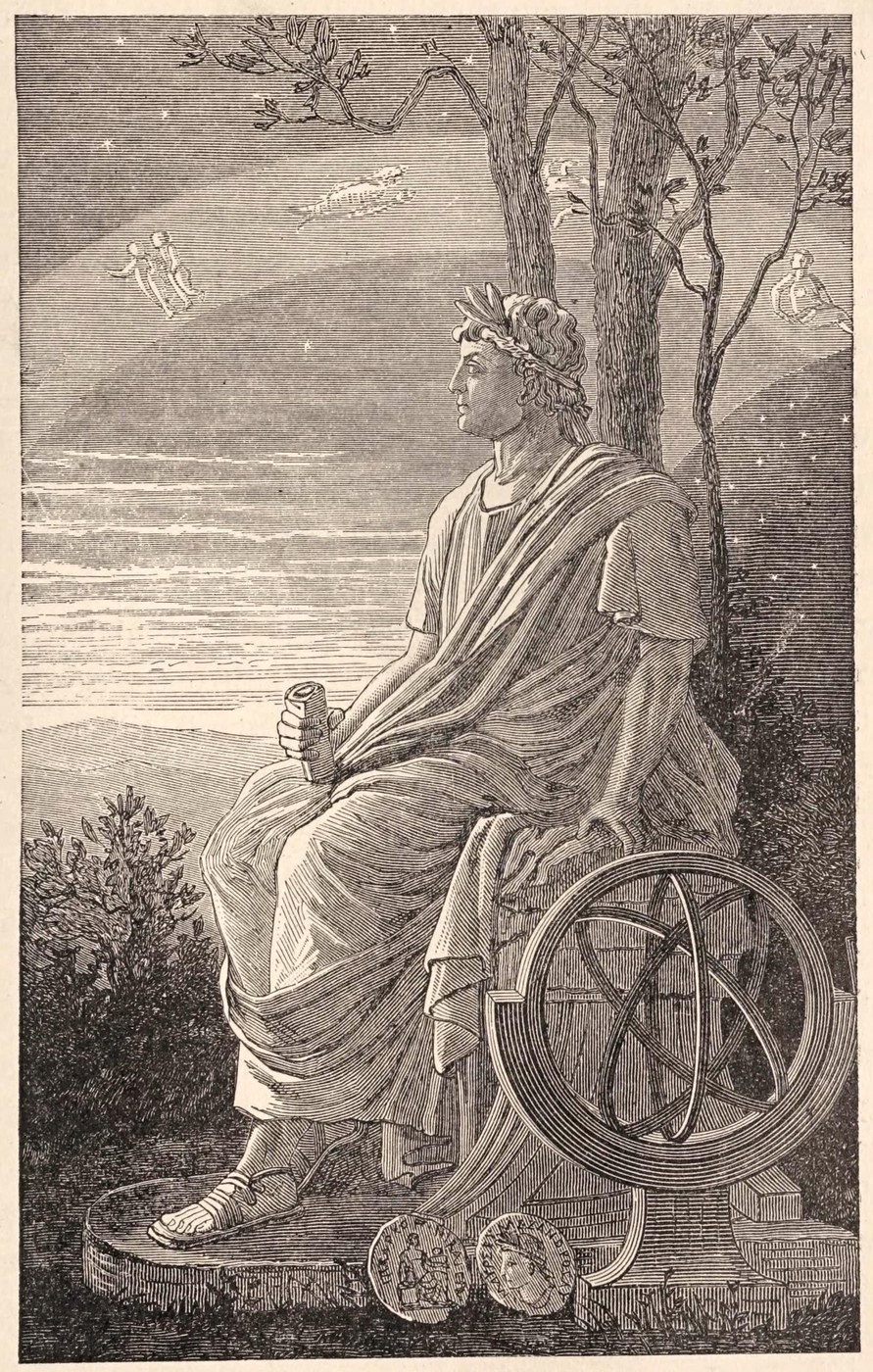
The other Ciceronian sphere is Rhodian and close in time to the wreck. In De natura deorum (On the Nature of the Gods), written in 45 BC, the Stoic speaker argues that no one, shown “the orrery recently constructed by our friend Posidonius”, which “at each revolution reproduces the same motions of the sun, the moon and the five planets” as take place in the heavens, could doubt that it was the work of reason — even if it were carried to Scythia or Britain (Nat. D. 2.88, Loeb translation). Posidonius of Apamea (c. 135–51 BC), philosopher, historian and astronomer, ran a school on Rhodes, where Cicero himself had studied with him.
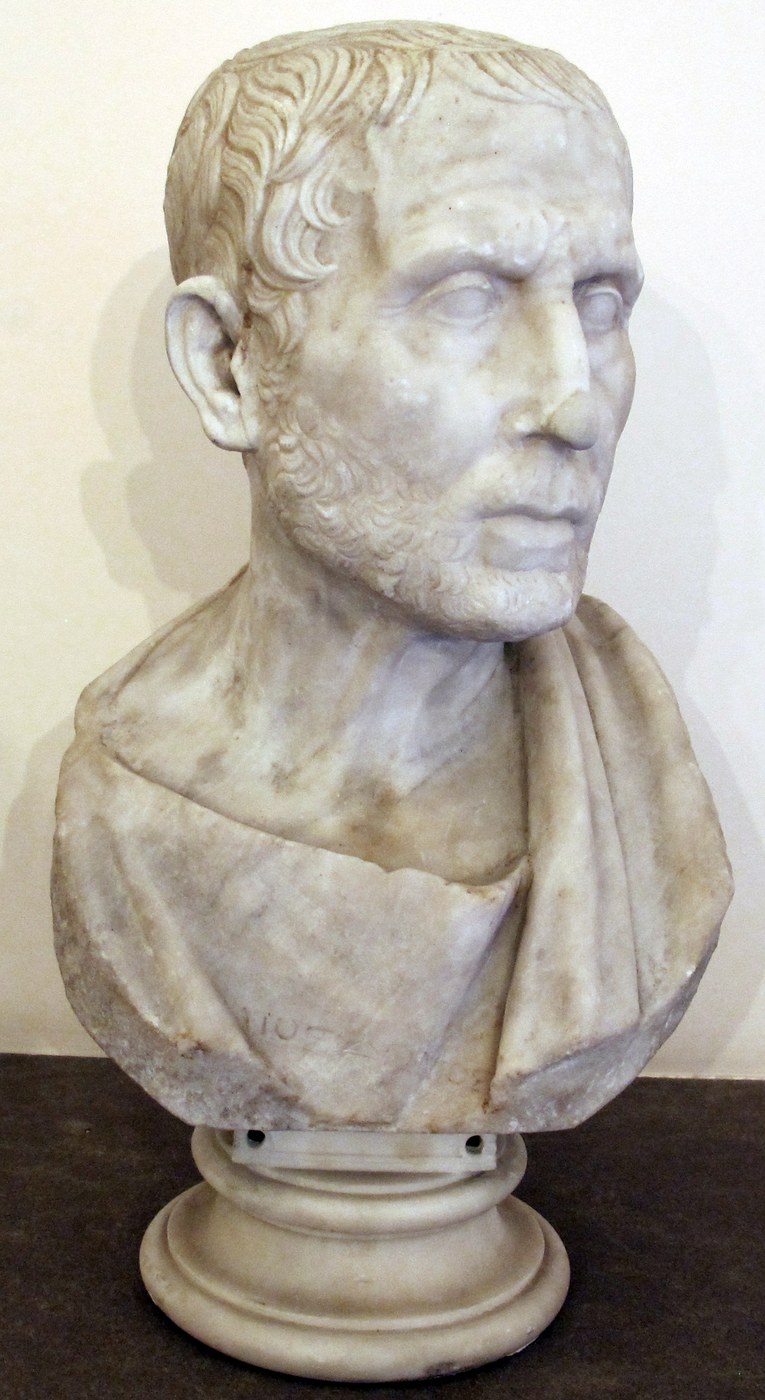
A device of exactly the right kind, made on Rhodes by a man alive when the ship sailed, is an obvious candidate, and the Rhodian hypothesis is sometimes put as “built in Posidonius’s school”. It cannot be more than that. Cicero says Posidonius made a sphere; he does not say only one existed, or describe its dials, and the Antikythera machine was evidently made for a client with an Epirote calendar. Tony Freeth posed the question in the title of a 2002 paper — “Is it Posidonius’ orrery?” — and the evidence still allows only a question mark.
11.6.4 A tradition, not a lone genius
What the texts do establish is that the Antikythera Mechanism was not unique. Archimedes made one such machine in the third century BC; Posidonius made another in the first; Cicero could assume that his readers knew what a “sphere” of this kind was. Pappus knew of a book on how to make them. The mechanism’s sophistication, its economy of gearing and its finished engraving are those of a mature craft with a history behind it, and its maker is best thought of as a member of that tradition, perhaps a workshop, rather than as an isolated genius whose name happens to be known.
11.7 Did It Ever Work?
11.7.1 Edmunds’s measurements, 2011
The question was put on a quantitative footing by Mike Edmunds, the astrophysicist who led the AMRP, in “An initial assessment of the accuracy of the gear trains in the Antikythera Mechanism” (Journal for the History of Astronomy 42, 2011, 307–320). From the CT data he measured how far each surviving tooth tip lay from its ideal position. He found two kinds of error: a random scatter in tooth placement in every gear, between about 4 and 8 per cent of the tooth spacing, and in some gears a systematic sinusoidal shift of up to about 2°, caused either by an off-centre axis or by the way the teeth were marked out on the blank. Modelling the gear trains with these errors, he concluded that the Metonic and Saros pointers would have been accurate enough to show their cells, but that the lunar pointer’s error would obscure the very anomaly the pin-and-slot was built to show. The machine, he suggested, was more a display or teaching device than an instrument for precise calculation.
11.7.2 The Mar del Plata simulation, 2025
In April 2025 Esteban Szigety and Gustavo Arenas of the National University of Mar del Plata posted “The Impact of Triangular-Toothed Gears on the Functionality of the Antikythera Mechanism” (arXiv:2504.00327). They combined Alan Thorndike’s analytical solution for the uneven motion of triangular teeth (published in the Evans Festschrift, 2020) with Edmunds’s error model, and simulated each meshing pair of the surviving trains in software.
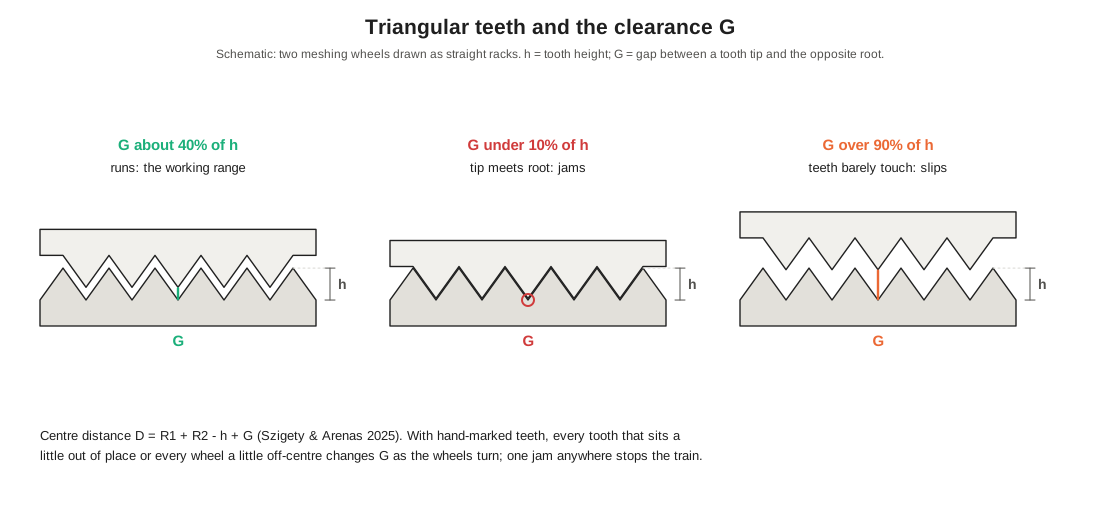
Their first finding was reassuring: triangular teeth, perfectly made, introduce errors on average about seven times smaller than Edmunds’s manufacturing errors — negligible. The second was not. Two meshing wheels must be set at a centre distance that leaves a clearance between each tooth tip and the opposite root. Too little clearance, and a tip strikes a root and the train jams; too much, and the teeth barely engage and slip. In their model a clearance below about 10 per cent of the tooth height jams, one above about 90 per cent disengages, and around 40 per cent is best. Random tooth errors and off-centre axes make the clearance vary as the wheels turn. Running 200 trials for each gear pair under Edmunds’s four error scenarios, and accepting at most a 1 per cent failure rate per pair, they found the two larger-error scenarios unusable, and even the second-smallest problematic for two pairs on the large wheels. “A mechanism with the errors found by Edmunds would generally stop after the solar pointer completed one-third (120°) of its full rotation” — about four months of simulated time — and a single jam anywhere stops the whole train, since every gear is driven from one input (Szigety and Arenas 2025).
Their conclusion is two-sided: “either the mechanism never functioned, or its errors were smaller than those found by Edmunds.” And they come down on the second side: “While it is conceivable — though unlikely — that someone would go to the trouble of constructing such a complex yet non-functional device, there are strong reasons to question whether Edmunds’ values accurately represent the mechanism’s original errors.” They give three: two thousand years of corrosion may have deformed the gears; the CT resolution may not locate tooth tips and roots precisely; and many gears are incomplete. Their final estimate is that the mechanism “could have functioned better than Case B and slightly worse than Case A”, with errors still small enough to do the proportional calculations it was designed for. The abstract itself warns that “our results must be interpreted with caution” (arXiv).
11.7.3 The counter-arguments
The popular coverage — “the Antikythera Mechanism jams after four months”, “it may have been a toy” — went further than the paper. The strongest counter-arguments are the authors’ own: the error measurements come from corroded, incomplete gears seen through tomography of limited resolution, and the simulation assumes perfectly circular, flat, coplanar gears with straight-sided symmetrical teeth, so other real-world departures are unmodelled in both directions. A maker would presumably also have adjusted centre distances by trial, filing and re-seating until a train ran — a step no simulation of measured fragments can reproduce.
The object itself argues for use. The Back Cover Inscription appears to describe how to reset the Metonic pointer when it reaches the end of its spiral (Volume 9); the calendar ring was made movable so that it could be kept in step with the year; the dials carry corrections — omitted days, Exeligmos hours — that only matter to someone reading results over years. Wright’s estimate of a working life of about thirty years presupposes a machine that was turned. And modern hand-made replicas with triangular teeth, described in Volume 13, do run, though they are made with modern measuring tools and show only that the design can work, not that the original did.
The fairest summary is that the question is open. The measured errors may be inflated by corrosion; the original may have run stiffly, been adjusted often, or been turned gently through short spans of time to demonstrate the heavens rather than to compute them. Edmunds’s description of a display or teaching device and the Back Cover Inscription’s address to a viewer point the same way: a machine meant to be shown working, which need not have run smoothly for years to do that.
11.8 What Can Be Said
The mechanism sank around 70–60 BC, or at the latest about 50 BC. Its lettering allows any date from the late third century BC to then. Its eclipse dial and its calendar were both set to begin in 205 BC, a deliberately chosen, astronomically clean origin; a rival reading sets the origin at a December eclipse of 178 BC. Neither is a build date, and the strongest synthesis puts manufacture in the first half of the first century BC. Its calendar is Corinthian in type and most likely Epirote; its games include Dodona’s and, very probably, Rhodes’s own festival of the Sun; its star calendar was observed near the latitude of Rhodes; and Rhodes, the island of Hipparchus and Posidonius, is the most likely place it was made, perhaps for an Epirote client. Archimedes, Hipparchus and Posidonius each belong to its story through the tradition of sphere-making and the astronomy it embodies, not through any evidence on the object. And whether it ran smoothly, stiffly or barely at all depends on how far two millennia of corrosion have distorted the measurements of its teeth.
Next — Volume 12: A Thousand Years of Silence — From Byzantium to the Astronomical Clock. After the ship went down, nothing so complex survives for more than a millennium — but gears did not vanish. Odometers in Vitruvius and Heron; a Byzantine pocket sundial with a calendar gear train; al-Bīrūnī’s geared Moon box and a geared astrolabe from Isfahan; Su Song’s water-driven clock tower; and in fourteenth-century Europe, Richard of Wallingford’s clock and Giovanni de’ Dondi’s seven-faced astrarium. Then the mechanism’s place at the head of the history of analog computing.
Comments (0)