Antikythera · Volume 13
Antikythera — Volume 13 — Rebuilding It — Replicas from Price to Clickspring
A century of brass, Perspex, Lego, watch movements and laser-cut plastic: what each rebuilding of the mechanism was trying to prove, and what it got right
13.1 About This Volume
Volume 12 followed the long silence after the mechanism went into the sea, and the slow return of geared astronomy in Byzantium, the Islamic world and medieval Europe. This volume is about a different kind of return: the attempts, since the 1900s, to build the machine again. Every serious reconstruction of the Antikythera Mechanism is also an argument. A model built in 1930 says what one naval officer thought the corroded lumps were. A model built in 1980 says what Derek de Solla Price’s radiographs showed him, and it carries his mistakes. A model built in 2006 says that Michael Wright’s tomography had overturned them. Read in order, the replicas are a second history of the research, written in metal, Perspex, plastic and, in one case, Lego.
The volume runs roughly in date order: the first models of the 1900s–1930s; Price’s model and the Bromley–Percival machine; Wright’s working reconstruction; the museum and workshop replicas of Kostas Kotsanas and others; the Swiss watch movement of 2011; Andrew Carol’s Lego machine of 2010; Chris Budiselic’s Clickspring project, the most ambitious hand-made reconstruction yet attempted; the 10× replica at the University of Sonora; the computer and physical models of Tony Freeth and the UCL team; and the hobby models anyone can print. It ends with the mechanism’s life on screen. The question kept in view throughout is the same one Volume 11 asked of the original: what does this object actually show, and how much of it is evidence and how much reconstruction?
Two warnings apply to every replica in this volume. First, the original’s front face and its planetary gearing are almost entirely lost (Volumes 7 and 10), so every front dial on every replica is a hypothesis. Second, a replica that works does not prove the original worked the same way. It proves only that the proposed design is mechanically possible with the replica’s materials and tolerances.
13.2 The First Models: Theophanidis and the “Ploognomon”
The first person known to have built a mechanical model of the mechanism was the Greek naval officer Ioannis Theophanidis, who studied the fragments in the decades after Valerios Stais noticed the gear wheel in 1902 (Volume 3). Theophanidis read the device as a navigational instrument and gave it the name ploognomon — roughly, “voyage indicator” — and he published his interpretation in 1928 and 1934 (National Archaeological Museum research timeline). His model is now of historical interest only: it was built from what could be seen on the surfaces of the fragments, before anyone could look inside them, and the navigational reading did not survive. It matters because it establishes a pattern that has held ever since. Each generation’s model fixes the state of knowledge at the moment it was built.
The German philologist Albert Rehm, working around 1905, had already recognised the device as astronomical and drawn a gear train (Volume 3). Rehm’s reading, and not Theophanidis’s, pointed the way the research eventually went.
13.3 Price’s Model (1970s–1980)
Derek de Solla Price’s Gears from the Greeks (1974) was the first reconstruction grounded in a look inside the fragments: the gamma- and X-ray radiographs made by Charalambos Karakalos at the Demokritos research centre in 1971 (Volume 3). Price used them to count teeth, identify gear trains and propose a complete mechanism. A physical model based on his work was built and given by Price to the National Archaeological Museum in Athens in 1980, where it is still displayed beside the fragments.
The museum label for the Price model, as recorded on its Wikimedia Commons photograph, describes a rectangular box of 33 × 17 × 10 cm carrying plates with Greek inscriptions, and “a complex set of 32 gears of various sizes.” It adds, with unusual frankness for a museum label, that the model “remains the reference for the study of the original despite the fact that its construction has been subject to much criticism” (Commons file description, NAMA inv. BE 109/1980).

The criticism is specific. Price proposed a differential gear to subtract the Sun’s motion from the Moon’s and so drive a lunar-phase display. No differential exists in the fragments; Wright later showed that the phase display was driven by a small separate train, and the 2005 CT scans confirmed it. Price also read the back dials as sets of concentric rings rather than as spirals, and he had no inkling of the eclipse glyphs, the games dial or the pin-and-slot lunar anomaly (Volumes 6 and 8). None of this diminishes the achievement. Price had radiographs, not tomography, and his model put the mechanism into museums, textbooks and the phrase “an ancient Greek computer.” It is a model of 1974 knowledge, honestly labelled as such.
13.4 The Bromley–Percival Machine
The Sydney computer scientist Allan Bromley began to question Price’s reconstruction in the 1980s. He did so partly by building: the Sydney clockmaker Frank Percival made a working model to Bromley’s design, which is now in the University of Sydney’s collection (formerly the Nicholson Museum, now the Chau Chak Wing Museum); it is pictured in Volume 4. Bromley went on to collaborate with Michael Wright on X-ray work in Athens in the 1990s (Volume 4).
The Bromley–Percival machine is the first replica in this story built mainly as an experiment rather than a display. A model can be wrong in a way that a drawing cannot hide: gears that look fine on paper may not mesh at the tooth counts proposed, or may collide on the arbors available. Building Price’s scheme showed where it strained. The machine is also a reminder that the research on the mechanism has always depended on people outside classics — a computer scientist and a clockmaker in this case, a museum engineer in the next.
The later falling-out between Bromley and Wright over access to their joint images, as told in Jo Marchant’s Decoding the Heavens (2008), is contested by people who knew both men and is not retold here.
13.5 Michael Wright’s Reconstruction
Michael T. Wright, curator of mechanical engineering at the Science Museum in London, did more than anyone before the 2005 imaging to replace Price’s picture of the mechanism. Working with Bromley, and using linear X-ray tomography — a technique suggested to him by the retired radiologist Alan Partridge — he rejected the differential, identified a gear in Fragment C as part of a moon-phase display, raised Price’s count of identified gears from 27 to 31, and was the first to read the upper back dial as a five-turn spiral of 235 months (Wikipedia, “Michael T. Wright (curator)”).
Wright then built the whole machine. His reconstruction added a planetarium display on the front, with pointers for the Sun, the Moon, the inner planets Mercury and Venus, and the outer planets Mars, Jupiter and Saturn, using epicyclic gearing of a kind that Greek astronomy and Greek mechanics could have supplied. He set out his planetary proposal in the early 2000s (the brief for this series dates the working model to 2002) and, by the account of his Wikipedia biography, completed what he considered an almost exact replica in 2006, presenting it at the National Hellenic Research Foundation in Athens on 6 March 2007. The dates differ between sources because the model grew in stages; the 2006–07 machine is the complete one.
Two features of Wright’s model have lasted. The first is the pointer-style planetary display: separate concentric pointers, one per body, each read against the zodiac ring. Freeth and Jones adopted the same idea in 2012 (Volume 10), and most later replicas, including the kit described in Volume 14, follow it. The second is the moon-phase ball, half silver and half black, turned by a small gear train so that it shows how much of the Moon is lit. Wright’s lower back dial was more tentative; he linked it to eclipse prediction, and he accepted the Antikythera Mechanism Research Project’s revision of it after 2006. A Wright model is on display in Athens alongside the fragments and the Price model.
13.6 Kotsanas and the Museum Replicas
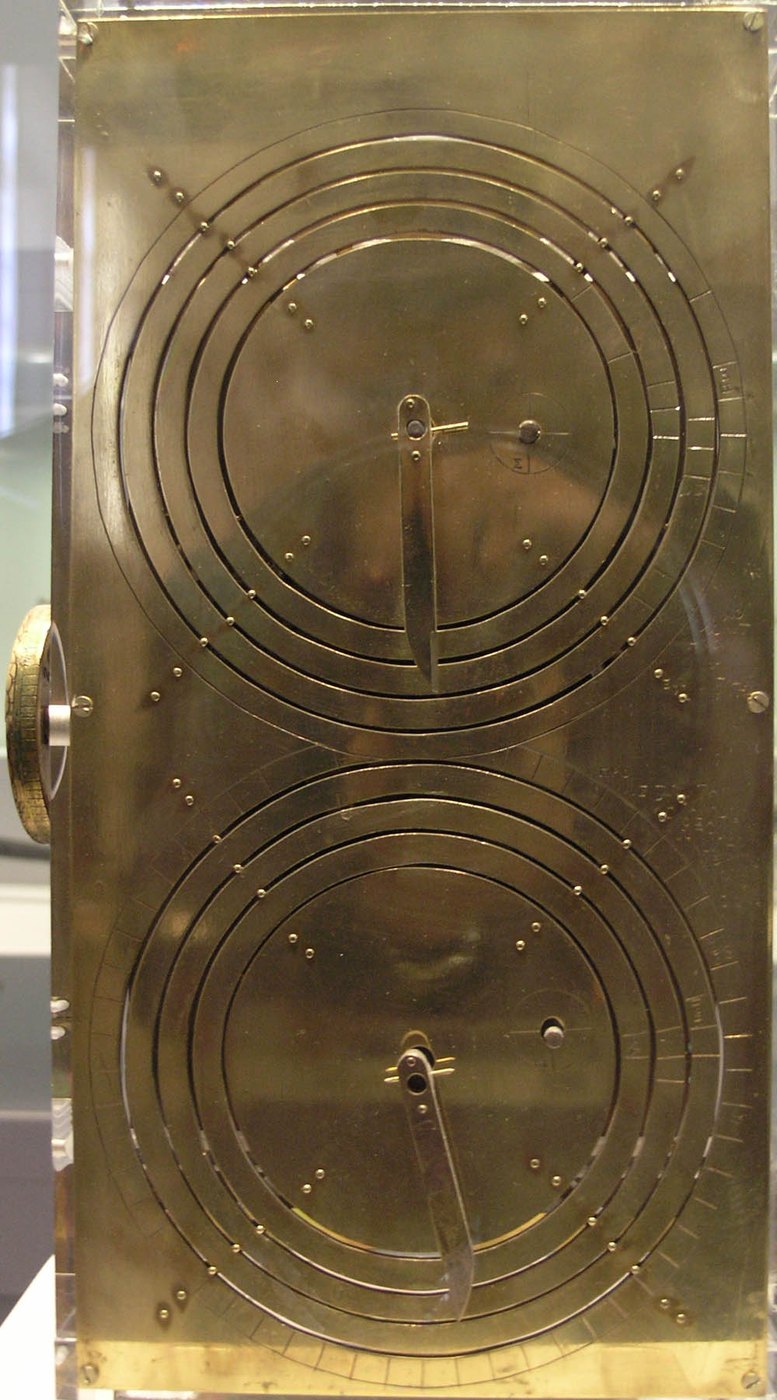
Outside the research projects, the mechanism became one of the best-represented objects of ancient technology in museum workshops. The most widely seen are the reconstructions by the Greek researcher of ancient technology Kostas Kotsanas, displayed in the Kotsanas Museum of Ancient Greek Technology in Athens and in his travelling exhibitions. They are presentation pieces: bronze-coloured plates, legible inscriptions, working front and back dials, and a hand crank on the side, built to show visitors how the machine was used.
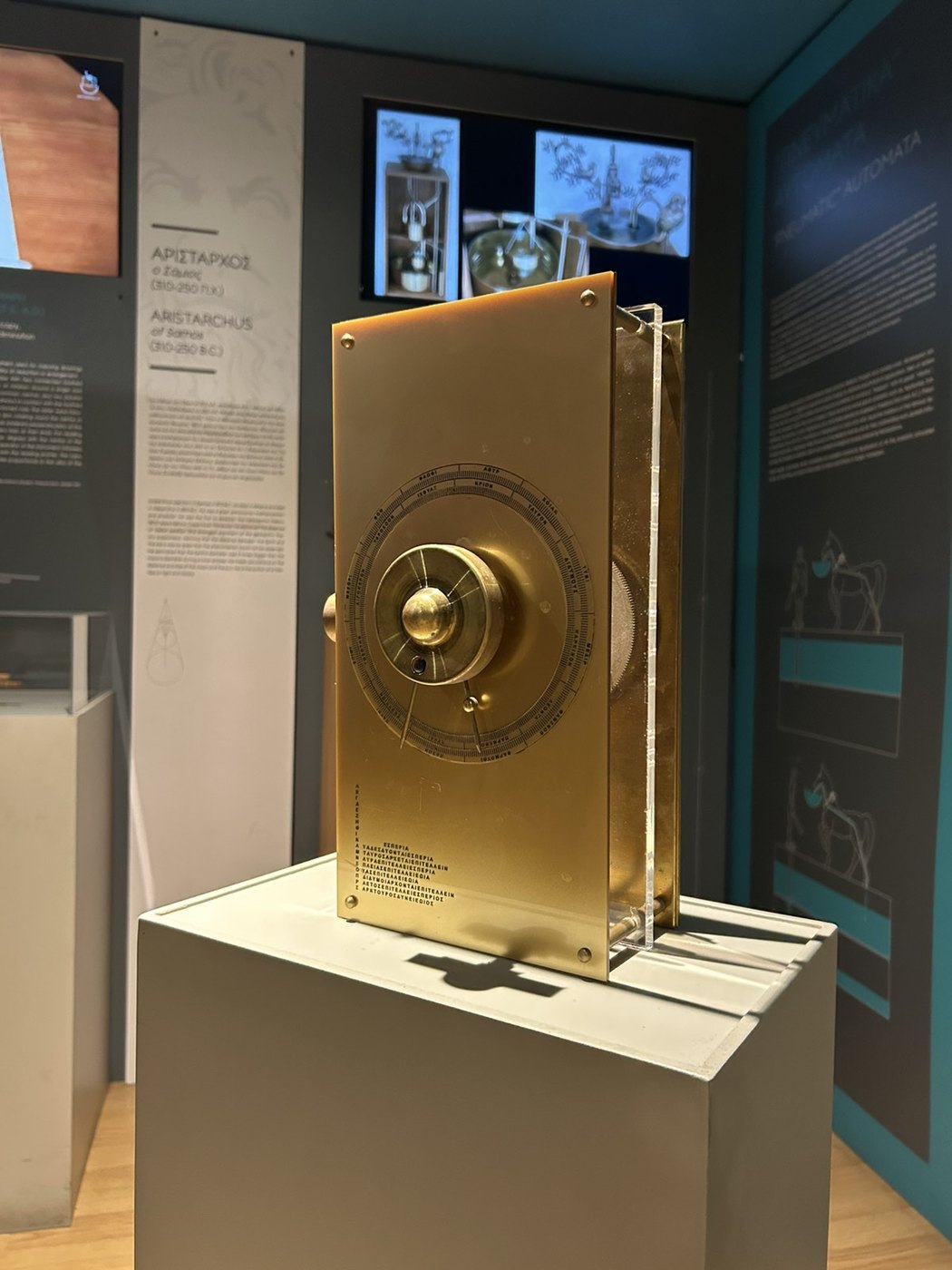
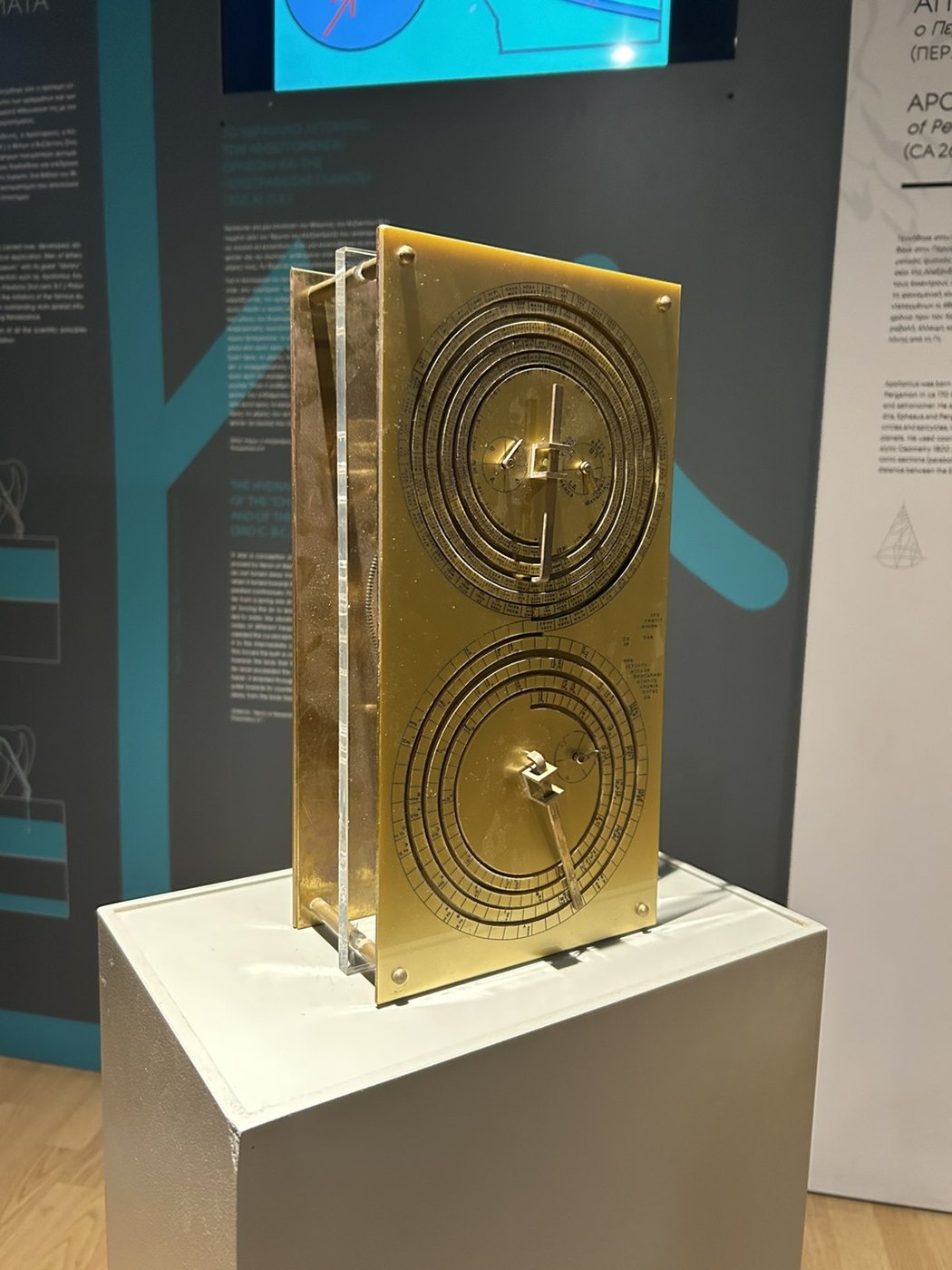
The Kotsanas back face is a useful image of what the research of 2006–2008 established: two large spirals with followers, subsidiary dials inside them, and the eclipse cells of the lower spiral. The front, like every front, is a choice among hypotheses.
Other museums show their own replicas. The Musée des Arts et Métiers in Paris displays a large brass reconstruction; it was also where Hublot unveiled its watch movement in 2011 (below). Its maker is not identified on the photograph used here.
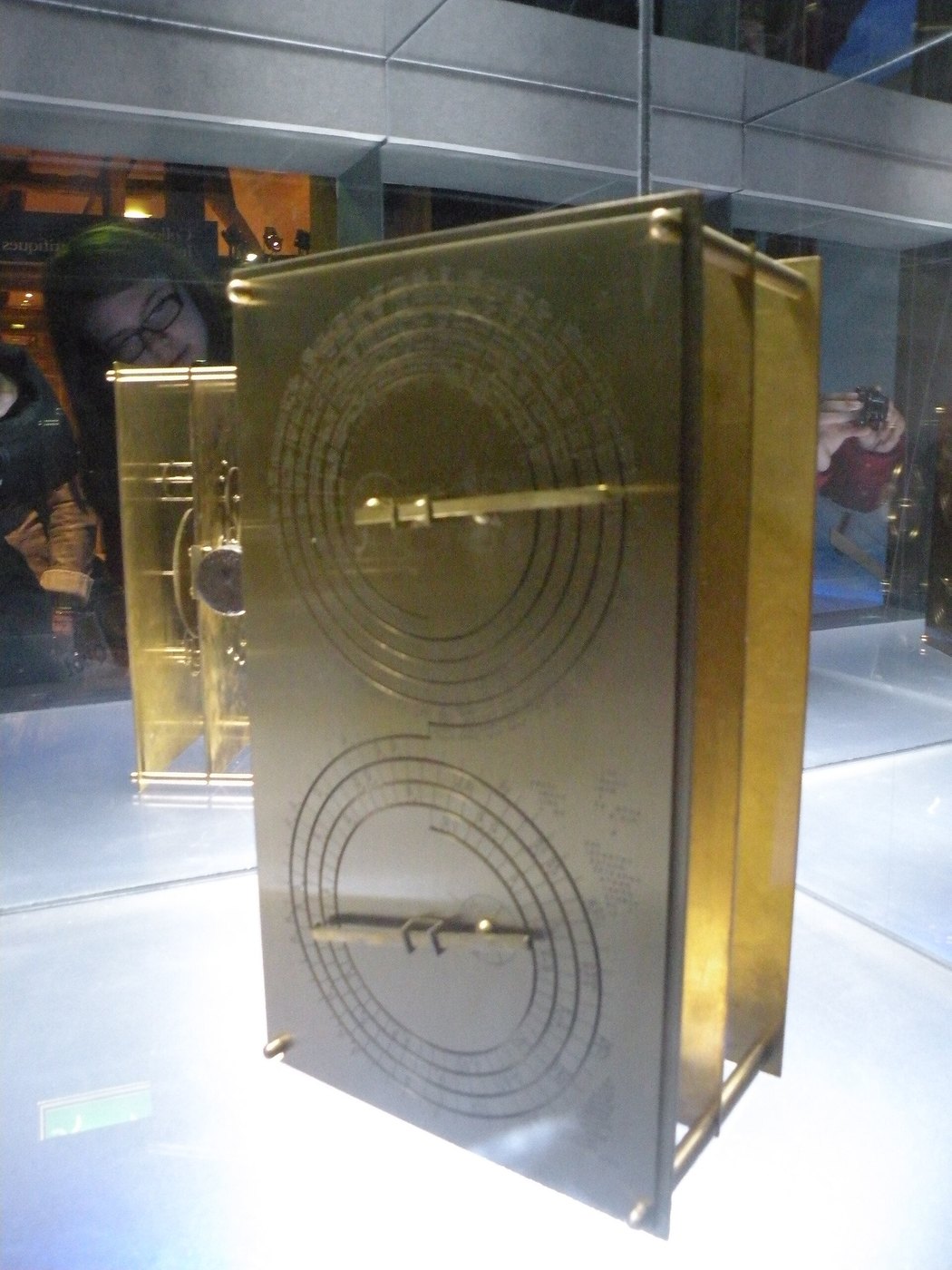
13.7 Hublot’s Tribute Movement (2011)
In October 2011 the Swiss watchmaker Hublot unveiled, at the Musée des Arts et Métiers, a wristwatch-sized mechanical movement it called a tribute to the Antikythera Mechanism. The project was led by Mathias Buttet, then Hublot’s director of research and development, with advice from members of the research community. The movement packs the original’s double-sided layout into a watch: on one side, the Egyptian calendar, the games cycle and the positions of the Sun and Moon in the zodiac; on the other, the Callippic, Metonic, Saros and triple-Saros (Exeligmos) cycles. It adds a tourbillon, which the original certainly did not have.
Hublot’s chairman Jean-Claude Biver limited the run to four movements, not offered for sale. By the brand’s account the first stayed with the Paris museum, the second was accepted into the collection of the National Archaeological Museum in Athens on 5 April 2012 — the first time that museum had taken a watchmaker’s movement — the third was to be auctioned to raise funds for the study and conservation of the original, and the fourth was kept by Hublot (La Côte des Montres; GPHG). Sources differ slightly on the fate of the third and fourth; the four-movement total is consistent. A wearable follow-up, the Antikythera SunMoon, appeared at Baselworld in 2013.
The Hublot movement proves something different from the research models: that the cycles of the mechanism — the ratios the Greek designer chose — can be rendered at watch scale with modern tooling. It says little about the original’s gear trains, which it does not copy.
13.8 Andrew Carol’s Lego Machine (2010)
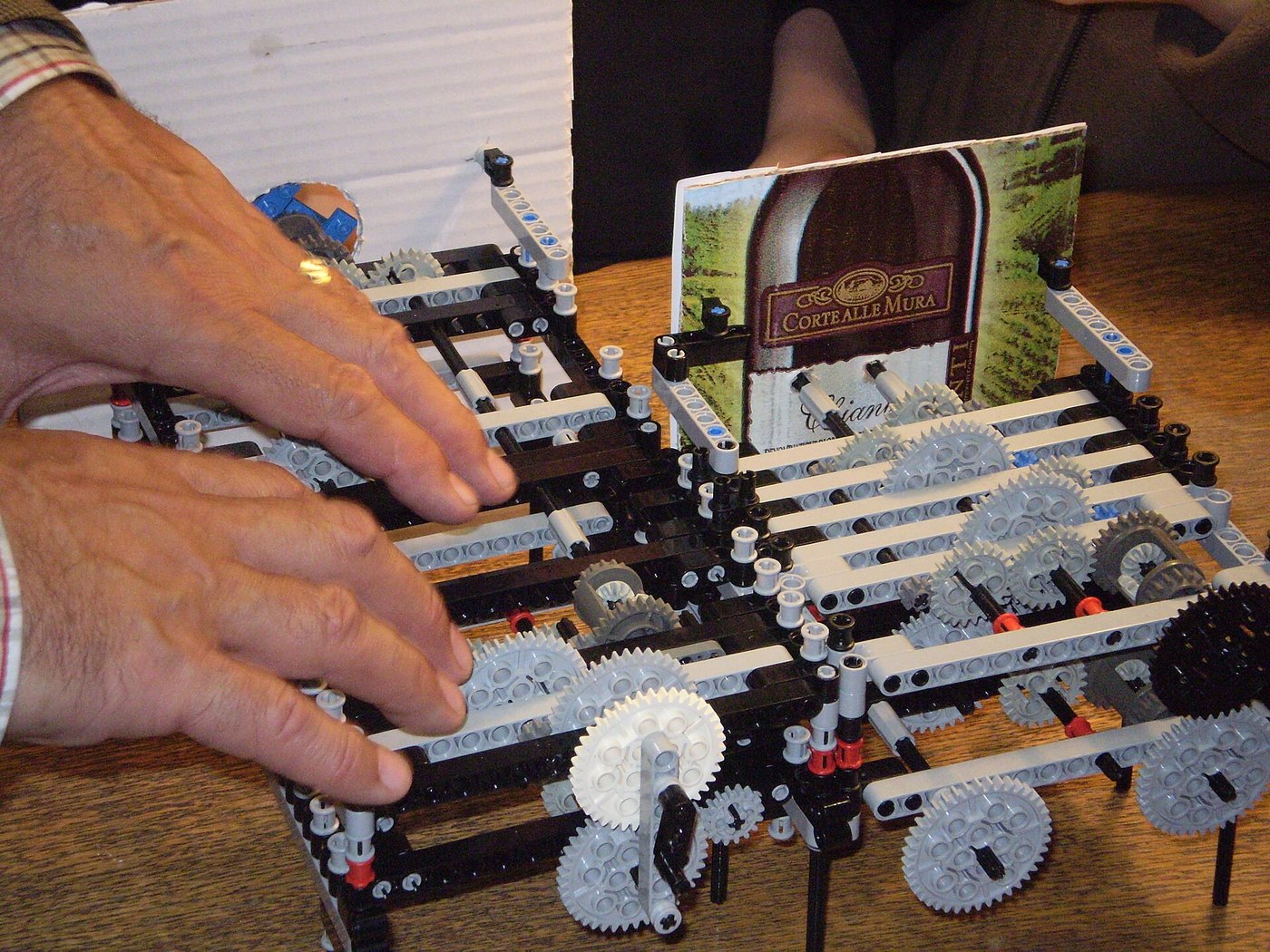
The most widely watched replica is made of Lego. Andrew Carol, a software engineer at Apple, completed a working Antikythera mechanism from Lego Technic in May 2010, after about 30 days of work. It used more than 1,500 parts and more than 100 gears, arranged in modules that each perform one calculation, with seven differentials reconciling their outputs. By the account in Archaeology, it predicts eclipses to within about 24 hours, against roughly 12 hours for the original (Archaeology, March/April 2011). A short film of the machine was made for Nature by John Pavlus (MIT Technology Review, 2010).
The differentials are the giveaway that this is a functional rather than a historical replica. Lego gears come in a few fixed tooth counts, so the original’s ratios — 223, 127, 53 and the rest — cannot be reproduced directly. Carol had to synthesise them from what Lego offers, and differentials are the natural way to add and subtract rotations when the exact gear does not exist. The Lego machine is, in that sense, closer to Price’s idea of the mechanism than to the original: it computes the same cycles by a different route. As a demonstration that the cycles are computable by gears, and as a way to put the idea in front of millions of viewers, it has had no equal.
13.9 Clickspring: Building It the Ancient Way
The most demanding reconstruction project of recent years is a YouTube series. Chris Budiselic, an Australian clockmaker and machinist from Melbourne who publishes as Clickspring, set out to build the mechanism using the tools and techniques its maker could plausibly have had — files, scrapers, bow drills, hand-cut teeth, a lathe of ancient type — before allowing himself modern machines once he had worked out how a part was originally made. The series, “Reconstructing the Antikythera Mechanism,” was already running by June 2017, when Make: magazine featured it (Make:, 20 June 2017); the exact start year is not given in any source found for this series, and episodes have continued into the mid-2020s, including one in 2024 on what the series calls the world’s first precision lathe. His reconstruction followed the best published scientific model of the time, that of Tony Freeth and the Antikythera Mechanism Research Project (Open Culture, 2021).
Clickspring is the one replica project in this volume that has fed back directly into the scholarship. Measuring the surviving holes in the calendar ring for his own build, Budiselic and colleagues — Aaron Thoeni, Michael Dubno and Andrew Ramsey — published “The Antikythera Mechanism: Evidence of a Lunar Calendar” in December 2020, arguing that the ring had about 354 holes, a lunar year, rather than 365 (British Horological Institute). In 2024 Graham Woan and Joseph Bayley of the University of Glasgow re-analysed the same hole positions with the statistical tools of gravitational-wave astronomy and found 354 or 355 holes most likely, with 360 strongly disfavoured and 365 not plausible (arXiv:2403.00040). The debate is not closed — the ring carries Egyptian month names, which belong to a 365-day year (Volume 7) — but it was reopened by someone building a replica with a file in his hand.
13.10 The Sonora Replica (2024)
In 2024 the University of Sonora (Universidad de Sonora) in Hermosillo, Mexico, unveiled a monumental, working replica more than three metres across. Its gears were sized to be up to ten times larger than the original’s, which is why it is usually described as a 10× replica. It was built with the clockmaking firm Relojes Olvera of Zacatlán, Puebla, and presented as a teaching tool for physics students; one of the professors involved called it the only large-scale functional example (Crónica, 7 November 2024). Wikipedia dates the unveiling to 8 February 2024, while the main press coverage appeared in November 2024; the year is secure, the day is not.
Scale has a point beyond spectacle. At ten times the size, the triangular teeth, the pin-and-slot lunar anomaly and the spiral followers can be seen from across a lecture hall, which is the one thing the original, with its 1.6 mm tooth pitch, could never offer.
13.11 Freeth’s Models: Animations, Papers and the UCL Build
Tony Freeth, of Images First and the Antikythera Mechanism Research Project, has produced a sequence of reconstructions that exist mainly as computer models and animations rather than as display pieces: the gear train of the 2006 Nature paper; the calendars, games dial and eclipse predictor of 2008; the planetary scheme of Freeth and Jones in 2012, with eight pointers on the front; and the 2021 UCL model in Scientific Reports, which replaced pointers with concentric rings for the planets, the Moon, the nodes and the date, and used the period relations 462 and 442 recovered from the Front Cover Inscription (Volume 10).
A computer model can be checked for consistency that a brass one cannot easily offer: every tooth count, every arbor and every clearance is explicit. But the UCL team itself stated that “we cannot claim that our model is a replica of the original,” and it set out after 2021 to build the model physically — first with modern machines, then, if that worked, by ancient methods. Adam Wojcik singled out the nested tubes carrying the outputs as a particular challenge, and noted that a modern lathe is itself an anachronism (Neos Kosmos, March 2021; ZME Science). No finished ancient-method build had been reported in the sources found for this series.
13.12 Printable and Kit Models
Since the 2010s anyone with a 3D printer can build a working Antikythera model. Free designs on Printables — notably one by “FreddyZ” based on Freeth and Jones’s 2012 scheme (Printables model 284372) — and the CAD files published by Scott Shambaugh (The Shamblog), whose gearing chart of the mechanism is widely reproduced, have made the gear train something that can be printed overnight. Paid printable kits are sold through small online shops.
A printed model inherits the strengths and limits of its source. Most follow Freeth and Jones 2012 because it is the most complete published pointer model; few attempt the 2021 ring display, which demands the nested tubes that worried the UCL team. Tolerances are generous by necessity — plastic teeth must be much coarser than the original’s — so the models are better at showing what connects to what than at showing how fine the ancient workmanship was.
The kit described in the next volume, S&T GeoTronics’ Open Antikythera, sits between the printable models and the museum replicas: laser-cut acetal gears, clear acrylic plates and brass axles, sold as parts, as a complete kit or assembled.
13.13 The Replicas Compared
Table 1 — The Replicas Compared
| Replica | Date | Material | What it tested or showed | Front display |
|---|---|---|---|---|
| Theophanidis | 1920s–1934 | Model (details unrecorded here) | A navigational reading (“ploognomon”) — abandoned | Not applicable |
| Price | 1970s; given to NAM 1980 | Metal, 33 × 17 × 10 cm, 32 gears | Price’s 1974 gear train, including the (wrong) differential | Price’s reading |
| Bromley–Percival | 1980s | Brass, glazed frame | Whether Price’s train could be built | Experimental |
| Wright | early 2000s; complete 2006, shown 2007 | Brass | Epicyclic planets, moon-phase ball, spiral back dials | Pointers: Sun, Moon, five planets |
| Kotsanas | 2000s–2020s | Bronze-coloured metal | Museum presentation of the 2006–08 findings | Pointers |
| Hublot | 2011 | Watch movement, 4 made | The cycles at watch scale | Calendar, games, Sun, Moon |
| Carol (Lego) | 2010 | Lego Technic, 1,500+ parts | The cycles are computable; differentials substitute for prime tooth counts | Functional |
| Clickspring | by 2017 – ongoing | Bronze/brass, hand tools | Whether ancient techniques suffice; calendar-ring hole count | Freeth/AMRP-based |
| Sonora | 2024 | Large metal gears, >3 m | Teaching at scale | Working |
| Freeth / UCL | 2006–2021 | Computer models; physical build begun | Complete gear trains; 2021 ring display | 2012 pointers; 2021 rings |
| Printable | 2010s– | PLA/PETG | Freeth & Jones 2012 for the home workshop | Pointers |
13.14 On Screen: Documentaries and Indiana Jones
The mechanism’s public fame owes as much to film as to the replicas. Documentaries include Naked Science’s “Star Clock BC” (2011), Tony Freeth’s own The World’s First Computer (Images First, 2012), and the BBC Four film The Two-Thousand-Year-Old Computer (2012), shown in the United States by PBS’s NOVA as Ancient Computer (2013). Jo Marchant’s book Decoding the Heavens (2008) brought the story of the investigators to a general readership, and Alexander Jones’s A Portable Cosmos (2017) is the standard scholarly book.
In 2023 the mechanism reached the biggest audience of its existence. Indiana Jones and the Dial of Destiny turns it into “Archimedes’ Dial,” a device built by Archimedes at the siege of Syracuse that locates fissures in time. The film’s dial is a fiction — it has no Saros spiral and no planets, and it does something no astronomical calculator could — but it draws on a real thread in the scholarship: the suggestion, discussed in Volume 11, that the mechanism belongs to a tradition of geared spheres that Cicero associated with Archimedes (Smithsonian Magazine). S&T GeoTronics, whose kit is the subject of the next volume, illustrated its product page with the caption “The real Dials of Destiny.”
The mechanism also turns up in music — a track on the Finnish band Nightwish’s 2024 album Yesterwynde — and in watchmaking beyond Hublot. Each of these is a replica of a kind: a version of the machine made to carry an idea of it to people who will never see the fragments.
13.15 What the Replicas Teach
Three lessons run through a century of rebuilding.
A replica fixes its moment. Theophanidis’s model records the surface view of the 1920s; Price’s, the radiographs of 1971; Wright’s, the tomography of the 1990s; Kotsanas’s back face, the CT findings of 2005–2008. None is “the” Antikythera Mechanism. A reader looking at any replica should ask when it was designed and whose reconstruction it follows.
The back is better known than the front. Every modern replica agrees, within small differences, on the back: a five-turn Metonic spiral with a games dial, a four-turn Saros spiral with eclipse glyphs, followers riding in grooves. The front varies from one maker to the next because the planetary gearing is lost.
Building is a form of research. Bromley’s model tested Price; Wright’s tested Bromley; Clickspring’s measurements reopened the calendar question; and the UCL team’s planned ancient-method build is designed to ask whether a Hellenistic workshop could have made what the 2021 model requires. The replicas are not only illustrations of the research. Several of them have been part of it.
Next — Volume 14: The Open Antikythera — S&T GeoTronics’ Kit. From the makers of the Open Enigma and the Open DSKY: a hand-cranked replica in clear acrylic, laser-cut acetal and hand-turned brass, crowdfunded in 2023, delayed by a gear one millimetre too small and a lathe that never came, and delivered in 2025 — with a front face of seven needles whose source reconstruction the makers never name.
Comments (0)