Antikythera · Volume 3
Antikythera — Volume 3 — A Century of Looking — From Stais to Price
The gear wheel noticed in 1902, the astrolabe theory, a philologist's unpublished notebook that got it right, a naval officer's model, and the Yale historian of science, the epigrapher and the radiographer whose work became Gears from the Greeks
3.1 About This Volume
This volume covers the first seventy-two years of the mechanism’s modern life, from the day in May 1902 when a gear wheel was noticed in a lump of corroded bronze to the publication in 1974 of Derek de Solla Price’s monograph Gears from the Greeks. It is a story of slow progress made with limited tools. For most of the period the only way to see more of the mechanism was to clean it, which destroyed some of what it exposed; the only way to read its inscriptions was to look at the surfaces that happened to be outermost; and the only way to see inside was, from 1971, a set of X-ray and gamma-ray radiographs in which every layer of gearing was superimposed on every other.
The volume introduces the people in turn: the archaeologist Valerios Stais, who noticed the gear; the numismatist Ioannis Svoronos and the naval officer Periklis Rediadis, who first published the fragments; the German philologist Albert Rehm, whose largely correct interpretation stayed in his notebooks; the naval officer Ioannis Theophanidis, who built the first model; and Derek J. de Solla Price, the Yale historian of science who, with the epigrapher George Stamires and the physicist Charalambos Karakalos, produced the first comprehensive account of how the mechanism worked. It ends with an assessment of what Price got right and wrong — the starting point for Volume 4.
3.2 May 1902
When the salvage of 1900–1901 ended, the finds from the Antikythera wreck went to the National Archaeological Museum in Athens (Volume 2). The museum’s staff spent the following months on the obvious priorities: reassembling the bronze Youth from its fragments, conserving the marbles, cataloguing the glass and bronze fittings. A group of corroded bronze lumps, with traces of wood around them, waited among the lesser material.
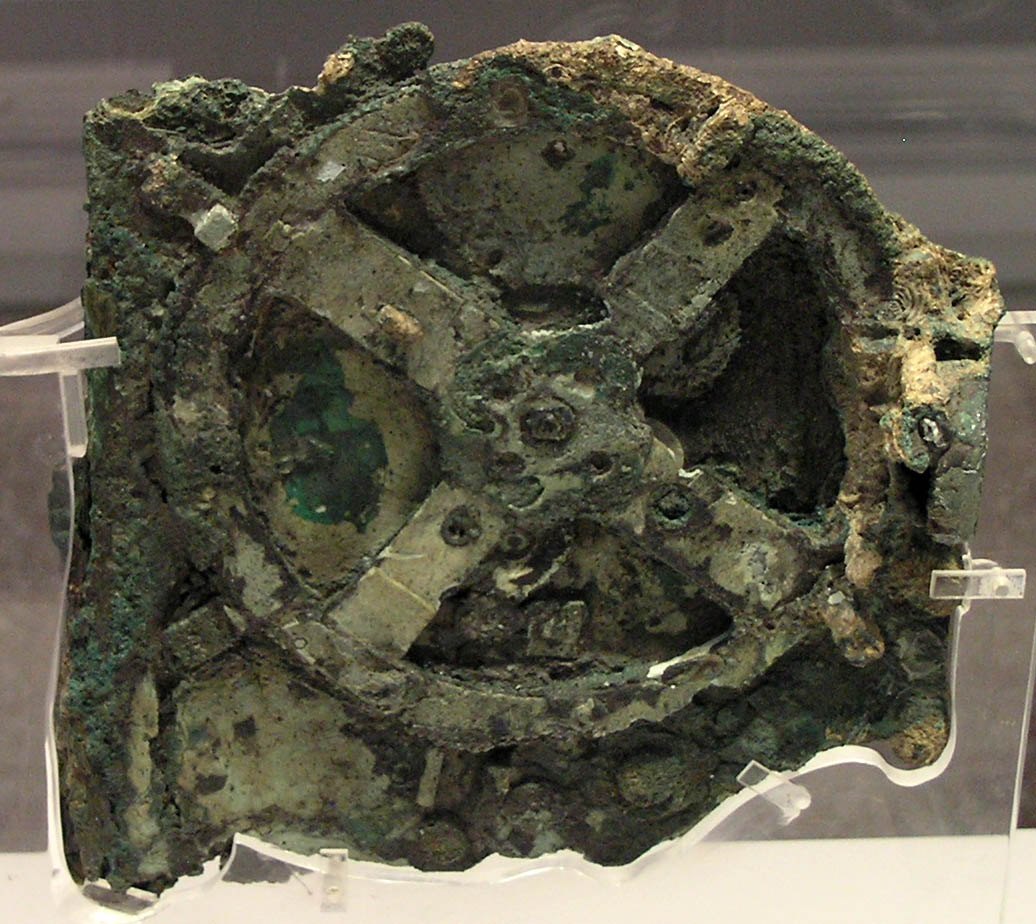
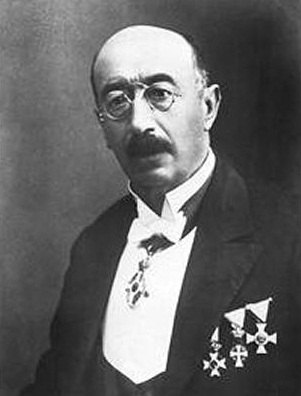
On 17 May 1902 the archaeologist Valerios Stais, with his cousin, the politician Spyridon Stais — the minister who had organised the salvage — was looking through the finds when he noticed that one of the lumps had split, and that a gear wheel was embedded in it. Another piece bore an inscription. Stais grasped at once that this was a mechanical device, and pressed for it to be studied. He thought it might be an astronomical clock.
That was too much for most of his contemporaries, who considered the idea prochronistic: geared machinery of such fineness was not thought possible in the Hellenistic world. One response was to suggest that the device must be later than the rest of the cargo. Another was to fit it into a known category of ancient instrument. In both cases the instinct was to shrink the object to fit the expected history of technology. The mechanism spent most of the next fifty years being shrunk.
The date is now marked as the anniversary of the mechanism’s discovery; on 17 May 2017 Google marked the 115th anniversary with a Doodle.
3.3 The First Readings, 1902–1910
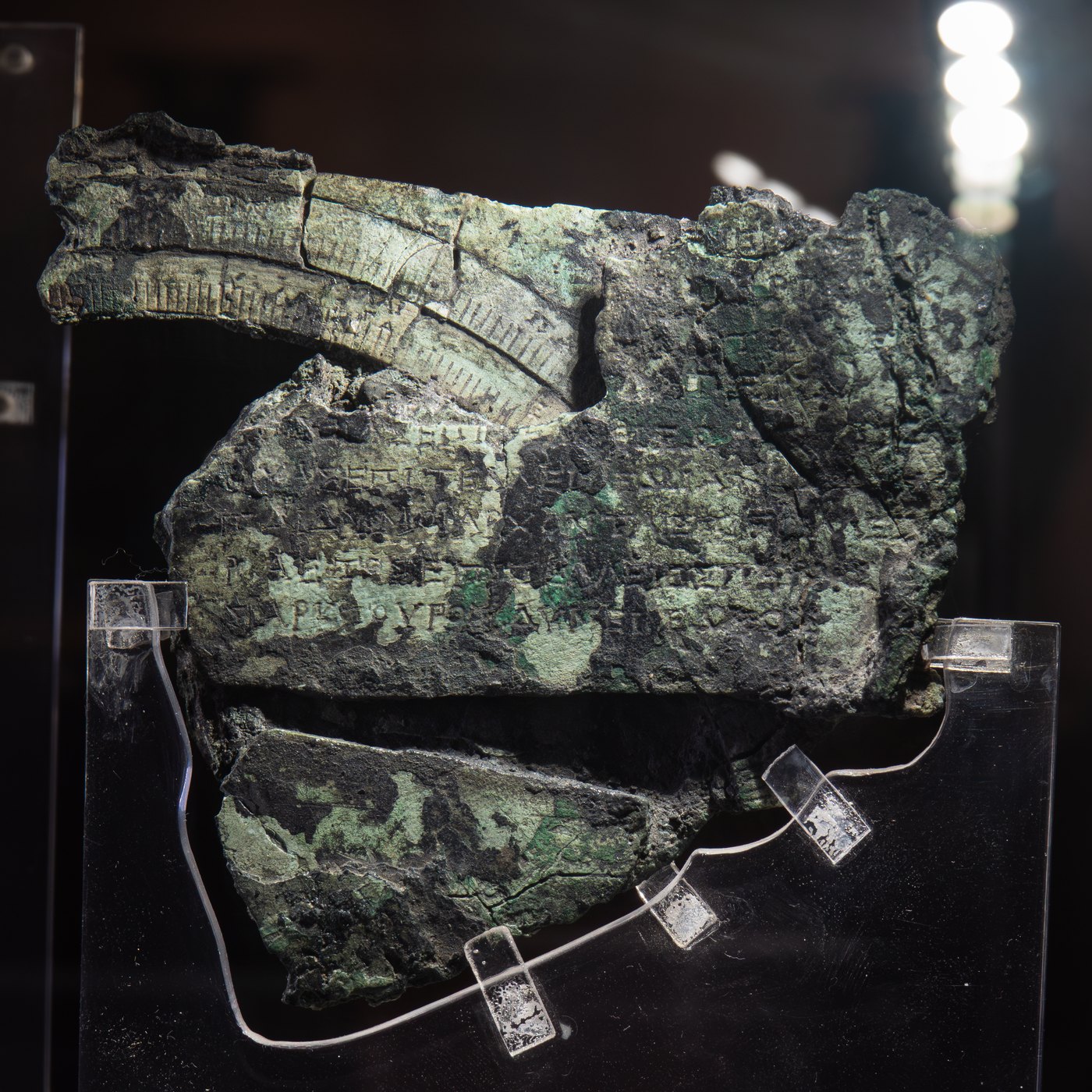
The first scholars to work on the fragments were Greek, and their work was quick and serious. Within days of the discovery, visible words on the outer surfaces were being read in the museum. By early 1903 the numismatist Ioannis N. Svoronos (1863–1922) had published the finds from the wreck, including a description of the mechanism by the naval officer Periklis Rediadis, who described the mechanical features and the inscribed letters. The two men gave the four fragments then known the letters A, B, C and D, and numbered their two faces 1 and 2 — a scheme still used, and later extended to fragments E, F and G and to seventy-five numbered small pieces.
Stais and Svoronos regarded the device as a kind of astrolabe, the flat star-map instrument used to find the time and the positions of stars. A second naval officer, Rados, joined the early group of investigators. An astrolabe was a reasonable guess, given the material at hand: a disk with a scale of the zodiac on Fragment C, an inscription mentioning astronomical phenomena, and a large wheel. But astrolabes are not geared. They work by rotating one flat plate over another, and nothing in the astrolabe tradition explained a train of meshing wheels with different tooth counts. The astrolabe interpretation nevertheless became the textbook account and stayed so for half a century.
3.3.1 Letters as evidence
In those first years the inscriptions drew at least as much attention as the gears. Two things were hoped for from them. The first was an explanation: a few legible words of text might say outright what the device was for, as an inscription on a statue base names its subject. The second was a date. Greek letter forms changed over the centuries in ways epigraphers had learned to recognise, and the style of the lettering on the mechanism might date not only the device but the whole wreck, at a time when there were no coins or pottery studies to do so.
Neither hope was fully met. The letters were tiny — between about 1.2 and 3 mm tall, cut in the style of contemporary inscriptions on stone — and most of the inscribed surfaces were hidden inside the lumps or crusted over. What could be read was enough to establish that the subject was astronomical, and the letter forms looked Hellenistic. But the precise dating of the wreck would come, decades later, from its coins and pottery (Volume 2), and the inscriptions’ full contribution to explaining the mechanism had to wait for imaging that could read text through the corrosion.
3.3.2 Cleaning, and its costs
The mechanism’s surfaces were caked with a hardened mixture of corrosion products and sediment, and adjacent components had fused together, hiding inscribed faces. For many decades the only way to reveal more was physical conservation: separating fused pieces and cleaning off the accretions. The Antikythera Mechanism Research Project’s 2016 review records major conservation campaigns in about 1905 and again in 1953, both of which exposed significant new text. Both also removed material that can never be put back. Some surfaces seen and photographed in the early twentieth century have since been lost or degraded, and the early photographs and transcriptions now occasionally serve as primary evidence for readings that the bronze no longer supports.
The cleaning also caused one of the mechanism’s lasting complications. Fragment G, a set of thin pieces with remains of the front dial and inscriptions, consists of material that was taken off Fragment C during cleaning, and its original relationship to C has had to be reconstructed.
3.4 Albert Rehm: Right, and Unpublished
The most perceptive early student of the mechanism did not publish his conclusions.
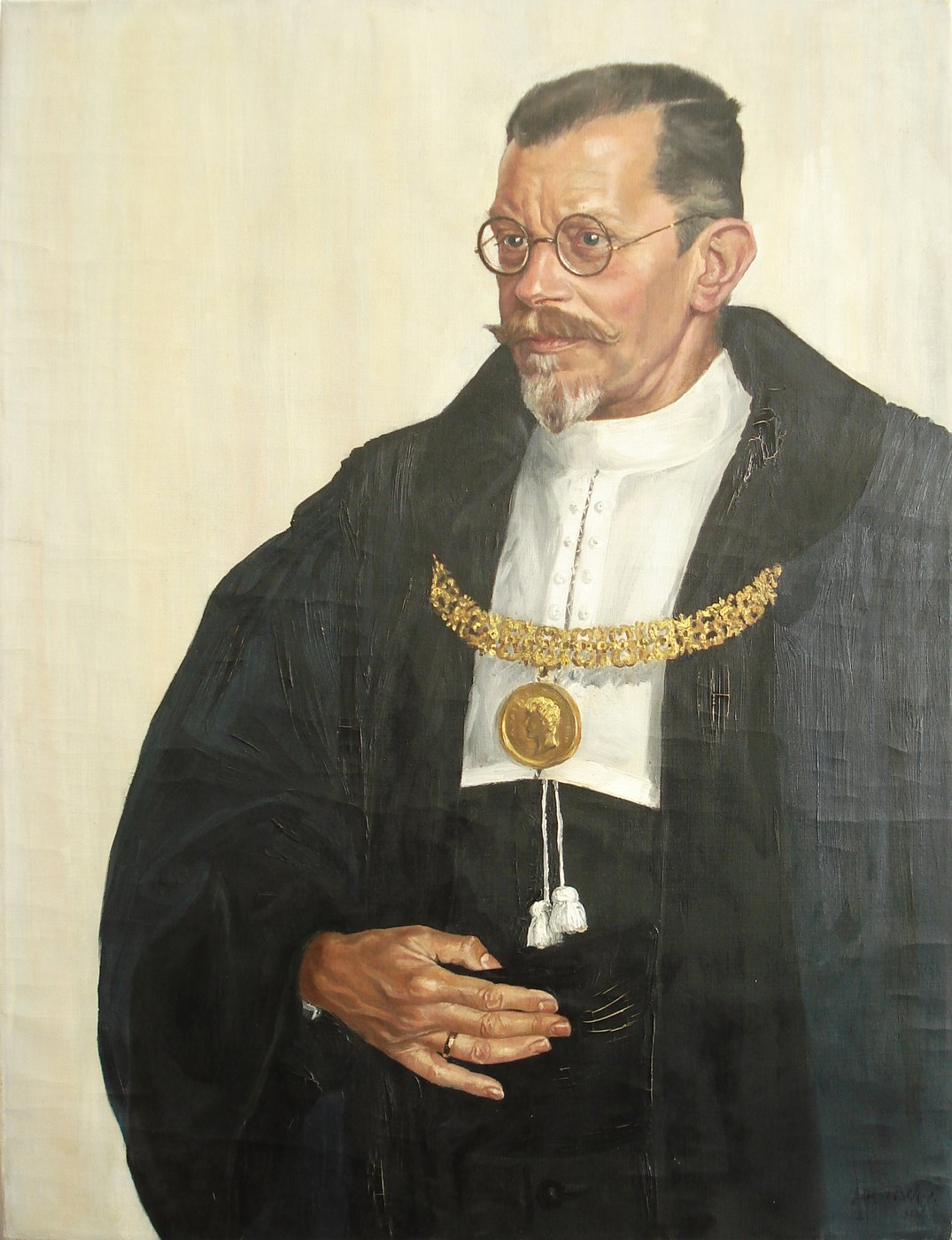
Albert Rehm (1871–1949) was a German classical philologist and epigrapher, later Professor of Classical Philology and Education at the University of Munich. He was an authority on the Greek parapegma (παράπηγμα), the star calendar in which the risings and settings of particular stars marked the days of the year, and he would go on to publish major studies of the subject, on the parapegma of Euktemon in 1913 and a set of Parapegmastudien in 1941. In the years after 1902 he examined the Antikythera fragments and their inscriptions in Athens, and in about 1905 wrote an extended paper, Astronomische Instrumente der Alten (“Astronomical Instruments of the Ancients”), which was never published. It survives among his papers, the Rehmiana, in the Bayerische Staatsbibliothek in Munich, together with a notebook covering 1903–1905, and includes a drawing that is the earliest known attempt to reconstruct the mechanism.
Rehm recognised what Stais had guessed and the astrolabe theory denied: that the mechanism was a geared calculator of astronomical cycles, and he called it a planetarium — a working model of the motions of the heavens. He recognised the parapegma inscriptions for what they were. The historian Alexander Jones, introducing a 2015 lecture on Rehm’s papers, described him as having proposed an identification “correct in principle” that anticipated many details revealed by modern research, while “a basically incorrect identification” was widely accepted for half a century.
Rehm’s notes did not vanish entirely. Derek de Solla Price later drew on them, and his reconstruction of the parapegma inscription in 1974 was based in part on Rehm’s unpublished work. (Price’s reconstruction allowed for about 24 parapegma events; later study of the modern imaging showed that the inscription listed about 42.) But for the field as a whole, Rehm’s planetarium identification was effectively lost until historians went back to his papers.
3.5 The Long Middle: 1910–1950
For the next four decades the mechanism attracted occasional, intermittent attention, and the questions barely moved.
Ioannis Theophanidis, a Greek naval officer who later rose to admiral, published on the mechanism in 1928 and 1934 and built the first mechanical model of it. He interpreted the device as a navigational instrument — a “ploognomon” (roughly, a “voyage indicator”) — for finding a ship’s position or course. The interpretation does not survive, but the model was a step forward: it treated the fragments as a machine to be rebuilt rather than an object to be classified. Reconstructions by Theophanidis are still displayed in Athens.
Others published short studies: the German historian of astronomy Ernst Zinner in 1931, the Oxford historian of science R. T. Gunther in 1932, and Willy Hartner in 1939. None had access to anything more than the visible surfaces, and none could resolve the basic question of how the gears fitted together.
The second great cleaning campaign, in 1953, exposed more text and more structure. It came just as the mechanism acquired its most important twentieth-century student.
3.6 Derek de Solla Price
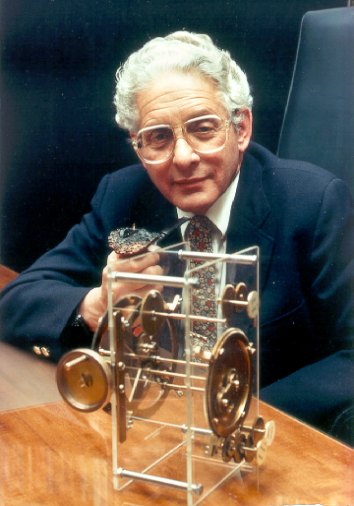
Derek John de Solla Price was born in Leyton, east London, on 22 January 1922. He trained as a physicist, and in 1948 took a three-year post teaching applied mathematics at Raffles College in Singapore. Back in Britain, he took a second doctorate at Cambridge in 1954, on a medieval astronomical manuscript, The Equatorie of the Planetis, which he edited and published in 1955. The Equatorie describes an equatorium, an instrument for computing planetary positions with circles and pointers — a background that prepared Price unusually well for the Antikythera fragments.
In 1959 Price went to Yale as a visitor for one year, and stayed for the rest of his life; he became Avalon Professor of the History of Science in 1962. He is remembered as much for founding the quantitative study of science itself — scientometrics — as for the mechanism: his Little Science, Big Science (1963) introduced the measurement of scientific growth through publications and citations. He died in London on 3 September 1983.
3.6.1 Interest, and the 1959 article
Price became interested in the mechanism in 1951, and examined the fragments in Athens through the 1950s. On his visit in 1958 he made two key advances. First, he worked out how Fragments A and B fitted together, and approximately how C related to them, and so deduced the basic two-faced structure of the device: a large dial at the front, dials at the back, gear trains between. Every earlier reconstruction had been built on speculation and on mistaken ideas about how the fragments had originally been arranged. Second, he brought in the epigrapher George Stamires (also spelled Stamiris) to read the inscriptions. By 1958 the number of legible letters stood at 793.
In June 1959 Price published “An Ancient Greek Computer” in Scientific American. The article rejected the astrolabe theory outright. The device, he argued, was a geared calendar computer with a clock-like mechanism, which calculated the positions of the Sun and the Moon and perhaps other celestial bodies from a single input. The article’s drawing showed a reconstruction with the gearing in an inner casing. It was the first account of the mechanism to reach a general scientific audience, and it introduced the word “computer” that has followed the device ever since.
3.6.2 Seeing inside: Karakalos’s radiographs
Price knew that the surfaces could not answer the central question. The gears were stacked in layers inside Fragment A, fused by corrosion; the visible ones showed only fragments of rims and a few spokes. To know how many gears there were, how many teeth each had, and which meshed with which, required seeing through the bronze.
In 1971–1972 the Greek nuclear physicist Charalambos Karakalos (also spelled Charalampos), usually described as working with the Greek national research centre Demokritos, made a series of X-ray and gamma-ray radiographs of the fragments for Price. Gamma rays, from a radioactive source, penetrate dense material well; together the two kinds of image showed the internal structure of the fragments for the first time.
They also had a fundamental limitation. A radiograph is a shadow: every layer of the fragment, from front to back, is projected onto one sheet of film at once. Where several gears lie on top of one another, their teeth overlap into a single tangle, and deciding which rim belongs to which wheel, and on which plane it lies, is a matter of interpretation. Volume 4 explains how linear tomography and then computed tomography solved this. Price, in the early 1970s, had to count teeth on superimposed shadows, estimate the counts of partial wheels, and infer the layering from what made mechanical sense.
3.6.3 Gears from the Greeks, 1974
The result was Price’s monograph Gears from the Greeks: The Antikythera Mechanism — A Calendar Computer from ca. 80 B.C., published in 1974 as a whole number of the Transactions of the American Philosophical Society (new series, vol. 64, part 7). It was the first comprehensive study of the mechanism: a catalogue of the fragments, a full set of transcriptions of the inscriptions, an analysis of the radiographs, a reconstruction of the gearing, and a historical argument.
The transcriptions were largely the work of Stamires, with occasional interventions by Price himself, whose own Greek was slight. They were a great advance on everything before, both in quantity and in accuracy. Price was nevertheless frank about their limits: of the longer inscriptions, he conceded, there were only two of which one could “read and understand more than a scattered word or two”.
The reconstruction was built around the great wheel b1 and the cycles of the Sun and Moon. Price identified some 27 gears and estimated their tooth counts. He argued that the gear train embodied the relationship at the heart of the 19-year Metonic cycle — 19 years contain 254 sidereal months, the Moon’s circuits of the zodiac — and that the front dial showed the Sun and Moon on the zodiac with an Egyptian calendar ring around it. He proposed a box-like structure in which an outer casing enclosed a smaller inner frame for the gears. He dated the device to about 80 BC — the subtitle’s “ca. 80 B.C.” — and argued elsewhere that it had been made around 87 BC and lost a few years later.
3.6.4 What Price got wrong
Three parts of Price’s scheme did not survive later investigation.
The differential. To drive a Moon-phase display, which depends on the difference between the Moon’s motion and the Sun’s, Price proposed a differential gear — an arrangement that subtracts one rotation from another. Had it been right, it would have been the earliest known differential by many centuries. Michael Wright’s tomographic work (Volume 4) showed that the gearing did not support it, and the proposal was abandoned. The Moon-phase display was eventually explained by a quite different, smaller mechanism.
The back dials. Price interpreted the upper back dial as five concentric rings of 47 divisions each — 235 months in all. The count was right, but the rings were in fact a spiral, read with a pointer that lengthened as it moved outward, and the lower back dial, which Price could not interpret satisfactorily, was the Saros eclipse spiral.
The date. Price’s “ca. 80 B.C.” was too close to the wreck. Later study of the lettering pushed the likely date of manufacture back into the second half of the second century BC (Volumes 4 and 11).
3.6.5 What Price got right
Against those errors stand the essentials. Price established that the mechanism was a geared astronomical calculator, not an astrolabe; that it had a front and a back with distinct displays; that its gear ratios embodied the Metonic relationship between years and months; and that it was technically far beyond anything previously credited to the ancient world. He brought radiography to the fragments and assembled the transcriptions on which everyone worked for the next thirty years. Every later researcher began from Gears from the Greeks, and many of them began by trying to prove it wrong.
3.6.6 The models
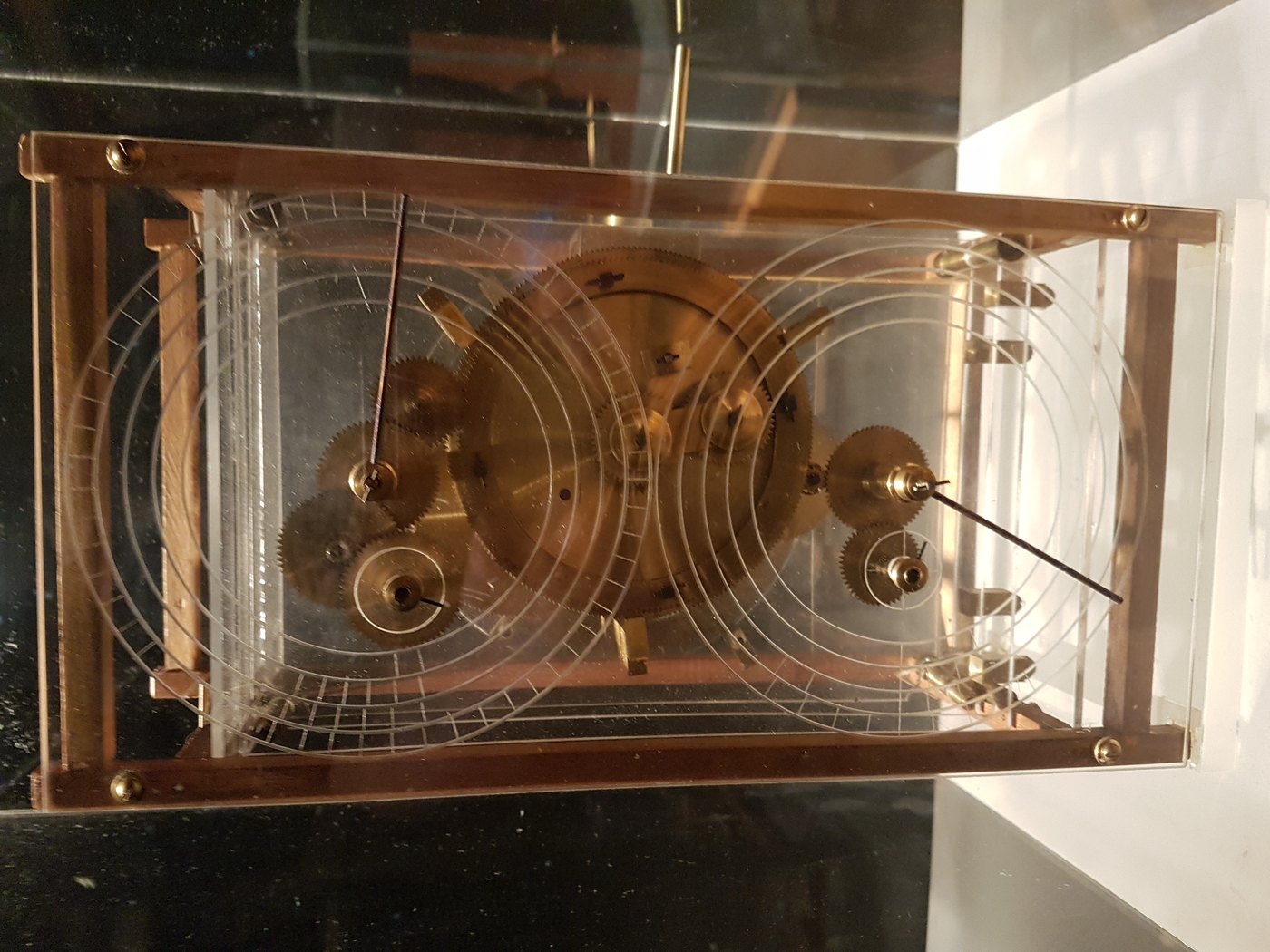
Price made models of his reconstruction, simple open frames of brass gears between parallel plates, one of which appears in the photograph above with him. Reconstructions after his design are displayed in Athens and elsewhere, alongside those of Theophanidis and later workers. They were teaching models of a hypothesis, not working replicas: Price’s gear train, built as he described it, would show some of the mechanism’s functions but not all, and some of what it showed was mistaken. Volume 13 follows the history of the models from Price’s to the present.
3.7 Where Things Stood in 1974
By the mid-1970s the state of knowledge was roughly this.
Table 1 — Where Things Stood in 1974
| Question | Answer in 1974 | Status today |
|---|---|---|
| What kind of object? | A geared calendar computer, not an astrolabe | Confirmed |
| Front dial | Zodiac and Egyptian calendar, Sun and Moon pointers | Confirmed; Moon-phase and pin-and-slot added later |
| Upper back dial | 235 months on five concentric rings | 235 months confirmed, on a five-turn spiral |
| Lower back dial | Unclear | Saros eclipse spiral, 223 months in four turns |
| Moon phase | Driven by a differential gear | Differential rejected; phase ball driven by a separate small train |
| Gears identified | About 27 | 30 surviving; more inferred |
| Inscriptions | 793 letters by 1958; few longer passages readable | Several thousand characters by 2016 |
| Date of manufacture | c. 80 BC | Most likely 150–100 BC from the lettering; disputed |
The common thread of the “status today” column is a technology Price did not have: imaging that separates one layer of the fragment from another. That is the subject of Volume 4.
Next — Volume 4: Seeing Inside — Wright, Bromley and the Antikythera Mechanism Research Project. A Sydney computer scientist who helped rebuild Babbage’s Difference Engine, a London Science Museum curator with a lathe, and a radiological trick that brings one plane of a fragment into focus; then, in 2005, a 450-kilovolt microfocus CT scanner and a computer-controlled rig of lights brought to the museum in Athens, two papers in Nature, and the moment the mechanism’s hidden text and hidden gears became readable at last.
Comments (0)