Antikythera · Volume 10
Antikythera — Volume 10 — The Lost Planets — Reconstructing the Cosmos Display
No planetary gear survives, yet the inscriptions demand five planets in order and two numbers demand accurate cycles: the reconstructions from Rehm's notebook to Wright's brass model, Evans, Carman and Thorndike, Freeth and Jones, and the 2021 UCL Model of the Cosmos — and why it is a model, not a replica
10.1 About This Volume
Every gear that survives in the Antikythera fragments drives the Sun, the Moon, the calendar or the eclipse dials. Not one drives a planet. Yet the Back Cover Inscription describes five planets travelling through their circles in cosmological order, and the Front Cover Inscription sets out each planet’s cycle in days (Volume 9). The front of the machine has therefore had to be rebuilt from inference: from the text, from holes, pillars and stubs on the great four-spoked wheel, from a single loose gear in Fragment D, and from what a Hellenistic astronomer could have known.
This volume follows that inference. It sets out the evidence any reconstruction must satisfy and the astronomy it must reproduce; then the main proposals in turn — Michael Wright’s working model of 2002, the dials and unequal zodiac of James Evans, Christián Carman and Alan Thorndike in 2010, Tony Freeth and Alexander Jones’s pointer display of 2012, and the ring display published by the University College London (UCL) team in 2021. The 2021 model gets the most space, because it is the only one built around the two planetary period relations discovered in 2016, and because its authors set out a method for how those relations might have been found. Every period relation and gear ratio quoted below has been recomputed for this series.
The principal source is T. Freeth, D. Higgon, A. Dacanalis, L. MacDonald, M. Georgakopoulou and A. Wojcik, “A Model of the Cosmos in the ancient Greek Antikythera Mechanism”, Scientific Reports 11 (2021) 5821, cited as SR21 (open access at PubMed Central), with its Supplementary Information.
10.2 What Has to Be Explained
A reconstruction of the front is an argument, and its premises are of three kinds.
The words. The Back Cover Inscription names Mercury, Venus, the Sun, Mars, Jupiter and Saturn in order outward from the centre, each with a “little sphere” travelling through its own arc or circle, and the Sun with a golden sphere on a pointer (Volume 9). The Front Cover Inscription describes, planet by planet, the stages of the synodic cycle — conjunctions, greatest elongations, stations, oppositions — with the days between them, and gives the period relations 462 years for Venus and 442 for Saturn. Because the stages are described, the display must have shown planets reversing, not merely their average positions (IAM 6).
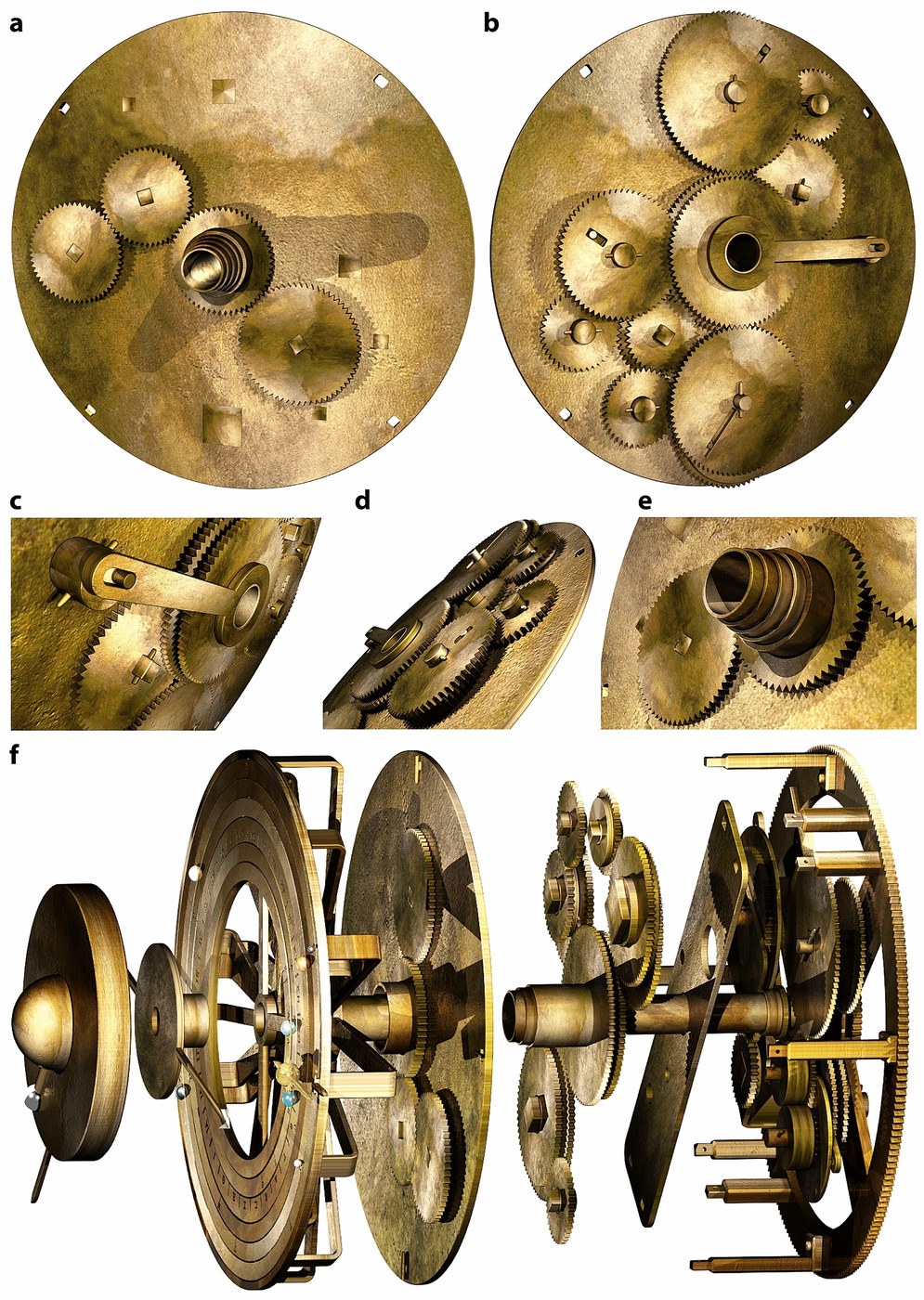
The metal. The main drive wheel, b1, the large four-spoked wheel that turns once a year, carries features with no function in the surviving trains: holes, flattened areas and a bearing on its spokes, and the broken stubs of pillars around its rim. Wright was the first to argue that these were the mountings of a lost epicyclic system — gears carried round on b1 itself. Tomography later showed that the pillars came in two lengths, four short and four long, each with a shoulder and a hole for a retaining pin, which implies two lost plates stacked in front of b1 (SR21). And Fragment D, found among the original fragments, holds a gear with a disk riveted to it, unconnected to anything that survives.
The space. The front gearing had to fit between b1 and the front dial plate, in a depth of a few centimetres, and its outputs had to emerge at the centre of the dial in a way that matched the description.
There is also a prehistory. In notebooks of 1905–06, the German philologist Albert Rehm sketched what he called “mein Planetarium”, a display with a ring for each planet. The 2021 team found that his ring display anticipated their own, though it was “mechanically completely wrong due to his lack of data” (SR21). Derek de Solla Price, in Gears from the Greeks (1974), suggested that lost gearing had calculated planetary motions but did not try to reconstruct it.
10.3 The Astronomy to Be Modelled
Seen from Earth, a planet moves eastward through the zodiac most of the time, but at intervals it slows, stops, moves westward for a while, stops again and resumes. The cycle is tied to the planet’s position relative to the Sun, and its length is the synodic period: about 116 days for Mercury, 584 for Venus, 780 for Mars, 399 for Jupiter and 378 for Saturn.
Babylonian astronomers predicted these cycles arithmetically, using period relations: statements that a whole number of synodic cycles fits into a whole number of years. The relations are written here as (synodic cycles, years). The “Goal-Year” texts used short, rough relations such as (5, 8) for Venus — five cycles in eight years. The later mathematical astronomy used long, accurate relations such as (720, 1151) for Venus (SR21). Greek astronomers, from Apollonios of Perga in the third and second centuries BC, explained the same motion geometrically: a planet rides on a small circle, the epicycle, whose centre is carried round the Earth on a larger circle, the deferent. The sum of the two uniform motions produces the loops.
A gear can turn a wheel at any rate that is a ratio of tooth counts, so a period relation can be built directly into gears — provided its numbers factor into primes small enough to be tooth counts. A practical upper limit in the mechanism is about a hundred teeth for the planetary gears (SR21). The variable motion can be produced in two ways that the surviving lunar mechanism already demonstrates (Volume 6): a pin-and-slot device, in which a pin on one gear drives a slotted gear on a slightly offset axis, or a pin-and-slotted follower, in which a pin on an epicyclic gear drives a slotted arm turning on the central axis. Either converts uniform rotation into the speeding up and slowing down that the geometry requires.
10.4 Wright’s Working Model, 2002
Michael Wright, curator of mechanical engineering at the Science Museum in London, had already overturned Price’s account of the Moon-phase gearing and recognised the back dials as spirals (Volume 4). In 2002 he published “A planetarium display for the Antikythera Mechanism” in the Horological Journal and built a working model in brass. It was, in the 2021 team’s words, “the first workable system at the front that calculated planetary motions and periods, with a coaxial pointer display of the Cosmos, proving its mechanical feasibility” (SR21).
Wright mounted epicyclic trains for the inferior planets on b1, used pin-and-slotted followers to produce the variable motions, and brought the outputs to the front as a nest of concentric pointers, one for each body. He chose very long period relations, of the Babylonian mathematical type, that keep an error of about a degree or less in five hundred years — wanting, as he explained, to show that a display representing the best astronomy of the period was physically practicable, and arguing that it was also probable (IAM 6). One of his physical models even included a Mars display with an eccentric deferent, the more advanced model in which the synodic cycle itself varies.
Two features of Wright’s design lasted: the concentric pointer display, adopted by most later reconstructions and replicas (Volume 13), and the principle that b1 was an epicyclic platform. His insistence on accurate periods looked like over-engineering until 2016, when the Front Cover Inscription showed that the designer had indeed used long, accurate relations.
10.5 Evans, Carman and Thorndike, 2010–2012
James Evans, Christián Carman and Alan Thorndike, in “Solar anomaly and planetary displays in the Antikythera mechanism” (Journal for the History of Astronomy 41, 2010, 1–39), approached the front from a different direction. They measured the divisions of the zodiac scale on Fragment C and found the twelve sectors not exactly equal. They argued that the inequality was deliberate: a pointer turning at the Sun’s mean rate, read against a zodiac with unequal signs, shows the Sun’s true position, so that a single pointer could show both the Egyptian calendar date and the true Sun without any extra gearing (IAM 3, n. 2).
For the planets, the same paper proposed a reconstruction in which each planet’s synodic cycle was shown on its own small subsidiary dial on the front face — five dials, each with a pointer turning once per cycle, the dates of the cycle’s phases marked around it — rather than planets moving round the zodiac (IAM 6, n. 33). It also proposed gear trains approximating long Babylonian period relations. In 2012 Carman, Thorndike and Evans published a second, distinct proposal, “On the pin-and-slot device of the Antikythera Mechanism, with a new application to the superior planets” (JHA 43, 93–116), using a pin-and-slot of the lunar type to drive pointers for the outer planets around the zodiac.
The 2016 edition counts against the subsidiary dials. The Back Cover Inscription describes the planets’ little spheres travelling through circles in cosmological order around the Sun’s pointer, and the Front Cover Inscription describes motion in longitude — stations, retrogradations — which separate cycle dials could not show (IAM 6). The unequal-zodiac argument for the true Sun remains open.
10.6 Freeth and Jones, 2012
Tony Freeth and Alexander Jones’s “The Cosmos in the Antikythera Mechanism” (ISAW Papers 4, 2012) built its display on a detailed reading of the Back Cover Inscription, with several lines revised by Jones. They argued that the text established “beyond plausible doubt” a display of all five planets, and that it consisted of pointers on the central dial, each carrying a small sphere, read against the zodiac (IAM 6, following Freeth & Jones 2012). Their gearing used shorter period relations of the Goal-Year kind, partly because shorter periods need simpler gears, and partly because the evidence for Greek knowledge of the long Babylonian periods before the first century AD was slender (IAM 6, n. 38). They also identified the components in Fragment D as parts of a Venus mechanism.
Their model is the source of the much-reproduced diagrams of a front dial with coloured spheres on concentric pointers (Volume 7), the layout most later replicas follow. In 2021 the UCL team, which includes Freeth, judged that the 2012 model “simplified the gearing but [was] limited to basic periods for the planets”, needed brackets to support its mechanisms, and shared a weakness of all pointer displays: with seven or nine concentric pointers at different heights above the dial, the reading depends on the angle of view — parallax (SR21).
10.7 Two Numbers Change the Problem
The 2016 edition of the Front Cover Inscription changed the terms of the debate. Its two numbers give the relations (289, 462) for Venus and (427, 442) for Saturn — 289 synodic cycles in 462 years, and 427 in 442 (Volume 9). Neither is known from any other source. Both are accurate. And both factor into primes below a hundred:
- 289 = 17 × 17 and 462 = 2 × 3 × 7 × 11;
- 427 = 7 × 61 and 442 = 2 × 13 × 17.
The editors showed how Venus’s relation could be a gear-friendly approximation to the Babylonian (720, 1151), which no gear train could use because 1,151 is prime: 462/289 is the last continued-fraction convergent of 1151/720 before the value itself, and differs from it by about one part in three hundred thousand. Saturn’s cannot be explained that way, because the Babylonian (256, 265) was shorter and already factorable (IAM 6). Factorability suggests the relations were built into gears, not merely quoted; so a reconstruction now had to mechanise long, complex periods for at least two planets in the same cramped space — the problem Wright had set himself, but with the designer’s actual numbers.
10.8 The UCL Model of the Cosmos, 2021
The UCL Antikythera Research Team — Tony Freeth, David Higgon, Aris Dacanalis, Lindsay MacDonald, Myrto Georgakopoulou and Adam Wojcik, hosted by UCL’s Department of Mechanical Engineering — saw their paper received by the journal on 30 September 2020 and published on 12 March 2021. Their aim was a model “to match all the surviving evidence”, governed by a written set of reconstruction principles, with each element rated by the strength of its evidence. What struck them, they wrote, “is just how few these options are: the constraints created by the surviving evidence are stringent and very difficult to meet” (SR21).
10.8.1 Finding the missing cycles: Parmenides’ method
The Front Cover Inscription gives the relations for Venus and Saturn only; those for Mercury, Mars and Jupiter are in lost or illegible lines. The team’s first problem was to recover them, and to do that they needed a theory of how the known two had been found.
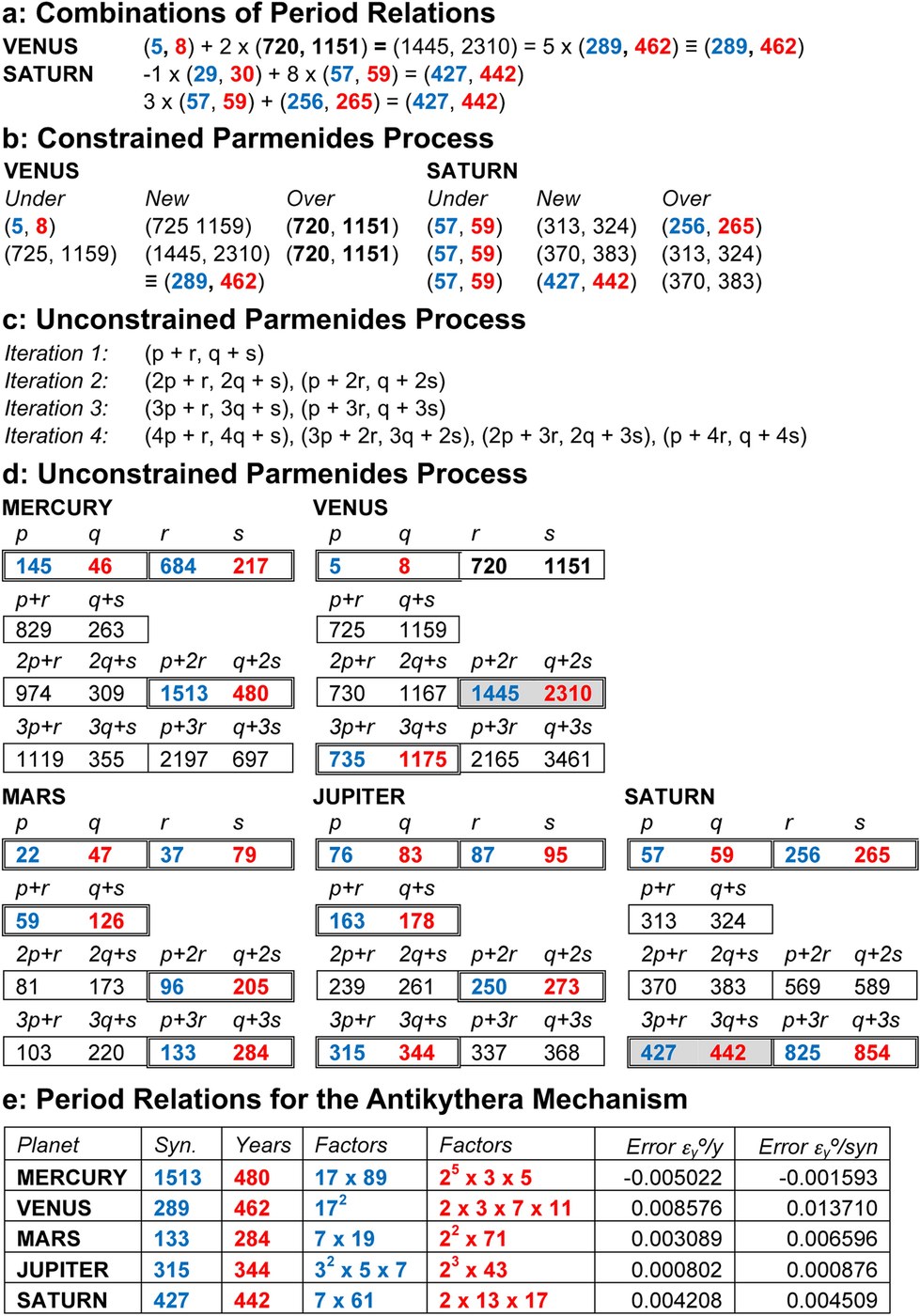
Their answer draws on the mathematics of Plato’s Academy. In approximating an unknown ratio θ, if two fractions satisfy p/q < θ < r/s, then the mediant (p + r)/(q + s) lies between them and is a better estimate on whichever side it falls. Citing D. H. Fowler’s work on the mathematics of Plato’s Academy, the authors call this the Parmenides proposition, after the dialogue of Plato named for the philosopher Parmenides of Elea. Applied repeatedly, it generates ever closer approximations from two “seed” ratios. The ordinary form of the process requires knowing at each step whether the new estimate is too large or too small, which needs error estimates that Hellenistic naked-eye astronomy could not supply. The team therefore proposed an Unconstrained Parmenides Process: generate all the combinations systematically, without knowing the direction of the error, and choose among them by three criteria — accuracy, factorability and economy, the last meaning periods whose prime factors let different planets share gears (SR21).
Starting from Babylonian seed periods, the process reproduces both inscribed relations at once:
- Venus: seeds (5, 8) and (720, 1151). The combination (5 + 2 × 720, 8 + 2 × 1151) = (1445, 2310), which is 5 × (289, 462) — the first factorable result.
- Saturn: seeds (256, 265) and (57, 59). The combination (256 + 3 × 57, 265 + 3 × 59) = (427, 442) — again the first factorable result.
The same process then yields the missing relations. For Mercury the economical choice is one sharing Venus’s factor 17: (1513, 480) = (17 × 89, 2⁵ × 3 × 5). For the superior planets the choice is relations sharing Saturn’s factor 7: (133, 284) for Mars, (7 × 19, 2² × 71), and (315, 344) for Jupiter, (3² × 5 × 7, 2³ × 43). The authors show that Mercury’s and Mars’s relations are uniquely determined by their criteria; for Jupiter two other candidates exist, of which they argue one is impossible and the other very unlikely. Apart from Venus and Saturn, all the final relations were already known in Babylonian astronomy (SR21 and Supplementary Information).
All five relations were recomputed for this series. Each, with a year of 365¼ days, gives a synodic period within a few hundredths of a day of the modern value:
Table 1 — All five relations were recomputed for this series. Each, with a year of 365¼ days, gives a synodic period within a few hundredths of a day of the modern value
| Planet | Relation (cycles, years) | Factors | Implied synodic period | Modern value |
|---|---|---|---|---|
| Mercury | (1513, 480) | 17 × 89 : 2⁵ × 3 × 5 | 115.88 days | 115.88 days |
| Venus | (289, 462) | 17² : 2 × 3 × 7 × 11 | 583.89 days | 583.92 days |
| Mars | (133, 284) | 7 × 19 : 2² × 71 | 779.93 days | 779.94 days |
| Jupiter | (315, 344) | 3² × 5 × 7 : 2³ × 43 | 398.88 days | 398.88 days |
| Saturn | (427, 442) | 7 × 61 : 2 × 13 × 17 | 378.08 days | 378.09 days |
The method is a hypothesis about ancient practice, not a recovered text. Its strength is that one simple procedure, applied to known Babylonian seeds, produces both inscribed numbers as its first usable results.
10.8.2 Fragment D: the Venus wheel
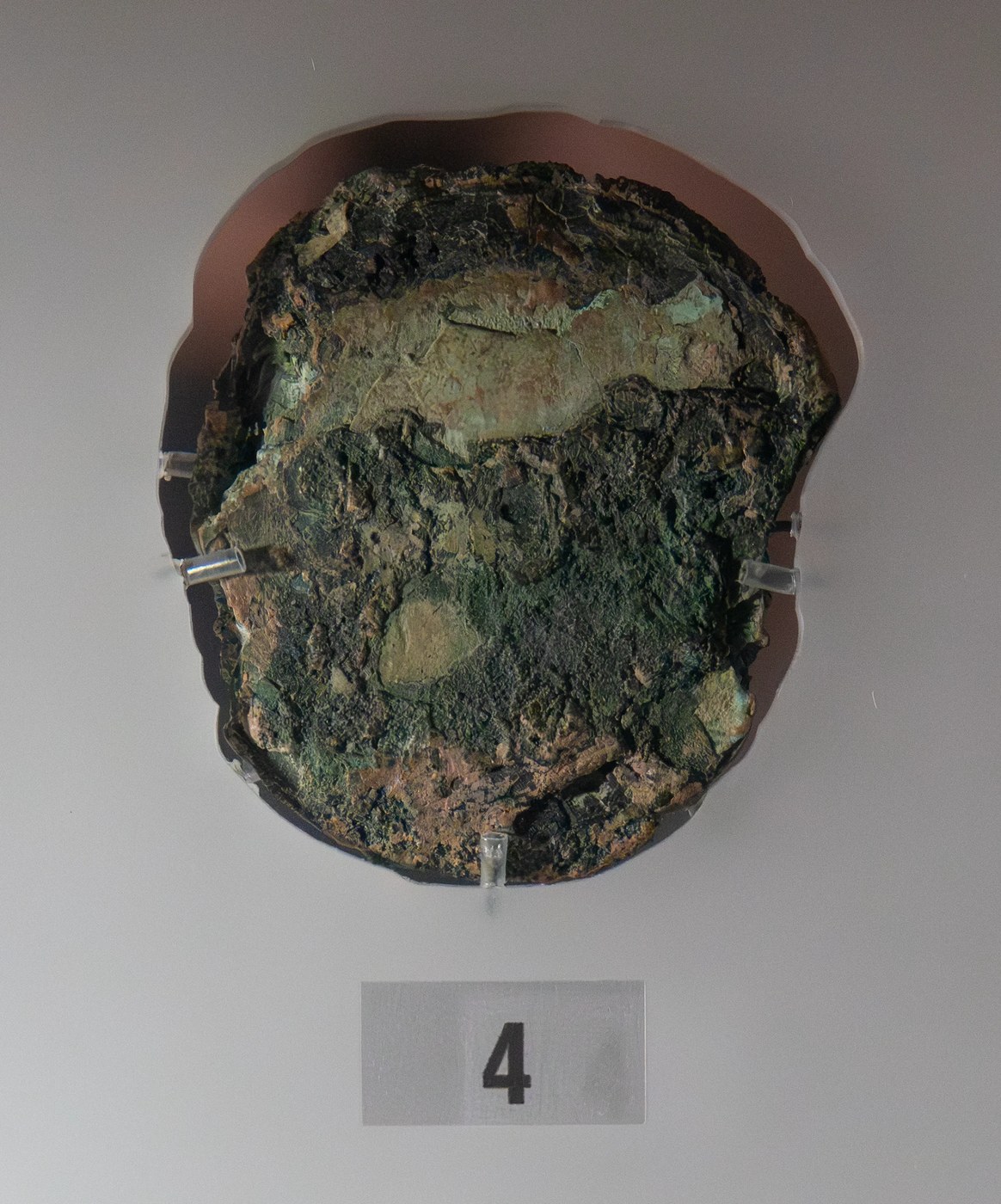
Fragment D had long been read as holding two gears. Tomography shows that this was an illusion caused by a split arbor. It holds one gear, whose tooth count “can be reliably determined as 63 teeth, given all but three of the teeth survive”, a disk riveted to the gear, a small plate (the “D-plate”) and an arbor joining them; the disk and gear have square central holes that fit a squared section of the arbor. No other surviving gear has a disk attached. In an inferior-planet mechanism the follower’s pin must sit beyond the edge of the epicyclic gear; the disk is the right size to carry it at the distance that models Venus’s greatest elongation from the Sun. The team concludes that Fragment D is “surely the epicycle for Venus”, as Freeth and Jones had suggested. The number fits too: 63 = 3² × 7 shares the factors 3 and 7 with 462 (SR21).
This identification is not universal. Aristeidis Voulgaris and colleagues have argued in a series of preprints that Fragment D belonged to a draconic gearing — a train for the Moon’s nodes — rather than to Venus (“The Draconic gearing of the Antikythera Mechanism: Assembling the Fragment D, its role and operation”, arXiv:2104.06181, 2021, and later papers). The gear’s role is an argument, not a fact.
10.8.3 On the main wheel: mean Sun, nodes, Venus and Mercury
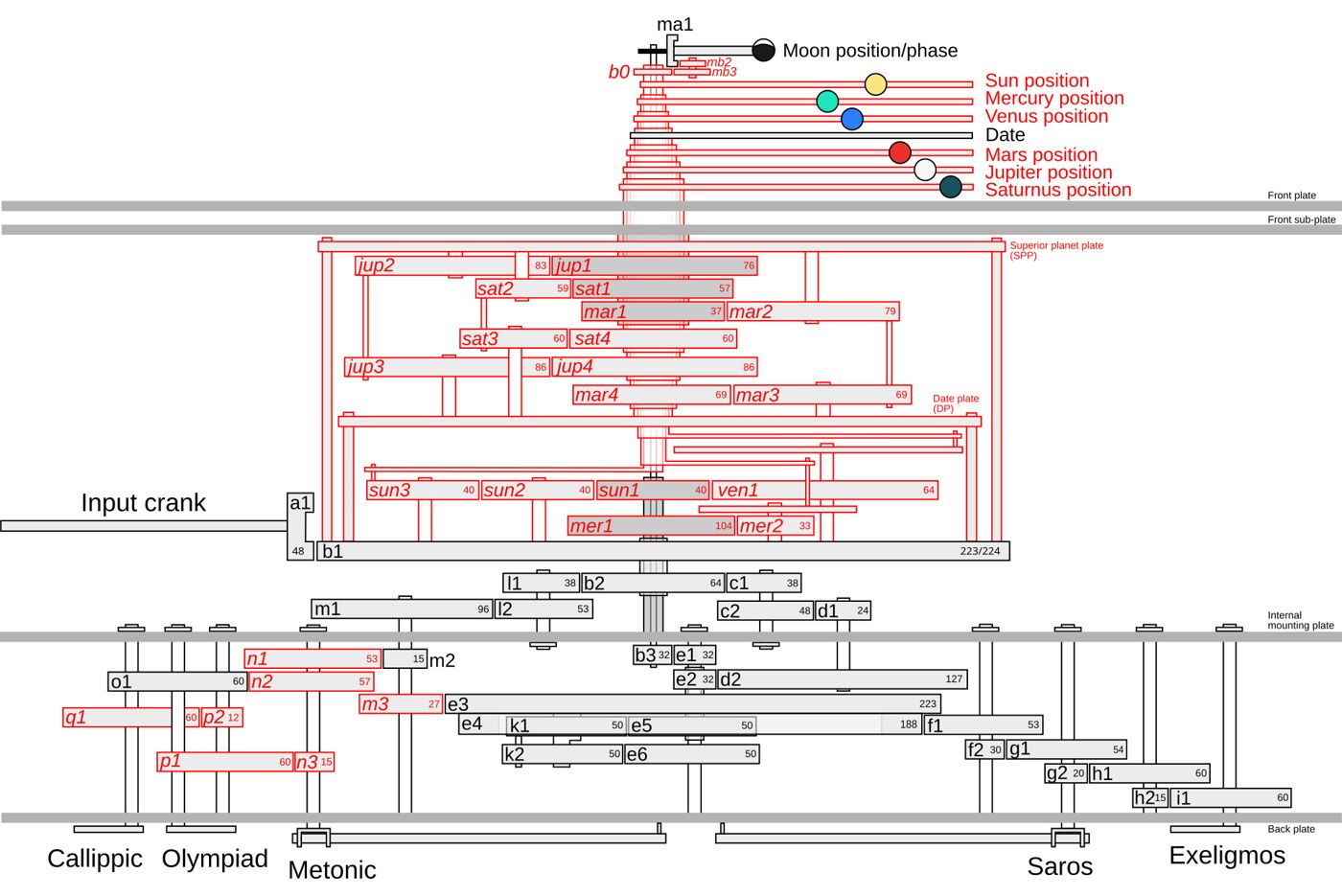
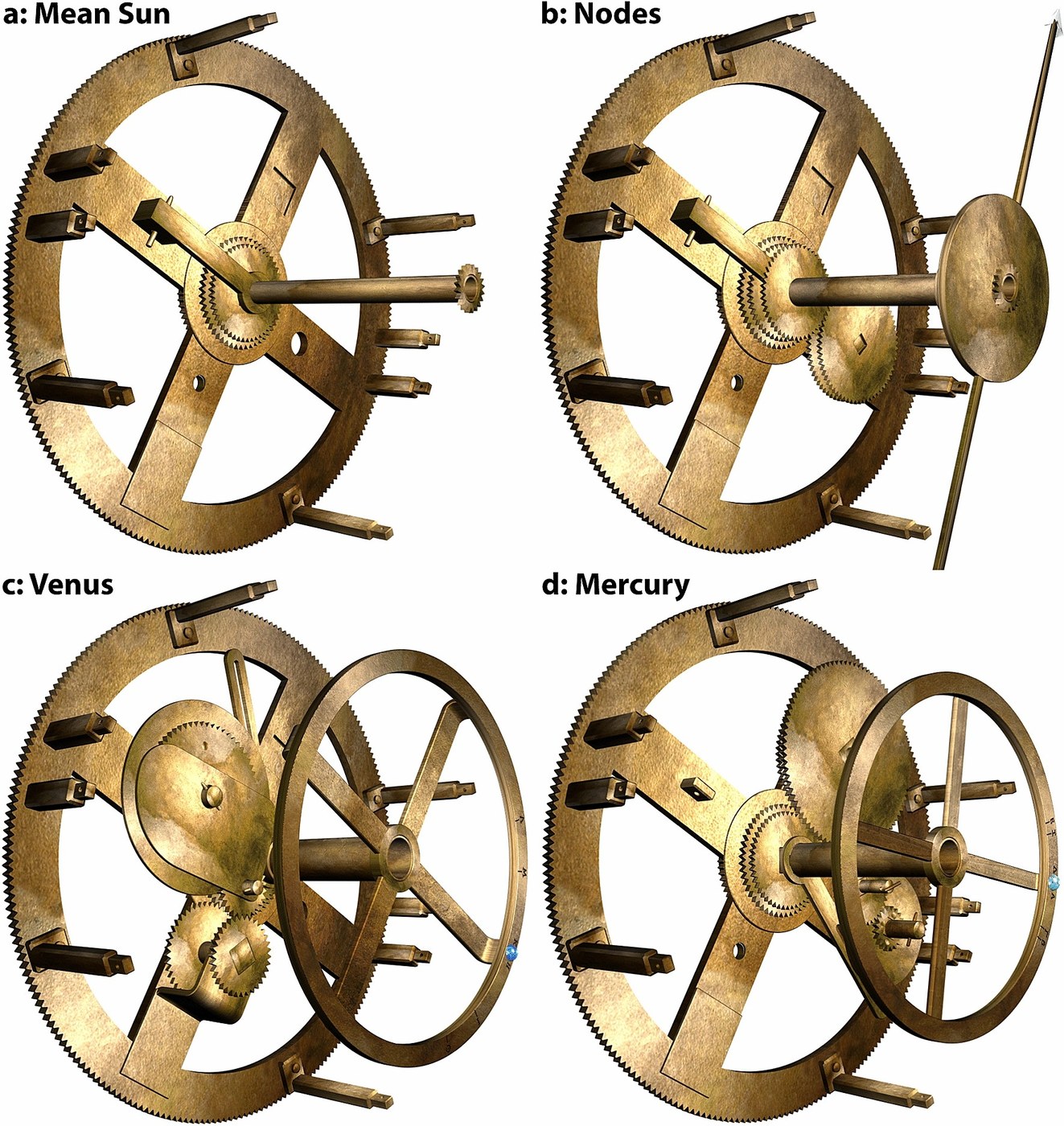
The team’s framework is set by b1’s pillars: a rectangular plate, the Strap, on the four short pillars, and a Circular Plate on the four long ones. Between b1 and the Strap is a space of 15.0 mm, into which they fit nine closely packed layers of gearing, matching the layer density of the surviving trains. Each of b1’s four spokes gets one function, matched to its surviving features (SR21):
- Spoke D — the mean Sun. A bar from a previously unexplained pierced block halfway along the spoke carries the Sun’s mean motion to an output tube next to the central lunar arbor, feeding the Moon-phase device.
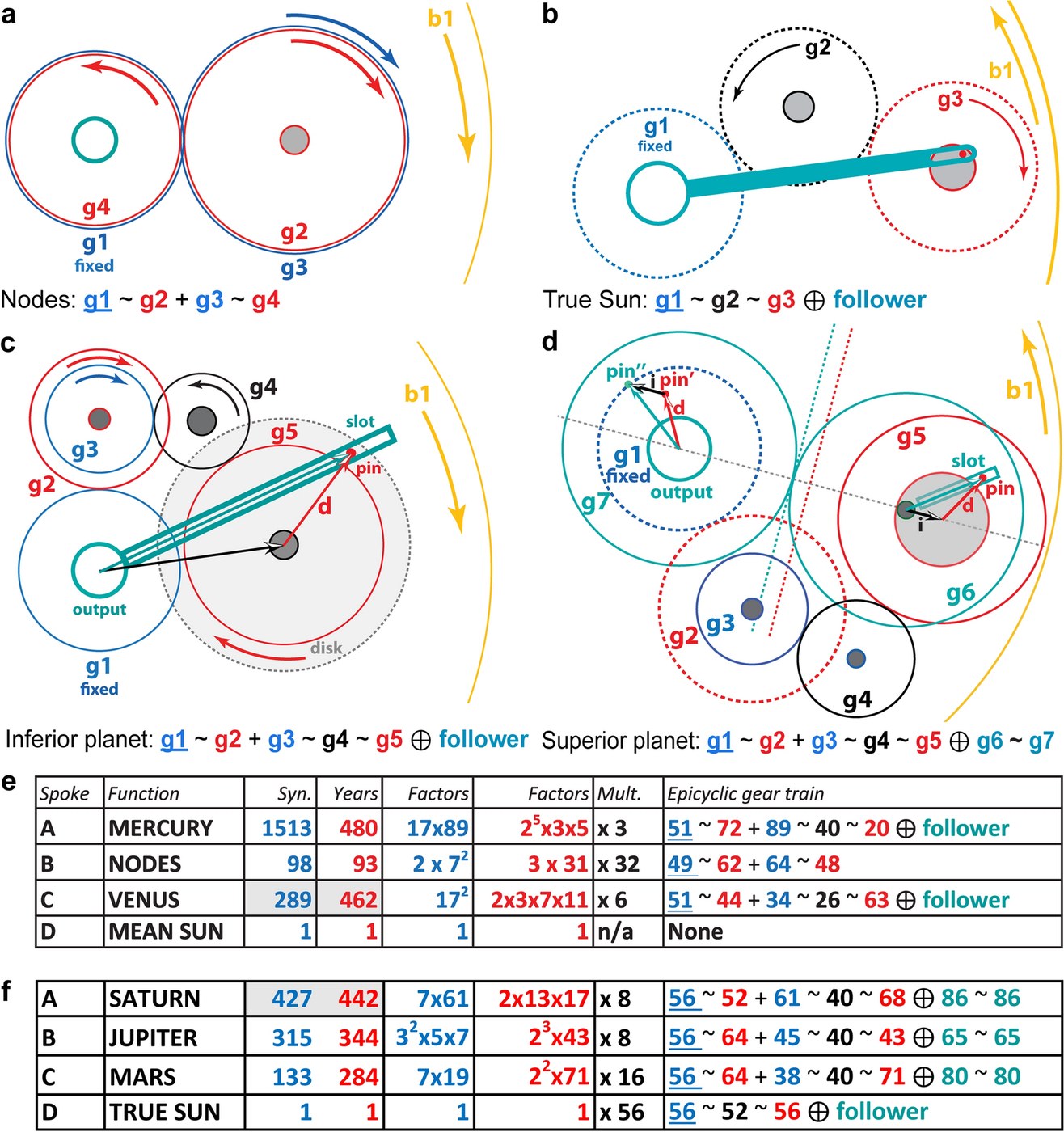
- Spoke B — the lunar nodes. A four-gear epicyclic train, 49 ~ 62 + 64 ~ 48 (in the paper’s notation, ”~” means “meshes with” and ”+” means “fixed to the same arbor”), turned by b1 about a fixed 49-tooth gear. Its output rotates −5/93 of a turn per year, once in 18.6 years backwards — the regression of the Moon’s nodes. The team found that its proposed tooth counts put the bearing in exactly the place where the spoke’s prominent bearing survives; “no other use has previously been found for this bearing.”
- Spoke C — Venus: 51 ~ 44 + 34 ~ 26 ~ 63, the last gear being Fragment D’s.
- Spoke A — Mercury: 51 ~ 72 + 89 ~ 40 ~ 20.
Mercury and Venus share the fixed central 51-tooth gear, made possible by the shared factor 17. The Strap is inclined at 11° to the spokes, which the team says is exactly the angle needed to accommodate the Mercury and Venus epicyclic gears and explains the otherwise odd angle of the short pillars.
The ratios check. For an epicyclic gear on a wheel turning about a fixed gear, the idler gears cancel, and the epicyclic gear’s rotation relative to the wheel is the product of the remaining ratios:
- Venus: (51/44) × (34/63) = 289/462;
- Mercury: (51/72) × (89/20) = 1513/480;
- Nodes: (49/62) × (64/48) = 98/93, so the output, relative to the fixed frame, turns 1 − 98/93 = −5/93 of a turn per year.
10.8.4 On the Circular Plate: the true Sun and the outer planets
For the true Sun and the superior planets “there is no surviving direct evidence”, and the team says so: “inevitably this means choices”, constrained by the 9.7 mm space between the Strap and the Circular Plate. A fixed 56-tooth gear at the centre drives all four mechanisms, made possible by the shared factor 7 (SR21):
- True Sun: 56 ~ 52 ~ 56 with a pin-and-slotted follower — a three-gear mechanism Wright had already proposed, giving one turn a year with the Sun’s variable speed;
- Saturn: 56 ~ 52 + 61 ~ 40 ~ 68, then a pin-and-slot pair 86 ~ 86;
- Jupiter: 56 ~ 64 + 45 ~ 40 ~ 43, then 65 ~ 65;
- Mars: 56 ~ 64 + 38 ~ 40 ~ 71, then 80 ~ 80.
These are seven-gear “indirect” mechanisms: the anomaly is produced not by a follower riding on the epicycle but by a pin-and-slot pair on slightly offset axes, the same device that produces the Moon’s anomaly at the back (Volume 6). The team argues that such mechanisms are more economical, fit the evidence better and incorporate the period relations exactly. Again the ratios check: Saturn (56/52) × (61/68) = 427/442; Jupiter (56/64) × (45/43) = 315/344; Mars (56/64) × (38/71) = 133/284; the true Sun 56/56 = 1. Gears are shared too: the 64 between Mars and Jupiter, the 52 between the true Sun and Saturn.
The model counts 34 gears in front of b1 for the Cosmos, which with the 35 extant gears behind it makes 69 in all (SR21).
10.8.5 Rings, not pointers
The outputs of all these trains emerge as nested tubes, one inside another, in cosmological order: Moon (on the central arbor), mean Sun for the phase device, nodes, Mercury, Venus, true Sun, Mars, Jupiter, Saturn and the date. Instead of pointers, each tube carries an arm supporting a ring: a ring for each planet with a “little sphere” marker, smaller markers for oppositions, and the true Sun’s ring carrying a “little golden sphere” with its pointer, as the Back Cover Inscription describes. The planets are identified by semi-precious stones. At the centre sits a dome for the Earth and the Moon’s position and phase, shown by a black-and-white sphere about 6 mm across. A narrow outer ring carries the date pointer against the Egyptian calendar (SR21).
The team gives four reasons for preferring rings. The description in the Back Cover Inscription — arcs and circles, each with a sphere travelling through it — fits rings better than pointers. Rings eliminate the “severe parallax inherent in a pointer system with nine outputs”. They allow each planet’s ring to be engraved with scale marks for its synodic events, read against the Sun pointer, with index letters keyed to the lines of the Front Cover Inscription — a hypothesis they admit “is not provable, as the beginning of the lines are lost”, but which would explain how a viewer could use the inscription at all (Volume 9). And the result is robust and elegant. They add that the machine itself could have computed the day-counts in the inscription by counting days on the calendar between the marks, without trigonometry.
Not everyone reads the text the same way. The Back Cover Inscription’s own editors understand it as describing pointers bearing little spheres (IAM 5), and the inscription’s “arcs” and “circles” can describe the paths the spheres trace as well as physical rings. The ring display is the 2021 team’s interpretation, argued from mechanics and readability; the text alone does not decide it.
10.8.6 The Dragon Hand
The most openly hypothetical element is a double-ended Dragon Hand whose head marks the Moon’s ascending node and tail the descending node, a feature common on later astronomical clocks. The team states plainly: “there is no direct physical evidence for an indication of the Line of Nodes of the Moon.” They add it for thematic reasons — the eclipse dial on the back depends on the nodes, but nothing at the front shows them — and because it is easily made. A rotation of −12/223 of a turn per year, derived from the Metonic and Saros cycles, could not be geared because 223 is a large prime; the simpler −5/93, with a period of 18.6 years, can be made with four gears on the bearing of Spoke B. Small triangles on the Sun’s ring mark eclipse limits: when the Dragon Hand lies within them at new or full Moon, an eclipse is possible, and a glyph will be found on the Saros dial (SR21).
10.9 Model, Not Replica
The 2021 paper ends with the most important sentence in it: “Because of the loss of evidence, we cannot claim that our model is a replica of the original, but our solution to this convoluted 3D puzzle draws powerful support from the logic of our model and its exact match to the surviving evidence” (SR21).
The model’s elements stand on very different footings:
- Strongly evidenced: that there was a planetary display of all five planets in cosmological order (the inscriptions); the Venus and Saturn period relations (the inscription); an epicyclic system on b1 with two lost plates on pillars (b1’s features); the Moon’s position and phase.
- Argued from evidence: Fragment D as the Venus epicycle; the Venus and Mercury trains, which the team considers “strongly indicated”; the mean-Sun bar on Spoke D; the nodes train on Spoke B’s bearing.
- Reconstructed by method: the Mercury, Mars and Jupiter period relations, recovered by the Parmenides process; the true Sun and outer-planet trains, for which no direct evidence survives.
- Hypothetical, by the authors’ own account: the Dragon Hand and the index-letter scheme; and, in the view of the inscription’s editors, the rings themselves.
That gradation is the honest summary of the lost planets. The question of whether the Antikythera Mechanism showed the planets is settled by its words. The question of how has a candidate answer that fits more of the evidence than any before it, by a team that has said in print what it cannot prove.
The authors’ own verdict on the whole is unrestrained: “an ancient Greek astronomical compendium of staggering ambition”, and “the first known device that mechanized the predictions of scientific theories”. Even discounting the enthusiasm, the planets change the picture of the designer. The lunisolar gearing at the back rests on Babylonian cycles. The planetary display, if anything like the reconstructions, combined Babylonian period relations, period relations refined by a Greek method, Greek epicyclic geometry and a mechanic’s economy in sharing gears — in a space a few centimetres deep.
Next — Volume 11: Who, Where, When — and Did It Ever Work? Lettering of 150–100 BC, an eclipse dial that seems to start in 205 BC and a rival “day zero” in 178 BC; Corinthian months, games at Dodona and Rhodes, and a star calendar observed near the latitude of Rhodes; Archimedes’ two spheres, Hipparchus’ Moon and the sphere Cicero’s friend Posidonius had “recently” made; and a 2025 simulation suggesting that, at the errors measured in its gears, the machine would have jammed within months.
Comments (0)