KIM-1 · Volume 8
KIM-1 — Volume 8 — The Replicas — Re-Making the KIM-1
Why no one can build a KIM-1 from new parts, the one workaround every replica uses, and a dated survey of what was actually available in October 2026: exact copies of the 1976 board, working clones with modern memory, a microcontroller emulator for the price of a meal, and software that runs the original monitor
8.1 About This Volume
An original KIM-1 is a collector’s piece. Boards that still work change hands at auction, and their owners are understandably reluctant to solder anything to them. For anyone who wants to key in programs, wire the user port to something and run The First Book of KIM on real hardware, the practical answer in 2026 is a replica. There are more of them than one might expect, built by hobbyists and small makers over almost twenty years, and they differ in what they copy: some copy the board itself, track for track; some copy what the board does, with modern memory and a USB lead; some copy only the behaviour, on a microcontroller.
This volume surveys them. It begins with the single problem every replica has to solve — the KIM-1’s two custom 6530 chips cannot be bought — and the workaround they all share. It then describes the replicas in three families, from most to least faithful, and the emulators that run the KIM-1’s software without any of its hardware. Volume 9 builds the one judged best.
Every price and stock level here was read from the maker’s or seller’s live page on 28 October 2026, and they will change. Where a page could not be reached or a fact checked, the text says so. Much of the history comes from Hans Otten’s site retro.hansotten.nl, which documents nearly every KIM-1 clone and whose author owns most of them; on 28 October 2026 it answered only over plain http://, its secure connection failing.
8.2 The 6530 Problem
8.2.1 A chip that was made to order
Volume 3 described the 6530 RRIOT: one chip with 1 K of mask ROM, 64 bytes of RAM, two I/O ports and an interval timer. The ROM is the difficulty. A mask ROM’s contents are fixed in the last stages of manufacture, so each program needs its own production run, and MOS made the KIM-1’s two, the 6530-002 holding the monitor and the 6530-003 holding the cassette routines, only for the KIM-1 and its successors. The parts have been out of production for decades. The few that surface are pulled from old boards, and they are worth more in an original KIM-1 than in a new one. Hans Otten, describing an exact-copy board that needs them, notes that the 6530-002 and -003 “are unobtainable since a long time”.
There is no drop-in modern equivalent either. No current chip combines mask ROM, RAM, ports and a timer in the 6530’s pinout, and the KIM-1’s software depends on all four functions appearing at their exact addresses.
8.2.2 The workaround: a 6532 and an EPROM
The solution every hardware replica uses was published by the Dutch hobbyist Ruud Baltissen in his “Build a KIM-1” design. The 6530’s general-purpose sibling, the 6532 RIOT, has the same two ports and the same interval timer, and 128 bytes of RAM, but no ROM. Baltissen’s circuit puts the monitor in an ordinary 2 K EPROM, mapped to 1800–1FFF where the two 6530 ROMs were, and adds about three logic chips to decode the 6532’s ports, timer and RAM to the 6530s’ addresses. The original KIM-1 software then runs unmodified, because every byte and register it touches is where it expects. Hans Otten sums up the lineage: “All replica’s, from the MICROKIM to the Nachbau followed his design.”
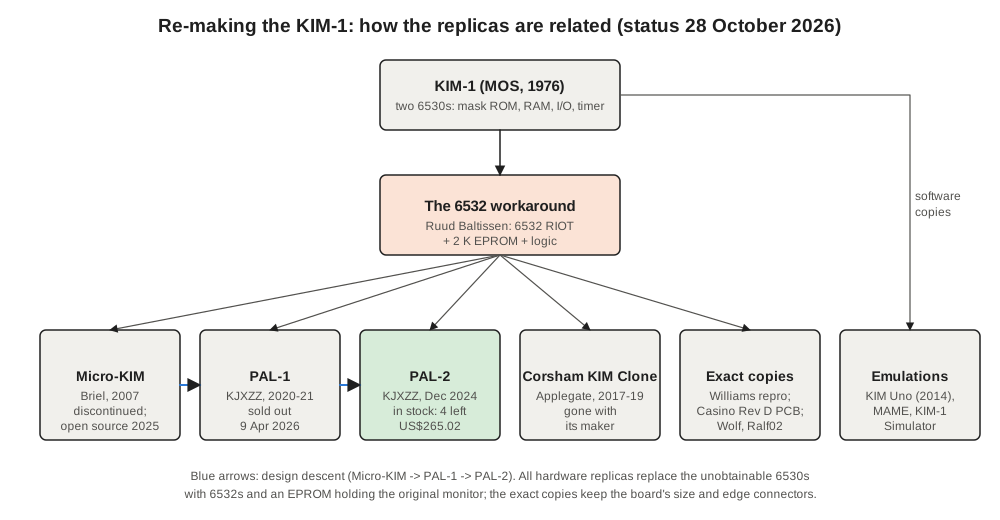
The workaround has two costs. The first is that the 6532 is itself long out of production. Kits ship recycled vintage chips, tested before sale; the PAL-II manual warns that the kit “includes recycled vintage, hard to find ICs”. Builders report the occasional dead one, and Hans Otten records one builder who ran into “broken 6532s from China and broken 2102 SRAM ICs”. The second is that the ROM images must come from somewhere. Copies of the two 6530 ROMs have circulated for decades and are hosted on Hans Otten’s site; a replica’s EPROM holds the -003 image at 1800–1BFF and the -002 image at 1C00–1FFF. (The series’ own simulator avoids the question by not using the ROMs at all, Volume 4.)
8.2.3 Degrees of faithfulness
Replicas differ in how much more of the original they keep. Five questions separate them:
Table 1 — Replicas differ in how much more of the original they keep. Five questions separate them
| Question | Most faithful answer |
|---|---|
| Is the processor a real NMOS 6502? | yes, at 1 MHz |
| Are there two RIOTs, so all of the KIM-1’s I/O and both timers exist? | yes, two 6532s |
| Is the original monitor unmodified? | yes, the 6530 ROM images |
| Is the board the original’s size, with edge connectors on the original pins? | yes |
| Are the teleprinter (20 mA loop) and cassette interfaces reproduced? | yes |
A board that answers yes to all five is, to its software and to anything plugged into it, a KIM-1. Most replicas trade one or more of these for convenience: a single 6532 and less I/O, a USB-serial adapter instead of a current loop, no cassette circuit, pin headers instead of edge fingers, more RAM.
8.3 Exact Copies
A few builders have reproduced the KIM-1 itself: the same board outline, connectors, parts placement and circuits, with only the 6530s replaced.
Eduardo Casino’s Rev D replica (Madrid, 2023) is the only copy of the actual printed circuit. He traced a revision D board from high-resolution photographs, drawing its curved hand-laid tracks as Bézier curves in Inkscape, imported the result into KiCad and checked it against the schematic; the MOS logo is reproduced too (github.com/eduardocasino/kim-1, CC BY-NC 4.0). Because it is a true copy, it needs real 6530s or a substitute that plugs into their sockets. Casino designed one, a dual 6530-to-6532 adapter carrying two 6532s, an EPROM and logic across both sockets, and a keypad replica. There is no kit. Builders have the boards made from his files and source every part themselves, including obsolete 6102 or 2102 RAMs; Casino’s notes warn of counterfeits. In February 2026 Hans Van Slooten offered three spare sets of the main board, adapter, keypad and diagnostic boards for “around $50 for the set” on the pal6502 group, parts not included.
Dave Williams’s MOS KIM-1 Reproduction (“Devilish Designs”) aims to “reproduce a KIM-1 as exact as possible”: the same dimensions, the same edge connectors physically and electrically, components in the same places, eight 2102 static RAMs for the kilobyte, and the full cassette interface with its 565 phase-locked loop and 311 comparator. Its 6530s are replaced on the board by two 6532s, a 2816 EEPROM and a 74LS138 decoder (Williams’s bill of materials, March 2021). The tracks are a modern layout without the original’s curves. The Centre for Computing History in Cambridge holds one. Hans Otten reports that they are sold “on ebay, not all the time”, and that a newer blue-board version and an I/O card had appeared by January 2026; no listing or price could be found on 28 October 2026.
Two community designs belong here too. Colin Wolf’s KIM-1 Replika (2021) keeps the original’s size and layout and hides the ROM and decoding on a small daughterboard. The Nachbau eines KIM-1 begun by “Ralf02” on the German forum64.de in March 2022 grew into a ninety-nine-page thread with a keypad replica and expansion cards; Hans Otten calls it “closer to the original KIM-1 than any KIM-1 replica designed”. Both are documented builds, not products.
The exact copies are the most satisfying replicas and the hardest to make. None can be ordered as a kit in October 2026.
8.4 Working Clones
The second family keeps the KIM-1’s memory map, monitor and keypad but not its board.
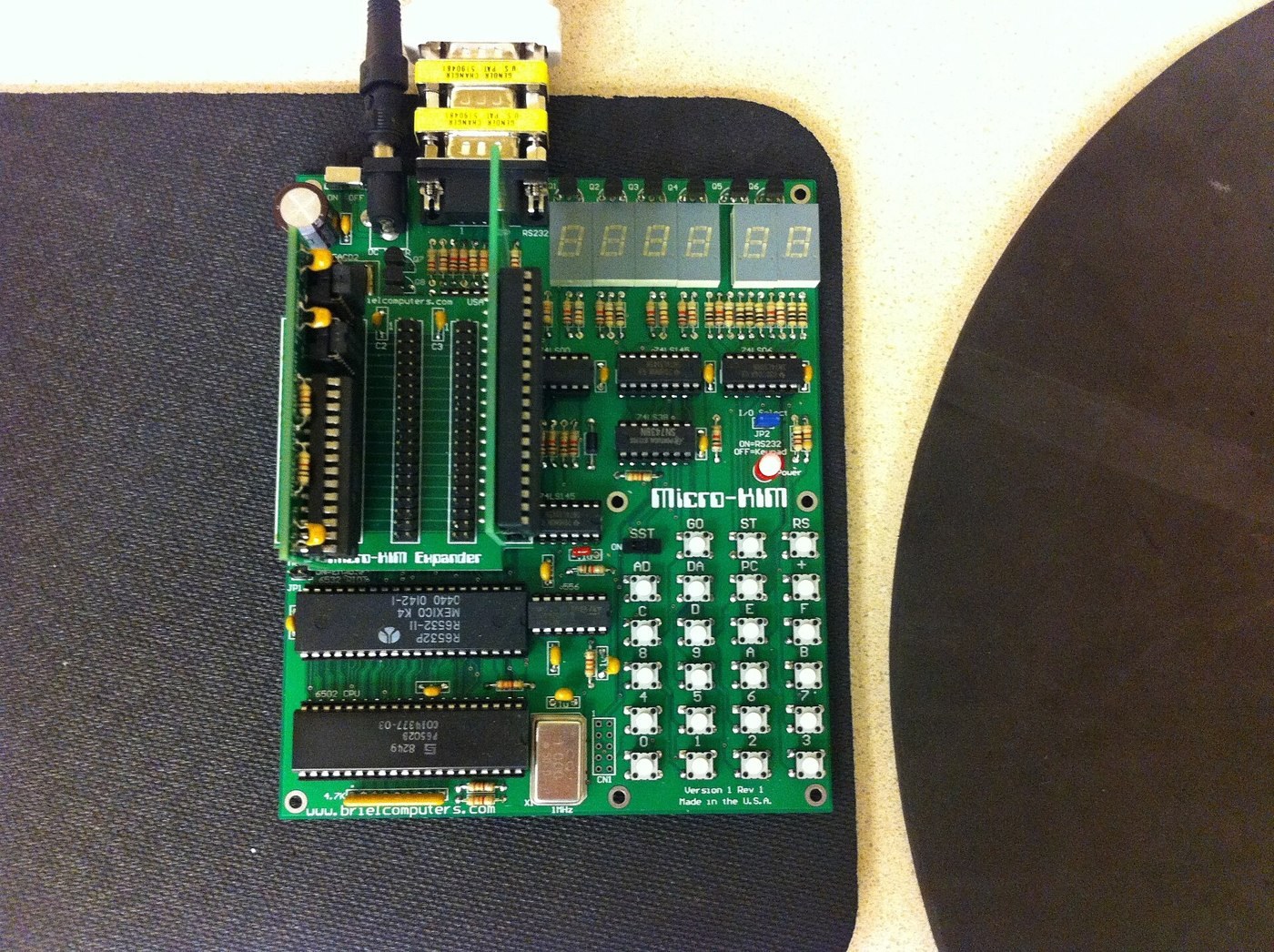
8.4.1 Micro-KIM (Briel Computers, 2007)
Vince Briel, who also made the Replica 1 Apple-1 clone, introduced the Micro-KIM in 2007; its manual went through revisions in July and September of that year. Hans Otten calls it “the first KIM-1 clone that was running the unmodified KIM-1 ROM.” It is a compact board with a 6502 at 1 MHz, a 2 K EPROM, 5 K of RAM in the KIM-1’s memory map, one 6532 with its 128 bytes of RAM mapped to cover both of the 6530s’ RAM areas, an RS-232 port the monitor’s teleprinter routines can drive, and a 40-pin expansion header. A second 6532 was an option board. It has no cassette interface. It sold for US$99. Owners found that fitting a CMOS 65C02 in place of the NMOS 6502 broke single-step, because of a short glitch in the stepping logic; the community’s fix is a small delay on the SYNC line.
The Micro-KIM is discontinued, but in 2025 its design files, manuals and ROM files were released under the GPL-3.0 licence (github.com/Retrotink/Micro-KIM), so it can be built from scratch.
8.4.2 Corsham Technologies KIM Clone (2017–2019)
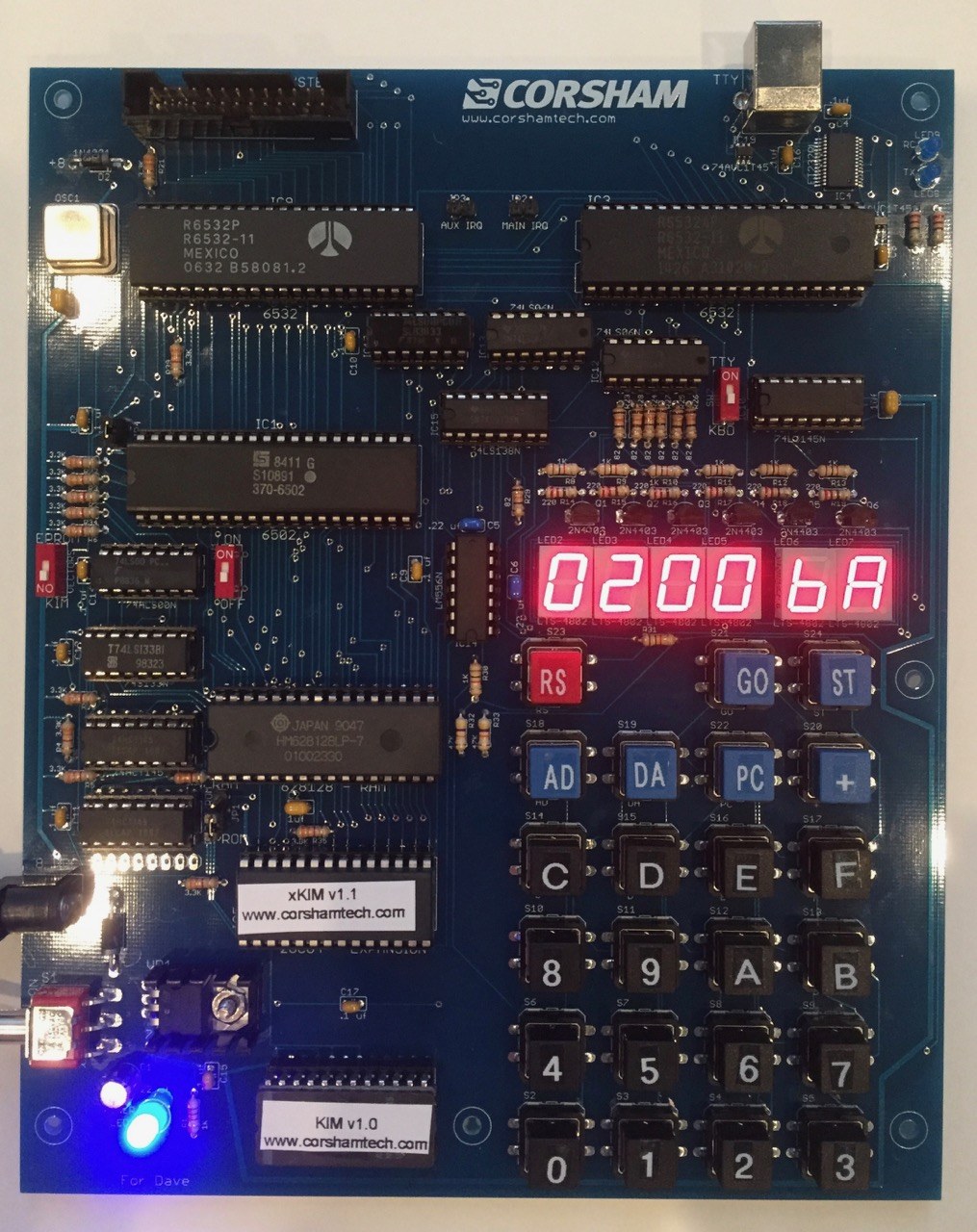
Bob Applegate of Corsham Technologies, Medford, New Jersey, began the KIM Clone in 2017 and took it through five revisions to Rev 5 in 2019, sold assembled or as a kit. It used two 6532s decoded as the 6530-002 and -003, RAM at 0000–13FF and 2000–DFFF, an EEPROM at 1800–1FFF holding a modified monitor with his own extensions (the entry points were preserved), a vector switch, larger keys, and a USB connection for the teleprinter. It had no cassette interface. Corsham also made add-ons that fitted original KIM-1s: a 60 K RAM/ROM board, an I/O board converting RS-232 to the current loop, an SD-card system and a 6530 replacement board.
Bob Applegate has since died — by October 2023 Hans Otten referred to “the late Bob Applegate” — and corshamtech.com no longer resolves. The KIM Clone is no longer available; its documentation survives in Hans Otten’s Corsham archive. RetroSpy Technologies now sells boards described as inspired by Corsham’s, including a surface-mount 6530 replacement that fits an original KIM-1’s sockets; its shop returned an error on 28 October 2026, so prices could not be checked.
8.4.3 PAL-1 (2020–2026)
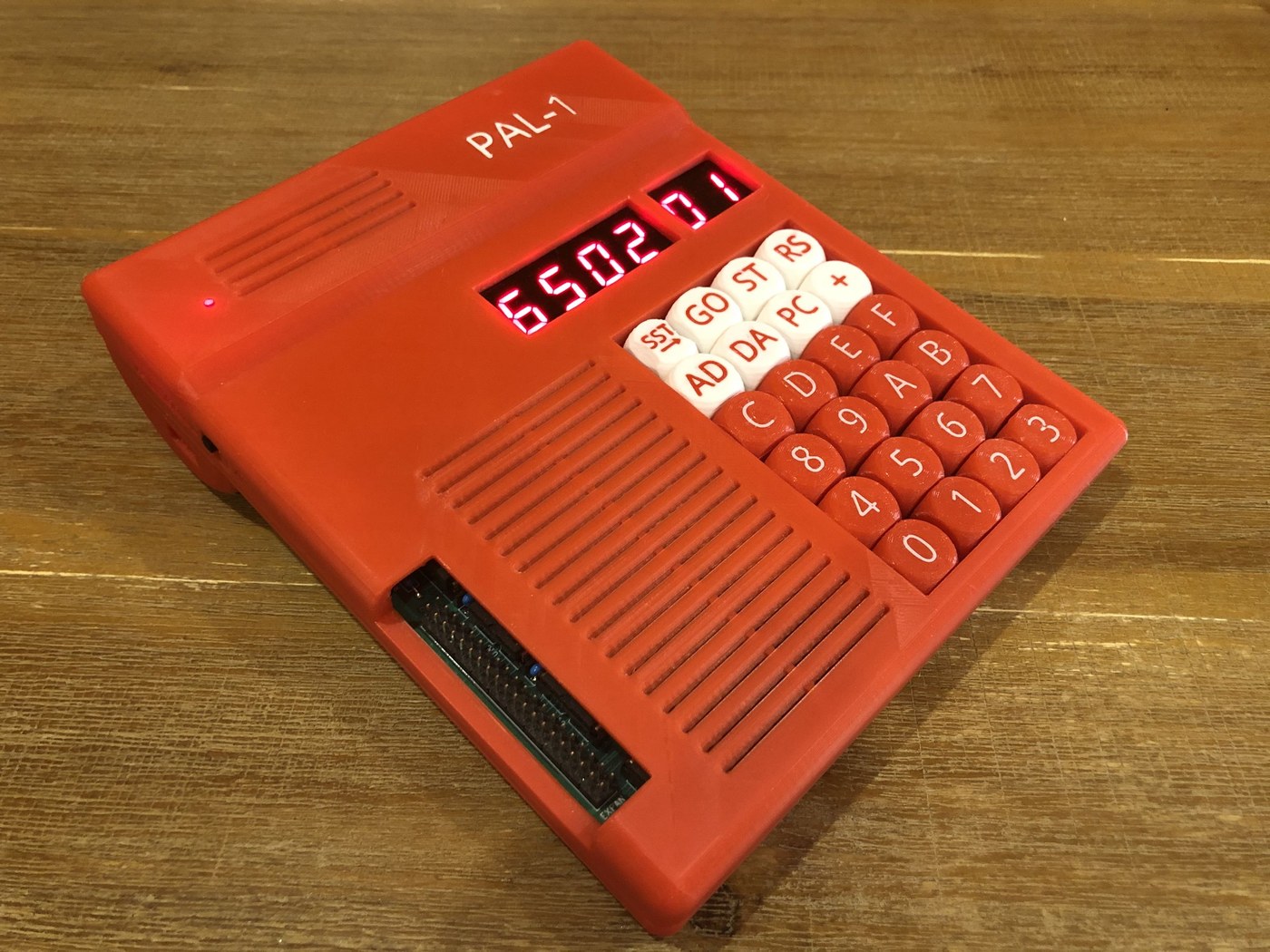
Liu Ganning, of Shenzhen, trading as KJXZZ, released the PAL-1 kit in late 2020; its manual is dated November 2020 and sales began in 2021. Its design is “basically copied from the MOS/Commodore KIM-1”, with the serial and expansion sections following Rich Dreher and Vince Briel, and Hans Otten and others place it in the Micro-KIM’s line. It has a 6502 at 1 MHz, one 6532, an EPROM holding the monitor, an 8 K static RAM of which 5 K is mapped, six LED digits and 23 tactile keys, an RS-232 port on a DB-9, and a 7.5 V power jack. A family of add-on boards supplied what it left out: a second RIOT, 32 K of RAM, a cassette interface and a motherboard.
The PAL-1 sold for US$80. On 28 October 2026 its Tindie listing read “Out of stock — Sold out since Apr 09, 2026”, and pointed buyers to its successor. Several of its add-on boards were still in stock in small numbers (one to ten of each, US$15 to US$27).
8.4.4 PAL-2 (2025–)
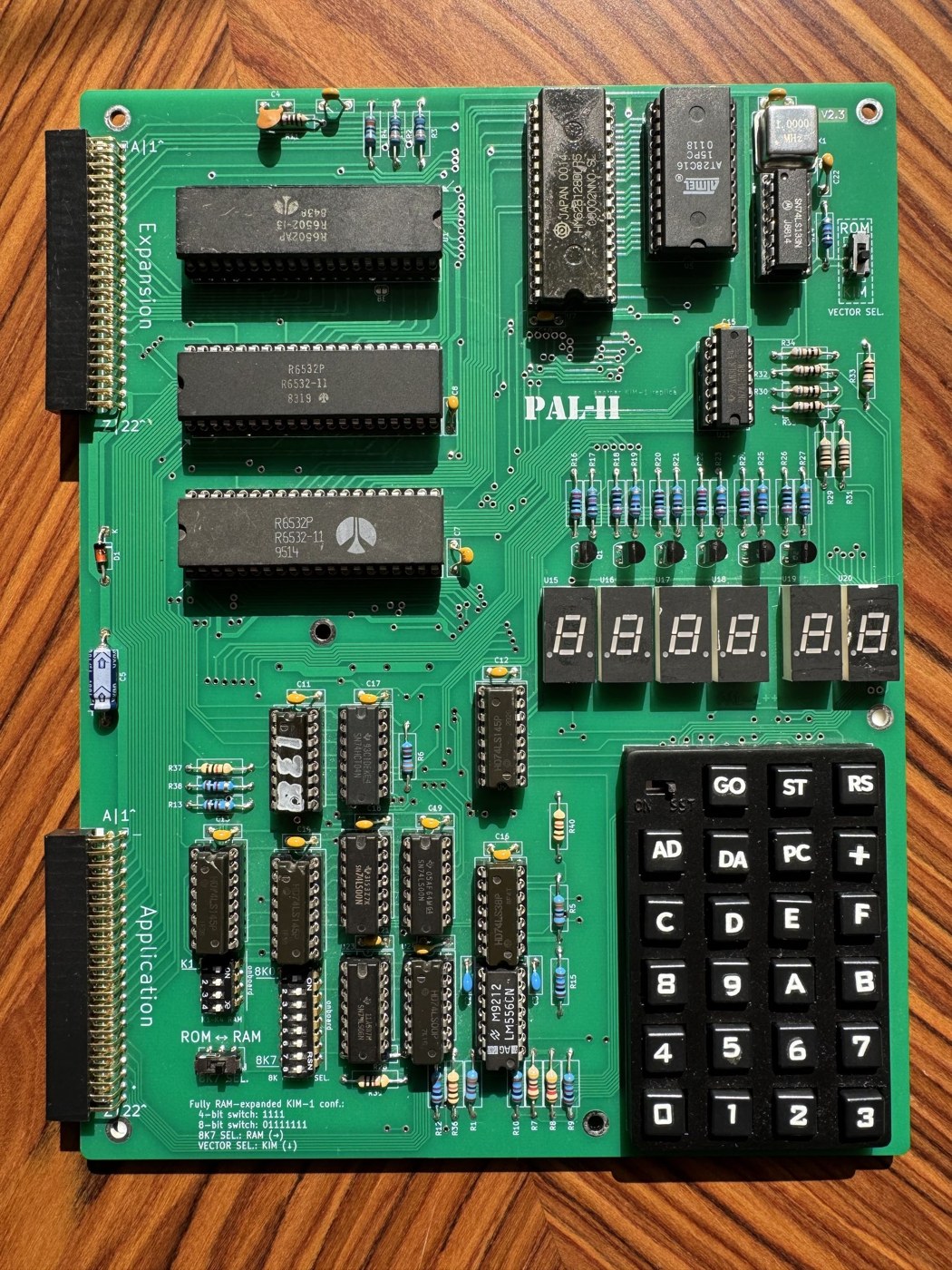
The PAL-II, usually written PAL-2, is Liu Ganning’s second design. Its user manual, version 1.0, is dated 30 December 2024, and Hans Otten had built one by February 2025. The manual calls it “another replica of the MOS KIM-1 and … an upgraded version of PAL-1 … a version closer to the original KIM-1”, and it is the closest of the clones:
- a real NMOS 6502 at 1 MHz (the kit pictured by the seller uses a Rockwell R6502);
- two 6532s, in the positions of the original’s 6530-002 and -003, so all of the KIM-1’s I/O and both timers are present;
- the unmodified monitor in a 28C16 EEPROM;
- a board laid out like the KIM-1, 168 × 218 mm, with the connectors on the left, the processor and RIOTs in a column and the keypad at lower right with its SST slide switch;
- the original’s 74LS145 decoders for keys and digits and 556 debouncer for ST and RS;
- a 128 K static RAM switched in 1 K and 8 K blocks by DIP switches, so the board can be the original 1 K KIM-1 or a fully expanded one;
- Application and Expansion connectors on 2.54 mm pin headers with the KIM-1’s pin names.
It departs from the original in three ways the manual is open about. There is no cassette circuit — “PAL-II replicates almost all the functionalities of KIM-1, except for audio-related features”. The teleprinter port is at TTL level, for a USB-to-TTL adapter, instead of a 20 mA loop. And because the connectors are pin headers, original KIM-1 plug-in cards need adapting; the Application connector’s audio pins are reused for the memory decoding. Hans Otten has shown that the cassette can be restored with one patch wire and the PAL-1’s cassette board.
On 28 October 2026 the PAL-2 kit was listed on Tindie at US$265.02, with the note “Only 4 left in stock” (Tindie listing).
8.5 Emulations
The third family contains no 6502 at all.
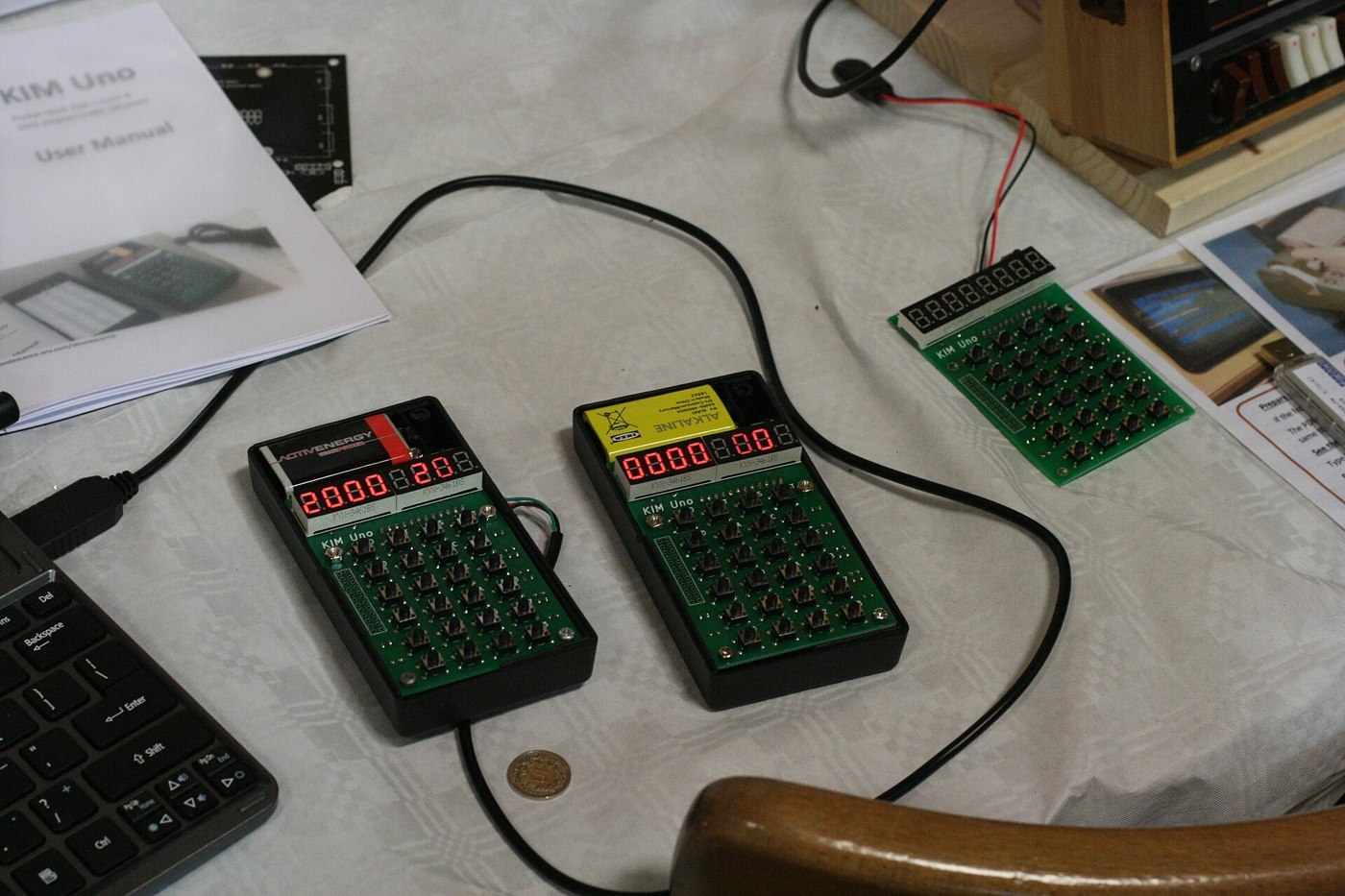
KIM Uno (Oscar Vermeulen, Obsolescence Guaranteed, 2014). A small board with 24 tactile keys and a seven-digit calculator LED display, with an Arduino Pro Mini on the back running Mike Chambers’s 6502 emulator and an emulation of the KIM-1’s hardware (kim-uno details). It has the KIM-1’s 1 K of RAM and RIOT RAM, uses the microcontroller’s EEPROM as a second kilobyte and as a cassette substitute, and carries extra ROMs including Microchess, a floating-point calculator mode and, after a 2020 firmware update, an Apple-1 mode. Its monitor is patched to work with the emulated hardware, so programs that drive the KIM-1’s ports directly do not all run. Vermeulen sold kits for US$17.50. His page now says he has stopped making them “due to lack of time”; the design is open hardware, the parts cost about $10, and an eBay seller offers kits. More than 900 had been built by August 2022.
MAME includes a kim1 driver that emulates the keypad and LEDs, a cassette device and a serial terminal; its one remaining to-do note is that the LEDs “should be dark at startup” (MAME source, kim1.cpp).
The KIM-1 Simulator by Hans Otten and Eduardo Casino (version 2.3.0, 2019–2026) runs on Windows, Linux, macOS and the Raspberry Pi 5. It concentrates on the teleprinter side, with a debugger and emulations of later expansion hardware; its LEDs are driven through a patched display routine, so LED games that write to the ports directly do not run.
Others include Cameron Kaiser’s Incredible KIMplement, which runs a KIM-1 on a Commodore 64, browser emulators, and several command-line ones. Hans Otten notes that most emulators patch the monitor’s bit-banged serial routines, its speed measurement and its display routine, which is why direct-to-port LED programs fail on them.
This series’ own simulator, kim1_sim.py (Volumes 3, 4 and 10), takes the opposite approach for the display. It contains none of the monitor’s code, but it models the ports and multiplexer, so a program that lights the segments itself is shown correctly.
8.6 What the Replicas Run
A replica that keeps the memory map and the unmodified monitor runs the KIM-1’s software as it was published. That includes the programs of The First Book of KIM, loaded by keypad or as paper-tape files through the serial port, Peter Jennings’s Microchess (Volume 5), and Microsoft’s BASIC for the KIM, distributed as KB-9, which needs far more than the original kilobyte and so a replica with its extra memory switched in. The replicas have also attracted new software. CP/M-65, a port of the CP/M idea to the 6502, has run on the PAL-2 with an SD card wired to the user port, as Jan Rydval described in his build log of October 2026 (blog.jaxtax.eu), and Eduardo Casino has published a KIM-1 port and expansion cards for it.
Two cautions apply to software. Programs written for a replica’s extra RAM or extended monitor will not run on a 1 K original. And programs that use the KIM-1’s cassette routines need a cassette interface, which the PAL-2, the Micro-KIM and the Corsham clone do not have on the board. Most owners now move programs as paper-tape-format text files sent from a terminal program. Builders report that the monitor’s bit-banged serial routine drops characters if a file is sent at full speed, so the usual advice is to add a few milliseconds’ delay after each character and a longer one after each line (the PAL-1 manual suggests 5 ms and 100 ms).
8.7 The Survey at a Glance
Status as read on 28 October 2026:
Table 2 — Status as read on 28 October 2026
| Replica | Maker | Since | Kind | Faithfulness | Price | Availability |
|---|---|---|---|---|---|---|
| PAL-2 | Liu Ganning (KJXZZ) | Dec 2024 | clone, two 6532s | high; no cassette, TTL serial | US$265.02 | in stock, “Only 4 left” |
| PAL-1 | Liu Ganning (KJXZZ) | 2020–21 | clone, one 6532 | medium | US$80 | sold out since 9 Apr 2026 |
| Micro-KIM | Vince Briel | 2007 | clone, one 6532 | medium | was US$99 | discontinued; open source (2025) |
| KIM Clone | Bob Applegate (Corsham) | 2017–19 | clone, two 6532s, extended monitor | medium | — | gone |
| MOS KIM-1 Reproduction | Dave Williams | c. 2020 | exact size and connectors | very high | not found | eBay, intermittent |
| Rev D replica | Eduardo Casino | 2023 | exact PCB copy | highest | open design | self-build only |
| KIM Uno | Oscar Vermeulen | 2014 | Arduino emulation | low | was US$17.50 | DIY; eBay kits |
| MAME, KIM-1 Simulator | various | — | software | software only | free | download |
8.8 Choosing One to Build
For a build volume the choice has to balance faithfulness against two practical tests: can the kit be bought, and is it documented well enough to build and test?
The exact copies win on faithfulness and lose on both practical tests. The Williams reproduction cannot be ordered on demand, and Casino’s board is a sourcing project for obsolete chips rather than a kit. The KIM Uno is easy to get and to build but is an emulator with a patched monitor and a different keypad. The Micro-KIM and the Corsham clone are no longer sold, and the PAL-1 sold out in April 2026.
That leaves the PAL-2. It is the only complete KIM-1 replica kit in stock in October 2026. It has both RIOTs, the original memory map and the unmodified monitor on a real NMOS 6502, and a board and keypad laid out like the original. It is documented by its maker’s manual, schematic and bill of materials, by Hans Otten’s build notes and by an active users’ group (pal6502 on Google Groups). Its gaps — no cassette circuit, a TTL serial port, pin headers instead of edge fingers, recycled chips — are documented, and the cassette gap can be closed.
Volume 9 builds a PAL-2. A purist’s alternative, Casino’s exact board with his 6532 adapter, is described there briefly for anyone with the patience to source its parts.
Next — Volume 9: Building a KIM-1 Replica. The PAL-2 from box to
KIMprompt: the parts, the soldering order, the switch settings, the first press of RS, the manual’s first program and a teleprinter session over USB, and how to give it back the cassette interface the original had.
Comments (0)