KIM-1 · Volume 7
KIM-1 — Volume 7 — Commodore, the PET and the KIM's Legacy
A calculator maker buys a chip maker for stock, the KIM-1 gets a Commodore logo, Chuck Peddle turns the lessons of a single-board computer into the PET 2001, Rockwell, Synertek and Elektor build their own KIMs, and the 6502 goes on to outlive them all
7.1 About This Volume
In 1976 MOS Technology had the cheapest good microprocessor in the world, a single-board computer selling far beyond expectations, and not enough money. By the end of the year it belonged to Commodore, a Canadian-American calculator company run by Jack Tramiel. This volume follows the KIM-1 into Commodore: the takeover and why it happened, what changed on the board, how the KIM’s designers used what it had taught them to build the PET 2001, one of the three complete personal computers of 1977, and how other companies built their own KIM-like boards. It ends with the 6502’s long afterlife and with the original KIM-1s that survive in museums and collections.
The main sources are the Computer History Museum’s oral histories of Chuck Peddle and Bill Mensch (2014), Brian Bagnall’s On the Edge (Library copy of the TIM and KIM chapter), contemporary reports gathered by commodore.ca and David Farquhar, and museum catalogue records. The PET’s story is told here only as far as it concerns the KIM; it deserves its own unit.
7.2 Commodore Buys MOS
7.2.1 The calculator war
Commodore began in Toronto in the 1950s as a typewriter business, moved into adding machines and, by the early 1970s, electronic calculators, which it assembled from chips bought from other companies. In 1975 that business turned against it. Texas Instruments, which made its own chips, began selling calculators at prices below what Commodore paid for the parts, and Japanese makers with low-power CMOS chips and liquid-crystal displays were taking the top of the market. Tramiel concluded that he needed his own chip supply. His later explanation, as quoted by commodore.ca, was: “From there on, I felt the only way to continue in the electronics business was to control our own destiny.”
MOS Technology, which made calculator chips and was weakened by the Motorola lawsuit and the collapse of the calculator market, was the obvious target. Peddle remembered the company’s position plainly: “We were making a little bit of money selling KIMs, but we didn’t have the income that would justify where we needed to go. And so he made him a good offer” (Peddle, CHM oral history, 2014, p. 52). Bill Mensch, who left MOS around that time, put it more sharply: Tramiel “saw blood in the water”, and it was “a depressed situation, or a fire sale” (Mensch, CHM oral history, 2014).
7.2.2 The deal
The purchase was announced in September 1976 and completed in the autumn, by November at the latest. It was paid for in shares. New Scientist, reporting the deal that September, said that Commodore, valued at $60 million on the New York Stock Exchange, had acquired all of MOS Technology, privately owned and valued at about $12 million, in exchange for a 9.4 per cent stake in Commodore. Peddle’s later comment was that Tramiel “sold them Commodore stock, which at that time went from $1 to $500 over time. So he paid a lot, but he didn’t know it.” Peddle himself joined Commodore as part of the arrangement, and the MOS plant at Norristown became Commodore’s semiconductor division.
7.3 The KIM-1 Under Commodore
7.3.1 A new logo on the board
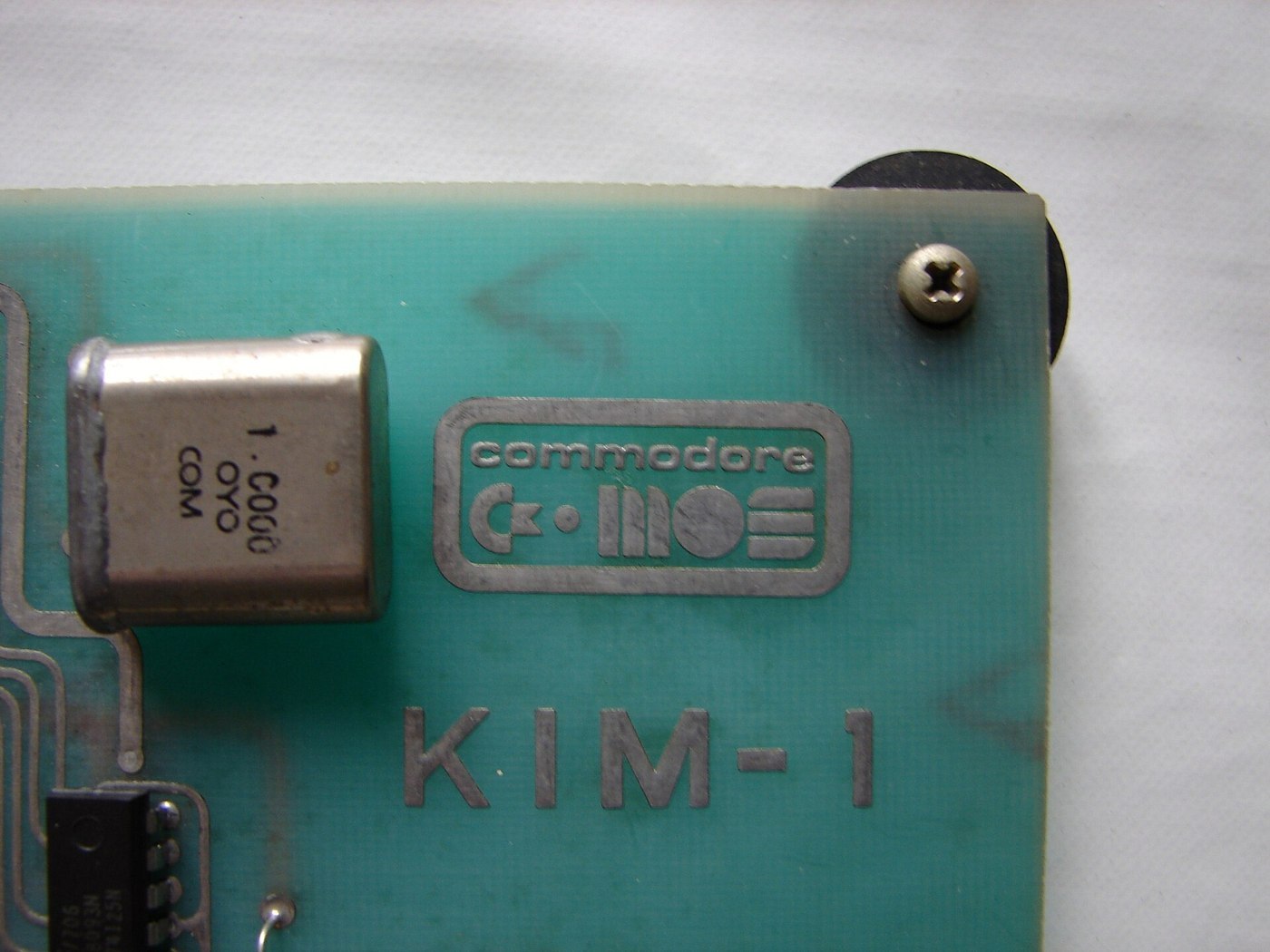
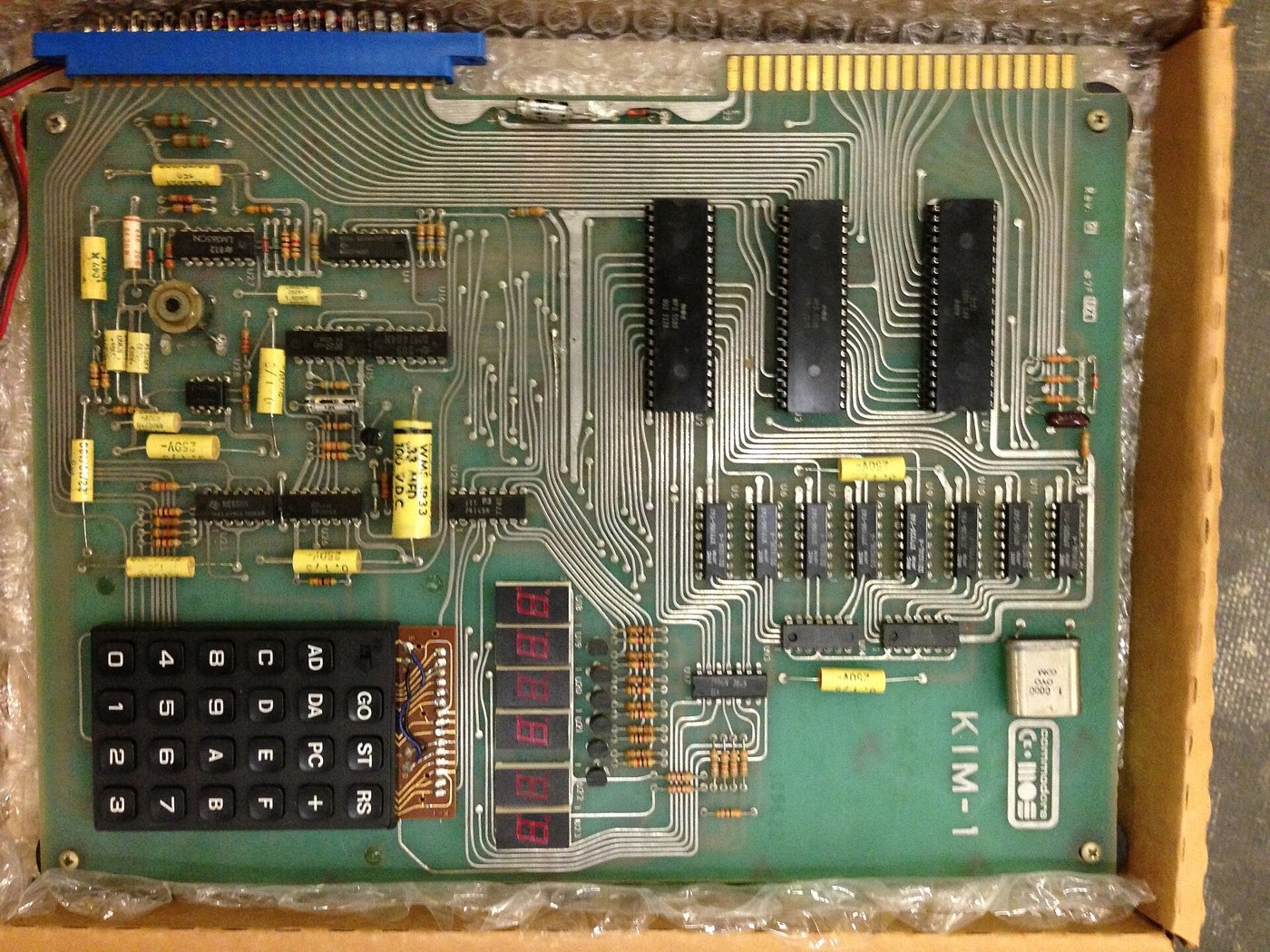
For KIM owners, the visible change was small. Later KIM-1s carry Commodore’s “chicken head” logo etched into the copper next to the MOS mark, and the documentation and packaging changed name; Bagnall notes that the KIM-1 thereby became the first computer sold under the Commodore name. The circuit stayed essentially the same through a series of board revisions, from the earliest MOS boards (some of which still carry early 6502s without the ROR instruction, Volume 2) to the Commodore “Rev F” and “Rev G” boards of 1978 and after. There was never a KIM-2 computer; the name was used for a memory board.
7.3.2 Selling a system
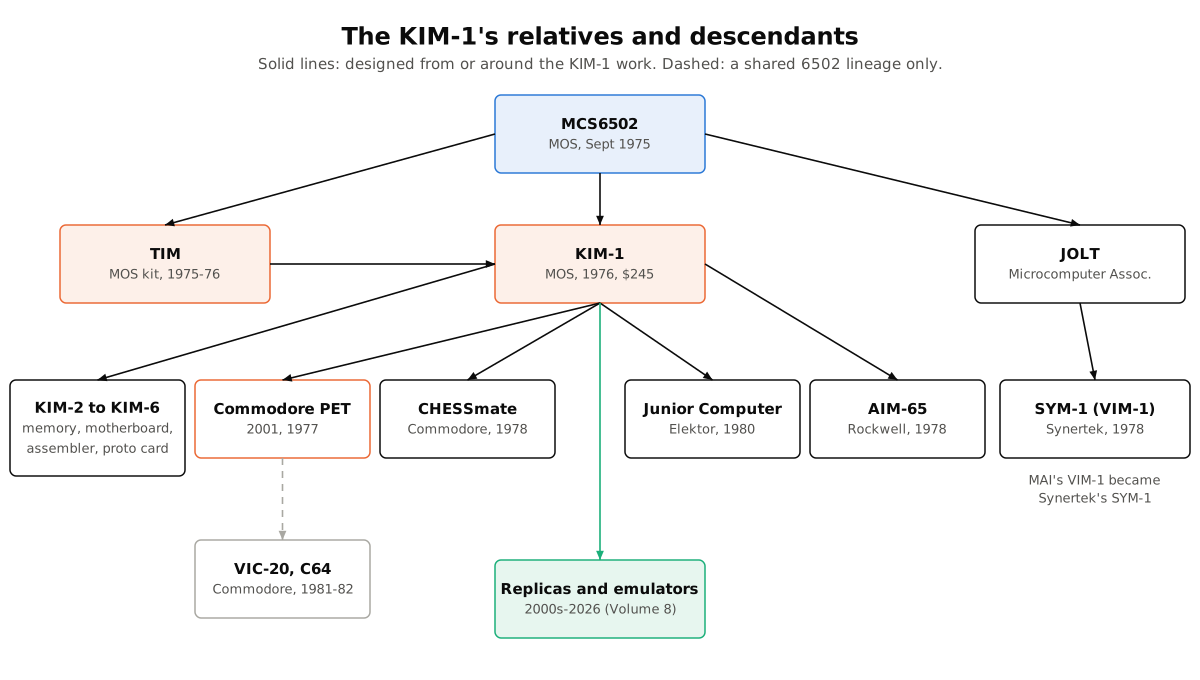
Commodore kept selling the KIM-1, and briefly treated it as the centre of a system. In partnership with Larry Hittle, a former General Electric engineer whose Denver company Monolithic Systems built the boards, Commodore marketed the KIM-2 (4 KB) and KIM-3 (8 KB) memory cards, the KIM-4 motherboard with six 44-pin slots that mated with the KIM-1’s expansion connector, the KIM-5 ROM card with a resident assembler and editor, and the KIM-6 prototyping card, in a colour brochure of the whole line. It also sold an optional plastic case. At shows, Commodore’s Rick Simpson demonstrated the KIM-1 by playing Microchess and sent customers to Peter Jennings, and Commodore agreed to put Jennings’s Microchess flyer in every KIM-1 box (Volume 5).
In 1978 Commodore advertised against the KIM’s imitators, asking: “Honestly: How many reasons do you need to make sure your next microprocessor is the original, genuine KIM?” By then, though, the company’s attention was elsewhere. Bagnall dates the end of KIM-1 production to about 1981. No total has been published; estimates by people involved range from Mensch’s “about 50,000” to Yannes’s “a couple of hundred thousand, I think” (Volume 1).
7.3.3 Growing a KIM into a computer
Before the PET existed, KIM owners were already turning the board into something like it, and their efforts show what the market wanted. Don Lancaster, whose TV Typewriter articles had shown hobbyists how to put text on a television, designed the TVT-6, a video display of about ten low-cost chips that used the KIM’s own memory for the screen and its processor to generate the picture; it was the cover story of Popular Electronics in July 1977, sold as a $34.95 kit by PAiA Electronics, and typically showed 16 lines of 32 upper-case characters. Forethought Products of Oregon sold the KIMSI, a motherboard with eight S-100 slots that let a KIM use the memory and peripheral cards made for the Altair. Owners added full keyboards, Selectric typewriters as printers, and BASIC from tape (Volume 5).
The most ambitious example was Peter Jennings’s own system. Bagnall records that Jennings expanded his KIM to 8 KB, added two 8-inch floppy disk drives and wrote a disk operating system for them, wrote the Micro-ADE assembler, and connected the machine to a modem. When he flew to Santa Clara to deliver the CHESSmate program and found it needed changes, he dialled his KIM in Toronto from a terminal at Microcomputer Associates, edited and reassembled the source code remotely, and punched a new paper tape to be burned into ROM. He used the same system to develop later versions of Microchess for the PET and the Apple II.
A KIM-1 built up that far worked well, but it was a bench full of boards, cables and power supplies, assembled by an expert. The lesson for Commodore was that the same capabilities, packaged in one case and sold ready to switch on, would sell to people who would never solder a connector.
7.4 From KIM to PET
7.4.1 “Something we can plug in and program”
What the KIM-1 taught MOS, Peddle said, came from its users. At shows, the programmers who bought KIMs told him: “We don’t want to build kits… We want something we can plug in and program” (oral history, p. 62). The KIM had proved that thousands of people would buy a computer to learn on and play with, and it had shown where it fell short: no keyboard, no screen, no language but machine code, no case, no power supply. The next machine would fix all of those at once.
Radio Shack was circulating a specification for exactly such a machine, and Commodore’s head of engineering, André Sousan, backed building one. Peddle summarised the specification as “integrated video, integrated storage, integrated keyboard, integrated computer”. He brought in Bill Seiler, who did much of the hardware, and John Feagans, who wrote much of the software; Leonard Tramiel, Jack’s son, worked on the character set. Peddle wrote the cassette routines himself, “with an oscilloscope in my hand”. The new machine’s language would be BASIC in ROM, and Peddle went to Albuquerque to license it from Microsoft. Bill Gates, he recalled, looked at the 6502 and called it “a piece of junk, because it’s got a 256 byte stack”; the licence was a single payment, which Tramiel later put at $25,000, rather than the royalty Gates had wanted. To give the machine “dignity”, as Peddle put it, among buyers who thought computers cost $20,000, he added the IEEE-488 instrument bus.
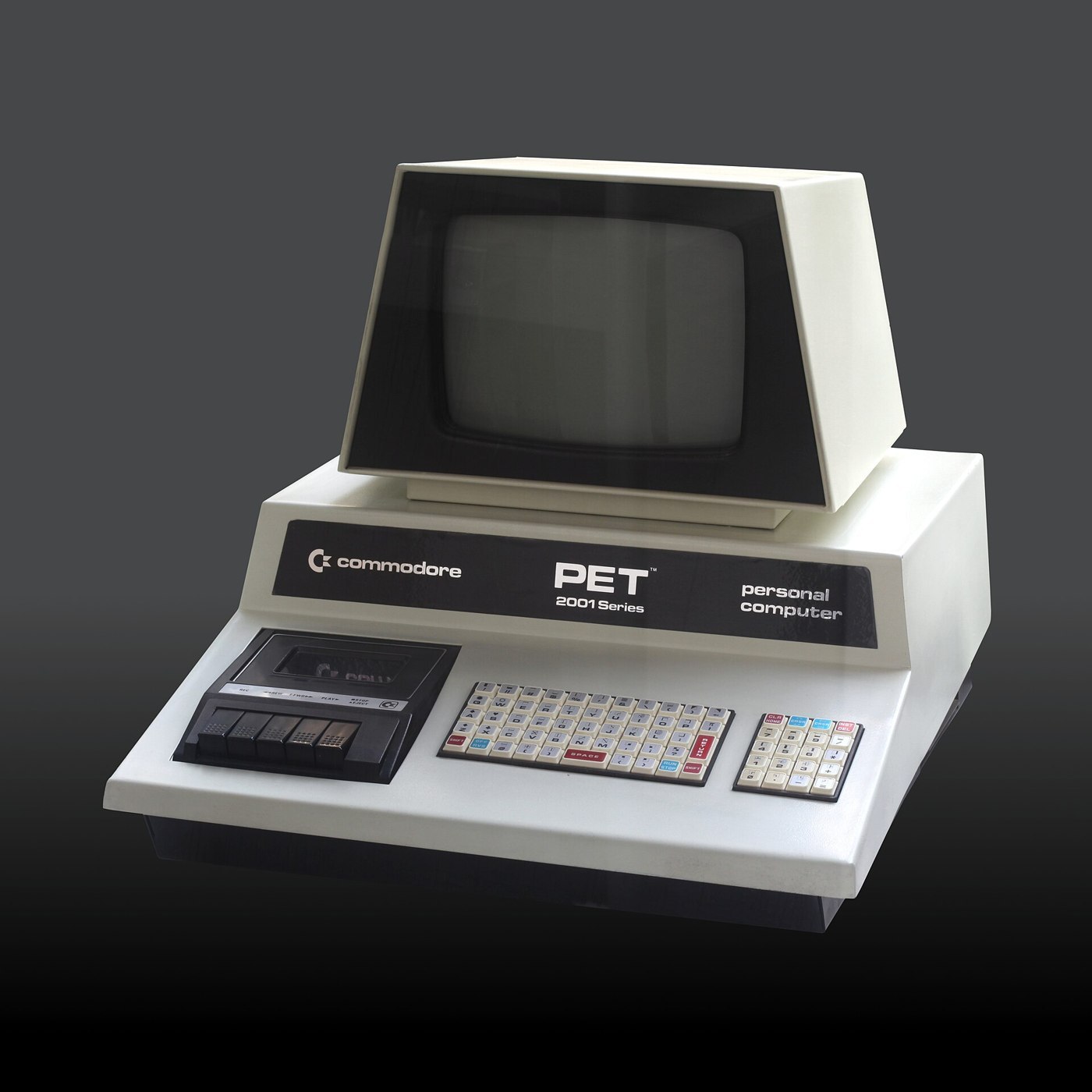
7.4.2 The PET 2001
The prototype was shown privately at the Consumer Electronics Show in Chicago in January 1977, in such a hurry that, Peddle said, “we got the CRT right side up just in time”. At that show, by Peddle’s account, Tramiel offered to finish the machine for Radio Shack only if Radio Shack also stocked Commodore’s whole calculator line; Radio Shack declined and built the TRS-80 instead. Sousan named the machine after the Pet Rock craze of the previous Christmas; the letters were later explained as “Personal Electronic Transactor”, and, Peddle added, “legend is that it stands for Peddle’s Ego Trip.” Pre-production PETs were shown publicly at the first West Coast Computer Faire in San Francisco in April 1977, alongside the Apple II. The first machines reached buyers in the autumn of 1977, mostly magazines and developers, with general availability around the end of the year; prices quoted for the first models range from $495 to $795 depending on the source and the memory size.
The PET was a different kind of machine from the KIM-1 — a sealed appliance with a keyboard, a nine-inch screen and a built-in cassette recorder, programmed in BASIC — but its lineage is direct. It used the 6502 and MOS’s own interface chips; it was designed by the same people; and its built-in machine-language monitor was MOS’s TIM, the teletype monitor that shared its code with the KIM’s, which Commodore’s documentation describes as “expanded and adapted” for the PET. The Computer History Museum’s catalogue entry for its KIM-1 (serial 12829, object X365.84) states simply that the KIM-1 “led directly to the Commodore PET 2001” (CHM).
7.4.3 What carried over
The PET’s debt to the KIM is clearest in the details. It ran a 6502 at 1 MHz, as the KIM did. Its keyboard, cassette and screen were handled by MOS’s own interface chips, the 6520 PIA and the 6522 VIA — descendants of the I/O half of the 6530 and of Peddle’s PIA work at Motorola. Its machine-language monitor was TIM. Its cassette format grew out of the same experience as the KIM’s. And its user port, a card-edge connector at the back carrying a set of programmable I/O lines, was the KIM’s application connector moved into a case. Bagnall makes the point about the whole Commodore line: the KIM established a tradition of “containing everything on a single board, with specialized user ports for peripherals”, which the PET, VIC-20 and Commodore 64 all followed. A generation of Commodore owners who drove relays, sensors and home-made interfaces from the user port were doing what KIM owners had done with PA0 to PA7 (Volume 6).
7.4.4 The Apple that got away
One episode connects the KIM’s world to another unit on this site. In 1976, before the PET was designed, Commodore looked at buying a small company whose founders had built a 6502 computer of their own: Apple. Peddle recalled that Sousan proposed buying Apple and fitting a modified Apple board into a Commodore case. Steve Wozniak, speaking at the Computer History Museum in 2007, remembered that “Chuck Peddle from Commodore came to the garage and he was one of about three people we showed the Apple II prototype ever”, and that Steve Jobs asked “a few hundred thousand dollars”. Commodore thought it too much. The machine Apple built instead, and the one before it, are the subject of this site’s Apple-1 unit.
7.5 Rivals and Descendants
7.5.1 Rockwell’s AIM-65
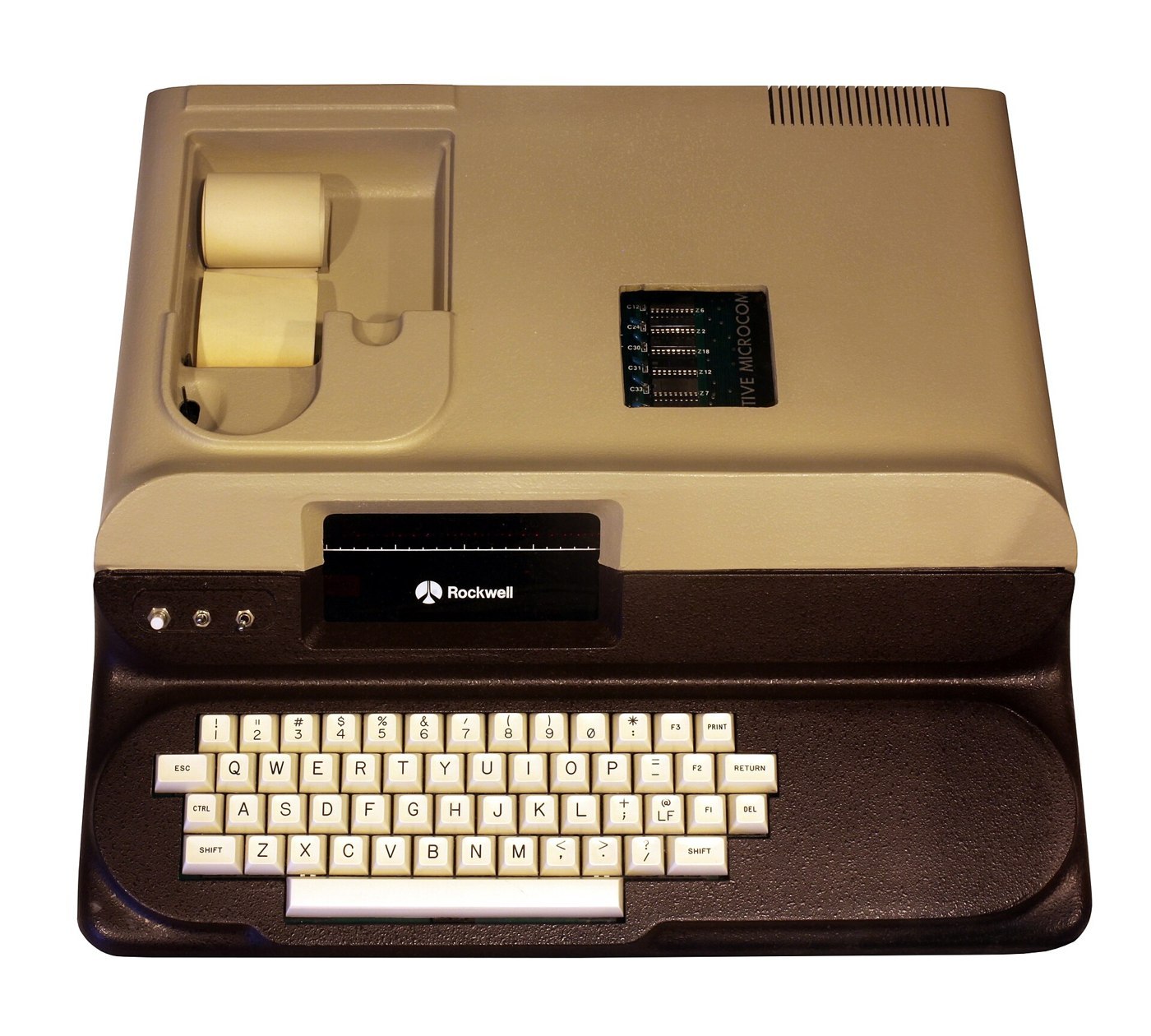
The KIM-1’s success invited copies, and the first came from the 6502’s own licensees. Rockwell International, which Peddle said he had brought in as a third source for the 6502 after the takeover, wanted to sell a KIM-1 clone; Commodore would not license one. Rockwell built its own instead: the AIM-65 (Advanced Interactive Microcomputer), introduced in 1978 at about $375. It kept the KIM’s idea — a complete 6502 computer on one board, with a monitor in ROM and spare I/O lines — but added a full typewriter keyboard on a cable, a 20-character alphanumeric LED display and a small built-in thermal printer, with BASIC and an assembler available in ROM. It became widely used in schools, laboratories and industry as a controller and development system.
7.5.2 Synertek’s SYM-1
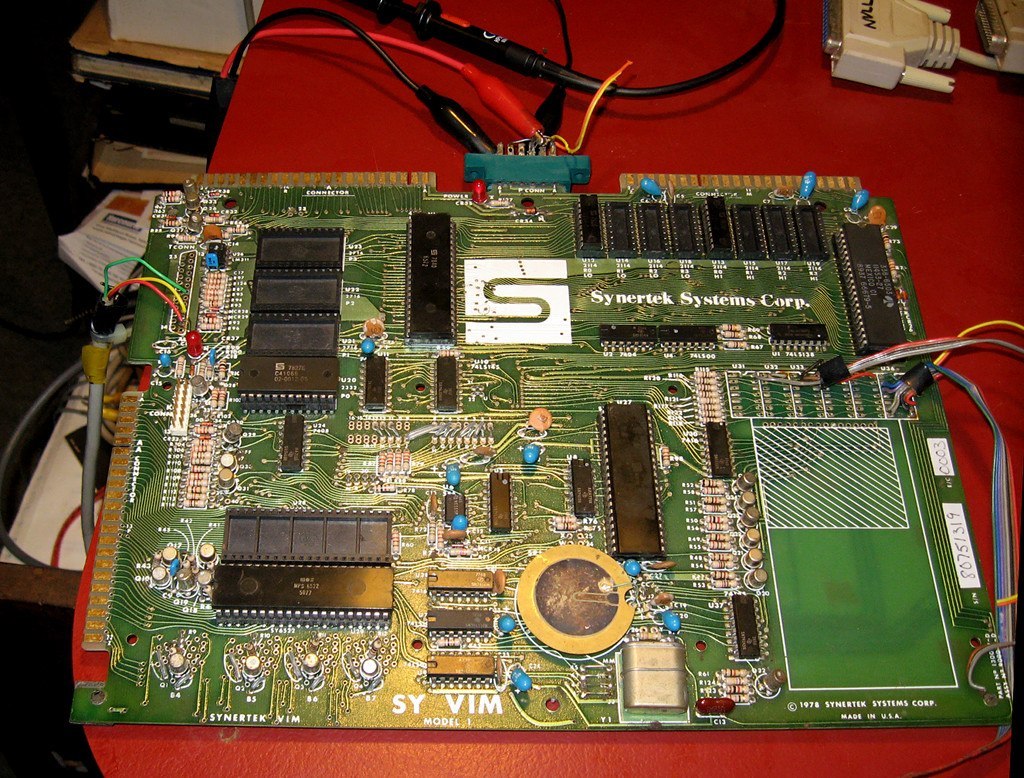
The 6502’s first second source, Synertek, took over a board designed by Microcomputer Associates, the company that had written MOS’s TIM monitor and built the JOLT. Sold first as the VIM-1 and then, Bagnall says, renamed to avoid confusion with a cleaning product, the SYM-1 (about 1978, around $239) looked and worked much like a KIM — six LED digits and a keypad on one board — but had a larger monitor in ROM, more RAM, a larger membrane keypad, a true RS-232 serial port and room for the same ROM options as the AIM.
7.5.3 Elektor’s Junior Computer
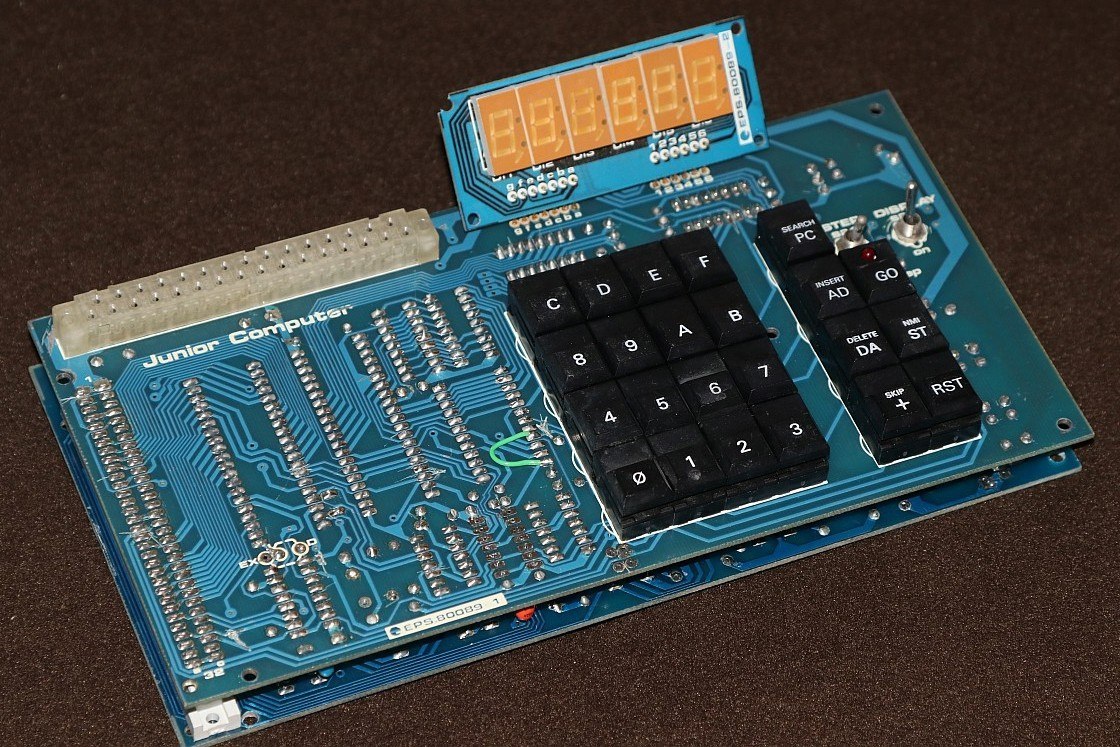
In Europe, the electronics magazine Elektor (Elektuur in the Netherlands) published the Junior Computer in 1980, designed by Loys Nachtmann. It was a near-copy of the KIM-1 in function and spirit, built from parts a reader could buy: a 6502, a standard 6532 RIOT chip in place of the custom 6530s, and its monitor in a 2708 EPROM. Readers built it from Elektor’s printed circuit boards and a series of books; it was popular in the Netherlands, Germany and France, and kept the KIM’s style of computing alive into the 1980s. Germany also had its own KIM-derived trainers.
7.6 The 6502 Outlives Them All
The KIM-1 was a showcase for a chip, and the chip went further than anyone at MOS imagined. After the PET, the 6502 or a close relative was the processor of the Apple II (1977), the Atari 2600 (as the 6507) and the Atari 400 and 800, the Commodore VIC-20 and, as the 6510, the Commodore 64, the BBC Micro, and, as Ricoh’s 2A03, the Nintendo Entertainment System. Mensch, asked in 2014 how many 6502-family processors had been made, said: “I’ve been saying 5 to 10 billion for the last 15 years.”
The KIM’s other chip had a career too. The 6530 itself was a custom part, made with each customer’s program in its ROM, which is why replicas have to replace it (Volume 8). Its general-purpose sibling, the 6532 RAM-I/O-timer, dropped the ROM and kept 128 bytes of RAM, two 8-bit ports and the interval timer. Atari’s VCS paired a 6507 with a 6532 to make a games console of 1977 out of three main chips, and Elektor’s Junior Computer used a 6532 to stand in for the KIM’s 6530s. The combination that Mensch had designed to compete with Intel’s 4040 chipset — a 6502 plus one chip with memory, ports and a timer — turned out to be the shape of a great many small computers.
Rockwell’s line also ran on: the AIM-65 was followed in 1981 by the AIM-65/40, with a 40-character display, and Rockwell’s own R6500 family included single-chip versions of the 6502 with on-chip RAM, ROM, I/O and timers — in effect a KIM-1 on one die.
Mensch left MOS around the time of the takeover and founded the Western Design Center in Arizona in 1978. WDC designed a low-power CMOS version, the 65C02, and later the 16-bit 65C816 used in the Apple IIGS and the Super Nintendo. As of 2026 WDC still sells the W65C02S in the original 40-pin package, and on 16 September 2025 it marked the fiftieth anniversary of the 6502’s launch at WESCON. A new 65C02 is not a drop-in choice for a KIM-1 replica, though: on the Micro-KIM the CMOS part broke the monitor’s single-step, and the PAL-2 built in Volume 9 ships with an NMOS 6502 (Volumes 8 and 9).
7.7 Survivors
Original KIM-1s survive in public collections, among them the Computer History Museum in Mountain View (several boards, including serial 12829 and one entered in The Computer Museum of Boston’s 1986 contest for early personal computers), the University of Amsterdam’s computer museum, the Heinz Nixdorf MuseumsForum in Paderborn, the Musée Bolo in Lausanne and the HomeComputerMuseum in Helmond. Many more are in private hands, often with their manuals, power supplies and expansion boards. No authoritative register of survivors exists. The few that come up for sale are priced by their sellers in the low thousands of dollars or euros; one Commodore Rev G board with power supply and books was listed in Germany in 2025 at €2,990, apparently without selling. Collectors distinguish the early MOS boards, the boards with a Rockwell badge reported from 1977, and the Commodore boards, and check early boards for a 6502 without ROR.
For most people who want a KIM-1 in 2026, the answer is a replica. Volume 8 surveys them.
7.8 What the KIM Left Behind
The KIM-1’s legacy runs along three lines. The first is commercial: the board helped keep MOS alive through a lawsuit and a market collapse, made it worth buying, and gave Commodore the chips, the engineers and the experience from which the PET, the VIC-20 and the Commodore 64 came. The second is cultural: the KIM’s users created the first newsletter-and-user-group community of the microcomputer era, the first commercial microcomputer game, and the habit of sharing code that every later home computer inherited (Volume 5). The third is educational, and the most lasting: the KIM was the machine on which a large number of the engineers and programmers of the 1980s first learned what a processor does, a story Volume 11 takes up.
Next — Volume 8: The Replicas — Re-Making the KIM-1. From faithful part-for-part reproductions to modern boards built around a 6502 and a 6532, and pocket-sized microcontroller emulators that run the original monitor: what is available in October 2026, from whom, for how much, and how close each comes to the board of 1976.
Comments (0)