KIM-1 · Volume 5
KIM-1 — Volume 5 — The KIM Community — The First Book of KIM, User Notes, Microchess and Focal
A newsletter born at a Cleveland computer show, a Toronto programmer who explained the KIM to everyone, a book of games for six red digits, a chess program in 1,118 bytes that started a software business, and the languages, clubs and courses that grew up around one identical board
5.1 About This Volume
A computer is only as useful as what its owners know how to do with it, and in 1976 no one knew what to do with a KIM-1 beyond the handful of examples in its manual. What turned a demonstration board into a platform was its users: people who wrote programs, worked out how to make the six-digit display spell words, discovered how to load tapes six times faster, built interfaces, and then — crucially — wrote it all down and mailed it to each other. This volume is about that community and what it produced: the newsletter KIM-1 User Notes, the Toronto programmer Jim Butterfield and the book he edited, The First Book of KIM; the games written for six red digits; Peter Jennings’s Microchess, the program that showed a kilobyte computer could play chess and became one of the first commercial software products for a personal computer; and the languages, clubs and courses that followed.
The main sources are the scans of the newsletter itself (issues 0 to 12 on the Internet Archive and the full run at 6502.org), the scan of The First Book of KIM (Internet Archive), Peter Jennings’s own history of Microchess at benlo.com, and Brian Bagnall’s interviews for On the Edge (Library copy).
5.2 A Population of Identical Machines
The KIM-1’s great advantage as a platform was that every one was the same. Every board had the same 6502 at the same 1 MHz, the same kilobyte of RAM at the same addresses, the same monitor in the same ROM with the same entry points, the same keypad, the same six digits and the same tape format. A program written in Toronto would run, unchanged, on a KIM in Pennsylvania or California, and could be sent there on a cassette, a sheet of paper tape, or a page of hexadecimal in a newsletter. Bagnall put it plainly: “The simple operating system put all KIM-1 users on equal footing, so programmers knew their programs would run on all standard KIM-1 computers.”
That sameness made sharing cheap, and in 1976 sharing was the only way most people could get software at all. BYTE had complained in December 1975 of a “software vacuum” in the microcomputer world. For KIM owners, the vacuum began to fill within months, and almost entirely from the owners themselves.
5.3 KIM-1 User Notes
5.3.1 A newsletter from a show
The newsletter began at the Midwest Regional Computer Conference in Cleveland in May 1976. Among the exhibitors and speakers was Rick Simpson, MOS Technology’s KIM-1 product manager, who gave a talk on the board that, the first issue noted approvingly, “did not sound like a sales pitch”. A group of KIM owners met him there:
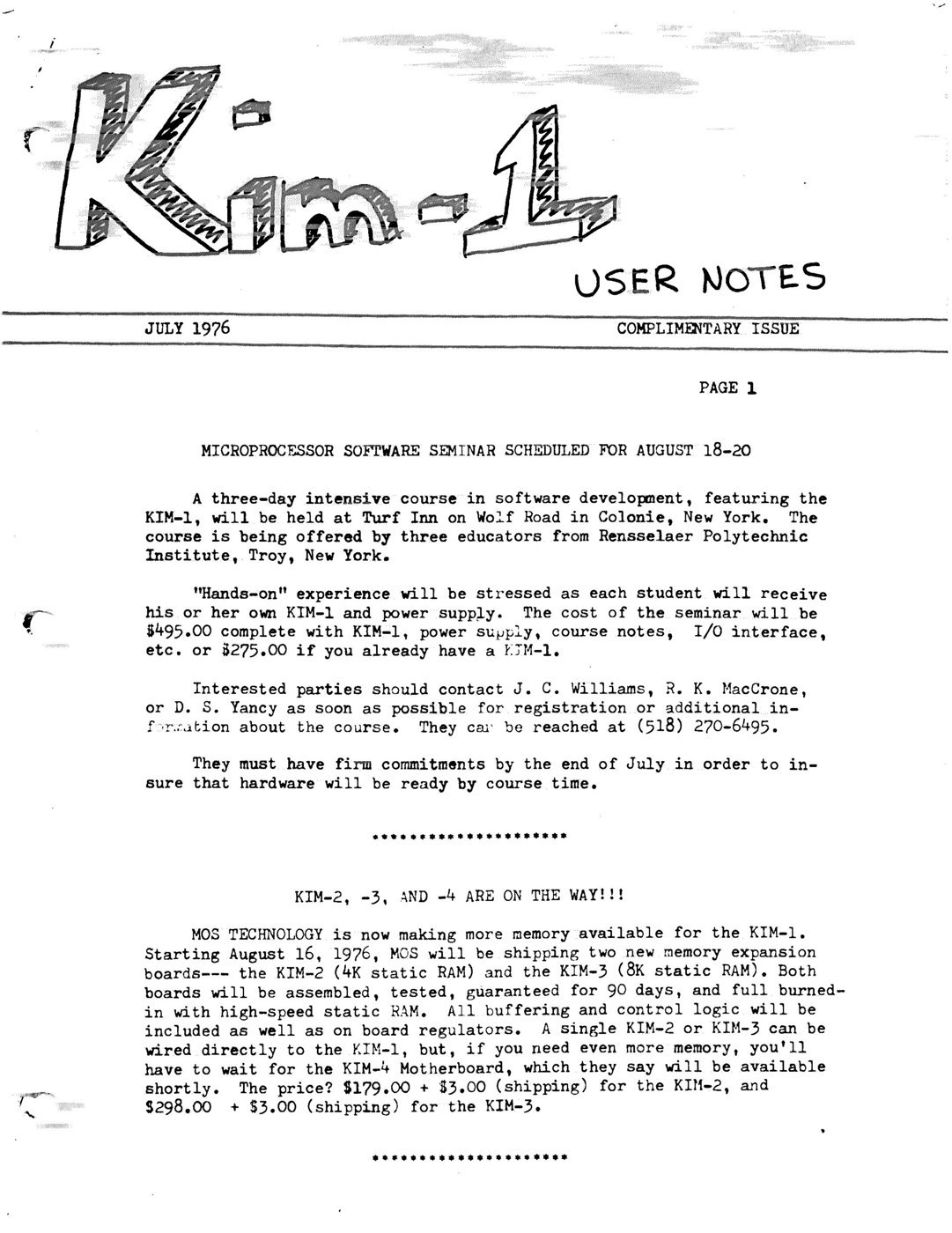
“We all agreed that there was a need for KIM-1 owners everywhere to be able to exchange ideas much like other user groups. It was thought that a newsletter could fulfill that need — so I decided to take part in it as editor and Rick Simpson volunteered technical support from MOS as well printing and distributing this first issue of KIM-1 User Notes to all KIM-1 purchasers.” (KIM-1 User Notes, issue 0, July 1976)
The writer was Eric Rehnke, of West Norriton, Pennsylvania, a few miles from the MOS plant. Issue 0, dated July 1976 and marked “complimentary issue”, was printed by MOS and mailed to everyone who had bought a KIM-1. It asked readers for “articles of all kinds — programming tricks, hardware hints, interface ideas”, and posed the questions every new owner was asking: “How did you gain access to the display to make it do what you wanted it to do? How did you package your KIM? Does anyone have assemblers or high level languages running on the 6502?” The same issue announced the KIM-2 (4 KB, $179) and KIM-3 (8 KB, $298) memory boards, and a three-day KIM-1 software seminar at Rensselaer Polytechnic Institute costing $495, KIM-1 included.
5.3.2 The run
From issue 1 (September 1976) the newsletter was independent and paid for by its readers: $5 for issues 1 to 6, first-class postage included, in the United States and Canada. It appeared roughly every two months — issue 2 in November 1976, issue 3 in January 1977, and so on — and by August 1977 had, according to Kilobaud, “over eight hundred” subscribers. During 1977 it became KIM-1/6502 User Notes, reflecting readers with other 6502 boards. Later issues were doubled up (7–8, 9–10) and doubled in size; issue 12 announced a new rate of $13 for six double issues. The run reached issue 17, eighteen numbers in all, before the newsletter’s readership and Rehnke’s column moved to Compute II, the single-board-computer companion to COMPUTE! magazine launched in 1980, where Rehnke wrote “The Single-Board 6502”; Compute II was merged into COMPUTE! at the end of 1980. Whether the newsletter was formally absorbed by COMPUTE! or simply ceased could not be confirmed.
What filled those pages was the raw material of a computing culture. Readers sent routines to make the display show letters; methods for driving a teletype, a Selectric typewriter or a television; cassette tricks; bug reports in the monitor; reviews of assemblers; lists of local user groups; programs printed in full as hexadecimal dumps for others to key in. Software was announced there first: Tom Pittman’s Tiny BASIC for the KIM, offered for $5 by Itty Bitty Computers of San Jose in issue 1; Jennings’s Microchess in issue 3; two versions of FOCAL in issue 5. The Microchess announcement in issue 2 appeared on the cover before Jennings himself knew about it.
5.4 Jim Butterfield
5.4.1 The explainer
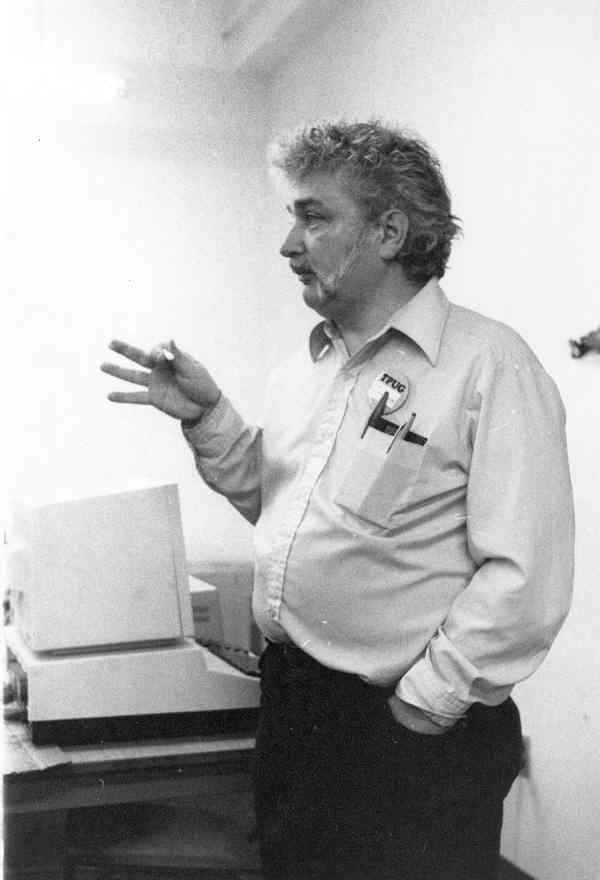
If the KIM community had a centre, it was Jim Butterfield (1936–2007) of Toronto. Bagnall described him as having “the rare ability to understand complex subjects and describe them in simple terms”, and as someone for whom “using a KIM-1 was an adventure in exploration”. Butterfield’s goal was to find out how the board really worked, down to its undocumented corners, and to pass what he found to anyone who asked. He presented his discoveries at meetings of KIM owners in Toronto, wrote them up for User Notes and the magazines, and went on to do the same for the Commodore PET and 64 for the next thirty years.
5.4.2 Lunar Lander
His most popular program was a game. Lunar Lander put the player in a lunar module 4,500 feet above the Moon with 500 units of fuel, controlling the throttle with the number keys. There were no graphics: four digits showed altitude and two showed the rate of descent, and the fuel remaining could be called up in place of the altitude. A landing could take five minutes; at the end the display spelled out either a safe landing or the crash. BYTE published a version as “KIM Goes to the Moon” in April 1977. Bagnall’s verdict is that the absence of pictures was the point: “Anyone playing would have to imagine himself huddled in a capsule with only the instrument readings to guide him.”
5.4.3 Hypertape
Butterfield’s other famous contribution was a speed-up. The KIM-1’s standard tape format was robust but slow, taking more than two minutes to load a full kilobyte. Over lunch with another KIM owner, Julien Dubé, Butterfield remarked that “you don’t need all those 1’s and 0’s written on the tape” — the board’s tape input circuit would accept a much denser recording. Dubé tried it and reported a threefold speed-up the next day; Butterfield refined it further. The result, first called Supertape and renamed Hypertape in User Notes issue 6 “to avoid confusion with a cassette tape brand name”, wrote tapes that loaded a full 1K in about 21 seconds and could still be read by the KIM’s own monitor. Butterfield noted that dropping compatibility with the monitor’s loader could make it four or five times faster again.
5.5 The First Book of KIM
5.5.1 The book
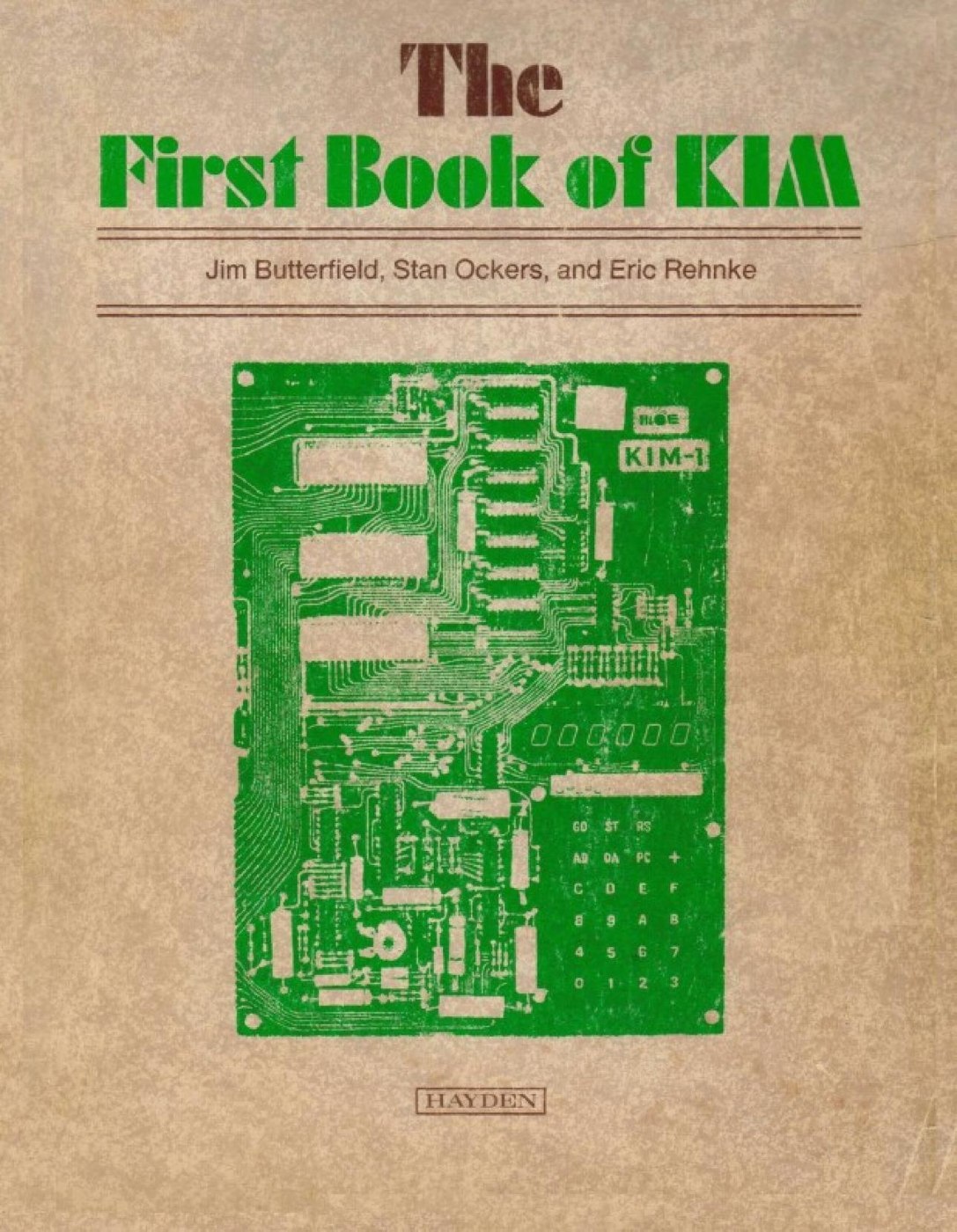
User Notes produced enough good material for a book. Butterfield, Stan Ockers and Rehnke edited it, and Hayden Book Company of Rochelle Park, New Jersey, published it as The First Book of KIM (copyright 1977 and 1978 by F. J. Butterfield; ISBN 0-8104-5119-0), about 176 pages long. Its dedication sums up its purpose: “Dedicated to the person who just purchased a KIM-1 and doesn’t know what to do with it…” Its terms sum up its spirit: “Individual programs in this book were contributed by the various authors without copyright restrictions. These programs may be used or copied without restriction.” Readers were asked to send new programs to User Notes, where they “might appear … and even in a future Book of KIM”. No second book appears to have been published.
The book was organised in six parts: a beginner’s guide to KIM programming; recreational programs; diagnostic and utility programs; expanding the KIM; “connecting to the world” (how a KIM could sense and control other devices); and a miscellany. It promised that every program ran on the basic KIM-1 with no extra memory. It ended with a list of software sources “as of summer 1977” — ARESCO, The Computerist, Itty Bitty Computers, Micro-Ware, the 6502 Program Exchange and others — and a bibliography of KIM articles in BYTE, Kilobaud, Interface Age and 73, which is still the best map of the early KIM literature.
5.5.2 Programs for six digits
The recreational section was the book’s heart, and it shows what a determined programmer could do with a hex keypad and six seven-segment digits. Butterfield contributed Lunar Lander, Bagels (a number-guessing game), Blackjack, a one-armed bandit, a music box that played tunes through a speaker on the I/O port, a binary and hexadecimal drill, and utilities including Hypertape. Stan Ockers contributed Wumpus, a sixteen-room version of the cave game Hunt the Wumpus, and Asteroid, in which the player steers between Mars and Jupiter. Lew Edwards wrote Kim-Tac-Toe and Shooting Stars; Peter Jennings contributed a reaction timer, “Quick”. Bagnall’s list of the KIM games of the period adds Hangman, Mastermind, Maze, NIM, Craps, a horse race, Farmer Brown, Ping-Pong and Duel, a two-player reaction game that he counts among the earliest two-player games on a microcomputer.
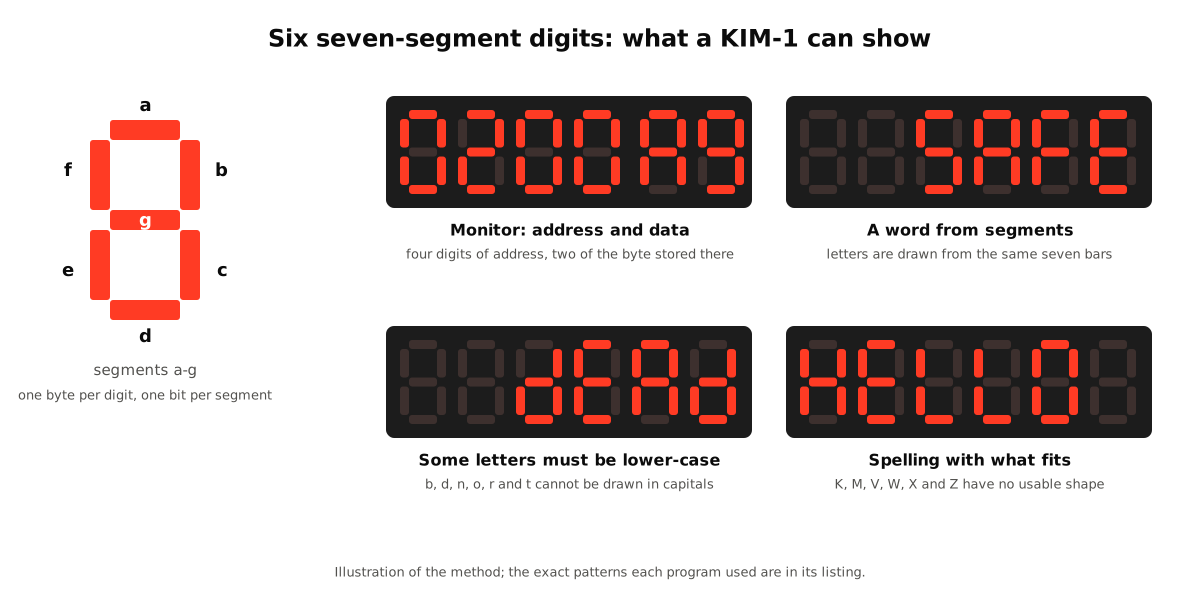
Every one of these programs had to live within the display’s limits. Letters had to be built from seven bars, so words were chosen from the letters that could be drawn. Maze showed only the walls immediately around the player’s blinking position; Wumpus required a pencil and paper to map the cave. The First Book taught the techniques directly, including how to write custom patterns to the display and how to use the timers inside the 6530 chips, both things that the MOS manuals did not explain. Bagnall notes that one of the people who learned game design on these programs was Chris Crawford, who wrote his first computer game on a KIM-1 and went on to design celebrated games for Atari and to write about the theory of game design.
5.6 Microchess
5.6.1 The program
The KIM program that reached furthest was a chess program. Peter Jennings, a recent university graduate in Toronto, wanted a computer and had to choose between the 8080 and the 6502. Working at the time-sharing company Comshare, he wrote simulators of both processors on its Xerox Sigma computer to compare them, and chose the 6502. In May 1976 he drove to the Midwest Regional Computer Conference in Cleveland, the same show where User Notes was born, and paid $245 for a KIM-1.
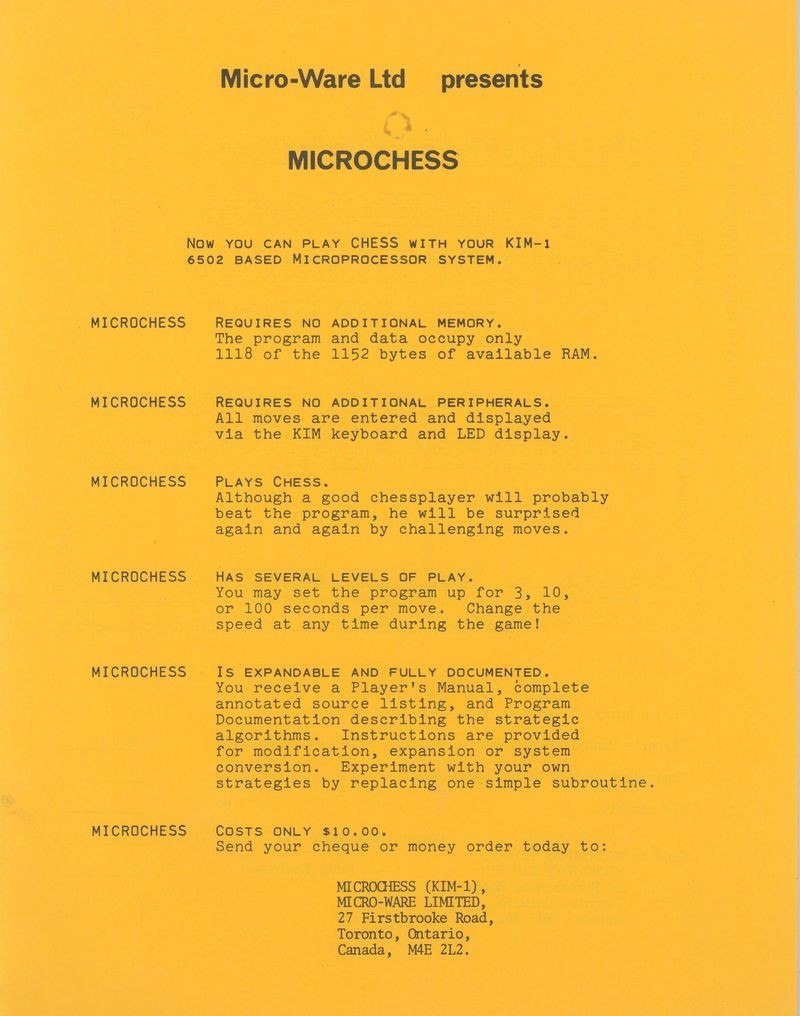
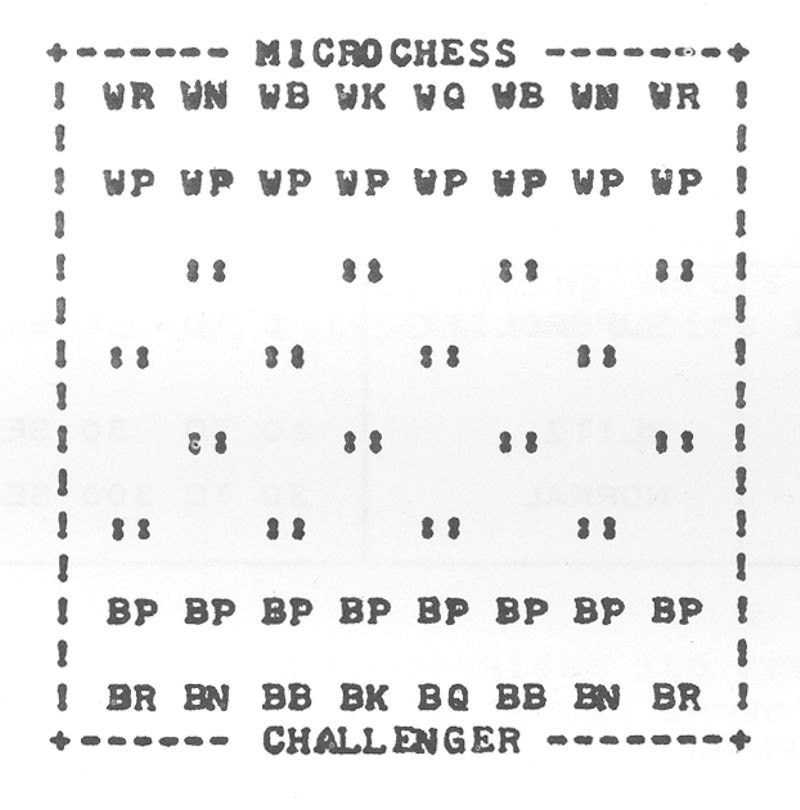
He then set out to make it play chess, which nearly everyone told him was impossible in a kilobyte. A chess program must generate every legal move for six kinds of piece, keep track of the board, look ahead and evaluate positions, and do it all in a memory smaller than one screen of text on a later computer. Jennings worked on it for about six months. The finished Microchess used, in the words of his own order form, “only 1118 of the 1152 bytes of available RAM” — the KIM’s 1,024 bytes plus the 128 bytes of RAM inside its two 6530 chips. Moves were entered on the keypad and shown on the six digits as from-square and to-square coordinates. The display flickered as the program worked, and Butterfield recalled that Jennings could read it “and he could read what it was up to — ‘It’s checking Queen mobility now…’”.
Jennings first showed it to a gathering of KIM owners in Butterfield’s house, where Butterfield had set up a chessboard marked with the KIM’s square numbers. A guest played the program and lost. Strong players beat it easily; Butterfield was reminded of Samuel Johnson’s remark about a dog walking on its hind legs, that “it’s not so much that he does it well, as that he does it at all.”
5.6.2 The business
There was no software industry to sell it through, so Jennings created one. He sold the first copy of Microchess on 18 December 1976, by post, for $10, which bought a player’s manual, a programmer’s manual and a fully commented source listing; User Notes issue 3 (January 1977) carried the announcement. Paper tape and cassette versions cost a little more. In April 1977 he incorporated Micro-Ware Limited in Ontario and ran it from a back bedroom of his house in Toronto. Chris Crawford described what software publishing meant at the time: “If you wrote a program, you duplicated some cassettes, typed up and photocopied a manual, and stuffed the whole thing into a Ziploc bag, and then sold it to whomever would take it” (quoted by Bagnall).
Then MOS, by now part of Commodore, agreed to put Jennings’s flyer into every KIM-1 box. Bagnall tells the story of Jennings coming home to find two Canada Post canvas bags on his doorstep, full of orders. Jennings estimated that about one in three KIM-1 buyers ordered Microchess. Chuck Peddle, who had offered Jennings $1,000 for all rights to the program, had been turned down.
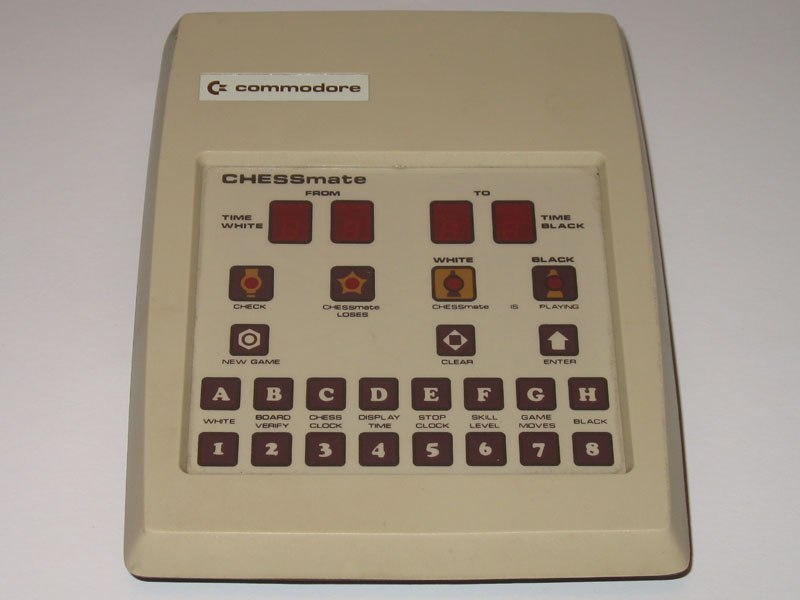
Microchess grew from there. Jennings wrote Micro-ADE, a 4K assembler, disassembler and editor for the KIM, announced in User Notes in July 1977; he joined forces with Dan Fylstra, who had bought one of the first copies of Microchess, and their company Personal Software published Microchess for the TRS-80, the Apple II and the PET, and later published VisiCalc. Commodore turned Microchess into a dedicated chess computer, CHESSmate, essentially a KIM-1 with a 6504 processor and more ROM, shown in January 1978; Jennings added an opening library and eight levels of play, and his contract required it to beat Fidelity’s Chess Challenger, which it did. Jennings later estimated that Microchess sold several million copies across all its versions. Bobby Fischer, then living in seclusion in Pasadena, played the prototype and asked Jennings for a game.
5.7 Languages for a Kilobyte Machine
A basic KIM-1 could only be programmed in machine code. Once owners added memory, languages followed, and User Notes is a record of them arriving.
Tiny BASIC. Tom Pittman’s Tiny BASIC, an integer-only BASIC in a little over 2 KB, was the first high-level language for the KIM, offered for $5 by Itty Bitty Computers of San Jose from September 1976 and later on KIM-format cassettes for $9.50. It needed about 4 KB of extra memory to be useful. Loading it from the KIM’s standard-speed tape was slow and error-prone, which helped make Hypertape popular.
FOCAL. DEC’s FOCAL, a small interpreted language popular on PDP-8 minicomputers, reached the KIM in two versions announced in User Notes issue 5 (May 1977): FCL-65 from the 6502 Program Exchange of Reno, Nevada, which took “a little over 4K of memory” and came on paper tape with a source listing, and a FOCAL from ARESCO of Haddon Heights, New Jersey, for $40, also with source. FOCAL’s floating-point arithmetic made it attractive for scientific and engineering work, and an extended FCL-65E with eight- to nine-digit accuracy followed. Who wrote FCL-65 could not be confirmed.
Microsoft BASIC. In late 1977 Johnson Computer of Medina, Ohio, began selling Microsoft 8K BASIC for the KIM-1 on cassette, in two versions, KB-6 (six-digit arithmetic) and KB-9 (nine-digit), both loading at address 2000 hexadecimal and supplied with a Schaum’s Outline text on BASIC programming. This was the same Microsoft 6502 BASIC that Commodore licensed for the PET.
Assemblers and monitors. For machine-code programmers, the most important tools were assemblers: MOS’s own resident assembler and editor (later sold through ARESCO), ARESCO’s 2.5K and 6K assemblers, Jennings’s Micro-ADE, and the KIM-5 assembler in ROM. Pyramid Data Systems’ XIM, an “extended I/O monitor” of a little under 1K, added seventeen commands for terminal users, among them block move, block search, breakpoints and — a telling convenience — automatic calculation of relative branch offsets. MOS’s KIMATH package added floating-point and decimal arithmetic routines.
5.8 Clubs, Courses and Shows
KIM owners found each other through the newsletter’s lists of local groups — Somerville, New Jersey; Santa Barbara; Tulsa; a club meeting at Argonne National Laboratory near Chicago — and through KIM sub-groups that formed inside general computer clubs. In the Netherlands a KIM club began publishing De KIM Kenner in 1979; it became the 6502 Kenner in 1981 and ran for many years.
The KIM was also a teaching platform in the formal sense. Besides the RPI seminar, User Notes in late 1977 reported a course developed by faculty from Purdue and Oklahoma State “based on KIM-1 hardware”, costing about $600 with a KIM-1 the student kept. Universities bought KIMs for laboratories; Bagnall records that Villanova had them when the KIM’s designer John May came to give a presentation there.
The community’s high point may have been the Trenton Computer Festival in New Jersey in April 1977. Rehnke’s report in User Notes issue 5 called the KIM “the real star”, from demonstrations to Tod Loofbourrow’s KIM-controlled robot — “it was Kim’s day all the way”. The most memorable demonstration was by Hal Chamberlin, who, “with just a basic Kim and a handful of parts”, made the computer play the theme from Exodus in four-part harmony. Volume 6 follows both of those threads, the robot and the music, into the KIM’s life as a controller.
5.9 What the Community Left
The KIM community lasted only a few years as a community; by 1979 most of its members had moved on to the PET, the Apple II, the TRS-80 and the other computers that came with keyboards and screens. But much of what it invented carried forward. User Notes was a model for the user-group newsletters of every later machine. Butterfield’s way of explaining a computer from the inside became, through COMPUTE! and the Commodore user groups, the voice in which a generation of home-computer owners learned machine language. Microchess and Personal Software showed that software could be a business, and the money it made helped launch VisiCalc. And The First Book of KIM, a book of programs given away “without copyright restrictions”, remains the clearest picture of what people did with a kilobyte and six red digits.
Next — Volume 6: The KIM as a Brain — Robots, Controllers and Mike/Microtron. Fifteen spare I/O lines and a hardware timer: how the KIM-1 ended up inside aircraft navigation experiments, radio stations, music synthesizers and model railways, and how a teenager in 1976 made one the brain of a robot.
Comments (0)