KIM-1 · Volume 2
KIM-1 — Volume 2 — MOS Technology and the $25 Microprocessor — Peddle, the 6800 Team and the 6502
How a group of Motorola engineers walked out to build a microprocessor cheap enough to replace ordinary logic, how a Pennsylvania calculator-chip maker learned to make it, how it went on sale for $25 from a San Francisco hotel suite, and why the company then needed a little computer on a board to show people what to do with it
2.1 About This Volume
The KIM-1 exists because of one chip, and that chip exists because of one argument. This volume tells the story of the MCS6502 microprocessor from the argument to the board: Chuck Peddle’s idea of a processor cheap enough to be used anywhere, Motorola’s refusal to build it, the engineers who left Motorola with him in August 1974, the small Pennsylvania company that took them in, the design decisions that made a $25 price possible, the launch at the WESCON show in San Francisco in September 1975, and the Motorola lawsuit that followed. It ends where the KIM-1 begins: with a company that had a revolutionary chip, very few customers who knew how to use it, and an idea for a calculator-like board that would teach them.
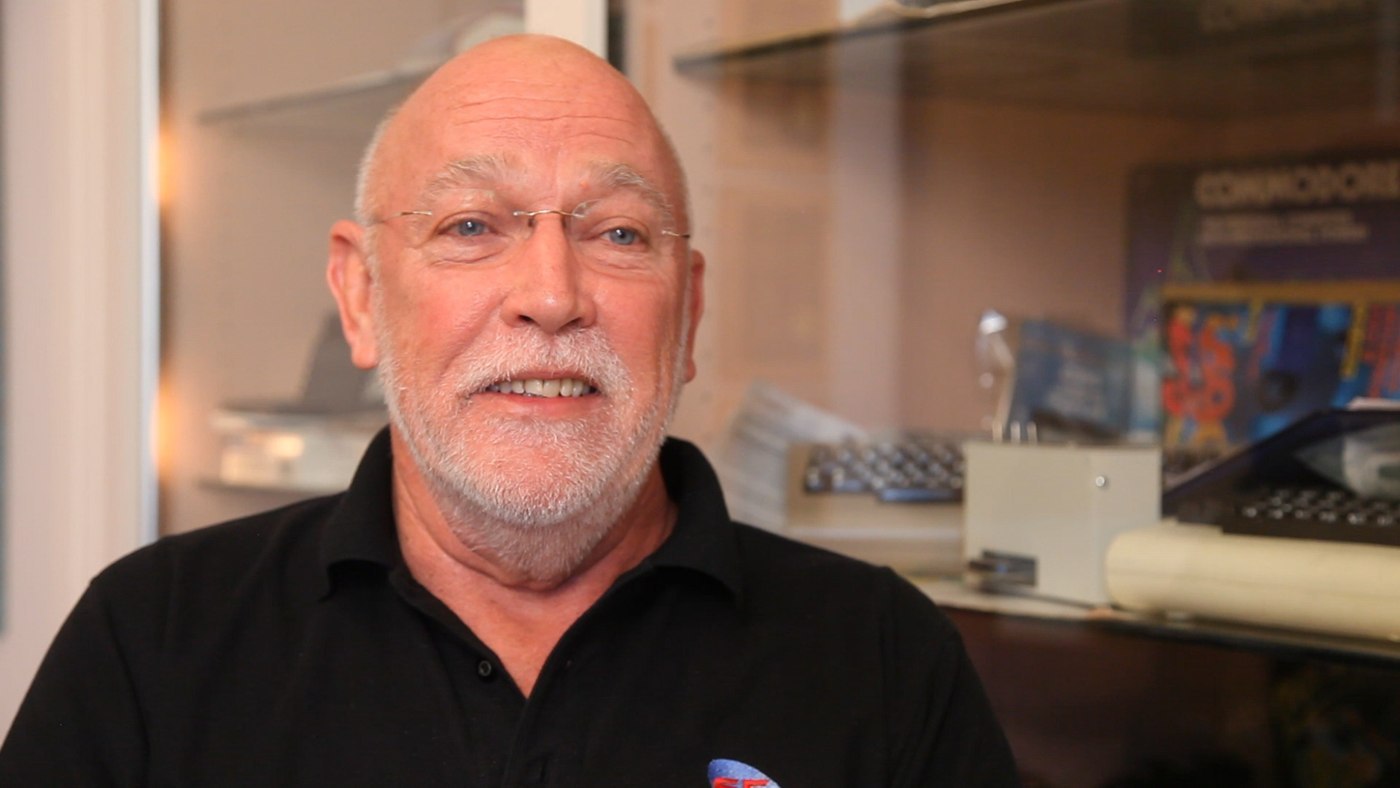
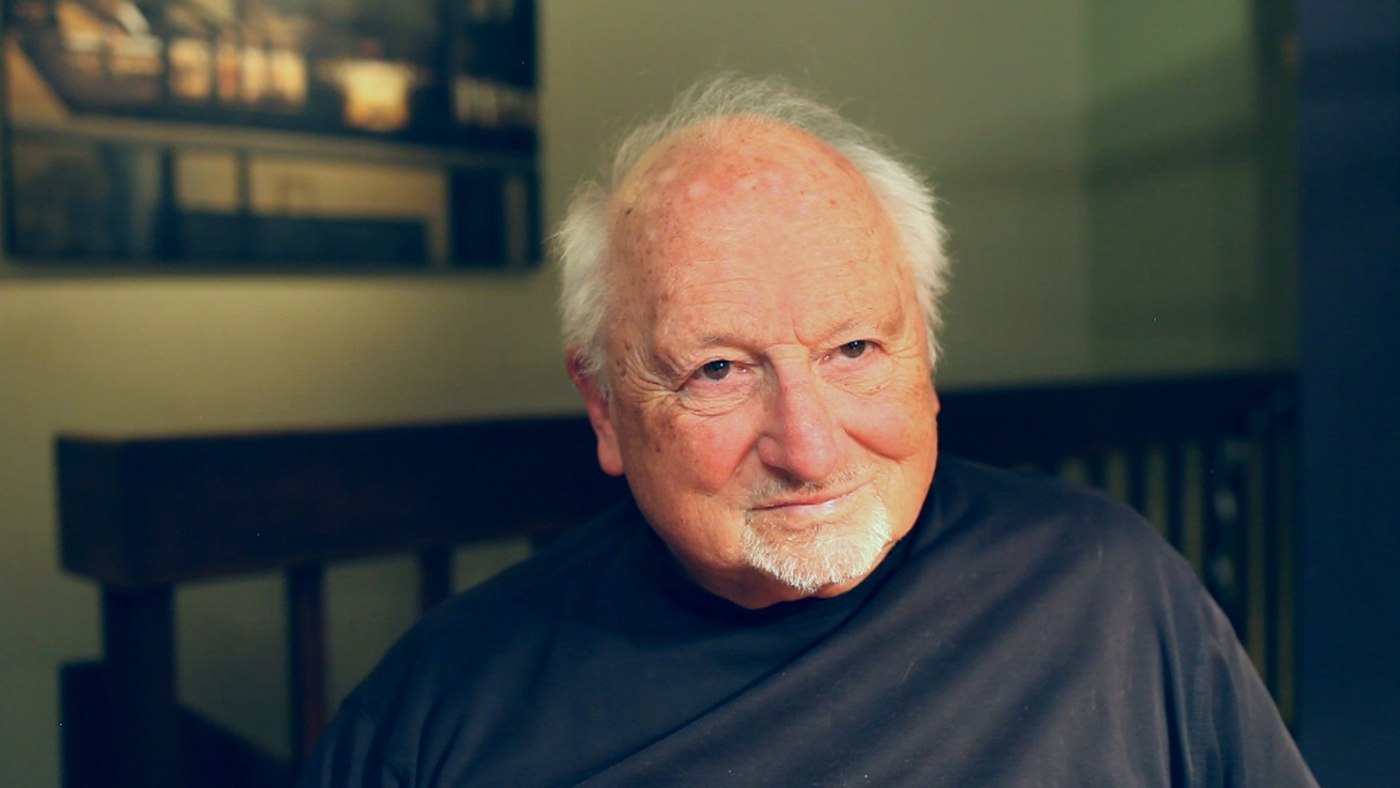
The people are heard mainly through their own later accounts: the Computer History Museum’s oral histories of Chuck Peddle and Bill Mensch, both recorded in 2014, and Brian Bagnall’s interviews for On the Edge: The Spectacular Rise and Fall of Commodore (Library copy of the TIM and KIM chapter). Those are recollections forty years after the event. Where they disagree with each other, or with the documents of 1975–76, the text says so.
2.2 The Argument at Motorola
2.2.1 A processor for everything
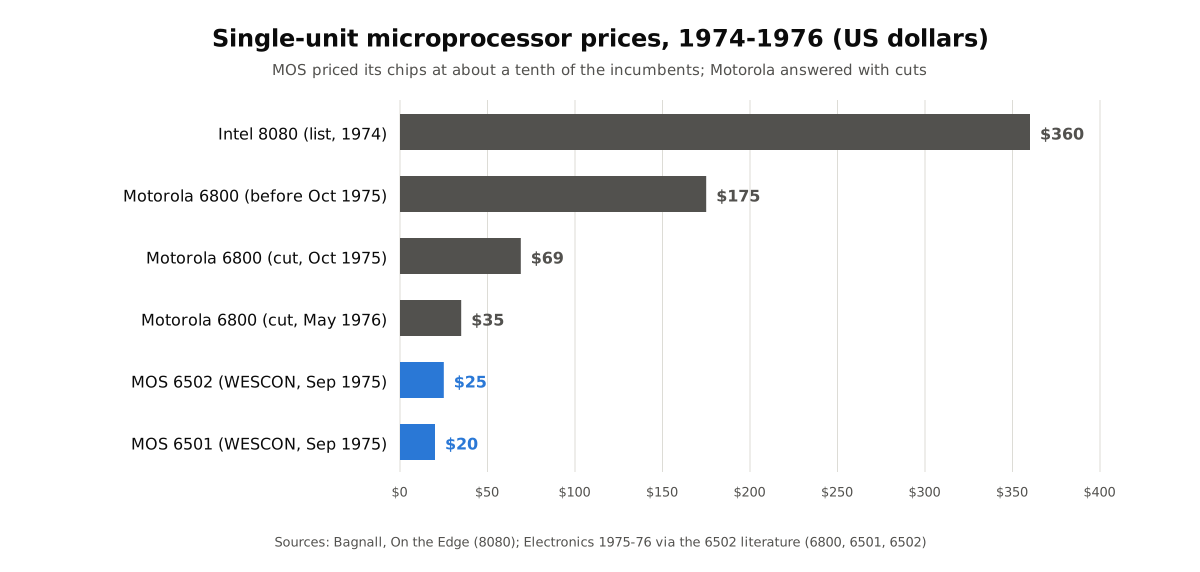
In the early 1970s a microprocessor was an expensive part for expensive products. Intel’s 8080, introduced in 1974, listed at $360. Motorola’s answer, the 6800, was announced the same year at a similar price, with a family of support chips around it. Peddle had joined the 6800 group at Motorola in 1971 after years in General Electric’s computer business; his major contribution to the 6800 family was the Peripheral Interface Adapter (PIA), the companion chip that connected the processor to the outside world (CHM catalog record of the Peddle oral history).
What Peddle saw from talking to customers was that most of them did not want a minicomputer on a chip. They wanted to replace the boards of logic that ran cash registers, copiers, terminals and appliances with something programmable, and for that the price had to fall by an order of magnitude. “I wasn’t trying to make a minicomputer,” he said in 2014. “I was trying to make something that was a logic replacement. And I understood that, and the guys at Intel didn’t understand that, and the guys at Motorola didn’t understand that.” He began work on a stripped-down, low-cost processor in the 6800 group.
2.2.2 “Stop work”
Motorola’s management did not want a cheap processor competing with the expensive one. Peddle’s account is that after a customer trip on which marketing accused him of undermining the 6800, he received a formal letter telling him to stop work on the low-cost microprocessor. He replied that this was “project abandonment”, so that his work up to then belonged to him, and that he would do no further development for Motorola (Peddle, CHM oral history, 2014, pp. 24–25). Motorola was at the same time moving its Phoenix design group to Austin, Texas, and several of the engineers did not want to go. Peddle went looking for a company to back a new processor, and for a team to build it.
He first approached L. J. Sevin at Mostek, who declined; Sevin told him much later that he had been afraid Motorola would sue. A customer at Ford then reminded Peddle of John Paivinen, his old manager from the General Electric days, who was now running a semiconductor company in Valley Forge, Pennsylvania, “building the biggest, smartest calculators”. Peddle went to see him early in 1974. Paivinen, he recalled, “caught it in about 20 seconds”.
2.3 MOS Technology
MOS Technology had been founded in 1969 by Paivinen, Mort Jaffe and Don McLaughlin, all formerly of General Instrument, to make metal-oxide-semiconductor (MOS) integrated circuits; the industrial-controls company Allen-Bradley took a majority interest in 1970 (Wikipedia, “MOS Technology 6502”, citing the trade press). By 1974 the company’s business was calculator chips, sold to the many American and Japanese firms then fighting a price war in pocket calculators, and its plant stood at 950 Rittenhouse Road in Lower Providence Township, with a Norristown postal address.
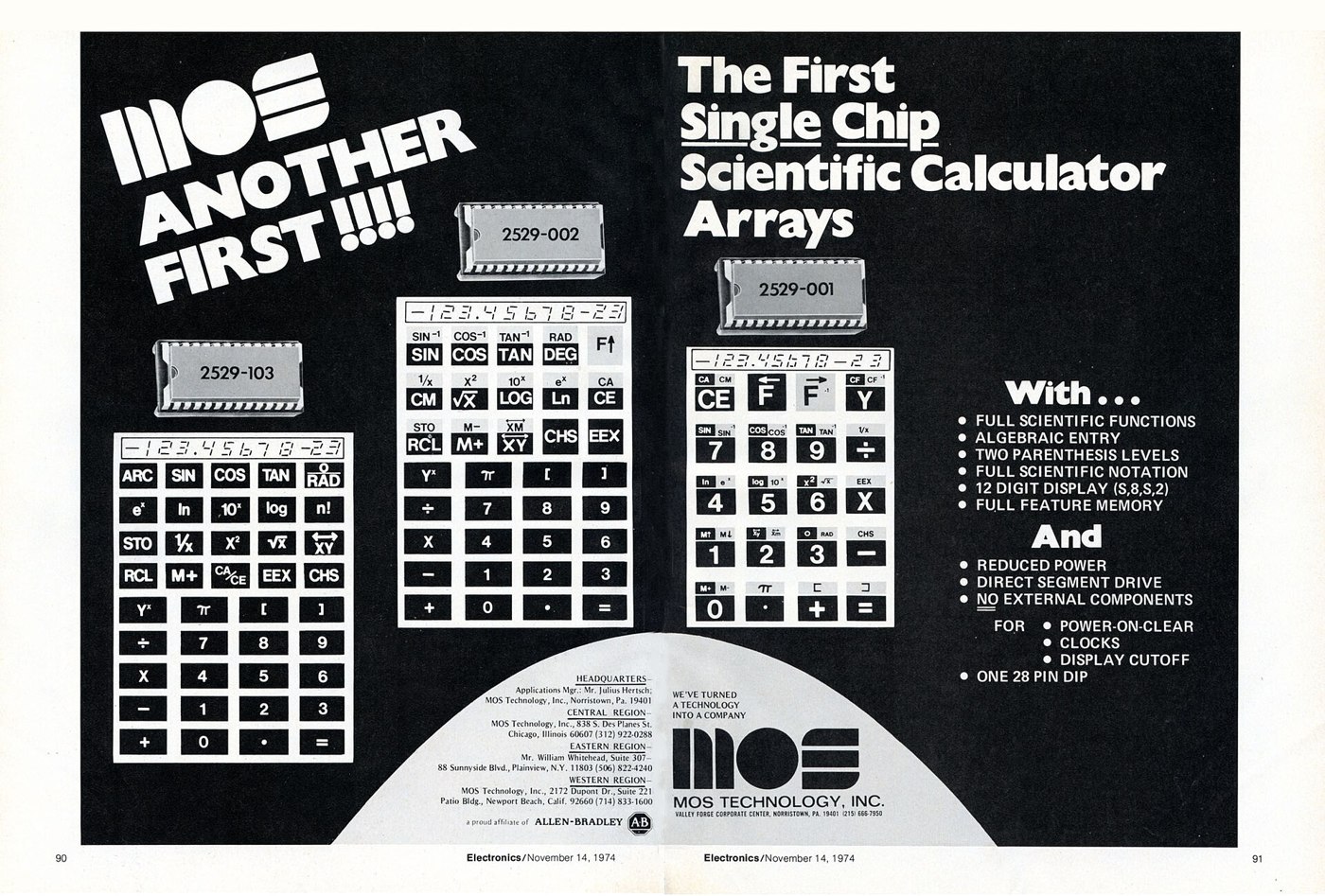
What MOS had that Motorola lacked, in Peddle’s telling, was a man who understood both computers and process. Paivinen had taught himself semiconductor processing at General Instrument. At MOS he was developing a new n-channel process with depletion-mode loads, which let a chip run from a single +5 V supply and gave good speed in a small area. “Paivinen had to invent the process,” Peddle said, “and he did that in the same amount of time it took us to design the processor.”
2.3.1 The team
On 19 August 1974, according to the account assembled from the trade press of the time, Peddle, Bill Mensch, Rod Orgill, Harry Bawcom, Ray Hirt, Terry Holdt and Wil Mathys left Motorola for MOS; Mike Janes followed later. They were eight of the seventeen people who had designed and laid out the 6800. Peddle remembered loading the moving trucks in Phoenix with them, and telling them repeatedly not to bring anything that belonged to Motorola, a warning that would matter a year later.
The division of labour, as the two principals described it in 2014, was that Peddle set the architecture and the instruction set, and Orgill and Mensch turned much of it into circuits; Peddle remembered with pride that “between Orgill, his half worked the first time, Mensch’s half worked the first time”. Mensch, asked who came up with the architecture, answered simply: “it would be Chuck, I would say. I’m a semiconductor engineer, so I’m building what Chuck” wanted (Mensch, CHM oral history, 2014).
2.4 Designing to a Price
2.4.1 The die-size budget
The 6502 was designed backwards, from its price. Peddle recalled that he and Paivinen “set down and did a calculation. And the chip has to fit in this area. Period, end of discussion.” The target was a chip that cost about $5 to make, so that it could be sold profitably far below the competition. Every design decision was weighed against silicon area. The finished die measured about 3.9 by 4.3 mm, some 16.6 square millimetres, with about 3,500 transistors.
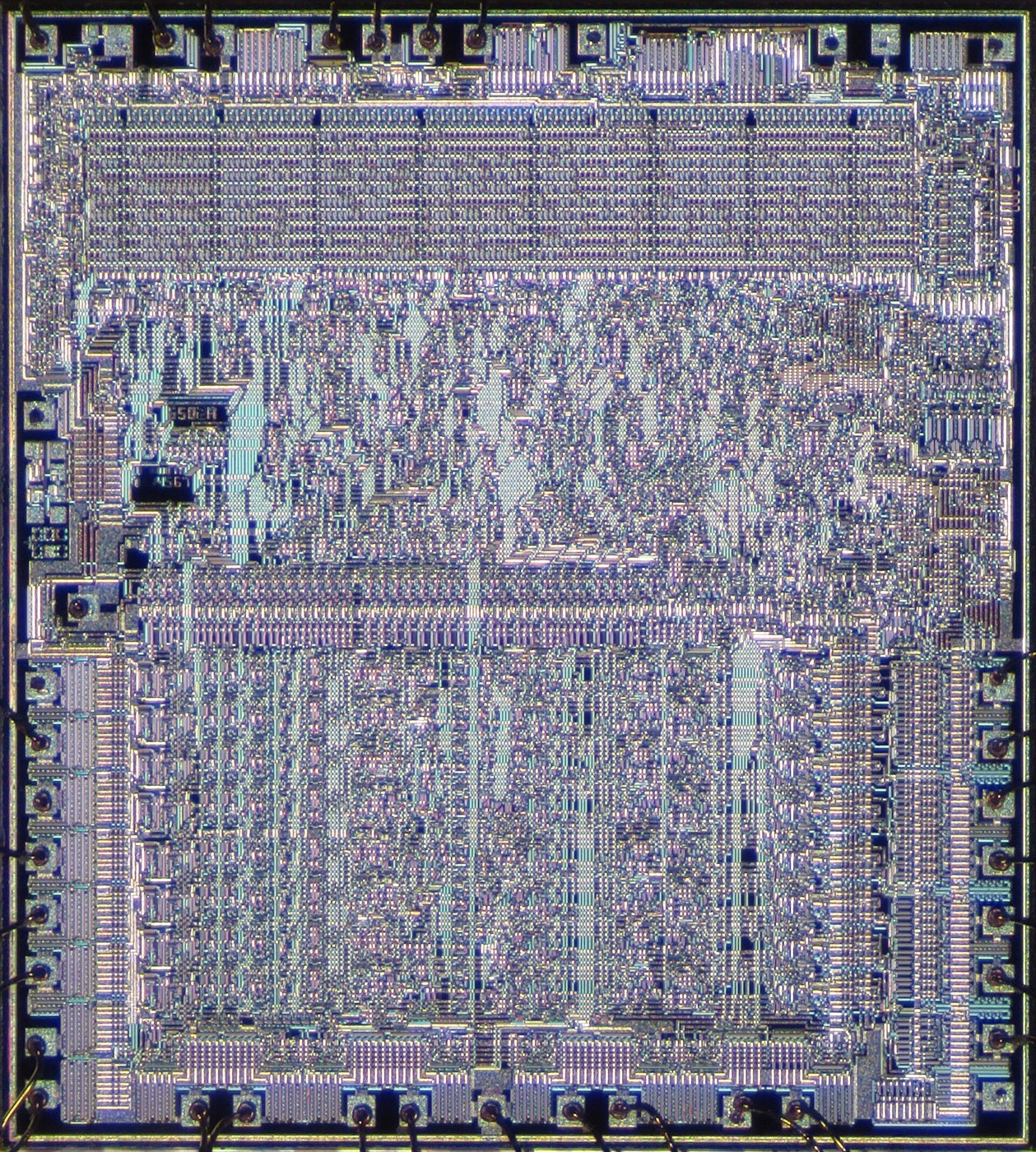
The architecture shows the budget everywhere. The 6502 has one 8-bit accumulator where the 6800 had two, two 8-bit index registers (X and Y), an 8-bit stack pointer that confines the stack to one 256-byte page, and a 16-bit program counter. Instead of more registers it offers zero page: the first 256 bytes of memory can be reached with one-byte addresses and fewer clock cycles, so that a program can treat them almost as a bank of extra registers. Mensch, in 2014, called this the key to the chip’s long life: “we had zero page as an example, three cycle accesses, and so we could actually access memory registers, addressable registers, in memory to do floating point faster than you could do on a 6800 or anything out of Intel.” Its indexed and indirect addressing modes, built on the same idea, gave compact code for tables and pointers.
Two features went in because they were cheap and useful. A decimal mode, switched by a bit in the status register, made the adder correct its results to binary-coded decimal on the fly, so that calculator and cash-register arithmetic needed no extra instructions. It became the subject of the one patent on the 6502, with Peddle, Mensch, Orgill and Mathys as the four inventors; Mensch wrote a FORTRAN simulator to check every combination. The second was an on-chip clock generator, which saved the customer a separate clock chip — and which, as the next section shows, decided the chip’s name.
2.4.2 Making it in quantity
The other half of the price was yield, the fraction of chips on each silicon wafer that work. Mask-making in the industry still commonly used contact printing, in which the photographic mask touched the wafer and wore out after a few uses, and every flaw in the mask became a dead chip. MOS used masks that did not touch the wafer, and it “retouched” them: by comparing two copies of a mask and painting over the flaws in each, it produced near-perfect masks that could be used for hundreds of wafers. Mensch recalled Motorola’s process engineers waiting for ten good chips per wafer while MOS was getting “like 100 good die-per-wafer on the 6502. We had at least 10 times the yield per wafer. … So when we sold a $20 6501 and a $25 6502, we were making money.”
2.4.3 The missing instruction
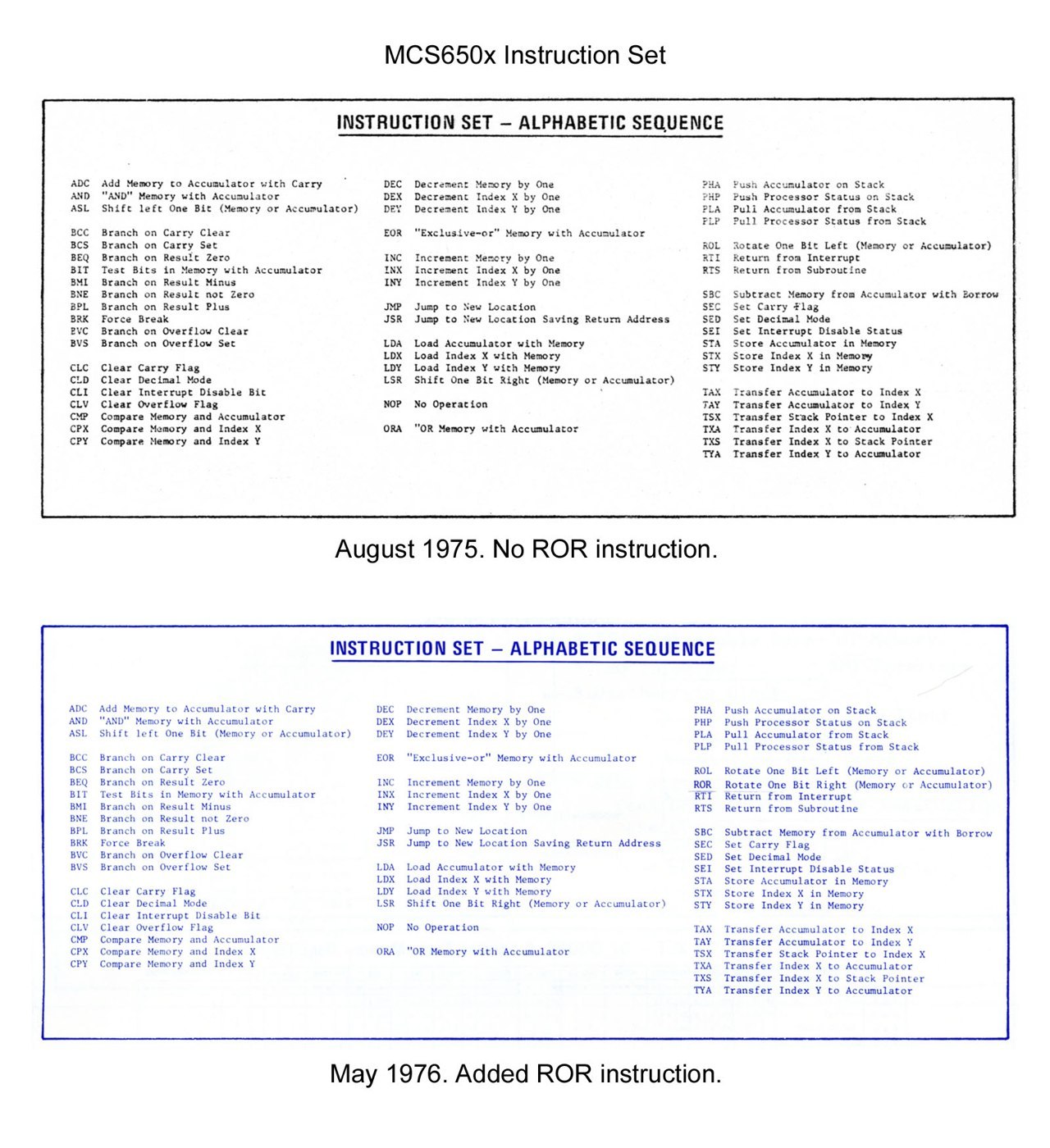
The first 6502s, made in 1975, lacked one instruction. ROR, rotate right, was not in the preliminary data sheets of August 1975, which listed 55 instructions; it appears in the May 1976 data sheet, which lists 56, and in chips made from about the middle of 1976. The KIM-1’s first production run used early chips, which matters to owners of very early boards and to anyone running old KIM software that uses ROR. Volume 3 returns to the point.
2.5 Two Chips from One Die: the 6501 and the 6502
The family was announced as a set: the 40-pin 6501 and 6502, and a row of cheaper 28-pin versions (6503 to 6507) with fewer address lines for small controllers. The 6501 and 6502 were the same silicon, differing only in the final metal layer. The 6501 used the same pin-out as Motorola’s 6800, so that it could be dropped into a 6800 socket (though it could not run 6800 programs, because its instruction set was entirely different). The 6502 rearranged the pins to use its own on-chip clock generator.
Mensch recalled a friendly bet with Rod Orgill while they waited for the first wafers. Orgill thought the 6501’s drop-in compatibility would sell “a ton more 6501s than 6502s”; Mensch thought the cleaner 6502 would win. “I’m saying I think technology wins over marketing. Rod says marketing wins over technology.” Peddle’s later account is blunter: the 6501 “was just an in-your-face to Motorola”, and “we built a few 6501s, we never sold one” except a few at the launch. The 6502, he said, “was the thing”.
2.6 Twenty-Five Dollars at WESCON
2.6.1 The advertisements
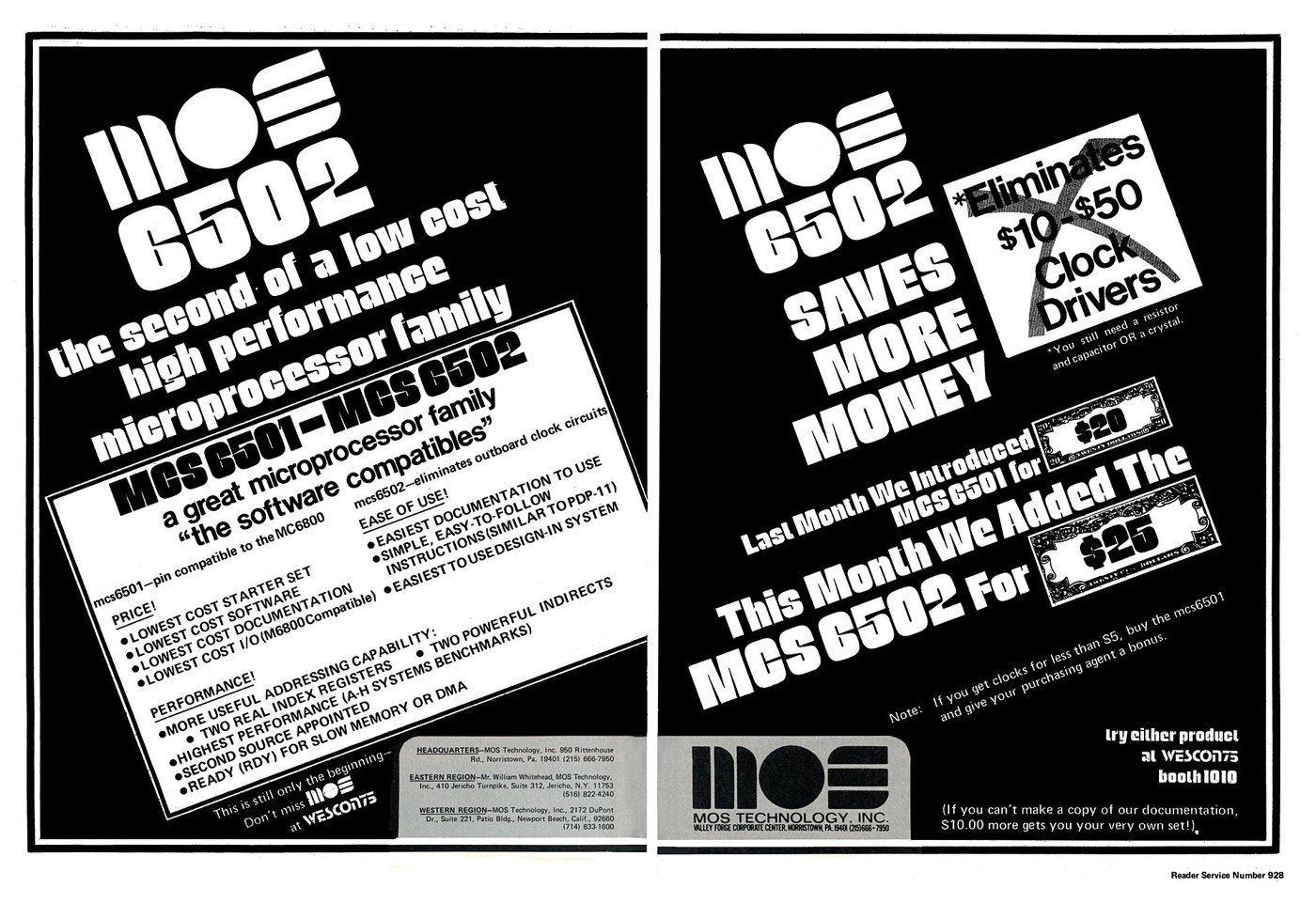
MOS announced the family to the trade press in the summer of 1975 and advertised it in Electronics and EDN: the 6501 at $20 and the 6502 at $25, in single quantities, with documentation for $10 more. The advertisements invited engineers to come and buy chips at WESCON, the Western Electronic Show and Convention, in San Francisco, opening on 16 September 1975. At that moment a 6800 cost $175 and an 8080 about $360.
2.6.2 The MacArthur Suite
The show did not allow exhibitors to sell goods on the floor, so MOS rented the MacArthur Suite at the St. Francis Hotel and sent buyers there. Peddle’s wife, Shirley, sat at the door with what he described as a barrel of processors and a barrel of support chips; later accounts describe large jars of chips. Around the walls were the development tools MOS had rushed to finish in its engineering lab before the show: an in-circuit emulator, a time-sharing system for writing and assembling code, the TIM teletype monitor developed with Microcomputer Associates, and, in Peddle’s recollection, a “KIM station” showing the new single-board computer.
The manuals sold at the door had their own story. Peddle recalled that a programmer friend named Peter warned him that “people don’t know how to use this thing. Unless we write a really good” manual “it’s not going to get used”. When Peddle kept being pulled away to the telephone, Peter went to Paivinen, who banned Peddle from the building until the manuals were written; Peddle wrote them at home with Peter as editor. “Those manuals, really and truly we were proud of them.” He remembered that people in the queue for the suite asked whether they were on “the bus to the MacArthur Suite”, and that “before they walked out we had their money. And more importantly we had their mind.”
Among the buyers was Steve Wozniak, who has described buying his 6502 from Peddle and his wife in the suite; his accounts of how many chips he bought, and whether he paid $20 or $25, vary (Farquhar, “The 6502 CPU’s odd debut”). The chip he bought became the processor of the Apple-1 the following year (see this site’s Apple-1 unit). Peddle remembered that Steve Jobs bought a manual. Stephen Diamond, who interviewed Peddle for the Computer History Museum in 2014, said that he had been in the suite too, and remembered “the manuals and the color of the manuals” and how crowded it was.
2.7 Motorola Sues
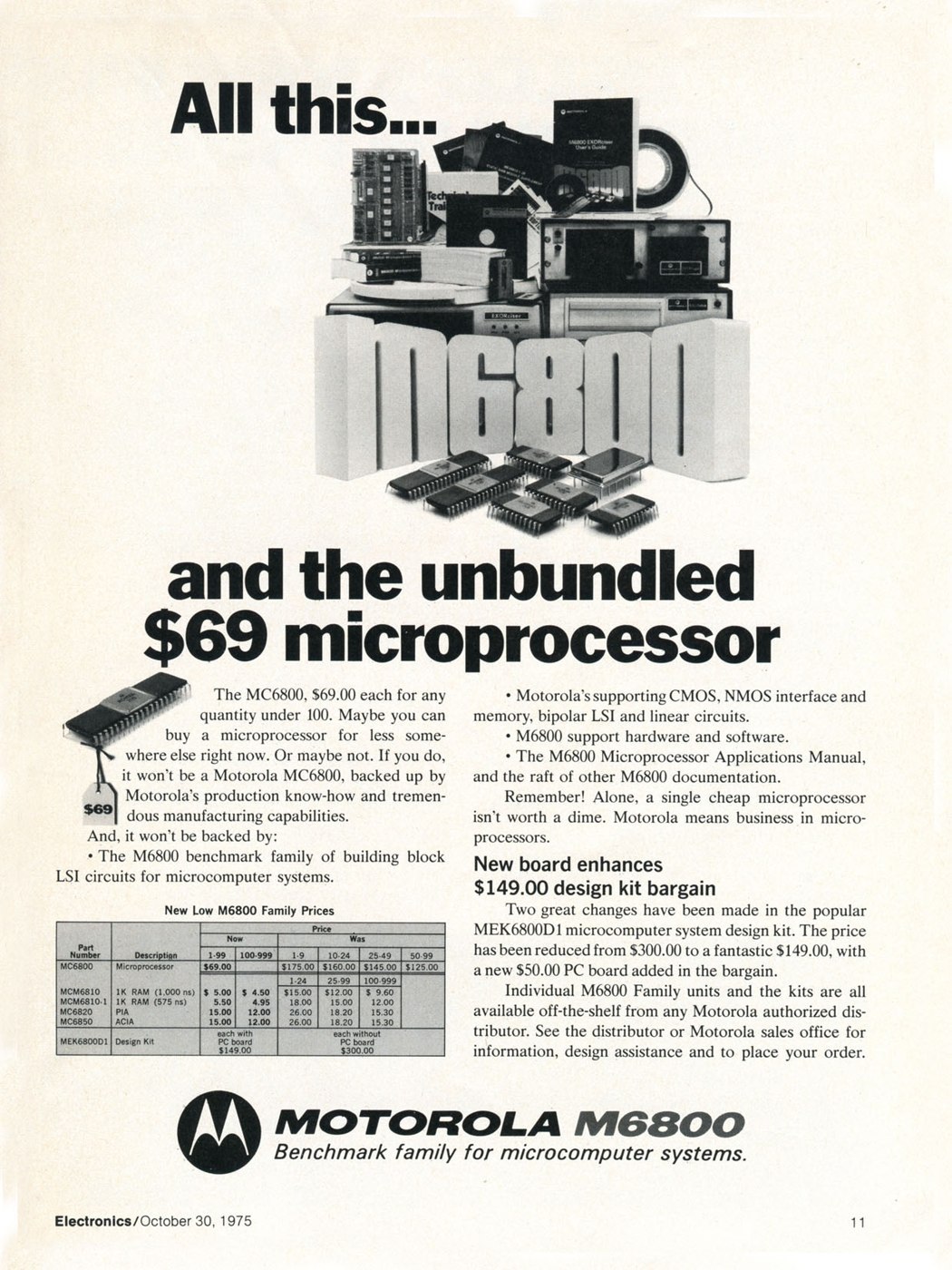
Motorola’s response came in two parts. It cut the 6800’s price from $175 to $69 in October 1975, and on 3 November 1975 it went to federal court, accusing MOS and the former Motorola engineers of patent infringement and of taking trade secrets. Allen-Bradley, which did not want a fight with Motorola, sold its stake in MOS back to the founders.
The trade-secrets claim turned on one person. Peddle’s account is that a young layout designer hired from Motorola, despite repeated warnings, brought his 6800 drawings with him, regarding them as his own artwork; the drawings turned up after the suit was served and cost “six months and probably half a million dollars” to deal with. Mensch’s account is that the circuits could not have been copied in any case, because MOS’s depletion-load process needed entirely different circuits from Motorola’s, and that none of the 6800’s instructions ran on the 6502. On the patent side, Mensch acknowledged that MOS’s 6520 interface chip was essentially Motorola’s 6820 PIA, the chip he had designed there; Peddle remembered the decisive patent as one covering a step in MOS’s manufacturing process.
The case was settled in March 1976. MOS agreed to stop selling the 6501, to pay Motorola $200,000, to return documents Motorola considered confidential, and to cross-license microprocessor patents. The 6502, with its own pin-out, was untouched. Mensch won his bet: “Technology won out over marketing.”
2.8 Second Sources
Large customers would not design a chip into a product unless a second company could also make it. MOS licensed the 6502 to Synertek of Santa Clara as its second source, which Peddle regarded as “a very important step” in being taken seriously, and later to Rockwell International, which Peddle said he brought in as a third source after the Commodore takeover. Both companies would also build their own KIM-like boards, the SYM-1 and the AIM-65 (Volume 7). Over the following decade the 6502 and its relatives went into the Apple II, the Commodore PET, VIC-20 and 64, the Atari 2600 (as the cut-down 6507) and Atari 400/800, the BBC Micro and, as Ricoh’s 2A03, the Nintendo Entertainment System.
2.9 From Chip to Board
2.9.1 The problem of the empty bench
A cheap processor solved the price problem and created a teaching problem. In 1975 very few engineers had used a microprocessor at all. “You have to understand how little the world knew of microprocessors in 1974, ‘75 and ‘76,” Peddle told Bagnall. “There were guys making big money selling classes on microprocessors during that time.” A designer who bought a $25 chip still needed a working system around it — memory, a way to enter programs, a way to see results, a way to save work — before writing a single line of code.
MOS answered with two small systems. The first was TIM, the Terminal Interface Monitor: for about $30, a 6530 chip pre-programmed with a monitor (the 6530-004) and a manual of fourteen large sheets, folded and stapled, with a suggested circuit, the monitor’s commands and a listing of its code. The buyer supplied everything else, including the 6502, wired it together and connected a teletype. Microcomputer Associates of Santa Clara, run by Manny Lemas and Ray Holt, wrote the monitor and taught engineers to use microprocessors; their own 6502 board, the JOLT, was advertised in BYTE in December 1975 at $249 as a kit or $348 assembled.
The second system was the KIM-1, and it came, Peddle said, from the “calculator guys”. MOS’s founders had spent years making the chips that went into calculators, and their instinct was to build the development system as a calculator: a keypad to enter numbers, a row of LED digits to show them, everything on one board, fully assembled. Peddle’s summary in 2014 was: “they basically build a calculator on a board that you could type in and put instructions in and make it run. And the KIM-1 did very well for us. Because it was really a usable device that you hand programmed.” Its built-in program was written using the same code base as TIM, and its heart was the 6530, the chip Mensch had designed to put ROM, RAM, input/output and a timer in one package, so that a 6502 and a 6530 together made a working computer. Peter’s well-written manuals came in the box.
2.9.2 Why the timer mattered
One feature of the 6530 had a history of its own. Peddle said that an interval timer was “the last thing, which I wasn’t allowed to do at Motorola”, and explained why it mattered:
“Without an interval timer you can’t do real-time control. If you want to make your arm come out this much, you turn the motor on, you time out how long you’ve applied the power, turn it off. That’s how you make your copier work … you have to have a real time base. And you can’t do it by counting program cycles.” (Peddle, CHM oral history, 2014, p. 27)
That timer, on the KIM-1’s second 6530, is what made the board useful as the brain of instruments and robots (Volume 6).
2.9.3 The company afterwards
The 6502 sold, and the KIM-1 sold far better than anyone expected, but the lawsuit had been expensive and the calculator business that paid MOS’s bills was collapsing under Japanese and Texas Instruments competition. “We were making a little bit of money selling KIMs,” Peddle said, “but we didn’t have the income that would justify where we needed to go.” In the autumn of 1976 Jack Tramiel’s Commodore bought MOS Technology for Commodore stock, and the KIM-1 became a Commodore product. Volume 7 tells that story.
Next — Volume 3: The Board — 6502, Two 6530 RIOTs, a Keypad, Six LEDs, Cassette and Teletype. The KIM-1 chip by chip: how one 6530 scans the keypad and lights six digits through the same handful of lines, how the cassette and teletype circuits work, what the two edge connectors carry, and where everything sits in the 6502’s memory.
Comments (0)