KIM-1 · Volume 1
KIM-1 — Volume 1 — The Board That Taught a Generation Machine Code
A bare green circuit board with a calculator keypad and six red digits, sold for $245 in 1976 to show engineers what a $25 microprocessor could do, and how it became the machine on which thousands of people learned to program a computer one hexadecimal byte at a time — the orientation volume for the eleven-part series
1.1 About This Volume
This is the entry point to an eleven-volume deep dive on the KIM-1, the single-board computer that MOS Technology of Norristown, Pennsylvania, began selling in 1976 for $245. It was a bare printed circuit board about the size of a sheet of writing paper, carrying a 6502 microprocessor, a kilobyte of memory, two combination chips that held its built-in program, a 23-key keypad and six seven-segment LED digits. It had no case, no power supply and no screen. It was meant as a demonstration and development tool for the 6502 chip, a way of letting engineers try the processor before designing it into a product. It became, instead, one of the most widely used teaching machines of the microcomputer era: the board on which a large share of the first generation of hobbyist programmers learned what a computer actually does, one instruction and one byte at a time.
This volume explains what the KIM-1 was, how a person used it, why it mattered, and how its story connects to the 6502, to Commodore and the PET, to the first commercial computer game, to robots, and to the replicas that are still being made in 2026. It then tours the series volume by volume. Readers who want the company history can go straight to Volume 2; readers who want to know how the board works can start at Volume 3; readers who want to program one can jump to Volumes 4 and 10; readers who want to build one can go to Volumes 8 and 9. The series ends with Volume 11, an account of learning machine code on a KIM-1 in the 1970s.
1.1.1 The Eleven-Volume Series
Table 1 — The Eleven-Volume Series
| Vol | Title | Focus |
|---|---|---|
| 1 | KIM-1 — The Board That Taught a Generation Machine Code (this volume) | Orientation: what it was, how it was used, the whole story in miniature |
| 2 | MOS Technology and the $25 Microprocessor — Peddle, the 6800 Team and the 6502 | The team that left Motorola, the 6502, WESCON 1975 and the lawsuit |
| 3 | The Board — 6502, Two 6530 RIOTs, a Keypad, Six LEDs, Cassette and Teletype | The hardware, chip by chip, with the memory map |
| 4 | The KIM Monitor — Keying In, Stepping and Saving Programs | The built-in program and how to drive it |
| 5 | The KIM Community — The First Book of KIM, User Notes, Microchess and Focal | Newsletters, books, games, languages and the first software business |
| 6 | The KIM as a Brain — Robots, Controllers and Mike/Microtron | The KIM-1 inside instruments, radios and robots |
| 7 | Commodore, the PET and the KIM’s Legacy | The takeover, the PET 2001, rivals, descendants and survivors |
| 8 | The Replicas — Re-Making the KIM-1 | Reproductions and emulators available in 2026 |
| 9 | Building a KIM-1 Replica | A build of the best available replica |
| 10 | Programming the KIM-1 — From Lit Segments to Games | Worked programs, run in a simulator |
| 11 | ⭐ Learning Machine Code on a KIM-1 | A first-person account of learning machine code on the KIM, with the method explained |
1.2 A Computer on One Board
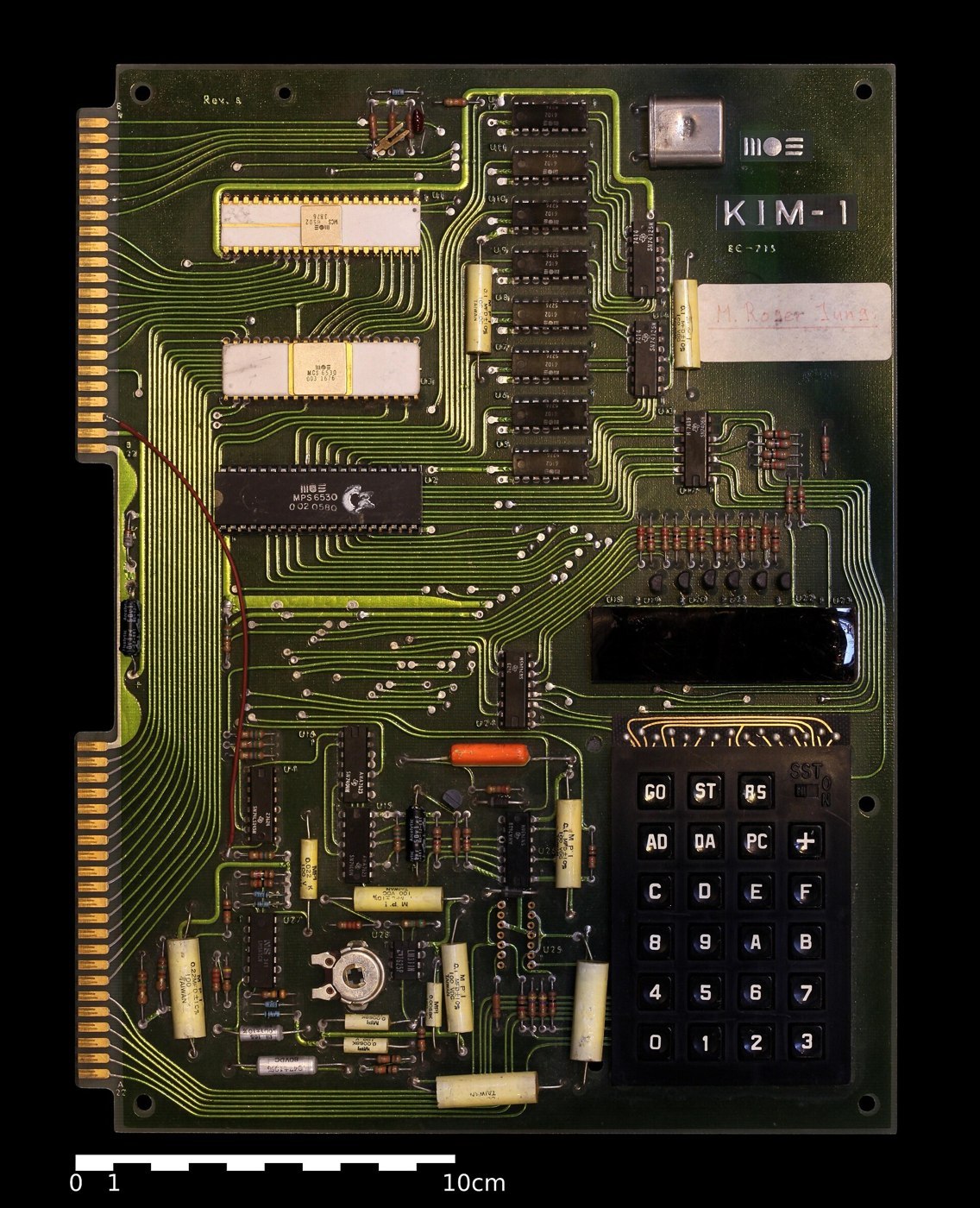
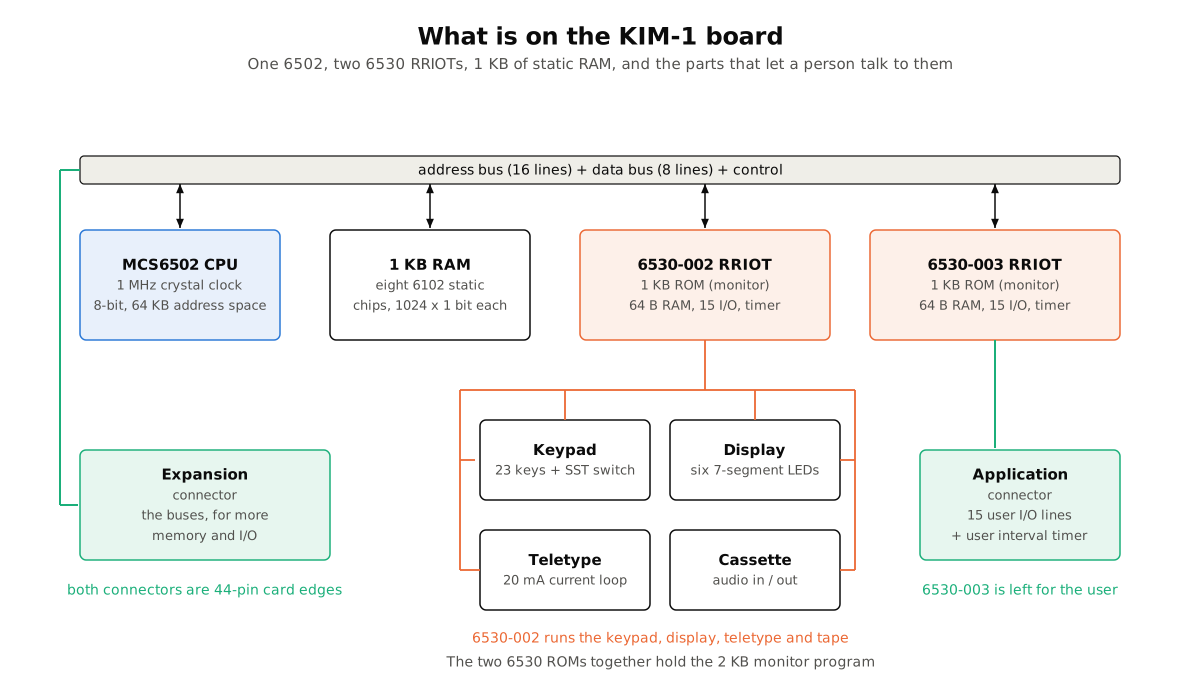
Picture a green fibreglass board, roughly the size of a sheet of letter paper, with a row of gold fingers along one long edge. Down the left side stand three large 40-pin chips: the MCS6502 microprocessor and two MCS6530 “RRIOT” chips (ROM, RAM, I/O and timer, all on one die). Beside them is a column of eight small memory chips, each holding 1,024 single bits, which together make the board’s kilobyte of user memory. At the lower right sits a black keypad with sixteen hexadecimal keys, 0 to F, and seven command keys, and above it a strip of six red seven-segment LED digits. A small crystal can near the top keeps time at 1 MHz. Everything else on the board is support: resistors, capacitors, a handful of logic chips, the circuits for a cassette recorder and a teletype.
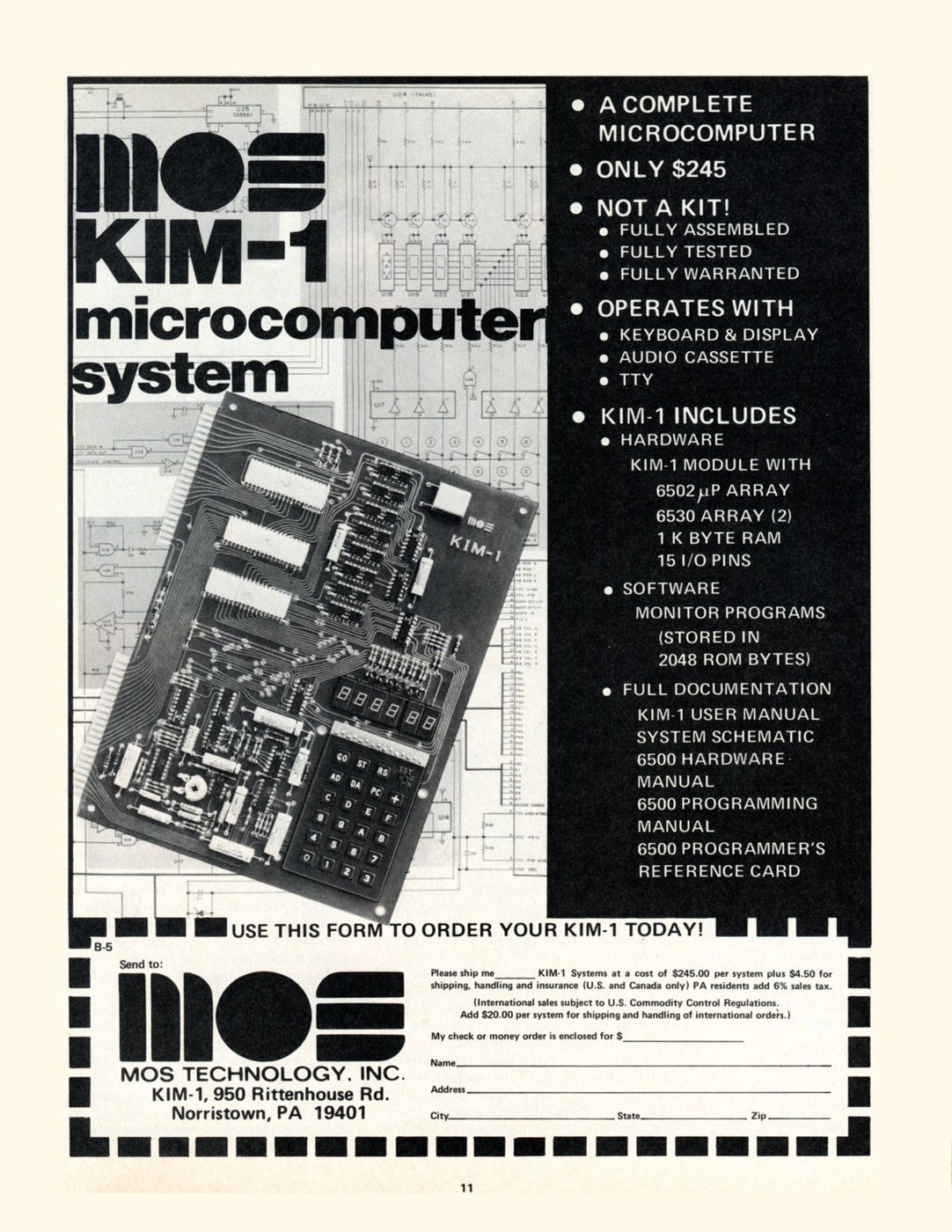
That is the whole computer. MOS Technology’s first advertisement for it, in the April 1976 issue of BYTE, listed it under the heading “A complete microcomputer system”: 6502 microprocessor, two 6530 arrays, a 1K-byte RAM, 15 I/O pins, monitor software in 2,048 bytes of ROM, and three manuals, all for $245, “fully assembled, fully tested, fully warranted” and “not a kit”. The order coupon asked for payment by cheque or money order to MOS Technology, 950 Rittenhouse Road, Norristown.
1.2.1 The name
The name is an acronym in the MOS manner. Before the KIM-1, MOS had offered a kit called TIM, the Terminal Interface Monitor: a pre-programmed 6530 chip and a set of instructions for wiring up a 6502 system that talked to a teletype. The new board could be used without a terminal at all, from its own keypad, so it became the Keyboard Input Monitor, KIM; the “-1” was added, according to Brian Bagnall’s history of Commodore, because it carried one kilobyte of memory (Bagnall, On the Edge, ch. 1.5, “Tim and Kim”). The habit of three-letter names stuck: MOS and then Commodore went on to the KIM-2, KIM-3 and KIM-4 expansion boards, and later to the PET, VIC and others (Volume 7).
1.2.2 What it was for
MOS did not set out to sell a personal computer. It had a new and very cheap microprocessor, the 6502, introduced at $25 in September 1975 when its competitors cost between $175 and $360 (Volume 2), and it needed engineers to try it. The KIM-1 was a development system: something an engineer could put on a bench, program, connect to an experimental circuit through its spare input and output lines, and use to decide whether the 6502 belonged in a product. The first page of the KIM-1 User Manual (MOS Technology, publication 6500-15B, second edition, August 1976; scan at bitsavers) makes the promise in those terms:
“As the owner of a KIM-1 Microcomputer Module, you now have at your disposal a completely operational, fully tested, and very capable digital computer which incorporates the latest in microprocessor technology offered by MOS Technology, Inc. By selecting the KIM-1 module, you have eliminated all of the problems of constructing and debugging a microcomputer system. … you should be able to achieve initial operation of your KIM-1 module within a few minutes after unpacking the shipping container.”
The manual also says what the board was meant to do once it was running: “The KIM-1 system is intended to provide you with a capable microcomputer for use in your ‘real-world’ application”, with “15 bidirectional input/output pins to allow interface control of your specific application” and an interval timer “available for generation of time base signals required by your application”. That sentence is the root of Volume 6, on the KIM-1 as the brain of instruments, controllers and robots.
1.3 Where It Came From
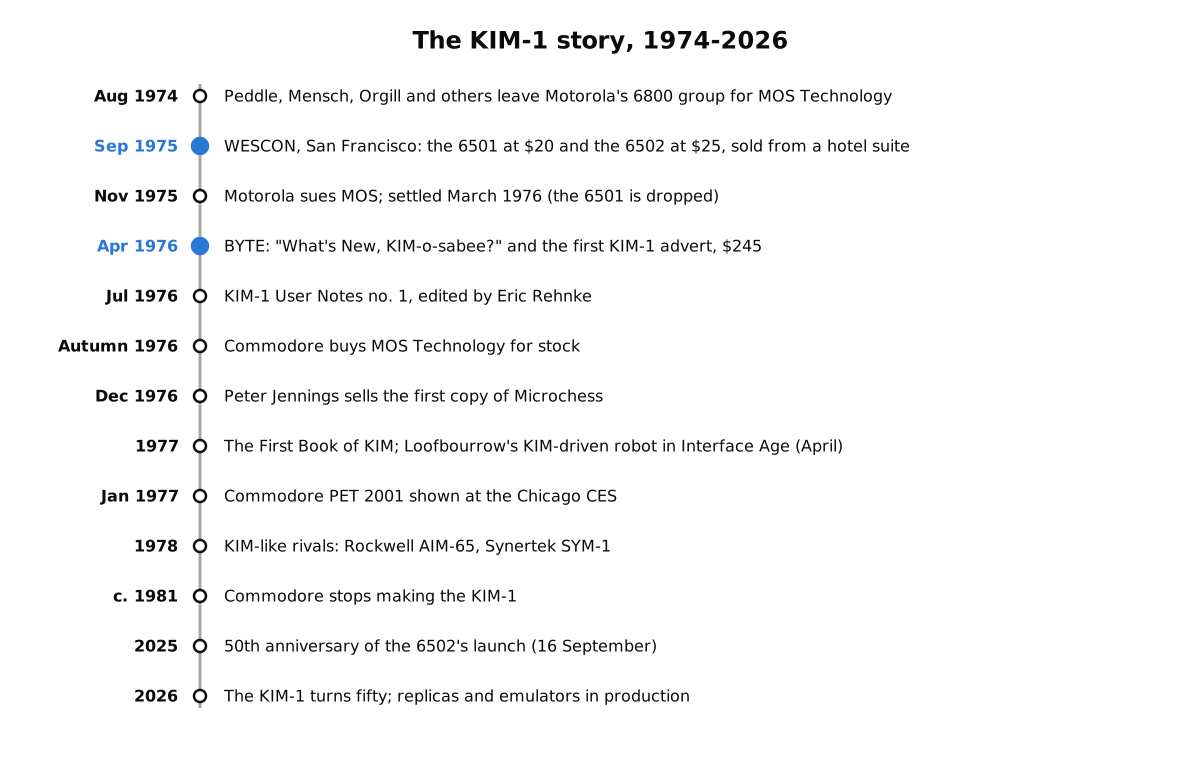
The KIM-1 is a product of the 6502, and the 6502 is a product of a walkout. In August 1974 a group of engineers from Motorola’s 6800 microprocessor team, led by Chuck Peddle and including Bill Mensch, Rod Orgill and Wil Mathys, left Motorola for MOS Technology, a small Pennsylvania chip maker that had made its name on calculator chips. Peddle wanted to build a microprocessor cheap enough to replace ordinary logic in everyday products, and MOS, under its president John Paivinen, had a new manufacturing process that could make it. The result was the MCS650x family, launched at the WESCON electronics show in San Francisco in September 1975, where MOS sold the 6501 for $20 and the 6502 for $25 from a hotel suite because exhibitors were not allowed to sell on the show floor. Motorola sued; the settlement in March 1976 killed the 6501, whose pins matched Motorola’s 6800, and left the 6502 as the family’s flagship. Volume 2 tells that story in full.
A $25 chip is only useful if people know how to use it, and in 1975 very few did. Peddle later recalled that MOS built “two or three little test machines” to exercise the new chips, and that “the guys at MOS Technology came up with the idea for the KIM-1. And their argument was you need a little keyboard — if you look at, they’re calculator guys. And they basically build a calculator on a board that you could type in and put instructions in and make it run” (Peddle, CHM oral history, 2014, p. 30). Bagnall credits the idea to Don McLaughlin, a founder of MOS, with Peddle and the programming manager Bob Winterhalt joining in the design, and quotes the MOS engineer Al Charpentier naming his friend John May as “the primary mover on that project”, the engineer who did the hands-on work. Bill Mensch, who designed the 6530 chip at the KIM’s heart, called it in his own oral history “probably the most endeared single board computer of all time” (Mensch, CHM oral history, 2014).
The board was being shown in 1975: Peddle recalled a “KIM station” in the WESCON suite alongside the TIM and an in-circuit emulator. Bagnall dates the start of sales to the middle of 1975, but the dated evidence — the April 1976 BYTE announcement under the headline “What’s New, KIM-o-sabee?”, MOS’s first advertisement in the same issue, and manuals dated 1976 — puts the KIM-1 on sale in early 1976. BYTE followed in May 1976 with “A Date with KIM”, a long and enthusiastic description by Richard Simpson.
1.4 How a Person Used It
1.4.1 Power, reset and the first program
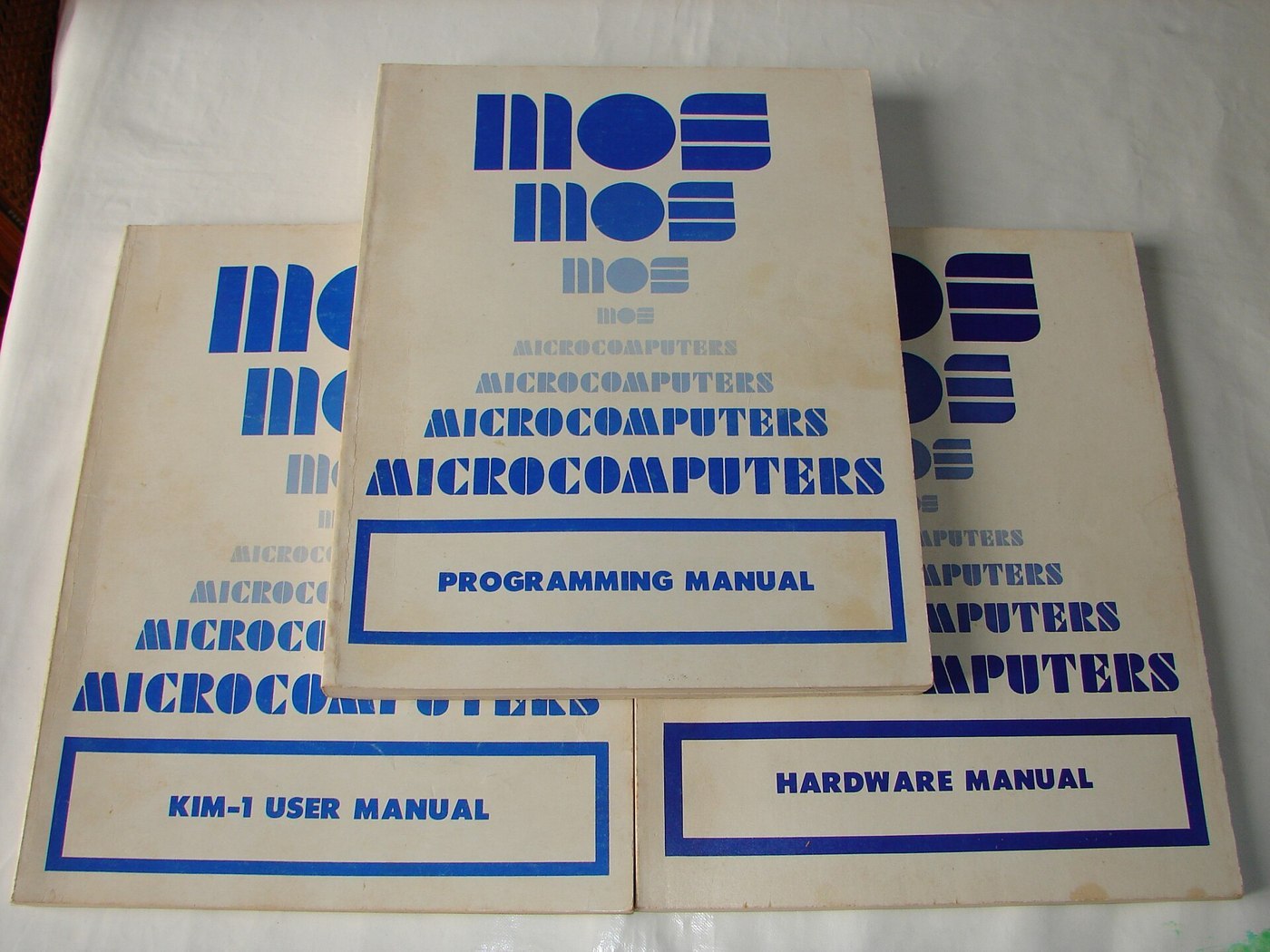
A KIM-1 arrived in a cardboard box from “MOS Microcomputers”, sealed in a black anti-static bag and packed with three manuals: the KIM-1 User Manual, the MCS6500 Microcomputer Family Hardware Manual and the Programming Manual, plus a programming card and a fold-out system schematic. The buyer supplied the power: a regulated +5 V at 1.2 A for the computer and, only if a cassette recorder would be used, +12 V at 0.1 A for the tape circuits (User Manual, figure 2.2). The manual included a schematic and parts list for a simple supply for owners who did not have one. There was no on-off switch. After wiring the supply to the lower edge connector (and fitting a jumper the manual calls “essential for system operation”), the owner pressed RS, reset, and the six digits lit.
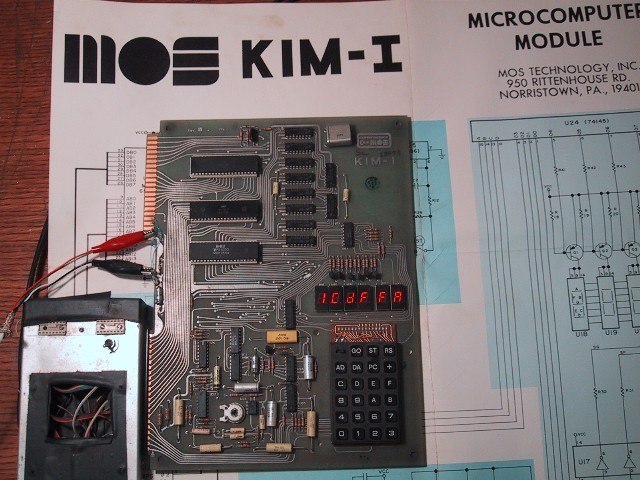
What the display showed was the monitor program, kept permanently in the two 6530 chips. The left four digits were a memory address in hexadecimal, from 0000 to FFFF; the right two were the byte stored there, from 00 to FF. The keypad drove it. AD put the keypad in address mode, so that the hex keys typed a new address; DA put it in data mode, so that the hex keys changed the byte at that address; + stepped to the next address. A program was entered by choosing a starting address, pressing DA, typing two hex digits, pressing +, typing the next two, and so on. GO ran the program from the displayed address. ST stopped a running program and returned to the monitor. PC recalled where a stopped program had got to. A slide switch marked SST turned on single-step mode, in which each press of GO ran exactly one instruction and stopped, so that the program could be watched working.
The manual’s first exercise, in section 2.4, “Lets try a simple program”, is a seven-instruction routine that adds two 8-bit numbers held in memory and shows the result on the display. The owner keys in the bytes 18, A5, 00, 65, 01, and so on, one pair at a time, then puts two numbers in locations 0000 and 0001 and presses GO. Volume 4 walks through the monitor in detail, and Volume 11 looks at what that process taught.
1.4.2 Tape and teletype
Two additions turned the KIM from a toy into a tool. The first was an ordinary audio cassette recorder. A 1-kilobyte program typed in by hand could take an hour and be lost the moment the power was cut; with a recorder plugged into the board’s audio lines, the monitor could write the program to tape and read it back later. The format was slow — about two minutes for a full kilobyte — but it worked with almost any recorder, and it made programs shareable: a KIM owner could post a cassette to another KIM owner, and it would load. Jim Butterfield’s later “Hypertape” routine cut a 1K load to about 21 seconds (Volume 5).
The second was a teletype or a serial terminal. The KIM-1’s other built-in interface was a 20 mA current loop of the kind used by the Teletype Model 33, and the monitor measured the terminal’s speed automatically when it started. With a teletype attached, the owner could type commands and hexadecimal on a full keyboard, get a printed listing of memory, and read and punch paper tape. Bagnall notes that onlookers were impressed to see the small board driving “a massive piece of hardware normally connected to minicomputers or mainframes”, but also that many owners preferred the keypad and LEDs to the noise, mess and cost of a teletype.
1.4.3 Expansion
The upper edge connector carried the 6502’s address, data and control lines, so that more memory and more input/output could be added. MOS and its partners sold the KIM-2 (4 KB) and KIM-3 (8 KB) memory boards, the KIM-4 motherboard with six slots, the KIM-5 resident assembler and editor in ROM and the KIM-6 prototyping card; Forethought Products’ KIMSI adapted the board to the S-100 bus used by the Altair. Don Lancaster designed a low-cost video display that let the KIM write text on a television. A fully expanded KIM-1 system, with 8K or more of memory, a terminal and an assembler, was a capable small computer by the standards of 1977. Volume 3 covers the board’s two connectors; Volume 7 covers the expansion line and Commodore’s plastic case for the bare board.
1.5 Why It Mattered
1.5.1 It was ready to use
The famous microcomputer of 1975 was the MITS Altair 8800, sold as a kit for $439 and assembled for $621. Its front panel was a row of toggle switches and lights: a program was entered one binary word at a time by flipping switches, and the basic machine had no way to save it. The KIM-1 cost $245, came assembled and tested, entered programs in hexadecimal from a keypad, showed results in readable digits, and saved its work to an ordinary cassette recorder. It was smaller, cheaper and more complete. The difference was a matter of design philosophy as much as price: the Altair was a box of slots waiting for cards; the KIM was a whole computer on one board, with expansion as an option rather than a necessity. Bagnall describes the KIM-1 as having become “known as the first single-board computer”, and while there were earlier single-board designs in industry and in kit form, it was the first to sell in such numbers to so many individuals.
1.5.2 Every KIM was the same
Because every KIM-1 had the same processor, the same memory map, the same monitor in ROM and the same keypad, display and tape format, a program written on one would run on all of them. Bagnall points out what that meant in practice: “programmers knew their programs would run on all standard KIM-1 computers”, and the standard tape interface made them easy to swap. Within months there was a newsletter, KIM-1 User Notes (first issue July 1976), a stream of magazine articles in BYTE, Kilobaud, Dr. Dobb’s Journal and Interface Age, and in 1977 a book of programs, The First Book of KIM by Jim Butterfield, Stan Ockers and Eric Rehnke. Out of that community came games written for six digits — Lunar Lander, Hunt the Wumpus, Blackjack — and Microchess, Peter Jennings’s chess program squeezed into 1,118 bytes, which Jennings began selling by post on 18 December 1976 for $10 and which is often described as the first game sold commercially for a home computer. Volume 5 tells that story.
1.5.3 People put it inside other things
The KIM-1’s spare 6530 chip gave it fifteen programmable input/output lines and a hardware timer that the owner’s program could use as it liked. That made it an inexpensive controller. Bob Yannes, then a MOS engineer and later the designer of the Commodore 64’s sound chip, told Bagnall that customers asked, “Why do we want to design our own computer? We have one right here and it’s only [$245], which is cheaper than we can build it for”, and that “they would just buy KIM-1’s and bury them in their products.” A 1977 article in Kilobaud said that most of the 7,000-odd KIM-1s then in the field were being used by industry. Owners used them to run amateur radio stations, play music, control model railways, drive laboratory instruments and, most memorably, to steer robots. Volume 6 follows the KIM-1 into those machines, including Tod Loofbourrow’s robot “Mike”, also called “Microtron”, featured in Interface Age in April 1977 and documented on this site in its own dive (Loofbourrow’s Mike/Microtron, robots.fubsypoly.com).
1.5.4 It taught machine code
Above all, the KIM-1 was a teaching machine. Nothing stood between the owner and the processor. There was no operating system, no high-level language in ROM, no screen of friendly prompts: just an address, a byte and a keypad. To make the KIM do anything, its owner had to learn the 6502’s instruction set, translate each instruction into its hexadecimal code by hand, work out where every byte would sit in memory, key the bytes in, run the program and, when it failed, single-step through it watching the registers and memory change. That is exactly the knowledge that most later computers hide, and it is why the KIM-1 is remembered as the board on which a generation learned how computers really work. Peddle’s own summary was that “you could sit down and learn to program using my manuals” (quoted by Bagnall). Volume 11 is about that experience.
1.6 Commodore and After
In the autumn of 1976 MOS Technology was bought by Commodore Business Machines, Jack Tramiel’s calculator company, which wanted its own chip supply in a price war with Texas Instruments. The KIM-1 became the first computer sold under the Commodore name: later boards carry a Commodore logo etched into the copper beside the MOS mark. Peddle, now at Commodore, went on to design the PET 2001, shown in January 1977 and on sale late that year: a complete computer with keyboard, screen and cassette in one case, built around the 6502 and descended, in its monitor and in its designers’ experience, from the KIM and TIM. Rockwell and Synertek, the 6502’s second sources, built their own “KIM-like” boards, the AIM-65 and the SYM-1; the Dutch magazine Elektor published a KIM clone, the Junior Computer, in 1980. Commodore made the KIM-1 until about 1981. Volume 7 covers all of this.
How many KIM-1s were made is not known. Kilobaud reported “over seven thousand” in the field by mid-1977. The recollections of the people involved range from Bill Mensch’s “about 50,000” to Bob Yannes’s “a couple of hundred thousand, I think”; Peddle would only say that it was “certainly higher than ten thousand”. No production record has been published. Survivors are in the collections of the Computer History Museum (which describes its serial 12829 as the machine that “led directly to the Commodore PET 2001”), the Heinz Nixdorf MuseumsForum, the Musée Bolo and many private hands, and the few offered for sale are priced by their owners in the low thousands of dollars or euros.
1.7 The KIM-1 in 2026
Fifty years on, the KIM-1 is easier to get than it was in 1976. Original boards are collectors’ pieces, but the machine itself lives on in reproductions that copy the original board part for part, in modern boards that keep the keypad and display and replace the custom 6530s with available chips, and in small emulators built on microcontrollers that run the original monitor and programs on a handheld board. Volume 8 surveys what is available as of October 2026 — vendors, prices, how faithful each is — and Volume 9 builds the best of them. The 6502 itself has never gone out of production: the Western Design Center, founded by Bill Mensch, still sells a CMOS version, the W65C02S, and marked the fiftieth anniversary of the chip’s launch on 16 September 2025.
For anyone who wants to learn what the KIM taught without buying anything, a software model of the board is enough. This series includes one: kim1_sim.py, a simulator built on a tested 6502 core that models the KIM-1’s memory map, its 6530 input/output, the six-digit display and keypad, and the monitor’s entry points by their behaviour. Every program in Volumes 4 and 10 is run in it, with the display shown as text.
1.8 The Story in Miniature
Volume 2 goes back to Motorola in 1974, where Chuck Peddle’s idea of a microprocessor cheap enough to replace logic chips ran into a company that did not want it. It follows the team to MOS Technology, the design of the 6502 and its clever cost-cutting, the $25 launch at WESCON in September 1975, and the Motorola lawsuit that ended the 6501.
Volume 3 takes the board apart: the 6502, the two 6530 RRIOTs and what each does, the eight memory chips, the keypad scanning and display multiplexing that share one set of I/O lines, the cassette and teletype circuits, the two edge connectors and the memory map.
Volume 4 is a guide to the monitor: entering and examining memory, running and stopping programs, single-stepping, the cassette load and save, the teletype commands, and the routines inside the monitor that a program can call to scan the keypad or light the display.
Volume 5 is about the people: KIM-1 User Notes and its editor Eric Rehnke; Jim Butterfield of Toronto and The First Book of KIM; Peter Jennings and Microchess, the first software business built on a microcomputer game; Tiny BASIC, FOCAL and Microsoft BASIC for the KIM; and the user groups that grew around the board.
Volume 6 follows the KIM into other machines: what made it a good controller, the documented uses in instruments, radio and music, and the robots, above all Tod Loofbourrow’s Mike/Microtron.
Volume 7 covers Commodore’s purchase of MOS, the KIM-1 under the Commodore name, the PET 2001, the rival and descendant boards, and the KIM-1’s place in museums and collections.
Volume 8 surveys the replicas and emulators of 2026; Volume 9 builds one, from parts to first reset; Volume 10 programs it, from lighting a single segment to writing a game, with every program run in the series’ simulator.
Volume 11 closes the series with an account, in the first person where the evidence allows, of learning machine code on a KIM-1 in the 1970s, set beside an explanation of what that learning involved.
1.9 A Note on Sources
The most important primary sources for this series are MOS Technology’s own documents — the KIM-1 User Manual, the MCS6500 Hardware Manual and Programming Manual, the 6502 and 6530 data sheets — together with KIM-1 User Notes and The First Book of KIM, all of which survive as scans. The people involved are heard through the Computer History Museum’s oral histories of Chuck Peddle and Bill Mensch (both 2014) and through Brian Bagnall’s interviews for On the Edge: The Spectacular Rise and Fall of Commodore (2005), whose chapter on the TIM and KIM is in this site’s library (Library copy). Where these sources disagree — on dates, on who designed what, on how many boards were sold — the text says so.
Next — Volume 2: MOS Technology and the $25 Microprocessor — Peddle, the 6800 Team and the 6502. A letter from Motorola telling Chuck Peddle to stop work on his low-cost processor, eight engineers who left with him, a new process in a Pennsylvania calculator-chip plant, and a hotel suite in San Francisco where a microprocessor went on sale for $25.
Comments (0)