Fialka · Volume 6
Fialka — Volume 6 — In Service: Key Lists, Cards and Procedure in the Warsaw Pact
How a Fialka was keyed and worked, following the East German Army's 1978 operating manual: the monthly key packages, the daily key table and punched card, message keys and identification groups, the layout of a message, the checks and the destruction rules, who made the keys and who could talk to whom, and how the machine was guarded.
6.1 About This Volume
A cipher machine is only as secure as the way it is used, and the Allied codebreakers of the Second World War read the Enigma at least as much through German procedure as through its wiring. This volume describes how the Fialka was used. It covers what the operator was issued and when, how a day’s key was set, how each message got its own key, what a finished message looked like, what checks were made, and what happened to the key material afterwards. It also covers the arrangements behind the operator: who made the keys, who could talk to whom, and how the machine was guarded.
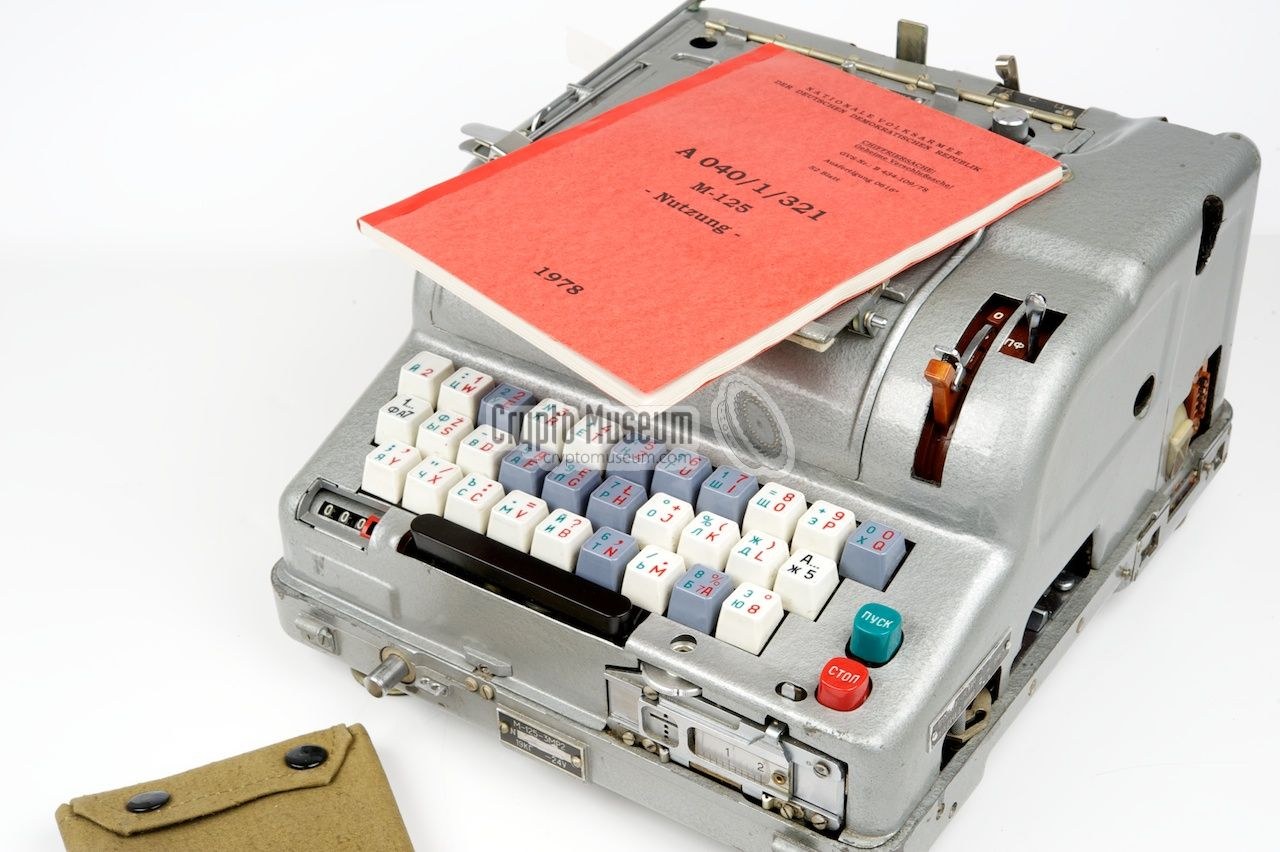
Almost all of it comes from one document, the East German National People’s Army (NVA) operating manual A 040/1/321, M-125 Nutzung, which came into force on 1 December 1978. It covers the M-125-3MN and M-125-MN. Copy 0595 of this “Geheime Verschlusssache” (GVS B 434-109/78), eighty-four sheets long, survived the end of the GDR. The Crypto Museum published a scan, the former NVA cipher officer Jörg Drobick a retyped German edition, and Jerry McCarthy an English translation (NVA 1978, German; Library copy; English translation; Library copy). It replaced earlier East German instructions for the “FIALKA system” dated 1970 (GVS-XI/897/70), so it describes a mature procedure, a quarter-century into the machine’s life. Other countries’ procedures are not known in this detail. Where this volume relies on other sources, chiefly Reuvers and Simons’ interviews with former East German operators, it says so.
The mechanics of setting the wheels belong to Volumes 3 and 4. Volume 10 runs the whole procedure on the simulator with a real worked message.
6.2 The System
The manual opens with a short definition. “The M-125 cipher-system is a machine-based system for stationary and mobile use.” It processed German or Russian plain text and numbers-only text, and it was approved for traffic “to and including classification level GVS” (secret). Messages enciphered with it “can be transmitted by any means of communication, including radio”. It allowed three kinds of traffic:
- Individual traffic: from one station to another.
- Circular traffic: from one station to several named recipients.
- General traffic: to all stations in a key area.
A key area could have up to 600 participants. The “system” was more than the machine. It consisted of the machine with its wheels and power supply, the key packages, the rules in force, and the technical descriptions (NVA 1978, sec. 1–2; Library copy).
6.3 The Key Packages
The key material came in three kinds of sealed package.
6.3.1 The Daily Key Package
Each Daily Key Package held the daily keys for one month:
- 31 Daily Key Tables,
- 31 punched key cards for the card reader (designated “KC-30 × 30”),
- one signature sheet on which each withdrawal was recorded.
Tables and cards were numbered 1 to 31, and the number was the date. The cover was marked with the package type, a serial number, a copy number, the classification and the period of validity. The type was OSB-25-MN for the adjustable PROTON-2 wheels, and OSB-25-N or OS-25 for the older fixed wheels (NVA 1978, sec. 2.2.3; Library copy). A daily key was valid for 24 hours and changed at 00:01.
Reuvers and Simons, drawing on interviews with former operators, describe the daily keys arriving a month at a time in a sealed plastic bag. They knew of no surviving bag and reproduced a drawing from the manual (Reuvers & Simons 2009, 1.2.5; Library copy). The Crypto Museum adds that the stacks of cards were made in the Soviet Union, a year in advance, for every Warsaw Pact country. Each country had its own stacks, each valid for a month, and the card number showed through a cut-out in the bag (Crypto Museum, key card).
6.3.2 The Message Key Package
Each Message Key Package held:
- 40 Message Key Tables,
- 2 identification-group tables,
- 2 signature sheets.
It was marked KV-25-MN or KV-25-N for individual traffic and ZV-25-MN or ZV-25-N for circular traffic. Each table gave one message key: two five-letter groups that set the starting positions of the ten wheels. The tables were numbered 01 to 40. Packages came in pairs, normally copy 1 for enciphering and copy 2 for deciphering. Each identification-group table held twenty five-letter groups and twenty five-figure groups, one of each for every message key, used to tell the receiver which key had been used (NVA 1978, sec. 2.2.4; Library copy).
6.3.3 The Identification Group Package
For general traffic, a third package held fifty tables of 48 identification groups each, enough for 24 messages per table. Two adjacent groups made one message key, and each group could be used once (sec. 2.2.5).
6.4 Setting the Daily Key
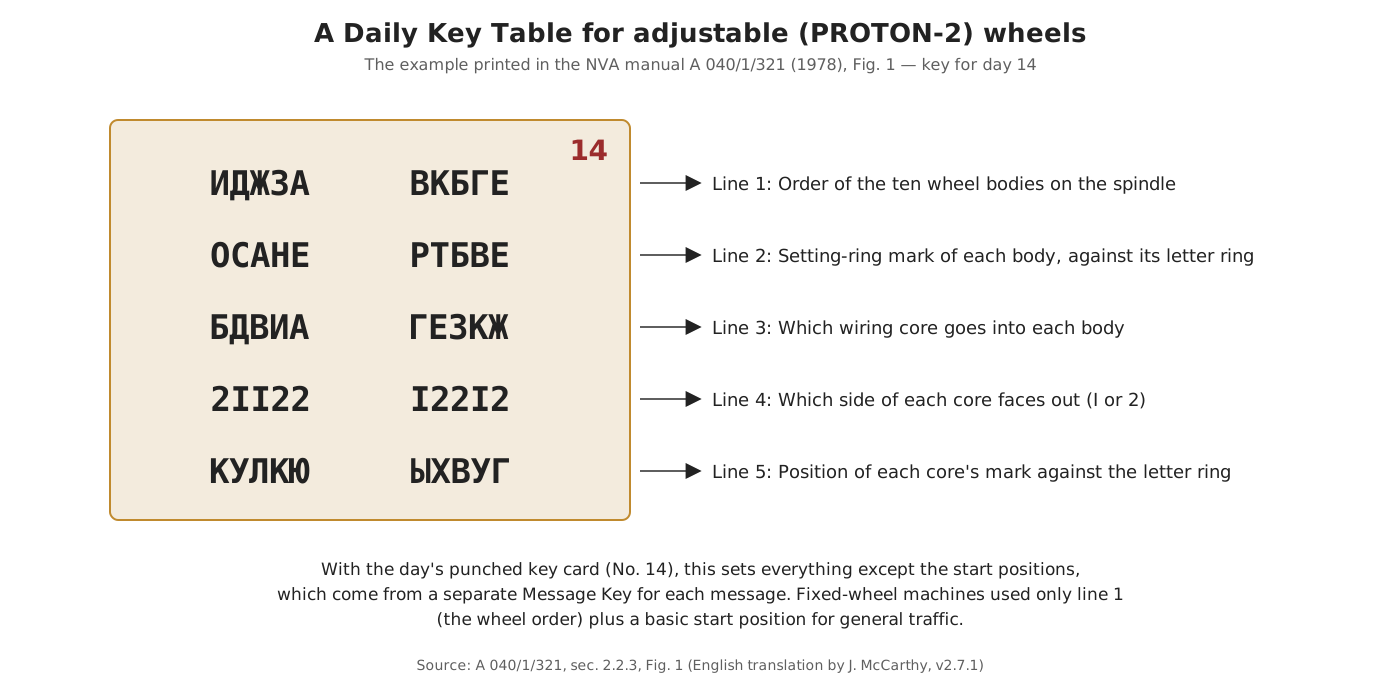
A day’s work began by taking that day’s table and card from the package and signing for them. For the adjustable wheels, the Daily Key Table had five lines of two five-character groups. The manual’s example, valid on the 14th, is redrawn above. The lines meant:
- ИДЖЗА ВКБГЕ — the order of the ten wheel bodies on the spindle. The bodies are identified by the ten letters А Б В Г Д Е Ж З И К, and each letter could appear only once. A table that broke this rule was not to be used.
- ОСАНЕ РТБВЕ — for each body, in that order, the letter of its letter ring against which the setting mark was placed.
- БДВИА ГЕЗКЖ — which wiring core went into each body. Cores are also identified by the ten letters, and again each could appear once.
- 2II22 I22I2 — which side of each core faced out, side 1 or side 2. A core turned over reverses its wiring.
- КУЛКЮ ЫХВУГ — the position of each core’s mark against its body’s letter ring.
The operator took the spindle out of the machine, pulled off the wheels, unlocked each body and removed its core, laid the bodies out in the order of line 1, set their rings, fitted the cores in the order, orientation and position of lines 3 to 5, locked them, and put the wheels back on the spindle against its stop. Reuvers and Simons describe the result as the wheels “taken from the machine, laid out on the table and disassembled” and then rebuilt, every day (NVA 1978, sec. 7.2.3; Library copy; Reuvers & Simons 2009, 1.2.5; Library copy).
For machines with the older fixed wheels, the table was shorter. The first line gave the wheel order, and the second (sometimes running into a third) gave a basic starting position used for general traffic. Where machines with both kinds of wheel had to work together, the adjustable wheels were assembled in a fixed neutral arrangement and set from the short table. The manual explicitly forbids using that neutral arrangement, or the fixed wheels at all, for numbers-only text in general traffic (sec. 7.2.1, 7.2.4).
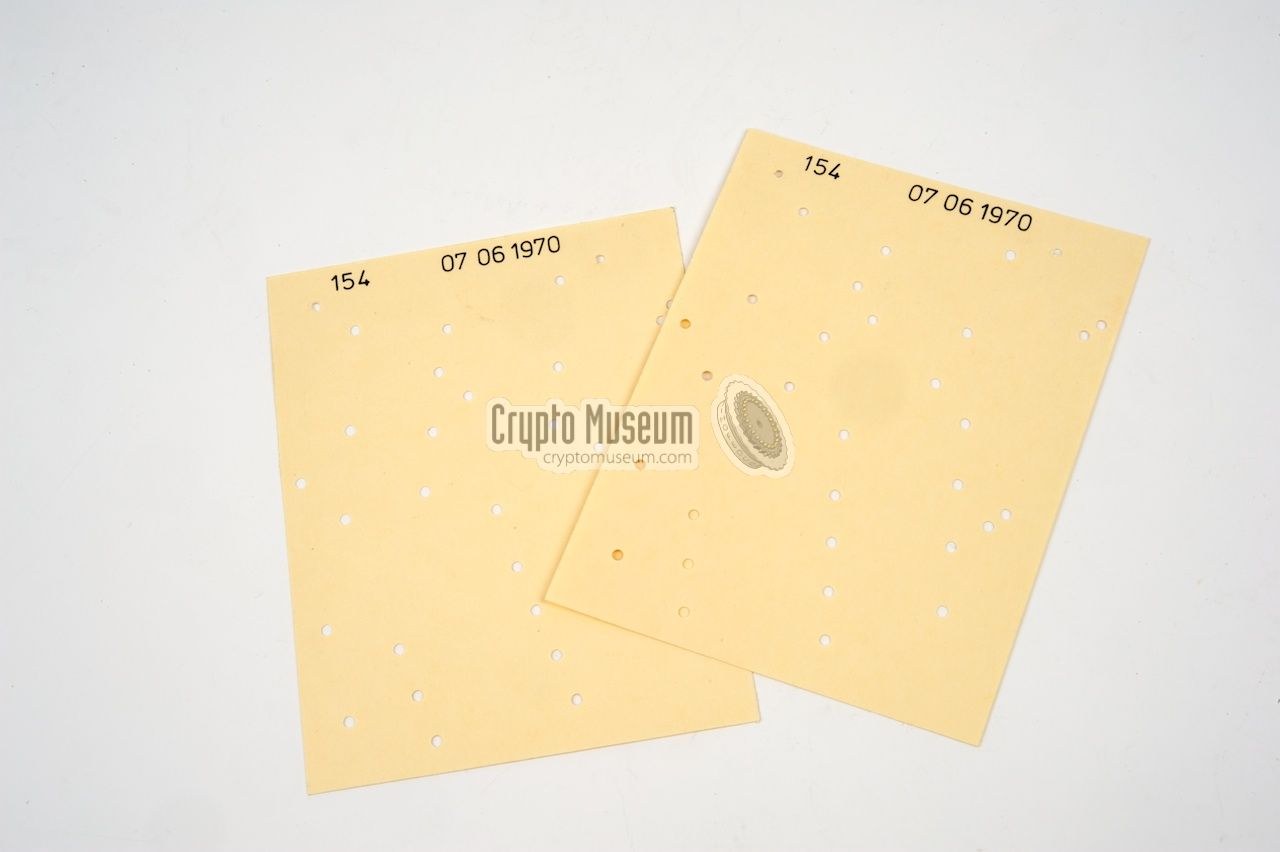
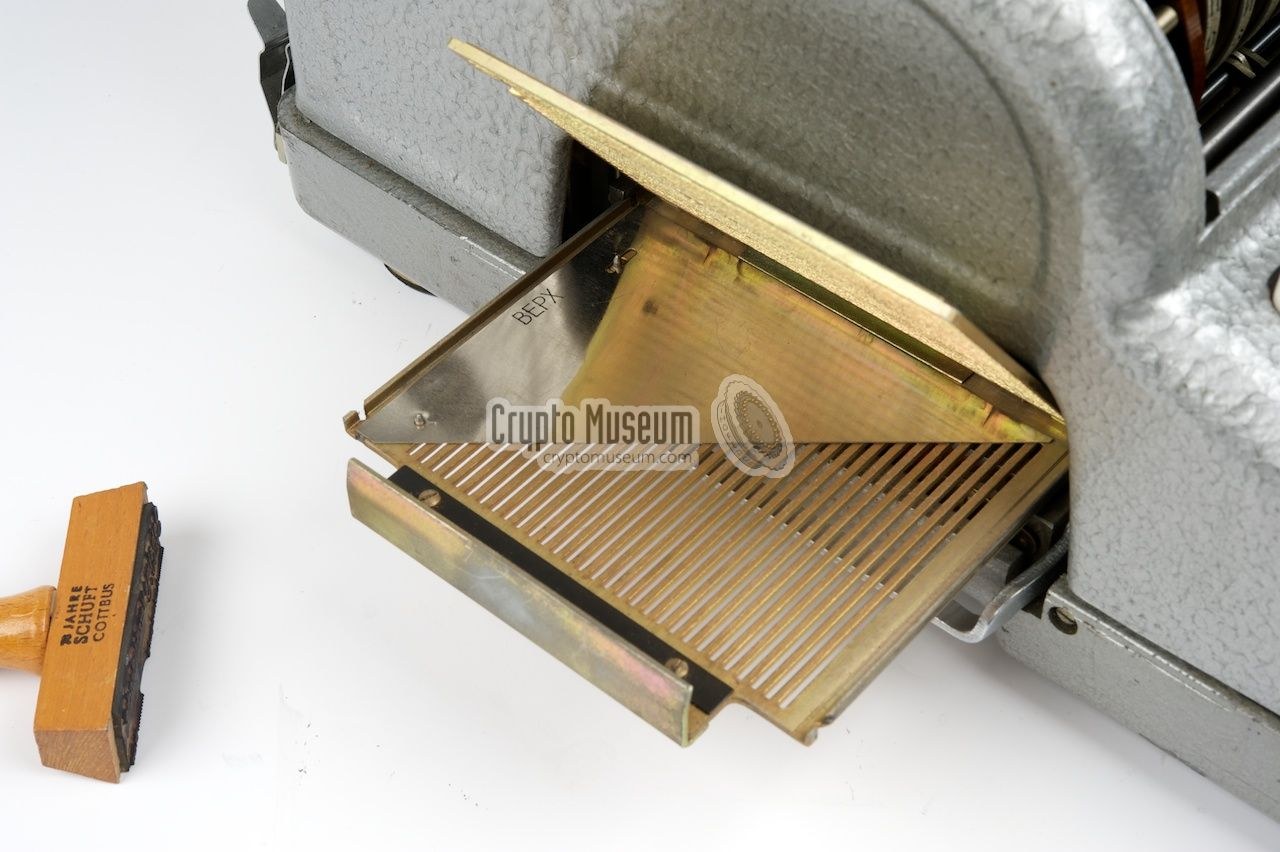
Then came the key card. The operator lowered the latch, pulled out the reader’s drawer, removed the previous day’s card or the metal test triangle, laid the new card in with its two-digit number at the left corner against the stop, and pushed the drawer home (sec. 7.2.2). The card had thirty holes, exactly one in each row and each column of the reader’s 30 × 30 contact grid. It set a full permutation of the thirty letters, through which the current passed twice on every key press. The card was printed on very thin paper. The Crypto Museum notes that opening the drawer a second or third time was likely to tear it, which was deliberate, to make sure a card could not be used again (Crypto Museum, key card).
The manual insists: “The Daily Key Settings must always be checked” (sec. 7.2.1(5)). Before enciphering, the operator also ran the machine through functional checks in plain-text, encipher and decipher modes, set out in the manual’s section 5.
6.5 Message Keys
The daily key fixed the wheels’ wiring, order and rings and the card’s permutation. It did not fix where the wheels started. That was set separately for every message by the message key, two five-letter groups giving the starting letter of each of the ten wheels, read against a setting bar just above the drum. The first letter set the first wheel from the left, and so on to the tenth (sec. 7.3.2). The rule was absolute: “Each Message Key will become invalid after one use. Repeated use of a key table for the enciphering of individual, circular or general traffic is forbidden!” (sec. 7.3.1(3)).
Individual and circular traffic used keys from the Message Key Package in numerical order. The sender used key 01 for the first message, 02 for the second, and so on. The identification group printed against each key in the table went into the message in clear, so the receiver, holding the matching package, could find the same key.
General traffic, sent to a whole key area, needed something else, because the senders could not all share a numbered list. Here the message key was generated. The operator set the wheels to a basic position, AAAAAAAAAA for the adjustable wheels or the position given in the daily table for fixed wheels. In encipher mode, the operator then typed either two identification groups taken from the general-traffic package or ten characters chosen at random. The machine printed two five-character groups, and those became the message key. The two identification groups went into the message in clear, with each character typed three times, so that a receiver could re-encipher them on the same daily key and arrive at the same message key. Randomly typed identification groups must not use repeated characters or “a logical succession on the keyboard”. The resulting key had to contain at least three different characters, or a new one had to be made. The manual ends this section firmly: “The generation of the Message Key by any other method that differs from that listed is strictly prohibited!” (sec. 7.3.3).
This scheme invites comparison with the Enigma’s pre-war indicator procedure, in which the operator enciphered his own chosen message key twice at the start of each message. That repetition gave the Polish codebreakers their first way in (Enigma Volume 7). In the Fialka procedure, the message key itself is never sent. For individual and circular traffic it comes from a printed table, and the message carries only a reference to it. For general traffic, what goes out in clear is the input to the key, not the key enciphered. The threefold repetition protects the identification groups against garbling on a radio circuit. Whether it helped an enemy is discussed in Volume 7.
6.6 The Shape of a Message
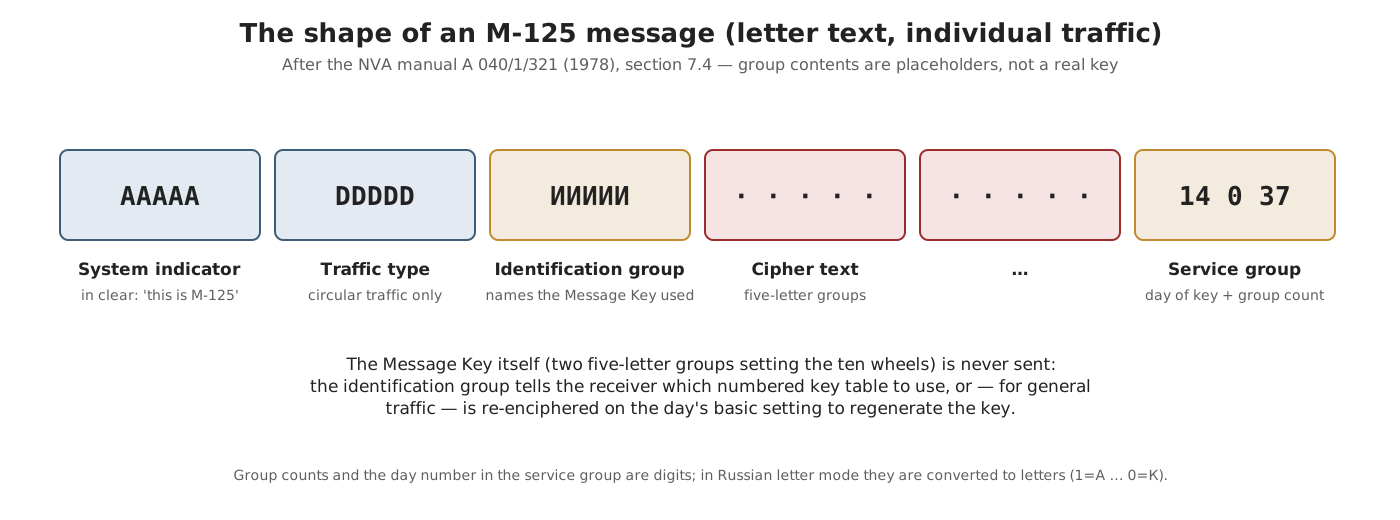
A finished message consisted of message detail groups around the cipher text, in a fixed order (sec. 7.4):
- System indicator group, typed in clear, to mark the message as an M-125 message rather than one from another system: AAAAA for letter text, 11111 for numbers. General traffic carried none.
- Traffic-type group, for circular messages only: DDDDD for German letter text, 55555 for numbers.
- Identification group(s), in clear, naming the message key. For individual and circular traffic they were taken from the table in order, down the columns and left to right. For general traffic each character was sent three times.
- The cipher text, in five-letter groups, the last group padded with spaces.
- The service group, five digits: the day of the daily key, followed by the number of groups in the message (counting the indicator, traffic-type and identification groups but not the service group itself), padded to three digits. In Russian letter mode the digits were converted to letters, 1 = А through 0 = К.
The day in the service group told the receiver which daily key to set, the identification group which message key, and the group count whether anything had been lost in transmission.
6.6.1 Writing the plain text
Before any of this, the plain text had to be pre-edited to the manual’s rules, which take up a whole section. Single spaces went between words and before and after numbers. Double spaces went around proper names and in place of commas where no misunderstanding was possible, and five spaces marked a paragraph. Roman numerals were flagged with “RÖM” or “РИМ”. Latin letters in a Russian text, or Cyrillic in a German one, were converted letter by letter through a table and flagged “RUS” or “ЛАТ”. On the M-125-3MN the operator had to choose the right print head and the right mode switch for letters, mixed text or numbers. When a key area allowed both letter text and mixed text, a letter-text message began with the group БББББ (BBBBB) to say so (sec. 3). Standardised writing like this kept messages unambiguous. Volume 7 asks whether it also handed an enemy predictable plain text, which is the old problem of stereotyped openings that helped break the Enigma.
6.7 Enciphering, Step by Step
The manual’s workflow for a message printed on tape runs as follows (sec. 7.5.2):
- Set the text-mode and 10/30 switches. Set the mode lever to О (plain text) and the output switch to ПЧ (print). Engage the automatic five-letter grouping and line up the tape-feed marks. Switch on.
- Type the system indicator, traffic-type and identification groups in clear.
- Switch the mode lever to З (encipher). Zero the group counter. Turn off automatic grouping.
- Set the ten wheels to the message key.
- Type the pre-edited plain text, or run it in from punched tape through the reader with the ПУСК (start) and СТОП (stop) buttons. Pad the last group with spaces, checking against the counter.
- Switch back to О, press the space bar once and type the service group in clear.
- Switch off, run out about 30 cm of tape, tear it off and stick it to the message form.
To punch a tape for a teleprinter or radio circuit instead, the output switch went to ПФ (print and punch), and the tape carried the message both as holes and as printed text.
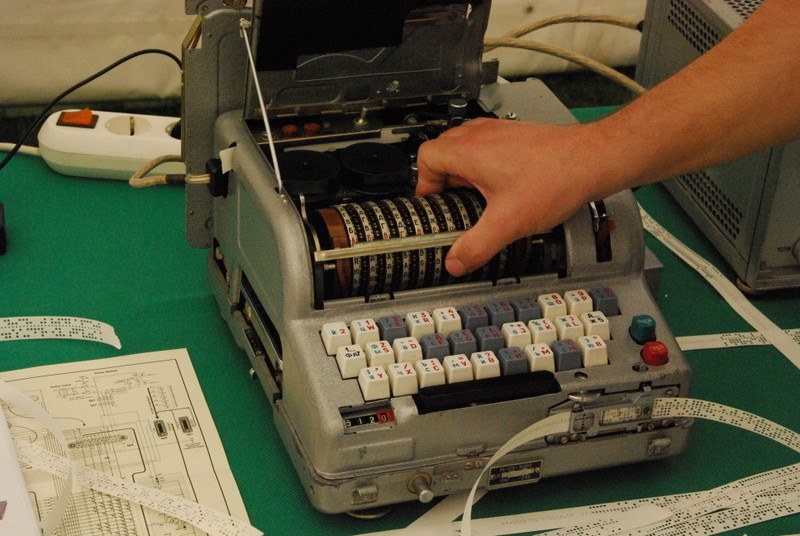
Every message was then checked. The manual requires the operator to “decipher at least the beginning of the cipher-text”, compare it with the plain text, and then “demonstrably destroy the deciphered text along with other intermediate materials” (sec. 7.5.1(5)). Reuvers and Simons, from former operators, describe the East German practice in full. Fialka was always used off-line, never connected directly to a radio. The message was enciphered onto punched tape, the machine was switched to decipher, and the tape was run back through it as a check, before the tape went to the radio station to be sent from a separate tape transmitter. That way no text could go out in clear because someone had left the mode lever in the wrong position (Reuvers & Simons 2009, 1.2.4; Library copy).
6.8 Deciphering, Garbles and Queries
At the receiving end the process ran in reverse (sec. 8). The operator read the service group to find the day, set that daily key, read the identification group to find or regenerate the message key, set the wheels, switched to Р (decipher) and typed or fed in the cipher text. The manual devotes a section to “de-garbling”: what to do when a message would not decipher at all, or when the plain text broke down part-way through. It gives procedures for working back from a corrupt group and for messages in mixed mode, whose shift characters made garbles worse. A last section covers check-back queries, the formal way of asking the sender to repeat or confirm part of a message without compromising it (sec. 9–10).
6.9 Destruction
The paper had to be destroyed. The manual’s rules (sec. 2.2.2):
- Daily key tables and cards were taken from the package only when needed for immediate work, with date and signature recorded.
- Used message keys were struck out, signed and dated, and left in the package for destruction.
- Damaged, invalid or compromised key material was not to be used. The next uncompromised message key was taken instead, and a compromised daily key was reported to the key area’s control centre, which sent a replacement by enciphered message or courier.
- All key material, used or unused, was stored where unauthorised people could not reach it, and destroyed within 48 hours unless otherwise ordered.
- Every destruction was confirmed with a date and two signatures.
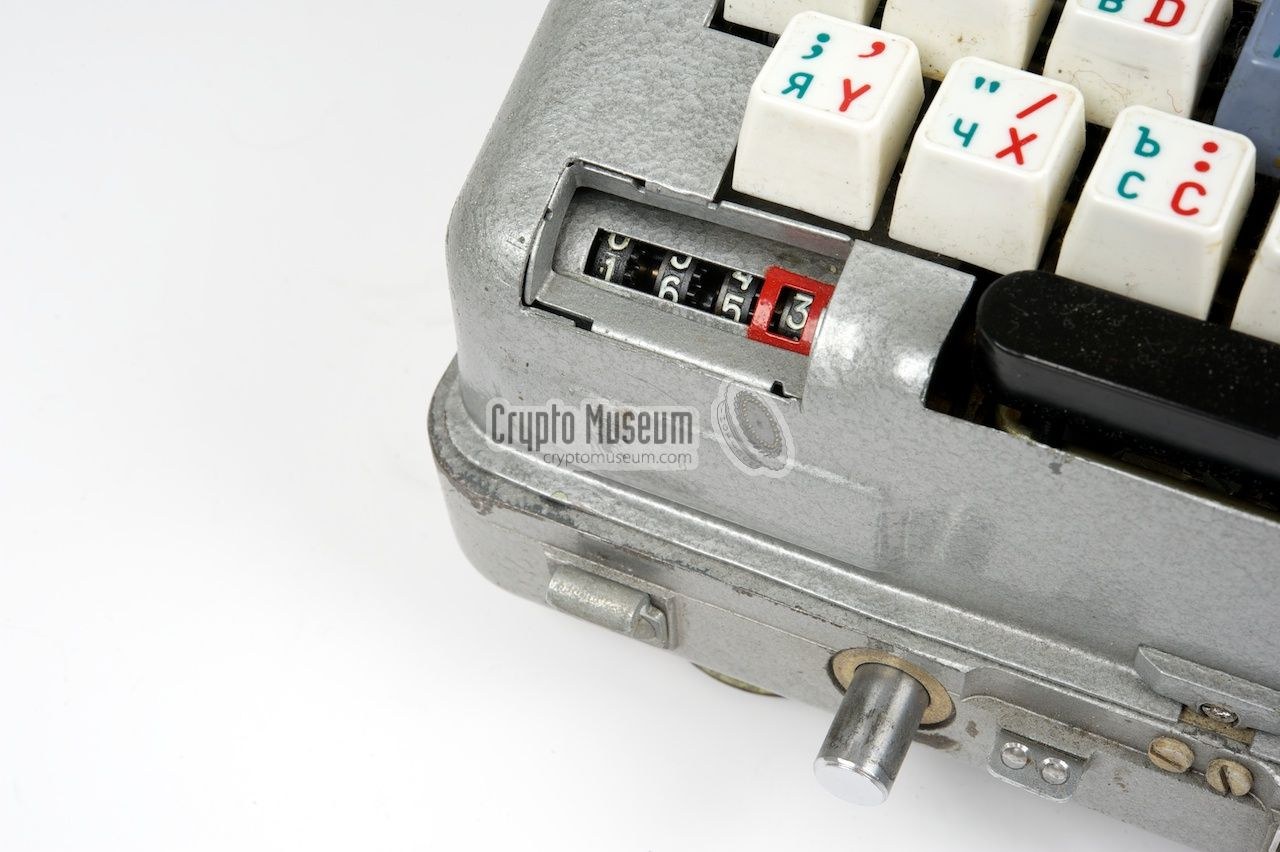
At the end of a key’s validity, and whenever the wheels were put away, they were returned to a neutral state. All rings were set to А, every core went back into its own body with side 1 out at position А, and the wheels went onto the spindle in alphabetical order (sec. 2.3(4)). A machine or a spare wheel set found in a cupboard would therefore reveal nothing about the last key. The card did the same. At the end of the day the key card was removed and destroyed, and the metal triangle went into the reader in its place (Crypto Museum, key card). Even the group counter was cleared. A bracket on the dust cover pressed the counter’s reset button as the cover went on, so a stored machine could not show the length of its last message.
6.10 Who Made the Keys, and Who Could Talk to Whom
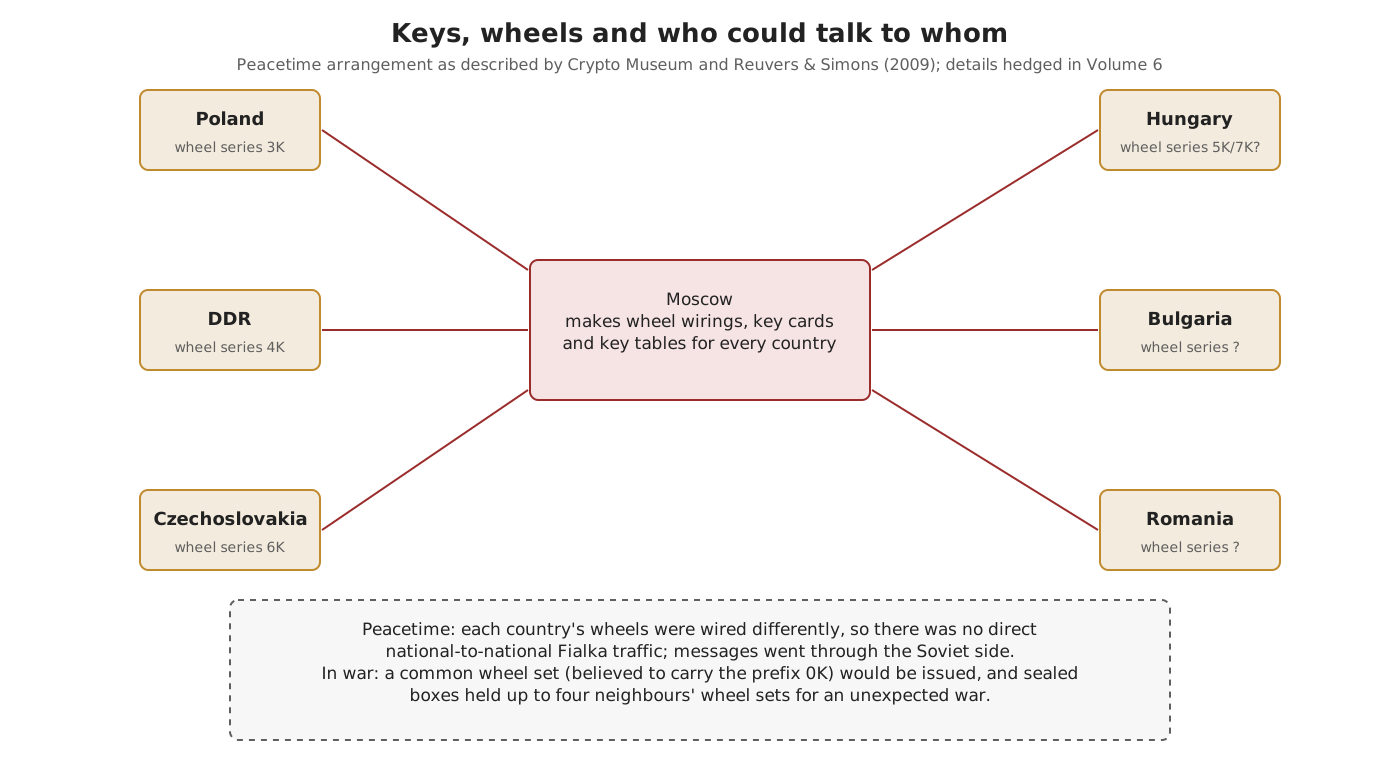
The East German manual describes a key area’s own control centre. It says nothing about where the keys came from. The Western accounts fill in the picture, with less certainty. The Crypto Museum states that the key cards were created by the Soviets for all Warsaw Pact countries, a year in advance, and that the PROTON-2 wheels “were prepared by the Russians well in advance of the actual release date” for each country. It also states that “direct communication between Warsaw Pact nations was strictly prohibited during peacetime and any messages had to be sent via the Russians” (Crypto Museum, wheels). The German Spy Museum in Berlin says the same more briefly: the Fialka “was not used to encrypt communication between these allied states” (Deutsches Spionagemuseum). The country-specific wiring made this a technical fact as well as a rule, since a Polish machine with 3K wheels simply could not decipher a Czechoslovak message enciphered on 6K wheels.
War was a different case. Reuvers and Simons report two provisions. In a war with time to prepare, identical wheels, probably carrying the prefix 0K, would be issued to every Warsaw Pact army. For an unexpected war, each country held special sealed boxes containing the wheel sets of up to four neighbours. The boxes were tied round with cord and closed with a wax seal, and they included an example photographed for the manual (Reuvers & Simons 2009, 1.2.6; Library copy). No 0K wheel has been found.
The machines themselves belonged to Moscow. The Crypto Museum describes the Polish and Czechoslovak machines as supplied “on a lend/lease contract with the USSR”. That is why, after 1990, Moscow could demand them back.
6.11 Guarding the Machine
The Warsaw Pact protected the Fialka as any army protects its high-grade cipher equipment. Reuvers and Simons, from their interviews with the former East German Fialka operator Jörg Drobick, describe it this way. Information about the Fialka was strictly need-to-know. Only operators had access to the machine, along with maintenance technicians under supervision. Even the people who originated and received messages were rarely allowed into a room where it stood. On large exercises the machine was set up in a closed house or tent, with the area around it sealed off. Warning signs announced a secret device, and a red light showed when it was working. Anyone who entered without the proper passes could expect to be arrested on the spot, and was at risk of being shot. Their manual includes a drawing of a 100-metre safety zone around the machine (Reuvers & Simons 2009, 1.2.4; Library copy). Foreign Policy adds, without a source, that soldiers trained on the machine had to sign contracts that barred them from travelling abroad for two years (Borshchevskaya 2019).
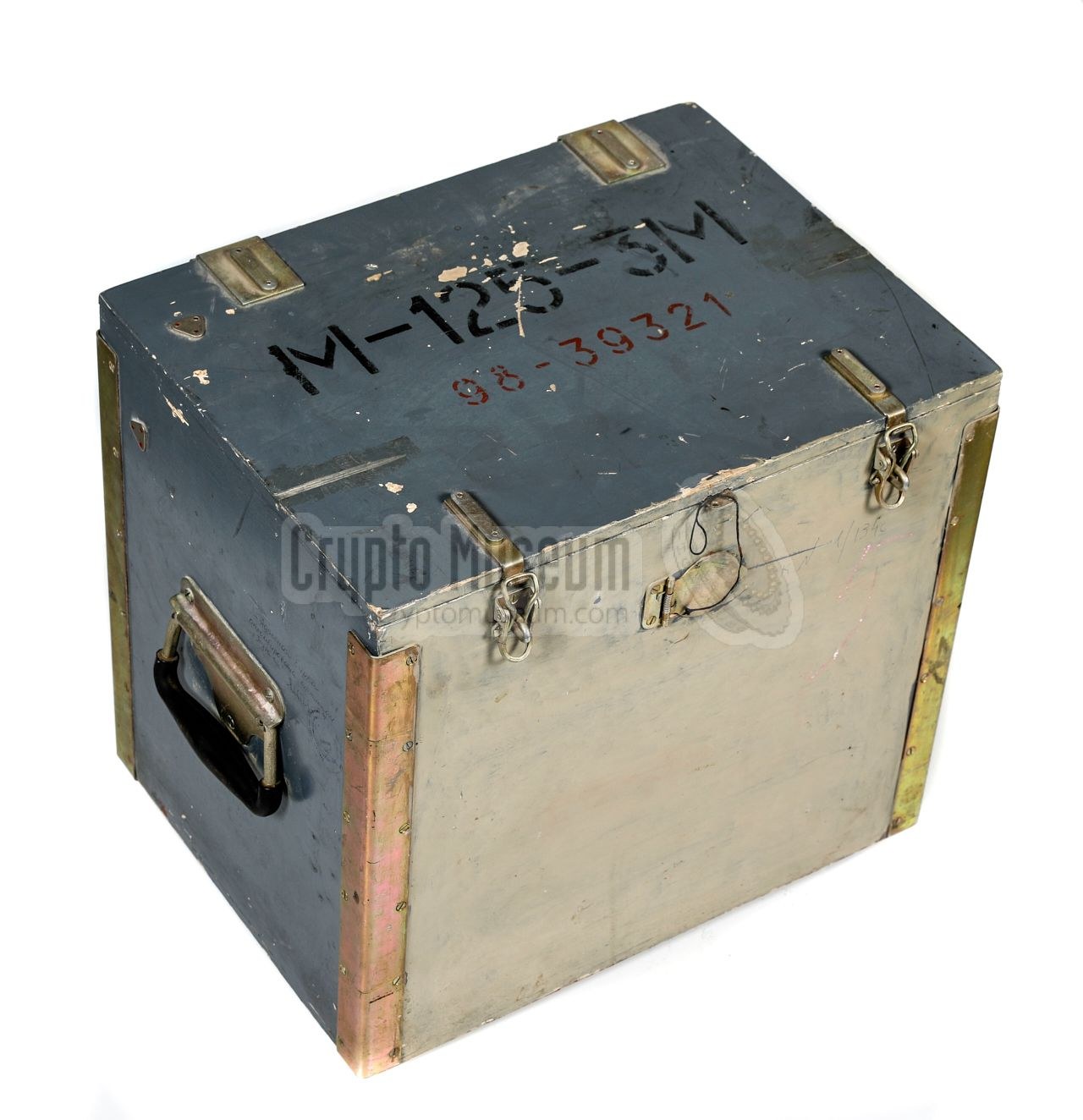
The machine travelled in a sealed wooden transport box marked with its model and serial number. In a mobile setting it could ride in a command vehicle. Reuvers and Simons found that an East German R-142 radio set built into a GAZ-66 truck had an empty space with mounting holes that fit a Fialka’s feet. The set’s 1983 block diagram shows a “special unit B2” labelled ФИАЛКА, to be issued only in a conflict. The machine would still have worked off-line, with tape carried to the radio, but the arrangement shows the Fialka was planned as part of a field army’s equipment as well as a headquarters’ (Reuvers & Simons 2009, 1.2.7–1.2.9; Library copy).
6.12 How Long It Lasted
The 1978 procedure, according to Reuvers and Simons, stayed in force in East Germany until about 1987. In the 1980s the GDR introduced its own cipher machine for much of its traffic, the T-310, developed from 1974. Elsewhere the Fialka served to the end of the Warsaw Pact and, in Russia, beyond it. Moscow’s Museum of Cryptography says the M-125-3M was in use in the Russian army until 2010 (Reuvers & Simons 2009, 1.2.3; Library copy; Museum of Cryptography). How the machines were then gathered in and destroyed, and how a few escaped, is Volume 8.
Sources
- Nationale Volksarmee der DDR, A 040/1/321 — M-125 Nutzung, GVS B 434-109/78, in force 1 December 1978; German original (Crypto Museum) (Library copy); English translation by Jerry McCarthy, v2.7.1 (Library copy); retyped German edition by Jörg Drobick, SAS- und Chiffrierdienst.
- Paul Reuvers and Marc Simons, Fialka M-125: Detailed description of the Russian Fialka cipher machines (Library copy), v2.0, 2009, sections 1.2.3–1.2.9, PDF.
- Crypto Museum, “Key card”, “Wheels”, “M-125”, “M-125-3”, cryptomuseum.com (read November 2026).
- Deutsches Spionagemuseum, “The M-125-3 Fialka cipher machine”, deutsches-spionagemuseum.de.
- Museum of Cryptography, Moscow, M-125-3M object page, cryptography-museum.ru.
- Anna Borshchevskaya, “The Soviets’ Unbreakable Code”, Foreign Policy, 27 April 2019.
Next — Volume 7: Security and Cryptanalysis. What ten irregular wheels, a non-reciprocal card and a “magic circuit” bought against the methods that broke the Enigma. Why the Fialka’s power supply had dummy loads and a noise generator. The three famous stories of the Fialka being read, by Israel, by Austria and by the NSA, traced back to their single source. And what can and cannot be said about whether anyone ever read it.
Comments (0)