Fialka · Volume 8
Fialka — Volume 8 — After 1990: Declassification, Collectors and Museums
How the Fialka machines were recalled and destroyed after the Warsaw Pact collapsed, how a few escaped, how two Dutch engineers and an American collector reverse-engineered a machine nobody would explain, how original Russian machines surfaced and Moscow declassified its own, and where Fialkas can be seen, bought and simulated today.
8.1 About This Volume
For about forty years the Fialka was a state secret across half of Europe, and for most of that time the West published nothing about it. Today it stands in museum cases in Berlin, Munich, Vienna, Bletchley and Moscow. Its wiring, circuit diagrams and operating manual can be downloaded free, simulators run on any computer, and machines change hands at auction for the price of a small car. This volume tells how that happened.
The story has four parts: the destruction ordered by Moscow after 1990; the escape of a few machines onto the surplus market; the work of private researchers, above all Paul Reuvers and Marc Simons of the Crypto Museum, who turned those machines into public knowledge; and the late Russian decision to show the machine at home. It closes with where a Fialka can be seen today and what one costs. Building one, in software or hardware, is Volume 9.
8.2 Recall and Destruction
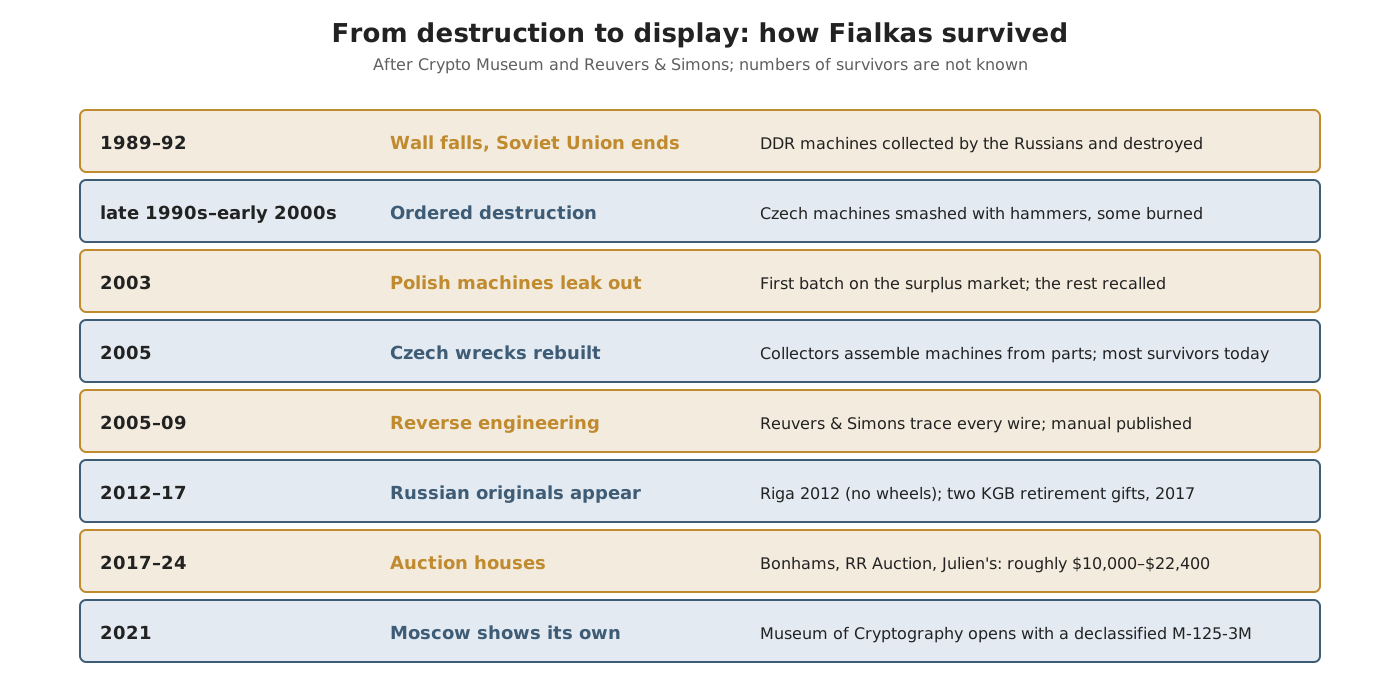
The machines had never belonged to the allies. The Crypto Museum describes the Polish and Czechoslovak Fialkas as supplied “on a lend/lease contract with the USSR”. When the Warsaw Pact dissolved in 1991 and the Soviet Union followed, Moscow wanted them back. The keys and wheel wirings had all been made in the Soviet Union, and the machines were still in Russian service. A surviving Fialka with its wheels was a reference sample of a working Russian cipher system.
The collection proceeded country by country, and each country’s survivors reflect how it went.
- East Germany. After the fall of the Berlin Wall some Fialkas surfaced briefly in the GDR, but they “were all collected by the Russians and subsequently destroyed” (Reuvers & Simons 2009, 1.1; Library copy). After reunification the National People’s Army’s machines were handed back. No East German Fialka is known to survive, and the wiring of the East German 4K wheels is unknown. What survived in East Germany was paper: the 1978 operating manual, which is now the main source on procedure (Volume 6).
- Czechoslovakia. The Czechoslovak machines were ordered destroyed, and the destruction took place between the late 1990s and the early 2000s. “Most of the machines were damaged by smashing them with a hammer and some were even burned” (Crypto Museum, Czech variant). Enough fragments escaped for collectors later to rebuild complete machines.
- Poland. The Polish machines were decommissioned and also ordered destroyed in the late 1990s and early 2000s. A very small number escaped (below).
- The Soviet Union and Russia. Russia kept its own machines in service. Moscow’s Museum of Cryptography says the M-125-3M was used by the Russian army until 2010. Its researcher Egor Efremov has said it was produced until 1991 and held in reserve until 2010 (Museum of Cryptography; Vechernyaya Moskva).
How many Fialkas were built, how many were destroyed and how many survive are all unknown.
8.3 The Survivors
8.3.1 Poland, 2003
The first Fialkas to reach the West were Polish. In 2003 a small batch of Polish M-125-3MR2 machines appeared on the European military-surplus market. Reuvers first heard of the machine that year, when someone told him “that a limited number of these machines had become available for sale” (Reuvers & Simons 2009, preface; Library copy). They were in excellent condition, well maintained, with matching wheel numbers and complete accessories. According to the Crypto Museum, “once the first batch of surplus Polish Fialka machines had hit the surplus market, the Russians intervened and collected the remaining machines, which were subsequently destroyed in Russia”. No more Polish machines have appeared since (Crypto Museum, Polish variant).
8.3.2 Czechoslovakia, 2005
From 2005 Czech survivors began to appear, mostly the remains of machines that had been smashed but not completely destroyed. Collectors rebuilt complete Fialkas from them, and most Fialkas in private hands today are Czech. Their quality varies widely, from excellent to beyond repair. Their wheels usually have unmatched serial numbers, because wheels and machines were recovered separately (Crypto Museum, Czech variant). Some rebuilds are composites. When the Deutsches Museum in Munich bought a Czech M-125 in 2018, its conservators found that “a previous owner had demonstrably assembled a Czech variant from several fragments that at first glance appeared to be coherent”. The keyboard came from several models and had been partly repainted, the metal cover had been adapted to match, and the housing showed fire damage (Deutsches Museum).
8.3.3 Hungary, 2014 and 2022
No Hungarian Fialka has been found. In July 2014, on one of their collecting trips, the Crypto Museum’s founders found in Hungary a complete, used set of adjustable wheels with matching serial numbers and the prefix 5K, and traced its wiring. A second set, prefixed 7K, turned up in Hungary in 2022 (Crypto Museum, Hungarian variant).
8.3.4 Russia, 2012 and 2017
For years Western researchers assumed that every Soviet machine had been destroyed or was still in Russian hands. Then, in 2012, a Russian M-125-3M surfaced in Riga, Latvia, in the private collection of a former KGB officer, Igor Ristolainen. Its wheels were missing. In 2017 two more appeared in Western Europe: an original Russian M-125 and an M-125-3M, each given to a high-ranking KGB officer on retirement, and both with their original PROTON-2 wheels. One went to an anonymous collector and the other to the Crypto Museum. On 23 December 2017 the museum published the wiring of the Russian wheels, which carried the series code 68. This was the first Soviet Fialka wiring to become public (Crypto Museum, Russian M-125; Russian M-125-3M). A Fialka given as a retirement present says something about how secret the machine still was in late-Soviet or post-Soviet practice, though nobody has explained the gifts.
8.4 Reverse-Engineering the Fialka
8.4.1 The first researchers
When the Polish machines appeared in 2003 there was, in Reuvers’ words, “no technical information available about this machine”. The first serious work was done in the United States. Tom Perera, a professor and collector who ran an online “virtual Enigma and Fialka museum”, and the Enigma researcher David Hamer studied the Polish machines and in 2003 became the first to recover the wiring of the Polish 3K wheels. Perera photographed every part of the machine and published the images. Their 2005 web article, “Russian Cold War Era M-125 and M-125-3MN Fialka Cipher Machines”, was the first substantial public description (Crypto Museum, Polish variant; Reuvers & Simons 2009, preface; Library copy).
8.4.2 The Crypto Museum
Paul Reuvers and Marc Simons are electronics engineers from Eindhoven in the Netherlands. Reuvers founded an embedded-software company in 1986, Simons a hardware-design company in 2000, and both had been building radios and electronics since childhood. In 2003 they founded the Crypto Museum, a non-profit foundation (Stichting Cryptomuseum) that operates as a virtual museum: a large website, open 24 hours a day, backed by a physical collection that is shown in exhibitions, lectures and partner museums. Its board and volunteers are unpaid (Crypto Museum, About). Reuvers had been “infected with the crypto-virus”, as he put it, by the Enigma, and the Fialka looked like its close relative.
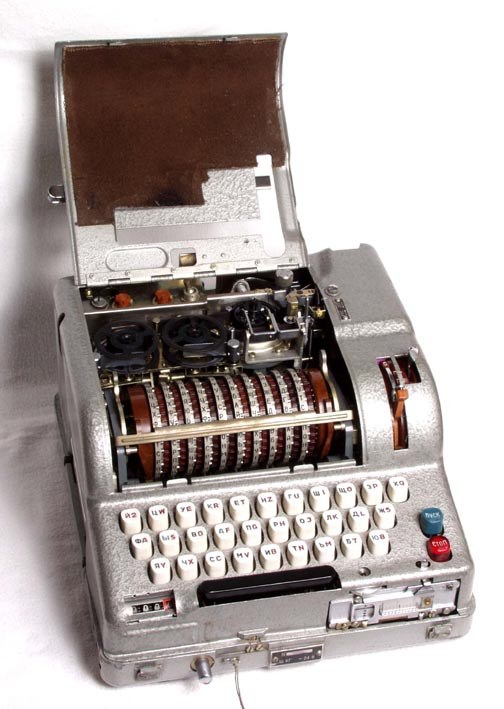
He got his first Fialka in 2005. The preface to the manual describes what he had to work with: one machine, a German operator’s manual and a badly damaged machine that he was allowed to take apart. The damaged machine was a partly disassembled drum mechanism lent by Tom Perera, and that was the breakthrough.
I subsequently spent many weekends, evenings and nights tracing each and every wire in the machine, until I finally got a good insight in the machine’s inner secrets and was able to draw the full circuit diagram.
(Reuvers & Simons 2009, preface, January 2006; Library copy.)
They published the intermediate results on the web as they went. The contacts that brought in were, Reuvers wrote, “a tremendous help”. Among them were Perera and Hamer, the former East German operator Jörg Drobick, the collector Günter Hütter and others. The result was the Fialka Reference Manual, formally Fialka M-125: Detailed description of the Russian Fialka cipher machines (Library copy), first published in 2005. Release 2.0 of 22 June 2009 runs to more than 140 pages with hundreds of drawings, photographs and circuit diagrams. It covers the history, the models, every mechanical and electrical part, the Russian markings, the accessories, the wheel sets with their wiring, repair, how the East German Army set its keys, and how to make key cards. It was sold in print for €55. On 6 January 2021, “to provide a little support in these difficult corona times”, the museum made it free to download (Crypto Museum, Fialka Reference Manual). Addenda followed on the Polish TEMPEST power supply and, after 2014, the Hungarian wheel wiring.
The museum’s Fialka pages have kept growing since. Its “recent changes” list includes the discovery of the original Russian machines and their wiring in December 2017, and a circuit diagram of the TEMPEST power supply in December 2024. Nearly every fact in this series about the Fialka’s hardware traces back to that work. It is unusual in the history of cryptography for a Cold War cipher machine to be documented almost entirely by private individuals, decades before the state that built it said anything.
8.4.3 The manuals
The operating manual came out of East Germany. The National People’s Army’s A 040/1/321 — M-125 Nutzung of 1978, a secret document in its day, survived the end of the GDR (Volume 6). Its scan was published by the Crypto Museum, a retyped German edition by Jörg Drobick on his website about the GDR’s cipher service, SAS- und Chiffrierdienst, and an English translation by the British enthusiast Jerry McCarthy. Polish and Czech documents have surfaced in fragments, among them the checklist of a Czechoslovak machine reproduced by Perera. No Soviet manual has been published.
8.4.4 Wiring, simulators and reproductions
Once the wiring was known, simulators followed. The Ukrainian programmer Vyacheslav Chernov wrote a graphical simulator for Windows that emulates all known models and country variants, with fixed and adjustable wheels. Its version 5.16 is dated 24 October 2014. The Slovak researcher Eugen Antal wrote a Java simulator. To help others, the Crypto Museum published the wirings and blocking-pin positions in July 2014 as XML files for simulator authors, later adding the Russian wiring (Crypto Museum, Fialka index). Volume 9 surveys these simulators and builds on them.
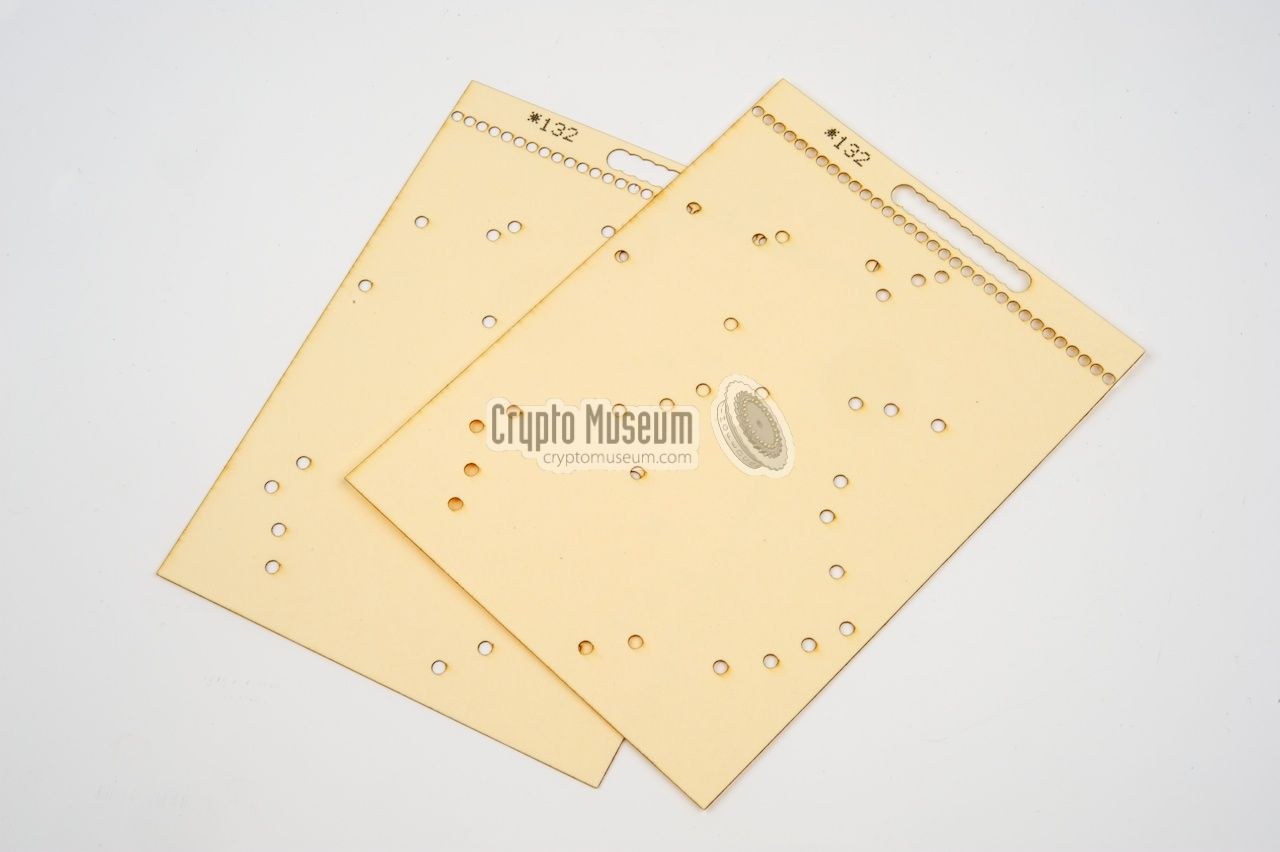
A Fialka without a key card cannot be used, apart from the test triangle that wires the reader straight through, and almost no original cards survive. Collectors therefore make reproductions. The Crypto Museum shows cards made by Günter Hütter and by Marc Sims, and publishes an accurate drawing of the card for anyone who wants to make their own (Crypto Museum, key card).
8.5 Declassification
Strictly speaking, the Fialka was never declassified in the West, because nothing about it had ever been officially published there. In Russia the position changed slowly. In 2009 Reuvers wrote that the machine “still isn’t officially declassified by the Russian authorities”. Foreign Policy reported in 2019 that “Russia did not declassify information about the machine until 2005” (Borshchevskaya 2019). That probably confuses the date when information first became public in the West with an official act. No Russian declassification decision of 2005 has been found.
The clear Russian step came with the Museum of Cryptography in Moscow. It was established by the Avtomatika concern in the buildings of the old Marfino institute (Volume 2) and opened in December 2021. According to Efremov, the Fialka was declassified “specially for the opening of the Museum of Cryptography in 2021”. The museum shows an original M-125-3M made in 1979, with its power supply, and describes itself as “the only place in Russia” where an original of the model is openly displayed (Museum of Cryptography; Metro, 15 November 2021). The museum’s account, naming the designer Nikolai Gyrdymov and the plants that built the machine, is the first Russian institutional history of the Fialka. Volume 2 draws on it.
8.6 Where to See One
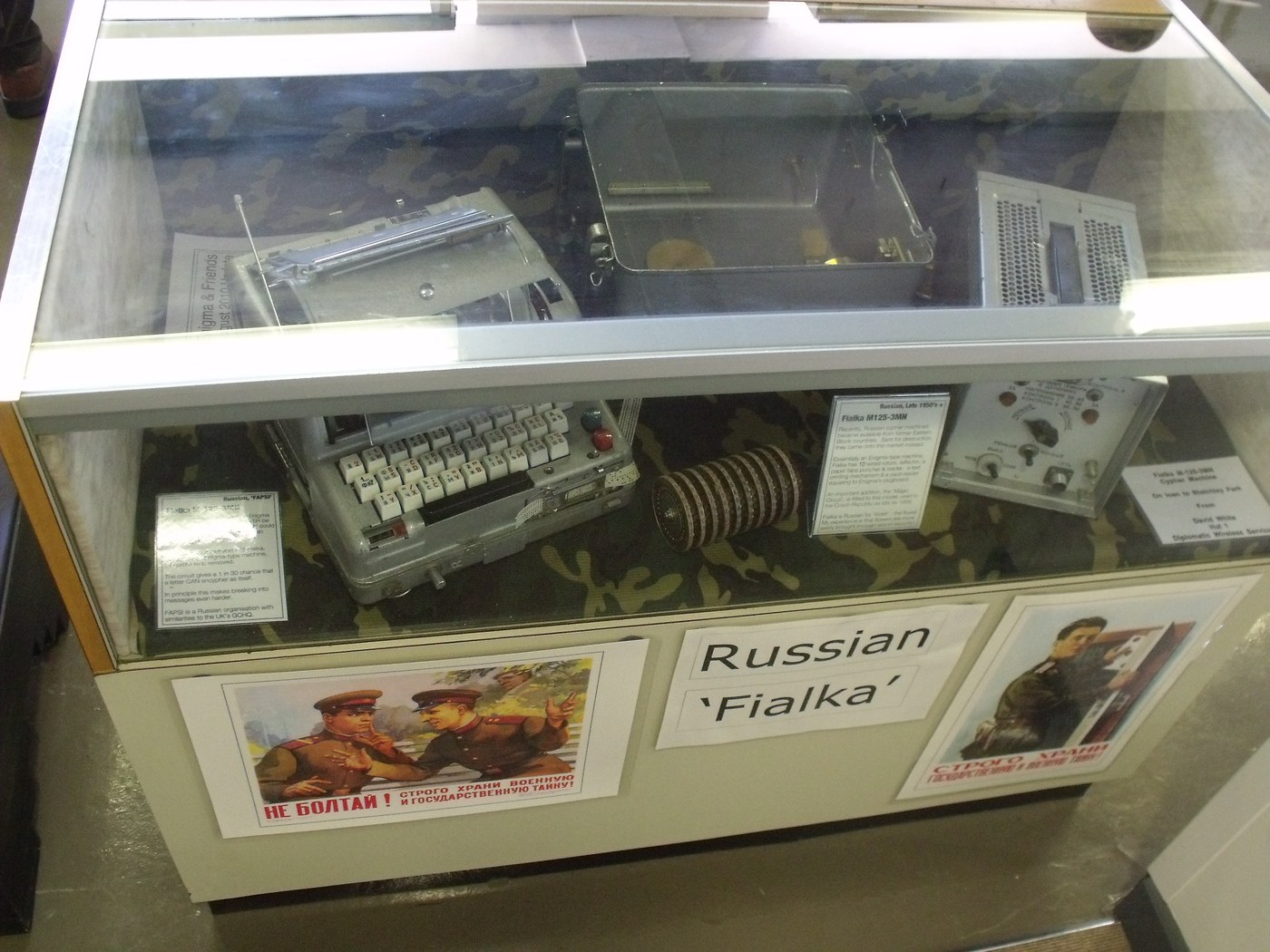
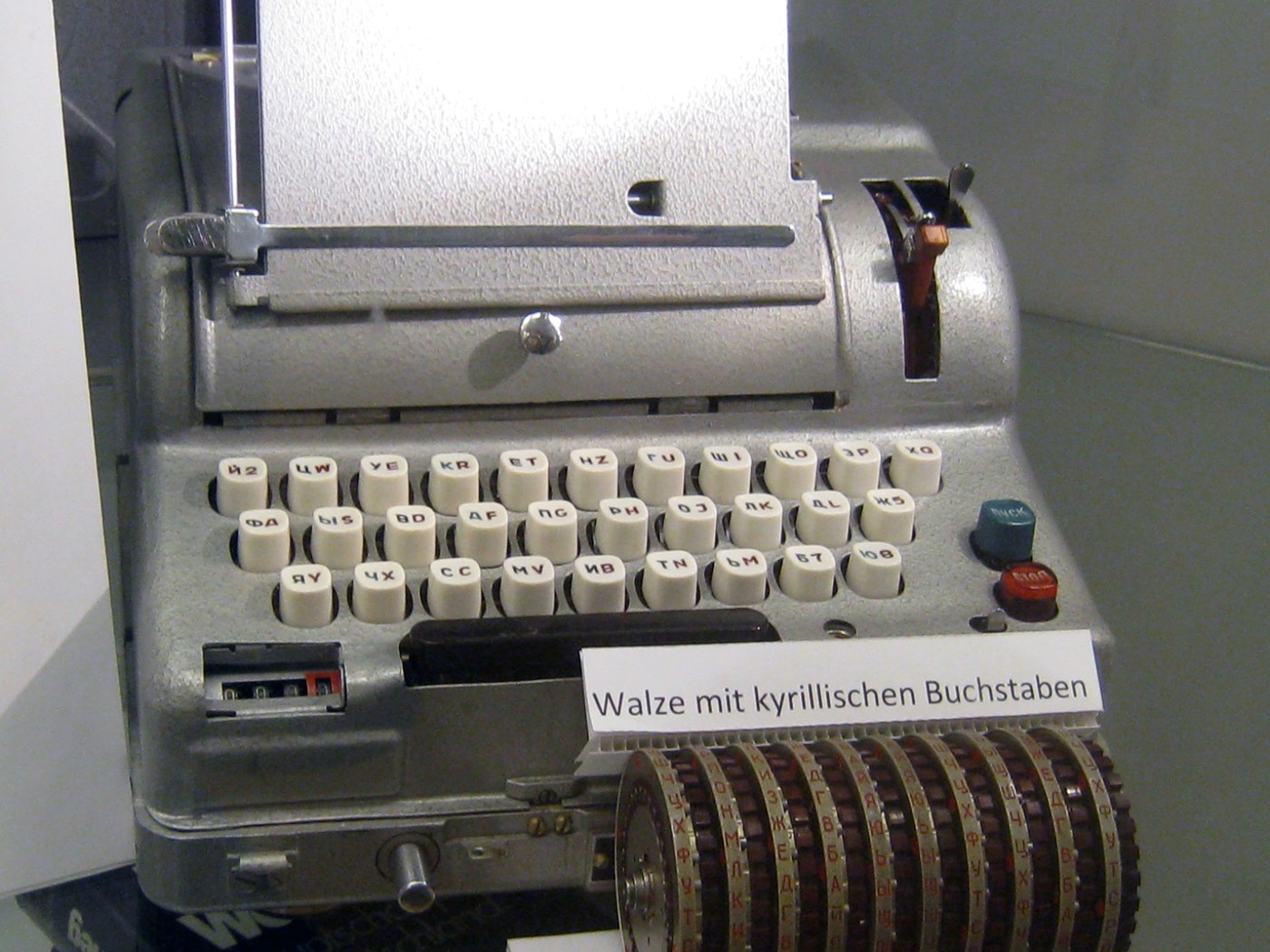
Fialkas are now on display in many museums. The list below gives those confirmed by the museums themselves or by dated photographs. Displays change, so check before visiting.
Table 1 — Where to See One
| Museum | Place | What | Source |
|---|---|---|---|
| Museum of Cryptography | Moscow | Original Soviet M-125-3M (1979) with power supply | Museum website |
| National Cryptologic Museum | Fort Meade, Maryland | M-125; lent in 2011 to the US Air Force ISR Agency heritage centre, Lackland AFB, Texas, where it was shown beside an Enigma and a SIGABA | US Air Force, 2011 |
| Bletchley Park | Bletchley, UK | M-125-3 with power supply in the Block B exhibition | Photograph, 2010 |
| Science Museum Group | UK (in the collection; display not confirmed) | 10-rotor Fialka with Cyrillic characters and spare wheel set (object 2011-114), dated “after 1958” | Collection online |
| Deutsches Museum | Munich | Czech M-125, composite rebuild, bought 2018 and restored; 3D-printed keyboard set made for display | Museum website |
| Deutsches Spionagemuseum | Berlin | Polish M-125-3 | Museum website |
| Heeresgeschichtliches Museum | Vienna | Fialka with wheel set | Photographs, 2018 |
| NVA Museum Harnekop | Brandenburg | Jörg Drobick’s machine | Photograph, 2007 |
| Festungsmuseum Reuenthal | Switzerland | Fialka with spare wheels | Photograph, 2014 |
| Crypto Museum | Eindhoven (virtual; shown at exhibitions) | Several, including Russian, Polish and Czech machines | Museum website |
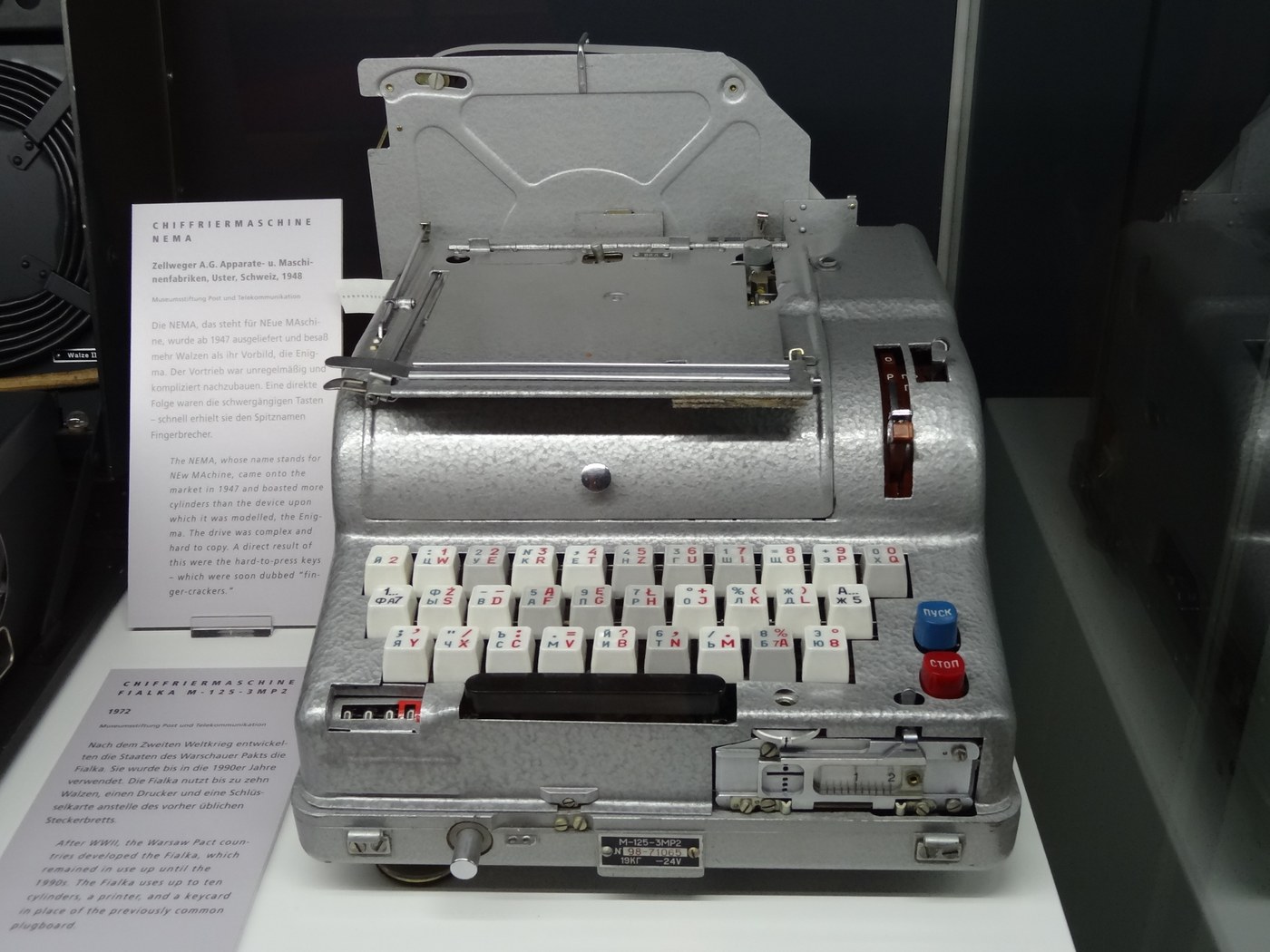
The 2011 American display is worth a note. The US Air Force’s intelligence history office borrowed an M-125 from the NSA’s National Cryptologic Museum and unveiled it on 22 September 2011. It stood beside an Enigma and a SIGABA, and staff claimed that no other public museum showed all three (US Air Force, 2011). The NSA’s museum had owned a Fialka long enough to lend one. When and how it acquired it has not been published.
The short-lived KGB Espionage Museum in New York, which opened in 2019, displayed an M-125-3M that Foreign Policy described as one of the first shown anywhere. The museum closed in 2020 during the pandemic. Its collection was auctioned in February 2021, and the Fialka sold for $22,400 against an estimate of $8,000–12,000 (The Register, 17 February 2021).
8.7 The Collector Market
A Fialka is a rare but not impossible purchase. Results from the major auction houses for complete machines, as published on their lot pages and as read in November 2026, include:
Table 2 — A Fialka is a rare but not impossible purchase. Results from the major auction houses for complete machines, as published on their lot pages and as read in November 2026, include
| Date | Auction house | Description | Price (with premium) |
|---|---|---|---|
| December 2017 | Bonhams, New York | M-125 Fialka | $10,000 |
| July 2020 | RR Auction, Boston | Russian Fialka M-125 | $22,000 |
| December 2020 | Bonhams, London | M-125 Fialka | £7,012.50 |
| February 2021 | US auction (KGB Espionage Museum collection) | M-125-3M with accessories | $22,400 |
| May 2023 | RR Auction, Boston | Fialka M-125 | $18,750 |
| September 2024 | Bonhams, London | Fialka M-125 with power supply | £8,960 |
Sources: Bonhams and RR Auction lot pages; The Register, 2021. Auction descriptions are not always reliable about the model.
Prices therefore run from roughly $9,000 to $22,000. Condition and completeness make the difference. What matters is a working machine, a full set of wheels (ideally with matching numbers, and better still both sets), the power supply, the dust cover and its accessories, and paperwork. Buyers should expect most machines to be Czech rebuilds and should check the points in Volume 5: keyboard style, wheel series and serial numbers, and signs of a composite. Original key cards are almost never included. The metal triangle usually is, and reproduction cards are available. Wheel sets and power supplies also appear on their own, and the TEMPEST power supply is the rarer of the two.
8.8 What Is Still Missing
The Fialka is now well documented as an object and still poorly documented as a piece of history. Several things are missing. There is no Soviet design history. No Soviet operating manual has been published, and of the national manuals only the East German one survives in full. The wiring of the East German, Bulgarian, Romanian and Cuban wheels, if they existed, is unknown, and so is the meaning of the model suffixes. Nothing has been published on how many were made. Above all, nothing from any intelligence service, East or West, says what the other side knew about it (Volume 7).
Moscow’s museum shows that some of this could change. A machine declassified for an exhibition in 2021 may be followed by documents. Until then the Fialka’s history rests on survivors, a few manuals and the patient work of collectors.
Sources
- Paul Reuvers and Marc Simons, Fialka M-125: Detailed description of the Russian Fialka cipher machines (Library copy), v2.0, 22 June 2009, preface and chapter 1, PDF; “Fialka Reference Manual 2.0” page, cryptomuseum.com.
- Crypto Museum, Fialka pages (index, Polish, Czech, Hungarian, Russian M-125 and M-125-3M, key card) and “About us”, cryptomuseum.com (read November 2026).
- Museum of Cryptography, Moscow, M-125-3M object page, cryptography-museum.ru; interview with Egor Efremov, Vechernyaya Moskva; Metro, 15 November 2021.
- US Air Force ISR Agency, “AFISRA debuts one-of-a-kind cryptologic display”, September 2011, af.mil.
- Deutsches Museum, “Objektgeschichten historischer Chiffriergeräte”, deutsches-museum.de.
- Deutsches Spionagemuseum, “The M-125-3 Fialka cipher machine”, deutsches-spionagemuseum.de.
- Science Museum Group, “‘Fialka’ Cipher machine (10 rotor) with Cyrillic (Russian) characters”, object 2011-114, collection.sciencemuseumgroup.org.uk.
- Anna Borshchevskaya, “The Soviets’ Unbreakable Code”, Foreign Policy, 27 April 2019.
- The Register, “Soviet ‘Enigma’ cipher machine sells for $22k at collapsed museum’s exhibits auction”, 17 February 2021, theregister.com.
- Auction results: Bonhams lots 24254/1260 and 29857/8; RR Auction lots 342939405882126 and 347318406842224.
- Tom Perera and David Hamer, “Russian Cold War Era M-125 and M-125-3MN Fialka Cipher Machines” (2005), w1tp.com.
Next — Volume 9: Building a Fialka — Simulator and Replica Options. The simulators that already exist, from Chernov’s Windows program to browser versions; the published wirings and blocking-pin tables that any build must match; this series’ own simulator and the checks it passes; and the routes to a physical Fialka, from 3D-printed wheels with real contacts to a microcontroller that drives thirty-letter wheels, a card reader and a printer.
Comments (0)