Fialka · Volume 5
Fialka — Volume 5 — Models and Variants
The M-125 and the M-125-3, how to tell them apart, the national versions for the Soviet Union, Poland, Czechoslovakia, East Germany and Hungary, their keyboards and print heads, the two generations of wheels and the wheel-series codes, the standard and TEMPEST power supplies, and the accessories that came in the box.
5.1 About This Volume
“Fialka” names a family of machines, not a single one. There were two basic models, the original M-125 and the later M-125-3. Each came in national versions for different countries, with different keyboards, print heads and wheel wiring. There were two generations of wheels, two power supplies and a long list of accessories. Survivors have usually lost their badges, their wheels have often been swapped, and some have been rebuilt from the parts of several machines, so knowing which machine is which takes some care.
This volume sorts them out. It relies mainly on the Crypto Museum’s survey of surviving machines, on the 1978 East German operating manual, and on Paul Reuvers and Marc Simons’ reference manual. Much of the designation scheme has been reconstructed from the outside, and the sources do not always agree. Where they do not, this volume says so. The mechanism shared by all the models is described in Volumes 3 and 4.
5.2 Two Machines on One Chassis
The M-125 is the original machine, in service from about 1956 (see Volume 2 for the uncertainty over the date). It enciphers letters only. Every message had to be written out in thirty letters, so figures were spelled in words. The Crypto Museum’s example for a German message is dreisieben for 37. Its wheels have their wiring built in and cannot be changed in the field (Crypto Museum, M-125).
The M-125-3 followed in the late 1960s and, according to Moscow’s Museum of Cryptography, entered Soviet Army service in 1970 as the M-125-3M (Museum of Cryptography). It is built on the same chassis and its cipher path is the same. What changed was the handling of text. The “3” in the designation, according to the Crypto Museum, stands for its three modes of operation:
- Letters only, exactly as on the M-125.
- Numbers only, for enciphering groups of figures, typically messages already encoded from a code book. A switch marked “30 ↔ 10” cuts the alphabet down to ten characters.
- Mixed, with a letter shift and a figure shift like a teleprinter’s, so that letters, figures and punctuation could be sent together.
The two models could still work together. In letter mode, an M-125-3 set up with the same key as an M-125 produced the same cipher text. The East German manual allows “cooperation” between its M-125-3MN and M-125-MN machines provided that both used the same key setting and the plain text had been written out in letters only (NVA, A 040/1/321, 1978, sec. 2.1.1; Library copy). From 1978 the M-125-3 was normally issued with the new adjustable wheels described below. With their cores set to a neutral position they matched the old fixed wheels, so the two generations could still interwork.
5.2.1 Telling them apart
The quickest test is the keyboard.
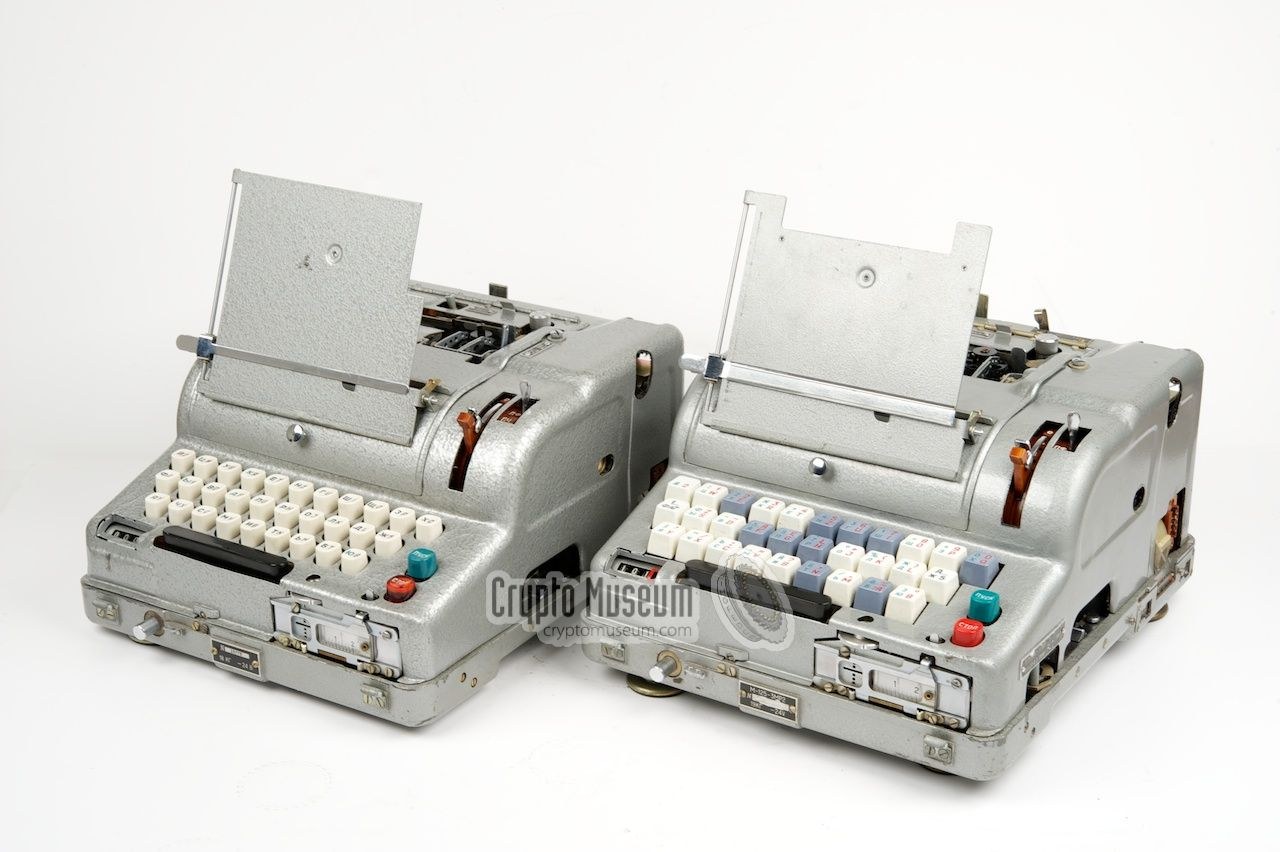
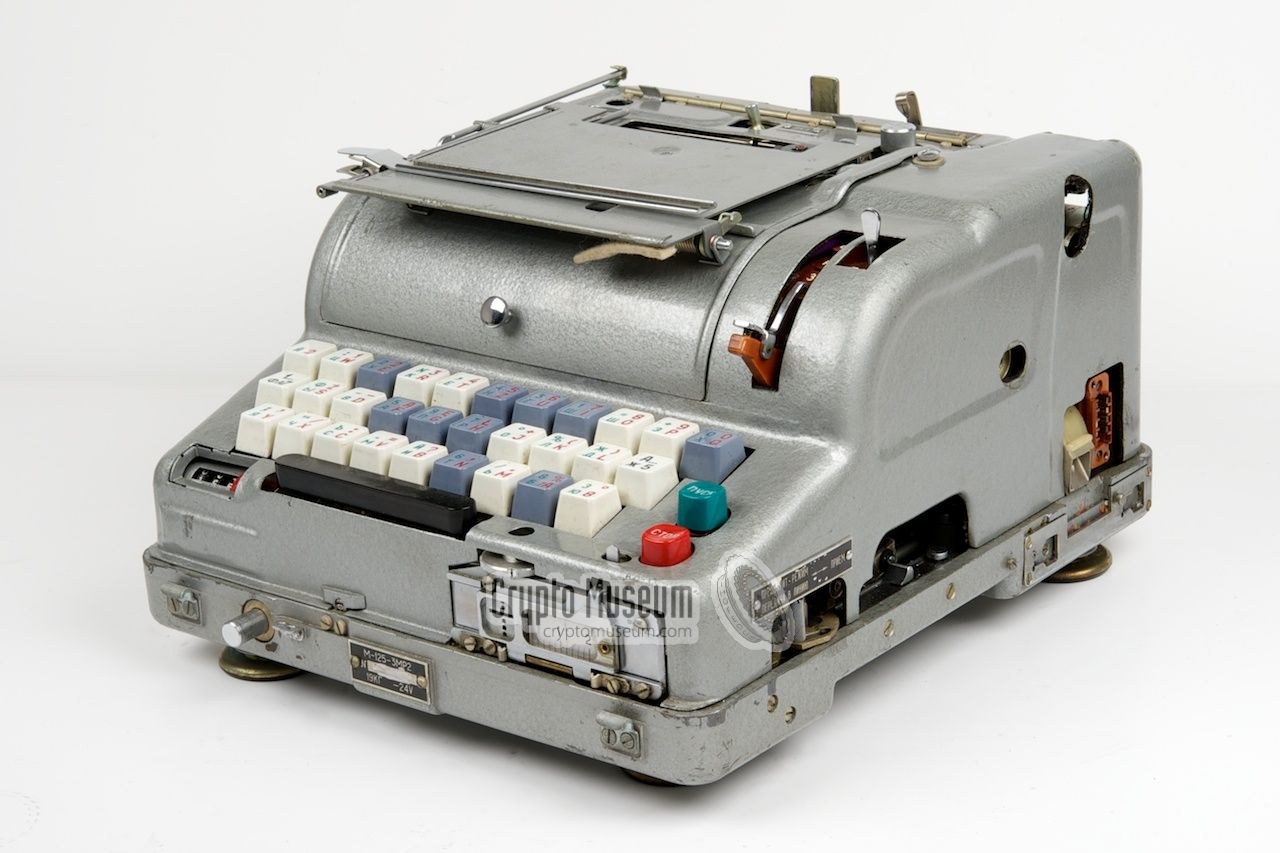
- M-125: rounded key tops. On the bilingual export machines each key carries two letters, a Cyrillic one and a Latin one printed in red. A switch on top of the machine selects which alphabet the print head uses.
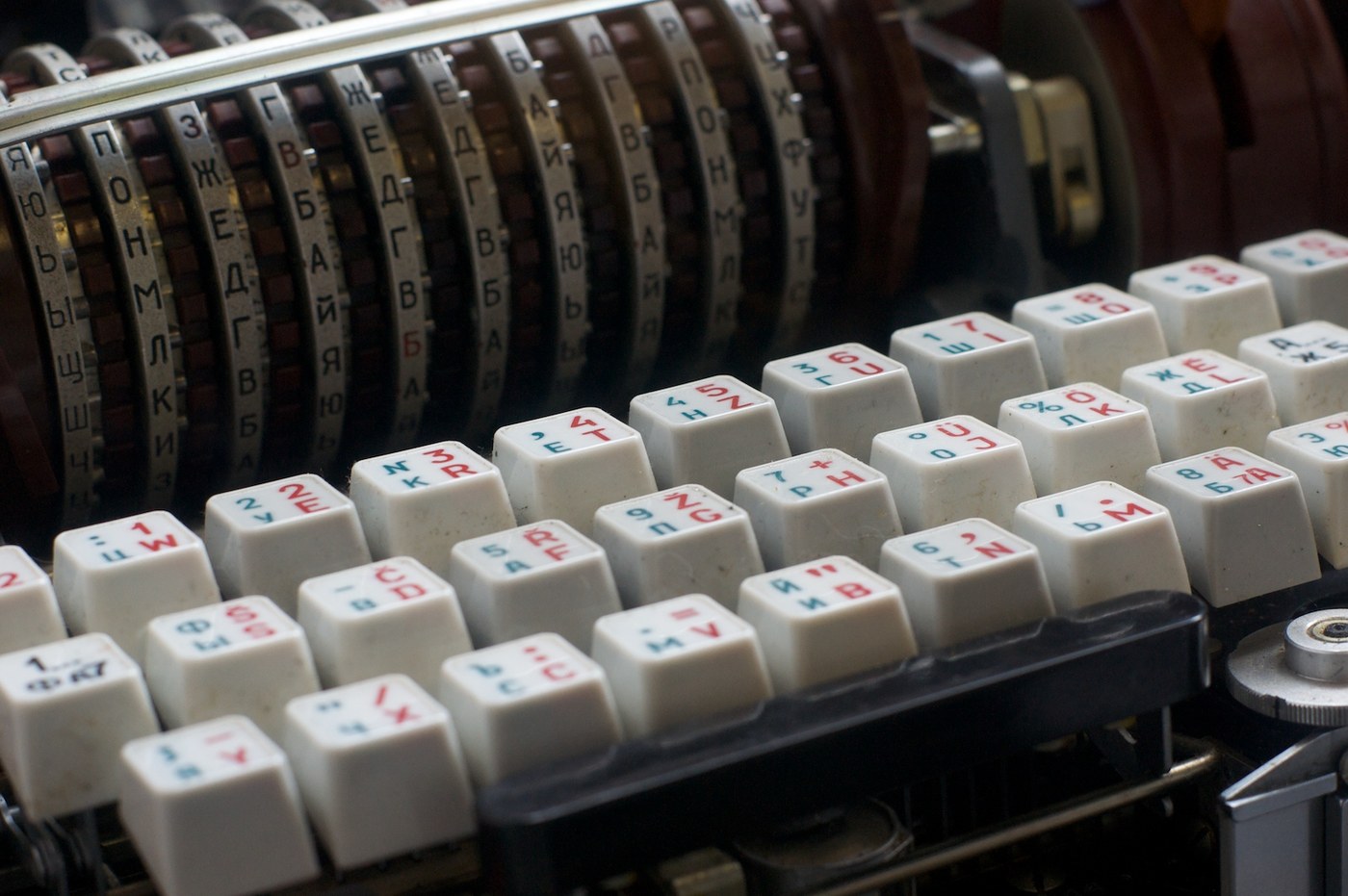
- M-125-3: square key tops, each carrying up to four characters, a Cyrillic and a Latin letter at the bottom and their figure-shift characters above. The keys used in numbers-only mode are in a darker colour. There is an extra mode selector at the rear, behind the printer.
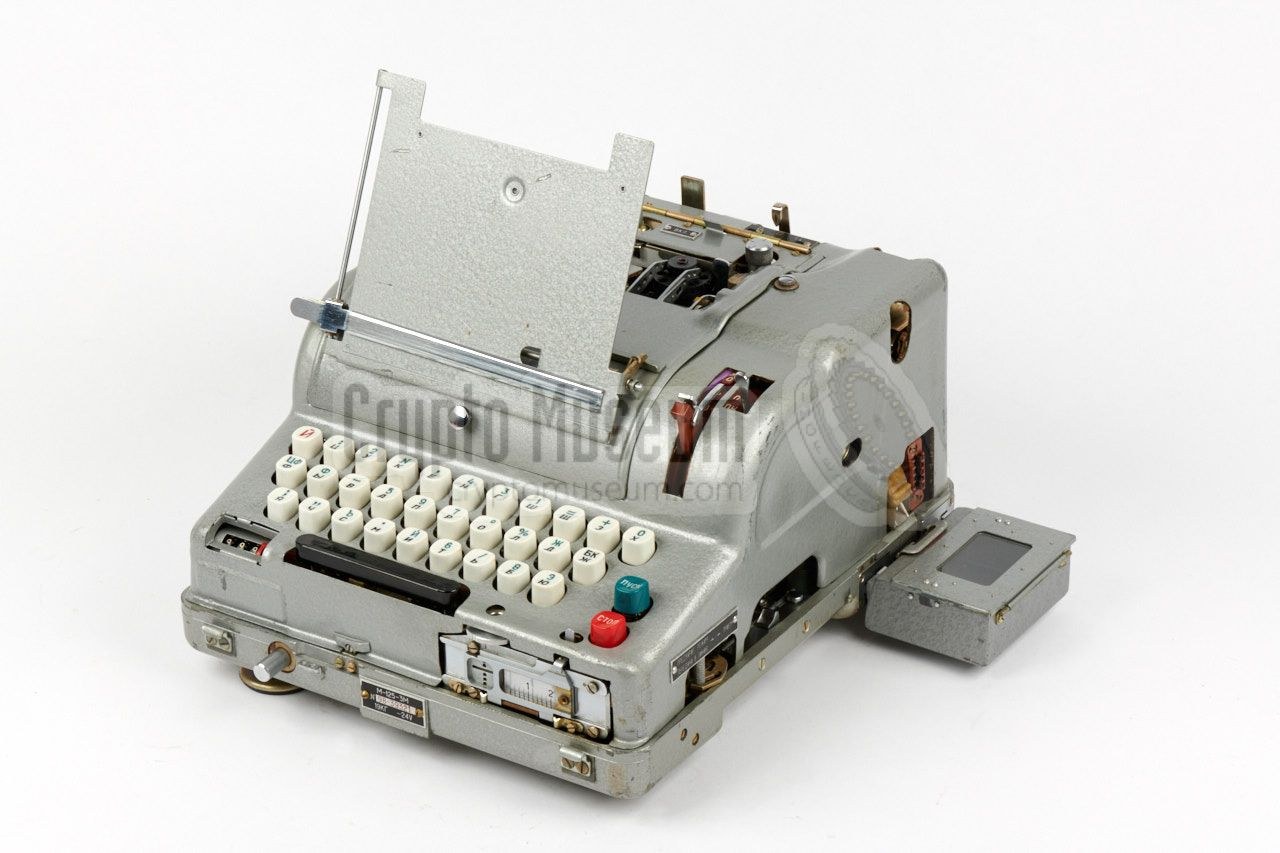
The exception is the Soviet Union’s own Russian-only M-125-3M. It has rounded keys like the old model, because it does not need room for a second alphabet. A machine with rounded keys and only Cyrillic characters is therefore either a Russian M-125 (one letter per key) or a Russian M-125-3M (a letter and a figure-shift character per key) (Crypto Museum, Fialka index).
The serial number was stamped on a badge below the keyboard. On most surviving machines the badge was removed during demilitarisation. The number is also stamped on several internal parts: the frame beside the entry disc, the hinge or inside of the top lid, the strip under the keyboard, the printer, the motor and the paper feed. It also appears on the dust cover and on the lid of the wooden transport box. A collector can usually recover it by taking off the top cover (Crypto Museum, M-125-3).
5.3 The Designations
Soviet practice added letters to the basic number to identify a version. Western researchers know the designations from markings on surviving machines and boxes, from checklists and from the East German manual. They do not know what the suffix letters mean. The Crypto Museum’s current table is the best summary.
Table 1 — The Designations
| Designation | Model | Keyboard | Country |
|---|---|---|---|
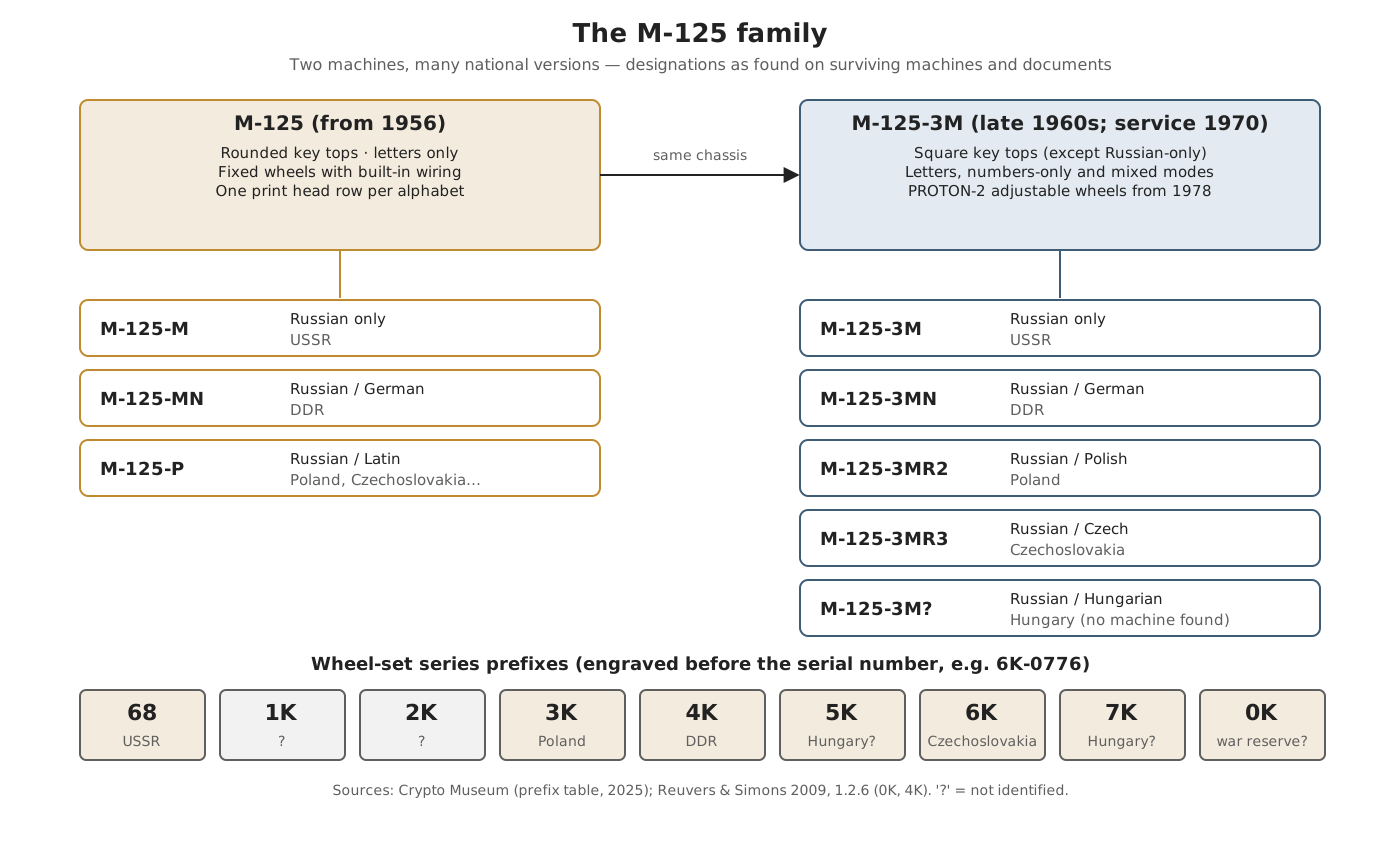
| M-125-M | M-125 | Russian only | USSR |
| M-125-MN | M-125 | Russian / German | East Germany (DDR) |
| M-125-P | M-125 | Russian / Latin | Poland, Czechoslovakia and others |
| M-125-3M | M-125-3 | Russian only | USSR |
| M-125-3MN | M-125-3 | Russian / German | East Germany (DDR) |
| M-125-3MR2 (М-125-3МР2) | M-125-3 | Russian / Polish | Poland |
| M-125-3MR3 (М-125-3МР3) | M-125-3 | Russian / Czech | Czechoslovakia |
| unknown | M-125-3 | Russian / Hungarian | Hungary |
Source: Crypto Museum, Fialka index and variant pages, read November 2026.
Two traps need flagging. First, the Polish and Czech suffixes appear in some places as “MP2” and “MP3” and in others as “MR2” and “MR3”. The markings are in Cyrillic, and the Cyrillic letter Р is the Latin R, though it looks like a Latin P. The Crypto Museum’s own pages use both forms. This series writes M-125-3MR2 and M-125-3MR3, the transliteration of the Cyrillic. Second, the East German manual calls its machines “M-125-3MN” and “M-125-MN”. The “N” suffix almost certainly marks the German-language version, but nothing published says so explicitly (NVA 1978, sec. 2; Library copy).
5.4 The National Versions
All the national versions shared the same chassis, internal wiring, controls and Cyrillic keyboard layout. Each country’s version differed in three ways: the Latin letters on its keyboard, its print head, and the wiring of its wheels. Because the thirty Cyrillic characters were in the same places everywhere and the Russian alphabet carried no national punctuation, any two machines could exchange Russian-language traffic if they were fitted with the same wheels. That was how, in principle, the alliance could communicate in war (Crypto Museum).
5.4.1 Soviet Union
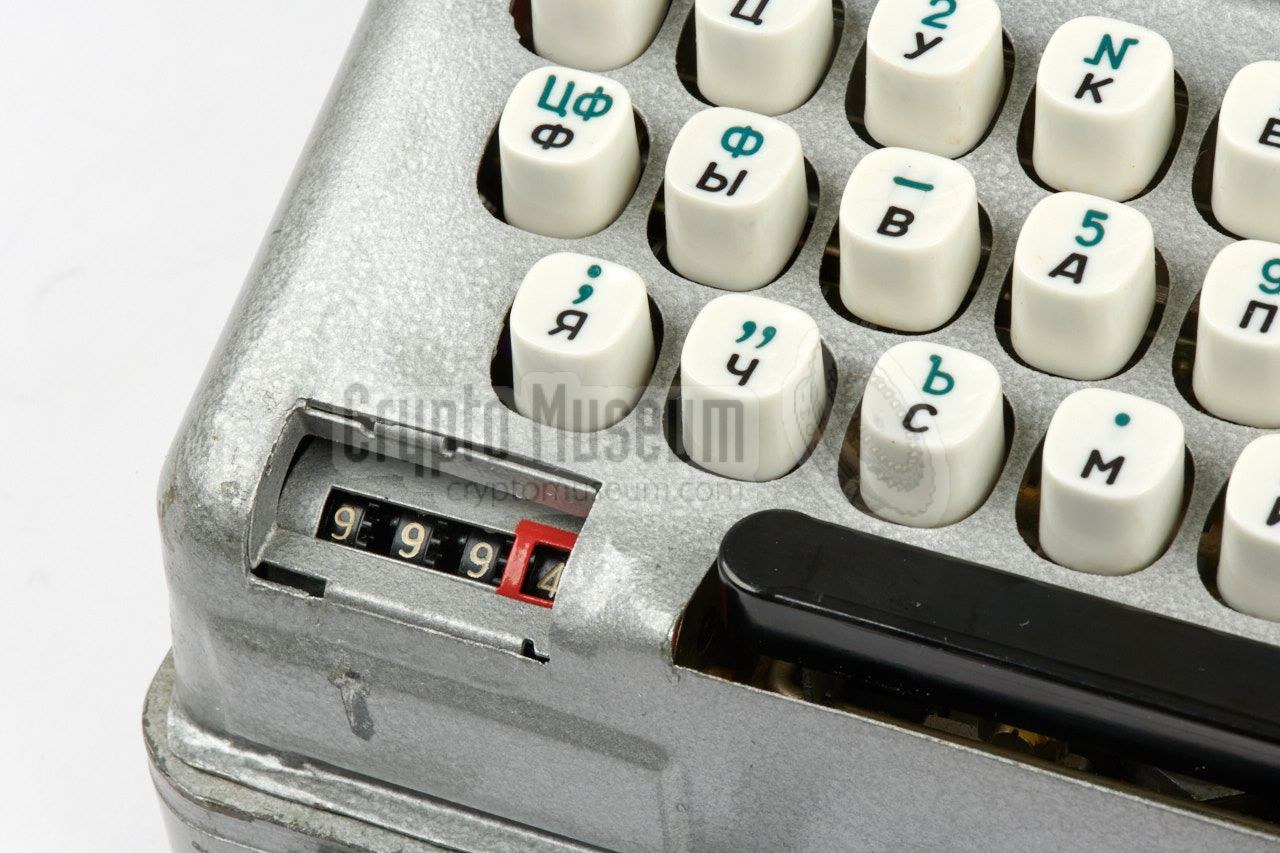
The Soviet machines are the originals, and for many years Western researchers believed none had survived. A Russian M-125-3M without its wheels surfaced in 2012 in the private collection of a former KGB officer in Riga. In 2017 two more turned up in Western Europe, an M-125 and an M-125-3M, both reportedly given to senior KGB officers on retirement. Both still had their original wheels, so their wiring could finally be recorded. The Russian-only M-125 has a single Cyrillic letter on each key. Its type wheel carries only the thirty Cyrillic letters, and there is no alphabet switch. The key at the top left, Й, is printed in red, because it shares its function with the space bar. It cannot be used in plain text, only in cipher text, and it is blocked in cipher mode.
The Crypto Museum lists the Soviet machines’ users as the armed forces, the police, the KGB and other intelligence services. Moscow’s Museum of Cryptography says the M-125-3M served the Soviet and then the Russian army and was used until 2010. The museum’s Egor Efremov has said it was produced until 1991 and held in reserve until 2010 (Crypto Museum, Russian M-125; Russian M-125-3M; Vechernyaya Moskva). The Crypto Museum believes the same Russian machines, with the same wheel wiring, were also used in the other Soviet republics.
5.4.2 Poland
The Polish M-125-3MR2 carried the Polish Latin alphabet with its special letters alongside the Cyrillic, plus a Polish print head. Its wheels are engraved with the series code 3K. Polish machines were the first Fialkas to reach the West. A small batch appeared on the European surplus market in 2003, and that year David Hamer and Tom Perera became the first to recover the wiring of the Polish 3K wheels. They are generally the best-preserved survivors, with matching wheel serial numbers and complete accessories, which the Crypto Museum credits to good Polish maintenance. After the first batch, the Crypto Museum reports, the Russians intervened and collected the remaining Polish machines, which were destroyed in Russia. No more have appeared since (Crypto Museum, Polish variant).
On the Polish M-125-3 keyboard the Cyrillic letter is at the bottom left of each key and the Polish letter at the bottom right. Above them are the characters reached with the letter-shift key in mixed mode, Russian on the left and Polish on the right. In numbers-only mode only the darker keys were used, with the figures printed by the Cyrillic print head.
Poland is also the only country besides the Soviet Union known to have used the TEMPEST power supply described below.
5.4.3 Czechoslovakia
The Czechoslovak M-125-3MR3 is electrically identical to the Polish machine. It has a Czech keyboard layout, its own print head, and wheels of the 6K series. Czechoslovak machines came with the standard power supply, not the TEMPEST one. After the Soviet Union collapsed they had to be destroyed, and the Crypto Museum reports that most were smashed with hammers and some burned, in the late 1990s and early 2000s. Enough wreckage survived for collectors to rebuild complete machines from the parts. Most Fialkas in private hands today are Czech machines that reached the surplus market from 2005. Their wheels seldom have matching serial numbers, because they had to be recovered separately (Crypto Museum, Czech variant). The Deutsches Museum in Munich, which bought a Fialka in 2018, found on examination that a previous owner had assembled its “Czech” machine from fragments of several. Its keyboard came from several models and had been partly repainted (Deutsches Museum).
5.4.4 East Germany
No East German Fialka is known to survive. After reunification in 1990 the National People’s Army’s machines were returned to the Soviet Union and destroyed. Even so, the East German version is in some ways the best documented, because its operating manual has survived. The manual is A 040/1/321, in force from 1 December 1978 and covering the M-125-3MN and M-125-MN. From it, with help from former operators, the Crypto Museum has reconstructed the keyboard. The key at the top left, shared with the space bar, carries a German J next to the Russian Й. In German, J can be replaced by I without losing the sense. The manual gives the wheel series as 4K. The wiring is not known. The Crypto Museum lists the confirmed East German users as the army, the police and the state railway, the Reichsbahn (Crypto Museum, DDR variant).
The manual makes clear how the two alphabets were meant to be used. A machine fitted with the Latin print head could process German text in letters-only or mixed mode. Fitted with the Cyrillic head, it processed Russian text or numbers-only text. A table converted stray Latin letters in a Russian text (and vice versa) to their counterparts, marked with the service codes “RUS” or “ЛАТ” (NVA 1978, sec. 3.1; Library copy).
5.4.5 Hungary
No Hungarian machine has been found, and its keyboard layout is unknown. In July 2014 the Crypto Museum found a complete, used set of adjustable wheels in Hungary with matching serial numbers and the prefix 5K, and traced their wiring. In 2022 another set, with the prefix 7K, was found there too. At least one of the two series was presumably Hungarian, but which one is not known (Crypto Museum, Hungarian variant).
5.4.6 Bulgaria, Romania, Cuba and others
The Crypto Museum believes that Fialkas went to every Warsaw Pact member: the Soviet Union, Albania (which effectively left the Pact in 1961 and formally in 1968), Bulgaria, Czechoslovakia, East Germany, Hungary, Poland and Romania. It also lists Cuba, as “likely but not certain”. No machines, wheels or documents from Bulgaria, Romania, Albania or Cuba have been published. Russian sources mention supplies to “friendly socialist countries, including Cuba” without detail. These countries are presumably behind the unidentified wheel series 1K and 2K, which have never been seen, and perhaps 7K.
5.5 Wheel Series
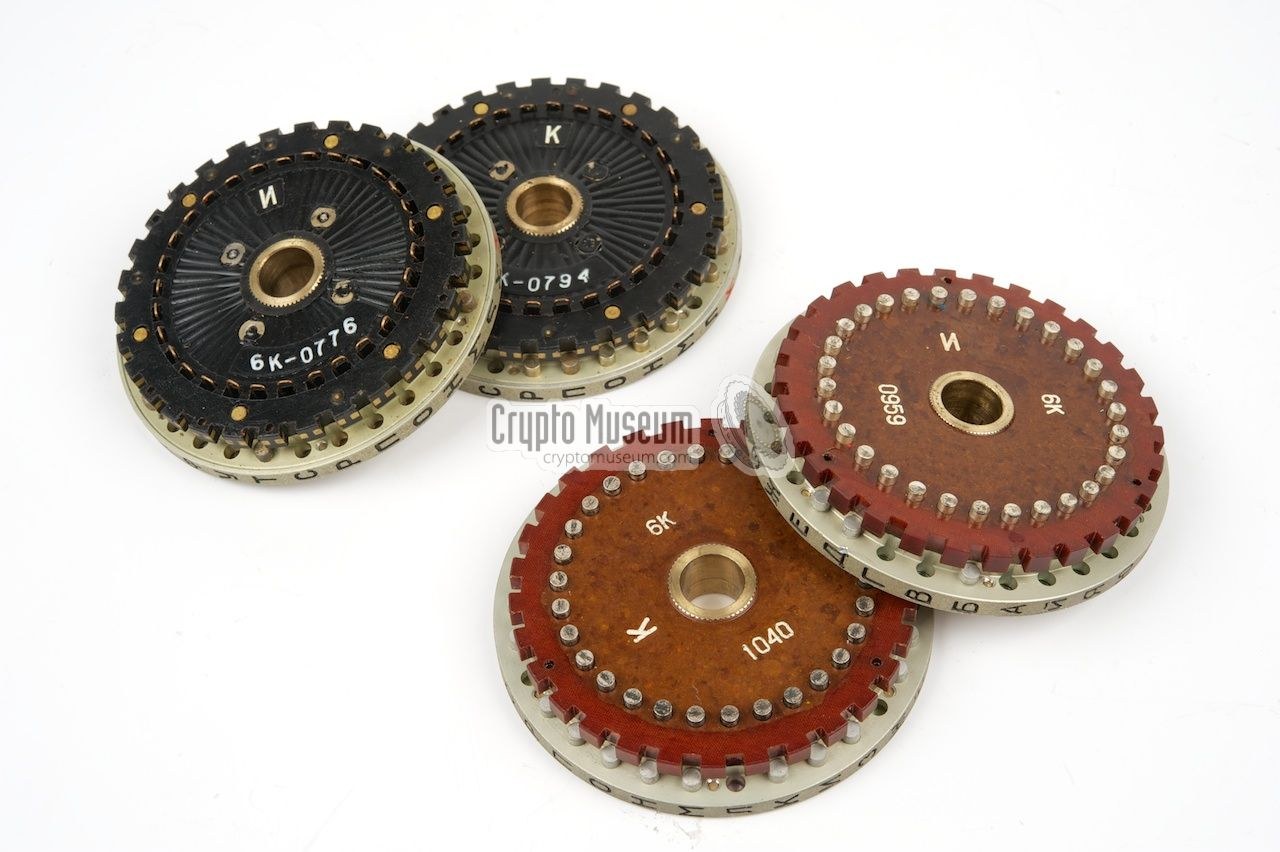
Each country’s wheels were wired differently, and each wheel carries a series code and serial number engraved on its side, for example 6K-0776. The code identifies the wiring. The known codes, as the Crypto Museum gives them in 2025, are:
Table 2 — Each country's wheels were wired differently, and each wheel carries a series code and serial number engraved on its side, for example 6K-0776. The code identifies the wiring. The known codes, as the Crypto Museum gives them in 2025, are
| Prefix | Country | Status |
|---|---|---|
| 68 | Soviet Union | Found (2017); wiring recovered |
| 1K | ? | Never seen |
| 2K | ? | Never seen |
| 3K | Poland | Found; wiring recovered |
| 4K | East Germany | Known only from the 1978 manual |
| 5K | ? (found in Hungary, 2014) | Wiring recovered |
| 6K | Czechoslovakia | Found; wiring recovered |
| 7K | ? (found in Hungary, 2022) | Found |
Reuvers and Simons’ 2009 manual gives 1K as the Russian prefix and reports that a common 0K series would have been issued to all Warsaw Pact countries in war. Neither claim is confirmed by a surviving wheel. The Russian machines found in 2017 carried 68-series wheels (Reuvers & Simons 2009, 1.2.6; Library copy; Crypto Museum). The wirings that have been recovered, together with the positions of every blocking pin, are published by the Crypto Museum as tables and as XML files for simulator writers. The simulator in Volumes 9 and 10 uses them.
Each machine came with two complete sets of wheels with identical wiring and serial numbers. The working set had its rim letters painted black. The spare set had red letters and was kept in an aluminium can inside the dust cover. A spare set meant the machine could keep working if a wheel was damaged, and it let an operator prepare the next key on one set while the other was still in use.
5.6 Two Generations of Wheels
The fixed wheels supplied with the M-125 from the start, and with the first M-125-3s, are brown Bakelite with a fibre-reinforced outer ring. They have thirty disc contacts on the left face, thirty spring-loaded pins on the right, and their blocking pins round the rim. Their wiring is fixed.
In 1978 a new set appeared, the PROTON-2 wheels. Each has a removable wiring core inside an outer body that carries the letter ring and the blocking pins. The core can be taken out, turned over so that its wiring runs the other way, rotated to any of thirty positions against the letter ring, and fitted into any of the ten bodies. The daily key now specified not only the order of the wheels but which core went into which body, which way round and at what offset. Volume 6 shows a daily key table for these wheels, and Volume 3 the mechanics. The Crypto Museum has found PROTON-2 wheels in both Bakelite and plastic.
The East German manual introduced its new procedure with the new wheels on 1 December 1978. The Crypto Museum’s overview gives “mid-1970s” for their introduction and its wheel page gives 1978. This series uses 1978, the date the procedure changed in at least one country. All surviving M-125s have been found with fixed wheels. The new wheels fit them, but no evidence has been found that they were used in the older machines (Crypto Museum, wheels).
5.7 Print Heads
The Fialka prints with a rotating type wheel that carries one or two rows of characters. A lift mechanism selects the row. A bilingual machine therefore needed a print head with its national Latin alphabet, a Cyrillic head and, on the M-125-3, heads for mixed mode. Spare heads were stored on an axle inside the dust cover beside the test reflector. On the East German machines the heads had to be changed to suit the work: Latin for German text, Cyrillic for Russian or numbers. The Russian-only M-125-3M needed only its Russian mixed-mode head, and its dust cover has no room for spares.
5.8 Power Supplies
The Fialka itself runs on 24 volts DC and has only two electrical connections, one on each side. It came with a separate power supply unit, of which two types are known.
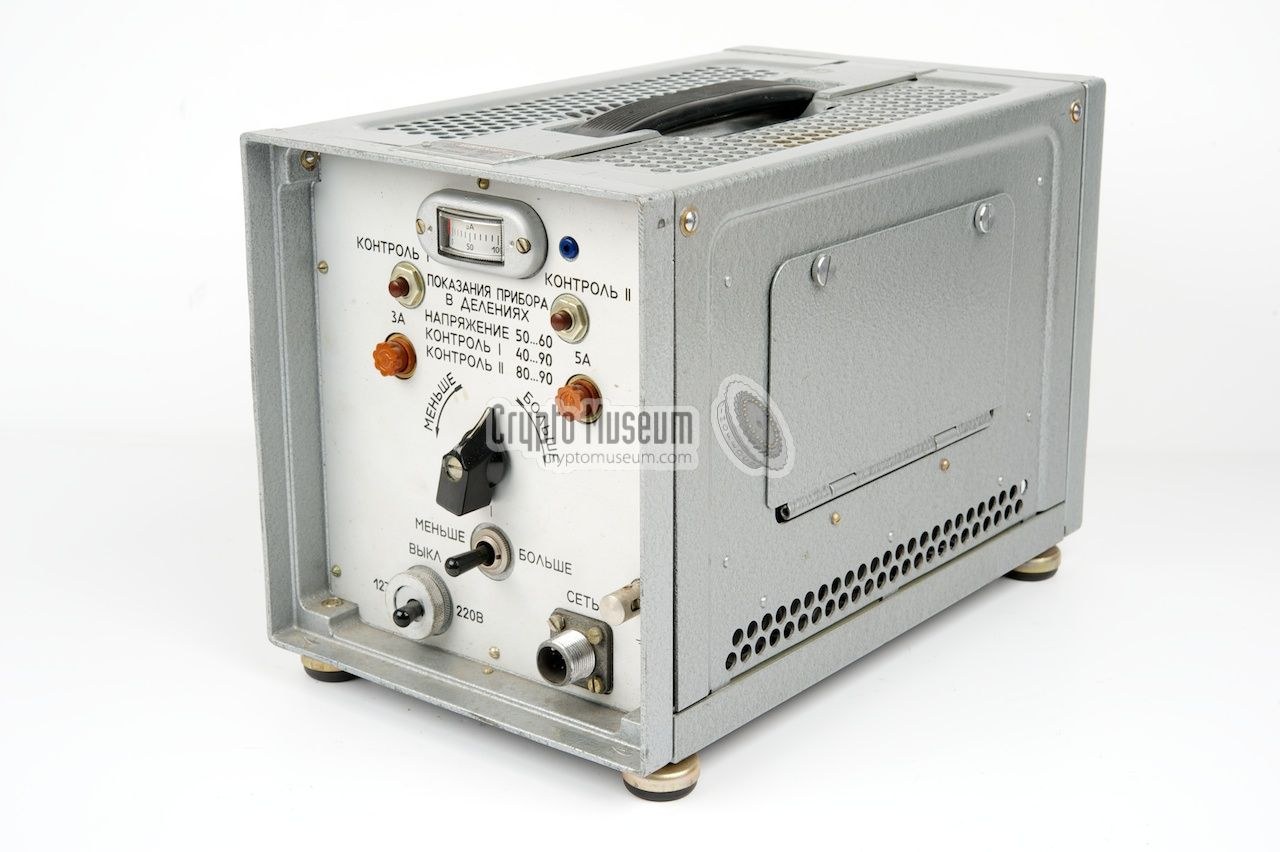
The standard PSU, BP-24, is a grey case containing a transformer, a rectifier and little else. It accepts a wide range of mains voltages, or the 24-volt supply of a vehicle. Most surviving machines came with it, and it is confirmed for East Germany, Czechoslovakia and Hungary. The same unit powered the M-105 “Agat” one-time-tape machine.
The TEMPEST PSU, BPK-125, was developed in the mid-1960s for the Fialka and is larger: 280 × 200 × 170 mm and 7.6 kg. It addresses a risk that Western engineers called TEMPEST and Soviet engineers called PEMIN, the leakage of information through unintended electrical emissions. A Fialka draws a different current for each character it prints or punches. In principle, an eavesdropper on the power line could read the plain text from the current. The BPK-125 counters this in two ways. A cable from the Fialka tells the supply which of the five data bits are active, and the supply switches in five dummy loads to even out the current. It also injects noise into the 24-volt line. According to the Crypto Museum it was issued only in the Soviet Union and Poland. Every other country kept the BP-24 (Crypto Museum, TEMPEST PSU). Volume 7 returns to it.
5.9 In the Box
Each Fialka left the factory with a handwritten checklist of everything supplied, with signature spaces for the manufacturer, the acceptance department and the customer. The one surviving checklist, for a Czechoslovak machine, divides the kit into three groups (Crypto Museum, checklist).
In the dust cover: the paper-tape holder, the aluminium can of spare wheels, the chad box that catches the paper punched out of the tape, a hand crank for moving the wheels when correcting mistakes, a test reflector that took the place of the wheels for fault-finding, and spare print heads.
With the power supply: the PSU and five cables.
Separately: a toolkit in a green canvas wallet, a wooden box of larger tools, a wooden ZIP box (zapasnye chasti i prinadlezhnosti, spare parts and accessories) of mechanical and electronic spares, a canvas cover and a shock-absorbing mat. Other items from the same kit have also been found: an oil can, a 24-volt service lamp, a damping tool for gummed tape, and a thin metal triangle. The triangle could be placed in the card reader instead of a key card to connect each letter straight through, for testing.
According to the Crypto Museum, the machine proved so reliable that mechanical spares were hardly ever needed. By the end of the Cold War, repair depots across the Eastern Bloc held warehouses full of them.
5.10 Specifications
The East German manual gives the most complete set of figures (NVA 1978, sec. 2.1.2; Library copy).
Table 3 — Specifications
| Item | Value |
|---|---|
| Supply | 100–250 V AC, 50 or 400 Hz, or 24 V DC ±10% |
| Power consumption | 50 VA |
| Machine in working position | 465 × 380 × 350 mm, 16 kg |
| Machine with cover | 350 × 280 × 215 mm, 19 kg |
| Complete set in shipping crate | 470 × 400 × 350 mm, 38 kg |
| Power supply unit (standard) | 270 × 175 × 190 mm, 6.8 kg |
| Operating temperature | 0–50 °C |
| Speed | up to 500 characters a minute from the keyboard, 455 from tape |
| Tape | 5-channel, 17.4 mm wide, 2.54 mm character pitch; internal 5-bit code |
| Error probability | 2 × 10⁻⁵ |
Sources
- Crypto Museum, “M-125 Fialka”, “M-125-3”, “Russian M-125”, “Russian M-125-3M”, “Polish”, “Czech”, “DDR” and “Hungarian” variant pages, “Wheels”, “Key card”, “Checklist”, “TEMPEST PSU”, cryptomuseum.com (read November 2026).
- Paul Reuvers and Marc Simons, Fialka M-125: Detailed description of the Russian Fialka cipher machines (Library copy), v2.0, 2009, PDF, with the addenda on the Polish PSU and the 3K/5K/6K wheel wiring.
- Nationale Volksarmee, A 040/1/321 — M-125 Nutzung, 1978; German original (Library copy), English translation by Jerry McCarthy (Library copy).
- Museum of Cryptography, Moscow, M-125-3M object page, cryptography-museum.ru.
- Deutsches Museum, “Objektgeschichten historischer Chiffriergeräte”, deutsches-museum.de.
Next — Volume 6: In Service — Key Lists, Cards and Procedure in the Warsaw Pact. A sealed monthly package with 31 key tables and 31 paper-thin punched cards; a key that changed at one minute past midnight; ten wheels taken apart and rebuilt on the operator’s table every morning; message keys used once and struck out; a five-group message format and a 48-hour destruction rule. All of it is from the East German Army’s manual of 1978, the most complete account of how a Fialka was actually used.
Comments (0)