Fialka · Volume 1
Fialka — Volume 1 — The Soviet Rotor Machine
What the M-125 Fialka was, why calling it 'the Russian Enigma' is only half right, who built it and who used it, how it was keyed and guarded, what happened to it after the Soviet Union fell, and how to build and run one today. This is the orientation volume for the ten-part series.
1.1 About This Volume
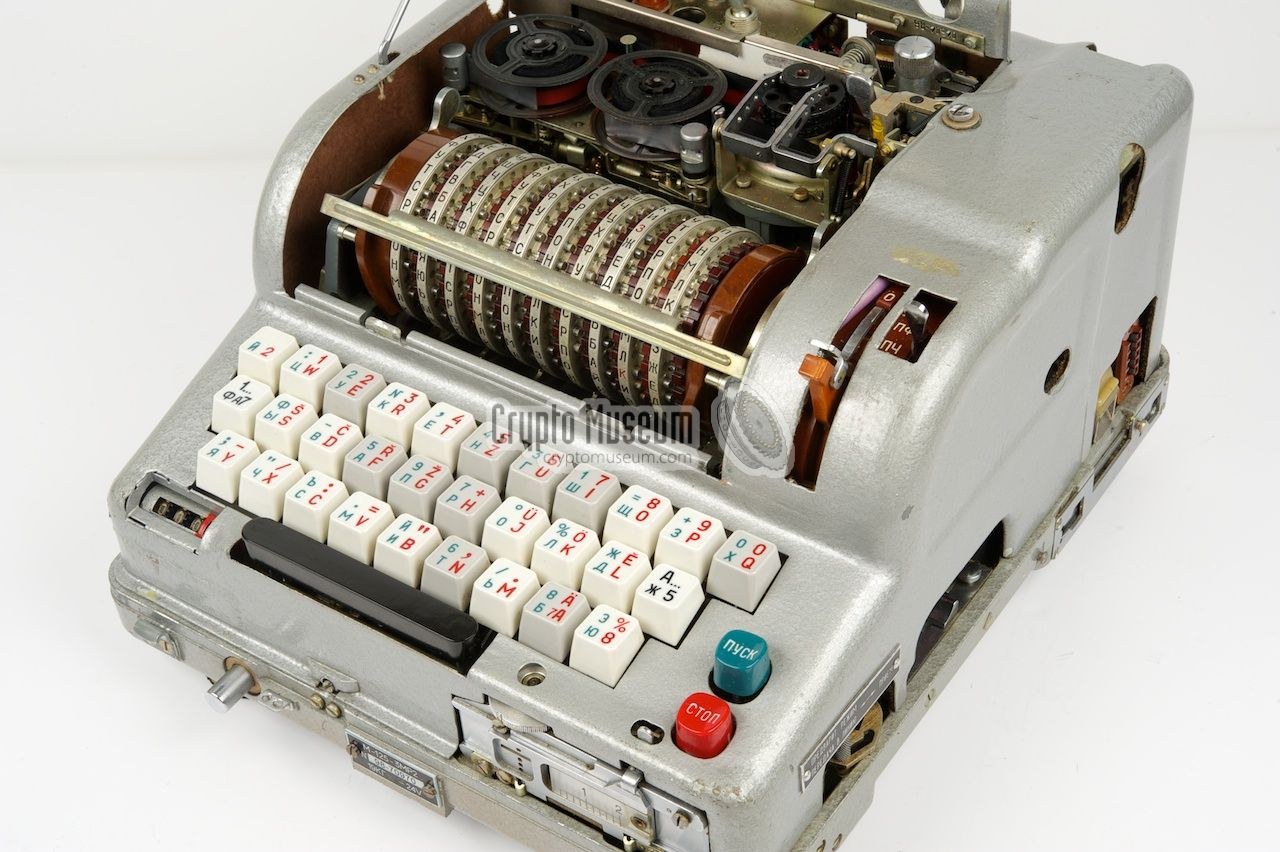
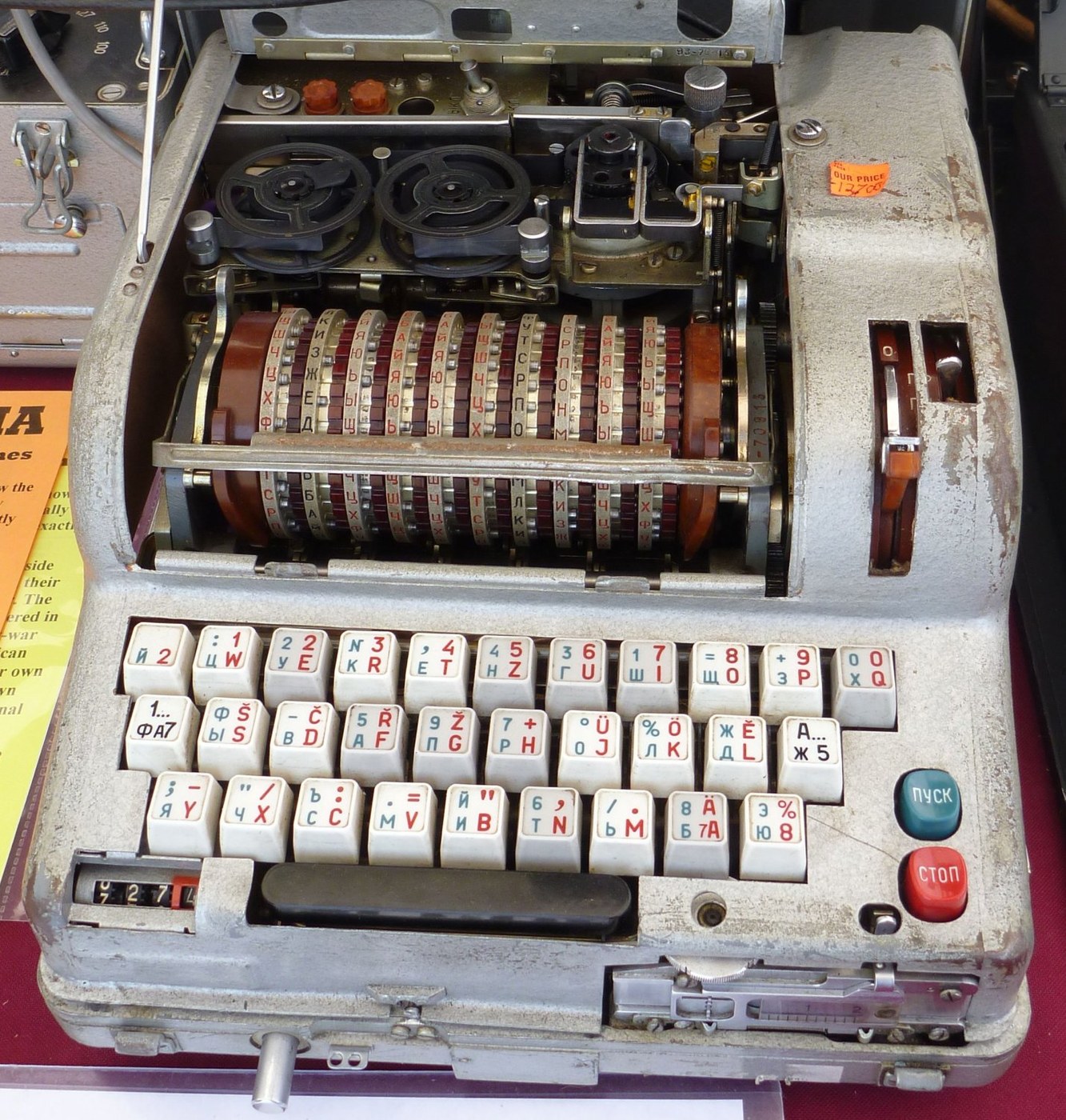
This volume opens a ten-volume deep dive on the M-125, a Soviet electromechanical rotor cipher machine better known by its codename Fialka (Russian ФИАЛКА, “violet”). From the second half of the 1950s until the end of the Cold War it was one of the main cipher machines of the Soviet armed forces and security services. It was also issued, in national versions, to the armies of the Warsaw Pact. It is a compact grey box, about the size of a large office typewriter. Inside are ten wired wheels with thirty contacts a side, a reader for a punched paper key card that was changed every day, a reflector, a printer that types the result onto paper tape, a tape punch and a tape reader.
Western writers often call it “the Russian Enigma”. The nickname is half right. The Fialka belongs to the same family as the German machine: an electric current is scrambled by rotating wired wheels, bounced off a reflector and sent back through them. In almost every detail, though, its designers did something different, and most of those differences fix weaknesses that let the Allies read Enigma traffic. A large part of this volume explains which half of the nickname holds and which does not.
The volume covers what the machine was, how it works in outline, who made it and when, who used it, how it was keyed and guarded, whether anyone broke it, and how it reached museums and collectors after 1990. It also tours the series. The origins are in Volume 2. The mechanism is in Volumes 3 and 4. The models and national versions are in Volume 5, the key lists and procedure in Volume 6, and security in Volume 7. Volume 8 covers the machine’s afterlife. The last two volumes cover building a Fialka (as software, as a replica, or as a microcontroller build) and running one.
1.1.1 The Ten-Volume Series
Table 1 — The Ten-Volume Series
| Vol | Title | Focus |
|---|---|---|
| 1 | The Soviet Rotor Machine (this volume) | Orientation: what it was, how it worked, the whole story in miniature |
| 2 | Origins — Soviet Cipher Machines from the 1930s to the M-125 | Volosok, Plant No. 209, the K-37, the post-war gap, the M-125 |
| 3 | How It Works I — Ten Rotors, Alternate Stepping and the Blocking Pins | The wheels, their wiring and the irregular stepping |
| 4 | How It Works II — The Card Reader, the Reflector, Keyboard, Printer and Tape | The rest of the signal path and the paper-handling machinery |
| 5 | Models and Variants | M-125, M-125-3, the national versions, keyboards, print heads, wheel series and power supplies |
| 6 | In Service — Key Lists, Cards and Procedure in the Warsaw Pact | The key packages, a day’s setup, message format, distribution and destruction |
| 7 | Security and Cryptanalysis | What the design fixed, what the West may have known, and what can actually be shown |
| 8 | After 1990 — Declassification, Collectors and Museums | Destruction, survival, the Crypto Museum’s reverse engineering, Moscow’s own museum |
| 9 | ⭐ Building a Fialka — Simulator and Replica Options | Software simulators, printed wheels, a microcontroller build |
| 10 | Running a Fialka — Setting a Key, a Worked Message, and an Attack Demo | A day’s key, a message sent and received, and an attack |
1.2 A Grey Box With Ten Wheels
A Fialka in a museum case looks like a heavy office machine painted in the hammer-finish grey of Soviet military electronics. In its working position, with the lid raised and the paper-tape holder fitted, the East German Army’s 1978 manual gives it as 465 mm wide, 380 mm high and 350 mm deep, weighing 16 kg. Closed under its steel dust cover it weighed 19 kg, and the complete set in its shipping crate weighed 38 kg (NVA, A 040/1/321, 1978, sec. 2.1.2; Library copy). The machine itself ran on 24 volts DC. A separate power supply let it run from 100–250 volt mains at 50 or 400 Hz, or straight from a vehicle’s 24-volt system.
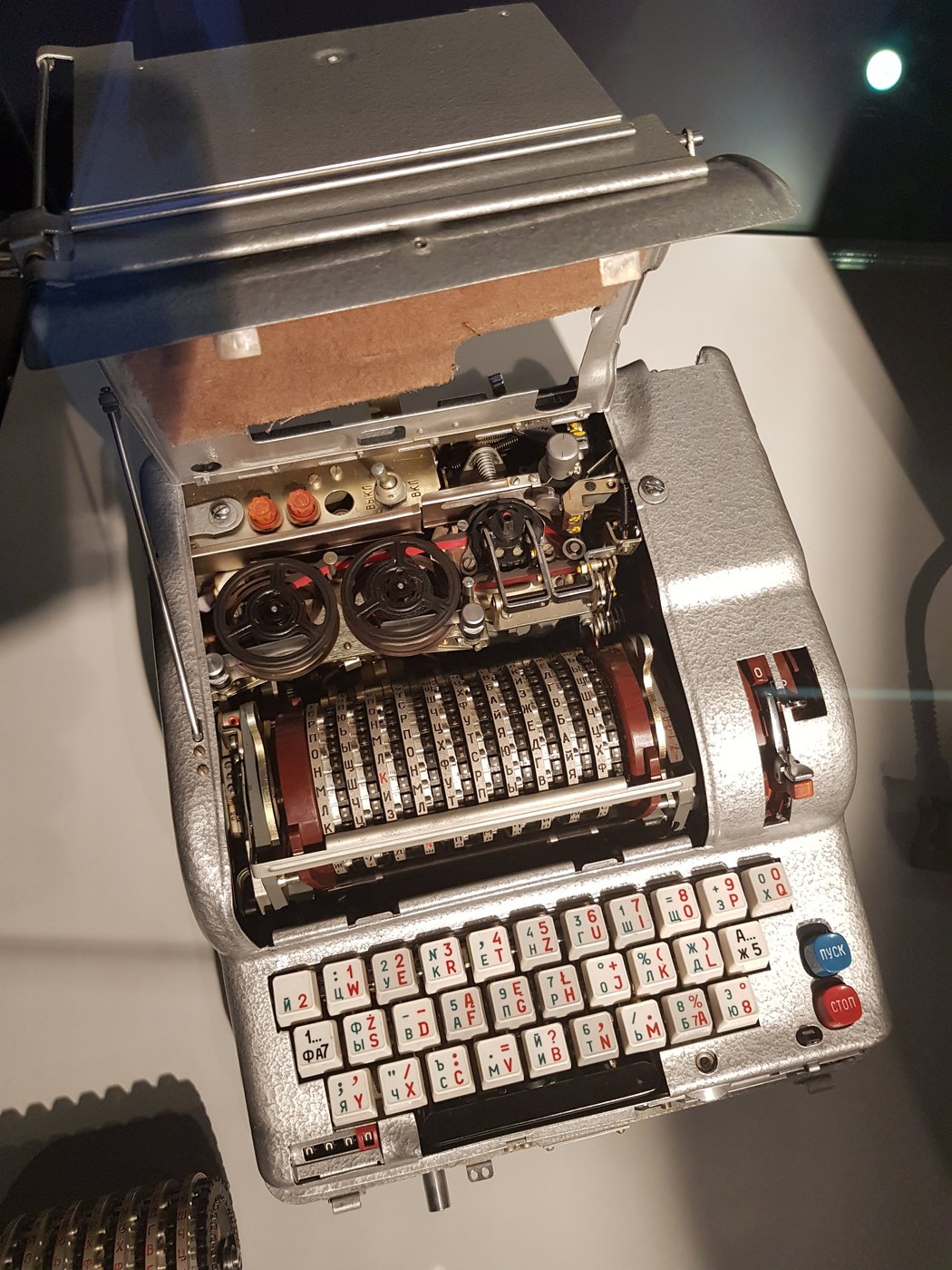
At the front is a keyboard of thirty keys with a long space bar. To the right of the keyboard, behind a small window, is a paper-tape reader, which could feed a previously punched message through the machine as if it were being typed. Behind the keyboard, under a hinged lid, is the drum: ten wheels on a spindle, held between a fixed entry disc on the right and a fixed reflector on the left. Behind the drum is a printer with a rotating type wheel, and next to it a tape punch. The printer types the result onto paper tape. The punch can encode the same characters as holes in standard five-hole teleprinter tape. On the left side is a small drawer, the card reader, which holds a thin punched card that formed part of the day’s key. A mode lever, set into a red housing beside the lid, chooses between plain text (О), encipher (З) and decipher (Р). A counter at the front left counts the letters typed in groups of five (Crypto Museum, “M-125”).
Nothing outside this box was secret. A Fialka was a printing telegraph terminal with a cipher drum, and the Soviet Union, like its rivals, built such equipment in quantity. What was secret was the wiring of the wheels, which differed from country to country. The daily keys were secret too, and the procedures were kept on a need-to-know basis.
1.3 How It Works, in One Keystroke
The core of every rotor machine is a wheel (the Russian sources and the Crypto Museum use “wheel”; English writers often say “rotor”). It is a disc of insulating material with electrical contacts round both faces. Inside it, wires join each contact on one face to a different contact on the other in a scrambled order. Current entering at one letter’s contact leaves at another’s. Stack several wheels side by side and the current is scrambled several times. Turn one of them and the whole substitution changes. The Fialka’s wheels have thirty contacts a side, not the Enigma’s twenty-six, because they were built for the Cyrillic alphabet. Thirty of its thirty-three letters were kept and the three rarest were dropped.
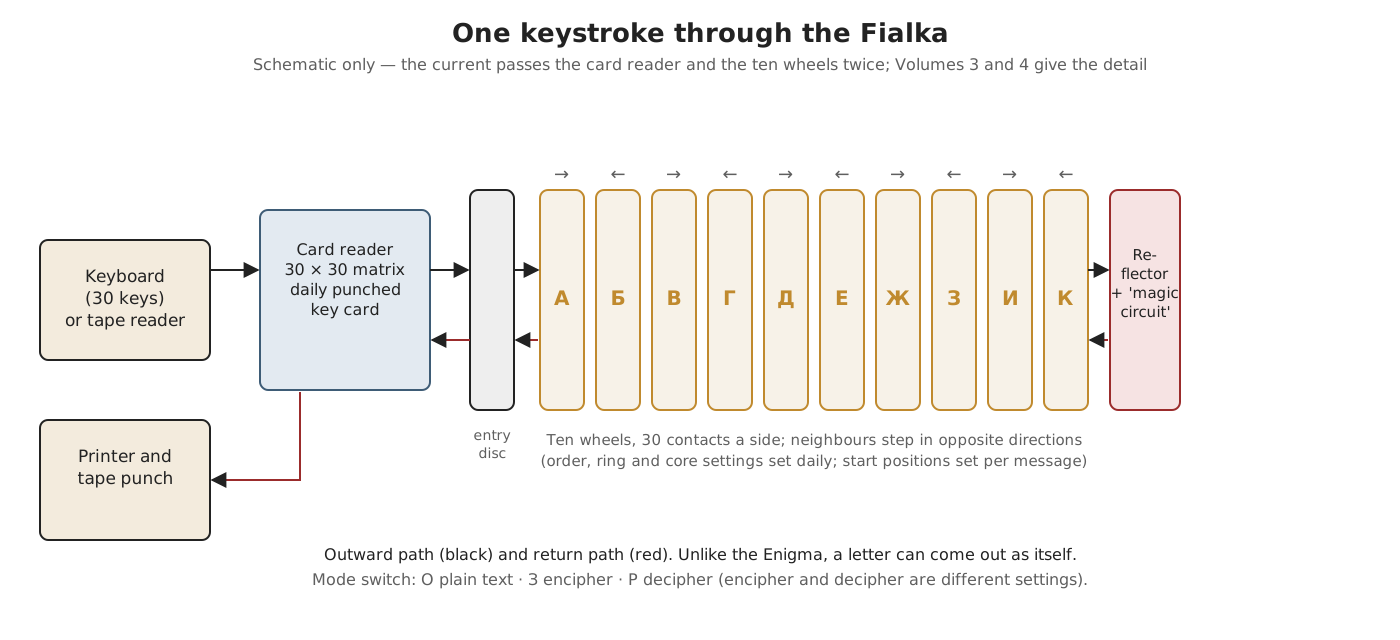
When the operator presses a key, the current takes this route:
- It passes first through the card reader, a 30 × 30 grid of contacts. That day’s punched card leaves exactly one connection open in each row and each column, so it sets up a fixed scramble of all thirty letters. The Crypto Museum describes the reader as a programmable wheel that does not move. It does the job of the Enigma’s plugboard, but it is a full permutation of thirty letters rather than a set of swapped pairs.
- It then passes through the fixed entry disc and the ten wheels, reaches the reflector, and comes back through the ten wheels and the card reader a second time.
- It arrives at the printer, which types the result on the tape, and at the punch if the punch is switched on.
After every key press the wheels move. That is where the Fialka departs most clearly from the Enigma. The Enigma’s wheels turned like a car’s odometer: the right-hand wheel stepped every time and the others only occasionally. The Fialka’s ten wheels can all step on every key press, and adjacent wheels turn in opposite directions. Whether a given wheel actually moves is decided by pins on the rim of its neighbour, known as advance blocking pins. Each wheel carries a different number of them in different places. The resulting movement is irregular and depends on the key (Crypto Museum). Volume 3 follows the stepping wheel by wheel.
One more detail matters a great deal. In the Enigma, the reflector made it impossible for a letter ever to encipher to itself, and Allied codebreakers exploited that rule constantly. The Fialka’s reflector pairs most of its contacts in the usual way, but it adds a small switching arrangement that the Crypto Museum calls the “magic circuit”. In the Fialka, a letter can come out as itself. That circuit also makes enciphering and deciphering different operations, which is why the mode lever has separate З and Р positions. Volume 4 explains it.
1.4 Why “the Russian Enigma” Is Half Right
The nickname is not a Soviet one. It appeared in Western collector and press writing after the first machines came to light in the early 2000s, and it has stuck because almost everyone has heard of the Enigma and almost no one has heard of the M-125. The Crypto Museum, whose founders did more than anyone to document the machine, uses the phrase but explains it with care. The machine “is similar to the American SIGABA, the KL-7 and, to a lesser extent, the Enigma. For this reason the machine is sometimes referred to as the Russian Enigma” (Crypto Museum, Fialka index). Moscow’s Museum of Cryptography, which now shows a Fialka of its own, says much the same from the other side: the machine is “much more than a ‘Soviet version of the Enigma’” (Museum of Cryptography, M-125-3M).
The table sets out which half is right.
Table 2 — Why "the Russian Enigma" Is Half Right
| Enigma (German Army and Air Force, 1930s–1945) | Fialka (M-125, from the later 1950s) | |
|---|---|---|
| Family | Electromechanical rotor machine with reflector | Same |
| Wheels in use | 3 (4 in the naval M4) | 10 |
| Contacts per wheel | 26 | 30 (Cyrillic) |
| Stepping | Regular, odometer-like | Irregular; neighbours step in opposite directions, controlled by blocking pins |
| Plugboard | Up to 13 swapped pairs, changed daily | Punched card: full 30-letter permutation, changed daily |
| Can a letter encipher to itself? | Never | Yes |
| Output | Lamp board; a second operator writes the letters down | Printed on tape; can also punch teleprinter tape |
| Encipher / decipher | Same setting (reciprocal) | Separate settings |
| Wiring | Same wheels for all users of a network | Wheel wiring different for each country; from 1978, rewirable cores |
The first row is why the nickname holds. The other rows are why it misleads. Experts on both sides of the old Iron Curtain describe the Fialka as a machine designed with the Enigma’s failures in mind. The Crypto Museum lists the improvements: ten wheels rather than three or four, more frequent and irregular turnovers, adjacent wheels moving in opposite directions, wheel wiring that could be changed in the field from 1978, a punched card in place of the plugboard, and the ability to encipher a letter into itself (Crypto Museum). Several of these are exactly the weaknesses that the Polish and British codebreakers used against the Enigma. The Enigma shelf in this collection tells that story, in Enigma Volume 5 on why the Germans thought it unbreakable and Volume 13 on its lessons.
How much the Soviet designers knew about those weaknesses, and when, is a separate question. Volumes 2 and 7 come back to it. In terms of design, the closer relatives are the American machines that moved their wheels irregularly. Those are the SIGABA (SIGABA Volume 1) and its post-war successor the KL-7. Like the Fialka, both machines printed their output and used several wheels whose motion an enemy could not predict.
1.5 Who Made It, and When
Volume 2 tells this story in full. Here is the outline.
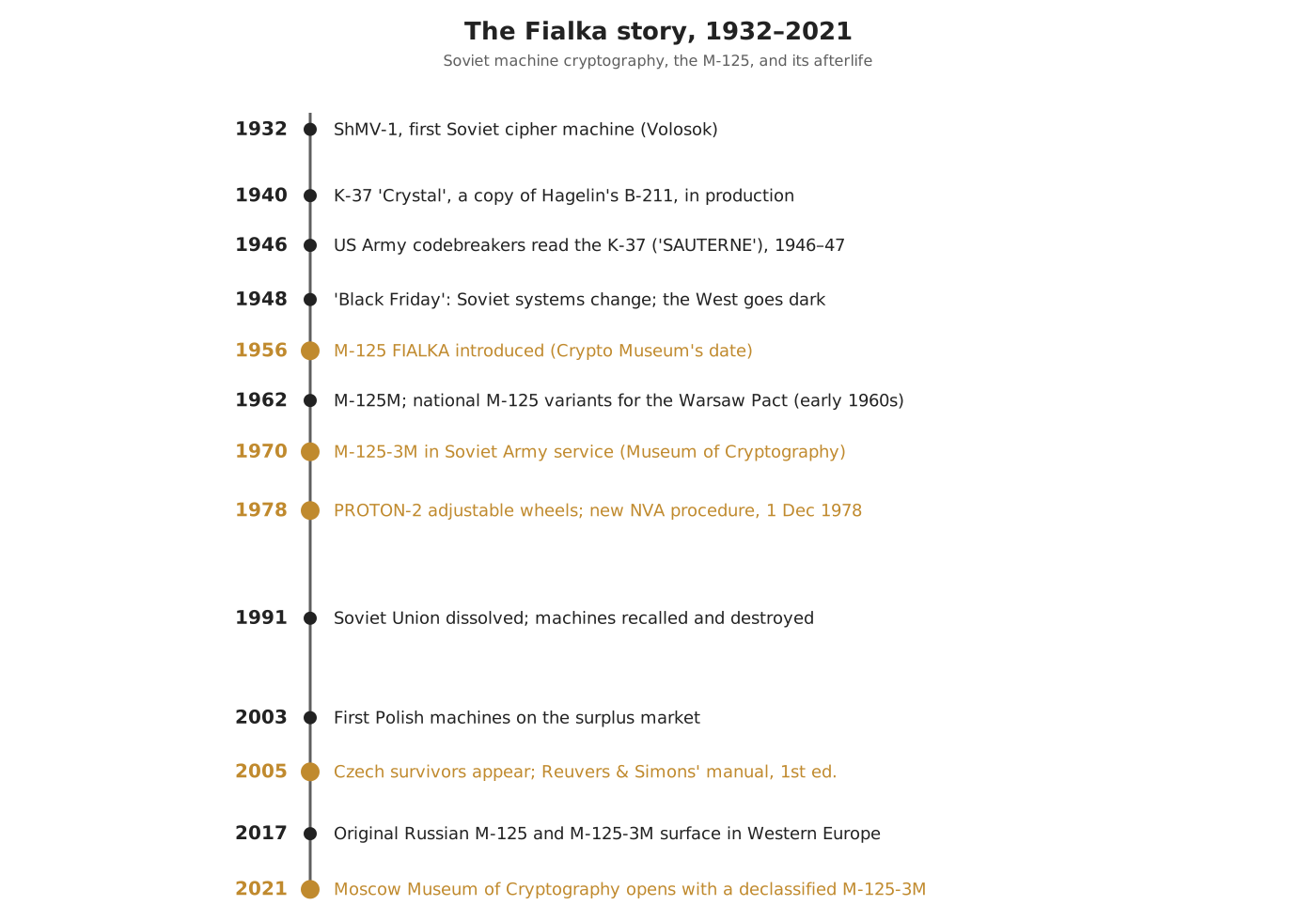
Soviet machine cryptography began in the early 1930s, when the Red Army’s cipher service set an engineer named Ivan Volosok to build a cipher machine. The first prototype, the ShMV-1 of 1932, was not a success. Before and during the Second World War, though, a Leningrad factory, Plant No. 209, produced tape-keyed machines for the high command and a rotor-and-pin-wheel machine called the K-37 “Crystal”. The K-37 was an unlicensed copy of a Swedish Hagelin design. After the war American codebreakers read K-37 traffic for a time, in 1946–47. Then, in the autumn of 1948, the Soviet Union changed its high-grade systems and Western codebreakers lost most of what they had been reading.
The M-125 came out of that post-war renewal. According to Moscow’s Museum of Cryptography, the first model was developed in the 1950s at Leningrad’s Plant No. 209 (today the A. A. Kulakov plant) under its chief designer, Nikolai Gyrdymov, for the Soviet Armed Forces. All later versions were manufactured by the Leningrad printing-machinery works, Lenpoligrafmash (Museum of Cryptography).
The date it entered service is less certain than most popular accounts suggest. The Crypto Museum gives 1956. The National Cryptologic Museum’s machine, lent to a US Air Force display in 2011, came with the statement that it “first went into operation in 1959” (US Air Force, 2011). The first editions of the Crypto Museum founders’ own reference manual said “around 1965”. That was before Russian machines and documents surfaced, and their website has since revised it. This series uses “about 1956”, with the M-125-3 following in the late 1960s, and treats every date before 1970 as approximate. The name probably came from the codeword used during development. The Moscow museum suggests it was chosen because the machine was small. In principle “Fialka” was the name of the cipher procedure and “M-125” the name of the machine, but everyone now calls the machine Fialka.
1.6 Two Machines, Many Versions
There were two basic machines. The original M-125 could handle letters only and had wheels with fixed wiring. Its keys have rounded tops. The M-125-3, which followed in the late 1960s and was in Soviet Army service from 1970, added a figures shift and a numbers-only mode. Its keys are square. From 1978 it was issued with new wheels whose wiring cores could be taken out, turned over and moved to another wheel body, a set known as PROTON-2 (Crypto Museum).
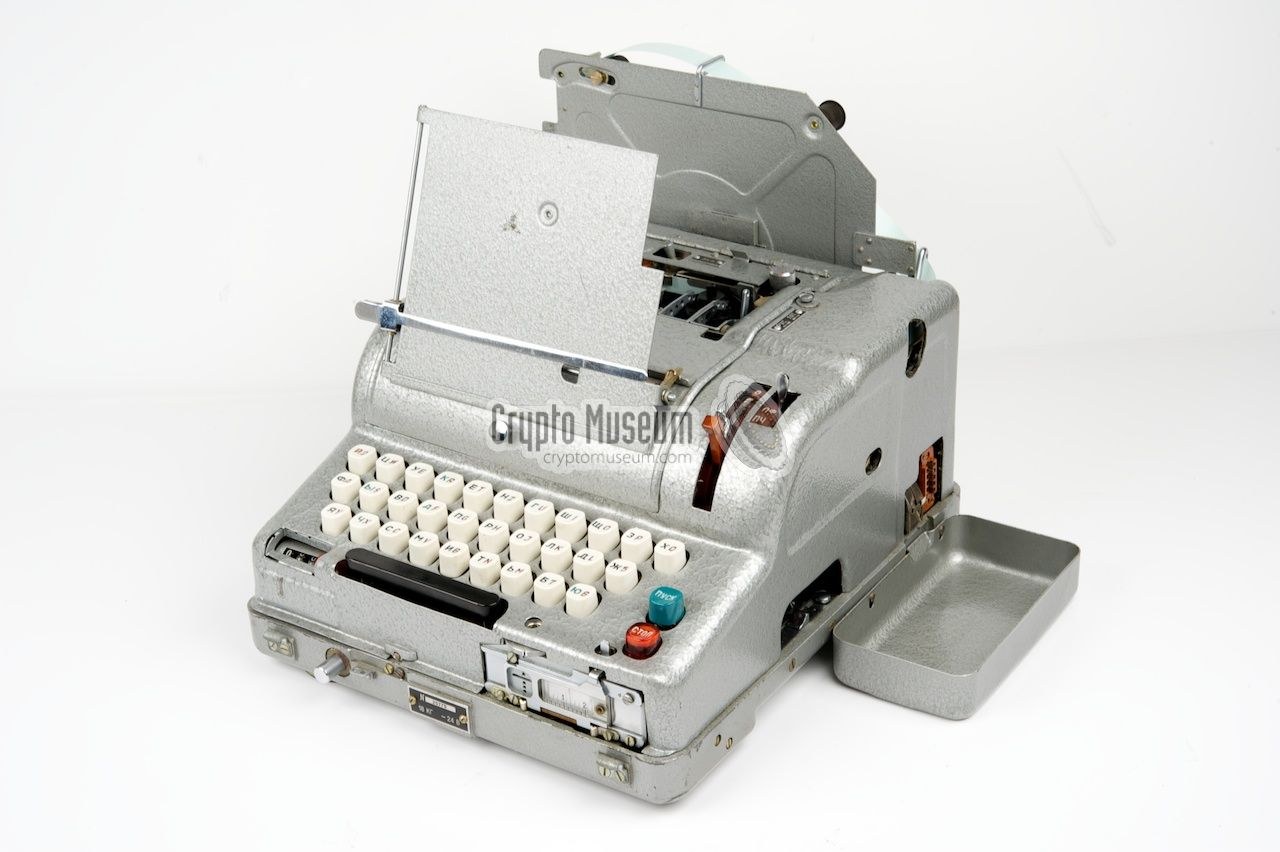
Each Warsaw Pact country received its own version. The thirty Cyrillic letters sat in the same places on every keyboard. Beside them, each country’s keyboard and print head carried that country’s own Latin letters, so that a Polish machine could print Polish and an East German one German. More importantly, each country’s wheels were wired differently. The wheels carry a series code before their serial number: 3K for Poland, 6K for Czechoslovakia, 4K for East Germany according to its manual, and others still being identified. As a result, two allies with Fialkas could not read each other’s traffic in peacetime. Volume 5 sorts out the designations, from M-125-MN to M-125-3MR2. Several of them have only been pieced together from surviving machines, and sources disagree about some of them.
1.7 How It Was Used
The Fialka was an off-line machine. An operator prepared a message on it, and the cipher text was then sent by whatever channel was available: teleprinter, radio, or a courier carrying the punched tape. The East German Army approved it for traffic up to Geheime Verschlusssache (secret) and for key areas of up to 600 participants. Its rules required each message to be enciphered onto punched tape, deciphered again on the same machine as a check, and only then handed over for transmission (NVA 1978, sec. 1; Library copy; Reuvers & Simons 2009, 1.2.4; Library copy). The check made sure that nothing went out in clear by mistake.
1.7.1 Keys and procedure (Volume 6)
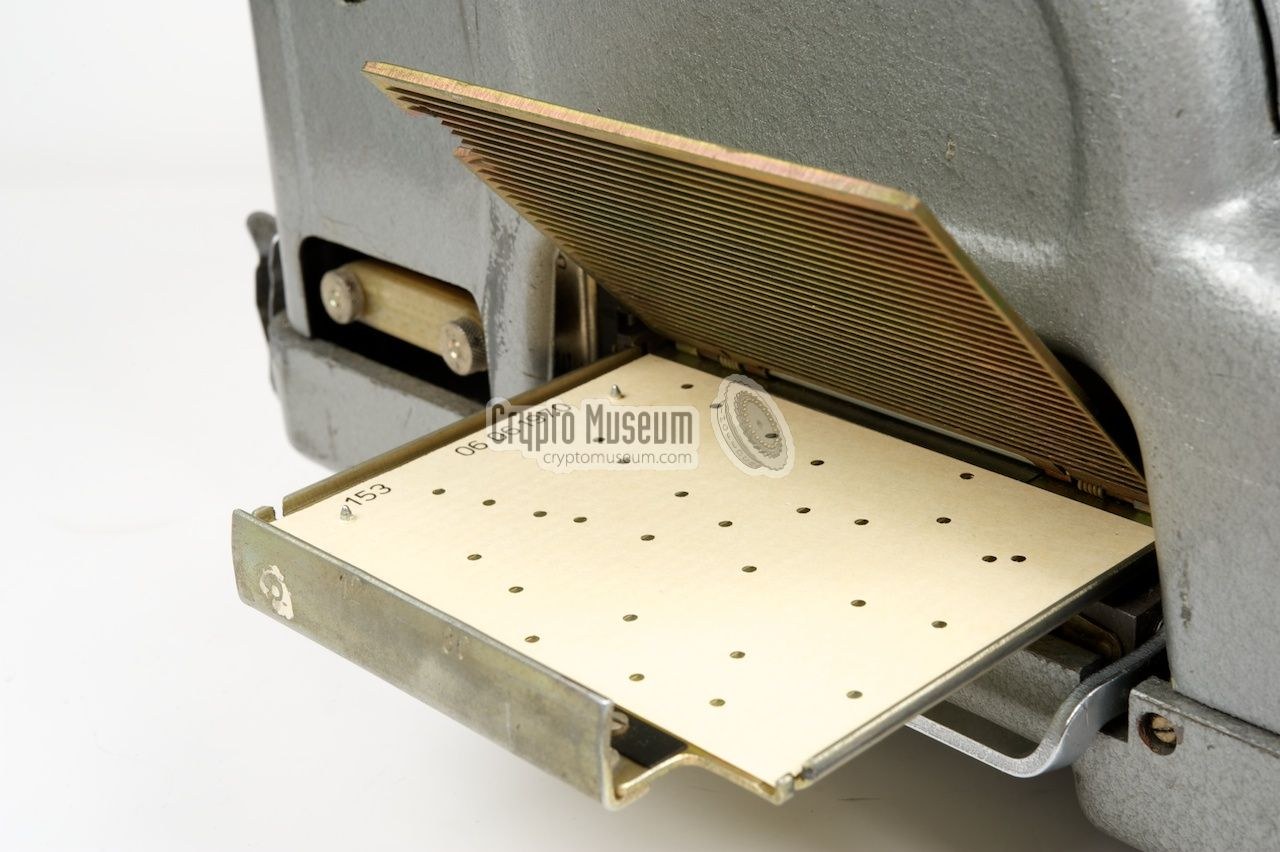
The key came in packages. Each month a sealed Daily Key Package brought 31 key tables and 31 punched key cards, numbered by day. The day’s table set the order of the ten wheels and, for the later wheels, how each wiring core was fitted. The day’s card went into the reader drawer. The key changed at one minute past midnight. For each message a separate message key set the starting positions of the ten wheels, and it was used once and struck out. The key cards were printed on paper so thin that they tore if the drawer was opened more than once or twice. A used card was destroyed and replaced in the reader by a metal triangle that wired the reader straight through (Crypto Museum, key card). Spent key material had to be destroyed within 48 hours, and two signatures had to confirm it. Volume 6 walks through a day’s setup using the 1978 East German manual, the only complete operating manual published so far.
1.7.2 Guarding the machine (Volume 6)
Fialka was kept on a need-to-know basis, like any high-grade Warsaw Pact cipher system. Accounts gathered from former East German operators describe the machine being worked in sealed rooms or tents on exercises, with warning signs and a red lamp to show it was in use. Even the people who wrote and received messages seldom saw it. The dust cover had a small bracket that pressed the counter’s reset button as the cover went on, so that a stored machine could not reveal the length of its last message. Every machine came with two sets of wheels. The working set was lettered in black and a spare set in red was kept in an aluminium can inside the cover.
1.8 Was It Ever Broken?
Nobody outside the intelligence agencies knows, and the agencies have not said. The design closed off the shortcuts that broke the Enigma, so any attack would have needed either far more computing power or help from captured material and careless operators. Three claims are repeated widely. One is that Israel captured Fialkas in the Six-Day War of 1967. Another is that Austria read a good deal of Eastern Bloc Fialka traffic. The third is that the NSA was reading it by computer in the 1970s. All three trace back to a single source, the first editions of the Crypto Museum founders’ reference manual, which credits them to anonymous informants. No declassified Western document has yet confirmed any of them. A 2013 academic paper by two Slovak cryptographers states flatly that “there are no known attacks on this cipher” (Antal & Hromada 2013; Library copy). Volume 7 sets out what can and cannot be shown, and Volume 10 runs an attack on the simulator to show what modern computing can do against a single message.
1.9 After 1990
The Fialka outlived the system it served. After the Berlin Wall fell in 1989 and the Soviet Union dissolved in 1991, Moscow recalled the machines its allies had held and had them destroyed. Every East German machine is believed to have gone. In Czechoslovakia the machines were smashed with hammers and some were burned, between the late 1990s and the early 2000s. A few slipped through. A small batch of well-kept Polish machines reached the European surplus market in 2003, after which, according to the Crypto Museum, the Russians collected the rest. From 2005 collectors began rebuilding Czech machines from the wreckage, and most Fialkas in private hands today are Czech.
That was when two Dutch engineers, Paul Reuvers and Marc Simons, came in. They run the Crypto Museum, a non-profit virtual museum in Eindhoven. Starting with one working machine, a German manual and a damaged drum lent by the American collector Tom Perera, they traced every wire and drew the full circuit diagram. In 2005 they published the results as a reference manual. Version 2.0 followed in 2009, and since 2021 it has been free to download. It remains the foundation of nearly everything written about the machine, this series included. Original Russian machines, long thought lost, turned up in 2012 and 2017. When Moscow’s Museum of Cryptography opened in 2021, it put on display a Fialka that the Russian state had declassified for the occasion. Volume 8 tells that story.
1.10 The Simulator and the Replica
Every worked cipher example in this series comes from one program, a Python simulator kept with the project at 03-outputs/tools/fialka_sim.py. It is checked against published test data before any example is written. The Crypto Museum has published wheel wirings and the positions of every blocking pin, together with stepping tables that a correct simulation must reproduce. Volume 9 describes how the simulator was checked, surveys the Fialka simulators already published, and lays out the options for a physical replica: printed wheels with real contacts, a card reader, and a microcontroller doing the work of the original’s motor and cams. Volume 10 uses the simulator and the 1978 manual to set a day’s key, send a message in period form, and then attack it.
1.11 Why It Matters
The Fialka matters for three reasons.
First, it shows what a rotor machine looked like after the lessons of the Second World War had sunk in. Its designers kept the Enigma’s basic architecture: wired wheels, a reflector, and a keyboard driving the whole stack. Then they took away, one by one, the properties that had let codebreakers in. These were the regular stepping, the reciprocal plugboard and the rule that no letter could encipher to itself. They also made the machine a complete printing terminal that could punch its own tape.
Second, it is a case study in alliance cryptography under one dominant power. Every Warsaw Pact army had its own version, but Moscow designed it, wired the wheels, made the key cards a year in advance and decided who could talk to whom. In peacetime the national versions could not talk to each other at all. A common wheel set was apparently held back for war. That is the opposite of the Anglo-American arrangement shown in SIGABA’s shelf, where two allies had to negotiate a shared machine (SIGABA Volume 7).
Third, almost everything known about it was recovered from the outside. No designer’s memoir has been published, and only scraps of official Soviet history are available. What exists comes from surviving machines, a few national manuals and the patient reverse engineering of private collectors. The Fialka is a reminder of how much of the history of cryptography is still being pieced together. The codebreakers’ side of that history, from the American school that broke PURPLE and built SIGABA, is on the Codebreakers shelf.
1.12 How to Read This Series
Each volume stands on its own, but they read best in order. Machine designations follow the sources. Where the same designation appears in different spellings (Latin P or Cyrillic Р, for example), Volume 5 explains why. Cyrillic letters are given as printed on the machine, with the meaning in English where it matters. The thirty wheel positions follow the Cyrillic order engraved on the wheels, А Б В Г Д Е Ж З И К Л М Н О П Р С Т У Ф Х Ц Ч Ш Щ Ы Ь Ю Я Й. Measurements are metric, as in the manuals.
Three kinds of figure appear: photographs of surviving machines and their accessories, most of them from the Crypto Museum’s collection; scans and redrawings of the surviving manuals; and line diagrams drawn for this series, whose generating scripts are kept with the project.
1.13 The One-Paragraph Version
The Fialka, properly the M-125, was a Soviet electromechanical rotor cipher machine developed at Leningrad’s Plant No. 209 in the 1950s and in service from about 1956. It had ten wired wheels with thirty contacts a side. They stepped irregularly, neighbours in opposite directions, under the control of blocking pins. A punched card changed every day added a full thirty-letter permutation, a reflector with a “magic circuit” let letters encipher to themselves, and a built-in printer, tape punch and tape reader made it a complete off-line message terminal. The improved M-125-3 of the late 1960s added figures, and from 1978 it had rewirable wheel cores. Every Warsaw Pact army had a version with its own keyboard, print head and wheel wiring, and Moscow made the keys for all of them. It served into the 1990s and was then systematically destroyed. The few survivors were reverse-engineered by Paul Reuvers and Marc Simons of the Crypto Museum, whose manual is the basis of all later work. Whether it was ever broken has never been shown. The remaining nine volumes are the long version, ending with a simulator, a replica and an attack.
Sources
- Paul Reuvers and Marc Simons, Fialka M-125: Detailed description of the Russian Fialka cipher machines (Fialka Reference Manual; Library copy), version 2.0, 22 June 2009 (first published 2005), ISBN 978-90-79991-01-3, cryptomuseum.com PDF.
- Crypto Museum, “M-125 Fialka” and linked pages, cryptomuseum.com (read November 2026).
- Nationale Volksarmee der DDR, A 040/1/321 — M-125 Nutzung (operations manual for M-125-3MN and M-125-MN), in force 1 December 1978; German original (Library copy) and English translation by Jerry McCarthy (Library copy).
- Museum of Cryptography, Moscow, “Шифровально-кодировочная машина М-125-3М, «Фиалка-3М»”, cryptography-museum.ru.
- US Air Force ISR Agency Public Affairs, “AFISRA debuts one-of-a-kind cryptologic display”, September 2011, af.mil.
- Eugen Antal and Viliam Hromada, “A New Stream Cipher Based on Fialka M-125” (Library copy), Tatra Mountains Mathematical Publications 57 (2013), 101–118, PDF.
- Eugen Antal and Pavol Zajac, “Key Space and Period of Fialka M-125 Cipher Machine”, Cryptologia 39:2 (2015), 126–144.
- Anna Borshchevskaya, “The Soviets’ Unbreakable Code”, Foreign Policy, 27 April 2019, foreignpolicy.com.
Next — Volume 2: Origins — Soviet Cipher Machines from the 1930s to the M-125. The general who designed the Red Army’s first cipher machine and the Leningrad factory that built it. Two Hagelin machines bought in Stockholm and copied for the front, then read by the Americans after the war. The autumn of 1948, when Western codebreakers lost their view of Soviet traffic. And the 1950s, when the same factory produced a ten-wheel machine called “violet”.
Comments (0)