Fialka · Volume 2
Fialka — Volume 2 — Origins: Soviet Cipher Machines from the 1930s to the M-125
How the Red Army's cipher service went from hand codes to machines; Volosok, Plant No. 209 and the first Soviet tape machines; two Hagelin machines bought in Stockholm and copied as the K-37; the post-war renewal of Soviet cryptography; and what can and cannot be said about who designed the Fialka and when it entered service.
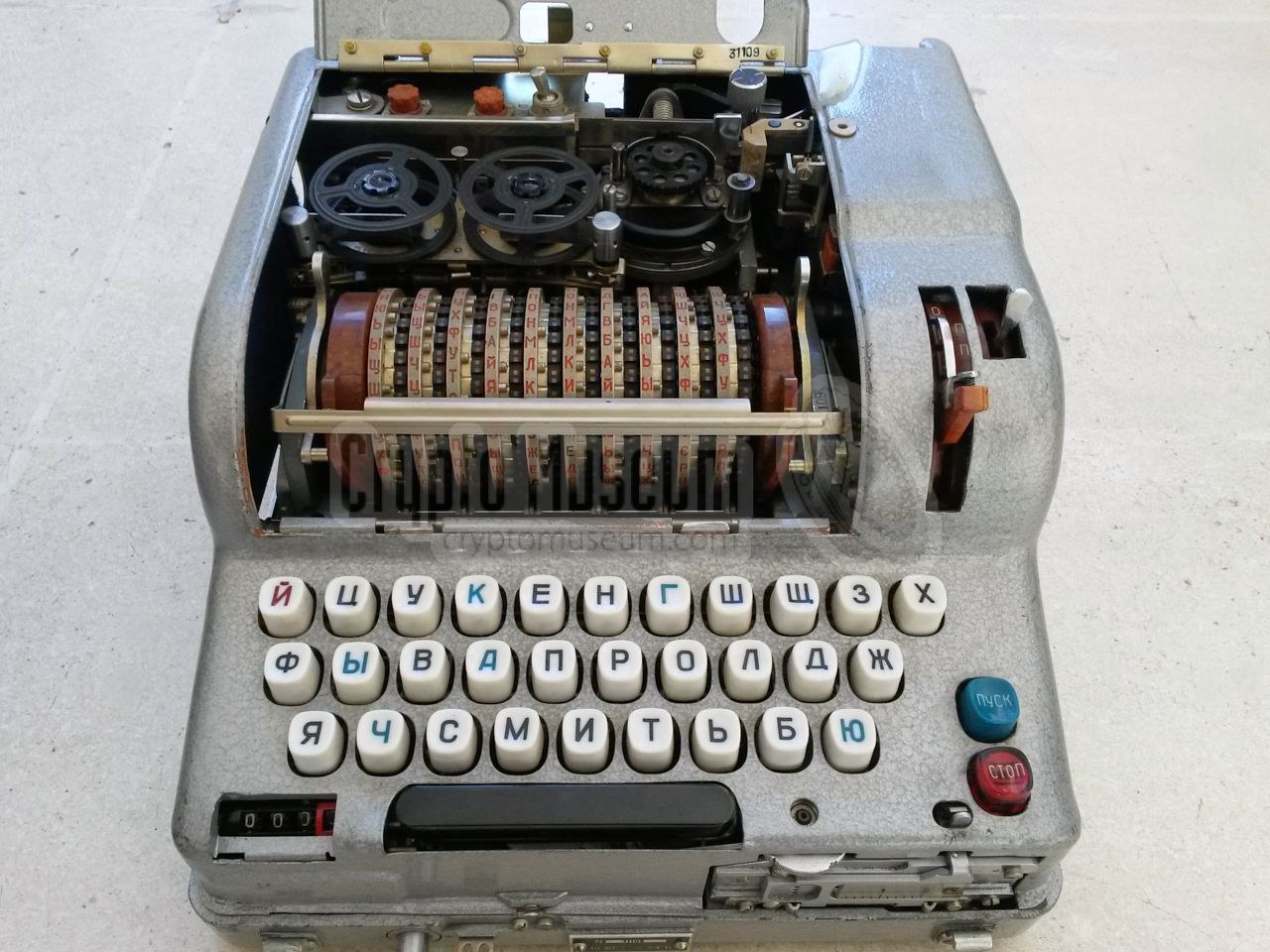
2.1 About This Volume
The Fialka did not appear from nowhere. By the time the M-125 entered service in the second half of the 1950s, the Soviet Union had been building cipher machines for more than twenty years. It had a dedicated factory in Leningrad, a generation of engineers who had kept the Red Army’s machine ciphers working through the war, and some hard lessons. One of them was that the K-37, its main wartime rotor machine, had been read by the Germans and later by the Americans.
This volume follows that story from the Red Army’s first experiments in the early 1930s to the M-125. It relies on Russian institutional histories, chiefly the Moscow Museum of Cryptography and a 2018 history of Soviet machine cryptography by Butyrsky, Golovanov, Emelyanov and Larin. It also uses the Crypto Museum’s work on surviving machines and the American and German records of the K-37. The sources do not always agree, and for the M-125 itself they disagree on the basic date. The disagreements are set out in this volume rather than smoothed over. The machine itself is described in Volumes 3 and 4. This volume is about where it came from.
2.2 From Hand Codes to Machines
At the end of the 1920s the Red Army enciphered by hand, using code books and paper tables. They were slow, error-prone and hard to change quickly. The answer, as in every other major army, was a machine.
The earliest Soviet work came from an unexpected direction. In 1921 the inventor Vladimir Bekauri set up a “Special Technical Bureau” (Ostekhbyuro) in Petrograd to develop new military technology, and according to the 2018 history it produced the first working Soviet model of a rotor cipher device there. Bekauri was shot in 1938 on a false charge of spying for Germany and rehabilitated in 1956. His bureau’s cipher work did not go into production (Butyrsky et al., BIS Journal, 2018).
The systematic programme began in 1930–31, when the Red Army Staff set up a cipher service, the 8th Department, with a technical laboratory. In 1932 that laboratory, led by a naval engineer named Ivan Pavlovich Volosok (1900–1982), built two prototypes of the first Soviet cipher machine. It was given the plain name ShMV-1, Shifroval’naya Mashina Voloska, “Volosok’s cipher machine, No. 1”. It was bulky and mechanically unreliable and never went into production. Volosok went on to become a major general and the leading designer of Soviet cipher equipment before and after the war (BIS 2018; Vechernyaya Moskva, interview with Egor Efremov of the Museum of Cryptography).
2.3 Plant No. 209
A cipher machine needs a factory. In late 1933 a working group was set up to find one in Moscow or Leningrad able to make secret equipment, and it chose Plant No. 209 in Leningrad. The plant made precision mechanical, electrical and radio equipment and telegraph apparatus. In November 1934 Volosok, now head of the Second Section of the 8th Department, visited it to satisfy himself that it could take on a product the country had never made before. His warning to the plant, as the 2018 history reports it, was that the machines would first have to be designed there, because nothing of the kind existed in the Soviet Union.
That decision shaped everything that followed. Plant No. 209, renamed in later years after A. A. Kulakov, became the centre of Soviet cipher-machine design and production for half a century. The group of engineers formed there in the mid-1930s included V. M. Domnichev, V. N. Rytov, O. A. Primazova and E. P. Izotova. Under the 8th Department’s chief from 1938, P. N. Belyusov, they were joined by P. A. Sudakov, P. I. Stroitelev, N. I. Gusev, N. M. Sharygin and M. S. Kozlov. Belyusov led the cipher service until 1961, finishing as a lieutenant general. These people, and their successors, built the M-125 (BIS 2018).
2.4 The First Generation: Tape Machines for the High Command
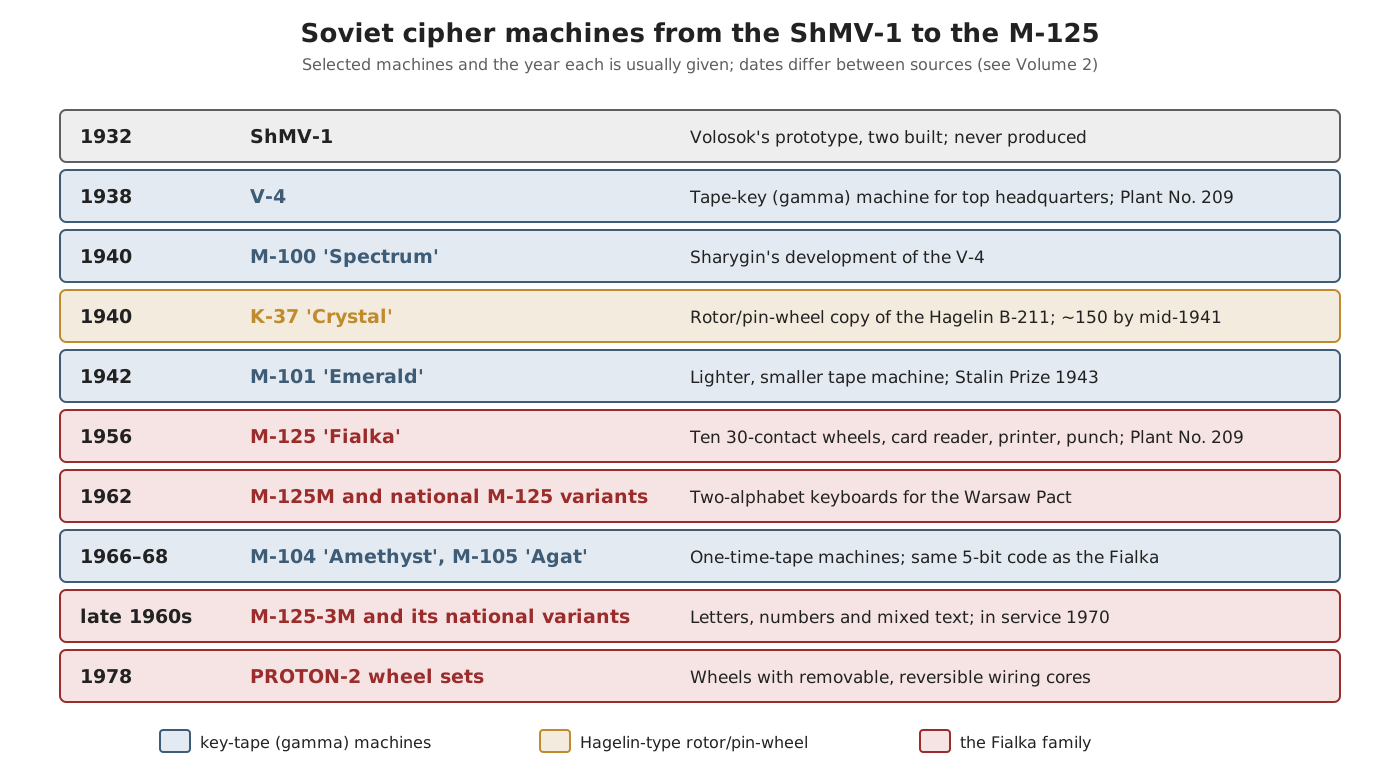
The plant’s first product was not a rotor machine. The V-4 was a key-tape machine, which Russian sources call a gamma machine (gamma is the Russian term for a keystream). It added a random key, punched on paper tape, to the message, much as the Vernam teleprinter ciphers did in the West. Design work took most of 1936, documentation was complete in 1937, and the People’s Commissar of Defence signed the order adopting it in May 1938. It entered service at the end of that year. N. M. Sharygin then produced a developed version, generally known as the M-100 “Spectrum” (Spektr), in service alongside the V-4 from 1940. Later came a lighter and much smaller successor, the M-101 “Emerald” (Izumrud). The 2018 history credits it with halving the weight and cutting the bulk sixfold. Its designers received a Stalin Prize in the spring of 1943 for a machine that, in the words of the citation as reported, guaranteed that enciphered telegraph traffic could not be read (BIS 2018). The sources are not fully consistent on which name belongs to which development stage, and this volume does not try to settle that.
These were first-generation machines for the highest headquarters, where strategic and operational traffic flowed. According to the same history they saw use in the Spanish Civil War, where two M-100s carried messages about the routes of Soviet ships, and in the fighting at Lake Khasan (1938), Khalkhin Gol (1939) and Finland (1939–40). In 1939 a hundred Studebaker buses were bought in the United States for conversion into mobile cipher offices. Five had been fitted out with a cipher operator’s station, a safe and a charging plant by December 1940. By the outbreak of war in June 1941 the cipher service had more than 150 K-37 machines and 96 M-100 sets in service and 1,857 staff. Machines had cut the time needed to process a cipher telegram by a factor of five or six.
The tape machines were secure if the tapes were truly random and never reused. That is the logic of the one-time pad, and it ran through Soviet high-grade cryptography for the rest of the century. The M-104 “Amethyst” and M-105 “Agat” one-time-tape machines of the later 1960s were issued across the Warsaw Pact. As Volume 4 shows, they used the same five-hole tape code as the Fialka (Crypto Museum, M-105). Tape machines had one great drawback, though. Every message consumed key tape, and the tape had to be manufactured, distributed, guarded and destroyed in quantities that grew with the traffic. For the large volume of military traffic below the very top, the Soviet Union needed a machine that produced its own key.
2.5 The K-37: A Hagelin Machine Copied for the Front
The first Soviet answer was to copy a foreign machine. Before the war the Soviet trade mission in Stockholm bought two machines from Boris Hagelin’s company. Hagelin recalled the deal in his memoirs:
I also might mention that I was obliged before the War to sell “two cipher machines” to the Russian Trade Commission in Stockholm (according to the purchase order). I sold them two B-211 machines which we had in stock in Stockholm. The machines were copied in Russia and used during World War II.
(Boris Hagelin, memoirs, p. 22, quoted by the Crypto Museum, K-37.)
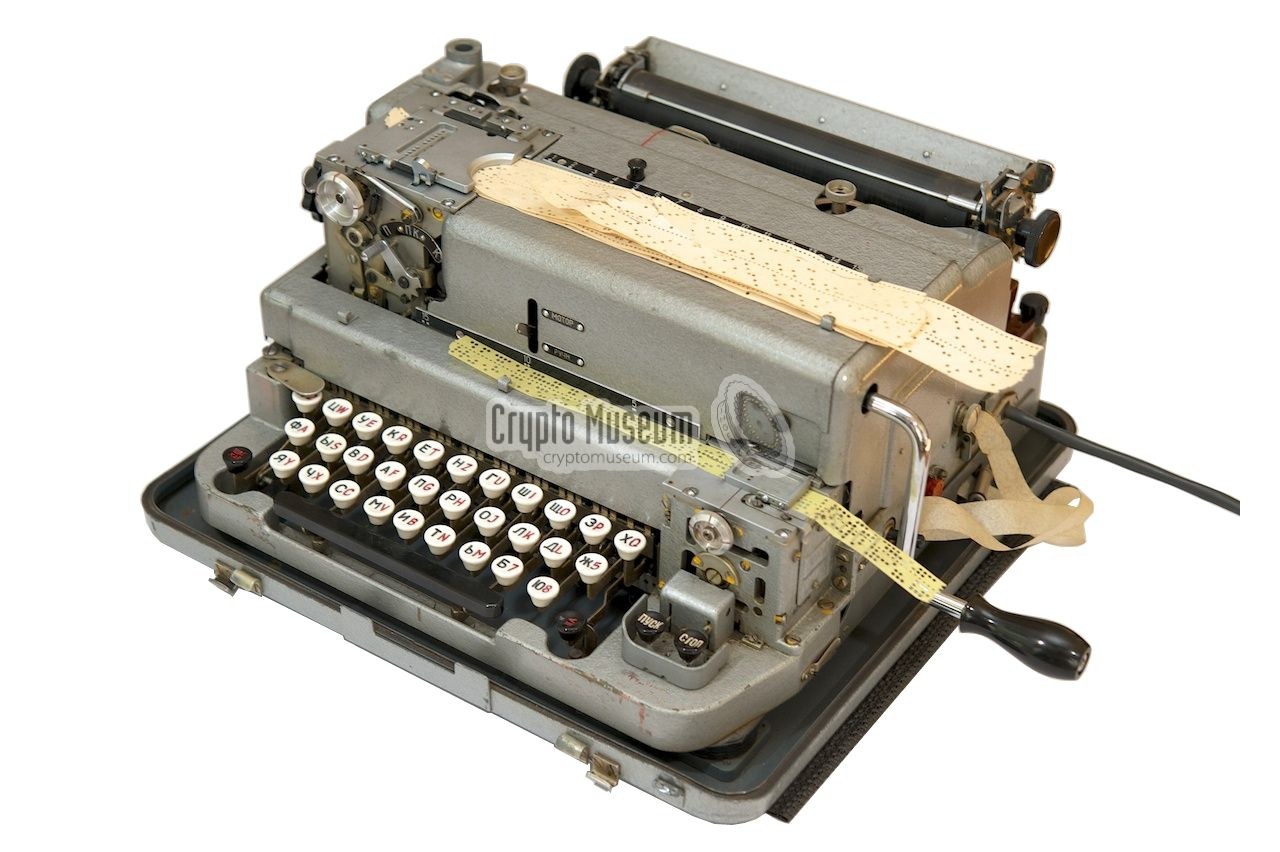
The B-211 was an electrical printing cipher machine of 1932. It combined Hagelin’s pin-wheels with a switching matrix that substituted letters, and it printed its result on paper strip. The French army bought more than five hundred. The Soviet copy, the K-37 “Crystal” (Kristall), used a 5 × 6 matrix in place of the B-211’s 5 × 5, so that it could handle thirty Cyrillic letters. The Russian designers dropped three rare letters, as they would again in the Fialka. They also brought the matrix’s plugging out of the machine to a separate box, so that it could be set without opening the case. The 2018 history credits the design to V. N. Rytov, who built a model in 1937 using the B-211 as the prototype, and says the machine was adopted after troop trials in 1939 and that a hundred sets were made in 1940. The Crypto Museum’s account has production at Plant No. 209 from mid-1940, about 150 machines by the summer of 1941, and wartime production at the evacuated branch, Plant No. 707, in Sverdlovsk in 1942–45. The K-37 served in army networks from 1941 to 1948, partly replacing the commanders’ hand code (BIS 2018; Crypto Museum).
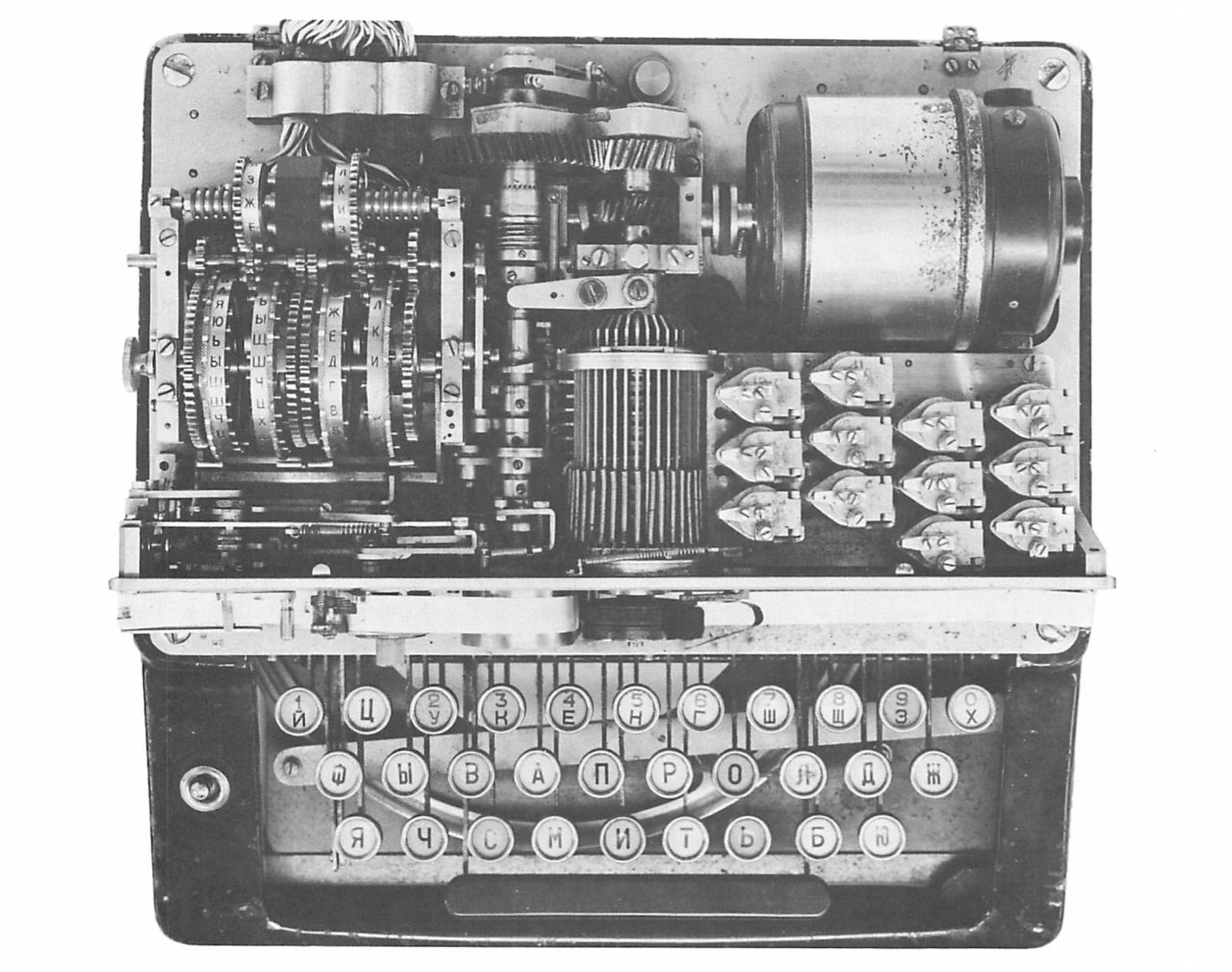
The K-37 is the closest thing the Fialka had to a direct ancestor in Soviet service. It was a wheel-driven machine that printed on paper strip, with a keyboard of thirty Cyrillic letters and part of its setting plugged in from outside. It also carries the clearest lesson of the period, because it was read twice.
The first reader was Germany. Otto Buggisch of OKW/Chi, the German armed forces’ cipher bureau, told Allied interrogators after the war that the Germans had captured and examined a K-37 in 1941 and could solve it given a crib of about ten letters. A German report of 1942 on the captured machine, translated by the American Armed Forces Security Agency in 1950, described a cable to an external plugging box that had been missing from the captured example (Crypto Museum, K-37, citing the TICOM interrogations).
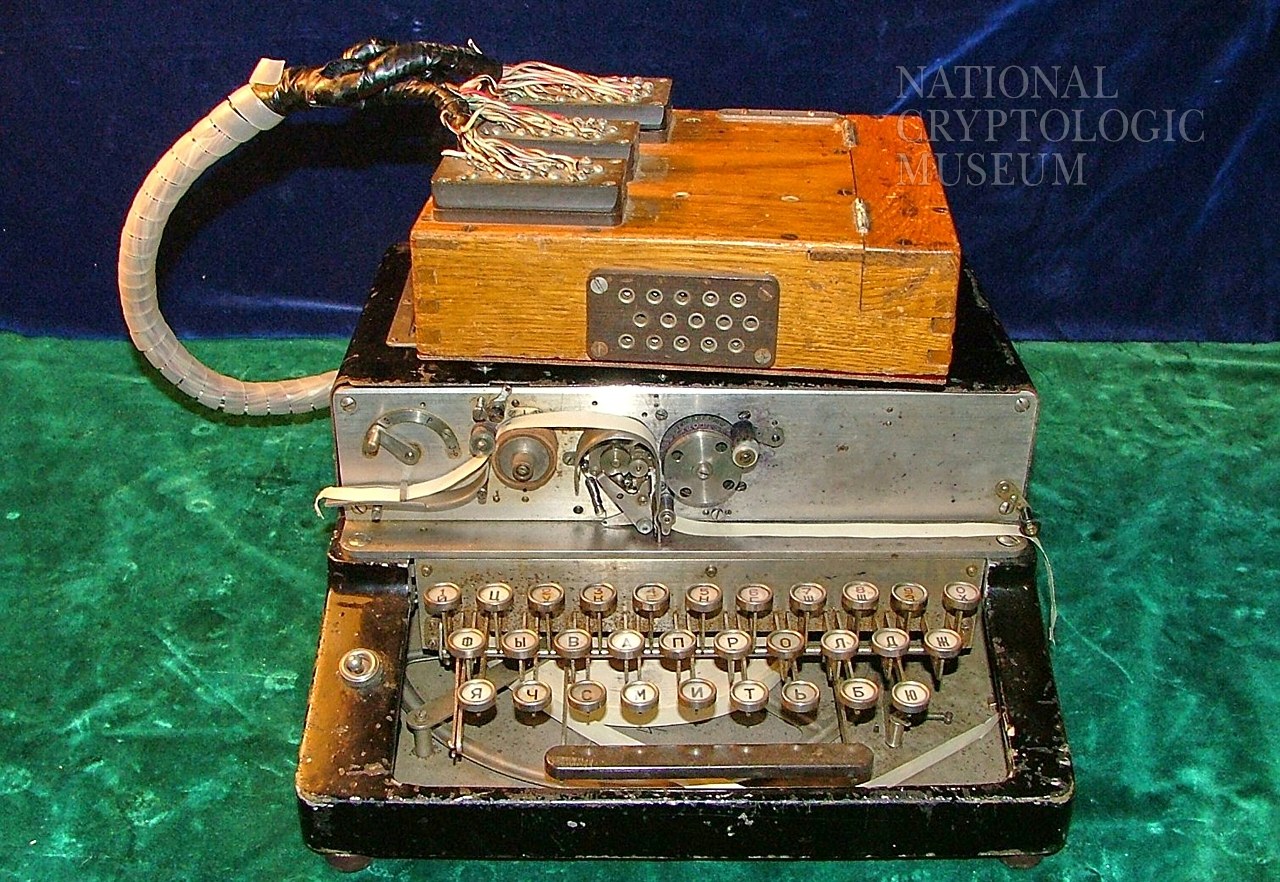
The second reader was the United States. The American codebreakers gave the K-37 the cover name SAUTERNE. According to the Crypto Museum, they read it from 1946 until it was withdrawn in 1947. A complete K-37, with its external plugging box, turned up in 2021 in the stores of the National Security Agency’s National Cryptologic Museum. It is the same machine that appears in Hagelin’s photograph.
2.6 1948: The West Goes Dark
The Soviet side of the story after 1945 is still largely classified. The Western side is better known, and it helps explain what the M-125 was designed against.
In the first years after the war American and British codebreakers read a good deal of Soviet traffic. They exploited machine systems like SAUTERNE and the reuse of one-time pads that underlies the famous Venona decryptions. Then, around the end of October 1948, almost all of it stopped. Soviet military, naval and police networks changed their systems at once. Some circuits carried only dummy traffic for a time, and in London and Washington there were fears that the change signalled preparations for war. American codebreakers called it “Black Friday”. The NSA’s own historians and the journalist Stephen Budiansky, whose Code Warriors (2016) is the fullest account, both treat it as the moment the West lost its view into high-level Soviet communications. Budiansky argues that it never fully regained that view. The change is usually connected with the work of Soviet agents inside the Western agencies, notably William Weisband in the American Army Security Agency (NSA, “The Soviet Problem”, History Today, July 2018; Budiansky 2016).
Black Friday was a change of systems, not the arrival of the Fialka, which came several years later. It shows the Soviet attitude that shaped the M-125, however. The Soviet leadership knew, from its own agents, that its wartime systems had been read. Some popular accounts claim that the Fialka was designed with detailed knowledge of the Enigma’s weaknesses, passed to Moscow by John Cairncross, the Soviet agent who worked at Bletchley Park in 1942–43. Reuvers and Simons raise that idea in their reference manual. It is plausible, but nothing published shows a direct line from Cairncross’s material to the M-125’s design (Reuvers & Simons 2009, 1.2.1; Library copy). What can be said is that the Soviet cipher service had first-hand experience of its own machines being broken, both by the Germans with the K-37 and, as its agents would have told it, by the Americans. The weaknesses the M-125 removed were also the textbook weaknesses of wartime rotor machines, the Enigma’s above all. Volume 7 returns to the question.
2.7 The Post-War Generation
The decade after the war brought a burst of new Soviet cipher equipment. The Crypto Museum’s list of known Soviet machines, compiled from Russian sources, includes the M-102 “Malachite” (given as 1945), the M-150 “Ruby” (1946), the M-152 “Granite” and M-103 “Malachite-2M” (1952), and the M-153 “Amethyst-A”, M-161 “Apatite” and M-111 “Marble” (1955) (Crypto Museum, USSR). Most are known only by name and date. The Moscow Museum of Cryptography displays some of them, including the TS-25 “Sail” (Parus) of 1950 and the “Apatite” of 1955 (Vechernyaya Moskva). The names come from minerals and gemstones, and the Fialka fits the habit of giving machines harmless code names, even if a violet is a flower rather than a stone.
That museum is itself part of the story. It occupies buildings in north Moscow that from 1946 housed the Marfino sharashka, a prison research institute where convicted scientists and engineers worked on secure telephony. Aleksandr Solzhenitsyn, one of its prisoners, described it in In the First Circle. The institute later became the research institute “Avtomatika”, the core of the present Avtomatika concern, which built the museum (Vechernyaya Moskva). Post-war Soviet cryptographic engineering was thus spread across several institutions: the Leningrad plant for machines, Moscow institutes for speech and electronic systems, and the cryptographic services of the Ministry of Defence and, from 1954, the KGB, whose Eighth Chief Directorate eventually took charge of government ciphers. Which of them set the requirement for the M-125 is not stated in any published source.
2.8 Designing the M-125
What is known about the design comes from one Russian institution and a set of surviving machines.
According to the Moscow Museum of Cryptography, the first model, the M-125, was developed in the 1950s at Leningrad’s Plant No. 209 under its chief designer Nikolai Gyrdymov, to an order from the Soviet Armed Forces. “Fialka” was the codeword used in discussion and correspondence during development. The museum suggests it was chosen because the machine was relatively small. The word later came to mean the cipher procedure as well. A modernised version, the M-125M (“Fialka-M”), followed in the early 1960s, and the M-125-3M (“Fialka-3M”) in the late 1960s, accepted into Soviet Army service in 1970. All of them were produced by the Leningrad printing-machinery works, Lenpoligrafmash (Museum of Cryptography; Metro, 15 November 2021). That a printing-machinery works built a cipher machine with a built-in printer and type wheel is less odd than it sounds. Building the printer, punch and tape reader was as much of the job as building the drum.
Gyrdymov’s name has not been found in any other published source, Russian or Western, and nothing is known of his team. The museum’s account is the best available, and the series follows it. A fuller history will have to wait for Russian archives.
The surviving machines show what the designers were aiming at. They kept the general layout of the Enigma and of Western rotor machines: wired wheels on a spindle, an entry disc and a reflector. They added the K-37’s Russian practice of a thirty-letter alphabet and a printed tape output. Then they changed almost everything that had made earlier rotor machines breakable:
- Ten wheels instead of three, four or five.
- Irregular stepping, with neighbouring wheels turning in opposite directions and blocking pins deciding which ones moved.
- A punched-card reader in place of a plugboard, giving a full and non-reciprocal permutation that changed daily.
- A reflector arranged so that a letter could encipher to itself.
- Country-specific wheel wiring, so that the capture of one ally’s wheels did not compromise another’s traffic.
- A complete off-line terminal: printer, punch and tape reader in one box, so that a message could be enciphered, checked and handed over as tape with nobody copying letters from a lamp board.
Volume 3 describes the wheels and stepping and Volume 4 the rest of the signal path.
2.9 When Did It Enter Service?
Most popular accounts say “1956”. The truth is less tidy. The table sets out the dates given by sources that can be traced.
Table 1 — When Did It Enter Service?
| Source | Date given | Notes |
|---|---|---|
| Crypto Museum, website (current) | “Introduced in 1956”; Russian M-125 “used from 1956 onwards” | The most widely repeated date |
| Foreign Policy, 2019 | Introduced 1956 | Probably follows the Crypto Museum |
| US Air Force / National Cryptologic Museum display, 2011 | ”Developed … in the late 1950’s”; “first went into operation in 1959, officials said” | Machine on loan from the NSA’s museum |
| Moscow Museum of Cryptography | First model created “in the 1950s”; M-125M early 1960s; M-125-3M in service 1970 | The only source naming the designer |
| Butyrsky et al., 2018 | Entered service “from 1962” in the USSR and socialist countries | Russian history of Soviet machine cryptography |
| Reuvers & Simons, manual v2.0, 2009 | ”First introduced around 1965” | Written before Russian machines surfaced; since revised by the same authors |
Two explanations fit most of the evidence. One is that the M-125 was developed and first issued inside the Soviet Union in the second half of the 1950s, and that the version with a second alphabet for the allies followed in the early 1960s. That would explain both 1956–59 and 1962. The other is that “1956” marks the end of development rather than general issue. The Moscow museum’s own catalogue, for its later machines, separates “end of development” from “start of series production”. Both may be true. This series uses “about 1956” for the M-125 and “late 1960s, in service 1970” for the M-125-3M, and marks any earlier date as approximate.
2.10 To the Allies
The Warsaw Pact was founded in May 1955. Its armies had to be able to communicate securely, with Moscow and, in war, with one another. The Fialka was the Soviet answer for written traffic, but it was supplied on Soviet terms.
The national versions began with the M-125 itself. The thirty Cyrillic letters stayed where they were on every keyboard, and a second, Latin alphabet in the local language was added. For Poland, Czechoslovakia and East Germany, the keyboard and print head carried that country’s letters. The wheels for each country were wired differently, and Moscow made them. The Crypto Museum describes the machines as supplied to the allies on a lend-lease basis from the early 1960s, still Soviet property and to be returned. That condition explains much of what happened in the 1990s, told in Volume 8. Peacetime traffic between allies was not supposed to pass directly from one national Fialka network to another. It went through the Soviet side. A common wheel set was apparently held in reserve for war (Crypto Museum, wheels; Reuvers & Simons 2009, 1.2.6; Library copy).
East Germany shows how long the arrangement lasted. The National People’s Army issued its own operating instructions for the “FIALKA system” in 1970 (reference GVS-XI/897/70). In 1978 these were replaced by a new manual, A 040/1/321, which renamed the procedure “M-125”. That manual is now the most complete source on how the machine was used, and Volume 6 is built on it. By then the M-125-3 had replaced the original model in most networks. Its PROTON-2 wheels with removable cores were on their way, and the machine had another decade of service ahead. Volume 5 sorts out the models and Volume 6 the procedure.
2.11 What Remains Unknown
A good deal remains unknown. No design documents for the M-125 have been published. The requirement it was built to meet, the cryptographic analysis that justified ten wheels and blocking pins, and the reasons for its particular wiring are all unknown outside Russia. So is the number of machines made, and so is the identity of most of the people who designed it. Nikolai Gyrdymov is a name and a title. Even the internal Soviet designation scheme is only partly understood: Western researchers do not know what the suffix letters in names like M-125-3MN stand for, or whether they are Latin or Cyrillic.
What is known comes from the outside: the machines, the East German manual, a handful of Polish and Czech documents, and the reverse engineering described in Volume 8. The Moscow museum’s opening in 2021, with a declassified Fialka, suggests that more may yet come from Russian archives.
Sources
- L. Butyrsky, S. Golovanov, G. Emelyanov and D. Larin, “Пионеры отечественной машинной криптографии” (Pioneers of Soviet machine cryptography), BIS Journal, 15 November 2018, journal.ib-bank.ru (citing Dadukov 2006 and Bulatov 2008).
- Museum of Cryptography, Moscow, “Шифровально-кодировочная машина М-125-3М, «Фиалка-3М»”, cryptography-museum.ru.
- “Рассекретили легендарную советскую шифрмашину” (interview with Egor Efremov, Museum of Cryptography), Vechernyaya Moskva / Pressa v obrazovanii, edupressa.vm.ru.
- Anna Zhukova, “Русская шифровальная машина оставалась засекреченной до недавнего времени”, Metro, 15 November 2021, x-holding.ru.
- Crypto Museum, “K-37 Crystal”, “USSR”, “M-105 Agat” and “M-125 Fialka” pages, cryptomuseum.com (read November 2026).
- Paul Reuvers and Marc Simons, Fialka M-125: Detailed description of the Russian Fialka cipher machines (Library copy), v2.0, 2009, PDF.
- Nationale Volksarmee, A 040/1/321 — M-125 Nutzung, 1978, English translation (Library copy).
- US Air Force ISR Agency, “AFISRA debuts one-of-a-kind cryptologic display”, September 2011, af.mil.
- National Security Agency, “The Soviet Problem, Old Poets, and the End of Mata Hari”, History Today, 23 July 2018.
- Stephen Budiansky, Code Warriors: NSA’s Codebreakers and the Secret Intelligence War Against the Soviet Union (Knopf, 2016).
- Boris C. W. Hagelin, The Story of the Hagelin Cryptos (memoirs), as quoted by the Crypto Museum.
Next — Volume 3: How It Works I — Ten Rotors, Alternate Stepping and the Blocking Pins. What lies inside the drum: ten wheels with thirty contacts a side, each engraved with the Cyrillic alphabet and carrying its own pattern of blocking pins; the two wheels that step on every key press; the chain of blocking pins that lets the others move or holds them still; and the 1978 PROTON-2 wheels, whose wiring cores could be turned over and moved from one wheel to another.
Comments (0)