Apple-1 · Volume 9
Apple-1 — Volume 9 — The Replicas — Re-Making the Apple-1
From Vince Briel's Replica 1 to board-for-board reproductions stuffed with 1970s chips: who has re-made the Apple-1, how close each comes to the machine of 1976, and what can actually be bought in October 2026
9.1 About This Volume
There are perhaps eighty original Apple-1s, and they sell for hundreds of thousands of dollars (Volumes 6 and 7). There are many more Apple-1 replicas — one experienced builder, Uncle Bernie of the applefritter forum, estimates fewer than a thousand Apple-1 clones worldwide — and some of them can be bought for the price of a dinner out. This volume surveys them: what each one is, who designed it, what is inside it, how faithful it is to the 1976 board, what it costs, and whether it can actually be bought.
That last question has a date attached. Every price and availability statement in this volume was read from the vendor’s own page on 28 October 2026, and is given as the page showed it. Replicas come and go with their makers’ circumstances, and several of the most important ones are, on that date, out of stock. Where a page could not be read, the text says so.
The volume runs from the most accessible replicas to the most authentic: the different kinds of replica; Vince Briel’s Replica 1, the workalike that started the field; the reproduction boards that copy the original layout; the period parts that fill them; single-board and modern takes; emulators and FPGA cores; and the question every replica faces, the monitor and BASIC code. A comparison table and a short guide to choosing close it. Volume 10 then builds one.
9.2 Three Kinds of Replica
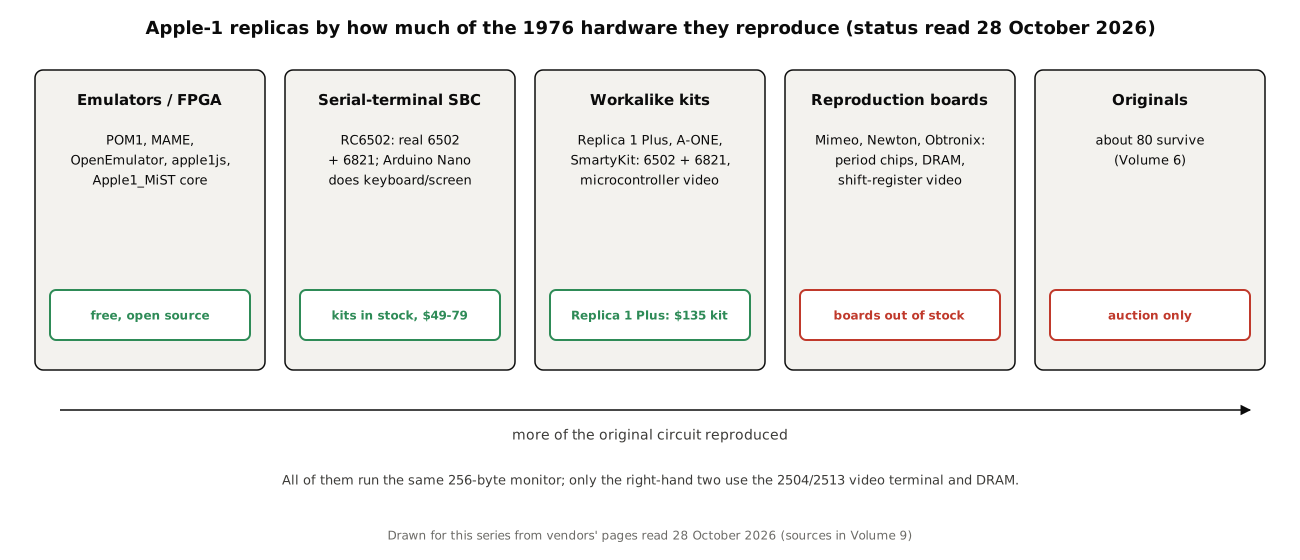
“Replica” covers a wide range. The useful distinction is how much of the 1976 circuit is reproduced.
- Emulators and FPGA cores reproduce the machine’s behaviour in software or programmable logic. They need no soldering and cost nothing or little.
- Workalikes use a real 6502 processor and a real 6820-family interface adapter at the original addresses, and run the original software, but replace the Apple-1’s shift-register video terminal and dynamic memory with modern parts — usually a microcontroller generating the video and reading a modern keyboard, and a single static RAM chip. The Briel Replica 1 is the archetype.
- Reproductions copy the original printed circuit board, hole for hole, and are populated with the same 1970s chips: MK4096 dynamic RAMs, Signetics 2504 shift registers, a 2513 character generator, an LM323K regulator, transformers off the board. Electrically they are Apple-1s. The Mimeo, the Newton boards and the Obtronix are of this kind.
Corey Cohen, the Apple-1 evaluator who now sells the Mimeo, draws the same line, calling the Briel boards “workalikes” and the copies of the board “reproductions” (myapplecomputer.net, Apple-1 replicas).
9.3 The Workalike: Briel’s Replica 1
9.3.1 Origins
Vince Briel, a hobbyist engineer, began the project publicly in March 2002 with a post on applefritter, built the first prototypes in August 2003 and the first production Replica 1 boards in October 2003 (Replica 1 Plus manual, “Forward,” June 2014, ReActiveMicro wiki). The question that made it possible was the ROM. Briel’s manual tells how a high-school friend “contacted Woz through his webmaster asking for permission to use the Apple 1 code,” and Wozniak gave it; the press at the time reported that Apple itself “declined to comment” (MacTech, 8 Sept. 2003). The introductory price is reported as $149 by Wikipedia and as about $200 in the 2003 press coverage; the sources disagree.
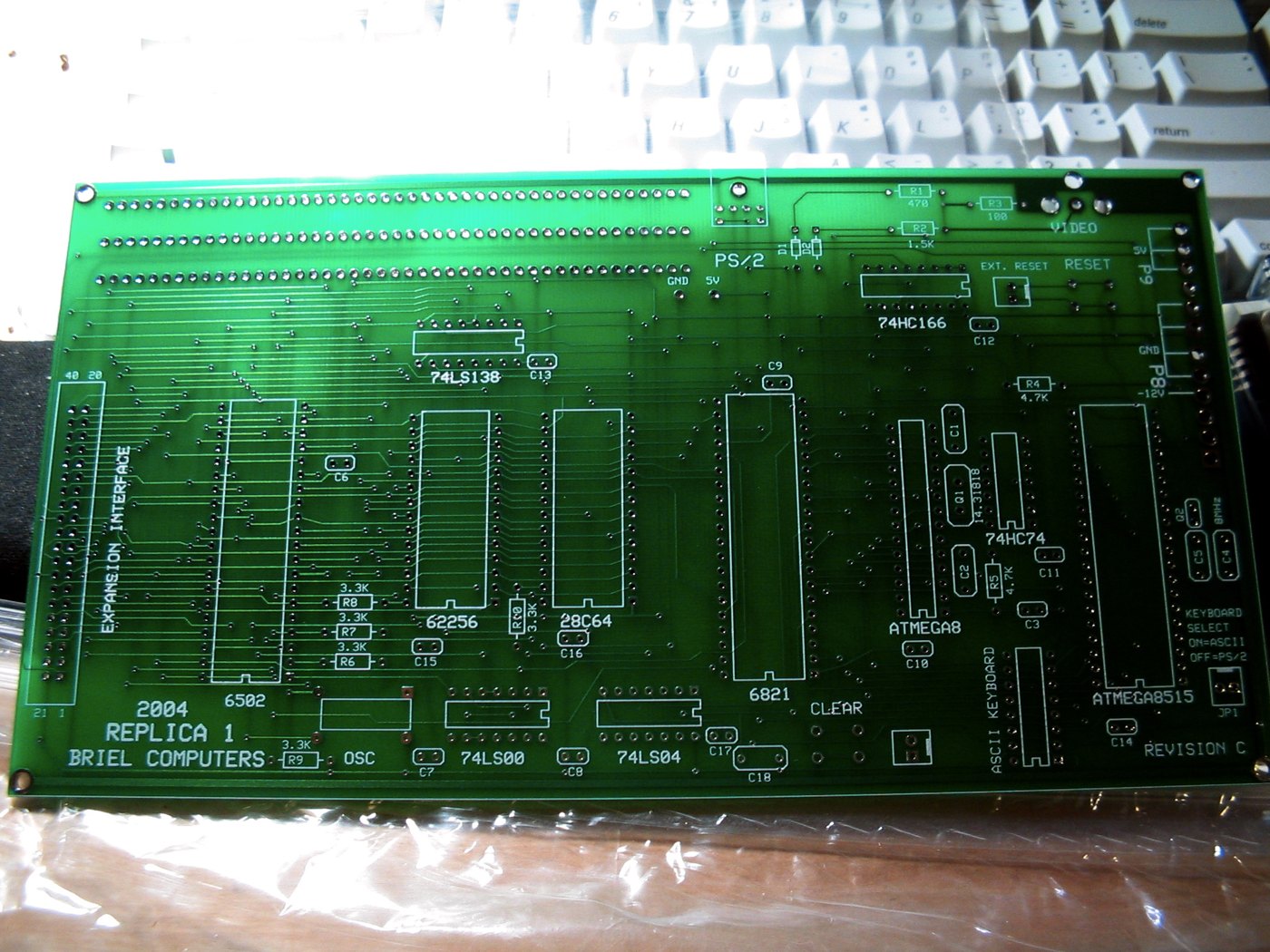
The design kept what a programmer sees — a 6502 at the processor’s address, a 6821 interface adapter at $D010–$D013, the Woz Monitor at $FF00 and Apple BASIC at $E000 — and replaced what a programmer does not see. The first Replica 1 generated its video and read its keyboard with Atmel AVR microcontrollers and had 32K of static RAM in a single 62256 chip.
9.3.2 The family
Table 1 — The family
| Version | Year | What changed |
|---|---|---|
| Replica 1 | 2003–05 | AVR microcontrollers for video and keyboard; 32K SRAM; Woz Monitor and Integer BASIC in ROM |
| SE (Second Edition) | 2006 | ATX power or a DC jack; built-in serial port; Ken Wessen’s Krusader assembler added to ROM |
| TE (Third Edition) | 2008 | Video and keyboard moved to a single Parallax Propeller microcontroller; an Apple-1-compatible 44-pin slot |
| TEN (Tenth Anniversary) | 2013 | Limited run of 50, red board |
| Plus | 2014 | USB for power and serial; ROM switch between Woz Monitor + Integer BASIC + Krusader and an “Applesoft-lite” |
| 20th Anniversary | 2023 (design files) | 65C816 processor, VGA 80 × 24; published under the MIT licence on GitHub; no evidence it was ever sold |
(Sources: Wikipedia, Replica 1; ReActiveMicro wiki, Replica 1; github.com/Retrotink/replica-1-20.)
9.3.3 Briel Computers today
Briel Computers no longer trades. On 28 October 2026 brielcomputers.com redirects to a GitHub profile that describes itself as “Formally Briel Computers, now an open source repository for my years of engineering work” (github.com/Retrotink). Briel had stopped production in 2015; in 2017 the Apple II specialist ReActiveMicro agreed to make the Replica 1 Plus, describing its version as “a direct reproduction with no design changes,” and it has been his authorised partner since March 2018 (ReActiveMicro, 1 March 2018).
As of 28 October 2026, ReActiveMicro’s product page lists the “Replica 1 Plus from Briel Computers – Assembled or Kit” at $135.00 (kit) to $184.99 (assembled), with an “Add to cart” button and no stock statement (ReActiveMicro). The same store lists a $10 power supply, a $6 USB-to-PS/2 adapter, a “Unified Retro Keyboard for Apple II and Replica 1” at $175–235, and the CFFA1 compact-flash storage card for the Apple-1 bus at $160.
9.3.4 Inside the Replica 1 Plus
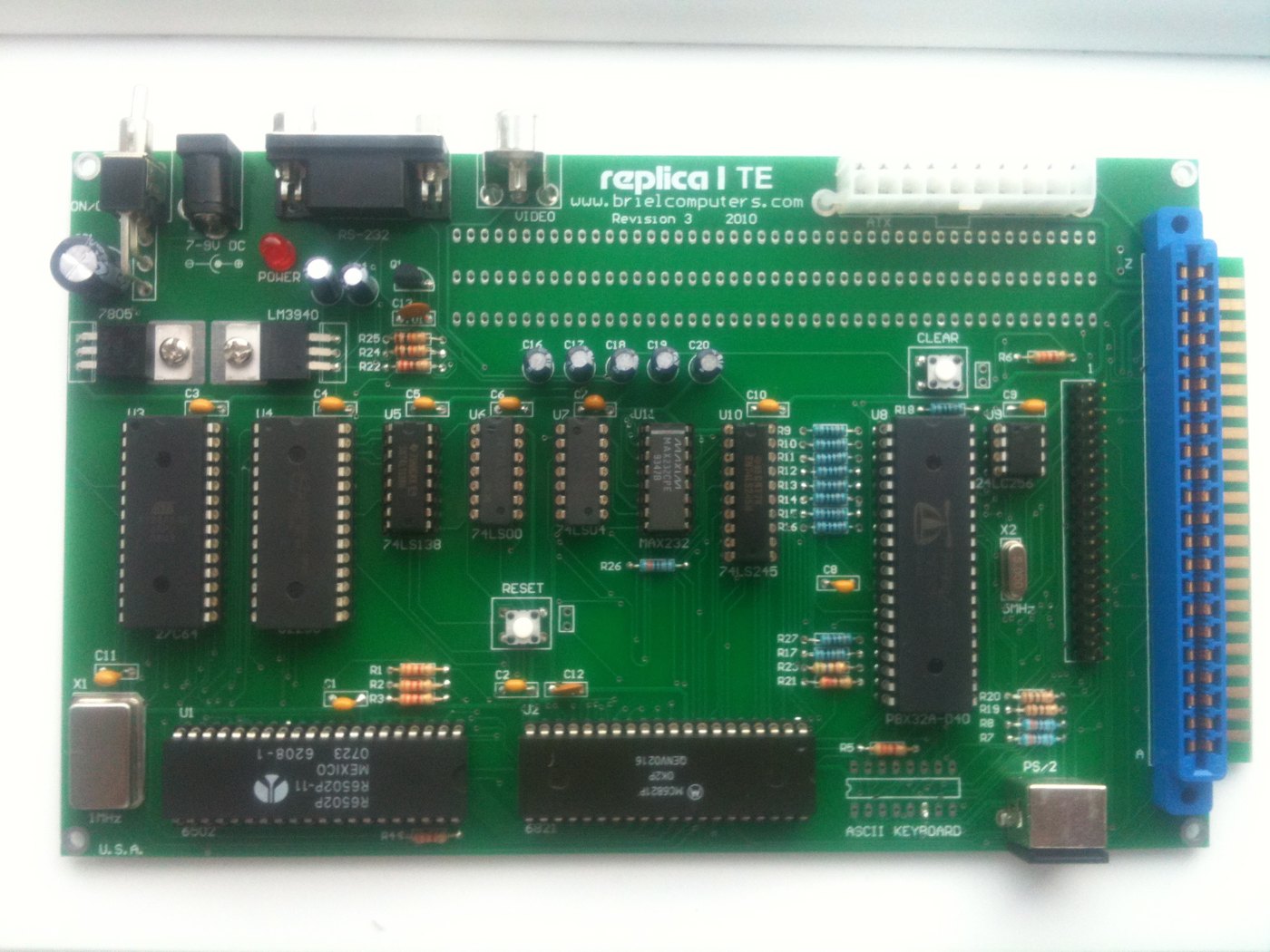
The kit list in the 2014 manual is short: a 6502 (or 65C02), a 6821 PIA, a 27C128 EPROM holding the ROM images, a 62256 32K static RAM, a Parallax P8X32A Propeller, a 24LC256 serial EEPROM for the Propeller’s program, a 74LS00 and a 74LS138, a 5 MHz crystal, and an FT232 USB module; “Only 8 IC chips are now on the replica 1 plus the serial USB adapter.” It produces composite video (the manual notes PAL is “not tested”), takes a PS/2 keyboard or an ASCII keyboard, and runs from USB. It has no cassette interface, but its 44-pin slot accepts Apple-1 cards; a user on applefritter reports that “the Replica 1 Plus is fully compatible with Uncle Bernie’s New Gen2 / Revised ACI card” (applefritter, node 32744).
What it is not is an Apple-1 circuit. There are no 2504 shift registers, no DRAM, no refresh, no 2513; the screen comes from the Propeller, programmed to imitate the original terminal’s 40 × 24 upper-case screen. For a programmer this is almost indistinguishable. For a hardware historian it is a different machine.
9.4 Reproductions: Copying the Board
9.4.1 Obtronix
The first board-level reproduction is generally credited to Steve Gabaly’s Obtronix in the mid-2000s, sold in small batches on eBay — a2central reported in 2008 that “Obtronix is auctioning off 10 more build-it-yourself Apple 1 reproduction kits” (a2central, Oct. 2008). Cohen calls it “the rarest of reproductions,” notes that its layout was redrawn in modern software, and says Obtronix boards can be recognised by the absence of a copyright line under the Apple logo. They are long discontinued.
9.4.2 Mimeo and Super Mimeo
Mike Willegal created the Mimeo in 2009 as “the 1st hyper accurate reproduction of the Apple-1 computer,” working from “hi-resolution photographs of a later NTI board, adapted to represent the early ‘Byte-Shop’ units” (Cohen, myapplecomputer.net). It was sold from 2010. Willegal’s own page gives the board’s vital statistics — 15.5 by 9 inches, two layers, 1,720 holes, 221 components and 59 sockets — and now says he is “not currently selling Mimeo PCBs or related Apple 1 components,” referring buyers to Cohen (willegal.net, Apple 1 kit). Cohen’s Super Mimeo uses a whiter board material to approximate the early Byte Shop boards, and his page claims “Most accurate Apple-1 reproduction available, even the mounting holes match,” “Every board is electronically ‘bed of nails’ tested,” and “over 160 boards sold,” adding that Mimeos have appeared “in all major Movies and TV shows to feature the Apple-1.”
As of 28 October 2026, the order page lists a “Bare Super Mimeo PCB, Cassette Interface PCB and full set of compatible proms (full bundle)” at $320, plus $30 shipping within the continental US — and states, above it, “Currently I am out of stock on all Mimeo boards while I look for a new US based manufacturer due to COVID-19” (myapplecomputer.net, order). The note is evidently from 2020 or later and has not been updated; on the day it was read, the Mimeo could not be ordered. Willegal’s assembly and bring-up guide, the most thorough published procedure for building any Apple-1 reproduction, remains on his site (Volume 10).
9.4.3 The Newton boards
Michael Ng (“NewtonMike”) made two reproduction boards: the Newton-1, after the first-run boards, and the Newton NTI, after the second-run boards marked NTI, with extra jumper options for cassette and peripheral compatibility (applefritter Apple-1 box, Newton NTI). In June 2022 he offered a motherboard and cassette-card bundle at $95 direct or $115 on eBay and wrote “I consider this to be the last batch” (applefritter, node 32739). No later offer was found; they should be treated as unavailable.
9.5 Period Parts
A reproduction board is only as authentic as the chips in it, and the chips are fifty years old.
Unicorn Electronics sells complete parts kits. As of 28 October 2026, its Apple-1 page lists an “Apple 1 Parts Kit” at 666.66 — “No board or ROMS,” but “all components, transformers & connectors,” with MK4096 memory, carbon-composition resistors and machine-pin sockets — and an “Apple 1A Parts Kit” at 559.99, with MK4027 memory and stamped sockets (“Whenever possible, we use period correct parts”). Neither page states stock. Individual parts are listed too: Signetics 2504V shift registers at $17.99, the 2519 and the 2513-equivalent character generator at $49.99, Sprague 2,400 µF and 5,300 µF filter capacitors at $34.99 each, and the Stancor P-8380 and P-8667 transformers at $109.99 and $49.99, with the note “Parts are limited quantities” (Unicorn Electronics, Apple 1). Builders on applefritter caution that Unicorn’s ICs are not tested; one reported that “every time I bought a 2504 kit from him one was not working,” replaced on request (applefritter, node 33613).
Uncle Bernie, the most prolific Apple-1 clone builder on applefritter, sold fully tested, burned-in IC kits and special diagnostic PROMs for builders of Mimeo and Newton boards. In August 2023 he wrote that “my kits … are sold out,” and that he did not expect many more, because the critical chips are dwindling or command “moon prices” (applefritter, node 33400). He also designed improved cassette cards — a “Gen1” ACI in 2022 with a working level indicator and Apple-II-style checksums, and a “Gen2” with a reworked tape-input stage — and advises against building a verbatim copy of the original ACI (applefritter, node 32048).
Counterfeits are a real hazard. Builders report fake DS0025 clock drivers, 6502s, 2504s, 2513s and 2519s in circulation, and the LM323K regulator has become expensive because only Texas Instruments still made it (applefritter, node 32541). A reproduction built today is, unavoidably, a collection of parts bought from strangers.
9.6 Single-Board and Modern Takes
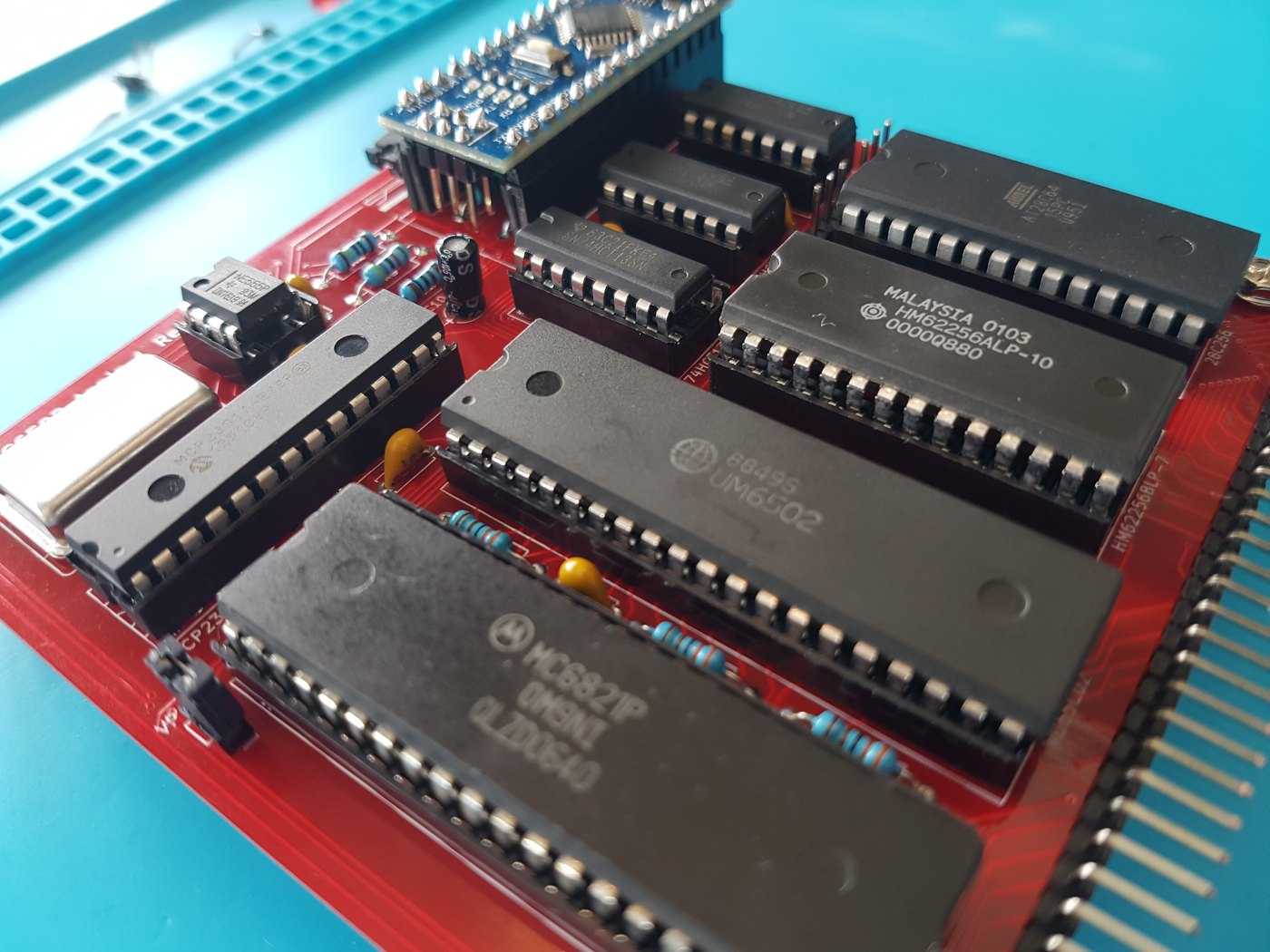
RC6502 Apple 1 Replica. An open-source design by the Norwegian builder “tebl,” published on GitHub under the GPL in 2017 and inspired by Tom Owad’s book Apple 1 Replica Creation (github.com/tebl/RC6502-Apple-1-Replica). It uses a 6502, an MC6821, a 62256 RAM and an EEPROM holding the original firmware, but no video circuit at all: “to keep things simple we are instead using an Arduino Nano to replace these parts,” so the Apple-1’s keyboard and screen become a terminal program on a PC over USB. It comes as a single board or as a backplane system. As of 28 October 2026, Tindie listings show the Rev H PCB and IC kit at $49 (“Only 6 left in stock”) and a fully assembled Rev H at $79 (“Only 1 left”) from the seller 74S00, and an assembled RC6502 SBC at $79 (“Only 7 left”) from Denjhang’s Retro Hardware (Tindie, 74S00; Tindie, Denjhang).
A-ONE. Two different products share the name. Franz Achatz’s A-ONE (Achatz Electronics, Netherlands, 2006) was a compact 6502/6821 board with an ATmega32 for video and an ATtiny for a PS/2 keyboard; it is no longer made (manual at the Internet Archive). Denjhang’s Retro Hardware in Malaysia now sells an “A-ONE – Apple 1 Mini SBC,” $139.00, “Only 7 left in stock” on 28 October 2026, which runs the original monitor with a PS/2 keyboard and supports the expansion bus; its chip list is not given on the page (Tindie).
SmartyKit. A New York company’s solderless kit, announced at CES in January 2020, builds an Apple-1 workalike on breadboards “With genuine WDC 6502 processor,” using AVR microcontrollers for the keyboard and the video (smartykit.io). Its site is live and lists two versions, “SmartyKit” and “SmartyKit Black (Limited edition).” Its current price and stock could not be read on 28 October 2026: every request for a product page was refused with “too many requests.” Press reports at launch gave prices between $99 and $119.
Others. Ruud van Falier’s “Apple 1 Mini” (a 6821 and an Arduino Nano) and Jason Putnam’s PE6502 (2017; 32K RAM, 16K ROM, PS/2) both appeared as small kits; neither could be confirmed as available on 28 October 2026 (the Tindie listing for the first returned an error, and Putnam Electronics’ site refused the connection). Many builders also run the Woz Monitor on Ben Eater’s 6502 breadboard computer, which is a 6502 trainer rather than an Apple-1. And 2026, the fiftieth anniversary, has produced one-off scratch builds documented in detail, such as a reproduction finished in March 2026 and written up on applefritter (node 39632).
9.7 Emulators and FPGA Cores
Software emulators are the cheapest replica of all. POM1, first written in Java by Verhille Arnaud and ported to C by John D. Corrado, was the long-standing desktop choice; MAME includes an apple1 driver whose model of the terminal this series follows (Volume 3); OpenEmulator emulates the Apple-1, the Replica 1 and the A-ONE with the cassette interface; apple1js runs in a browser. All of them load the original ROM images. For FPGA boards, Nino Porcino’s Apple1_MiST core for the MiST and SiDi runs the Woz Monitor and a working audio cassette interface (Apple1_MiST).
This series’ own model, apple1_sim.py (Volumes 5 and 11), is a different kind of thing. It does not load Apple’s ROM; it reproduces the monitor’s documented behaviour on a tested 6502 core, which is enough to run and check every machine-code program in these volumes.
9.8 The ROM Question
Every Apple-1 replica faces the same problem: the 256-byte monitor and the 4K BASIC are Apple’s. The replicas’ answer has rested on Wozniak’s personal approval. Briel’s manual credits “Woz for … [giving] the ok” in 2003; contemporary reports said Wozniak “has given the go-ahead” while Briel’s requests to Apple “have gone unanswered” and an Apple spokesman “declined to comment” (MacTech, above). No formal licence from Apple has been published, and no separate permission was found for the replicas that followed, which ship the same code. Cohen’s view, posted on his site, is that the design was effectively given away at the Homebrew Computer Club; that is his opinion, not a legal finding. This series takes the conservative course of reproducing no Apple ROM bytes at all.
9.9 The Field on 28 October 2026
Table 2 — The Field on 28 October 2026
| Replica | Kind | Processor / I/O | Video | Price as shown | Status read 28 Oct 2026 |
|---|---|---|---|---|---|
| Replica 1 Plus (Briel / ReActiveMicro) | Workalike kit | 6502 or 65C02, 6821 | Propeller, composite | $135 kit, $184.99 assembled | Listed, “Add to cart” |
| Super Mimeo (Willegal / Cohen) | Reproduction PCB + ACI + PROMs | Period parts (builder supplies) | 2504/2519/2513 | $320 bundle | ”Out of stock on all Mimeo boards” |
| Newton NTI / Newton-1 | Reproduction PCB | Period parts | 2504/2519/2513 | $95–115 (2022) | “Last batch,” 2022 |
| Obtronix | Reproduction kit | Period parts | 2504/2519/2513 | — | Discontinued |
| Unicorn Apple 1 / 1A parts kits | Parts only | NOS period parts | — | 666.66 / 559.99 | Listed; stock not stated |
| Uncle Bernie IC kits, Gen1/Gen2 ACI | Tested parts, cassette cards | — | — | — | IC kits sold out (Aug 2023) |
| RC6502 Rev H (74S00) | Open-source SBC kit | 6502, MC6821 | None (USB terminal) | $49 kit, $79 assembled | 6 and 1 left |
| RC6502 SBC (Denjhang) | Assembled SBC | 6502, MC6821 | None (USB terminal) | $79 | 7 left |
| A-ONE Apple 1 Mini (Denjhang) | Assembled SBC | not listed | Monitor output | $139 | 7 left |
| SmartyKit / SmartyKit Black | Breadboard kit | WDC 6502 | AVR | not readable | Site live |
| Emulators, Apple1_MiST | Software / FPGA | — | — | Free | Available |
9.10 Choosing
The choice depends on what the replica is for.
- To program an Apple-1 — to type in hex, run the test program, write 6502 code and use Apple BASIC — any of them will do, and an emulator or the RC6502 will do it for the least money. Volume 11’s programs run on all of them.
- To have an Apple-1 on the desk that behaves like one, with a keyboard, a composite screen, the flashing ”@” and the 44-pin slot, and to build it from a kit in an evening or two, the Replica 1 Plus is the one complete kit on sale from an authorised maker, with a step-by-step manual. It is the “best available” kit in the sense Volume 10 uses: the one a reader can order today and finish.
- To own the circuit of 1976 — shift-register video, dynamic RAM, the LM323K on its heatsink, the transformers — only a reproduction board will do, and on 28 October 2026 none is in stock. The route is a reproduction board when one returns (or second-hand), Unicorn’s parts kit or individually sourced and tested chips, PROMs, and a long, careful bring-up. Uncle Bernie’s estimate for doing it carefully is $400–500 in parts beyond the board, before keyboard and case; with the Unicorn kit and a keyboard the total passes $1,200. Volume 10 describes that path too.
Next — Volume 10: Building an Apple-1 Replica. The Replica 1 Plus from bare board to backslash, stage by stage with a test at each; then the reproduction route, Willegal’s bring-up method for a board full of 1976 chips.
Comments (0)