Apple-1 · Volume 2
Apple-1 — Volume 2 — Steve Wozniak — From Blue Boxes to the Homebrew Computer Club
A Lockheed engineer's son who designed computers on paper for a decade before he could afford to build one, built illegal telephone tone generators with Steve Jobs, designed calculators at Hewlett-Packard, cut chips out of an Atari game in four nights, and walked into a garage in Menlo Park in March 1975
2.1 About This Volume
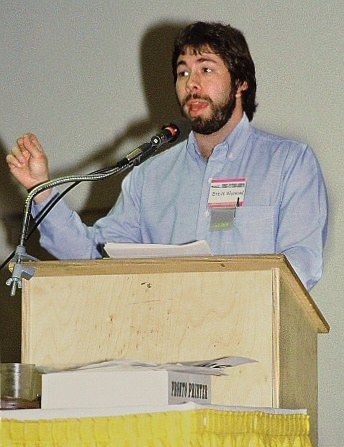
The Apple-1 was designed by one person. Steve Wozniak drew its schematic, chose its chips, wrote its monitor program and its BASIC, and debugged it, mostly alone and mostly at night. Other people mattered: Steve Jobs found the market and the money, Allen Baum pointed him to the 6502, Howard Cantin laid out the printed circuit board. But the design is Wozniak’s, and it cannot be understood without knowing what he had already done by the time he started it.
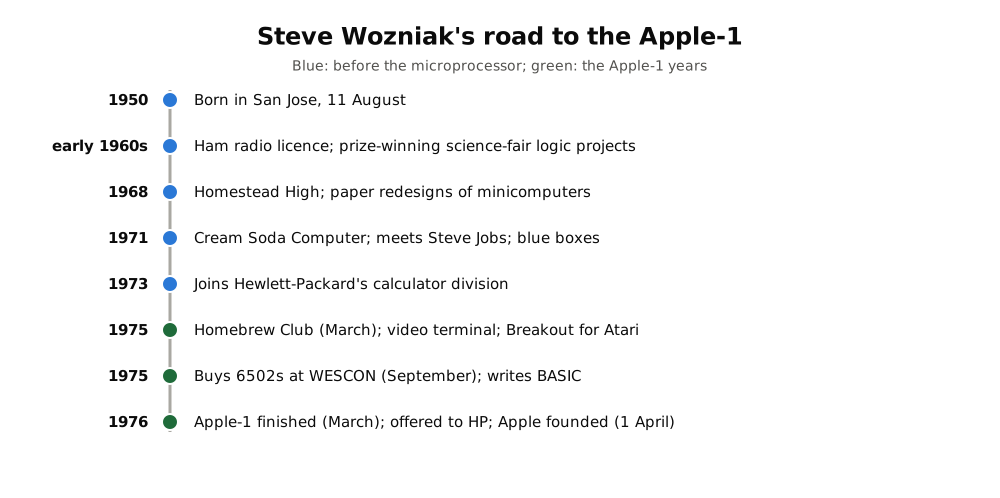
This volume follows Wozniak from his childhood in the 1950s to the spring of 1976, when the Apple-1 was finished. It covers the family and schooling that made him an engineer; the years of designing computers on paper; his first working computer; his friendship with Jobs and their blue-box business; his job at Hewlett-Packard; the Atari Breakout episode; the video terminal he built for himself; and the Homebrew Computer Club, where all of this came together. It ends where Volume 3 begins, with the design on the bench, and where Volume 4 begins, with Jobs proposing to sell it.
The main sources are Wozniak’s own: his interview with Gregg Williams and Rob Moore in Byte in December 1984 (transcript) and his memoir iWoz, written with Gina Smith (W. W. Norton, 2006). Where memoir and documents differ, the text says so. Wozniak tells his stories well and has told some of them many times, and the details sometimes drift between tellings.
2.2 A Lockheed Engineer’s Son
Stephen Gary Wozniak was born in San Jose, California, on 11 August 1950. His father, Francis “Jerry” Wozniak, was an engineer at Lockheed working on missile programmes, work so secret that he could not tell his son what it was. The family settled in Sunnyvale, in what was not yet called Silicon Valley. Wozniak has written that his whole idea of what an engineer is came from his father. Engineers, in his father’s account, could change the world with their work, and they had to be scrupulously honest because the things they designed had to work.
Jerry Wozniak also taught his son electronics directly. In iWoz Wozniak describes being shown, as a small boy, how resistors, transistors and diodes worked, and how logic gates could be built from them, long before he knew what the word “computer” meant. He held an amateur radio licence before he reached high school; the call signs recorded for him are WV6VLY and later WA6BND. He built his own transmitter and receiver from kits.
Around the age of thirteen he built an adder-subtractor from transistors, a small machine that could add and subtract binary numbers, and entered it in a science fair, where it won a top prize (IEEE Computer Society, “Stephan (Steve) Wozniak”). He later called it his first computer, though it was strictly a calculating circuit. It was the first of several logic projects he built for science fairs in his early teens.
2.3 Computers on Paper
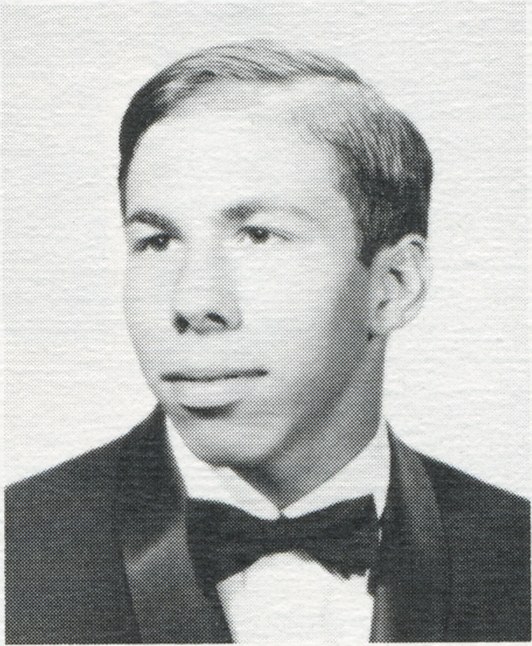
The most important thing Wozniak did as a teenager produced nothing that could be switched on. At Homestead High School in Cupertino, from which he graduated in 1968, he discovered that computer manufacturers would send their technical manuals to anyone who asked. He collected the manuals for the minicomputers of the day, from Digital Equipment Corporation, Data General, Varian, Hewlett-Packard and others, and designed his own versions of the machines on paper (Maliniak, review of iWoz, Electronic Design, 2007).
He could not afford the parts to build any of them. A minicomputer then cost as much as a house. So the exercise became one of economy. Each time he redesigned a machine he tried to do it with fewer chips than the last time, and fewer than the manufacturer had used. Chips were the cost he could count, and reducing the count became a game, then a habit, then a principle. He described the result to the IEEE Computer Society: when he designed his own computers, he found they needed about half as many parts as comparable machines, and “this principle of elegant, simple lines became my guiding force” (IEEE CS).
This is the single most important fact about the Apple-1’s design. By 1975 Wozniak had spent close to ten years designing computers he could not build, and he had become very good at making them small.
His formal education was patchier. He spent a year at the University of Colorado Boulder in 1968–69, then studied at De Anza College near home, then went to the University of California, Berkeley, in 1971. He left Berkeley without a degree, as the work he was doing outside class became more interesting than the classes. He returned in 1981, after the Apple II had made him wealthy, and graduated in 1986 under the name “Rocky Raccoon Clark”.
2.4 The Cream Soda Computer
Wozniak finally built a computer in 1970–71, with a younger neighbour, Bill Fernandez. Fernandez had a garage and some chips donated by an acquaintance at a local company. The machine they assembled used about twenty TTL logic chips and had 256 bytes of memory. It had a front panel of switches for entering a program and lights for showing the answer, much as the Altair would four years later, and it could do little more than add numbers. They named it the Cream Soda Computer, after the drink they consumed while building it. By Wozniak’s account it worked until a newspaper reporter came to see it, when the power supply burned out and the demonstration ended in smoke; in some tellings someone had stepped on the cable.
The Cream Soda Computer taught Wozniak that his paper designs could become real ones. It also brought him one introduction that would change his life. Bill Fernandez knew a boy from his street who was interested in electronics and thought the two should meet. In 1971 he introduced Wozniak, then 20 or 21, to Steve Jobs, then 16. Wozniak recalled that they sat on the pavement and talked for a long time about electronics, music and pranks. They were very different people. Wozniak was the engineer who wanted to design, Jobs the enthusiast who wanted to do something with what was designed. They got on immediately.
2.5 Blue Boxes
In October 1971 Esquire published an article by Ron Rosenbaum, “Secrets of the Little Blue Box”. It described the “phone phreaks”, a loose community of enthusiasts who had worked out that the American long-distance telephone network was controlled by audible tones sent down the same line as the caller’s voice. A tone of 2,600 hertz told a trunk line it was free. Particular pairs of tones then dialled through the network as an operator would. A small electronic box that generated these tones, the “blue box”, let its user place long-distance and international calls without being billed. Among the figures in the article was John Draper, known as “Captain Crunch” because a toy whistle from a box of that cereal happened to produce 2,600 Hz.
Wozniak read the article and, by his account, phoned Jobs to read it to him before he had finished it (Nieman Storyboard). They found the tone frequencies in a technical journal at a university library and Wozniak designed a blue box. As with everything else, he designed it to use fewer parts than anyone else’s, and it was digital, generating the tones with logic circuitry instead of tuned analogue oscillators, so that it stayed in tune. Jobs saw that people would buy it. The two sold blue boxes to students in the Berkeley dormitories, and accounts put their sales at about 200. The prices given vary between tellings.
The blue box business was illegal, and they gave it up after a frightening encounter during a sale. Wozniak’s favourite story from the period is that he used a blue box to call the Vatican pretending to be Henry Kissinger, and was nearly put through to the Pope before someone recognised the voice was wrong. It is told in iWoz and in many interviews.
The blue boxes are worth a paragraph in a history of the Apple-1 for two reasons. They were the first time Wozniak and Jobs worked together on a product, with the division of labour they would use again in 1976: Wozniak designed it, Jobs sold it. Jobs later told his biographer Walter Isaacson that without the blue boxes there would have been no Apple. And the box was a clean piece of digital design, built to work reliably with very few parts.
2.6 Hewlett-Packard
In 1973 Wozniak left Berkeley and took a job at Hewlett-Packard, in the division in Cupertino that designed its handheld scientific calculators. HP was then the engineer’s company of the Valley, founded in a Palo Alto garage in 1939 and famous for treating its engineers well. Wozniak has always said that he expected to stay there for life. He worked on calculator circuits. His heroes were the engineers who had produced the HP-35, the first scientific pocket calculator, in 1972, and the HP-65, the first programmable one, in 1974. He bought an HP-65, which he would sell in 1976 to raise money for the Apple-1’s circuit boards.
HP mattered to the Apple-1 in three ways. It gave Wozniak a salary, a bench and colleagues. It gave him an example of a computer small enough to own: the HP-65 was a programmable computer that fitted in a pocket. And it gave him the idea of what a computer’s language should be. HP’s minicomputers used BASIC, and HP’s 9830 desktop computer started up ready to accept BASIC commands, with no loading. Wozniak told Byte in 1984 that he wanted the same for his machine: switch it on and start typing a program, as on the 9830 (Williams & Moore, 1984).
Wozniak believed that, as an HP engineer, he owed the company first refusal on anything he designed. When the Apple-1 was working, he offered it to HP. His managers liked it, but saw no place for a hobbyists’ computer in HP’s business, and he was given a written release. In later accounts Wozniak says he offered it more than once. One account has it that an HP lawyer polled every division head and all of them said no (Linzmayer, Apple Confidential, via Macworld). He did not leave HP until early 1977, months after the Apple-1 was on sale.
At HP Wozniak also started a dial-a-joke telephone line, one of the first in the Bay Area, playing a recorded joke to anyone who called. The jokes were Polish jokes, and they drew complaints from the Polish American Congress, which, years later, gave him its Heritage Award.
2.7 Breakout
By 1975 Steve Jobs had a job at Atari, the video-game company in Los Gatos. Atari’s games were then built entirely from logic chips, with no microprocessor: each game was a custom digital circuit. Nolan Bushnell, Atari’s founder, wanted a single-player version of Pong in which a ball broke through a wall of bricks. The project was given to Jobs, who brought in Wozniak.
The story has been told many times, and its details vary. Atari offered a bonus for every chip saved below a target count. Jobs promised a working design in four days. Wozniak worked four nights running, after full days at HP, and produced a design that used only a few dozen chips, far fewer than Atari’s own engineers expected. Atari found it too tightly designed to manufacture and test reliably, and produced its own larger version; Breakout was released in 1976. Jobs told Wozniak that Atari had paid $700, and gave him half. Years later Wozniak learned that Jobs had in fact received a bonus of around $5,000 (Breakout, Wikipedia, summarising several accounts). Wozniak has said that the money mattered less to him than the fact that Jobs had not told him.
For the Apple-1, Breakout shows that Wozniak could design a complete video system, one that drew moving objects on a television screen, from logic chips, quickly and with very few parts. He later wrote Breakout again in BASIC for the Apple II, and has said that the experience of doing in software what had taken dozens of chips in hardware showed him how much the microprocessor would change.
2.8 The Terminal
The last piece fell into place in 1975. Wozniak wanted to use computers he could not own. Time-sharing services let a user dial in to a large computer from a terminal, and the ARPANET connected university and research computers across the country. But terminals were expensive. So Wozniak designed his own: a keyboard and a circuit that turned an ordinary television into a text display, connected to a modem. According to the Apple-1 Registry, he designed a version of it, the “Computer Converser”, with Alex Kamradt, whose time-sharing company Call Computer planned to sell it (Apple-1 Registry, “The Apple-1”).
Wozniak described the terminal’s role in 1984: before the Apple-1, he had built a TV terminal and a modem so that he could reach a time-sharing computer from home, and later the ARPANET (Williams & Moore, 1984). The terminal stored its screen in shift registers because cheap RAM did not exist, and it displayed about 60 characters a second. Almost unchanged, it became the video section of the Apple-1, which is why the Apple-1’s screen behaves like a terminal, adding text at the bottom and scrolling, rather than like the memory-mapped displays of later machines.
By the spring of 1975, then, Wozniak had a terminal, a keyboard, a decade of experience designing computers on paper, and a job that let him see the newest chips. What he did not yet have was a reason to put a computer behind the terminal.
2.9 The Homebrew Computer Club
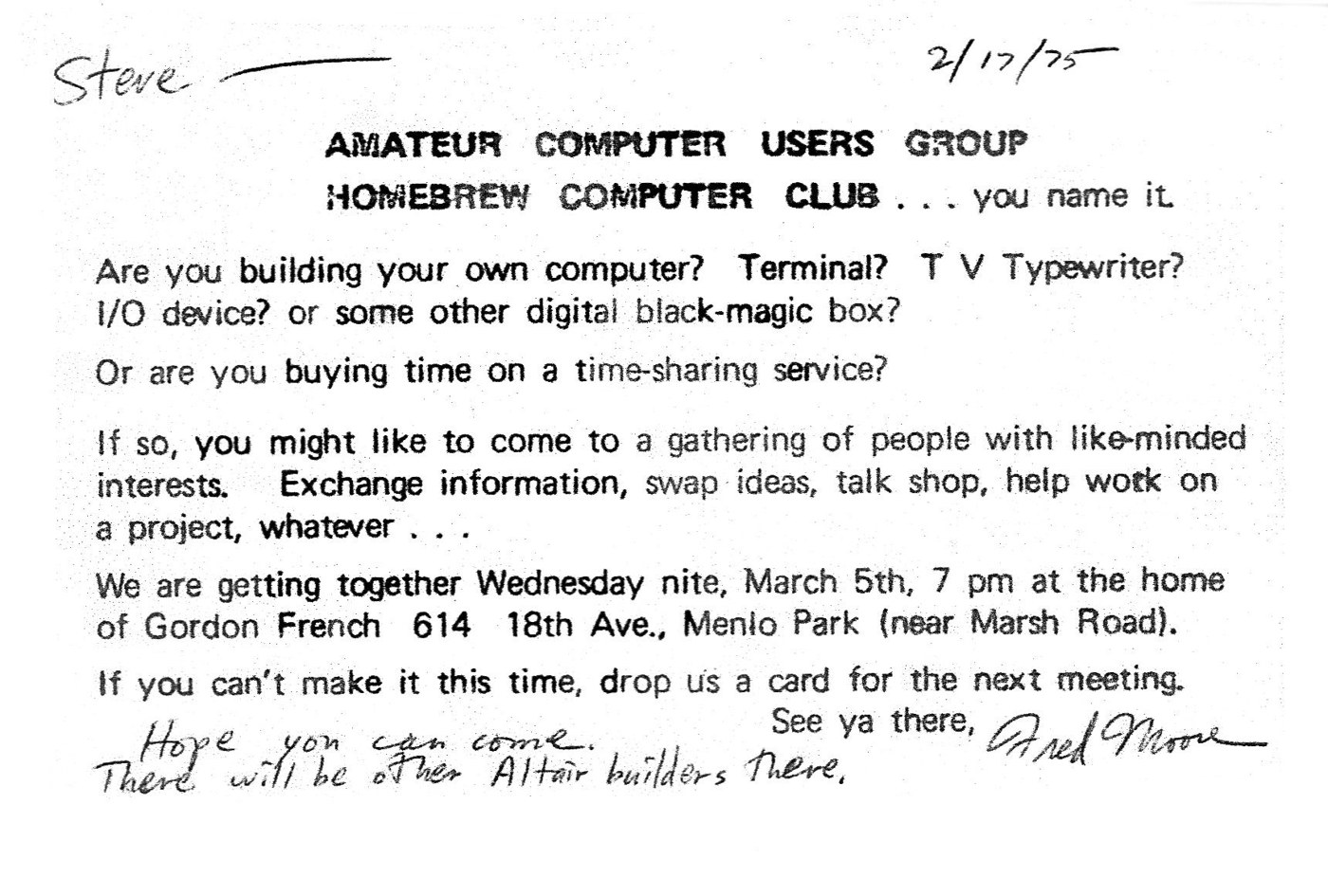
In February 1975 two Bay Area enthusiasts, Fred Moore and Gordon French, put up a notice calling a meeting of an “Amateur Computer Users Group — Homebrew Computer Club … you name it”. The invitation asked: “Are you building your own computer? Terminal? T V Typewriter? I/O device? or some other digital black-magic box?” The first meeting was on the evening of Wednesday 5 March 1975, in French’s garage in Menlo Park. About thirty people came. A MITS Altair 8800, the kit computer that had been on the cover of Popular Electronics that January, was there.
A colleague at HP, Allen Baum, had seen the notice and took Wozniak along. Wozniak, by his account, felt out of his depth: the others were talking about microprocessors and the Altair, which he had not followed. He took home a data sheet for a microprocessor and read it. It described a single chip that contained most of a minicomputer’s central processor. In iWoz he describes the realisation that followed. He had already designed minicomputers on paper and already built a terminal. A microprocessor, his terminal and some memory together would make a complete computer, one with a keyboard and a screen instead of the switches and lights of the Altair. He began to design it that night.
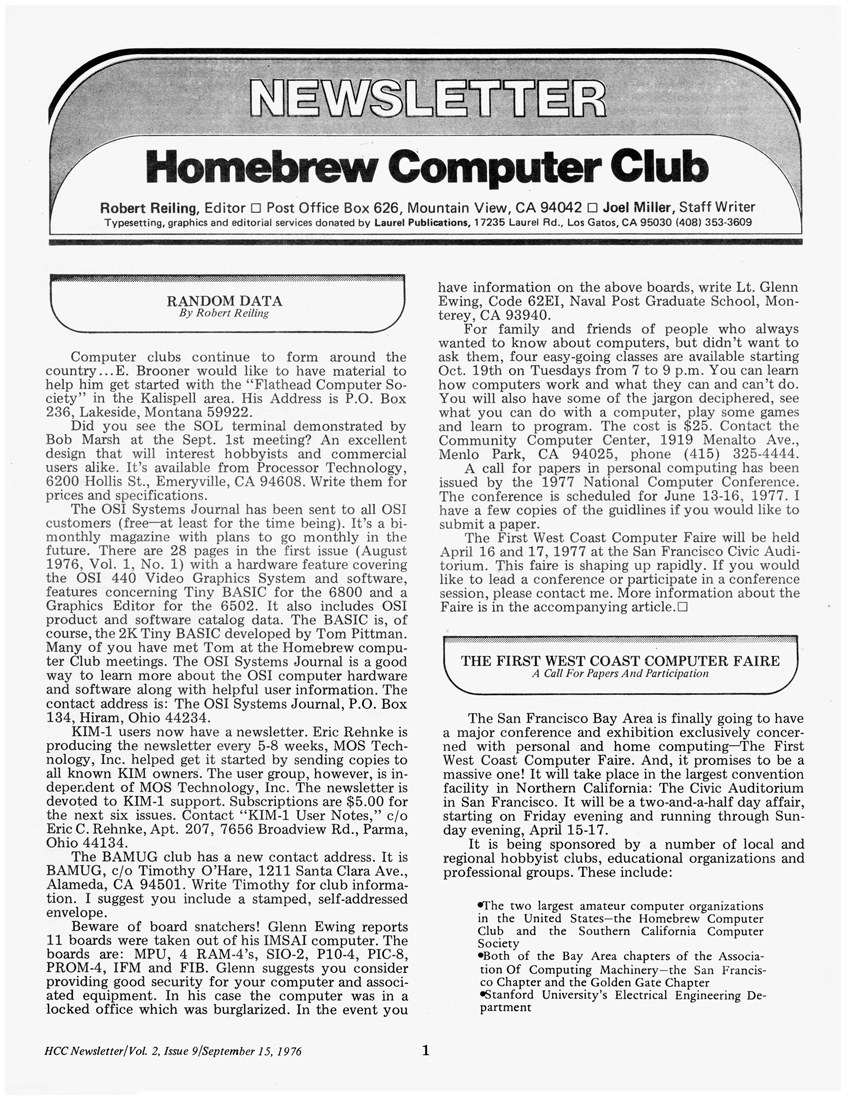
The club grew fast. It moved to larger rooms, then to the auditorium of the Stanford Linear Accelerator Center, and soon had hundreds of members. Its meetings had an unusual format: a “mapping” session in which people stood up to say what they were working on or looking for, a “random access” period of milling about, and demonstrations. Lee Felsenstein, who designed the Sol-20 and later the Osborne 1, usually moderated. Members shared schematics, software and parts freely; it was a culture of giving designs away. The club’s newsletter, edited by Robert Reiling, carried news of members’ projects and of the companies forming around them.
Wozniak went to every meeting he could, and Jobs began to come with him. In the spirit of the club, Wozniak gave away the design of his computer as it developed. He brought the board to meetings, handed out copies of the schematic, and helped other members build their own (Williams & Moore, 1984). In his own accounts, his motive was the respect of the people in that room, not money.
2.10 Choosing a Processor
The Altair used Intel’s 8080. In 1975 the 8080 and its rival, Motorola’s 6800, cost around $175–179 each in single quantities. Wozniak had access through HP to information on the 6800 and began a design around it, but he could not afford the chip.
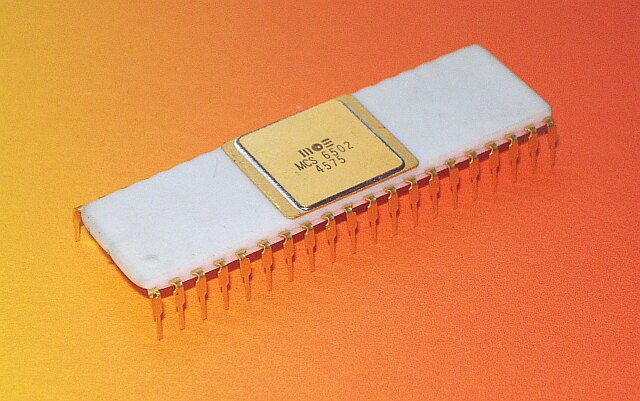
Then Allen Baum noticed that a new company, MOS Technology of Norristown, Pennsylvania, would sell two new microprocessors at the WESCON electronics show in San Francisco in September 1975. MOS Technology had been started by engineers led by Chuck Peddle who had left Motorola’s 6800 team. The 6501 was pin-compatible with the 6800, so it could be dropped into a 6800 design. The 6502 was the same processor with a slightly different pin-out and an on-chip clock generator. Trade-show rules did not allow sales on the exhibition floor, so MOS sold them from a hotel suite, out of large jars (IEEE Spectrum, “Chip Hall of Fame: MOS Technology 6502”). The price was the point. Wozniak recalled that he could buy a 6501 for about $20 and a 6502 for $25, when most microprocessors cost hundreds, and that “the actual choice of processors was dictated by what I could afford” (Williams & Moore, 1984).
By most accounts Wozniak bought his first processors at WESCON. The earliest Apple-1 prototype that survives, the board the Registry calls “Computer A”, carries a 6501 and the extra parts a 6800-style processor needs (Apple-1 Registry, #2). The production board used the 6502. Motorola sued MOS Technology over the 6501, which was soon withdrawn. The 6502 went on to power the Apple II, the Commodore PET and 64, the Atari 8-bit computers, the BBC Micro and the Nintendo Entertainment System, and, in 1976, MOS Technology’s own KIM-1 board, which has its own unit in this collection.
2.11 Bringing It Up
Wozniak’s biographers date his first success to the night of 29 June 1975. He connected his keyboard and his terminal to a processor board, typed, and saw the characters appear on his own screen. Wozniak has described it as the first time anyone had typed on a personal computer’s keyboard and seen the letters on its own screen. The date is earlier than the WESCON sale of the 6502, and no published account settles which processor that first test used. What is clear is that by the autumn of 1975 the keyboard, the terminal and a microprocessor were working together as one machine.
Then came the software. Wozniak had decided early that his computer must have BASIC. Bill Gates and Paul Allen’s BASIC for the Altair was the language every hobbyist wanted, but it ran on the 8080, and there was no full BASIC for the 6502 to be had. Wozniak had never written a BASIC interpreter or used an assembler for this processor. He wrote the interpreter by hand on paper, assembled it into machine code by hand, and typed the bytes in. He told Byte that writing BASIC took longer than designing the hardware. Volume 5 covers the result.
Two decisions shaped the final board. First, the memory. The only RAM available cheaply as surplus was the 2102, a static chip holding 1,024 bits, so 4 KB needed 32 of them. Jobs obtained samples of the new 16-pin dynamic RAM chips, which held 4,096 bits each. Eight of these replaced thirty-two 2102s, at the cost of one or two extra chips to multiplex the addresses (Williams & Moore, 1984). Wozniak said of the change, “my motivation was totally to save chips, not to add features”. Second, the monitor: a 256-byte program in two small PROM chips that let the user examine and change memory and run programs from the keyboard.
By March 1976 the design was finished. Howard Cantin, a printed-circuit layout engineer at Atari, drew the board, and on 16 March 1976 Jobs and Wozniak paid him $500 by cheque. That cheque sold at auction in January 2026 for $2,409,886 (RR Auction, reported by several outlets).
2.12 Where It Was Designed
The garage at the Jobs family house in Los Altos has become the emblem of Apple’s beginnings, and Volume 4 describes the work done there. Wozniak has been consistent that the design was not done there. In December 2014 he told Bloomberg Businessweek that the garage was “a bit of a myth”: the Apple-1 was designed and built in his HP cubicle at night and in his apartment in Cupertino (BGR, 4 December 2014). The Registry adds that he lived in two apartments in the same Cupertino complex during the design. The garage was where finished boards were tested and sold.
2.13 What Wozniak Brought to the Apple-1
Every major feature of the Apple-1 can be traced to something Wozniak had done before 1975.
Table 1 — What Wozniak Brought to the Apple-1
| Earlier work | What it gave the Apple-1 |
|---|---|
| Paper redesigns of minicomputers (1960s) | The habit of the minimum chip count; fluency in processor architecture |
| Science-fair logic, ham radio | Practical circuit building; comfort with analogue as well as digital design |
| The Cream Soda Computer (1970–71) | Proof that his designs worked; the partnership with Fernandez that led to Jobs |
| Blue boxes (1971–72) | A first product with Jobs; a digital design that stayed in tune |
| HP calculators and the 9830 (1973–76) | The model of a computer that starts up ready to type BASIC |
| Breakout (1975) | Video timing and screen generation from a handful of chips |
| The video terminal (1975) | The Apple-1’s entire display section, nearly unchanged |
| The Homebrew Computer Club (1975–76) | The idea, the processor, an audience, and the first customer |
2.14 Afterwards, Briefly
The rest of the story belongs to other volumes and other units. Wozniak designed the Apple II in 1976–77 and the Disk II floppy controller in 1977–78, both regarded as masterpieces of economical design. He left HP to work for Apple full-time in 1977. In February 1981 he was seriously injured when a light aircraft he was piloting crashed, and he took time away from Apple, finishing his Berkeley degree and staging two large music festivals, the US Festivals of 1982 and 1983. He left Apple as a regular employee in 1985, though he has remained on its payroll. He has spent much of his time since teaching, giving away money and speaking, and he has been generous with his time to the community of Apple-1 owners and replica builders. Many boards in the Registry carry his signature, added decades later at owners’ request. Volume 7 explains why collectors treat those signatures as a separate question from the board’s originality.
2.15 The One-Paragraph Version
Steve Wozniak, born in 1950, learned electronics from his father, a Lockheed engineer, and spent his teens designing minicomputers on paper with ever fewer chips because he could not afford to build them. With Bill Fernandez he built the Cream Soda Computer in 1970–71, and through Fernandez he met Steve Jobs, with whom he built and sold illegal blue boxes. At Hewlett-Packard from 1973 he designed calculators and admired the HP 9830, which started up ready for BASIC. For Atari he designed Breakout in four nights; for himself he built a video terminal. At the first meeting of the Homebrew Computer Club on 5 March 1975 he saw that a microprocessor plus his terminal would make a complete computer. He bought $25 6502s at WESCON in September 1975, wrote BASIC by hand, swapped thirty-two static RAM chips for eight dynamic ones, and by March 1976 the Apple-1 was finished. He gave the design away at the club until Jobs persuaded him to sell it.
Next — Volume 3: The Board — 6502, the 6820 PIA, a Video Terminal and 4K of DRAM. The Apple-1 chip by chip: the processor and its clock, the PIA that joins the keyboard and the screen to the bus, the dynamic memory and its refresh, the shift-register terminal and its character generator, the 256 bytes of PROM, and the on-board power supply, with the schematic read section by section.
Comments (0)