Apple-1 · Volume 7
Apple-1 — Volume 7 — Value, Auctions and Authenticity — Telling an Original from a Replica
Fifty years of Apple-1 prices, from $666.66 new to $14,000 in 2000 and $2.75 million in 2026; what makes one board worth three times another; the disputes over prototypes; and how specialists tell a board made in 1976 from an exact modern copy built with 1976 chips
7.1 About This Volume
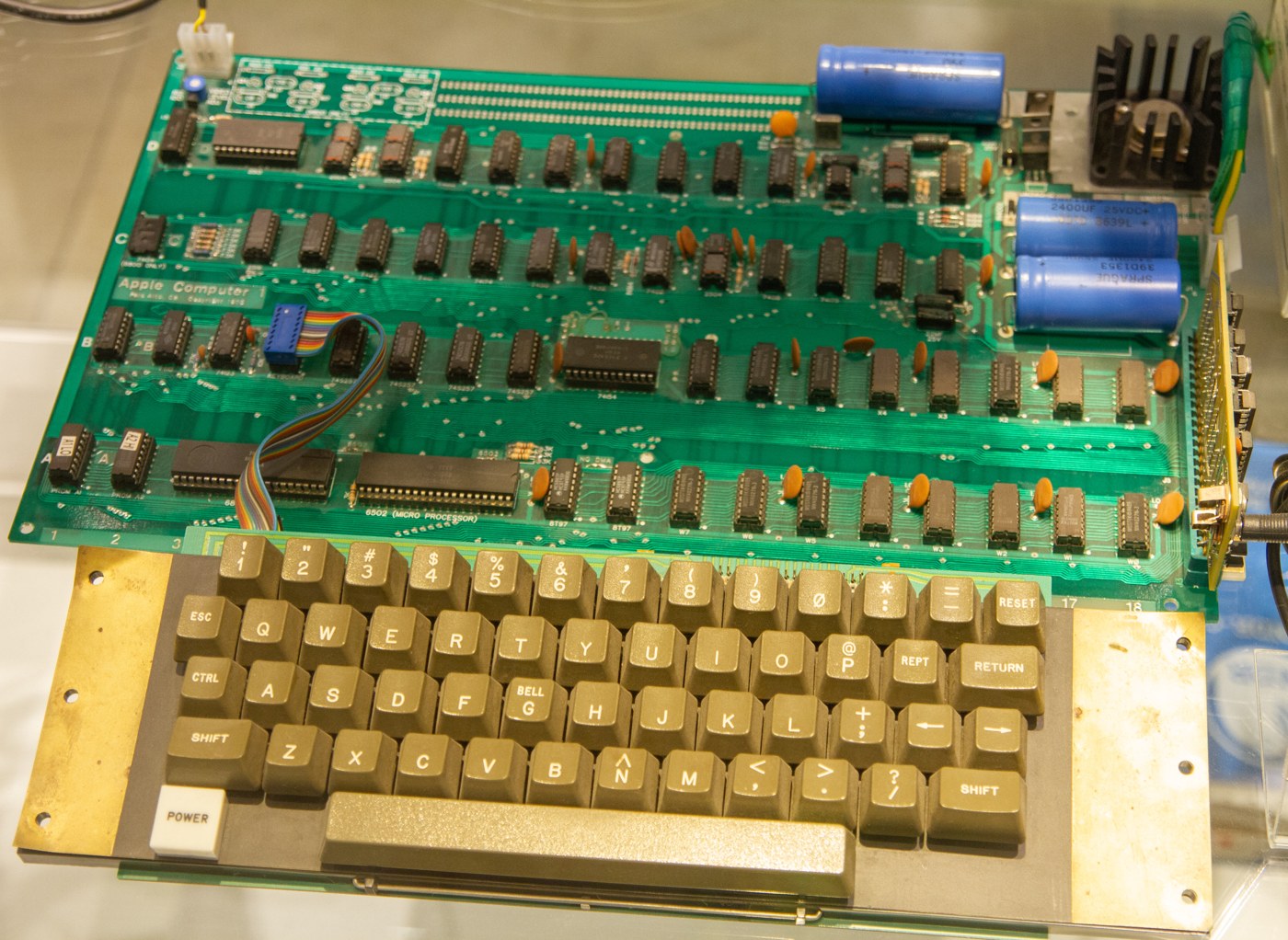
An Apple-1 sold new for $666.66. In 2000 one sold for $14,000. In 2014 one sold for $905,000. In January 2026 a pre-production board sold for $2.75 million, and in October 2026 a production board with a documented first owner sold for a reported $1,148,200. Few manufactured objects have risen in value so far, so fast.
This volume explains that market for owners, heirs and the curious. It traces the price history; sets out the factors that make one board worth far more than another; describes the disputes that have followed some sales; and then turns to the question underneath every sale, which is whether the board is real. Exact replicas of the Apple-1 exist, some built with chips carrying 1975 and 1976 date codes. Telling them apart is specialist work, and this volume describes how it is done, without pretending that a reader can do it from a checklist.
Nothing here is a valuation. Prices move, the sample is small, and every board is different. The sources are the Apple-1 Registry’s list of recorded sales (market page), its individual board entries, auction-house catalogues and press reports. Prices include the buyer’s premium unless stated. An auction “price realised” is typically 20–26 per cent above the hammer price, so the John Moran sale of 2021, for example, is $400,000 at the hammer and $500,000 with premium.
7.2 Fifty Years of Prices
7.2.1 1976–1999: a used computer
In 1977 an Apple-1 was a used computer of a kind its maker no longer supported. Owners sold them for what they could get towards an Apple II: the Chaffey College board changed hands in 1977 for $600 (Apple-1 Registry, #94). Apple’s trade-in offer valued a board at roughly the difference between $400 and the price of an Apple II board. By 1986 Apple’s own Apple IIe Owner’s Guide suggested that an Apple-1 might be worth $10,000–15,000 to a collector, but there was barely a market.
7.2.2 2000–2010: the collectors’ market forms
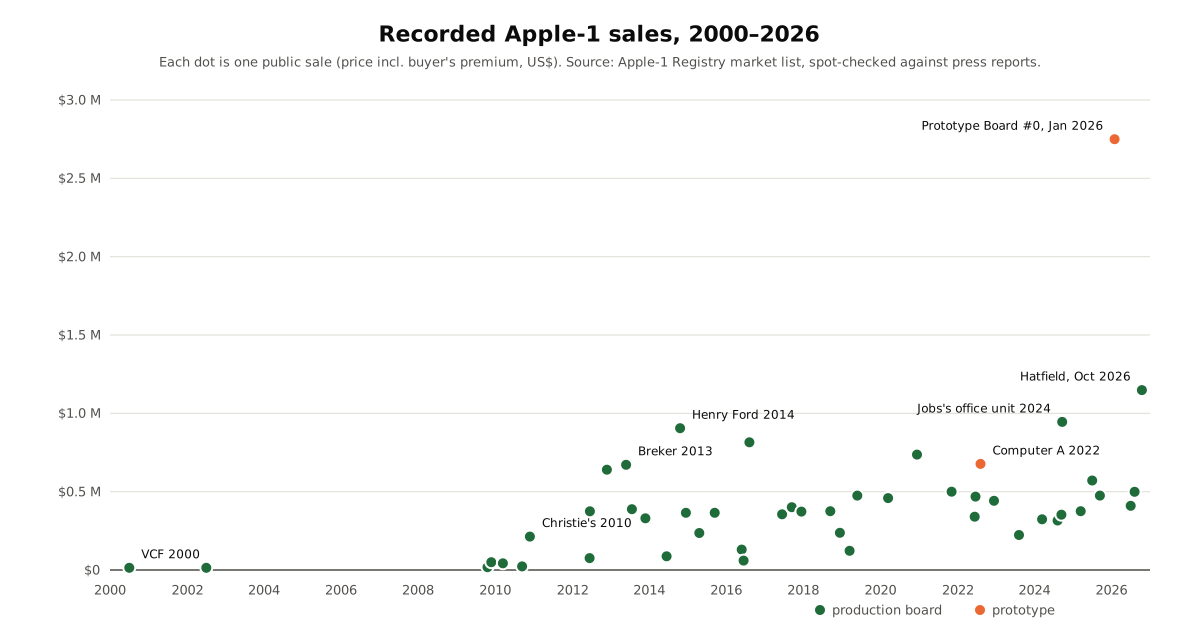
The first recorded public sales were at the Vintage Computer Festival auctions: $14,000 in 2000 and $14,000 again in 2002. Sales on eBay in 2009–10 ranged from about $18,000 to $50,000. Then in November 2010 Christie’s London sold a board, with its original packaging, a letter signed by Steve Jobs and other documents, for £133,250, about $213,000 at the time (BBC, 23 November 2010, as cited in Wikipedia, “Apple I”). It was the first sale by a major international auction house, and it reset the market.
7.2.3 2011–2016: records
Steve Jobs died in October 2011, and interest in Apple’s origins rose sharply. In June 2012 Sotheby’s New York sold a board for $374,500. In November 2012 Auction Team Breker in Cologne sold one for about $640,000, and on 25 May 2013 Breker sold the Hatfield board, with Jobs’s 1978 trade-in letter, for €516,400 (about $671,400) (Computerworld; Apple-1 Registry, #48). In October 2014 The Henry Ford museum bought the John Anderson board at Bonhams New York for $905,000 (Apple-1 Registry, #19). In 2016 a board known as “Celebration” made $815,000 at a charity auction.
7.2.4 2017–2025: a plateau
For most of the following decade, ordinary production boards traded in a band from about $200,000 to $500,000, depending on condition, completeness and history. RR Auction of Boston became a regular venue, alongside Christie’s, Bonhams, Sotheby’s and Breker. Representative results: $375,000 (RR, September 2018); $458,711 (RR, March 2020); $500,000 (John Moran, November 2021, the Chaffey College board in its Byte Shop case); $223,520 (RR, 2023); $375,000 (RR, March 2025). Boards that were incomplete, heavily modified or poorly documented sold below the band: $60,300 for a board in poor condition on eBay in 2016, $122,566 at Bonhams in 2019.
Two prototype-related sales sat above it. In August 2022 RR Auction sold the badly damaged pre-production board the Registry calls “Computer A” for $677,196. In September 2024 Christie’s sold the “Demo unit”, a second-run board in a unique metal case, which had been used by Steve Jobs as Apple’s own demonstration machine and kept in his office until an engineer took it home when Jobs left Apple in 1985, for $945,000 (Apple-1 Registry, #70).
7.2.5 2026: above a million
On 30 January 2026, in a sale timed for Apple’s fiftieth anniversary, RR Auction sold the board it called “Prototype Board #0”, a fibreglass pre-production board that it described as the earliest known board used to validate the Apple-1 design before production, for $2,750,000, against an estimate of $500,000 (reported by Tom’s Hardware and others). The same sale realised $2,409,886 for Jobs and Wozniak’s $500 cheque of 16 March 1976 to Howard Cantin, who laid out the board.
On 14 October 2026 the Hatfield board came back to auction, at Bonhams New York, and sold for a reported $1,148,200, the first production Apple-1 to pass a million dollars at auction (Apple-1 Registry, #48). It is the same board that set a record at $671,400 in 2013.
7.2.6 Notable sales
Table 1 — Notable sales
| Date | Venue | Board | Price (US$) |
|---|---|---|---|
| 2000 | Vintage Computer Festival | #49 | 14,000 |
| Nov 2010 | Christie’s, London | #41 Frank Anderson | £133,250 (≈ 213,000) |
| Jun 2012 | Sotheby’s, New York | #37 Cooper | 374,500 |
| May 2013 | Breker, Cologne | #48 Hatfield | 671,400 (€516,400) |
| Oct 2014 | Bonhams, New York | #19 John Anderson (to The Henry Ford) | 905,000 |
| Dec 2014 | Christie’s, New York | #30 Ricketts (sold by Jobs from Los Altos) | 365,000 |
| Aug 2016 | Charitybuzz | #75 Celebration | 815,000 |
| Nov 2021 | John Moran | #94 Chaffey College | 500,000 |
| Aug 2022 | RR Auction | #2 “Computer A” prototype | 677,196 |
| Sep 2024 | Christie’s | #70 Demo unit (Jobs’s office) | 945,000 |
| Jan 2026 | RR Auction | ”Prototype Board #0” | 2,750,000 |
| Oct 2026 | Bonhams, New York | #48 Hatfield | 1,148,200 (reported) |
The Registry’s list records about fifty public sales from 2000 to October 2026, totalling more than $20 million. Many more boards have changed hands privately, at undisclosed prices.
7.3 What Makes One Board Worth More Than Another
Auction catalogues and collectors return to the same factors again and again. Roughly in order of effect:
1. Provenance. A board’s documented history is worth more than anything on the board itself. The highest prices have gone to boards connected directly with Jobs or Wozniak (a prototype, Jobs’s demonstration unit, a board sold by Jobs from his parents’ house) or with a documented first owner and a paper trail: a sales receipt, a cheque, an Apple letter. The Hatfield board’s 1978 letter from Jobs is part of what it is worth. A board with no history at all, even a perfect one, sells at the bottom of the range.
2. Originality. Specialists distinguish a board whose chips, capacitors, sockets and regulator are the ones fitted in 1976 from a board that has been repaired with later parts. A few replaced chips are normal for a computer that was used. Wholesale replacement, a non-original regulator, re-soldered sockets or a board that has been “restored” to look new all reduce value. The Smithsonian’s own board has had several chips replaced and a non-original regulator fitted (Apple-1 Registry, #62).
3. Batch and serial number. First-run boards are generally preferred to second-run (NTI) boards. A hand-written serial number in Jobs’s hand on the back of a first-run board links it to the Byte Shop order and to Jobs personally. Forensic examination by PSA, the authentication company, and documentary research by the Registry’s curator in January 2022 established that the numbers were written by Jobs (Gizmodo). Low numbers attract a premium.
4. Working condition. A board that runs is worth more than one that does not, and auction houses state whether a board was tested and by whom. But making a board run can reduce its value if it involves replacing original parts. Volume 8 explains why a careful owner has a board assessed before anyone applies power.
5. Completeness. The original Apple Cassette Interface, a Datanetics keyboard, a Byte Shop koa case, period power transformers, the original operation manual, BASIC tapes, letters and receipts all add value. The Chaffey College board came with its Byte Shop case, cassette interface, keyboard, tapes and a working monitor.
6. Signatures. Steve Wozniak has signed many boards at their owners’ request, decades after they were made. A Wozniak signature adds interest for some buyers. Others regard writing on a 1976 board as an alteration. Either way, a signature is not evidence that a board is original, and the authentication of the signature is separate from the authentication of the board.
7. The moment. Anniversaries, Apple news and a well-marketed sale move prices. The 2026 records came in Apple’s fiftieth-anniversary year.
7.4 Disputes
A market this valuable attracts disputes about what exactly is being sold.
“Computer A”, 2022. RR Auction offered a damaged pre-production board, silkscreened “Apple Computer A © 76” rather than “Apple Computer 1”, as the prototype Jobs used to demonstrate the Apple-1 to Paul Terrell of the Byte Shop, matched to Terrell’s own 1976 Polaroid photographs and authenticated in a 13-page notarised report by the Apple-1 specialist Corey Cohen. Before the sale, the San Jose Mercury News questioned parts of the catalogue history. Wozniak said the board was “one of the first” but not the board he had hand-soldered, and Terrell said that what he had been shown was a production board from the first delivery, not a prototype. RR Auction maintained that the lot was properly described (iLounge, August 2022). It sold for $677,196. The Registry treats the board as genuine pre-production hardware (Apple-1 Registry, #2); what was disputed was the story attached to it.
Prototype numbering, 2026. The board sold in January 2026 as “Prototype Board #0” is linked in the Registry’s sales list to the entry it calls “Celebration”, which had sold at a charity auction in 2016. How the various pre-production boards relate to each other, and to Terrell’s photographs, is still being worked out in public. Readers following a particular board should check the Registry’s current entry.
Press errors. Press reports regularly attach the wrong price to the wrong board. The Registry notes that reports of the 2022 prototype selling for more than a million dollars confused it with a different board. All prices in this volume are checked against the Registry’s unit pages as well as press reports.
7.5 What an Original Looks Like
Authenticating an Apple-1 is a matter of comparing everything about a board with what is known about the boards made in 1976. The Registry’s curator and a small number of specialists have examined dozens of originals and hundreds of photographs; that experience is what authentication rests on. The features they look at include the following.
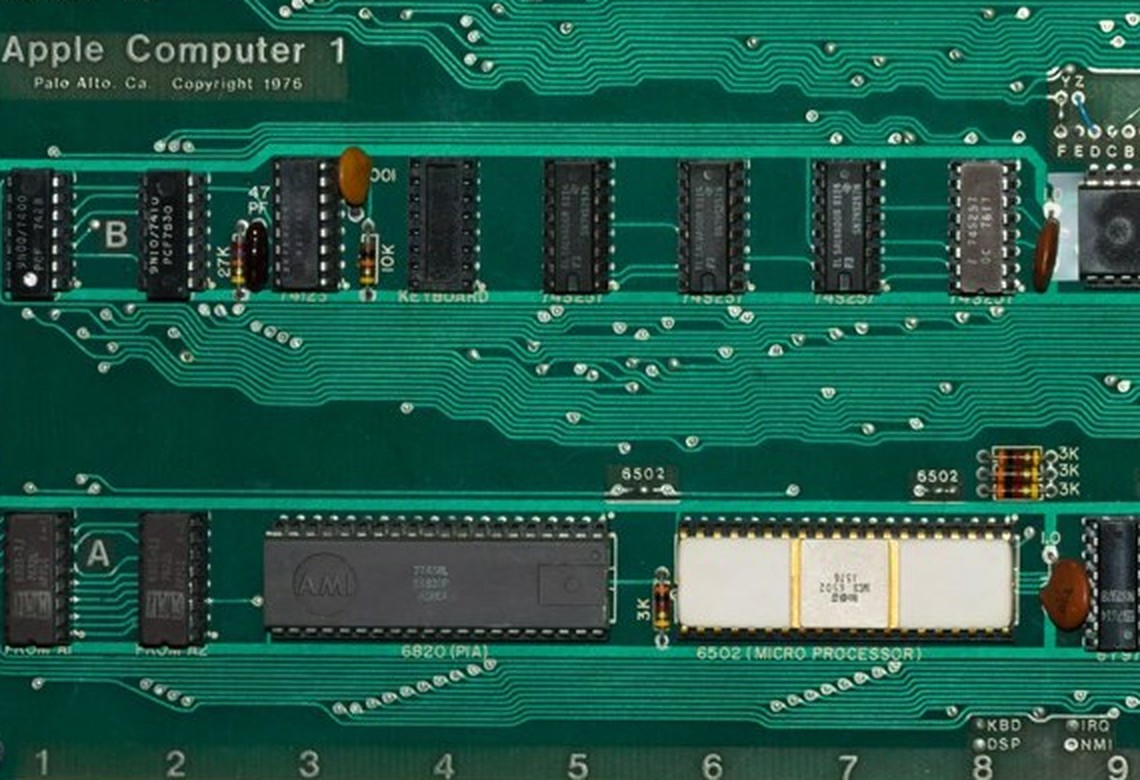
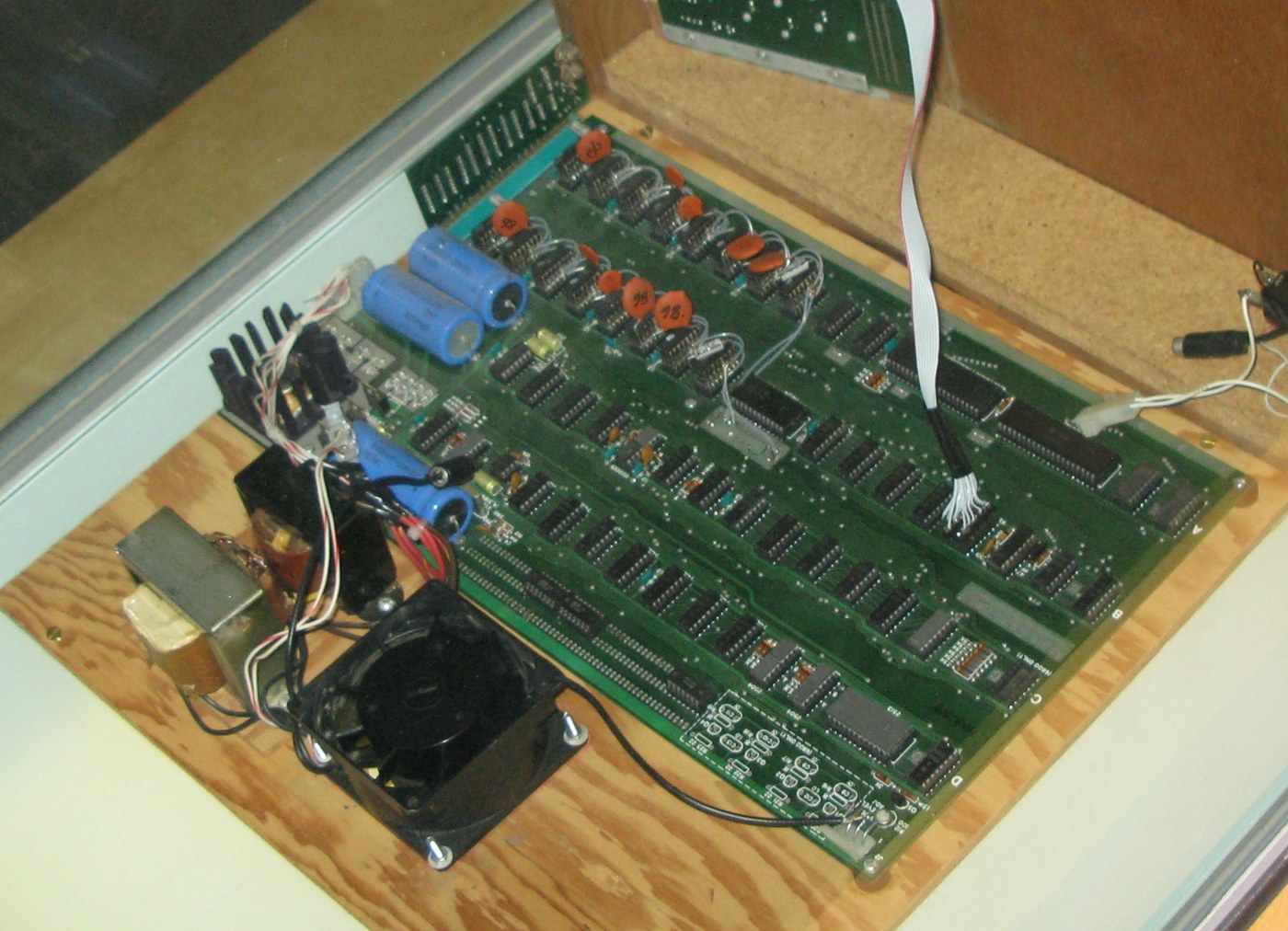
The board itself. A production board carries the legend “Apple Computer 1 / Palo Alto, Ca. Copyright 1976” in white silkscreen, the row letters A–D and column numbers 1–18 along its edges, and the part designations of every chip. Pre-production boards read “Apple Computer A © 76” and differ in layout. Specialists compare trace geometry, the shape and placement of the silkscreen lettering, via positions, the solder mask’s colour and finish, and the fibreglass substrate with reference photographs at high magnification. The production boards were wave-soldered, and the solder fillets look like it; the Registry records only two hand-soldered exceptions among its verified boards.
The batch. First-run boards have no board-maker’s logo, use brown ceramic-disc decoupling capacitors and blue-cased electrolytics, and often carry a white ceramic 6502 and a purple ceramic 6820. Most of their logic chips are by Fairchild. Second-run boards carry the diamond “NTI” logo below the Apple legend, use multilayer decoupling capacitors and yellow-cased electrolytics, mostly have plastic-packaged 6502 and 6820, and most of their logic chips are by Signetics (Apple-1 Registry, “The Apple-1”; Applebox, “The Newton NTI”). A board whose parts belong to the wrong batch is not necessarily fake, since parts were replaced during repairs, but it needs explaining.
Date codes. Most chips are printed with a four-digit date code, year and week: “7615” means the fifteenth week of 1976. Original boards carry codes from 1974 to the middle or end of 1976, consistent with their batch. A chip dated 1977 or later is a replacement. But date codes alone prove little, because period chips are still available on the surplus market and replica builders have used them.
Specific parts. The Apple-1 used parts that a modern copy has to hunt for: Mostek MK4096 dynamic RAMs, the Signetics 2513 character generator, 2504 and 2519 shift registers, a National DS0025 clock driver, a 14.31818 MHz crystal, Sprague electrolytic capacitors, Texas Instruments low-profile sockets, and a particular style of 44-pin edge connector. Their makers, markings and styles are compared with those on known originals.
Marks on the back. Many first-run boards have a hand-written number, “01-00xx”, in Jobs’s hand. Some second-run boards have a round inspection stamp with a date in 1976, or a label. These are themselves compared with known examples, and a number that duplicates a known board is a warning.
Wear and history. A fifty-year-old board shows its age: oxidised solder, discoloured silkscreen, old flux, dust in socket contacts, and the scars of the owner’s modifications. Wear that is too uniform, or a board that looks new, invites questions.
Paper. Documents (receipts, cheques, letters, manuals, photographs) are examined in their own right, and their history must match the board’s.
Two practical rules follow. No single feature authenticates a board; it is the consistency of all of them. And a board is authenticated by people who have examined many originals, in person or from complete high-resolution photographs of both sides, not by an owner comparing it with a list.
7.6 Replicas
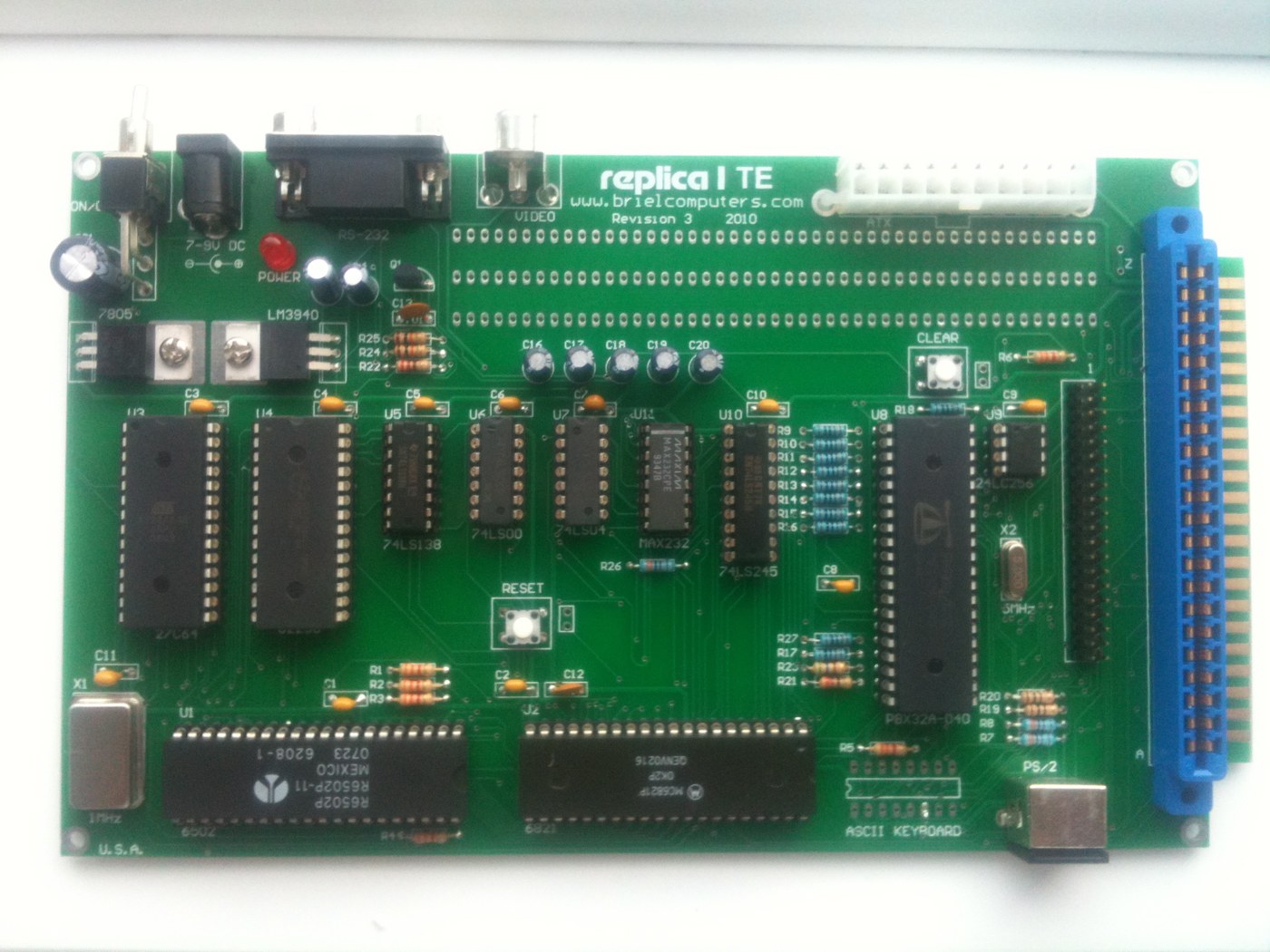
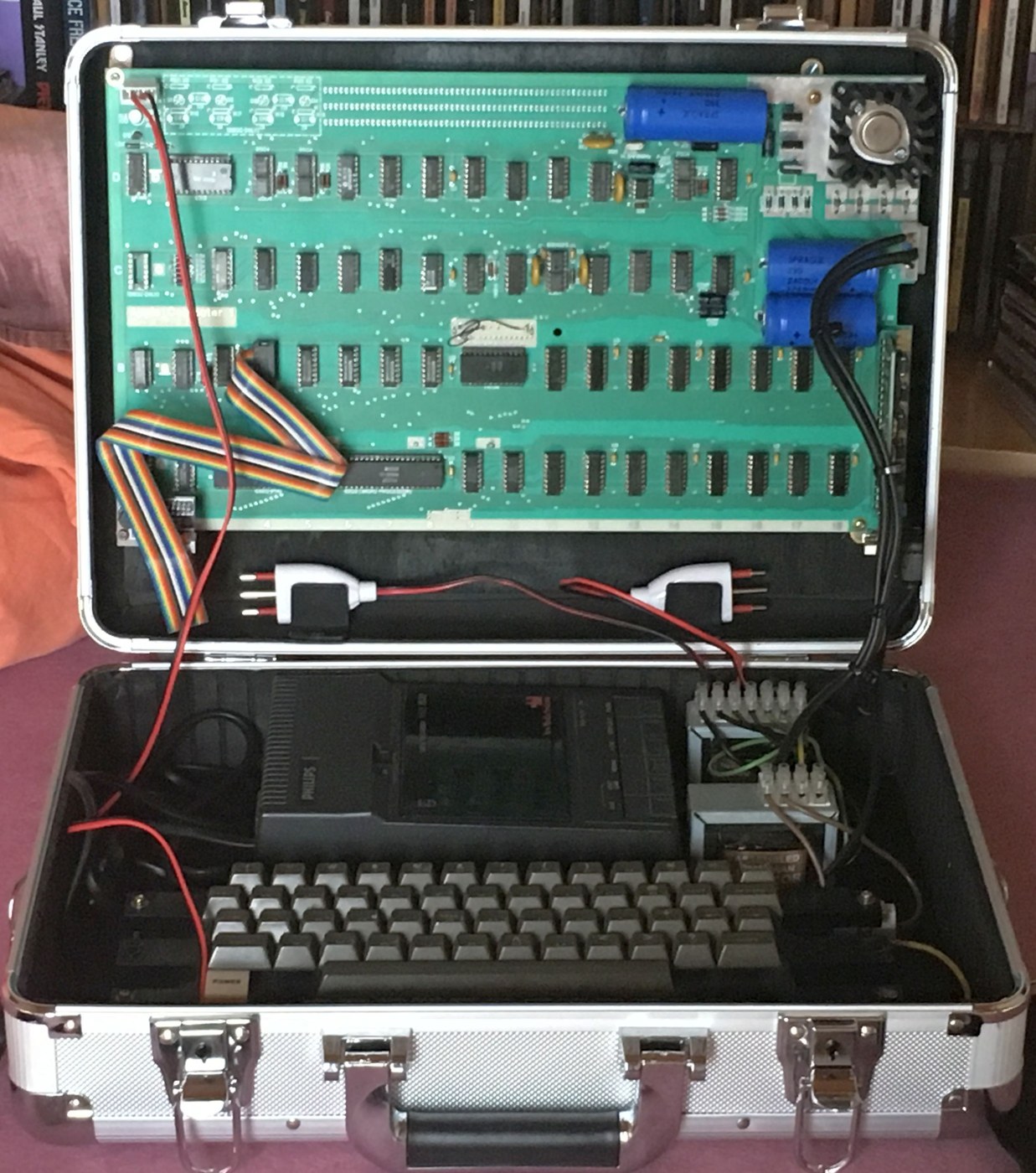
The Apple-1’s schematic has been public since 1976; Apple printed it in the operation manual. Building a copy has always been possible, and since the early 2000s replicas have been made in four broad kinds. Volume 9 describes them in full; what matters here is how each relates to an original.
Table 2 — Replicas
| Kind | Examples | Resemblance to an original |
|---|---|---|
| Functional replicas with modern parts | Briel Computers Replica 1 (2003 onward), Smarty Kit | Runs the same software; looks nothing like an Apple-1 board |
| Look-alike reproductions | Mimeo 1 (Mike Willegal, later distributed by Corey Cohen); Newton-1 and Newton NTI (Michael Ng); Obtronix | Reproduce the board’s layout and silkscreen, often closely |
| Period-parts builds | Look-alike boards populated with chips carrying 1975–76 date codes | Can be very close; the Registry warns that some have date-code-correct parts |
| Counterfeits | Copies of replica boards sold cheaply, e.g. boards marked “Mimeo” only on the reverse | Unknown quality and origin |
The look-alike replicas were made openly, sold as replicas, and are fine machines in their own right. Their makers documented them: Willegal, for example, published notes on each revision of the Mimeo, and genuine Mimeo boards are known, sold and traced as Mimeos. Collectors describe one early look-alike as a “ten-footer”: perfect from ten feet away, plainly not original up close (Applefritter forum).
The danger is not the replica but the story told about it later. A look-alike replica built with period chips, aged by thirty years in a garage, and sold without its history by someone who does not know what it is, can look very like an original to a non-specialist. A deliberate fake, made to deceive, would be harder still. That is why serious buyers insist on examination by a recognised specialist and on comparison with the Registry, and why the Registry’s verified list is the reference point for the market.
7.7 Signs That Need Explaining
None of the following proves a board is not original. Each is something a specialist will ask about.
Table 3 — Signs That Need Explaining
| Observation | Why it matters |
|---|---|
| Chips with date codes after 1976 | Replacement parts; normal in small numbers, significant in large numbers |
| Parts that belong to the other batch | Repair, or assembly from mixed parts |
| A board that looks new | Originals are fifty years old; restoration or replica |
| No history before a recent sale | Not disqualifying, but every other test must carry more weight |
| A serial number that duplicates a known board, or does not match Jobs’s hand | Strong warning |
| A “Mimeo”, “Newton” or other maker’s marking anywhere, including the back | A replica |
| Unwillingness to allow photographs of both sides, or examination | A red flag in any high-value sale |
| A Wozniak signature offered as proof of originality | A signature authenticates a signature, not a board |
7.8 For an Owner
An owner who believes he or she has an original Apple-1 is in a position few collectors will ever be in, and a few practical points follow from this volume:
- Do nothing irreversible. Do not clean, repair, replace chips, have the board signed, or power it up before it has been examined. Volume 8 explains why.
- Photograph everything: both sides of the board, every chip’s markings, the cassette interface, the case, the keyboard, every document. Good photographs are what a specialist needs first.
- Gather the history: who bought it, where, when and for how much; letters, receipts, cheques, manuals, tapes, family photographs with the machine in use. Provenance is the largest single element of value, and it is the one most easily lost when the person who remembers is gone.
- Contact the Registry. The Apple-1 Registry will help identify and document a board in confidence and will not publish an owner’s name without permission.
- Get an independent opinion before any sale or insurance valuation, from a specialist with no interest in buying the board.
- Choose a sale venue carefully, if selling. The major auction houses and the specialist American sale rooms have all sold Apple-1s, and their commissions, marketing and buyers differ.
7.9 The One-Paragraph Version
The Apple-1 went from a $666.66 new computer to a $14,000 collector’s item by 2000, crossed $200,000 at Christie’s in 2010, set records of $671,400 in 2013 and $905,000 in 2014, and settled for a decade at $200,000–500,000 for ordinary production boards. In 2024 Steve Jobs’s own demonstration unit made $945,000; in January 2026 a pre-production board made $2.75 million; in October 2026 the Hatfield board made a reported $1,148,200. Value turns on provenance first, then originality, batch and serial number, working condition, completeness, and the moment. Authentication rests on the consistency of every detail of the board, its parts, date codes, markings, wear and paperwork with known originals, judged by specialists with the Apple-1 Registry as reference. Look-alike replicas, some built with period chips, are good machines but make expert examination essential, and no single feature, signature or date code proves a board is original.
Next — Volume 8: Caring for an Original — Storage, Handling, Inspection and the Question of Power. Heat, humidity, mice and static; how to store, photograph and document a board without harming it; what a conservator or experienced restorer checks first; and why fifty-year-old capacitors and a power supply that has not run since the 1970s mean that an original Apple-1 is never simply plugged in.
Comments (0)