Apple-1 · Volume 1
Apple-1 — Volume 1 — The Computer That Started Apple
A bare green circuit board sold for $666.66 in the summer of 1976, the two young men who made it, the two hundred or so that were built, and why the survivors now sell for more than a house — the orientation volume for the twelve-part series
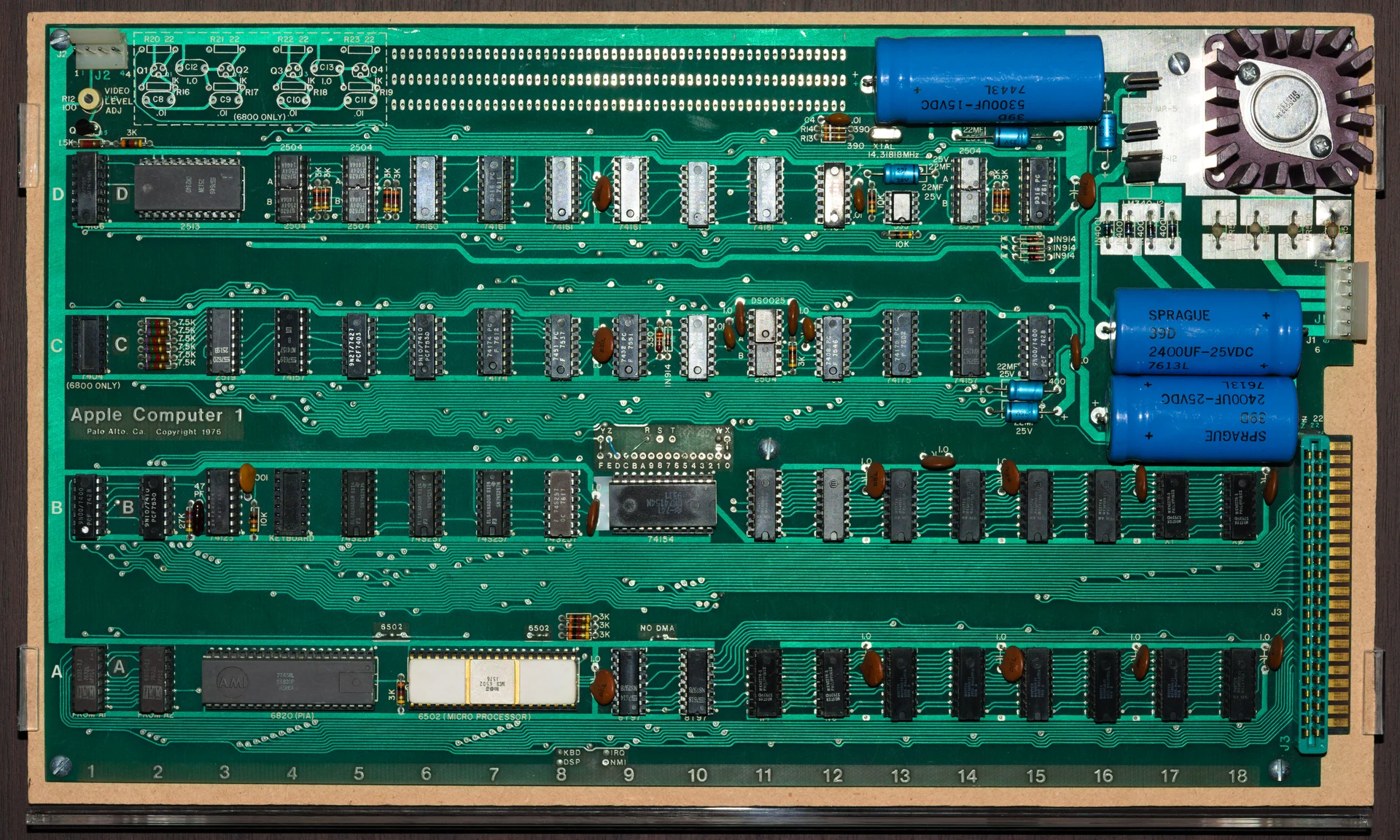
1.1 About This Volume
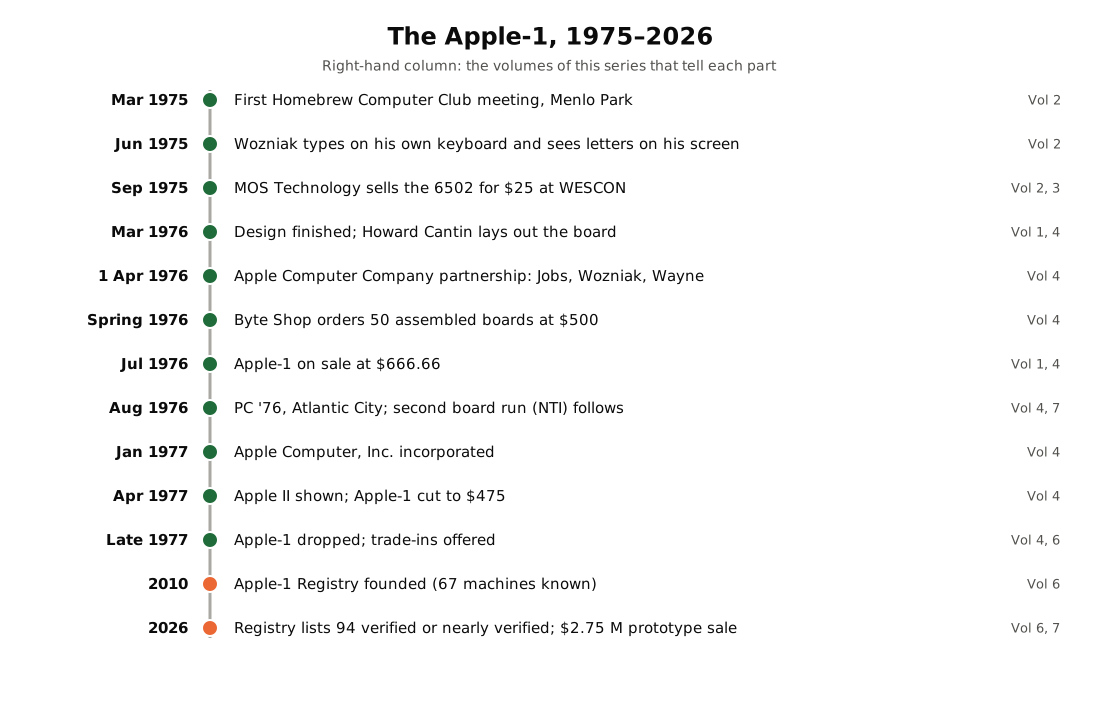
This is the entry point to a twelve-volume deep dive on the Apple-1, the first product of the Apple Computer Company. Steve Wozniak designed it in 1975–76, largely at night after his day job designing calculators at Hewlett-Packard. Steve Jobs persuaded him to sell it, found the first customer and the credit to buy the parts, and supervised the assembly. Roughly two hundred were made between the spring of 1976 and the autumn of 1977. A few dozen survive, and since 2010 they have become some of the most expensive objects in the history of technology.
The Apple-1 was not the first personal computer, nor the first microcomputer kit, nor the best-selling machine of its year. Its importance is of a different kind. It was one of the first microcomputers sold with its whole main board already assembled and tested, and one of the first to connect directly to a keyboard and a television screen instead of a front panel of switches and lights. It started the partnership that became Apple, and its sales paid for the design work on the Apple II. And it is the cleanest example of Wozniak’s engineering method: do the job with the fewest chips that will work.
This volume explains in plain terms what the Apple-1 was, what a buyer received for the money, how it worked from the keyboard to the screen, and why a board that cost $666.66 in 1976 was resold in October 2026 for more than a million dollars. It then tours the whole series. Readers who want the people and the business can go straight to Volumes 2 and 4. Readers who want the circuits and the software can start at Volume 3. Owners, buyers and the curious should read Volumes 6–8. Readers who want to build one should go to Volumes 9–11. The series ends with a family’s own Apple-1, an original board that has spent the last half-century in a garage in California.
1.1.1 The Twelve-Volume Series
Table 1 — The Twelve-Volume Series
| Vol | Title | Focus |
|---|---|---|
| 1 | Apple-1 — The Computer That Started Apple (this volume) | Orientation: what it was, what it did, the whole story in miniature |
| 2 | Steve Wozniak — From Blue Boxes to the Homebrew Computer Club | The designer: ham radio, paper computers, phone phreaking, Hewlett-Packard, Atari and the club that set him going |
| 3 | The Board — 6502, the 6820 PIA, a Video Terminal and 4K of DRAM | The hardware, chip by chip: processor, interface, memory, the shift-register video terminal and the power supply |
| 4 | The Byte Shop Order and the Birth of Apple Computer, 1976–77 | The partnership, the first order, the garage, the price, the second board run and the move to the Apple II |
| 5 | The Woz Monitor, Integer BASIC and the Cassette Interface | The 256-byte monitor, Wozniak’s BASIC and the $75 tape card |
| 6 | Owners and Survivors — The Registry, the Two Hundred Boards and Where They Are | Who bought them, what became of them, and the Apple-1 Registry’s census of survivors |
| 7 | Value, Auctions and Authenticity — Telling an Original from a Replica | Fifty years of prices, the record sales, and how experts authenticate a board |
| 8 | Caring for an Original — Storage, Handling, Inspection and the Question of Power | Climate, pests, static, documentation, and why an untested original is not simply switched on |
| 9 | The Replicas — Re-Making the Apple-1 | From the Briel Replica 1 to exact period-parts reproductions |
| 10 | Building an Apple-1 Replica | Choosing and assembling the best replica available in 2026 |
| 11 | Programming the Apple-1 — Monitor, BASIC and 6502 Assembly | Writing and running programs, with every example run in a simulator |
| 12 | ⭐ My Family’s Apple-1 | A family’s original machine, bought in the 1970s and still in the family |
1.2 A Computer on One Board
In the summer of 1976 the word “computer”, for most people who had one in mind, still meant a machine in a room: a mainframe or a minicomputer, with a staff, a budget and a door. The first microprocessors had appeared only five years earlier. In January 1975 Popular Electronics had put the MITS Altair 8800 on its cover, a kit built around Intel’s 8080 that was sold by mail order for about $400. Thousands of hobbyists bought one. What they got, once they had soldered it together, was a blue metal box with a row of toggle switches and red lights on the front. A program was entered by flipping switches, one binary word at a time. Results came back as patterns of lights. To make an Altair talk to a keyboard and a screen, the owner had to buy and build further cards, a terminal and usually a teletype or video display that might cost more than the computer itself. (The Altair has its own deep dive in the DigitalComputers collection at digital.fubsypoly.com.)
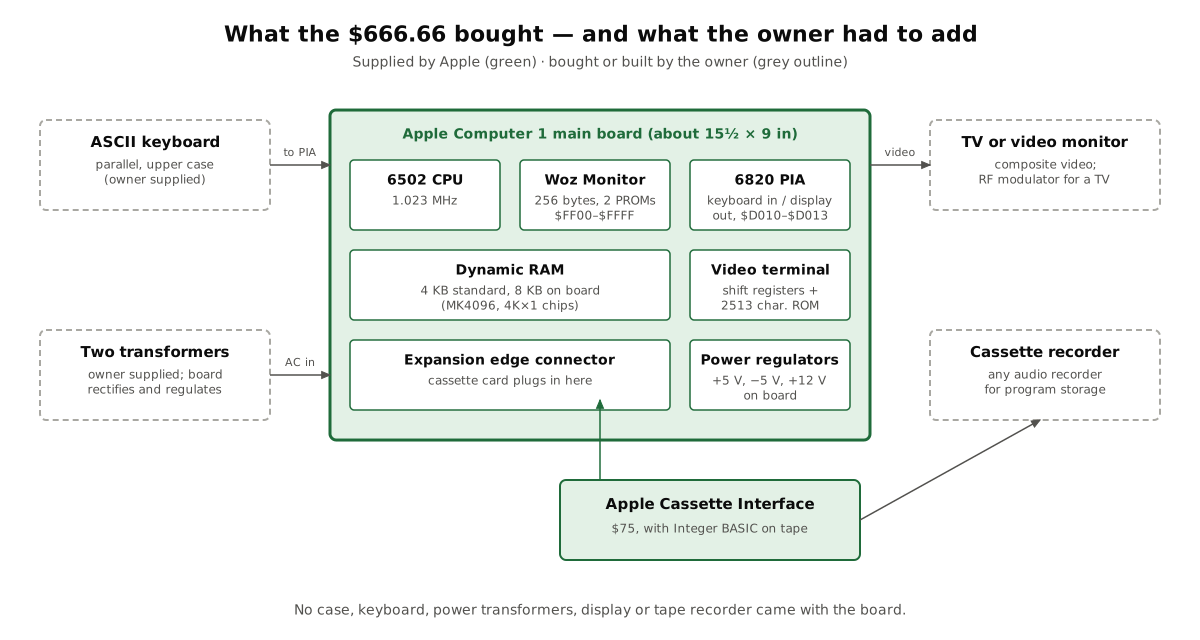
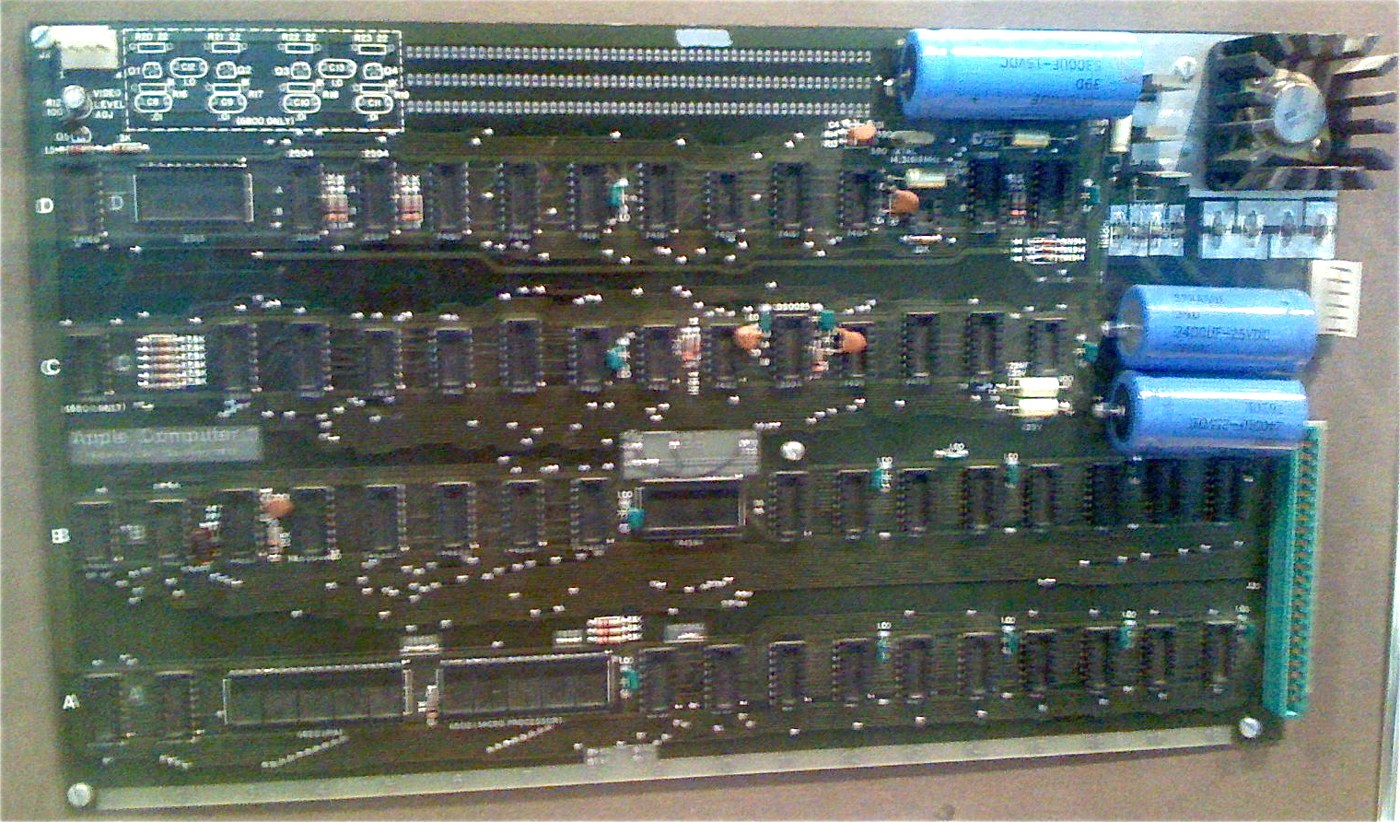
The Apple-1 took a different approach. It was a single printed circuit board, about 15½ by 9 inches, and on it were the processor, the memory, a small permanent program to get started, an interface for a keyboard, and a complete video terminal that drew text on an ordinary television set. There was no front panel at all. The owner connected an ASCII keyboard, a TV or video monitor and a pair of power transformers, switched on, pressed the reset button and typed. Letters appeared on the screen.
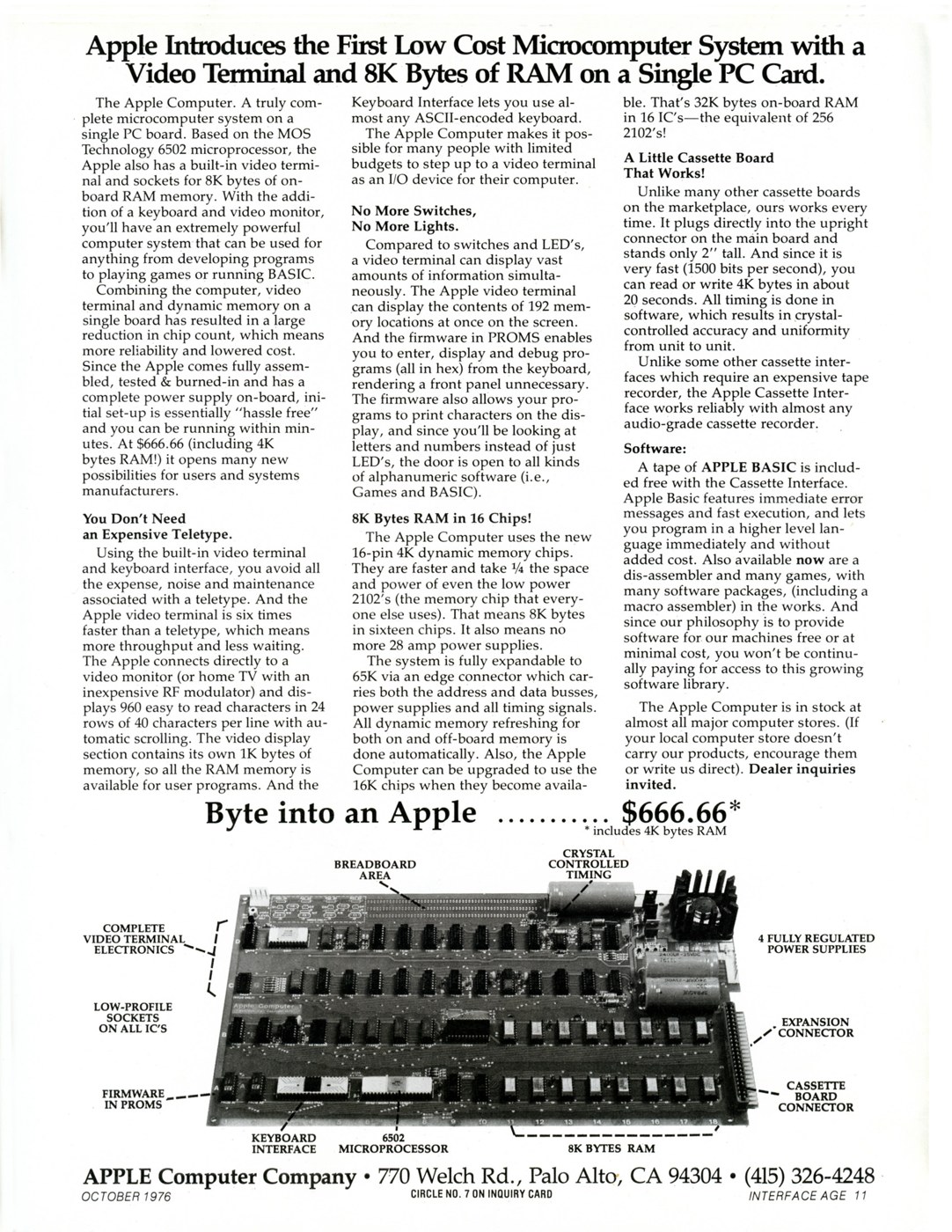
An Apple advertisement in Interface Age for October 1976 put it in one sentence: “Apple Introduces the First Low Cost Microcomputer System with a Video Terminal and 8K Bytes of RAM on a Single PC Card.” Under the subheading “No More Switches, No More Lights”, the copy promised that the board came “fully assembled, tested & burned-in” and that “initial set-up is essentially ‘hassle free’”. The claim of being first was advertising, and the 8K figure needed the optional second bank of memory chips. But the substance was right. Nobody else was selling a fully assembled, tested processor-plus-video-terminal board at that price.
1.2.1 What the buyer received
The Apple-1 was sold as a board. Fully assembled and tested, it cost $666.66. Wozniak, who later said he simply liked repeating digits, arrived at the price by adding a one-third markup to the $500 that dealers paid (Wozniak, iWoz, 2006, p. 180, via Wikipedia). It came with 4 KB of memory, expandable to 8 KB on the board. There was no case, no keyboard, no power transformer, no display and no means of storing a program. Most owners built or bought a wooden or metal box, found a surplus keyboard, and used the family television.
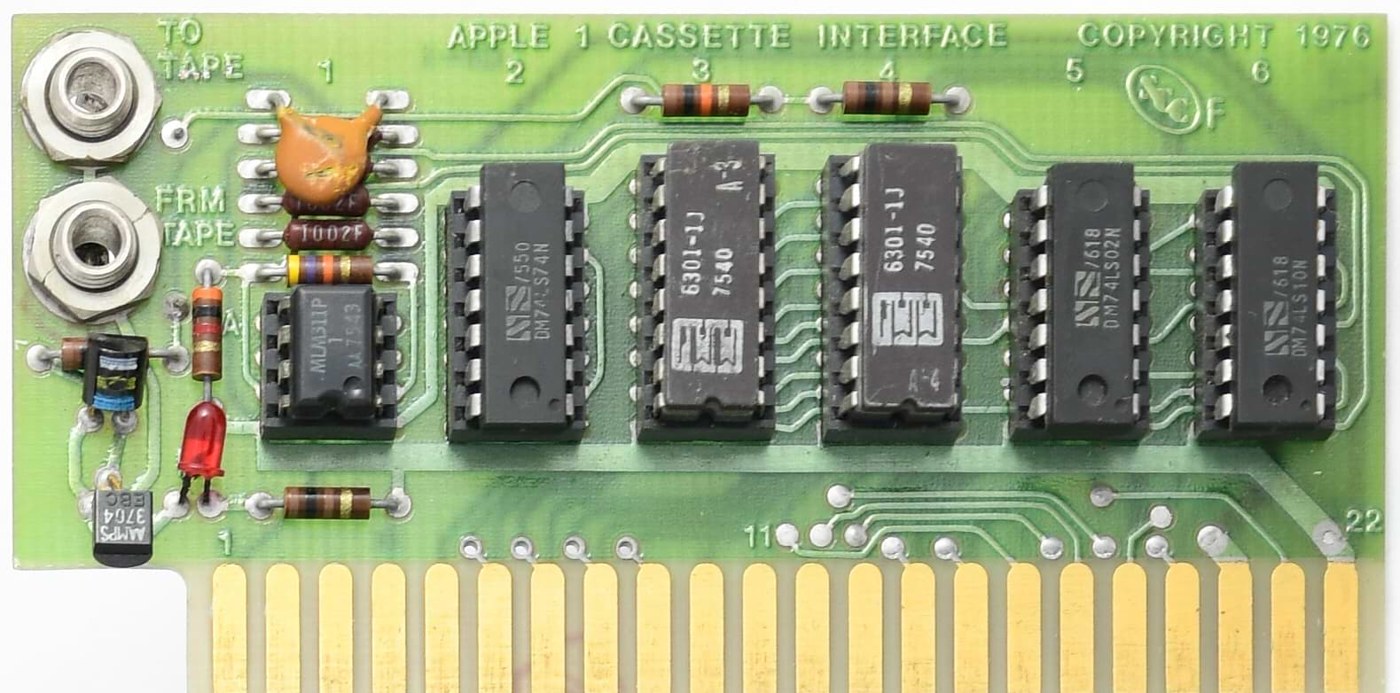
Apple sold one accessory in 1976: the Apple Cassette Interface, a small card that plugged into the main board’s edge connector and recorded programs on an ordinary audio cassette recorder. It cost $75, and it came with a tape of Wozniak’s BASIC. An Apple advertisement of the time stated the company’s line on software: “Our philosophy is to provide software for our machines free or at minimal cost” (quoted in Weyhrich, Apple II History, ch. 2).
1.2.2 What it could do
On its own, the Apple-1 did one thing when it was switched on. It ran a 256-byte program, the Woz Monitor, held in two small read-only memory chips. The monitor displayed a backslash and waited. The user could type a hexadecimal address to see what was stored there, type a range of addresses to see a block of memory, type new values to store them, and type an address followed by R to run the program found there. That was all. It was enough to enter a short machine-language program by hand, run it and see the result on the screen. Volume 5 describes the monitor in detail and Volume 11 uses it.
With the cassette interface and the BASIC tape, the machine became something a non-specialist could use. Wozniak’s BASIC loaded in under a minute and gave the owner a language in which programs were typed as numbered lines of English-like commands: 10 PRINT "HELLO", 20 GOTO 10. It handled integers only, with no decimal fractions. It was fast for its day, and it was written before the hardware was finished, because Wozniak wanted the machine to be usable the moment it was switched on. Further tapes followed at little or no charge, among them games such as Lunar Lander and Star Trek (Wikipedia, citing Apple’s 1977 price list).
The screen showed 24 lines of 40 upper-case characters. Text could only be added at the bottom: each new line pushed the others up and the top line fell off. There were no graphics, no colour, no sound and no lower-case letters. Characters appeared at about 60 per second, slow enough to see them arrive but around six times faster than the Teletype printers many hobbyists were using (Williams & Moore, Byte, Dec 1984).
1.3 How It Worked, in One Page
The design is described chip by chip in Volume 3. The outline is simple.
The processor is a MOS Technology 6502, an 8-bit microprocessor introduced in September 1975 at a price of $25. Its competitors, Intel’s 8080 and Motorola’s 6800, cost around $175–179. The price is the reason the Apple-1 uses it. Wozniak said so plainly: “the actual choice of processors was dictated by what I could afford” (Williams & Moore, 1984). The 6502 runs at about 1.023 MHz, a frequency obtained by dividing the 14.31818 MHz crystal used to time the video. The same chip, at the same speed, drove the KIM-1 single-board computer that MOS Technology sold as a development kit in 1976. The KIM-1 has its own unit in this collection.
The memory is dynamic RAM: eight Mostek MK4096 chips for each 4 KB bank, each chip holding 4,096 single bits. Dynamic RAM was cheaper and denser than the static RAM most hobby machines used, but it has to be refreshed constantly or it forgets. Wozniak tied the refresh to the timing of the video circuitry, so that the same counters that scan the screen also keep the memory alive, at the cost of briefly pausing the processor. That is the kind of saving his design is built from.
The keyboard and the display are connected through a Motorola 6820 Peripheral Interface Adapter (PIA), a chip with two 8-bit ports. One port reads the keyboard; the other sends characters to the video section. A program sees them as four memory addresses, $D010 to $D013. To print a character, the program writes it to the display port. To read a key, it waits for a flag on the keyboard port.
The video section is in effect a separate terminal on the same board. Wozniak had designed one for his own use in 1975, before he had a computer to attach it to. The 960 characters on the screen are stored in a chain of shift registers, circulating continuously in step with the television’s scan, and a Signetics 2513 character-generator ROM turns each 6-bit character code into the dot pattern of a letter. The terminal accepts one character at a time from the PIA when the circulating memory reaches the cursor position. That is why output is limited to roughly one character per screen refresh, about 60 a second.
The power supply is on the board too: rectifiers, filter capacitors and regulators that turn the output of two external transformers into the +5, −5 and +12 volts the chips need. The large blue capacitors and the finned heat sink in every photograph of an Apple-1 are the power supply.
The firmware is the 256-byte Woz Monitor at the very top of the memory map, $FF00–$FFFF, where the 6502 looks for its starting address when reset.
1.4 The Story in Miniature
1.4.1 The designer
Steve Wozniak, born in San Jose in 1950, was the son of a Lockheed engineer. He spent his teens designing computers on paper that he could not afford to build, redrawing the published schematics of commercial minicomputers with fewer and fewer chips. By 1975 he was 24, worked in Hewlett-Packard’s calculator division, and had built a TV terminal so that he could use distant time-sharing computers from home. In March 1975 he went to the first meeting of the Homebrew Computer Club, a group of Bay Area hobbyists who met to talk about the Altair, and saw that a microprocessor, his terminal and some memory together would make a whole computer. Volume 2 tells his story.
1.4.2 The partnership
Wozniak’s first plan was to give the design away. He handed out schematics at the club and helped other members build copies. His friend Steve Jobs, then 21 and working at Atari, argued that they should sell printed circuit boards: Wozniak estimated perhaps fifty buyers among the club’s roughly 500 members. To pay for the board artwork, Wozniak sold his HP-65 programmable calculator and Jobs sold his Volkswagen bus. On 1 April 1976 the two of them and Ronald Wayne, a draughtsman at Atari, signed a partnership agreement for the Apple Computer Company. Wayne withdrew less than two weeks later. Volume 4 tells the business story.
1.4.3 The order
The plan to sell bare boards lasted a few weeks. Paul Terrell, who had opened one of the first computer shops, the Byte Shop in Mountain View, saw the machine demonstrated at Homebrew. When Jobs visited the next day, Terrell offered to buy fifty, at $500 each, cash on delivery, on one condition: they had to arrive assembled. Jobs used the order to obtain the parts on thirty days’ credit, and the boards were built, partly at the Jobs family house in Los Altos, and delivered within the month. Terrell had pictured complete computers in cases. He received bare boards, but he paid.
1.4.4 The run
About two hundred Apple-1 boards were made, in two production runs in 1976. Wozniak later recalled that all but about 25 were sold within nine or ten months (Williams & Moore, 1984). Apart from the Byte Shop, the board was sold by mail order from Apple’s Palo Alto address, through a handful of other early computer stores across the United States, and it was shown at the PC ‘76 show in Atlantic City at the end of August 1976. In April 1977 the price was cut to $475 for 4 KB, and later that year the machine was quietly withdrawn. By then Wozniak had designed its successor. The Apple II, shown at the first West Coast Computer Faire in April 1977, had colour graphics, a built-in keyboard, a plastic case and BASIC in ROM. It made Apple a company and its founders rich, and it left the Apple-1 behind almost at once.
1.4.5 The survivors
Apple offered Apple-1 owners discounts against an Apple II and took some boards back. Those that came back were reportedly destroyed. Others were thrown away, broken up for parts or simply lost. For decades the survivors changed hands among collectors for modest sums: in 1986 an Apple publication guessed an Apple-1 was worth $10,000–15,000, and two sold for $14,000 each at the Vintage Computer Festival in 2000 and 2002. In 2010 the engineer Mike Willegal began the Apple-1 Registry, a census of known boards, now curated by Achim Baqué. As of 15 October 2026 it lists 94 boards as verified or almost verified, with a few more possibly surviving. Prices rose through the 2010s. In January 2026 a pre-production prototype board sold for $2.75 million, and in October 2026 a production board with a documented original owner sold for a reported $1,148,200. Volumes 6 and 7 follow the boards and the money.
1.5 What Made It Different
The Apple-1 is often called “the first personal computer”, which it was not. Its place in history rests on three narrower claims, each of which holds up.
It was assembled. Almost every microcomputer of 1975–76 was sold first as a kit: a bag of parts and a bare board for the buyer to solder. The Apple-1 was sold built and tested, because the Byte Shop insisted on it. Wozniak’s own preference had been to sell boards for hobbyists to build. The customer, not the designer, decided that the Apple-1 should be a finished product, and that decision shaped everything Apple made afterwards.
It had a terminal built in. Combining the computer and the video terminal on one board removed the most expensive accessory a hobbyist had to buy. With a keyboard and a second-hand television the Apple-1 was a working computer. An Altair needed a front panel to be any use, and a terminal to be much use.
It was economical to a fault. Wozniak’s guiding principle, stated in the 1984 Byte interview, was that “my motivation was totally to save chips, not to add features.” The dynamic RAM refreshed by the video circuit, the shift-register screen memory and the 256-byte monitor are all solutions chosen because they needed fewer parts than the obvious ones. That habit of mind runs straight into the Apple II and the Disk II controller, and it is why engineers still study the Apple-1’s schematic.
Equally, the Apple-1 had weaknesses that its successor fixed. Without a case or power supply it never appealed beyond hobbyists. Its display was slow and limited to text. Its BASIC had to be loaded from tape every session. Supporting it fell largely on Wozniak himself, which is one reason Apple tried so hard to swap owners onto the Apple II.
1.6 Where Apple-1s Are Today
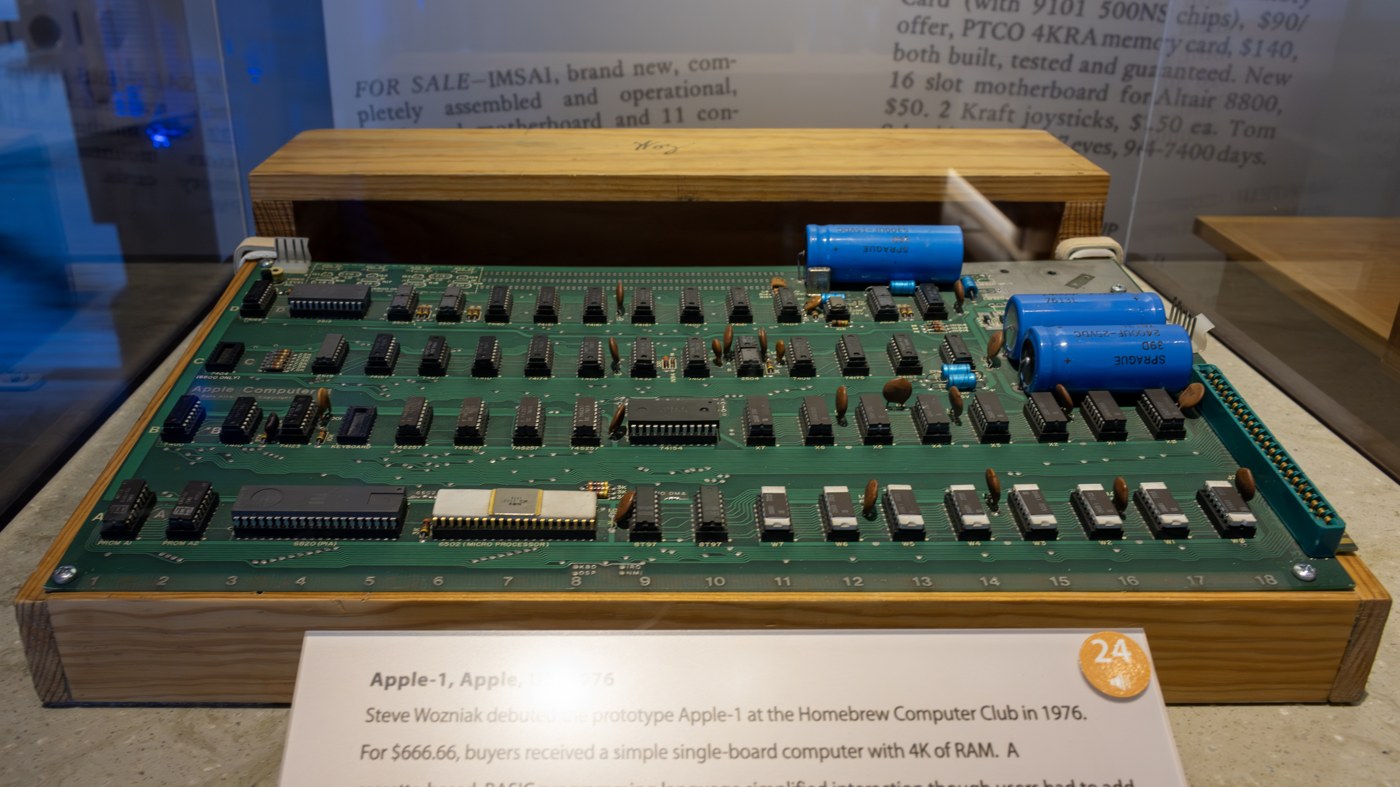
The Apple-1 Registry counts 19 of the verified or almost-verified boards in museums. Public collections that show one include:
Table 2 — The Apple-1 Registry counts 19 of the verified or almost-verified boards in museums. Public collections that show one include
| Museum | Place |
|---|---|
| Smithsonian, National Museum of American History | Washington, DC |
| Computer History Museum (two boards) | Mountain View, California |
| The Henry Ford | Dearborn, Michigan |
| History San Jose | San Jose, California |
| American Computer Museum | Bozeman, Montana |
| System Source Computer Museum | Hunt Valley, Maryland |
| Science Museum | London |
| National Museum of Scotland | Edinburgh |
| Deutsches Museum | Munich |
| Heinz Nixdorf MuseumsForum | Paderborn |
| Museum für Kommunikation | Bern |
| Powerhouse Museum | Sydney |
| Nexon Computer Museum | Jeju, South Korea |
The list is from the Registry’s museums page, read in October 2026. Displays change, so a visitor should check before travelling. Volume 6 covers these and the privately held boards.
1.7 Names, Numbers and Conventions in This Series
The name. Apple’s own materials called the machine the “Apple Computer” or the “Apple Computer 1”; the board’s silkscreen reads “Apple Computer 1”. After the Apple II appeared, the earlier machine became the “Apple I” or “Apple-1”. This series uses Apple-1, the form the Registry and most collectors use.
Numbers. Memory sizes are in bytes, with K meaning 1,024 (4K = 4,096 bytes). Addresses are hexadecimal, written with a dollar sign as 6502 programmers do: $FF00. Prices are in US dollars of the day, and where a modern equivalent is given it is computed from the US Consumer Price Index and labelled as such.
Counts. “About 200” is the production figure Wozniak gave in 1984; he has elsewhere said 175 were assembled, and one collector’s source claims 250 boards were printed. Survivor counts are always the Registry’s, with its date, because they change as boards surface.
Sources. Where the participants’ memories disagree, as they often do about the 1976 events, the volumes give both versions and say whose each is. Woz’s own published account, the 1984 Byte interview with Gregg Williams and Rob Moore, is treated as the primary source on the design. The Registry is the primary source on surviving boards.
Software examples. Every program listing and screen output in Volumes 5 and 11 comes from the series’ simulator, apple1_sim.py, which models the Apple-1’s memory map and terminal around a 6502 core. It reproduces the monitor’s behaviour without copying Apple’s ROM.
1.8 Why It Matters
The Apple-1 matters for three reasons.
First, it started Apple. The partnership, the first sales, the first dealer, the first advertising and the first profits all belong to it. The company that grew from it became, for much of the early twenty-first century, the most valuable in the world. Very few corporations can point to a single object that was the whole company at the start.
Second, it set the pattern for the home computer: an assembled machine, used through a keyboard and a television, that started up ready to accept typed commands. The Apple II, the Commodore PET and the Tandy TRS-80, the three machines of 1977 that took personal computing beyond hobbyists, all followed that pattern. The Apple-1 was its first commercial form.
Third, it is a document of a way of designing. The board is small enough, and the schematic short enough, for one person to understand completely. It shows what could be done in 1976 with a $25 processor and a few dozen ordinary logic chips by a designer who treated every chip as a cost. That is why people still build replicas, and why the series spends five volumes on how to own, care for, build and program one.
1.9 The One-Paragraph Version
The Apple-1 is a single-board microcomputer designed by Steve Wozniak in 1975–76 around the $25 MOS 6502 processor. It combined the processor, 4–8 KB of memory, a keyboard interface, a 256-byte monitor program and a complete 40-by-24-character video terminal on one board, so that with a keyboard, a television and two transformers it became a working computer. Wozniak and Steve Jobs founded the Apple Computer Company on 1 April 1976 to sell it. The first order, fifty assembled boards for Paul Terrell’s Byte Shop at $500 each, was financed with thirty days’ credit on parts. The machine retailed at $666.66, with a $75 cassette interface and BASIC on tape. About two hundred were made before the Apple II replaced it in 1977. Apple took some back and destroyed them; others were lost. The Apple-1 Registry now counts 94 verified or nearly verified survivors, which sell for hundreds of thousands of dollars and, in 2026, for more than a million. The remaining eleven volumes are the long version, ending with one family’s board in one family’s garage.
Next — Volume 2: Steve Wozniak — From Blue Boxes to the Homebrew Computer Club. A Lockheed engineer’s son in Sunnyvale who earned a ham radio licence before high school, won science fairs with logic circuits, and redrew minicomputers on paper because he could not afford the parts. Then the Cream Soda Computer, a magazine article about telephone phreaks, a job designing calculators at Hewlett-Packard, four sleepless nights on Breakout for Atari, and a Wednesday evening in March 1975 in a garage in Menlo Park.
Comments (0)