Apple-1 · Volume 12
Apple-1 — Volume 12 — My Family's Apple-1
An original Apple-1 bought by my family in the 1970s, the machine I learned BASIC and assembly on, and the garage where it still sits among my father's Apple-1s and Apple IIs — with what an Apple-1 cost a family then, how one was bought, and how a home machine of 1976–77 was set up and learned on
12.1 About This Volume
The first eleven volumes of this series are about the Apple-1 in general: the man who designed it, the board, the company it started, the survivors, the market, how to care for one, how to build a replica and how to program one. This last volume is about one particular Apple-1: my family’s.
We bought an Apple-1 in the 1970s. I learned to write BASIC and assembly language on it. My father still has it, in his garage, among several Apple-1s and Apple IIs.
That is what this volume can say in my own voice today. Photographs, serial numbers and the details of the story are still to be gathered from the garage and from family memory, and the places where they will go are marked. The rest of the volume, in the series’ reference voice, sets the scene: what an Apple-1 cost a family in 1976 and 1977, where and how one was bought, what had to be added to make it work, what learning to program on one involved, and what the Apple II did to the machines bought before it. It closes with the garage itself, and the practical side of looking after original machines that have stayed in a family for half a century.
12.2 Our Apple-1
My family bought an Apple-1 in the 1970s, and I learned to program on it: BASIC, and assembly language for its 6502 processor.
In the same years I also learned machine code and assembly on two other machines: a KIM-1, the MOS Technology single-board computer that uses the same 6502 processor as the Apple-1, and a Heathkit ET-3400 trainer, built around Motorola’s 6800, whose whole Heathkit course I worked through. About 1978 or 1979 I programmed a simple tickertape text program on the ET-3400 for my junior high school science class. The KIM-1 has its own unit in this collection.
12.3 What an Apple-1 Cost a Family
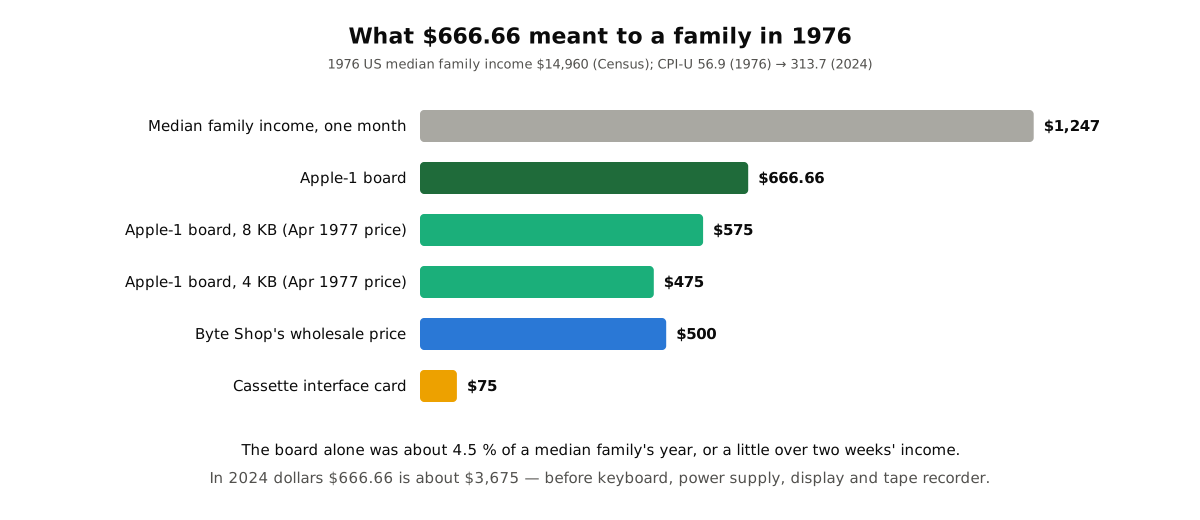
The Apple-1 went on sale in July 1976 at $666.66, assembled and tested, with 4 KB of memory (Volume 4). In April 1977 Apple cut the price to $475, or $575 with 8 KB (Weyhrich, Apple II History, ch. 2). The Apple Cassette Interface, with BASIC on tape, was $75.
To put those figures into a family’s terms: the US Census Bureau gave the median income of American families in 1976 as $14,960 (Census Bureau, Money Income in 1976 of Families and Persons in the United States, P60-114). The board alone was about 4.5 per cent of that, a little over two weeks of a median family’s income. Adjusted by the Consumer Price Index (CPI-U annual averages 56.9 for 1976 and 313.7 for 2024), $666.66 in 1976 is about $3,675 in 2024 dollars.
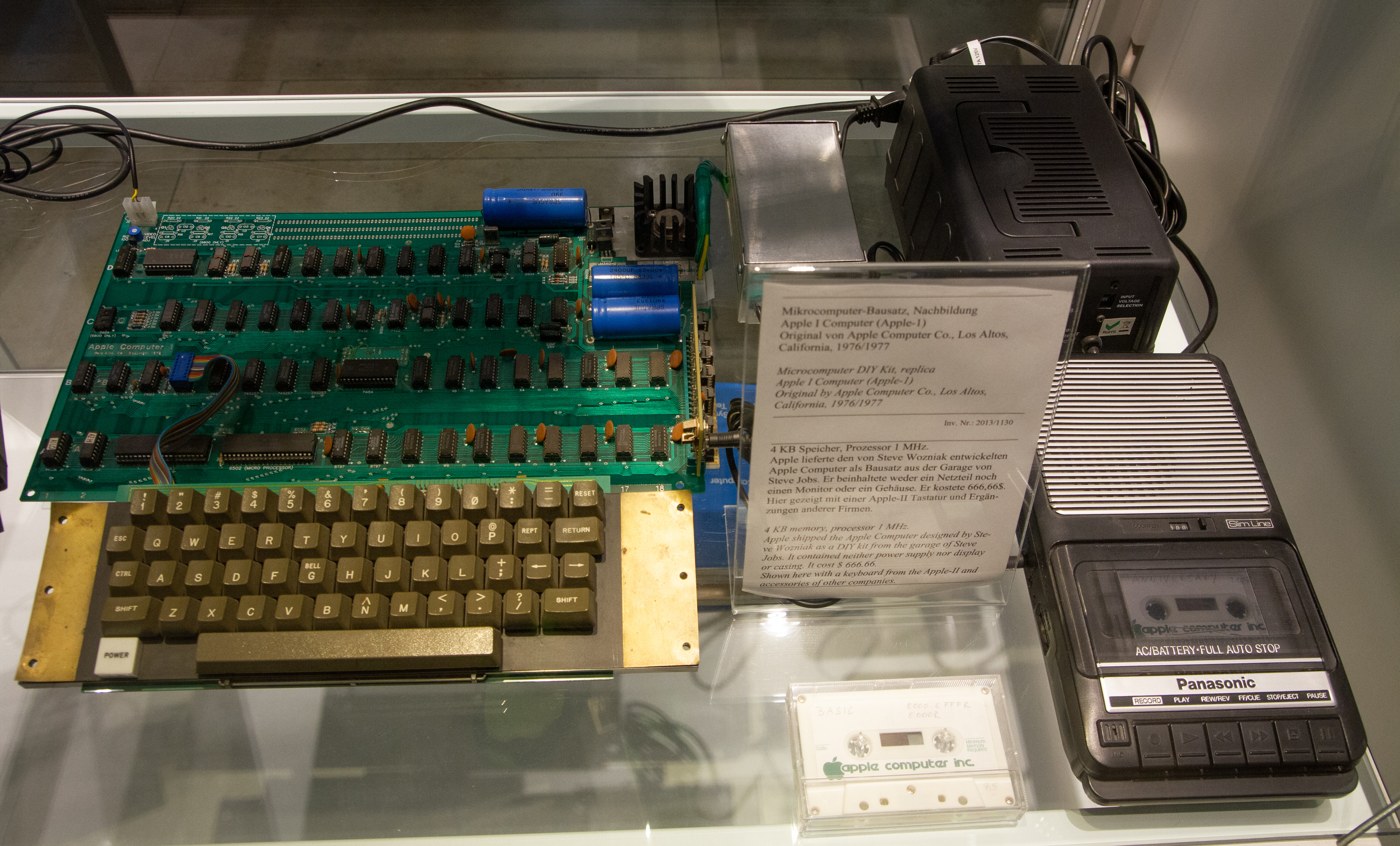
And the board was not the whole cost. Volume 1 lists what an owner had to add: a keyboard, a pair of power transformers, a television or video monitor, and, to keep programs, the cassette interface and a tape recorder. A household with a spare television and a cassette recorder needed less. One without them needed more.
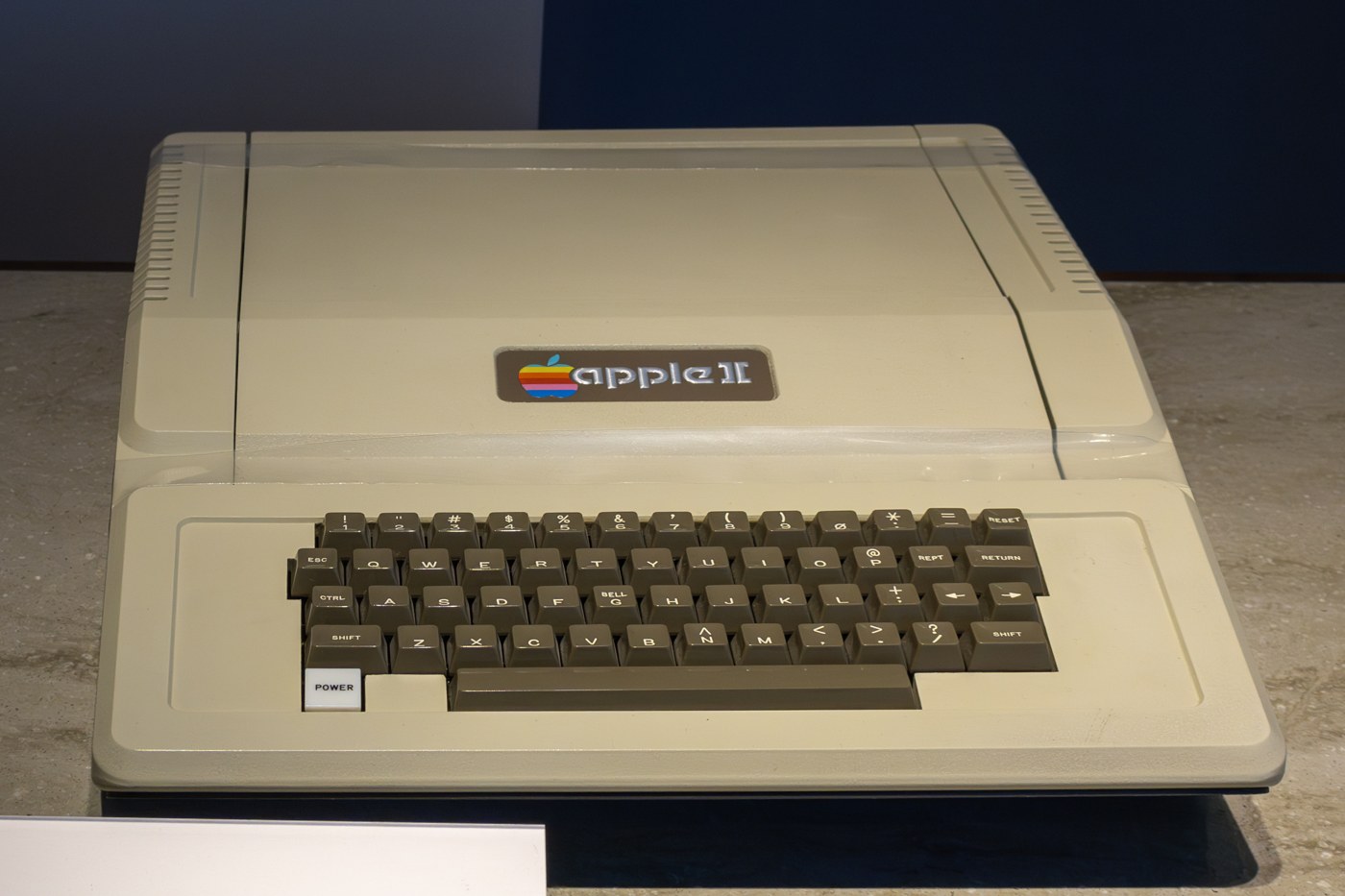
For comparison, the computers of the following year changed the arithmetic. The Apple II, launched in April 1977, cost $1,298 with 4 KB of memory, in a case, with a keyboard and power supply built in and BASIC in ROM, but still without a display or tape recorder. The Commodore PET and the Tandy TRS-80, both of 1977, came complete for less. For a family deciding in 1976, though, the Apple-1 was one of very few ways to have a computer that worked with a keyboard and a television, and it was among the cheapest.
12.4 How a Family Got One
There was no computer department in a department store in 1976. The ways to buy an Apple-1 were few, and each needed someone in the family who was following the new hobby.
From a computer shop. The Byte Shop chain, which began in Mountain View in December 1975 and had grown to dozens of stores by 1977, was the largest seller; its customers could also buy a koa-wood case. Other early shops that sold the Apple-1 included the itty bitty machine company in Evanston, Illinois, Data Domain in Bloomington, Indiana, and Stan Veit’s Computer Mart in New York (Wikipedia, “Apple I”).
From Apple directly. Apple’s advertisements and flyers gave a mailing address, 770 Welch Road, Palo Alto, and a telephone number. Buyers could write or call, and some bought in person from Steve Jobs at the family house in Los Altos (Volume 4).
From a club. The Apple-1 began at the Homebrew Computer Club, and boards were sold to members there. Other clubs around the country passed news, and sometimes machines, between members.
Second-hand. Once the Apple II appeared, some owners sold their Apple-1s to help pay for one. A college professor in California sold his in 1977 to a former student for $600, which went towards an Apple II (Apple-1 Registry, #94).
12.5 Setting One Up at Home
A family that bought an Apple-1 bought a circuit board. Everything else was a project. The Apple-1 Registry’s hundreds of photographs of surviving machines show how varied the results were.
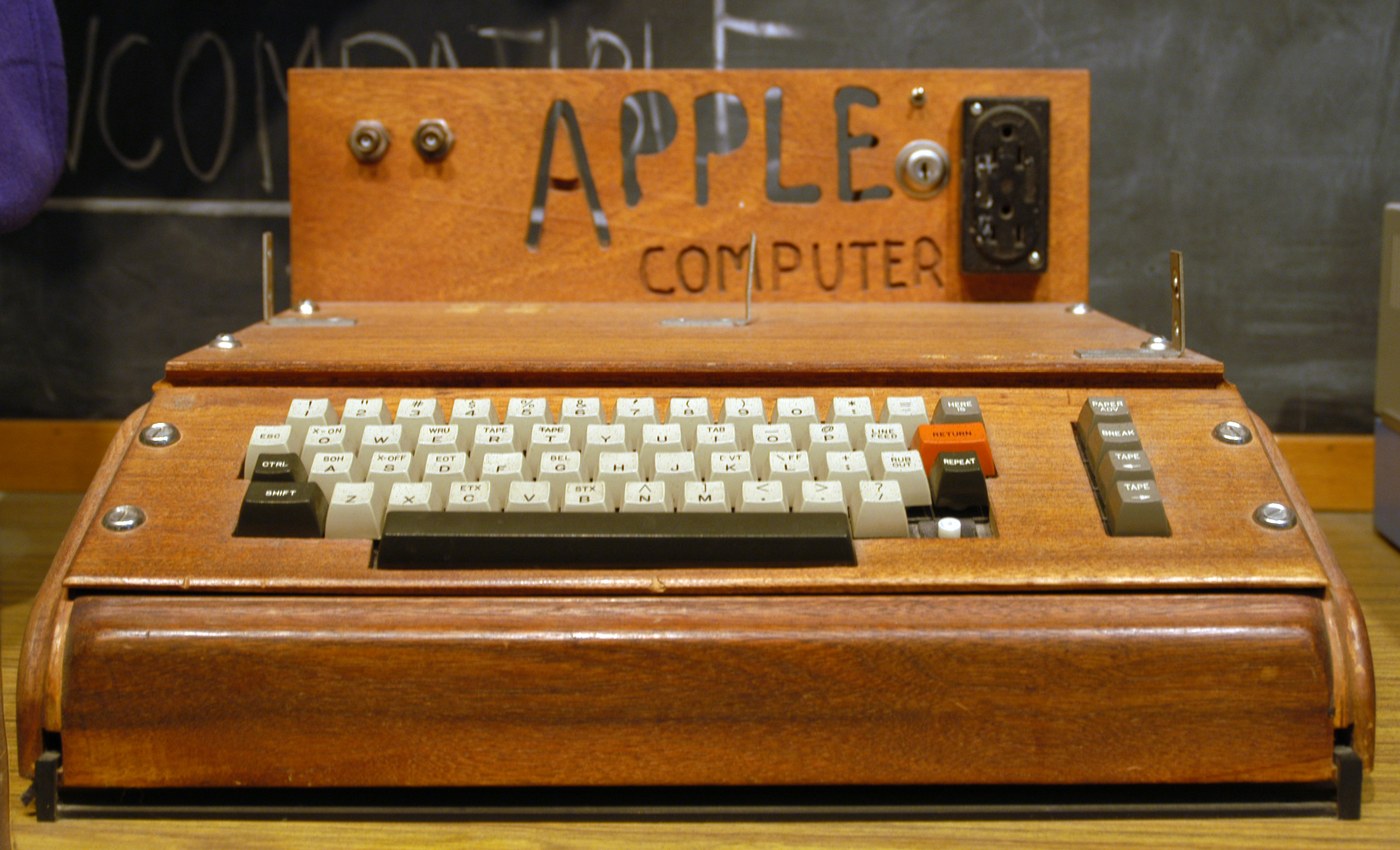
The case. Most owners built a box. Plywood and hardwood were the commonest, sometimes with the keyboard set into a sloping front, as in the Homestead High School case at the top of this volume. Some used metal enclosures or briefcases. The Byte Shop’s koa-wood case was the nearest thing to a factory option.
The keyboard. The Apple-1 accepted any keyboard that produced 7-bit ASCII codes in parallel with a strobe signal. Surplus keyboards were cheap and plentiful; many owners used one made by Datanetics. Some keyboards needed small modifications to match the board’s connector.
Power. The board carried its own rectifiers, filter capacitors and regulators, but not its transformers. The owner supplied two, one for the logic supply and one for the higher voltages, and mounted them in the case.
The display. The Apple-1 produced a composite video signal. A video monitor could take it directly. A family television needed an RF modulator, a small box that turned the video into a signal on a spare channel.
Storage. Without the $75 cassette interface, every program had to be typed in again after power was switched off. With it, any reasonable audio cassette recorder would do.
12.6 Learning to Program on an Apple-1
12.6.1 Switching on
An Apple-1 did nothing useful on its own. When it was switched on and its reset button pressed, the Woz Monitor (Volume 5) printed a backslash and waited. From there, there were two ways to program it.
12.6.2 BASIC
With the cassette interface, the owner loaded Wozniak’s BASIC from tape. The monitor was told to read the tape into memory, the recorder was started, and the program arrived in well under a minute. Then the screen showed BASIC’s prompt and the machine accepted programs as numbered lines.
Apple-1 BASIC was a small, fast language for its day. It handled whole numbers only, from −32,767 to 32,767, with no decimal fractions. It had strings, arrays, FOR loops, GOSUB and IF ... THEN, and it checked each line as it was typed, reporting errors at once. Programs were saved back to tape. Volume 11 shows working examples, run in the series’ simulator.
For a learner the attraction was immediacy: type a line, type RUN, see what happens. The limits taught their own lessons. Every number was an integer, so anything involving fractions had to be done by scaling. Memory was 4 KB or 8 KB, so programs had to be short. Text could only be added at the bottom of the screen and scroll upward, so programs that wanted to draw a screen had to print it line by line.
12.6.3 Assembly language
Below BASIC was the 6502 itself. The Apple-1 had no assembler in ROM, so a learner wrote a program on paper in 6502 assembly language, looked up the hexadecimal code for each instruction in a table, worked out the addresses of jumps and data by hand, and typed the resulting bytes into memory through the monitor. To run it, the learner typed the start address and R. To see what it had done, the learner examined memory. Mistakes usually meant a program that ran off into memory and never came back, and a press of the reset button.
It was slow, exacting work. It was also a direct education in how a computer works: registers, addresses, flags, the stack, and the way a single wrong byte changes everything after it. Many programmers of that generation have said that hand-assembling on a single-board computer taught them more than anything that came later. Two 6502 references were standard: MOS Technology’s own MCS6500 Microcomputer Family Programming Manual (1976), and, from 1979, Lance Leventhal’s 6502 Assembly Language Programming.
The 6502 that ran the Apple-1 also ran MOS Technology’s KIM-1, and assembly language learned on one transferred directly to the other. The input and output differed: the KIM-1 had a hexadecimal keypad and six seven-segment digits, the Apple-1 a full keyboard and a screen. But the instruction set, the registers and the habits of mind were the same.
12.7 When the Apple II Came
In April 1977 the Apple II was launched, and every Apple-1 owner had to decide what to do. Apple’s own answer was to offer a trade: an Apple-1 against a discount on an Apple II, on terms that changed over time. In January 1978 Steve Jobs offered one owner an Apple II 4K board in exchange for his Apple-1, minus its memory chips, plus $400 (Apple-1 Registry, #48). Boards that went back to Apple were, by several accounts, destroyed. Some owners traded, some sold, some kept the Apple-1 alongside a new Apple II, and some put it away. Apple handed support for the old machine to Joe Torzewski’s Apple I Owners Club (Volume 6).
Families that kept their Apple-1s did the history of computing a service without meaning to. Most of the boards that survive today survived because someone did not throw them away.
My family’s Apple-1 is still in the family. My father has it.
12.8 The Garage
My father still has several Apple-1s and Apple IIs, stored in his garage. Our family’s Apple-1 is one of them.
12.8.1 What the series says about boards like these
The volumes before this one were written knowing that a reader might have original boards in a garage. Their practical points, briefly:
Table 1 — The volumes before this one were written knowing that a reader might have original boards in a garage. Their practical points, briefly
| Question | Where it is answered |
|---|---|
| Which run is a board from, and what do its markings mean? | Volume 4 (the two runs, serial numbers, inspection stamps); Volume 7 (what an original looks like) |
| How many survive, and is a board already known? | Volume 6 (the Apple-1 Registry and its census) |
| What might it be worth, and what adds or loses value? | Volume 7 |
| How should it be stored, photographed and handled? | Volume 8 |
| Should it be switched on? | Volume 8: not before an experienced restorer has inspected it, because fifty-year-old capacitors and power supplies can fail destructively |
| Can its programs be run without risking it? | Volume 11 (the simulator) and Volumes 9–10 (replicas) |
A garage is the most common place for an old computer to survive, and also one of the harder places for it to stay well. Summer heat, winter damp, dust and rodents are the usual enemies of electronics in storage, and Volume 8 describes how conservators and experienced restorers deal with each. The documentation matters as much as the boards. Volume 7 explains that a board’s history (who bought it, where, when, for how much, and what was done with it) is the largest single part of its value to a museum or a collector, and the part most easily lost. Photographs of a family with its computer, receipts, letters and the memories of the people who used it are the provenance that no specialist can reconstruct later.
12.9 The One-Paragraph Version
My family bought an Apple-1 in the 1970s, and I learned BASIC and 6502 assembly language on it, in the same years that I learned machine code on a KIM-1 and a Heathkit ET-3400. My father still has it, in his garage, among several Apple-1s and Apple IIs. In the reference terms of this series: the Apple-1 cost a family $666.66 in 1976, or $475–575 after April 1977, about two weeks of a median family’s income before the keyboard, transformers, display and tape recorder were added. It was bought from a handful of computer shops, from Apple by mail or in person, at clubs, or second-hand, and finished at home in a case of the owner’s making. Learning on one meant loading BASIC from tape or hand-assembling 6502 code into the Woz Monitor. When the Apple II came, many Apple-1s were traded in and destroyed, and the survivors are mostly those that families kept. The details of this one, its photographs, its serial number and its story, are still to come.
Back to the beginning — Volume 1: Apple-1 — The Computer That Started Apple. The whole story in miniature: the board, the price, the two Steves, the two hundred machines, and why the few dozen that survive are worth more than the houses they were built in.
Comments (0)