Apple-1 · Volume 4
Apple-1 — Volume 4 — The Byte Shop Order and the Birth of Apple Computer, 1976–77
A calculator and a Volkswagen sold for circuit boards, a three-man partnership that lasted twelve days in its first form, a shop owner who wanted fifty finished computers and got fifty bare boards, thirty days' credit, a price of $666.66, and the year in which the Apple-1 made a company and was then left behind
4.1 About This Volume
By March 1976 Steve Wozniak had a working computer and was giving its design away at the Homebrew Computer Club (Volume 2). Eighteen months later the Apple Computer Company had sold about 175 of them, become a corporation with a professional chairman and an advertising agency, launched the Apple II, and dropped the Apple-1. This volume tells the business story of those eighteen months.
It covers Steve Jobs’s proposal to sell boards; the money raised to make them; the partnership agreement of 1 April 1976 and Ronald Wayne’s withdrawal; the Byte Shop order that turned a board into a product; the thirty-day credit that paid for the parts; assembly at the Jobs family house; the price; advertising and other dealers; the second production run; and the arrival of Mike Markkula, the incorporation of Apple Computer, Inc., and the Apple II. It ends with what happened to the Apple-1 once the Apple II was on sale.
The participants have told these stories for fifty years, to biographers, journalists and each other, and their memories disagree on dates, quantities and prices. The main sources here are Wozniak’s 1984 interview in Byte (transcript); Paul Terrell’s account as given to heise in 2025 (heise); the documents sold at auction, which have the virtue of fixed dates; and the Apple-1 Registry’s history pages. Where they differ, both versions are given.
4.2 “At Least We’ll Have a Company”
Wozniak’s plan for his computer was the Homebrew plan: publish the design and help others build it. Steve Jobs, who had been coming to the club with him, saw that most members could not or would not build a computer from a schematic alone. They would, however, buy a printed circuit board with the parts’ positions marked on it, and solder the chips in themselves.
Wozniak described the conversation to Byte. Jobs proposed making printed circuit boards to sell at the club. Wozniak thought perhaps fifty of the club’s roughly 500 members would buy one. Artwork for the board would cost about $1,000, and each board about $20 to make. Wozniak doubted they would get their money back. Jobs’s answer, as Wozniak remembered it, was that even if they lost money, “at least for once in our lives we’ll have a company” (Williams & Moore, 1984).
To raise the money, Wozniak sold his HP-65 programmable calculator. He valued it at about $500, and later wrote in iWoz that the buyer paid only half. Jobs sold his Volkswagen bus, for about $750 by the account the Apple-1 Registry follows; other accounts give larger sums, and some say Jobs had to refund part of the price when the bus broke down (Apple-1 Registry, “The Apple-1”). Together they had something over $1,000. Howard Cantin, a layout engineer at Atari, drew the board artwork, and was paid $500 by a cheque dated 16 March 1976.
4.3 The Partnership
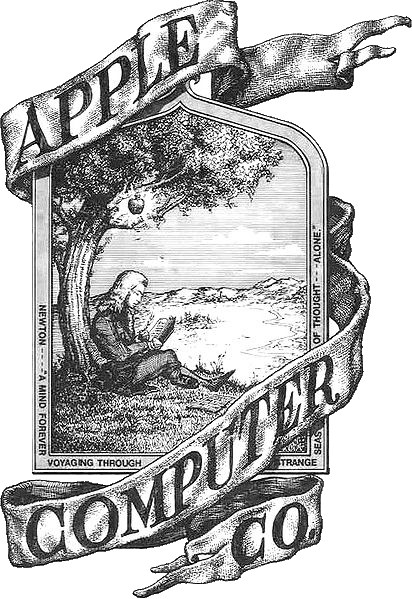
On 1 April 1976 three men signed a partnership agreement for the Apple Computer Company: Steve Jobs, Steve Wozniak and Ronald Wayne. Wayne was a chief draughtsman at Atari, where Jobs worked, and at 41 was twice the age of either of the others. The agreement gave Jobs and Wozniak 45 per cent each and Wayne 10 per cent, so that he could settle any disagreement between them. Wayne drew up the agreement, and he drew the company’s first logo: an elaborate pen-and-ink engraving of Isaac Newton under an apple tree, framed by a banner reading “Apple Computer Co.” and a line from Wordsworth about “a mind forever voyaging through strange seas of thought, alone”.
The name was Jobs’s. Accounts of why vary: Jobs had recently spent time on an apple orchard commune and was on a fruit diet; “Apple” came before “Atari” in the telephone directory; and, in Frank Rose’s account, Jobs “thought of the apple as the perfect fruit” (Weyhrich, Apple II History, ch. 2, citing Rose, West of Eden). There is no reason to choose between them.
Wayne did not stay. On 12 April 1976, eleven days after signing, he withdrew. The partnership was a general partnership, so each partner was personally liable for its debts, and Wayne had property to lose. He had been through an unsuccessful business before. When Jobs began buying parts on credit, Wayne decided the risk was not for him. His interest was bought out for $800, and he later received a further $1,500 to give up any claim. The partnership agreement, the amendment recording his withdrawal and a related county filing were sold at Sotheby’s in New York on 13 December 2011 for $1,594,500 (Computerworld). The 10 per cent Wayne gave up became, in later decades, the most-quoted example of a missed fortune in American business. Wayne himself has consistently said that he made the right decision for the man he was in 1976.
4.4 The Byte Shop
The first customer was not a Homebrew member building a kit. It was a shop.
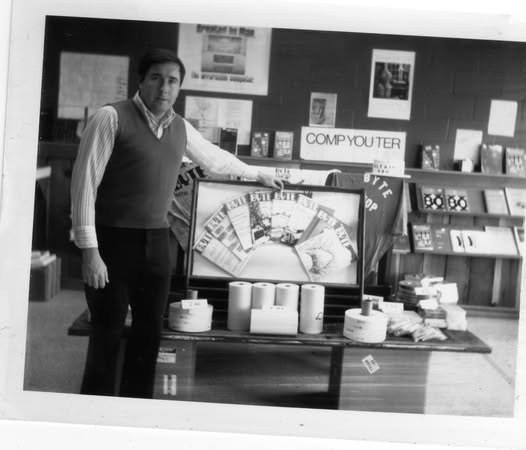
Paul Terrell had opened the Byte Shop at 1063 West El Camino Real in Mountain View on 8 December 1975, his birthday. It was one of the first retail computer stores in the country, and its name came from Byte magazine, whose first issue had appeared that September. Terrell had been selling MITS’s Altair, but at the World Altair Computer Convention in Albuquerque in March 1976 MITS insisted that its dealers sell no other make, and Terrell refused. He needed other computers to sell (heise, 2025).
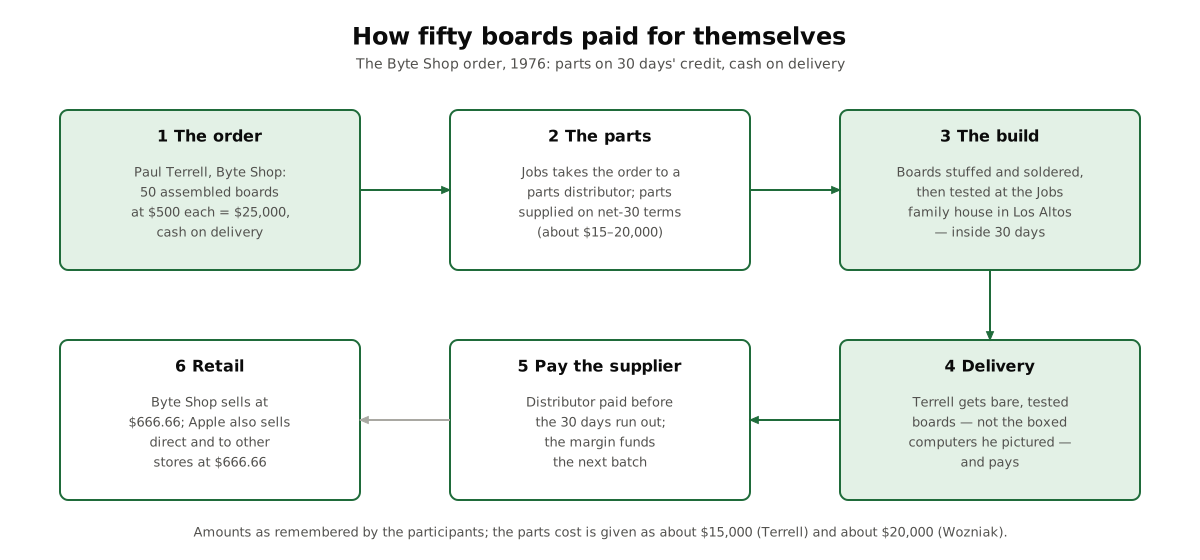
He saw the Apple-1 when Wozniak and Jobs demonstrated it at a Homebrew meeting in the spring of 1976. He was interested, and told Jobs to keep in touch. Jobs came into the Byte Shop the next day. Many accounts add that he was barefoot. Terrell made an offer that changed the plan. He would buy fifty computers at $500 each, paying cash on delivery, but only if they came fully assembled. He did not want bags of parts and bare boards that his customers would have to solder. He wanted machines that a customer could take home and use.
The order was worth $25,000. Wozniak’s recollection in 1984 was different: “something like 100” units at $500, a $50,000 order. Terrell has always said fifty, and the Registry agrees; the hand-written serial numbers on early boards, discussed below, suggest that the Byte Shop took fifty or so at first. Wozniak and Jobs no longer had a plan to sell boards for $20 in profit. They had a dealer, a wholesale price, and a delivery date.
4.5 Thirty Days
Fifty assembled computers needed parts that Apple could not pay for. The estimates of the cost vary: about $15,000 in Terrell’s account, about $20,000 in Wozniak’s. Banks would not lend to two young men with no company, no assets and an order from a shop that had been open for four months.
Jobs went to the electronics distributors instead. With the Byte Shop purchase order in hand, he asked a distributor, Cramer Electronics in most accounts, to supply the parts on net 30 terms: pay in thirty days. The credit manager telephoned Terrell to confirm that the order was real and that he would pay on delivery. Satisfied, the distributor supplied the parts. Wozniak recalled that they also borrowed $5,000 from Allen Baum and his father to cover the rest (Williams & Moore, 1984).
That turned the order into a race against the calendar. Apple had thirty days to build fifty computers, deliver them, collect $25,000 from Terrell, and pay the distributor before the invoice was due. Wozniak recalled that they delivered in ten days. Whatever the exact figure, it was well inside the month. It was the first and most important piece of business Jobs did, and it established a pattern Apple used for years: use the customer’s order as collateral, and use supplier credit as working capital.
4.6 Building Them
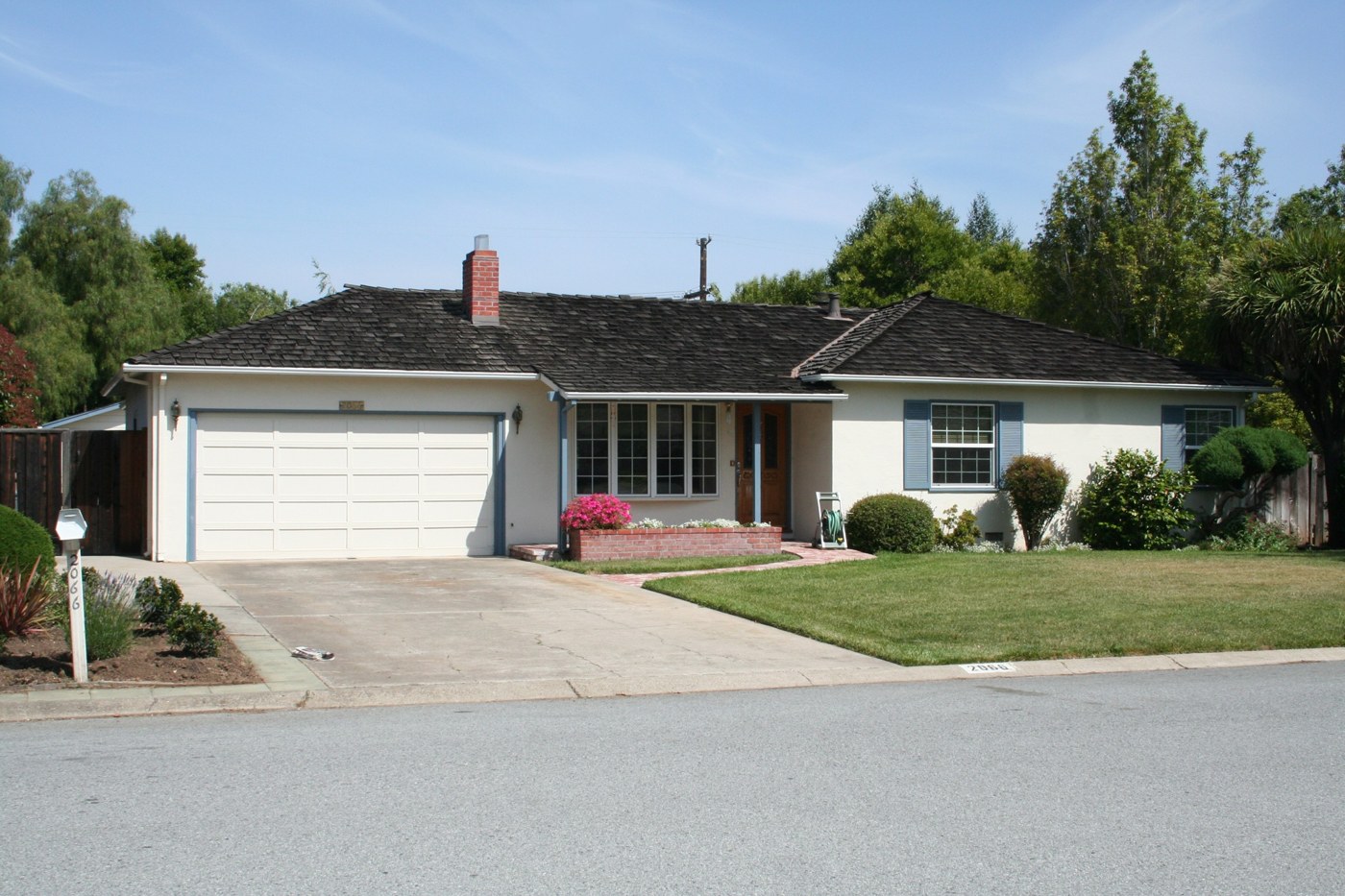
The printed circuit boards were made by an outside manufacturer from Cantin’s artwork. Everything else was done by the founders and whoever they could persuade to help. The work was done at the house of Jobs’s parents, Paul and Clara Jobs, at 2066 Crist Drive, Los Altos. According to the Registry, the first fifty boards were assembled in the house itself and the next fifty in the garage, with Wozniak checking the work about once a week. Helpers named in later accounts include Jobs’s sister Patty and his friend Daniel Kottke. Each board was populated with its chips and then tested before it left.
The garage is the most famous part of this story and, according to Wozniak, the most exaggerated. In 2014 he called it “a bit of a myth”: no design work was done there, and its main use was testing finished boards before they were sold (BGR, 4 December 2014). Both things can be true. The Apple-1 was designed in Cupertino, and the Apple Computer Company’s first manufacturing, shipping and selling happened in Los Altos. In October 2013 the Los Altos Historical Commission designated the house a historic resource, explicitly for its association with these events and not for its architecture.
Jobs delivered the boards to the Byte Shop. Terrell was, by his own account, taken aback: he had pictured complete computers, with cases, keyboards, power supplies and displays, and he received boards. But they were assembled and tested, as he had asked, and they worked. He paid. The Byte Shop then sold the boards to its customers, some of whom bought cases the shop offered. The Registry counts nine surviving Apple-1s in original Byte Shop cases, made of koa wood. Customers supplied the keyboards, transformers and displays themselves, exactly as Volume 1 describes.
4.7 Serial Numbers and the Byte Shop Boards
Apple did not give the Apple-1 serial numbers in any systematic way. But some early boards carry a hand-written number on the back, in the form “01-00xx”. The Registry’s research associates these numbered boards with the Byte Shop. In January 2022 Achim Baqué, the Registry’s curator, found documentary evidence that the numbers were written by Steve Jobs himself, and a professional handwriting analysis of two boards had reached the same conclusion. The highest number known is 01-0079; numbers above 50 are explained by later Byte Shop sales, including fifteen boards that Data Domain, a computer shop in Bloomington, Indiana, run by Ray Borrill, bought from the Byte Shop (Apple-1 Registry). Volume 7 explains why these numbers matter so much to value.
4.8 The Price and the Pitch
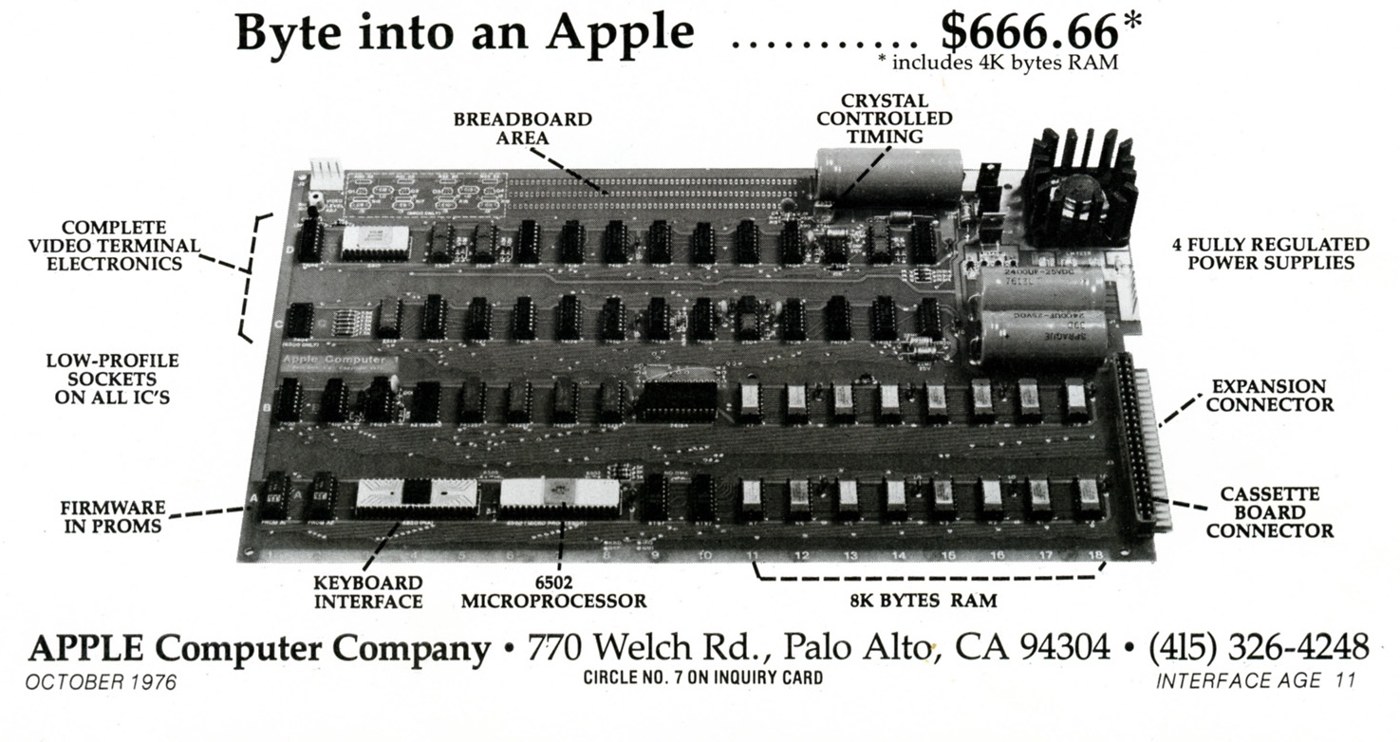
Apple sold the Apple-1 itself, at retail, for $666.66. Wozniak arrived at the figure by adding a third to the $500 dealer price, and liked it because the digits repeated. He has said he had no idea of any other associations of the number, and was surprised when people objected.
The pitch was made in small advertisements and a two-sided flyer. An advertisement in Interface Age for October 1976 is the best known. Its headline claimed “the First Low Cost Microcomputer System with a Video Terminal and 8K Bytes of RAM on a Single PC Card”. The text stressed that the board came “fully assembled, tested & burned-in”, that it needed only a keyboard and video monitor, and that BASIC came free with the $75 cassette interface. The slogan was “Byte into an Apple”. The address was 770 Welch Road, Palo Alto, a mail drop and answering service. Apple had no office of its own until 1977, and the telephone number on its paperwork was answered by a service while the founders worked from Los Altos.
4.9 Other Dealers, and Atlantic City
The Byte Shop was the first and largest dealer, but not the only one. Wikipedia’s account, citing a 2012 history, names the first four storefront sellers as the Byte Shop, the itty bitty machine company in Evanston, Illinois, Data Domain in Bloomington, Indiana, and Stan Veit’s Computer Mart in New York City (Wikipedia, “Apple I”). Apple also sold boards directly, by mail and in person, to Homebrew members and others who wrote or called. One such sale, to Charles Ricketts, was made by Jobs from the Los Altos house, and is documented in the papers that were sold with Ricketts’s board in 2014.
The Apple-1’s first appearance on a national stage was PC ‘76, the Personal Computing show in Atlantic City, New Jersey, on 28–29 August 1976. Jobs, Wozniak and Daniel Kottke travelled there and showed the board at Stan Veit’s booth. It was a small showing at a show dominated by MITS, Processor Technology and others, and accounts differ on how many orders resulted. But it put the Apple name in front of East Coast dealers and the hobby press.
4.10 The Second Run
The first production run of boards, made around April 1976, sold out. A second run was made in the second half of 1976 by a different board manufacturer whose logo, a diamond enclosing the letters “NTI”, appears on the boards below the “Apple Computer 1” legend. The circuit and layout were unchanged. The components were not: the second run used newer multilayer decoupling capacitors in place of ceramic discs, different electrolytic capacitors, and mostly plastic-packaged processors and PIAs in place of the white and purple ceramic packages on many first-run boards. Many second-run boards carry an inspection stamp on the back; the one known as the “Demo unit” reads “INSP. ON SEP 21 1976” (Apple-1 Registry, #70). No second-run board has a hand-written serial number. The Registry’s figures suggest the two runs were of similar size. Volume 7 uses these differences to date and authenticate boards.
The Apple Cassette Interface arrived during the same period. It had not been available when the first boards shipped, and it too exists in first and second versions.
4.11 Selling Out, Slowly
Wozniak summed up the commercial record in 1984: about 200 Apple-1s were manufactured in 1976, and all but 25 were sold over nine or ten months (Williams & Moore, 1984). On his figures, and at prices between $500 to dealers and $666.66 retail, the Apple-1 brought in something on the order of $100,000, an estimate, not a recorded figure. Elsewhere he has said that 175 were assembled. A few early employees later took unsold boards home from a cabinet at Apple.
The money mattered less than what it paid for. While the Apple-1 was selling, Wozniak was designing its successor. By the late summer of 1976 he had a prototype of a computer with colour graphics, sound, game paddles, BASIC in ROM and a keyboard in a case: the Apple II. Jobs showed it to the Byte Shop’s Terrell and to visitors to the garage. To build it in quantity would take far more money than the Apple-1 had made. Wozniak recalled the arithmetic: 1,000 boards at about $250 each in parts, $250,000 that the partners did not have (Williams & Moore, 1984).
4.12 Markkula and the Corporation
Jobs went looking for investors. The venture capitalist Don Valentine declined, and referred him to Mike Markkula, a former marketing manager at Intel who had retired in his early thirties on the proceeds of his stock options. Markkula visited the garage in the autumn of 1976, saw the Apple II prototype, and agreed to join.
On 3 January 1977 Apple Computer, Inc. was incorporated, and it bought out the partnership of Jobs and Wozniak. Markkula put in his own money, figures between $80,000 and $92,000 are given, and arranged or guaranteed a bank line of credit, so that the total commonly quoted is $250,000. Jobs, Wozniak and Markkula each held about 26 per cent. Markkula insisted that Wozniak leave HP and work for Apple full-time; Wozniak, reluctant to give up a job he loved, eventually agreed. Markkula brought in Michael Scott as president, the publicist Regis McKenna, whose agency commissioned Rob Janoff’s rainbow-striped apple logo, and a business plan. The company moved from Los Altos to an office in Cupertino.
The Apple II was launched at the first West Coast Computer Faire in San Francisco on 16–17 April 1977, and began shipping in June. It sold for $1,298 with 4 KB of memory, in a beige plastic case, ready to plug into a television. It was everything the Apple-1 was not, and it sold in thousands, then tens of thousands.
4.13 The End of the Apple-1
Apple cut the Apple-1’s price in April 1977, to $475 with 4 KB of memory or $575 with 8 KB (Weyhrich, ch. 2). It was dropped from the price list later that year; the dates given are 30 September and October 1977.
Apple then tried to move Apple-1 owners onto the Apple II. Owners were offered discounts on an Apple II in exchange for their boards, and the terms changed over time. One letter survives with its board. On 18 January 1978 Steve Jobs, signing as Vice President, Operations, wrote to Fred Hatfield of Computer Data Systems, who had complained about the shortage of Apple-1 software. Jobs offered him an Apple II 4K board in exchange for his Apple-1, without its memory chips, plus $400. Hatfield kept his Apple-1 (Apple-1 Registry, #48). That board sold for a reported $1,148,200 in October 2026.
Boards that did come back were, according to several accounts, destroyed. One family of owners, the Huston brothers, recalled seeing a pile of returned boards in Jobs’s office awaiting disposal, and were given two. The Registry has found only one confirmed trade-in, by Bob Bishop, and treats the scale of the destruction as uncertain.
Finally, Apple handed support to the owners themselves. A form letter from Apple Computer Inc. in Cupertino, addressed “Dear Apple I Owner”, explained that since the Apple II’s introduction interest in Apple I software had declined, that tapes were being made only by special order, and that support was costly and difficult. It announced that an owner, Joe Torzewski of Granger, Indiana, was starting an Apple I Owners Club, through which Apple would support Apple I software from then on (Applefritter archive). The club’s first newsletter counted about thirty members. Volume 6 follows the owners from there.
4.14 Timeline
Table 1 — Timeline
| Date | Event |
|---|---|
| 8 Dec 1975 | Byte Shop opens in Mountain View |
| Mar 1976 | Design finished; Cantin paid $500 for the board layout (16 Mar) |
| 1 Apr 1976 | Apple Computer Company partnership: Jobs, Wozniak, Wayne |
| 12 Apr 1976 | Wayne withdraws |
| Spring 1976 | Homebrew demonstration; Byte Shop orders 50 at $500 |
| c. Apr–Jul 1976 | First board run assembled in Los Altos and delivered |
| Jul 1976 | Apple-1 on retail sale at $666.66 |
| 28–29 Aug 1976 | PC ‘76, Atlantic City |
| Second half 1976 | Second (NTI) board run; cassette interface available |
| Autumn 1976 | Apple II prototype; Markkula joins |
| 3 Jan 1977 | Apple Computer, Inc. incorporated |
| Apr 1977 | Apple-1 cut to $475 / $575; Apple II launched at the West Coast Computer Faire (16–17 Apr) |
| Sep–Oct 1977 | Apple-1 dropped from the price list |
| 18 Jan 1978 | Jobs’s trade-in letter to Fred Hatfield |
| c. 1978 | Apple I Owners Club takes over support |
4.15 The One-Paragraph Version
In early 1976 Steve Jobs persuaded Steve Wozniak to sell his computer instead of giving the design away. They paid for the board artwork with a calculator and a Volkswagen, and on 1 April 1976 formed the Apple Computer Company with Ronald Wayne, who left twelve days later for $800. Paul Terrell of the Byte Shop in Mountain View ordered fifty, at $500 each, on condition they arrived assembled. Jobs used the order to get parts on thirty days’ credit; the boards were built and tested at his parents’ house in Los Altos and delivered within the month. The Apple-1 retailed at $666.66, was advertised from a Palo Alto mail drop, sold through a handful of stores and by mail, and went through a second board run made by NTI. About 200 were built and 175 or so sold. The profits and Wozniak’s Apple II prototype brought in Mike Markkula; Apple Computer, Inc. was incorporated on 3 January 1977 and launched the Apple II that April. The Apple-1 was cut in price, dropped in the autumn of 1977, partly taken back in trade, and handed over to its owners’ club.
Next — Volume 5: The Woz Monitor, Integer BASIC and the Cassette Interface. The 256 bytes that greet the user with a backslash; how a line of hex becomes an examine, a deposit or a run; Wozniak’s BASIC, written and assembled by hand and loaded from tape in well under a minute; and the small card that made the Apple-1 a computer you could switch off without losing everything.
Comments (0)