Apple-1 · Volume 6
Apple-1 — Volume 6 — Owners and Survivors — The Registry, the Two Hundred Boards and Where They Are
Who bought an Apple-1 in 1976 and 1977, what they did with it, how most of the boards disappeared, how a few dozen survived in closets, classrooms and garages, and how an American engineer and a German repairer came to keep the census of every known board
6.1 About This Volume
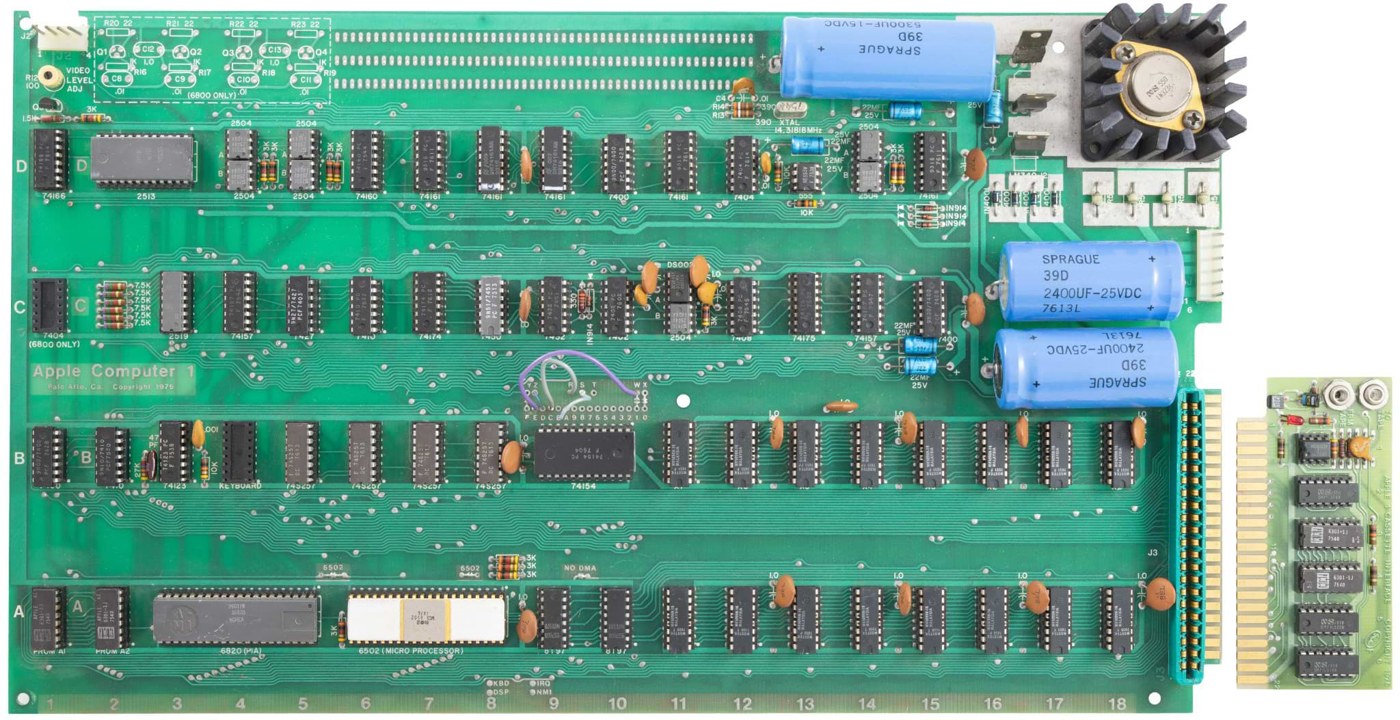
About two hundred Apple-1 boards were made. As of 15 October 2026, the Apple-1 Registry counts 94 that it has verified or almost verified, and a handful more that may survive. The other hundred or so have gone: traded in and destroyed, thrown away, broken for parts, or simply not yet found. This volume is about the people who bought Apple-1s, what became of the boards, and the census that now tracks every known survivor.
It begins with the buyers of 1976–77 and what they did with their machines, then follows the boards through the decades in which they were nearly worthless, and the stories of loss and survival that came out of those years. It then describes the Apple-1 Registry: who started it, who keeps it, what it records and how it decides that a board is real. It ends with where the survivors are now, in museums and private hands. Volume 7 covers the money, and the methods of authentication in detail. Volume 8 covers the care of a board that has spent decades in storage.
The Registry, at apple1registry.com, is the main source throughout. Its curator is the first to say that its entries rest on owners’ memories, auction catalogues and photographs of very variable quality, and that much of what it knows is confidential. The figures given here are the Registry’s own, on the date stated.
6.2 How Many Were Made
There is no Apple production record for the Apple-1. The figures come from the people involved.
Table 1 — How Many Were Made
| Figure | Source |
|---|---|
| About 200 manufactured, all but 25 sold over nine or ten months | Wozniak, interview with Williams & Moore, Byte, Dec 1984 |
| 175 originally assembled | Wozniak, quoted by the Apple-1 Registry |
| About 200, in two production runs | Apple-1 Registry |
| 250 boards printed, 100 in the first run and 150 in the second | A collector’s history page (Applebox), unsourced |
The working figure in this series is about 200. The difference between boards printed, boards assembled and boards sold is real: the Registry records that a stack of unsold second-run boards, some with empty sockets, sat in a cabinet at Apple and later in Steve Jobs’s office, and that some early employees took one home (Apple-1 Registry, “The Apple-1”).
The two runs are described in Volume 4. The first, made around April 1976, carries no manufacturer’s mark. The second, made later in 1976, carries the diamond-shaped “NTI” logo of the board maker. On the Registry’s count, 49 of the surviving boards are from the first run and 42 from the second.
6.3 The First Owners
The people who bought Apple-1s in 1976 and 1977 were not, for the most part, collectors or investors. They were engineers, hobbyists, teachers, students and small-business people, mostly in the United States, who wanted a computer and could afford about $666 for a board and a few hundred more for the rest. Their stories, collected by the Registry over many years, fall into a few groups.
Homebrew members and hobbyists. The board was conceived for the Homebrew Computer Club, and a number of members bought directly from Jobs and Wozniak. Most of these early private sales are poorly documented. One exception is Charles Ricketts, whose board, sold to him by Jobs from the Jobs family house in Los Altos in 1976, was later described by Christie’s as the only surviving Apple-1 documented as sold that way (Macworld, December 2014).
Shop customers. Most boards were sold through stores, and above all through the Byte Shop chain. Joey Copson, later an Apple employee and the programmer of Star Raiders for the Atari 5200, bought his at the Byte Shop in San Jose. Ray Borrill, who ran Data Domain in Bloomington, Indiana, bought fifteen boards from the Byte Shop for his own customers (Apple-1 Registry). Customers of Stan Veit’s Computer Mart in New York and of the itty bitty machine company near Chicago took others east.
Businesses. Fred Hatfield of Computer Data Systems bought an Apple-1 in 1976 and fitted it with an interface to an IBM Selectric typewriter so that it could print (Apple-1 Registry, #48). It is a reminder that some owners put their machines to work, not just to play.
Schools and teachers. The Apple-1 was a teaching machine almost from the start. According to the Registry, the first Apple-1 ever delivered went to Liza Loop, who in 1975 had founded the LO*OP Center, one of the first public-access computer centres outside a museum. Wozniak gave it to her himself, because she was the first person he had met who used computers in a classroom; it is still in the LO*OP Center’s hands (Apple-1 Registry, #27). Homestead High School in Cupertino, Wozniak’s old school, had one in a case built at the school. An electronics professor who taught microprocessors at Chaffey College in Rancho Cucamonga, California, had another, and sold it in 1977 to a former student, Joey Catuara, for $600 that went towards an Apple II (Apple-1 Registry, #94).
Families. Some Apple-1s were bought for a household, and learned on by the children of the house. These are the least documented of all, because nobody thought them worth documenting. Volume 12 is about one of them.
6.4 What Owners Did With Them
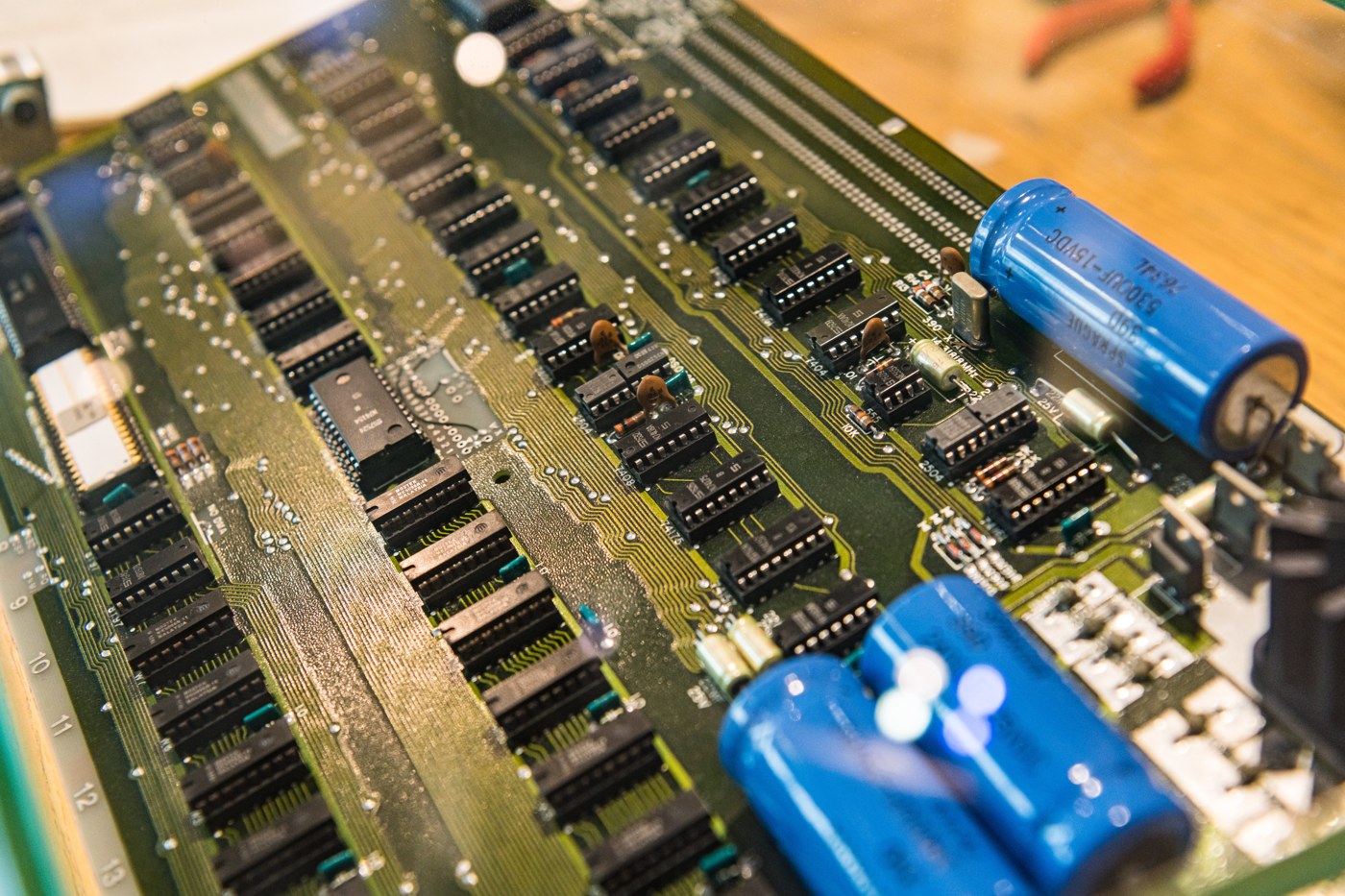
An Apple-1 owner in 1976 started with a bare board and had to finish the computer. The Registry’s photographs show what owners did. They built cases of plywood, hardwood, sheet metal and even briefcases. Byte Shop customers could buy one of the shop’s koa-wood cases; nine survive. They bought surplus keyboards, most famously the Datanetics keyboard that many owners used, and wired them to the board’s keyboard connector. They bought or built the two transformers the board needed and mounted them in the case. They used a family television with an RF modulator, or a small video monitor such as the Sanyo sets that appear in many photographs.
Then they programmed. Most owners bought the $75 cassette interface and loaded Wozniak’s BASIC; some wrote assembly language through the Woz Monitor. Apple supplied a small library of tapes, games among them. Owners swapped programs with each other, by mail and at clubs. Some extended the hardware: added the second bank of memory, fitted more memory on extra boards, added a lower-case modification, wired in printers. The Registry records many such modifications, and they matter to the boards’ later history: a board that was used hard in 1977 often has replaced chips, extra wires and holes drilled for switches.
6.5 The Apple II Effect
The Apple II, launched in April 1977, changed what an Apple-1 was worth to its owner overnight. It had colour, a case, a keyboard and BASIC in ROM. It cost more than an Apple-1, but it did far more. Apple-1 software was scarce, and Apple’s support for the old machine dwindled.
Apple offered owners discounts against an Apple II in exchange for their Apple-1s. The terms varied. In January 1978 Steve Jobs offered Fred Hatfield an Apple II 4K board in exchange for his Apple-1, without its memory chips, plus $400. Hatfield said no (Apple-1 Registry, #48). Other owners said yes, or sold their boards privately towards an Apple II, as Chaffey College’s professor did. Boards that went back to Apple were, by several accounts, destroyed. The Huston brothers, early Apple people, recalled a pile of returned boards in Jobs’s office that were to be destroyed, and were given two of them; both survive. The Registry, however, has found only one owner, Bob Bishop, who is confirmed to have traded a board in, and treats the extent of the destruction as unknown.
Support passed to the owners. Apple’s form letter “Dear Apple I Owner” announced that Joe Torzewski of Granger, Indiana, was starting an Apple I Owners Club, which would expand the software library and through which Apple would support Apple I software from then on (Applefritter archive). Torzewski had bought his board direct from Apple in 1977. The club’s first newsletter counted about thirty members. It kept going, in one form or another, for decades, and its newsletters and software archive are among the best surviving records of what owners actually did with their machines.
6.6 The Lost Decades
For roughly twenty-five years after 1977 an Apple-1 was a curiosity. An Apple publication, the Apple IIe Owner’s Guide of 1986, guessed one might be worth $10,000–15,000 to a collector; in practice few changed hands. At the Vintage Computer Festival auctions of 2000 and 2002 two sold for $14,000 each (Apple-1 Registry, market list). Boards sat in closets, attics, desk drawers and garages. That neglect is why some survived and why many did not.
The Registry collects the stories of the lost ones, and is careful to call most of them unconfirmed:
- A board said to have been donated to the US Olympic tennis team and destroyed in a plane crash.
- A board broken in two and thrown away by an owner’s father.
- A board put in a dumpster by an employee of a software company.
- A board left at a recycling centre.
The last story became front-page news in May 2015. An elderly woman, clearing out her garage after her husband’s death, dropped off boxes of old electronics at the Clean Bay Area recycling centre in Milpitas, California. She declined a tax receipt and left no name. Weeks later staff found an Apple-1 in the boxes. The company sold it to a private collector for $200,000 and, under its policy of returning half of such proceeds to the donor, appealed publicly for her to come forward to collect $100,000 (NBC Bay Area; Fox News). The Registry lists the story as unverified, because the board itself has never been identified. True or not, it describes exactly how Apple-1s are lost: by people who do not know what they have, clearing a garage.
Other boards survived because someone did know, or at least did not throw anything away. Copson kept his in his mother’s closet. Catuara kept the Chaffey College board in a closet until it stopped powering up, and it was repaired decades later by the Apple-1 specialist Corey Cohen, who found a couple of broken chips. The board in the Smithsonian came from Homestead High School: according to an early Apple engineer’s second-hand account, Apple obtained it for the museum by giving the school a fully equipped Apple II in exchange (Apple-1 Registry, #62).
6.7 The Registry
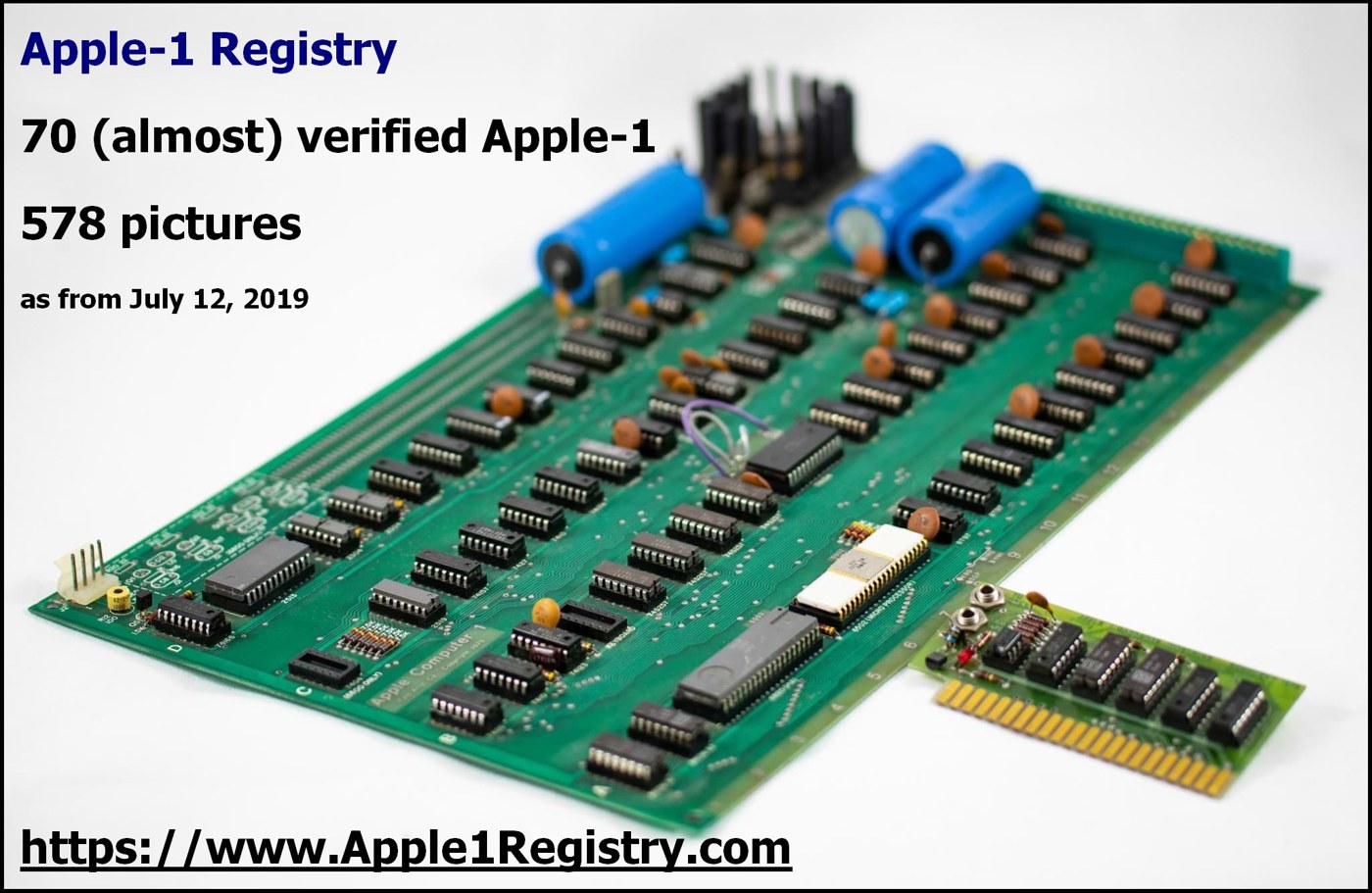
By 2010 prices were rising and nobody knew how many Apple-1s existed. The engineer and collector Mike Willegal, who had studied the board closely enough to make an exact reproduction of it (the Mimeo, Volume 9), began the Apple-1 Registry on 21 May 2010 to find out. He gathered every board he could identify from collectors, auction catalogues, museums and owners who came forward. At its start the Registry counted 67 machines (callapple.org, reporting the Registry’s history).
In 2018 Willegal handed the Registry over to Achim Baqué of Cologne, Germany, an Apple-1 owner and repairer who has since identified dozens more boards. Baqué rebuilt the site, added a database of photographs, components and histories, and has written the Registry’s future into his will: if he can no longer maintain it, his executor is to find a successor and hand over the access data, administration software and domain names (Apple-1 Registry, “Legacy”).
The Registry describes itself as independent, non-profit and non-commercial. It does not buy or sell boards on behalf of others, though its curator, like most people who know the field, is also a collector.
6.7.1 What it records
Each board in the Registry has an entry, numbered in order of addition and given a name, usually that of its first owner, or of its last known owner or location where the first is unknown: “Copson”, “Hatfield”, “Chaffey College”, “Smithsonian”. The number is the Registry’s, not Apple’s; it says nothing about the order in which boards were made. Each entry records, where known:
- the batch (first run or NTI second run) and how the board was soldered;
- any serial number, stamp or label: the hand-written “01-00xx” numbers on many first-run boards, inspection stamps, dealer labels;
- the components: processor and PIA makers, memory, capacitors, regulator, and which chips are original;
- accessories: cassette interface, keyboard, case, power supply, monitor, manuals, tapes, letters;
- condition: working, not working or unknown;
- history: owners, sales and prices, exhibitions;
- location, and whether the board is on public display;
- photographs, which are the evidence for much of the above.
6.7.2 How it decides a board is real
The Registry sorts boards into verified (it has seen enough evidence to be sure), almost verified (strong evidence, something still missing), unverified (reported, not yet substantiated), and lists of boards that might exist, might be listed twice, or may no longer exist. Its methods are those described in Volume 7: high-resolution photographs of both sides of the board, comparison of the circuit board itself, its silkscreen and its solder with known originals, the date codes and makers of the chips, the consistency of the parts with the board’s batch, serial-number handwriting, and documentary provenance. It warns plainly that “many very good replicas of Apple-1 exist”, some built with chips bearing period-correct date codes (Apple-1 Registry, list).
Much of what the Registry knows is private. Owners often do not want their names, locations or purchase prices published, and the Registry withholds them. That is why its public entries sometimes say “unknown” where the curator in fact knows.
6.8 The Census in October 2026
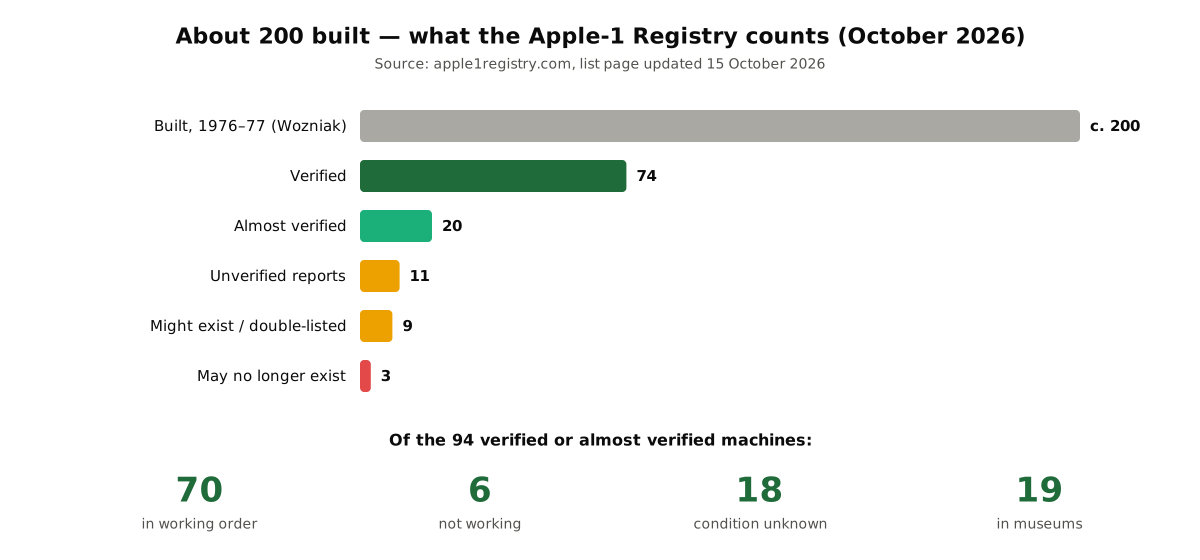
The Registry’s list page, updated on 15 October 2026, gives these figures (Apple-1 Registry, list):
Table 2 — The Registry's list page, updated on 15 October 2026, gives these figures ([Apple-1 Registry, list](https://www.apple1registry.com/en/list.html))
| Category | Count |
|---|---|
| Verified | 74 |
| Almost verified | 20 |
| Verified or almost verified, total | 94 |
| Unverified reports | 11 |
| Might exist, or could be double-listed | 9 |
| May no longer exist | 3 |
Of the 94 verified or almost verified boards:
Table 3 — Of the 94 verified or almost verified boards
| Count | |
|---|---|
| First production run | 49 |
| Second (NTI) run | 42 |
| Prototype or pre-production | 1 |
| In working condition | 70 |
| Not working | 6 |
| Condition unknown | 18 |
| In museums | 19 |
| First-run boards with a hand-written serial number | 35 of 49 |
| In an original Byte Shop case | 9 |
The batch figures as published do not quite sum to 94, because the Registry also lists two boards of unknown version and two hand-soldered boards that overlap with the other categories. The number of survivors has risen almost every year since 2010, as boards surface from estates, garages and private collections; the Registry’s entry numbers passed 100 in the 2020s, though some entries have since been merged or found to be duplicates. The true number of survivors is therefore somewhat above 94, and nobody knows by how much.
6.9 Where They Are
6.9.1 In museums
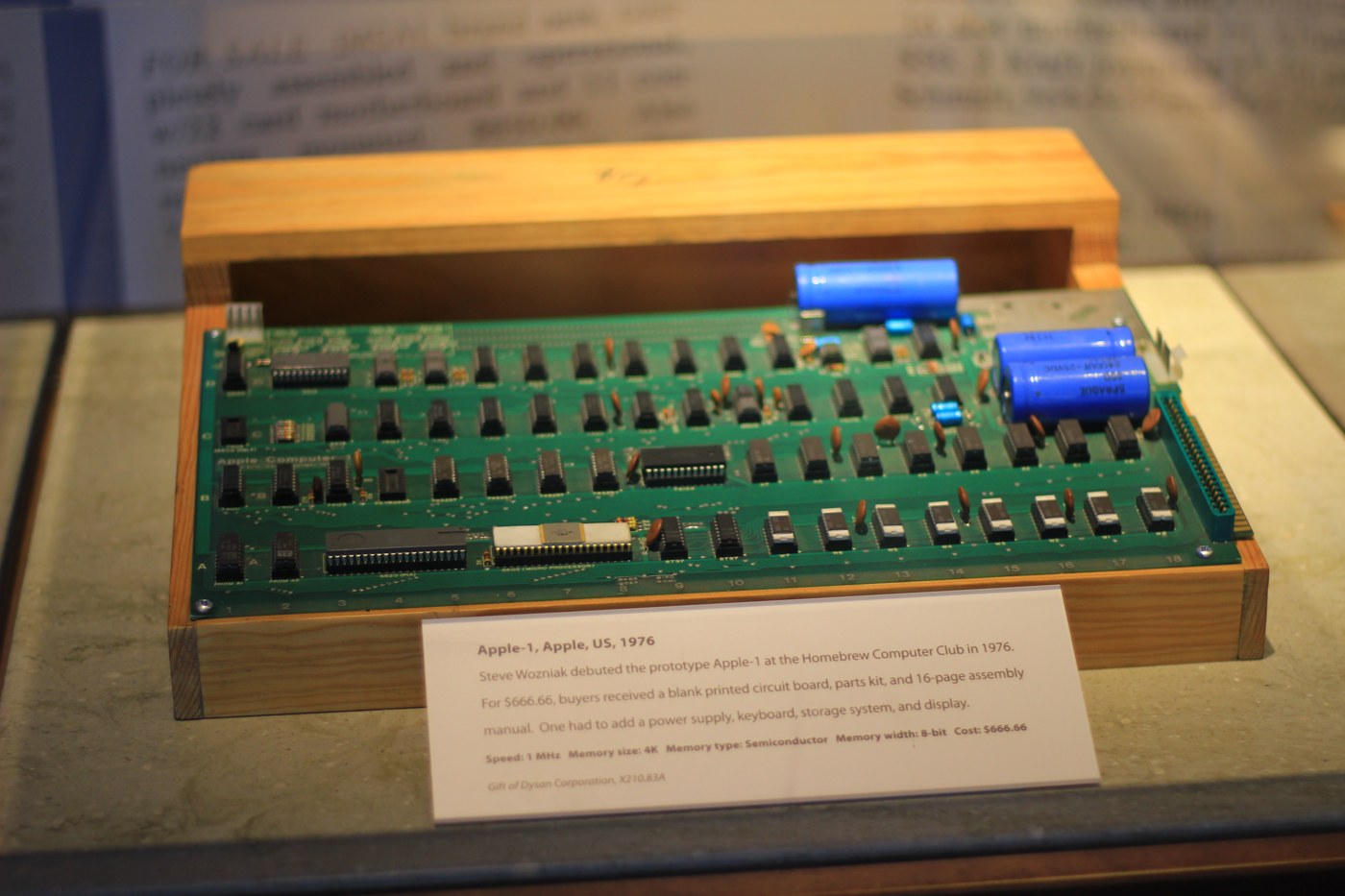
The Registry counts 19 boards in museums. Its museums page names these, among others (Apple-1 Registry, museums):
Table 4 — The Registry counts 19 boards in museums. Its museums page names these, among others ([Apple-1 Registry, museums](https://www.apple1registry.com/en/museums.html))
| Registry no. and name | Museum | Place |
|---|---|---|
| #5 CHM 1 | Computer History Museum | Mountain View, California |
| #46 Joe Altieri | Computer History Museum (not on display) | Mountain View, California |
| #10 Rick Conte | System Source Computer Museum | Hunt Valley, Maryland |
| #19 John Anderson | The Henry Ford | Dearborn, Michigan |
| #24 Winston Gayler | History San Jose | San Jose, California |
| #26 Rudie Hoess | Powerhouse Museum | Sydney, Australia |
| #29 Sicilian | Machine Museum (not yet open) | Palermo, Italy |
| #31 Copson | Deutsches Museum (on loan) | Munich, Germany |
| #35 Museum in Bern | Museum für Kommunikation | Bern, Switzerland |
| #37 Cooper | Nexon Computer Museum | Jeju, South Korea |
| #38 Nixdorf Museum | Heinz Nixdorf MuseumsForum | Paderborn, Germany |
| #39 Science Museum London | Science Museum | London, England |
| #52 American Computer Museum | American Computer Museum | Bozeman, Montana |
| #53 National Museum of Scotland | National Museum of Scotland | Edinburgh, Scotland |
| #62 Smithsonian | National Museum of American History | Washington, DC |
The Henry Ford’s board has a story typical of the best-documented survivors. It belonged to John Barkley Anderson, a founding member of an Ohio Apple user group, and carries the hand-written serial 01-0070. It came with its cassette interface, a hand-built keyboard interface, a power supply and a monitor. Anderson’s family sold it at Bonhams in New York in October 2014, where The Henry Ford bought it for $905,000, then a record (Apple-1 Registry, #19).
Museum displays change. A visitor who wants to see a particular board should check with the museum first.
6.9.2 In private hands
The remaining seventy-odd known boards are privately owned. Some belong to their first owners or their families; the Registry’s list includes boards that have never been sold since 1976. Many belong to collectors in the United States, Europe and Asia, and a few to the specialists who repair and authenticate them. Some are displayed in private museums or lent to public ones, as Baqué’s Copson board is lent to the Deutsches Museum. Others have not been seen in public for years. Volume 7 follows the ones that come up for sale.
6.9.3 Not yet found
Every year a few boards surface that nobody outside a family knew existed. They come from estate sales, from children clearing a parent’s house, from a professor’s office, from a garage. The Registry welcomes them: an owner can contact it in confidence, and the curator will help identify and document a board without publishing the owner’s name. For an owner, having a board documented is also the first step in looking after it. Volume 8 explains how to store, photograph and inspect a board without damaging it, and why an untested original should not simply be plugged in.
6.10 The One-Paragraph Version
About two hundred Apple-1s were made in two runs in 1976. They were bought by hobbyists, Homebrew members, shop customers, small businesses, teachers, schools and a few families, finished with home-made cases and surplus keyboards, and programmed in Wozniak’s BASIC and in 6502 assembly. The Apple II made them obsolete within a year. Apple offered trade-ins and destroyed some of the boards it got back, handed support to Joe Torzewski’s Apple I Owners Club, and moved on. For twenty-five years the boards were curiosities, and many were lost, broken or thrown away, one reportedly at a Milpitas recycling centre in 2015. Mike Willegal founded the Apple-1 Registry on 21 May 2010 with 67 known boards; Achim Baqué has kept it since 2018. On 15 October 2026 it counted 94 verified or almost verified survivors, 70 of them working and 19 in museums from Washington to Jeju, with more surfacing every year from closets, estates and garages.
Next — Volume 7: Value, Auctions and Authenticity — Telling an Original from a Replica. From $14,000 at the Vintage Computer Festival in 2000 to $2.75 million in January 2026: every kind of sale, what drives price, the provenance that adds hundreds of thousands of dollars, the disputes, and how experts tell a 1976 board from an exact modern replica built with period chips.
Comments (0)