KENBAK-1 · Volume 8
KENBAK-1 — Volume 8 — The Replica Kits — Re-creating KENBAK-1 Fifty Years On
Two ways to own a KENBAK-1 without paying six figures: rebuild the 1971 circuit in real TTL with a pair of scarce 1404A shift registers, or emulate it on a microcontroller behind a look-alike panel — every kit, board and replica, with what is in the box and what was actually on sale in October 2026
8.1 About This Volume
Fourteen original KENBAK-1s survive, and the last one sold cost $119,700 (Volume 5). Anyone who wants to use one, rather than look at one through glass, needs a replica. This volume surveys every way of getting one: the reproduction kits that rebuild the 1971 circuit chip for chip, the emulation kits that run the instruction set on a modern microcontroller behind a copy of the front panel, the open designs that can be built from published files, and the software emulators that need no hardware at all.
For each it gives the maker, what is in the box, what is not, how faithful it is to the original, and — the reason this volume carries a date — what was actually on sale. Prices, contents and stock are as shown on each vendor’s own page on 27 October 2026. They will change; the pages are linked so that they can be checked. Volume 9 is the build procedure; Volume 10 is a book of programs that run on any of these machines.
8.2 Two Families of Replica
Every KENBAK-1 replica belongs to one of two families, and the difference matters more than size or price.
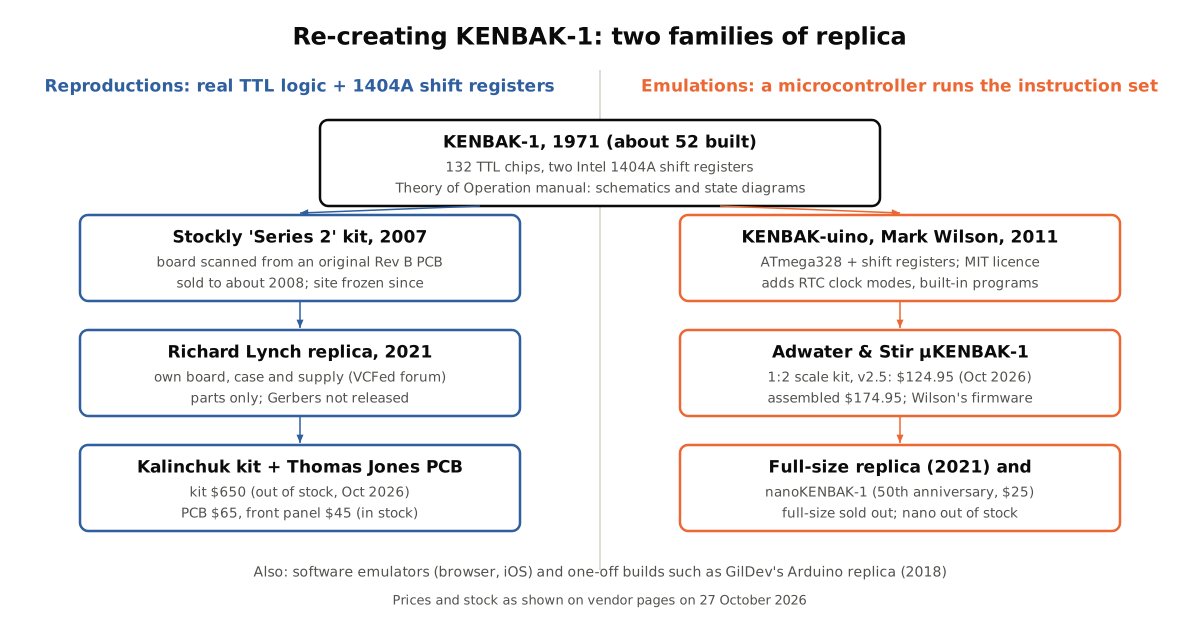
A reproduction rebuilds Blankenbaker’s circuit. It has the same printed circuit board layout, about 130 chips from the 7400 TTL family, and the same two Intel 1404A 1,024-bit MOS shift registers for memory. It runs at the same speed for the same reason — it is the same serial machine — and it fails in the same ways. Building one is building a 1971 computer, and debugging one teaches what the Theory of Operation manual teaches. The 1404A is the bottleneck: Intel stopped making it decades ago, and every reproduction depends on new-old stock.
An emulation replaces the logic board with a microcontroller programmed to behave like a KENBAK-1: to read the same buttons, light the same lamps, and execute the same instruction set on the same 256-byte memory map. A well-written emulation runs every program in the 1971 manuals exactly as the original did, and a user at the front panel cannot tell the difference by programming it. It is cheap, reliable, small, and can do things the original could not, such as load programs over USB or keep time. It teaches the instruction set (Volumes 6 and 7) but not the hardware (Volume 3).
8.3 Reproductions: Rebuilding the TTL Machine
8.3.1 The first kit: Grant Stockly’s KENBAK-1 Series 2 (2007)
The first KENBAK-1 kit of any kind was made thirty-six years after Blankenbaker refused to sell one. In 2007 Grant Stockly, of Stockly Electronics, who had earlier reproduced Altair parts, launched kenbakkit.com, “Home of the Official Kenbak-1 Reproduction Kit”, with Blankenbaker’s permission (kenbakkit.com).
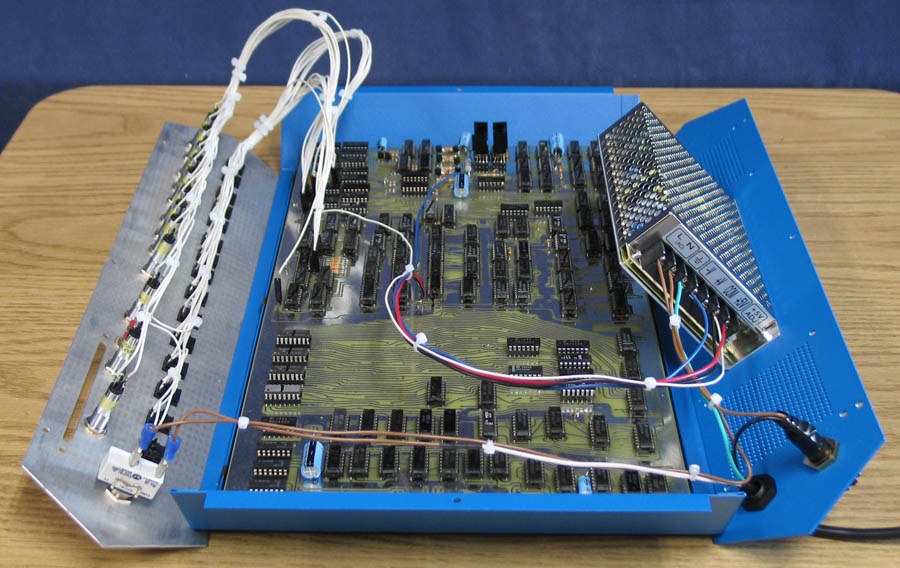
The kit’s board was a faithful copy. Blankenbaker lent Stockly an unpopulated original Revision B board, which Mile High Testing Services of Longmont, Colorado, scanned at 1,200 dpi and converted into manufacturing files. Laid over the original against a light, the reproduction board’s holes matched; the only changes were the words “Homebrew 2007” and the kenbakkit.com address, added to deter counterfeit “originals”. The collector Erik Klein, who owned an original, measured his case with digital calipers that Stockly mailed him — three measurements per point, averaged — so that the reproduction enclosure would match. The kit was announced with every part needed except the power cord: the board, a custom steel case with painted top and bottom, a silk-screened brushed-aluminium front panel, custom aluminium handles, a choice of LED or incandescent lamps and of clicky or silent switches, a 60-watt switching supply, and a one-inch binder of restored manuals. The front panel read “KENBAK-1 Series 2”, a suffix borrowed from Todd Fischer’s IMSAI Series 2 (kenbakkit.com, differences). Stockly offered a repair guarantee for kits assembled with “a good effort”, and Blankenbaker offered to sign the rear panels.
Stockly’s restored scans of the original manuals — the Programming Reference, Laboratory Exercises, Theory of Operation, Installation & Maintenance and programming worksheets, at 600 dpi and text-searchable — remain on the site and are the copies nearly everyone now uses, including this series.
Status, October 2026. The site has not changed since 2007; its last news item is dated 3 November 2007, and it still invites reservations by e-mail, with no price stated. The kenbak.com reproduction guide says the kit was sold until about 2008 and that Stockly stopped answering enquiries years ago (kenbak.com); a builder on the Vintage Computer Federation forum reported in January 2021 that Stockly’s own forum had been inactive since 2017 (VCFed forum). How many Series 2 kits were made is not recorded. Not available. Series 2 machines turn up occasionally second-hand.
8.3.2 One-off builds and the open route
Between Stockly’s kit and the next one, the KENBAK-1 was reproduced by individuals. Two routes are documented.
Richard Lynch’s replica (2021). For the machine’s fiftieth anniversary a builder posting as Richard L on the Vintage Computer Federation forum built a TTL replica from period-correct parts, with his own board, a case drawn in Fusion 360 with steel halves cut and bent by a local sheet-metal shop, aluminium handles and a silk-screened panel. He added a paper-tape reader interface through the front slot and experimented with extending the memory beyond 256 bytes. He sold a few spare boards, replica power-supply boards and heat sinks on eBay in September 2021 but said he did not plan to release his design files (VCFed forum).
The kenbak.com “Making a Reproduction” guide. The authors of the kenbak.com registry have built five reproductions since 2005, starting from schematics supplied by Herbert Eisengruber of the Nova Scotia Computer Museum, and publish the board’s Gerber and silkscreen files free for anyone to send to a board maker (kenbak.com). Their parts list is a useful picture of what a reproduction is:
Table 1 — The kenbak.com "Making a Reproduction" guide. The authors of the kenbak.com registry have built five reproductions since 2005, starting from schematics supplied by Herbert Eisengruber of the Nova Scotia Computer Museum, and publish the board's Gerber and silkscreen files free for anyone to send to a board maker ([kenbak.com](https://www.kenbak.com/reproduction)). Their parts list is a useful picture of what a reproduction is
| Part | Quantity | Note |
|---|---|---|
| 7400-series TTL ICs | about 131 | including 45 × 7400, 15 × 7410, 13 × 7495, 10 × 7474 |
| Intel 1404A shift registers | 2 | 1,024 bits each; scarce, quoted at $30 to $100 each |
| Transistors / diodes | 6 NPN, 2 PNP; 8 × 1N914, one 5.1 V Zener | lamp drivers and the −5 V supply for the memory |
| Push-buttons / lamps / toggles | 15 / 12 / 2 | 8 data + 4 control lamps |
| Power supply | +5 V at 3 A, −12 V at 0.5 A | measured draw about 2.3–2.5 A at 5 V |
The guide is frank about the work. None of its five builds worked at first power-up; cold solder joints were the commonest fault; it recommends a logic analyser or oscilloscope, because a multimeter alone is little help in debugging a serial machine. The original transformer power supply, it notes, wastes most of its power as heat, and a modern switching supply is easier. And because the Bud “Grand Prix” case is long discontinued, a case has to be made: the authors cut and bent their own from measurements of photographs.
8.3.3 Artem Kalinchuk’s kit, board and panel (2024–)
The one TTL reproduction sold as a product in 2026 comes from Artem Kalinchuk of Virginia, who also sells reproduction boards for other early machines, among them the Mark-8, the SCELBI and Don Lancaster’s TV Typewriter. His KENBAK-1 offering has three parts, sold separately (kalinchuk.com, read 27 October 2026):
- Kenbak-1 Reproduction PCB — $65.00, available. The board “was re-created by Thomas Jones using computer software”. It is a bare board: “You will need to source all of the parts but most of them are easy to find.”
- Kenbak-1 Reproduction Front Panel — $45.00, available. Bare 5052 aluminium, cut to match the original Bud panel, with no lettering or finish; the lettering is provided as vector artwork to download. The case itself is not sold; its CAD files are on PCBWay’s shared-projects site, and PCBWay will make one.
- Kenbak-1 Reproduction Kit — $650.00, listed Out of Stock. All the components to assemble a working machine except the board and the case, including “the hard-to-find components, such as the 1404A shift registers”.
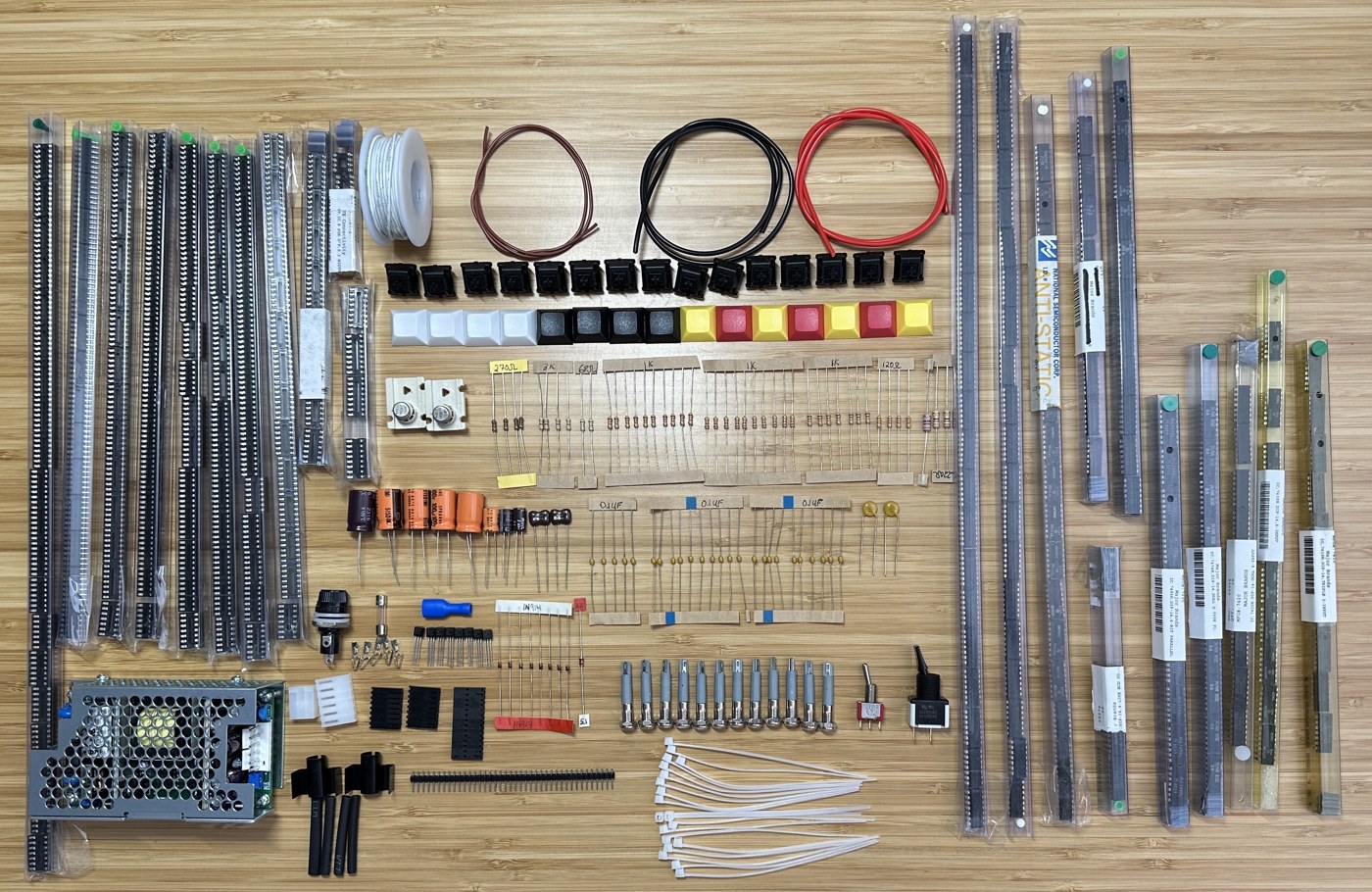
The kit’s listed contents are a direct count of a KENBAK-1: two 1404A shift registers, 130 assorted integrated circuits, 134 DIP sockets, 44 resistors, 37 capacitors, 9 diodes, 8 transistors, 15 keyswitches with caps, 2 toggle switches, 12 LEDs, a fuse holder and fuse, a power supply, heat sinks for the shift registers, wire and crimp pins, a parts-layout sheet and a parts list. Kalinchuk lists three departures from the original: a regulated switching power supply, “unlike the bulky one used in the original Kenbaks”, with reproduction linear supply kits “coming soon”; LEDs instead of incandescent lamps, “though this is not 100% authentic”; and components “from various time periods and … not necessarily from the 1970s”. The kenbak.com guide recorded the kit as available in early 2025.
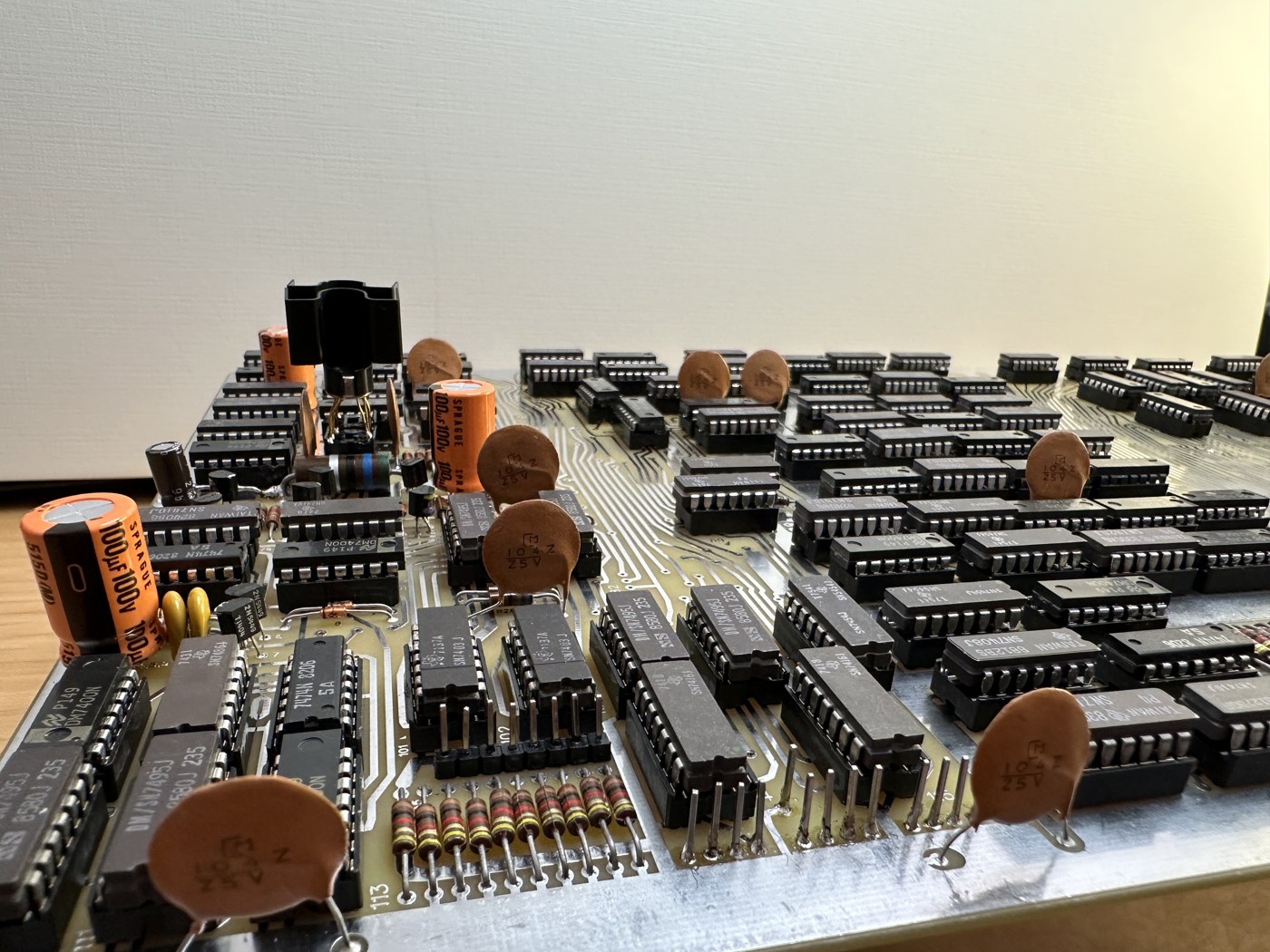
What a TTL build needs in October 2026. With the kit out of stock, a builder can still buy the board and panel from Kalinchuk, or have the free kenbak.com board files made, and must then source the parts: the TTL chips are common, the 1404A shift registers are not. A case must be made or ordered. The total, depending on how the shift registers and the case are found, runs from several hundred dollars to well over a thousand.
8.4 Emulations: The Instruction Set on a Microcontroller
8.4.1 KENBAK-uino, Mark Wilson (2011)
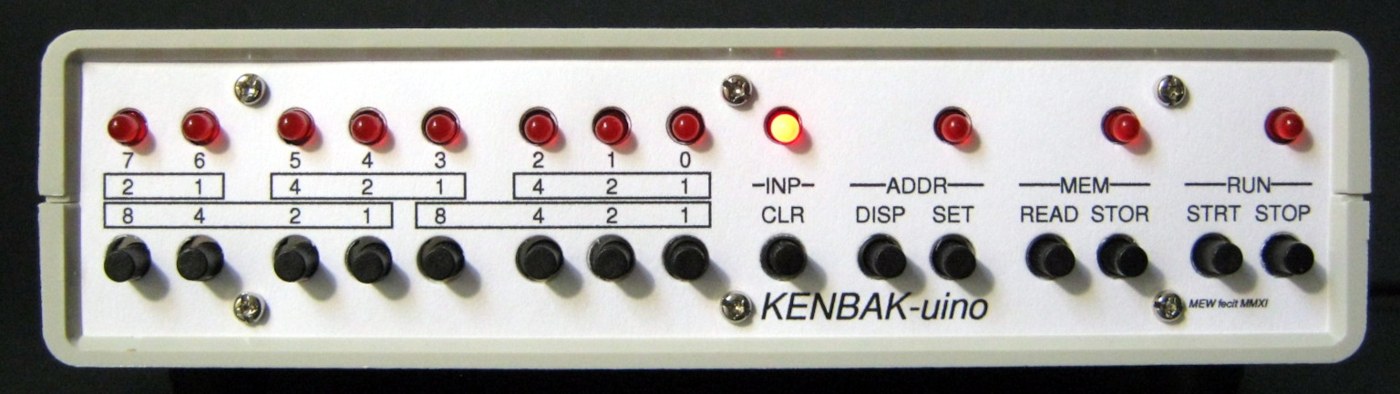
The emulation family descends from one program. In 2011 Mark Wilson of Christchurch, New Zealand, built the KENBAK-uino: an Arduino-compatible ATmega328 microcontroller running his emulation of the KENBAK-1 instruction set, with fifteen push-buttons read through two 74HC165 shift registers, twelve LEDs driven through a 74HC595, four more status LEDs, and a DS1307 real-time clock, in a small grey box with a front panel laid out like the original (GitHub, funnypolynomial/Kenbakuino). The code is open source under the MIT licence. The README says it “attempts to accurately emulate the original, but with some extensions”: reading the clock, generating random numbers, loading built-in programs, saving and loading memory to EEPROM, sending and receiving memory over a serial link, and several clock-display modes. Wilson has maintained it since; the changelog runs from December 2018 to May 2025, with fixes to the shift instructions, the program counter and the RUN lamp.
8.4.2 Adwater & Stir: µKENBAK-1, nanoKENBAK-1 and the full-size replica
Adwater & Stir is the kit business of Chris Davis (Famous Davis LLC, Willmar, Minnesota), who also makes the Altair-Duino. After the Altair-Duino, he wanted a project “with blinking lights … and a great history”, found Wilson’s work, and with Wilson’s support turned it into a kit (adwaterandstir.com). All his KENBAK models run Wilson’s firmware on an ATmega328P.
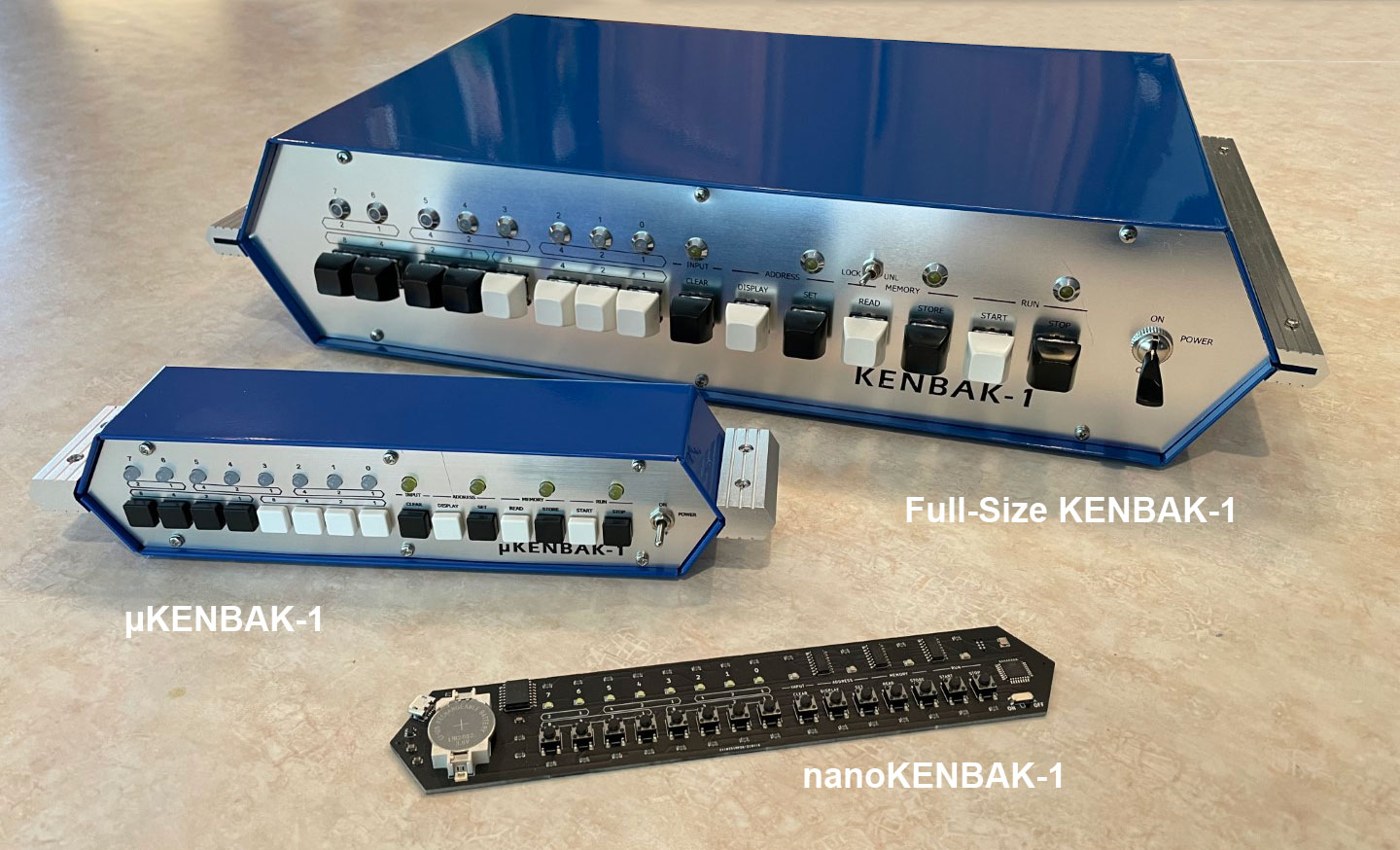
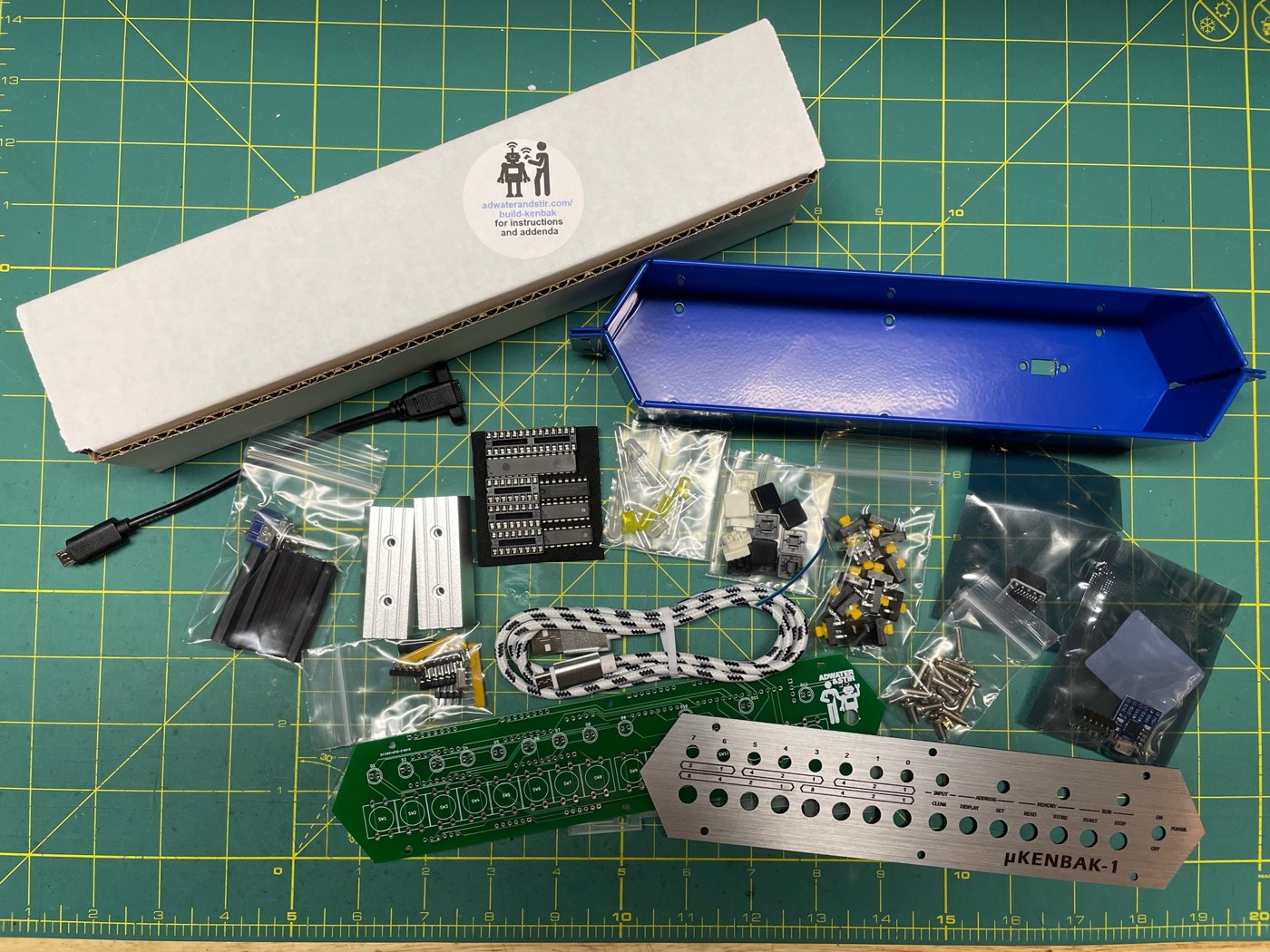
µKENBAK-1 kit, version 2.5 — $124.95 (reduced from $134.95), in stock. A half-scale replica. The kit contains a professionally made board, all components, a steel case with CNC-milled aluminium ends, a screen-printed brushed-aluminium front panel and printed instructions; construction is all through-hole, and the maker estimates one to two hours for the build. The case was drawn from the original Bud Industries engineering drawings (below). Version 2.5 changed the front panel from aluminium-coloured acrylic to brushed aluminium, the case to a fingerprint-resistant matte finish, and its colour to a lighter blue “closer to the original”. Beyond the original’s functions, it has a real-time clock with three clock displays (BCD, counting and binary) and a USB connection through which a terminal program can upload programs instead of keying them in byte by byte; it runs from a USB power supply (product page, read 27 October 2026). The Tindie listing showed “Only 4 left in stock” on the same day (Tindie).
µKENBAK-1 assembled and tested — $174.95, “Only 1 left in stock”. Test units built for version 2.5 (product page).
The original µKENBAK-1, sold from about 2018 in a 3D-printed case, has not been available since March 2020, when printing cases in quantity proved “untenable”.
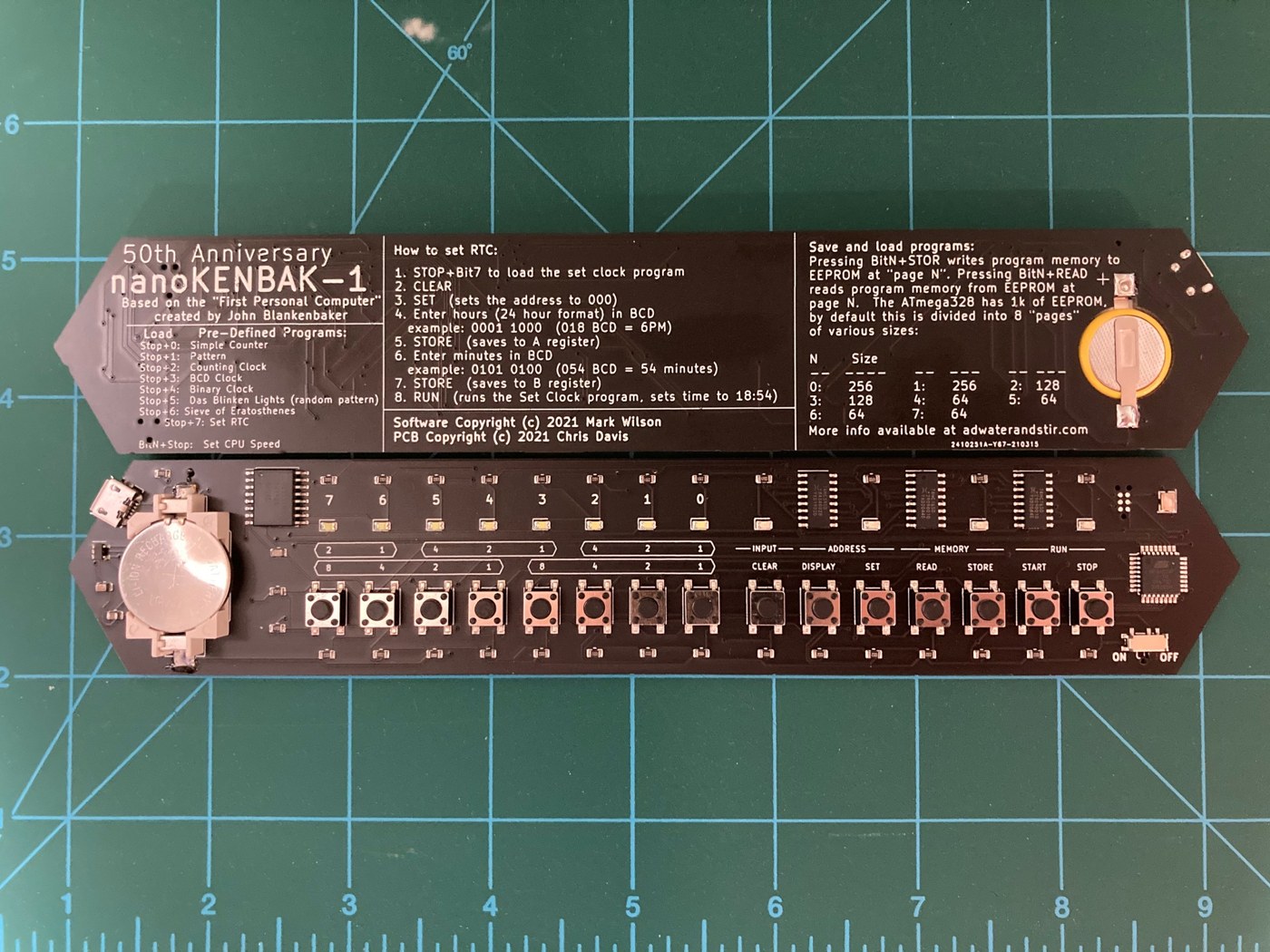
nanoKENBAK-1, 50th Anniversary — $25.00 (reduced from $30.00), out of stock. A pocket-sized, fully assembled board, 8.5 by 1.5 inches, made with surface-mount parts and modelled, its maker says, on the Digirule 2 programmable ruler. It has the same firmware, a DS3231 real-time clock so that it can sit on a desk as a binary or BCD clock, and a rechargeable LIR2032 cell charged from micro-USB, good for three and a half to four hours. The page warns emphatically against fitting an ordinary CR2032 (nanoKENBAK-1; product page). The store offers an e-mail notice when stock returns.
Full-size KENBAK-1 replica (2021) — sold out, “will not return”. Customers of the µKENBAK-1 asked for a full-size version, and Davis’s search for the case led him to Bud Industries of Ohio, which still exists. The “Grand Prix” enclosure had been discontinued about the time a long-serving employee, Jenene, had joined the company in the 1980s; Bud could not make a run of them, but sent him the original engineering drawings. He converted them to metric and had a metal shop build a small batch. The replica had LEDs in place of incandescent lamps, Cherry MX keyswitches with matching keycaps, and the same electronics as the µKENBAK-1: inside, “not much … It’s just an empty box full of history!” Davis has published the case files on PCBWay, which will make one to order at a cost he estimates at around $850, front and rear panels not included. At least three of the replicas went to computer museums, among them the HomeComputerMuseum in the Netherlands and the Intergalactic Museum of Computing and Technology History in Florida, whose replica Blankenbaker autographed (full-size replica).
8.4.3 Other emulations
Other emulators are built as personal projects rather than products. A French student, GilDev, built a breadboard replica in 2018 from an Arduino, an MCP23017 input expander and a TLC5940 LED driver, published the code under the MIT licence, and put the cost at about $30 (GilDev). There are browser emulators, and an iOS app, Kenbak-1, listed as emulating all the original instructions (App Store). This series has its own: kenbak_sim.py, a plain-Python emulator written for Volumes 6, 7 and 10, with a self-test drawn from the examples in the 1971 manuals, kept with the project files.
8.5 The Kits Side by Side
As read from the vendors’ pages on 27 October 2026:
Table 2 — As read from the vendors' pages on 27 October 2026
| Kit | Type | Scale | What you get | Price | Status |
|---|---|---|---|---|---|
| Stockly KENBAK-1 Series 2 (2007) | TTL reproduction | full | board, case, panel, all parts, manuals | not published | not available since c. 2008 |
| Kalinchuk reproduction kit | TTL reproduction | full | all parts incl. 1404A; no board, no case | $650.00 | out of stock |
| Kalinchuk reproduction PCB | TTL reproduction | full | bare board (Thomas Jones layout) | $65.00 | available |
| Kalinchuk front panel | — | full | bare aluminium panel | $45.00 | available |
| kenbak.com board files | TTL reproduction | full | Gerber + silkscreen files | free | download |
| Adwater & Stir µKENBAK-1 v2.5 kit | emulation (ATmega328P) | 1:2 | board, parts, steel case, aluminium panel | $124.95 | in stock (4 left on Tindie) |
| Adwater & Stir µKENBAK-1 assembled | emulation | 1:2 | built and tested | $174.95 | 1 left |
| Adwater & Stir nanoKENBAK-1 | emulation | assembled SMD board | $25.00 | out of stock | |
| Adwater & Stir full-size replica | emulation | full | assembled | — | sold out, discontinued; case files on PCBWay |
| KENBAK-uino (Mark Wilson) | emulation | small | open-source code and schematic | free | GitHub |
8.6 Choosing One
The choice is between authenticity and practicality, and the two families answer different questions.
To understand the 1971 hardware, only a TTL reproduction will do. It is the one way to watch the serial clock tick through a byte on an oscilloscope, see the 1404A shift registers circulate, and debug the machine Blankenbaker debugged. In October 2026 it is also the hard road: the kit is out of stock, the shift registers are scarce, the case must be made, and the kenbak.com builders’ experience is that the first power-up will not work. The board and panel are available, and the board files are free.
To learn the instruction set and run the programs, an emulation is the practical choice. The µKENBAK-1 is the one kit in stock, a beginner’s through-hole build, and Wilson’s firmware has been refined for over a decade. Its USB upload removes the tedium of keying long programs in byte by byte, though keying them in is part of the experience. The nanoKENBAK-1 does the same in a pocket, when in stock.
For display, the full-size replica was the answer and is gone; a PCBWay case built from Davis’s files, with Kalinchuk’s front panel, is the nearest available route to a full-size blue box.
Whatever the choice, the programs are the same. Every program in Volumes 7 and 10 is given in octal as keyed on the front panel and runs unchanged on an original, on a reproduction, on an emulation kit, or on the series’ own emulator.
8.7 What Is Not Faithful, and Why It Matters
Even the TTL reproductions differ from an original in ways that matter to a collector, though not to a programmer.
- Lamps. Every current replica uses LEDs. The original’s Type 680 incandescent bulbs glowed a warm yellow; LEDs are whiter, brighter and switch instantly.
- Power. Replicas use switching supplies. The original’s linear supply ran warm, drew about 65 watts and needed a fan; Blankenbaker designed it to keep working down to 70 volts AC.
- Keys. Original push-buttons were epoxied to the panel and, as Blankenbaker himself admitted, sometimes broke loose. Replicas use modern keyswitches such as Cherry MX.
- Case. No replica uses a real Bud “Grand Prix” enclosure; they are reproductions from Bud’s drawings or from measurements of originals.
- Parts. Reproduction chips are of mixed date codes, and the 1404A shift registers are new-old stock of unknown history.
- Extras. Emulations add clocks, random numbers, USB upload and stored programs that a 1971 machine did not have.
None of this changes what a KENBAK-1 is to use. A program keyed in octal through eight buttons, run with START and read off eight lamps, behaves the same on all of them.
Next — Volume 9: Building the Kit. The build procedure, step by step: what to check before heating the iron, the order of assembly, the front panel and its wiring, power-up and the first tests from the 1971 Installation & Maintenance manual, and the first program keyed in on the front panel.
Comments (0)