KENBAK-1 · Volume 2
KENBAK-1 — Volume 2 — John Blankenbaker — A Computer for Everyone
An Oklahoma farm without electricity, binary arithmetic worked out on scratch paper, a summer on SEAC, a computer with one flip-flop, eight years of stock quotations, and a $6,000 parting gift — the life of the man who built the first personal computer
2.1 About This Volume
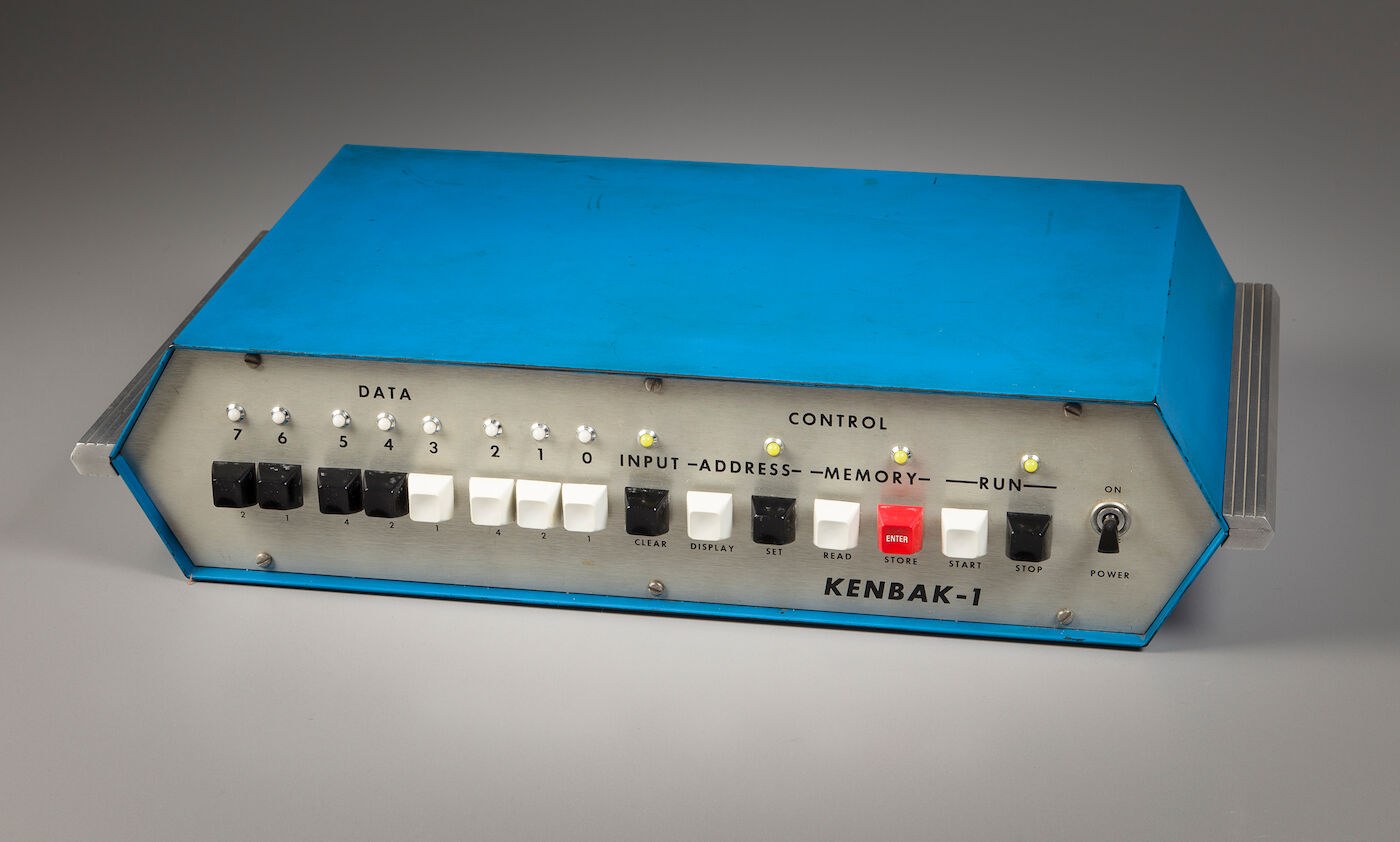
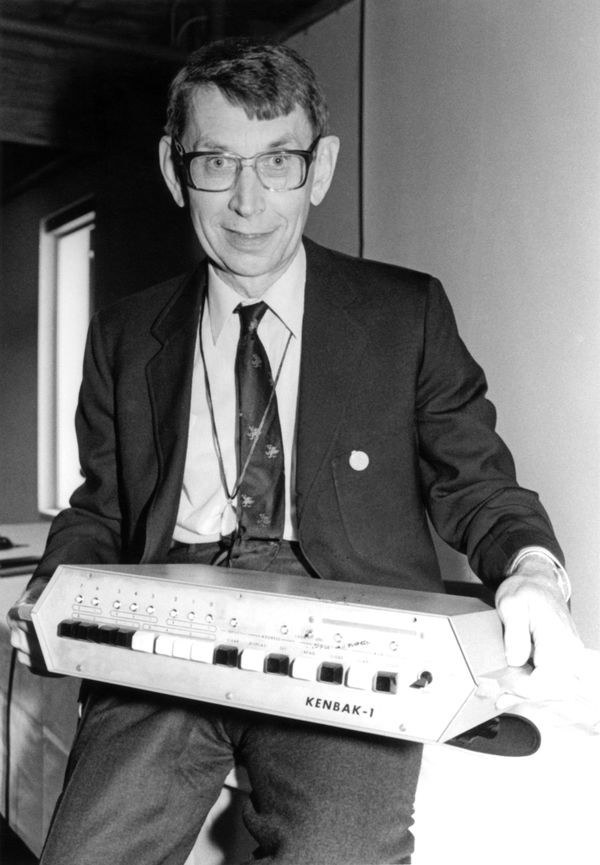
The KENBAK-1 was one man’s machine. John Virgil Blankenbaker designed its logic, laid out its circuit board, wrote its manuals, raised its money, placed its advertisements, answered its mail, shipped it on approval by bus, and in the end sold the rights to it. He had been thinking about cheap computers for twenty years before he built one, and nearly every feature of the KENBAK-1 — its serial design, its registers in memory, its lights and switches, its manuals that “assume the reader is approaching a computer for the first time” — comes from something he had done or seen before.
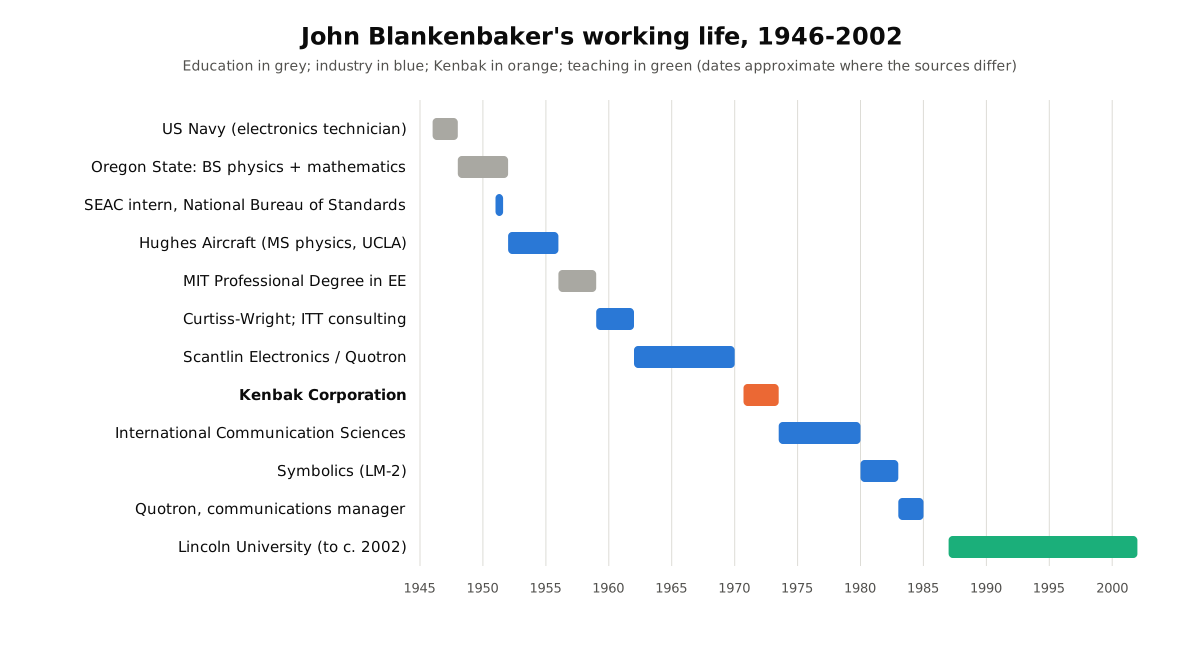
This volume follows his life from an Oklahoma farm to the Navy, Oregon State, the National Bureau of Standards, Hughes Aircraft, MIT, the Quotron stock-quotation system and the garage in Los Angeles where Kenbak Corporation was run, and then through the forty years after it: vocoders, Lisp machines, an investment newsletter, physics teaching, genealogy and, in 1986, a trip to Boston to collect a prize. The main sources are his own words: a 54-page oral history recorded for the Computer History Museum by Lee Felsenstein in June 2007 (CHM X4068.2007), the speech he gave in Boston in 1986 (CHM blog, 2016), and a detailed biography on kenbak.com that his daughter reviewed with him in 2022 (kenbak.com). The business of Kenbak Corporation is told in Volume 4; the machine’s hardware in Volume 3.
2.2 A Farm Without Electricity
Blankenbaker was born on 24 December 1929, “at the start of the Depression, in Oklahoma”, into a farming family that raised dairy cattle and cotton on land it did not own. The nearest town he knew was his grandfather’s, Apache, Oklahoma, “population several hundred”. His father had studied for a year at a seminary before illness ended it; his mother was a schoolteacher, a strong believer in reading. He had a brother ten years older and another two years younger. In 1937, when he was seven, the family moved to Oregon, to a farm belonging to a cousin of his father, and he spent the next sixteen years there (oral history).
The farms had no electricity. He went to school in one- and two-room schoolhouses until the eighth grade, then to Albany Union High School, where he took the college-preparatory course with science electives. At fourteen he was driving the family car to school, because the high school ran no bus and the head of the school board signed a certificate saying he needed a licence. He took an old car apart “down to the last nut and bolt”, read Popular Science, and built radios: a crystal set that never worked (“the earphones sold to me were bad”) and a battery-powered one-tube receiver with a grid detector that did. He tried to add a second tube to make it louder and could not; nobody could tell him why (oral history).
2.3 The Navy and Oregon State
College was not affordable. In the spring of 1946, as a high-school senior, he signed up for a Navy programme that offered eleven months of electronics school in return for two years’ service, with the GI Bill to follow. He did boot camp at Great Lakes, north of Chicago, about seven months of “Primary School” in electronics, and a further school in Washington, D.C., and served as an electronics technician third class, maintaining transmitters, receivers, radar, sonar and LORAN. It was, he said, “an eye-opener … for this farm boy that had never experienced the big city life” (oral history).
He then went to Oregon State College in Corvallis and chose physics over electrical engineering. In his freshman year, around 1949, he read a magazine article — he thought it was in Popular Science — about the new electronic computers: rooms of equipment, thousands of vacuum tubes, “and only two numbers, zero and one — strange combination”. The vacuum tubes did not frighten a man who had maintained radar sets with hundreds of them. The two numbers did. Over several days, on scratch paper, he worked out for himself how to write numbers in binary, how to convert them to and from decimal, and how to do arithmetic in binary:
It really took me several days to work out these simple things, which now I guess grade school students understand — or some of the better ones do.
— John Blankenbaker, CHM oral history, 2007
He had a practical motive. Physics students were expected to do laboratory calculations with logarithms, and most of them used slide rules and, he admitted, made up the fourth digit. A computer would do better. He sketched an arithmetic unit built from relays, with a novel two-position latching rod moved by electromagnets — “I learned later that it was a JK flip-flop” — and a relay memory that he would select by turning a crank. It was not a stored-program machine. Then he added up the cost against his savings of about $1,000 from the Navy and gave it up (oral history). In Boston in 1986 he began his speech with that moment: “I started the design of my computer in 1949” (CHM blog).
2.4 A Summer on SEAC
Between his junior and senior years, in the summer of 1951, he won a place as one of about a hundred summer interns at the National Bureau of Standards in Washington, and was one of four assigned to SEAC, the Standards Eastern Automatic Computer. SEAC had been running for about a year. It was a serial machine with mercury delay-line memory and a four-address instruction format — two operands, a result and the address of the next instruction — and it was, in Blankenbaker’s judgement, “probably the most useful computer in America at the time”. It ran around the clock “lightning permitting”, because it was sensitive to thunderstorms, and that was when interns got a turn: “It was during thunderstorms that private individuals could maybe try a program, if they understood that sometimes it might not get any result” (oral history).
The interns built small packages of delay lines and diode logic. Late in the summer he wrote his first program, to solve a quadratic equation. It never worked. He graduated in 1952 with bachelor’s degrees in physics and in mathematics.
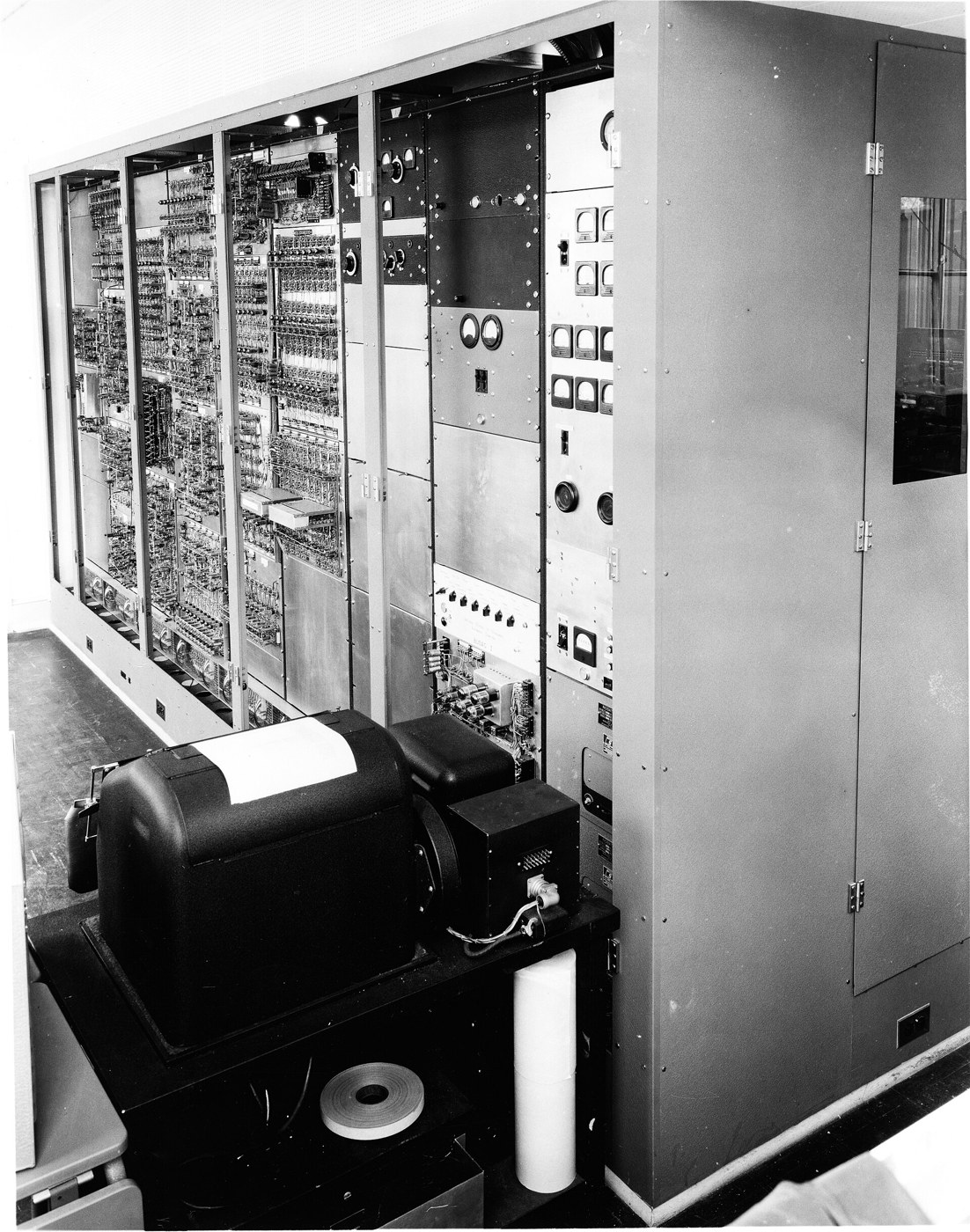
SEAC mattered to the KENBAK-1 in two ways. It made him a serial-machine man: “I have done … far more work with serial memories than I have with parallel memories”, he said in 2007, listing drums and mercury delay lines, “and so the drum memories were serial, the mercury delay lines were serial. I was well acquainted with serial memories.” The KENBAK-1’s circulating shift-register memory is a direct descendant. And it showed him what it was like to have a computer and not be able to use it.
2.5 Hughes Aircraft and the One-Flip-Flop Computer
In 1952 he joined Hughes Aircraft Company on a scheme that let him work half-time and study half-time for a master’s degree in physics at UCLA. After a few months he was assigned to a new department building a large business data processor, and he designed its arithmetic unit. The machine was built from vacuum tubes and diode logic packages, and it was expensive. The head of the department told him that every flip-flop added about $500 to the price — three vacuum tubes and a package each. “I felt a great pressure to try and eliminate the flip-flops, or to do things more simply” (oral history).
He pushed the question to its limit. Having read a suggestion that a flip-flop need not be a circuit at all but could be a magnetised spot on a drum, he designed, around 1955, a computer with only one flip-flop and a small fixed memory of about 25 diodes. In that memory one stored the description of another computer and the problem it was to solve, and the tiny machine evaluated, step by step, what the target machine would do. It was a universal machine, and very slow. Interviewers always compared it to Alan Turing’s abstract machine; Blankenbaker preferred his own, because “I knew a decided procedure for translating it and executing it. With the Turing machine I never felt that I could program one.” The patent department was not impressed. When he explained that it could do what any computer could do, the answer came back: “If it is not general, there is nothing unique about it” (oral history).
He published the idea as “Logically Micro-Programmed Computers” in the IRE Transactions on Electronic Computers in June 1958. It is the intellectual ancestor of the KENBAK-1, though not its design. “Logically micro-programmed computers were more of a motivation than a guideline as to how to do it,” he said; they “led me to believe that computers could be much simpler than what was being built” (oral history).
Hughes cancelled the business computer when a new general manager commissioned a market study that forecast sales of about twenty. Blankenbaker spent his last year there on air-traffic control and built a digital differential analyser. He had been granted or filed several patents at Hughes, and in 1954 he won a $400 company award (kenbak.com biography). After four years he left to study at MIT.
2.6 MIT, Ramo-Wooldridge and the East Coast
In the autumn of 1956 he enrolled in MIT’s Professional Degree programme in electrical engineering. During the summer of 1957 he consulted for the Ramo-Wooldridge Corporation alongside Gene and Lowell Amdahl, and he was later named as one of five inventors on US Patent 3,246,303, “Stored Logic Computer”, filed in 1961. He spent a second summer consulting for Litton Industries and a semester at General Precision on display terminals for the Federal Aviation Administration. His MIT thesis, completed in 1959, was “Prediction and Filtering of Binary Sequences” (kenbak.com biography).
In 1959 he married Eleanor and moved to the Princeton, New Jersey, area. He spent about a year at Curtiss-Wright on digital logic trainers for a Navy system, and in 1962 consulted for ITT on a telegraph message-switching system for the State Department. That autumn, returning from a long vacation to vote in Princeton, he found a phone message from Montgomery Phister, a colleague from the Hughes business-computer project who had moved on to Thompson Ramo Wooldridge and now worked for a small company in New York. “So I went up to have lunch with Monty, and by the time I went home I had taken a job with him” (oral history). Phister turns up again and again in this story: he was an investor in Kenbak Corporation, and it was he who, in 1985, told Blankenbaker about The Computer Museum’s search for early personal computers.
2.7 Quotron: Eight Years of Stock Quotations
The small company was Scantlin Electronics, maker of the Quotron system. Its founder, Jack Scantlin, had first put a loop of magnetic tape in each broker’s office that recorded the ticker and could be read backwards to find a stock’s last price. By 1962 the system was centralised: a broker typed a symbol on a desk unit and received the open, high, low, last price, net change and volume, sent over 2,400-baud lines from a centre in New York built on four Control Data 160A computers, each with 8K words of 12-bit memory and a shared bank of 24K. “The genius of Jack Scantlin was that he figured out how to encode the data so that it would fit in these machines” (oral history).
Blankenbaker began in New York in operations and programming, supervising the “correction desk” that fixed errors in the exchange data and writing programs at night because the computers were busy all day. Quotron computed the Dow Jones average on demand within a minute, and on some days disagreed with Dow Jones about whether the market had gone up or down; the salesmen wanted the figure changed. He moved to the engineering department in California at the end of 1964, became the architect of the Quotron stock-market monitor, and was named vice president of engineering in March 1970 (kenbak.com biography). Customers came to Scantlin with other problems — loan companies, Hilton and Howard Johnson room reservations, a warrant system for the Los Angeles police — and he enjoyed those. He did not enjoy managing people.
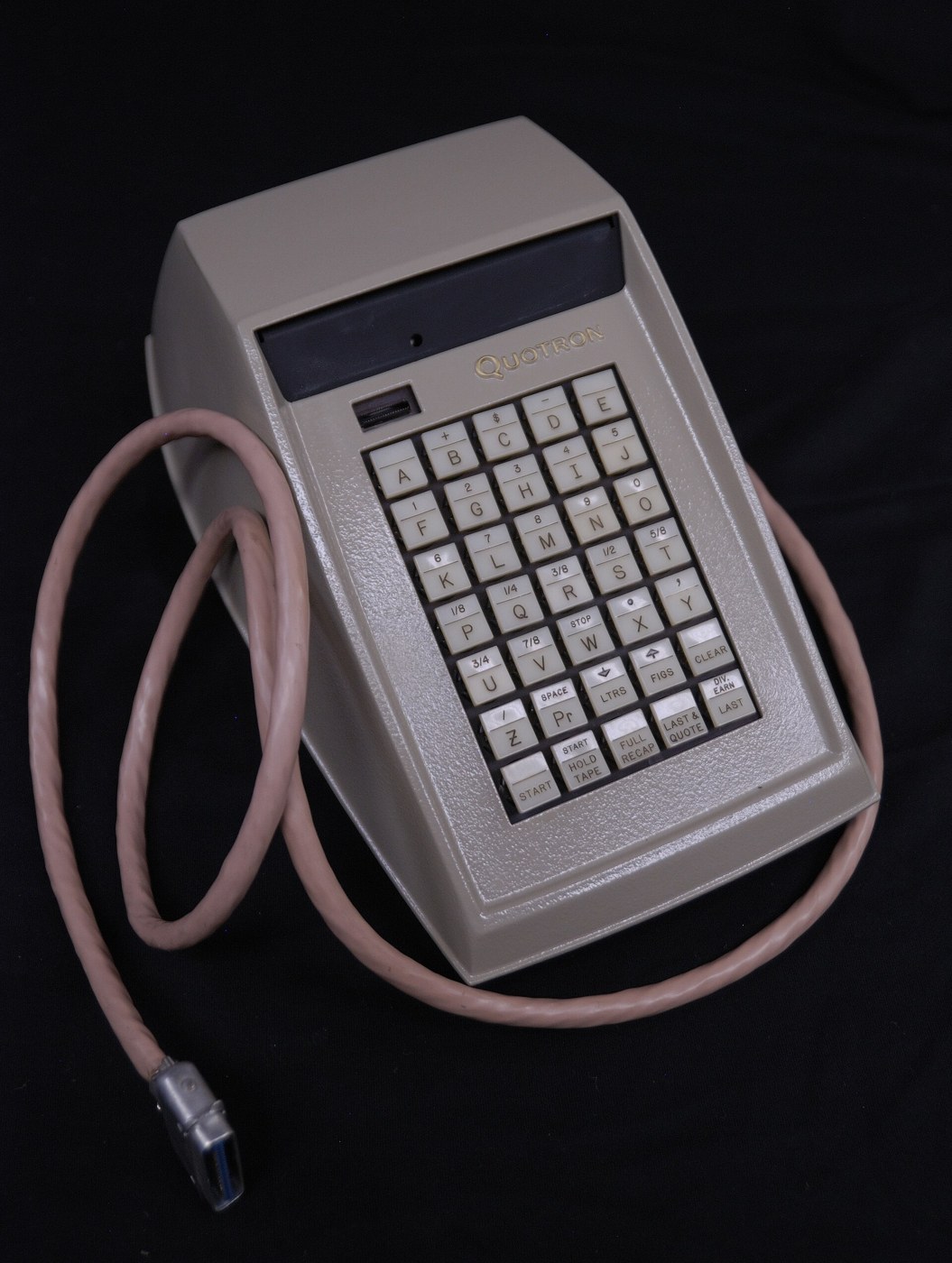
In 1970 Jack Scantlin arranged with the board to fire the company’s president and bring in another. Blankenbaker, caught between them, resigned. The board said he had “done some good things for us” and gave him $6,000 as a gift.
2.8 1970: Fifteen Years of Saying It Could Be Done
So I was unemployed, $6,000 in my pocket, and a little bit of other resources, and here I had been saying for 15 years, computers can be built much more cheaply. Maybe this is the time to think about it. So, as a proprietor I started thinking about what I would do, and that’s the start of the Kenbak computer.
— John Blankenbaker, CHM oral history, 2007
He went about it the way an engineer at a parts counter would. He took out the catalogues from Allied and Newark and looked at what was cheap and available: cases, memories, logic. Serial MOS shift registers were “pretty cheap and pretty good storage”. Integrated circuits he knew. Input and output had to cost almost nothing, “so it’d just have to be lights and switches” (oral history).
The why was personal. He remembered designing the arithmetic unit of a large computer at Hughes when he had written exactly one program in his life, and it had not worked. A small machine on which a person could learn programming at the most elementary level would have saved him that. Interviewing him in 2007, Lee Felsenstein put it back to him: “It sounds as if you wanted to create a computer that people could learn to program on at the most elemental level because you wished you’d had that.” Blankenbaker answered: “Yes.”
His first vision was not of classrooms. “In my very earliest thinking, I had visions of a newsletter. In other words, private individuals, a fun device, and that the newsletter might have games and programs to do and ask readers for their solutions” (oral history). The newsletter never happened. The decision to aim at schools instead, and his later regret about it, are the subject of Volume 4.
2.8.1 The name
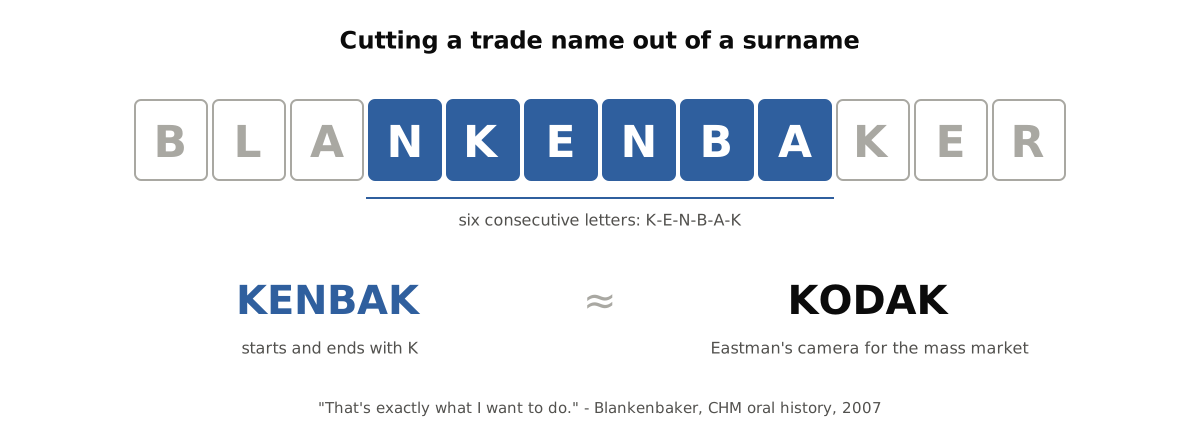
The name came from the same impulse. “Blankenbaker of course is too long and people can’t spell it, can’t even pronounce it.” Inside it, though, were six consecutive letters that began and ended with a K, like Kodak, and Blankenbaker knew what George Eastman had wanted: “to make a camera for the mass market, to make it popular, not for the professional but for the amateur. I said, ‘That’s exactly what I want to do.’ … My wife warned me that no one would be able to spell it but that was beside the point” (oral history).
2.8.2 The designer at work
Blankenbaker’s way of designing shows in the machine. He did not draw schematics first: “I am a believer in state concept and Boolean equations and schematics mean nothing to me really.” He defined fewer than 32 machine states and wrote the equations for moving between them, and generated a set of schematics only after the machine was built. He laid out the printed circuit board himself, and changed the logic as he went to fit the parts already on the board. He designed the power supply so conservatively that it would run on 70 volts AC and its regulator transistors, he said in 2007, had never failed in any machine. His brother, the one ten years older to whom he had been saying for years that it could be done, laid the tape on the mylar. “When you take all of the job into your own hands and don’t have to report to a committee or a set of specifications,” he reflected, “sometimes it pays” (oral history).
The prototype first worked in the spring of 1971. It is a revealing object: its board carries the earliest layout, with many cut traces and jumper wires, and an added transistor, capacitor and two diodes mounted above the board to make it work; its power supply produced +5, −5 and −12 volts, where later machines derived the −5 volts on the logic board; and its front panel had a red ENTER button where production machines have STORE (kenbak.com registry). He went straight from paper design to printed circuit board, with no breadboard. “No, it didn’t work,” he said of the first power-up; “I found out why.” The bit counter that generated the clock pulses could lock up in a state he had overlooked, “an embarrassment to me … who advocates state design so much” (oral history).
2.9 After Kenbak
When Kenbak Corporation stopped trading in 1973, Blankenbaker had to find work. He was by then buying, with a VA loan, the house he had been renting. He became director of engineering at International Communication Sciences, a start-up founded by a former Scantlin colleague, which was trying to multiplex four digitised voices onto one telephone line. He designed an 8 MHz “vector” computer to perform the fast Fourier transforms the speech coding needed. The computer worked; the 2,400-baud voice coding did not sound good enough, and after about seven years the company failed (kenbak.com biography).
In 1980 he was one of the founding employees of Symbolics, the Lisp-machine company spun out of MIT, as director of engineering, and helped deliver its first product, the LM-2, of which about eighty were sold. He left in 1983 after a long dispute inside the company, in which Montgomery Phister, again, was asked to act as referee. He then spent about two years back at Quotron, as manager of communications, running some 13,000 telephone lines through the break-up of AT&T (oral history; kenbak.com biography).
In 1985 the Blankenbakers moved to Pennsylvania, near Eleanor’s family. He edited an investment newsletter, A Non-Random Walk, for more than seven years, worked for a small company called Science Products for the Blind on instruments for blind users, including cash registers and a blood-glucose meter, and began tutoring at nearby Lincoln University. Before long he was teaching physics full time and mathematics part time, and he taught there until about 2002 (CHM blog; kenbak.com biography).
2.9.1 The prize
In 1985 Montgomery Phister saw The Computer Museum’s appeal for early personal computers and urged Blankenbaker to enter. He went up to his attic, where three KENBAK-1s were stored — the prototype, an early board and one that did not work — picked the working one, and shipped it to Boston. In 1986 the judges, Steve Wozniak among them, gave it first prize as the earliest personal computer known to them, and Blankenbaker was flown to Boston to collect an engraved silicon-wafer medal and give a short speech (The Computer Museum Report, Fall 1986). He ended it by explaining why he was leaving the machine there: “It will contribute more to the background of computing by being here in the Museum than by being up in the attic” (CHM blog). Volume 5 tells the contest in full.
Recognition followed slowly. In 2005 a computer museum in Bozeman, Montana, gave him its George R. Stibitz award (kenbak1registry.com), and the prototype, still working, was shown at Montana State University that October (kenbak-1.net). In 2007 he gave the CHM oral history; in 2017 Oregon State inducted him into its Engineering Hall of Fame (Oregon State University). He allowed Grant Stockly to make a reproduction kit from one of his boards in 2007 and offered to sign the rear panels of the kits; Volume 8 covers it. In 2015 he sold the prototype at Bonhams for $31,250, after replacing a failed shift-register chip to get it running again.
2.9.2 Germanna, and later years
Retirement brought a second career as a historian. From 1989 he wrote and edited Beyond Germanna, a bimonthly newsletter on the German families who settled the Germanna colony in Virginia in the early eighteenth century, for fifteen years, and the Germanna Foundation honoured him for that work (kenbak.com biography). In the 2007 interview, asked about modern computing, he admitted that half the acronyms in a computer magazine were “Greek to me” and that he did better asking his son, who had been about eight when the KENBAK-1 was built.
In March 2022, at 92, he wrote to Achim Baqué, the German collector who had bought the prototype, giving permission to preserve his old website, kenbak-1.net, which he could no longer maintain (kenbak1registry.com). The kenbak.com biography, reviewed with him by his daughter Anne Killheffer, records that as of early 2023 he and Eleanor were living in New Hampshire and that he had just celebrated his 93rd birthday, on 24 December 2022, “still enjoying his large extended family and staying in contact with friends all over the world by email” (kenbak.com biography). Later news of him could not be confirmed when this volume was written.
2.10 What He Built Into the Machine
Read against his life, the KENBAK-1 is almost autobiographical.
- Serial logic and circulating memory come from SEAC and from the drums and delay lines he had used for twenty years.
- Simplicity as a goal in itself comes from Hughes, the $500 flip-flop and the one-flip-flop computer.
- Registers at memory addresses come from a teacher’s instinct that one rule learned should explain as much as possible.
- Lights, switches and octal come from the parts catalogue and a budget of $150 a machine.
- The manuals, which start “on the assumption you knew nothing about computers”, come from a man who had designed a computer’s arithmetic unit before he had written a working program.
- The name comes from George Eastman, and the hope of selling to everyone.
He did not build the KENBAK-1 to make a fortune, and it did not make one. He built it, as he told Felsenstein, because “for 15 years I’d been saying it could be done.”
Next — Volume 3: A Computer Without a Microprocessor — TTL and Shift-Register Memory. Inside the blue box: about 130 TTL chips on one board, a one-bit-wide arithmetic unit, fewer than 32 machine states, two Intel 1404A shift registers circulating 2,048 bits, and the clock that counts them round.
Comments (0)