KENBAK-1 · Volume 4
KENBAK-1 — Volume 4 — Selling a Computer in 1971 — Fifty Machines and a Scientific American Advert
Five investors and $20,000, parts for fifty computers, a $750 advert in Scientific American, machines sent on approval by Greyhound, a sales manager who vanished with $3,000, and the long slow slide to CTI — the business history of Kenbak Corporation
4.1 About This Volume
In 1971 nobody sold computers to individuals, because nobody believed an individual would buy one. John Blankenbaker did not believe it either, quite; he believed a school would. This volume follows Kenbak Corporation from a working prototype in the spring of 1971 to the sale of its rights in 1973: how it was financed, what it cost to make a KENBAK-1 and what it sold for, how it was advertised and to whom, who actually bought one, and why a machine that its users liked could not find enough buyers to keep a one-man company alive.
The main sources are Blankenbaker’s own accounts — the 2007 oral history recorded for the Computer History Museum (CHM X4068.2007) and his 1986 speech in Boston (CHM blog) — together with Kenbak’s own manuals and advertisement, the notices he placed in the Amateur Computer Society newsletter as summarised by the kenbak.com biography (kenbak.com), and the provenance research of the kenbak.com registry. Volume 2 covers the man; Volume 5 the machine’s afterlife.
4.2 The Product
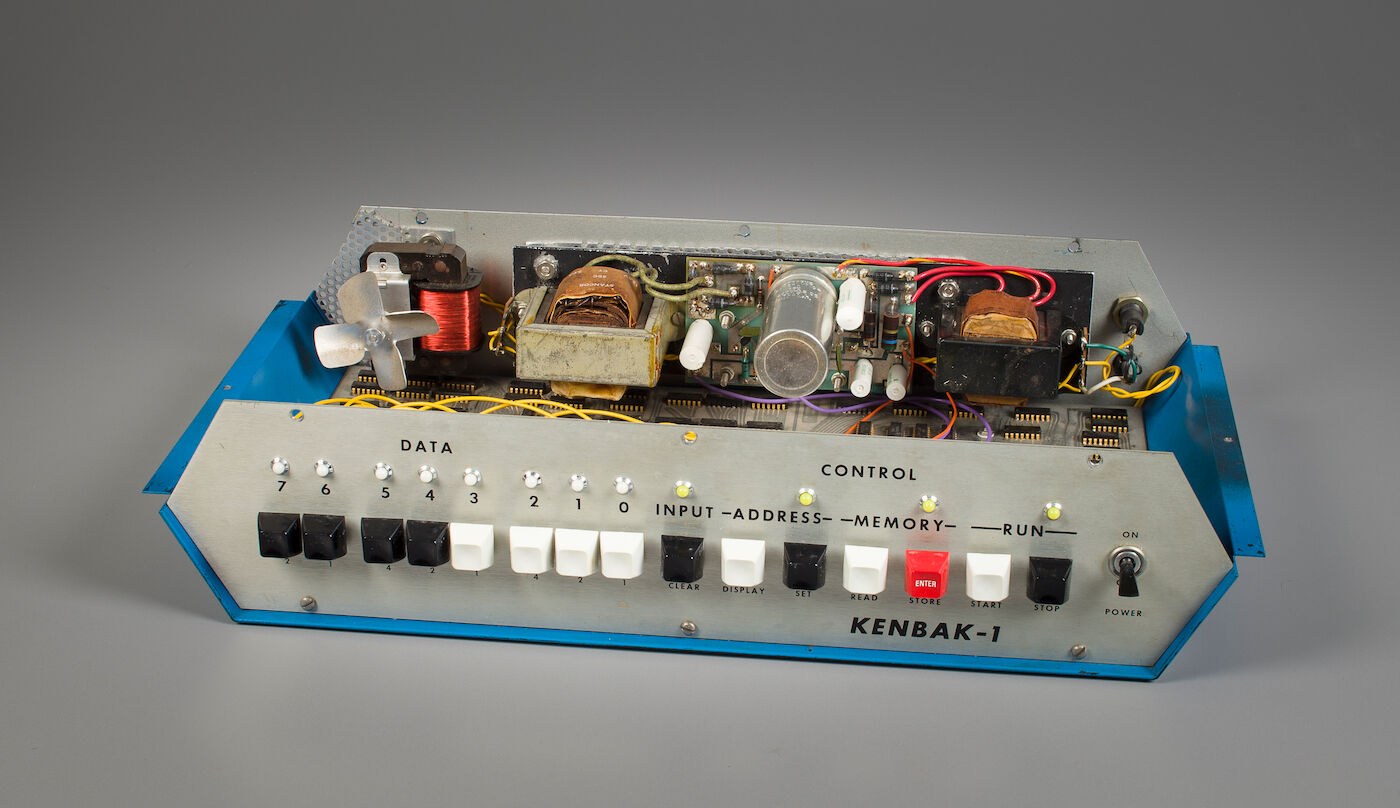
Kenbak Corporation sold one thing: a fully assembled, tested computer in a blue steel case, with a one-year warranty and a binder of manuals. The price was $750, about $6,000 in 2025 money. There were no options, no peripherals and no kit version. The card-reader slot on the front panel was covered with a blank plate; reading punched cards photoelectrically had turned out to be harder than expected, and the reader was never made (CHM blog).
The manuals were as much the product as the box. Blankenbaker designed them in tiers. The Laboratory Exercises started “on the assumption you knew nothing about computers” and walked the reader from binary numbers to programs, in about 150 pages. The Programming Reference Manual, for those who already understood computers, summarised the machine in 24 pages; its title page lists every page as dated 4-1-71 and gives its price as $2.00 (PRM). Programming worksheets and an Installation & Maintenance manual completed the set, and a Theory of Operation manual, with schematics and state diagrams, documented the hardware.
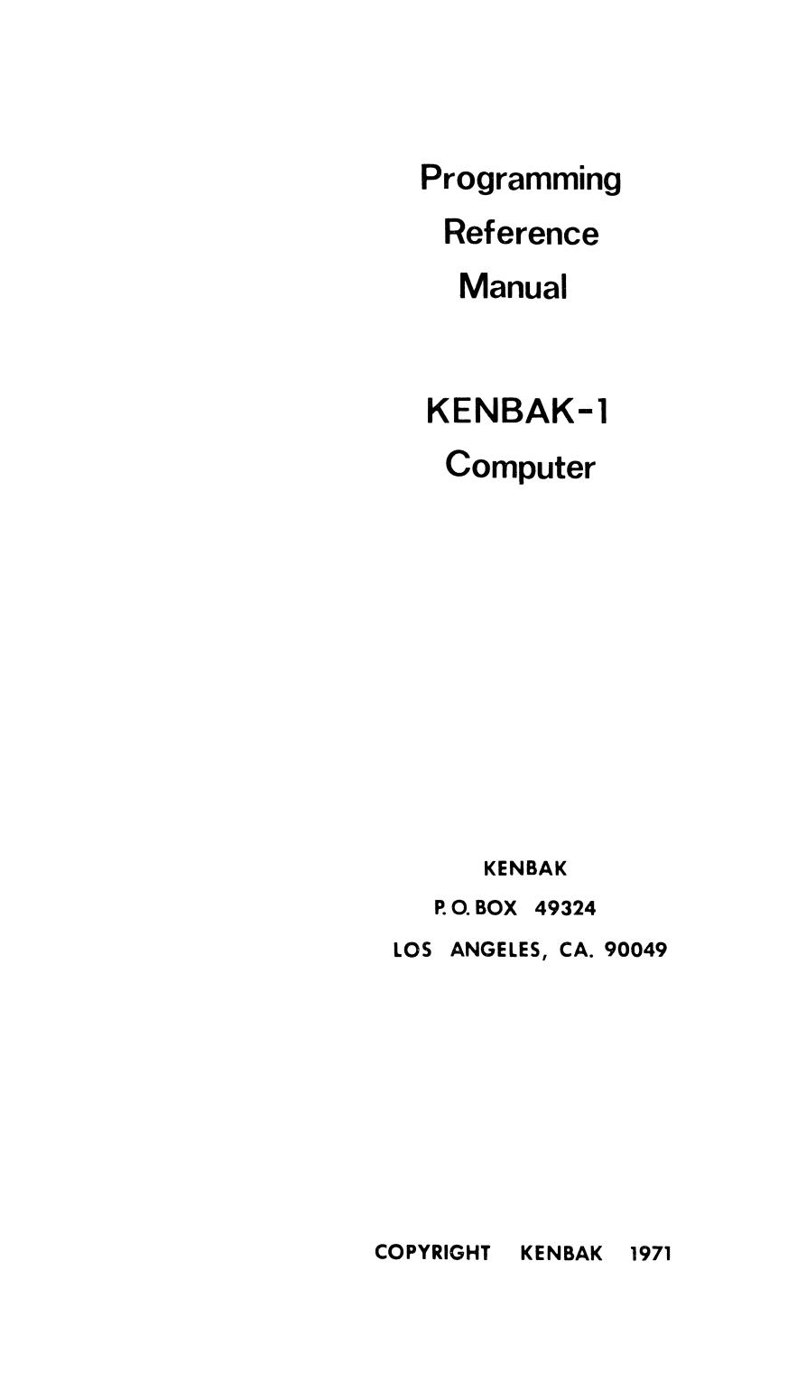
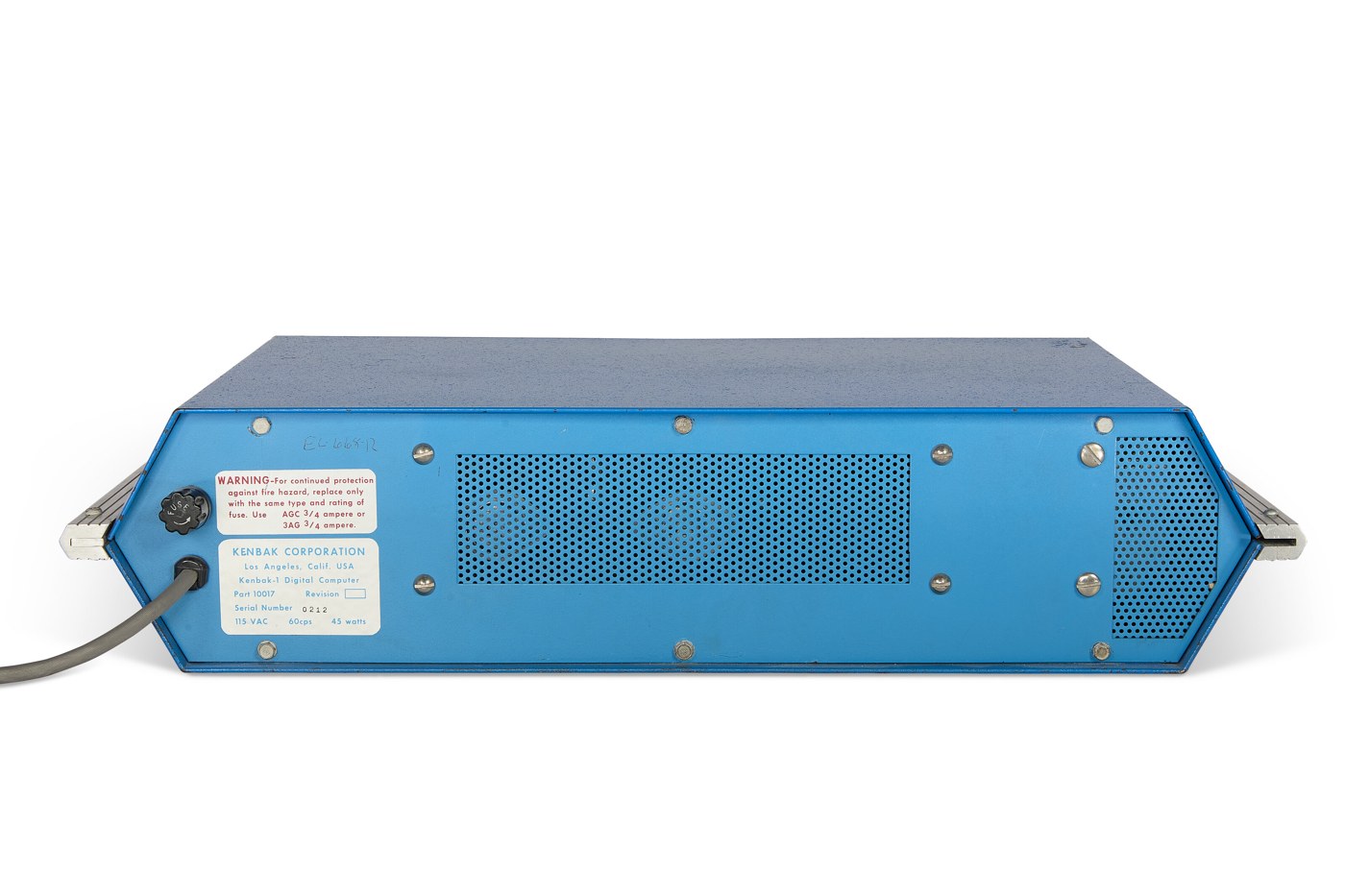
The Installation & Maintenance manual is the voice of a company that expected to be selling to schools. It explains how to fit the three-pin grounding adaptor to an old two-pin outlet, how to oil the fan (one or two drops of SAE 20 or 30, at two points), how to replace a Type 680 lamp with needle-nose pliers, and how to claim the one-year warranty — by letter, to a P.O. box in Los Angeles. It also contains the most honest sentence in any 1971 computer manual:
90% or more of the cases where it is first thought the computer is not working correctly, it will turn out that the user is in error. The computer is a piece of sophisticated electronic equipment, but it is usually more reliable than our understanding of it.
— Installation & Maintenance, KENBAK-1 Computer, 1971, p. 1
4.3 What It Cost to Make
Blankenbaker’s target was a parts cost of $150 per machine, which he hoped would let him sell it for about $500. He did not reach it. Bought fifty sets at a time, the parts came to about $250: “My aim incidentally was I wanted to do it for $150 of parts and in volume I might have made that. More in the volumes that I bought, which at 50 was the most, was about $250 for parts cost” (oral history).
To that he added labour, a share of the tooling-free case, manuals, shipping and advertising, and a salary for himself that he described as “very, very small”. The $750 price therefore gave a gross margin of about two-thirds on parts, but a company that sold a few machines a month could not cover its advertising from that margin, let alone pay back investors.
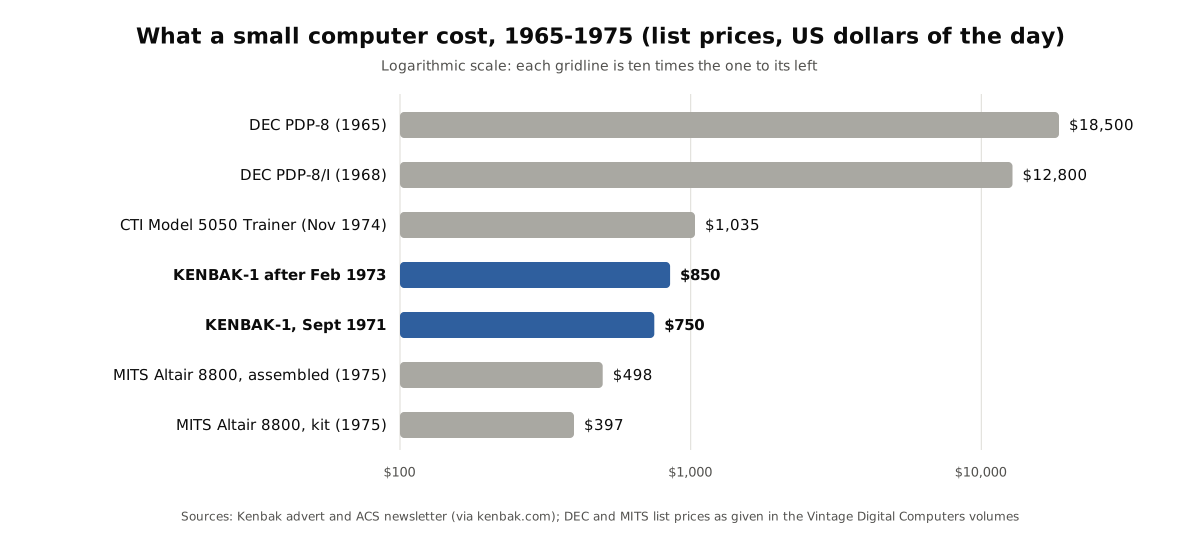
The economics are clearer when set beside the computers of the day. Digital Equipment Corporation’s PDP-8, the machine that defined the minicomputer, had been introduced in 1965 at $18,500; the integrated-circuit PDP-8/I of 1968 cost about $12,800. Those machines were vastly more capable — twelve-bit words, 4,096 words of core memory, teletype input and output — and they were sold to laboratories and companies. The KENBAK-1 offered an individual a real stored-program computer for about one twenty-fifth of a PDP-8’s price. Three and a half years later the MITS Altair 8800 would cut the price in half again, as a $397 kit, by building its processor around a single Intel 8080 chip. The PDP-8/I and the Altair each have their own deep dives on the Vintage Digital Computers site (digital.fubsypoly.com).
4.4 Money: Five Friends and $20,000
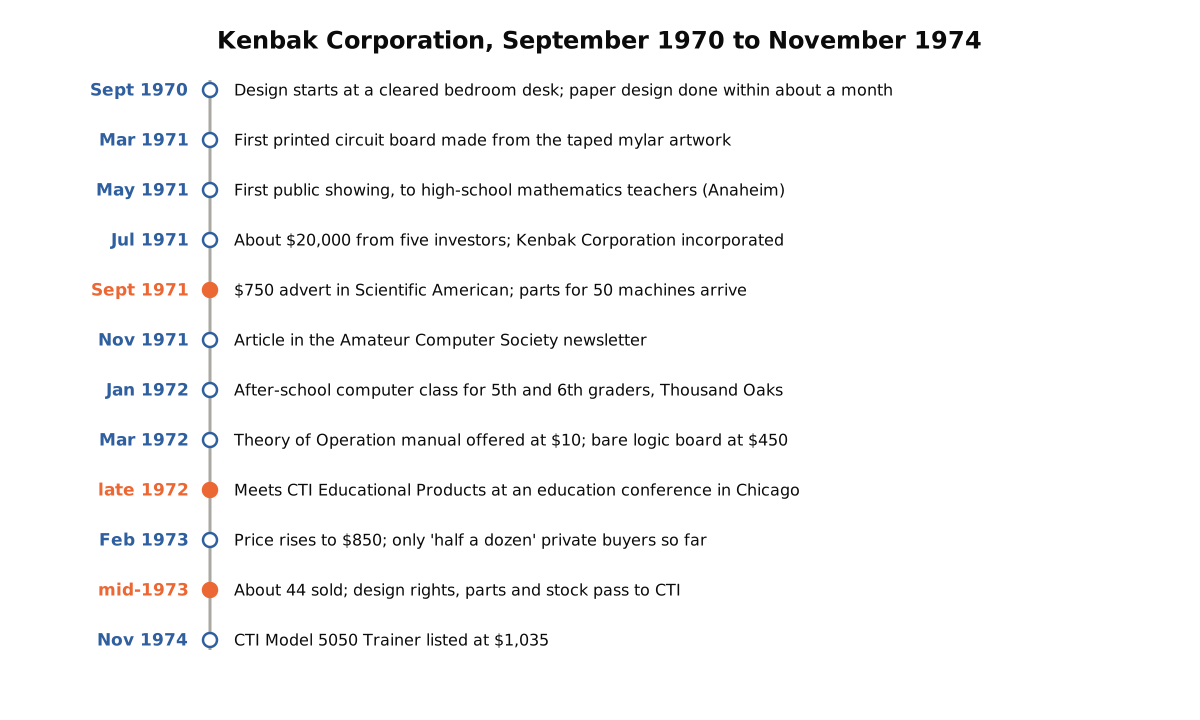
Until the prototype worked, Kenbak was a sole proprietorship financed by Blankenbaker’s $6,000 parting gift from Scantlin Electronics. In the spring of 1971, with a machine to show, he incorporated and wrote to friends asking them to invest. To avoid the paperwork of a wider offering he limited it to California residents. Five responded, all men he had worked with, four of them at Scantlin: Montgomery Phister, his colleague from Hughes and the man who had hired him at Scantlin; Christopher Kamp, a programmer; James Dougherty, Scantlin’s vice president of finance; John Blatner, a programmer; and Vance Holdem, Scantlin’s former president. (The spellings of Kamp and Blatner vary between sources.) Together they put in “about $20,000 or just slightly over”, in return for stock. The money came in around July 1971 (oral history).
The investors took little part in running the company. “The involvement of the investors in the company was very minimal and chiefly limited to annual meetings or something of that nature,” Blankenbaker said, ”… when I say we, that’s the royal we, nearly always it was my sole decision.”
He spent most of the money on parts for fifty computers, ordered in late summer 1971 and delivered in September. The rest went on advertising, a secretary, an assembler, and four months’ rent on an industrial unit in the San Fernando Valley — a former printed-circuit factory with workbenches and offices — before it was “obvious that we weren’t selling at a rate sufficient to do this and we moved back to the garage” (oral history). The assembler was let go and took one computer as part of his pay; his family, both professional programmers, later told Blankenbaker that they took it on holiday with them. Blankenbaker’s own summing-up, in 1986, was blunt: “We were so undercapitalized we could hardly wait” (CHM blog).
4.5 Finding Customers
4.5.1 The first showing
The first public showing of the KENBAK-1 was to a convention of high-school mathematics teachers, probably in May 1971, which Blankenbaker remembered as being in Anaheim (oral history). Bonhams, selling the prototype in 2015, called it “the very one used in the first demonstration of a commercial personal computer” (Bonhams, lot 76). The choice of audience was not yet a strategy; he had been thinking about hobbyists and a newsletter. But a list of private secondary schools from the public library and a mailed letter produced the first two sales, and “so I thought then maybe educational market was the place to be”.
4.5.2 The advert
Kenbak advertised widely and mostly without result. Blankenbaker tried educational journals such as College Management and Nation’s Schools, high-school magazines, computer newspapers including Computerworld, direct mail, newspaper product announcements and conventions (kenbak.com biography; CHM blog). “It was just trial, live and learn, and then you find out that it was just wasted money. Scientific American is the one that really paid for itself.”
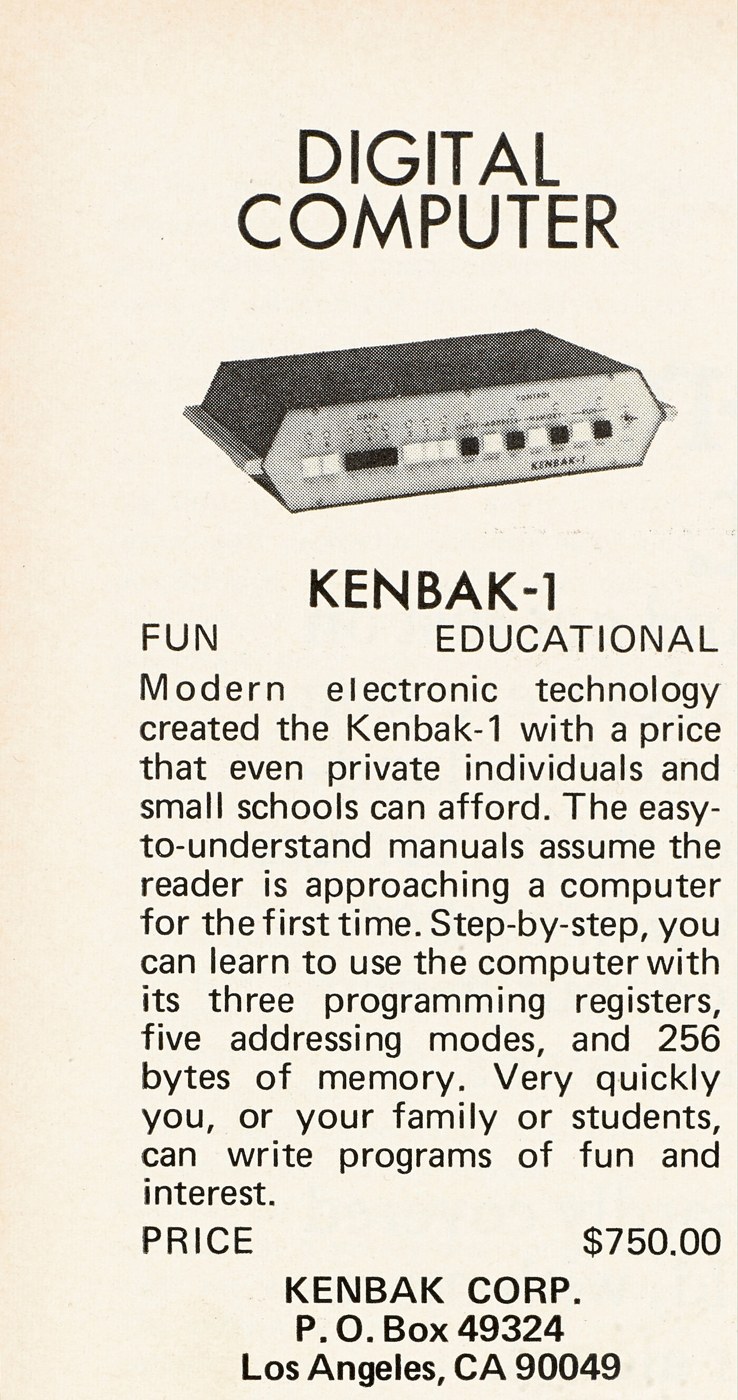
The Scientific American advertisement appeared in the September 1971 issue (Bonhams, lot 76). It was the most expensive he placed, and the only one he thought worth it: “Even though that was the most expensive ad, you had the better class of readers.” The text survives in the advertisement sheet that went with the prototype:
Modern electronic technology created the Kenbak-1 with a price that even private individuals and small schools can afford. The easy-to-understand manuals assume the reader is approaching a computer for the first time. Step-by-step, you can learn to use the computer with its three programming registers, five addressing modes, and 256 bytes of memory. Very quickly you, or your family or students, can write programs of fun and interest.
— Kenbak Corporation advertisement, 1971
The advertisement reached readers everywhere — “private individuals, companies, you name it … overseas, domestic” — but most wrote for more information. Only one simply sent money:
The one that said, “Here’s $750. Send me a computer.” There was only one of those.
— John Blankenbaker, CHM oral history, 2007
In his 1986 speech he added that the cheque arrived before he had received his own copy of the magazine (CHM blog).
4.5.3 Selling on approval
A one-man company with customers all over the country could not make sales calls, so Blankenbaker made the machine its own salesman. “If I thought you were really interested, I will send you a computer for ten days. … And if you want to buy it, okay. If you don’t want to buy it, send it back to me.” (In 1986 he gave the trial period as two weeks.) He would not trust the KENBAK-1 to the post office. In some states it went by UPS and elsewhere by bus, and the customer collected it at the bus station; either way the cost of sending one out was under $10 (oral history). Some machines came back and some were bought; he could not later say in what proportion.
He also hired a sales manager once. “He made away with $3,000 and returned nothing. I have a low opinion of sales managers.”
4.6 Who Bought One
Kenbak never published a customer list, but the shape of its sales can be pieced together.
Schools were the main market — about 80 per cent of the effort, Blankenbaker estimated. Private schools could buy quickly, because the teacher could go straight to the head; public schools could not. “Even though they like it it’ll be two years before they can buy.” The best customer was a high school in upstate New York that bought four, ordering them months before it had the money. Its teacher let students take the computers home — “to carry it home on a bus was something that I really hadn’t envisioned” — and one student wrote an assembler for the KENBAK-1 on the school’s larger computer, the only assembler the machine ever had; Blankenbaker’s own students assembled their programs by hand (oral history). A community college in Canada bought several through a Canadian educational dealer.
Teachers and professors wrote to say they liked it. Kenbak collected their letters for its sales literature: a computer-science professor who had taken it to high schools, grade schools and his own course called it “a great motivational tool”; a business instructor at a junior college wrote that “concepts that we had only talked about came alive” (kenbak.com biography).
Children used it too. On 16 January 1972 the News-Chronicle of Thousand Oaks, California, reported on an after-school class Blankenbaker taught to mathematically gifted fifth- and sixth-graders, which it called “the world’s first elementary school computer class” (kenbak.com biography).
Private individuals were few. In February 1973 Blankenbaker told the Amateur Computer Society newsletter that only about half a dozen non-educators had bought a KENBAK-1, and only about half of those were programmers or engineers (kenbak.com biography). One of them, Thomas Crosley, ordered his new after seeing the Scientific American advertisement and kept it until 2004; it survives as serial 197 (kenbak.com provenance). Another private buyer paid with a cheque that bounced.
Overseas buyers took four machines, one each in France, Spain, Italy and Mexico. Exporting a computer in 1971 required a licence above a certain memory size, which Blankenbaker found was 2,048 bits. “I had exactly 2048,” he recalled, but the Commerce Department insisted on a licence anyway. “I just went ahead and shipped them overseas and never worried about it” (oral history).
4.7 Reaching for the Hobbyists, Too Late
There was a hobbyist world in 1971, small and mostly invisible: the Amateur Computer Society, run by Stephen B. Gray, whose newsletter circulated among people building computers at home. In November 1971 it carried an article on the KENBAK-1 describing the machine, its instructions and plans for a punched-card reader. In March 1972 it reported that the card reader had been shelved in favour of a cassette-tape interface, that the Theory of Operation manual with schematics was available for $10, so that a hobbyist could build a KENBAK-1 from scratch, and that Kenbak might sell a fully built logic board without case, supply, lamps or switches for $450 (kenbak.com biography). Few took up either offer.
Blankenbaker would not go further and sell a kit. His reason, given in 2007, was the difficulty of the build — about 130 chips on a densely packed board, with a fussy serial clock — not the margin. “Some people thought maybe I should have made a kit, I never agreed with that, it was too difficult but at $750 that was in the reach of private individuals and if they wanted a time payment plan I could talk to them” (oral history). Thirty-six years later the first KENBAK-1 kit was sold, by someone else, as a historical reproduction; Volume 8 covers it.
In February 1973 the newsletter reported the end of the cassette interface (“not necessary for educational users”), the half-dozen private buyers, and a price rise to $850 (kenbak.com biography).
4.8 The End: CTI and the Model 5050
By the end of 1972 Blankenbaker was looking for a buyer. At an educational conference in Chicago he met CTI Educational Products of South Carolina, which made electronics trainers for vocational schools and community colleges and needed new products. They reached an agreement for CTI to buy the rights to the computer. Kenbak sent CTI “all the drawings they needed, the manuals that they needed”, and some finished machines; Blankenbaker had by then “sold about 44 out of that 50” (oral history).
CTI renamed the machine the CTI Model 5050 Trainer. At first it simply stuck foil “CTI” labels over the KENBAK-1 name; later it had at least four new front panels silk-screened with its own logo and without the card slot. CTI made training videotapes, and by November 1974 the Amateur Computer Society newsletter gave the 5050’s price as $1,035 (kenbak.com biography).
How many 5050s CTI made is disputed. Blankenbaker believed CTI “went into a production run which I believe called for 50 machines” and sold most of them to the Canadian community college. Robert R. Nielsen, owner of the Nielsen Electronics Institute in Charleston, South Carolina, who worked with CTI’s marketing team, maintained that CTI never built a single machine from scratch and never sold any except the eight his school bought (kenbak.com provenance). The registry’s estimate that about fifty-two KENBAK-1s were made in all, counting the prototype and CTI’s finished machines, supports Nielsen’s version. Nielsen’s eight stayed in use in his school into the mid-1990s, with holes drilled in their tops to cure overheating, and they are the source of half the surviving machines today (Volume 5).
CTI did not pay in full. “There were several years of limbo while status was most uncertain because CTI didn’t pay up and for several years until we finally in desperation took the parts back that they had bought.” CTI itself went out of business soon after. Kenbak Corporation never filed for bankruptcy: “We owed a few debts when we went out of business but we never filed for bankruptcy we just terminated operations, the corporation ceased to exist.” The investors lost their money. When the Blankenbakers moved to Pennsylvania in 1985, he threw the returned parts away, “sad to say” (oral history).
4.9 What Went Wrong
Blankenbaker diagnosed the failure himself, and the diagnosis has stood.
The wrong market. “It was 80% educational market that we were thinking about and in retrospect that was a mistake.” Schools liked the machine but bought on budget cycles of a year or two, which a company with $20,000 of capital could not wait out. “We should have emphasized the private individual and we should have hit these popular magazines from the public.”
Too little capital. With money for fifty machines and a few advertisements, Kenbak could not afford the repeated advertising and the field sales that the education market needed, nor survive the slow payment of a school or a CTI.
No kit, no expansion. The hobbyists who were about to create the personal-computer industry wanted cheap kits they could build and extend. The KENBAK-1 was only ever sold assembled, and it had no way to save a program, no interface to a teletype or terminal, and no expansion bus. The card reader and cassette interface were both announced and both shelved.
The microprocessor. Intel announced the 4004 in November 1971, two months after the KENBAK-1’s advertisement, and the 8-bit 8008 in 1972. Every later personal computer was built round such a chip. A design of 130 TTL packages could not follow that cost curve.
None of this was obvious in 1971. Blankenbaker had read the hobbyist market correctly in 1970 — his first plan, a fun machine for private individuals with a newsletter of games and puzzles, is almost exactly what the Altair and its clubs became in 1975 — and then talked himself out of it.
4.10 Kenbak Corporation in Numbers
Table 1 — Kenbak Corporation in Numbers
| Item | Figure | Source |
|---|---|---|
| Design started | September 1970 | oral history |
| First public showing | May 1971, Anaheim | oral history; Bonhams |
| Investors | 5, about $20,000 | oral history |
| Target parts cost / actual | $150 / about $250 | oral history |
| List price | $750 (Sept 1971); $850 (Feb 1973) | advertisement; ACS newsletter |
| Production run | 50 sets of parts; serials 167–216 | oral history; kenbak.com registry |
| Sold by Kenbak | about 44 | oral history; Christie’s |
| Built in all (incl. prototype, CTI) | about 52 | kenbak.com registry |
| Sold overseas | 4 (France, Spain, Italy, Mexico) | oral history |
| Private (non-school) buyers by Feb 1973 | about 6 | ACS newsletter |
| Successor | CTI Model 5050 Trainer, $1,035 (Nov 1974) | ACS newsletter |
| Known survivors (2026) | 14 | kenbak.com registry |
Next — Volume 5: The Verdict — The Computer Museum Contest and the Surviving Machines. A ComputerLand chairman’s remark, a contest that drew 320 offers from 13 countries, a jury of Wozniak, Bunnell and Strimpel, and a KENBAK-1 taken down from an attic that still worked when it was unpacked. Then the rival claimants, the fourteen survivors, where each one is now, and how the price of a $750 computer climbed to $119,700.
Comments (0)