KENBAK-1 · Volume 5
KENBAK-1 — Volume 5 — The Verdict — The Computer Museum Contest and the Surviving Machines
How a museum in Boston went looking for the first personal computer and found it in an attic in Pennsylvania; what the judges meant by 'first', and who else has a claim; and the fourteen known survivors, where they are, and what they have sold for
5.1 About This Volume
The KENBAK-1’s fame rests on a single decision by a jury of three in Boston in 1986. This volume tells how that contest came about, how it was run, what the judges said and did not say, and why “first personal computer” is a defensible but argued title. It sets the KENBAK-1 beside the other machines that have been called the first: the Olivetti Programma 101, the Datapoint 2200, the Micral N and the Altair 8800. It then follows the machines themselves: of about fifty-two built, fourteen are known to survive, nine of them in museums. The volume lists every one, traces how half of them came down through a single vocational school in South Carolina, and charts the documented sales from $2,000 on eBay in 2004 to $119,700 at Christie’s in 2024.
The contest account comes from the museum’s own report, Oliver Strimpel’s “The Early Model Personal Computer Contest” in The Computer Museum Report for Fall 1986 (PDF). The census of survivors and their provenance comes from the registry kept at kenbak.com (registry; provenance), read in October 2026, checked against auction-house records where they exist.
5.2 The Contest
5.2.1 A remark on a museum tour
The Computer Museum began in 1979 as Digital Equipment Corporation’s Digital Computer Museum in Marlborough, Massachusetts, and in 1984 moved to Museum Wharf in Boston. It collected computers of every kind, but it had come late to personal computers. In the spring of 1985, William Millard, then chairman of the ComputerLand retail chain, toured the museum with Pat McGovern, chairman of CW Communications, the largest publisher of computer trade magazines, and Gwen Bell, the museum’s founding president. Millard noticed the gaps in the personal-computer collection and asked how they might be filled before the early machines disappeared. Bell, “half in jest”, suggested a contest to find the earliest personal computers. Millard offered ComputerLand’s support, McGovern offered to publicise it, “and the contest was born” (The Computer Museum Report, Fall 1986).
From October 1985 to March 1986, advertisements ran in CW Communications’ magazines around the world under the heading “Wanted: Old Thinker-toys”, and Phil Lemmons, editor-in-chief of Byte, put out the call in that magazine’s tenth-anniversary issue. Entrants did not have to donate their machines; they had to pay return shipping only if they wanted them back.
5.2.2 What came in
Offers “flooded in”: 320 of them from 13 countries. Early American commercial machines were well represented, led by the Altair 8800 with thirteen offers. There were many one-off home-built machines and single-board computers, mostly still in working order, and some oddities, the strangest a manuscript from Argentina of about 1800 containing a punched card said to carry a coded message from Marie Antoinette in prison. The museum accepted 137 items and declined the rest to avoid duplication or because they were outside its collecting categories. The response from abroad was, the report admitted, disappointing (The Computer Museum Report).
5.2.3 The jury and the definition
The accepted machines were shipped to Boston for judging by three people: Steve Wozniak, designer of the Apple II and co-founder of Apple Computer; David Bunnell, an early employee of MITS, makers of the Altair, and by then publisher of PC World; and Oliver Strimpel, the museum’s associate director and curator, who wrote the report. Wozniak used the occasion to announce that he would give his own collection of hardware and notebooks to the museum, and gave a public lecture after the judging.
The judges first had to decide what a personal computer was. They excluded “plastic or cardboard educational and toy kit ‘computers’ (such as CARDIAC, BRANIAC and GENIAC), as well as programmable calculators.” They then judged in categories: highly original designs that shaped the technology; early commercial products; hobbyist machines; and home-built machines.
5.2.4 The prizes
Table 1 — The prizes
| Category | Prize | Honourable mentions |
|---|---|---|
| Original designs | Don Lancaster’s TV Typewriter (TVT-1 prototype); Lee Felsenstein’s Visual Display Module (VDM-1 prototype) | — |
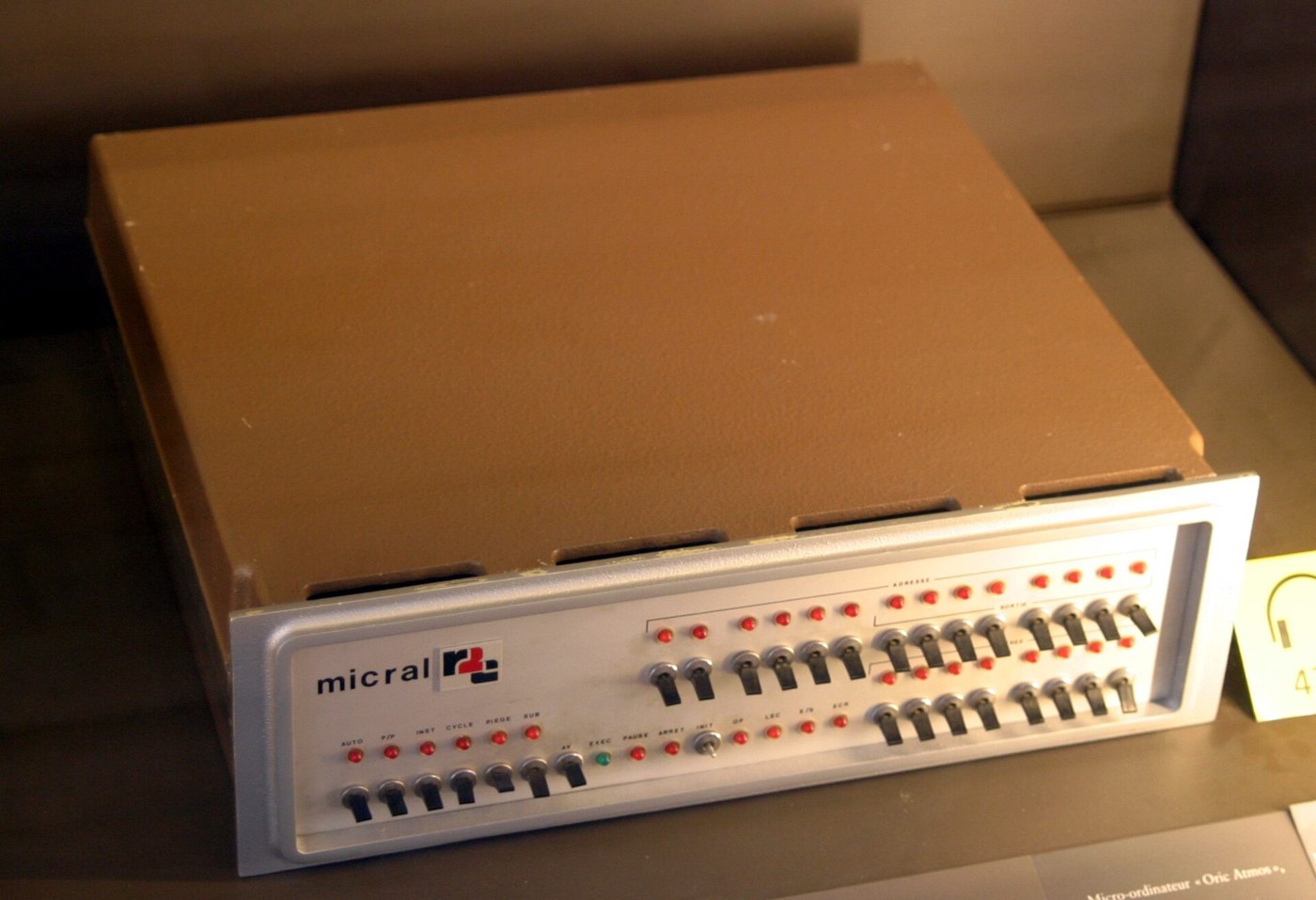
| Early commercial products | First prize: KENBAK-1 (1971), submitted by John Blankenbaker; Micral (1973), Thi T. Truong, “first commercially available microprocessor-based computer” | Scelbi-8B; EPA Micro-68; Cromemco Dazzler |
| Hobbyist zeal | Robert Pond’s Altair 8800 | a Southwest Technical Products 6800; a fully equipped TRS-80 Model I |
| Home-built | — | a machine built on an RGS-008 kit |
The citation for the KENBAK-1 is the sentence on which its reputation rests:
We awarded the first prize to the 1971 Kenbak-1, submitted by its creator John Blankenbaker. This small machine contained an eight-bit processor built up from medium-scale and small-scale integrated circuits, and qualified as the earliest personal computer known to the judges.
— Oliver Strimpel, The Computer Museum Report, Fall 1986
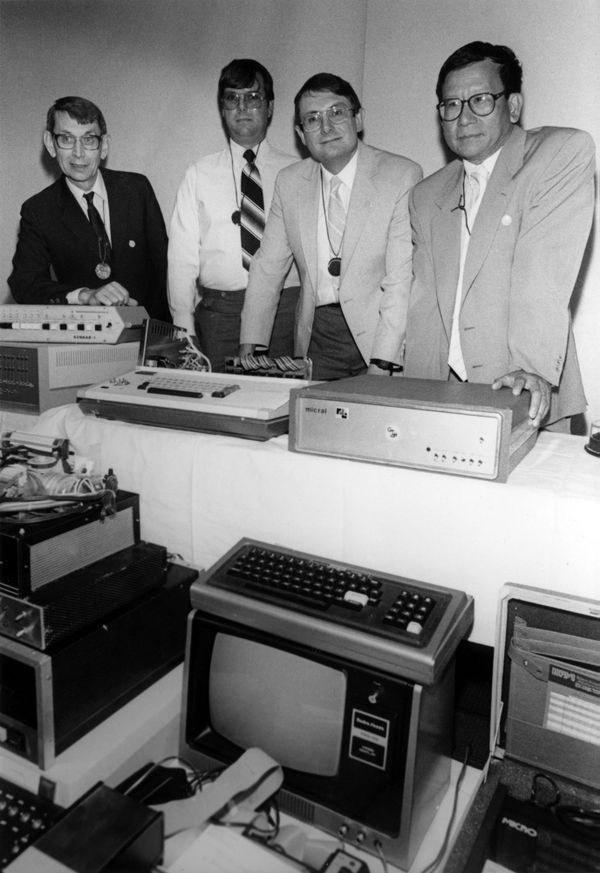
The winners were flown to Boston for “Personal Computer Pioneers Day” and presented with engraved silicon-wafer medals. Don Lancaster could not attend. A photograph in the Computer History Museum’s collection shows three of the entries — the KENBAK-1, a Processor Technology Sol Terminal Computer and a Super Elf — and dates the contest entries to May 1986 (CHM catalog 102623957); another dates a Pioneer Day photograph to 14 June 1986 (CHM catalog 102623955).
5.2.5 A note on the date
Accounts give the year of the contest as 1985, 1986 or 1987. The appeal was conceived in spring 1985 and advertised from October 1985; the judging and prize-giving took place in 1986 and were reported in the museum’s Fall 1986 report; some later sources, including Blankenbaker’s own website and the 2015 Bonhams catalogue, say 1987. This series uses 1986, the museum’s own date.
5.3 The Machine From the Attic
Blankenbaker was not following the computer hobby in 1985; he was teaching physics in Pennsylvania. His old colleague and investor Montgomery Phister saw the museum’s announcement and urged him to enter. Phister wrote to Gwen and Gordon Bell offering one of Blankenbaker’s machines. Blankenbaker had three in his attic: the prototype, an early production unit, and one that did not work. He sent the working one, which, as he told the audience in Boston, had been modified by his son, and when he unpacked it at the museum it still worked (CHM, “In His Own Words”).
He gave a short speech at the prize-giving, recounting his first sketches of a computer in 1949, the one-flip-flop machine, the design of the KENBAK-1 and its sales — “We sold about forty some odd computers” — and closed with his reason for leaving the machine behind: “It will contribute more to the background of computing by being here in the Museum than by being up in the attic” (CHM blog).
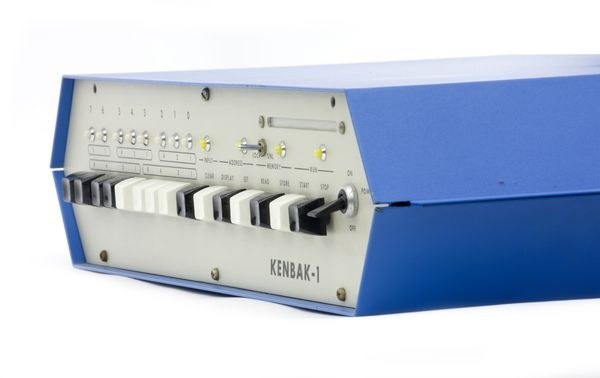
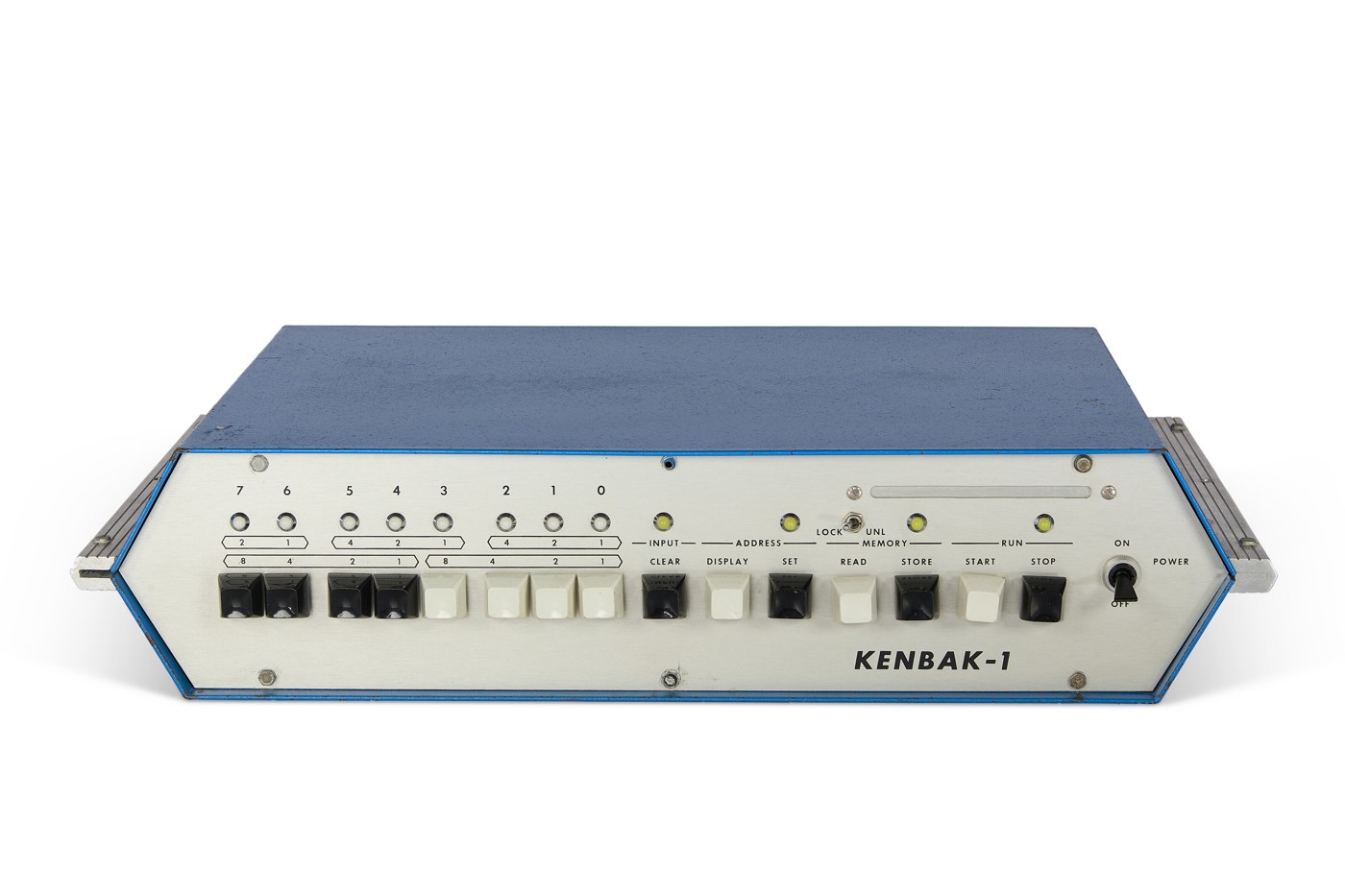
That machine is now the Computer History Museum’s KENBAK-1, on display in Mountain View. It carries a serial-number sticker reading 216, the last number in the production run of 167 to 216. Close examination by the kenbak.com registry’s authors found that it is in fact one of the first machines made: one of only two early “Revision A” boards built after the prototype and before the “Revision B” production boards, neither of which was sold to a customer, and unlike production boards it has no serial number stamped on the board itself. The registry concludes that Blankenbaker probably applied his last spare serial sticker before shipping it to Boston. Its aluminium handles were lost somewhere between Boston and the hangar at Moffett Field where the collection waited for the new museum building; they were replaced with reproductions in February 2023 (kenbak.com registry, serial 216).
5.4 What “First” Means
The museum’s verdict was careful: the KENBAK-1 was the earliest personal computer known to the judges, under a definition that excluded calculators and toys. Whether it is the first personal computer depends on what one requires a personal computer to be. The common tests are:
- A stored-program, general-purpose computer, not a calculator or a fixed-function device.
- Commercially available, sold as a product, not a one-off.
- Priced for an individual, not an institution.
- Complete, usable on a table top without other equipment.
The KENBAK-1 passes all four. The rival claimants each fail at least one, or pass on a looser reading.
- Olivetti Programma 101 (1965). A desktop programmable machine with magnetic-card program storage and a printer, sold in large numbers, often called the first desktop computer. It is usually classed as a programmable calculator: it has no general addressable memory that programs and data share, and the 1986 jury excluded programmable calculators by rule.
- Datapoint 2200 (announced 1970). A programmable terminal with a screen, keyboard and cassette drives whose processor, built from TTL chips, became the template for Intel’s 8008 and so for the x86 family (historyofinformation.com). Its makers sold it to businesses as a terminal, not to individuals as a computer.
- Micral N (1973). Designed in France by François Gernelle for André Truong Trong Thi’s company R2E, it was the first commercial computer built around a microprocessor, Intel’s 8008. The Computer History Museum calls it the first personal computer using a microprocessor (CHM, “What Was The First PC?”). It was sold assembled, largely for industrial process control, and won its own prize in 1986.
- MITS Altair 8800 (1975). The machine that started the personal-computer industry, sold as a kit for $397 through Popular Electronics and bought by thousands of hobbyists. It came four years after the KENBAK-1. The Altair has its own deep dive on the Vintage Digital Computers site (digital.fubsypoly.com).
On the four tests, the KENBAK-1’s claim is strong and its earliness is not in doubt: it was designed in 1970, working in spring 1971 and advertised in September 1971. The objection most often raised is not that something came earlier but that the KENBAK-1 is too slight — no keyboard, no screen, no storage, 256 bytes — to count. The museum’s judges, one of whom had designed the Apple II, did not think so, and the Computer History Museum has kept the verdict.
5.5 The Survivors
About fifty-two KENBAK-1s were made: the prototype, two Revision A boards, the fifty-machine production run (serials 167 to 216), and whatever CTI finished from the parts it bought. Fourteen are known to survive. The kenbak.com registry gives each a nickname after the person who preserved it through the 1980s, when it was most likely to be thrown away (kenbak.com registry).
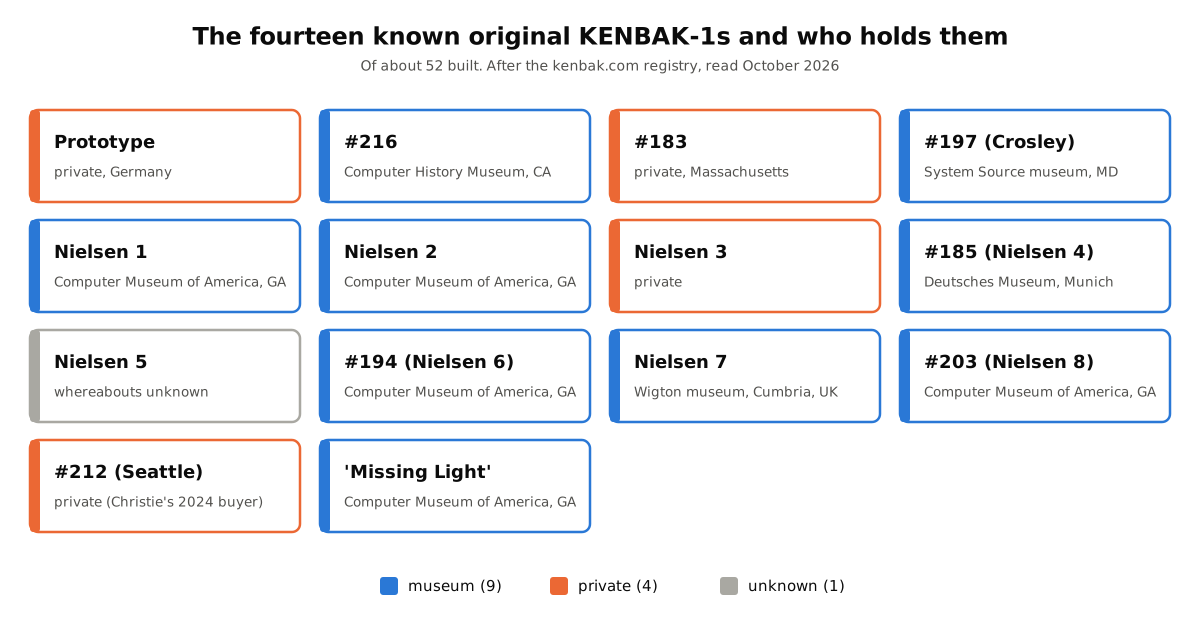
Table 2 — The Survivors
| Name | Serial / note | Where now (registry, Oct 2026) | Path |
|---|---|---|---|
| Prototype (“John 1”) | earliest board, red ENTER button | Achim Baqué, Germany (private) | Blankenbaker → Bonhams 2015 → Jeremy Norman & Co. → Baqué |
| ”John 2” | 216 (Rev A board) | Computer History Museum, Mountain View | Blankenbaker → The Computer Museum 1986 → CHM |
| ”John 3” | 183 | private collection, Massachusetts | Blankenbaker’s non-working machine → eBay 2010 (Italy) → eBay 2016 |
| Crosley | 197 | Computer Museum @ System Source, Maryland | bought new 1971 → eBay 2004 → Erik Klein → museum 2024 |
| Nielsen 1 | — | Computer Museum of America, Roswell, Georgia | CTI → Nielsen → Nova Scotia → eBay 2019 → CMoA 2022 |
| Nielsen 2 | — | Computer Museum of America | CTI → Nielsen → Eisengruber → Lonnie Mimms |
| Nielsen 3 | grey case | private | Nielsen → Eisengruber → private buyer 2009 |
| Nielsen 4 | 185 | Deutsches Museum, Munich | Nielsen → Eisengruber → Vinal Applebee → Breker 2015 |
| Nielsen 5 | — | unknown | sold by Eisengruber c. 2008 |
| Nielsen 6 | 194 | Computer Museum of America | Nielsen → Eisengruber → Mimms |
| Nielsen 7 | ”big holes” | Wigton museum, Cumbria, UK | Nielsen → Eisengruber → Timeline Computer Archive c. 2008 |
| Nielsen 8 | 203 | Computer Museum of America | Nielsen → private sale to Mimms 2011 |
| Seattle | 212 | private | eBay 2005 → Living Computers Museum (Paul Allen) → Christie’s 2024 |
| ”Missing Light” | — | Computer Museum of America | provenance unknown; first photographed 2014 |
5.5.1 The Nielsen hoard
Half the survivors share one history. When CTI Educational Products was considering buying Kenbak in late 1973, it asked Robert R. Nielsen, who ran a school in Charleston, South Carolina, training former servicemen in electronics and computers, for his opinion. Nielsen liked the machine and bought several for his school, the Nielsen Electronics Institute; when CTI failed, he bought its KENBAK-related stock at auction and later claimed to have bought the rights as well. His eight machines stayed in use into the mid-1990s. They overheated, so the school drilled holes in their tops; their push-buttons broke off if pressed too hard and had to be replaced. When the school closed, Nielsen boxed them in his garage (kenbak.com provenance).
In the early 2000s he offered them to museums, which would accept a donation but would not pay. In April 2003 Herbert Eisengruber of the small Nova Scotia Computer Museum in Annapolis Royal traded him a used laptop for one; in September 2003 Eisengruber bought six more, with documentation, for $15,000, while Nielsen kept the eighth until 2011. Over the following years Eisengruber sold most of his on, at around $10,000 each, to collectors and museums (kenbak.com provenance). Every Nielsen machine can be recognised by the holes in its top.
5.5.2 Where to see one
- Computer History Museum, Mountain View, California: serial 216, on permanent display in the Revolution exhibition, below an enlargement of the 1971 advertising photograph.
- Deutsches Museum, Munich: serial 185, bought at Auction Team Breker in 2015.
- Computer Museum of America, Roswell, Georgia: five machines from the collection of Lonnie Mimms, one on public display and the others in storage or used for temporary displays.
- Computer Museum @ System Source, Hunt Valley, Maryland: serial 197, given by the collector Erik Klein in 2024.
- Wigton, Cumbria, UK: Nielsen 7, held by the Timeline Computer Archive, mostly in storage with occasional pop-up displays.
Museum displays change; the registry notes which machines were on view when it was last updated. Several museums that cannot get an original show a full-size replica instead (Volume 8).
5.6 The Prices
Originals almost never came up for sale before 2003. Since then, every sale has been documented by the registry, and some by the auction houses themselves.
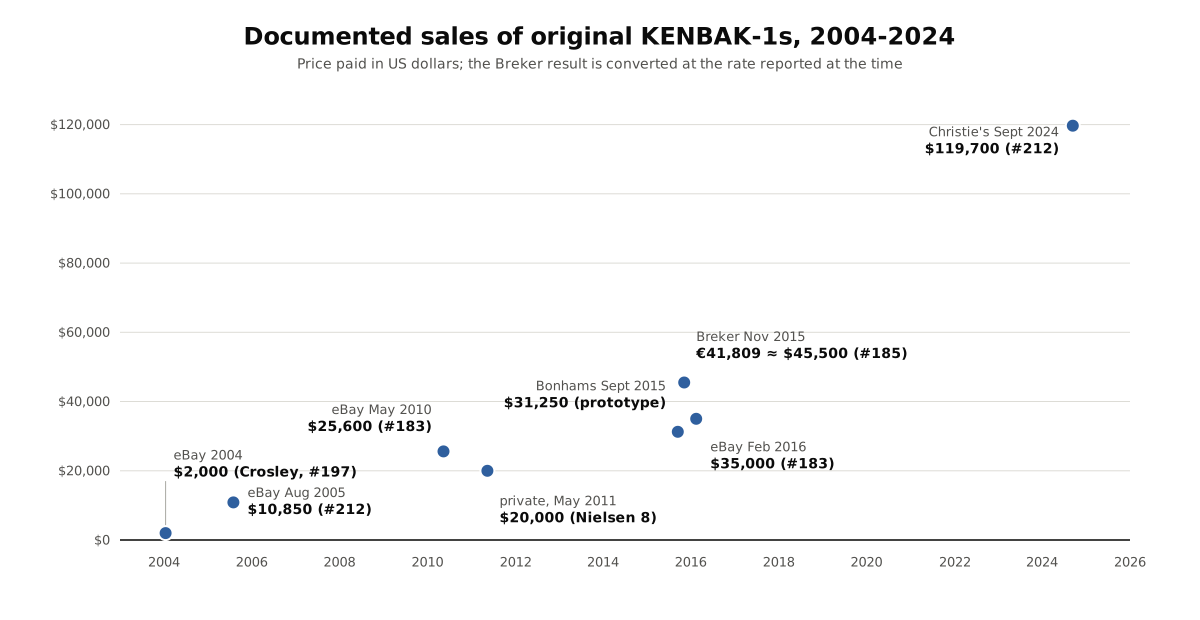
Table 3 — The Prices
| Date | Machine | Venue | Price | Source |
|---|---|---|---|---|
| 2004 | Crosley, 197 | eBay | $2,000 | registry |
| 1 Aug 2005 | 212 | eBay | $10,850 | registry |
| May 2010 | 183 | eBay (sold by Blankenbaker’s daughter) | $25,600 | registry |
| May 2011 | Nielsen 8 | private sale after a failed eBay auction | $20,000, with other memorabilia | registry |
| 15 Sept 2015 | prototype | Bonhams, sale 22964 lot 76 | $31,250 | Bonhams; registry |
| 2015–16 | prototype | Jeremy Norman & Co. catalogue 54, then private | listed $65,000; sold $41,250 | registry |
| 7 Nov 2015 | 185 | Auction Team Breker, Cologne | €41,808.78 (about $45,500) | Antique Trader, 20 Dec 2015; registry |
| Feb 2016 | 183 | eBay | $35,000 | registry |
| Sept 2024 | 212 | Christie’s, Firsts: The History of Computing from the Paul G. Allen Collection, lot 121 | $119,700 | Christie’s results release, quoted by File 770, 16 Sept 2024 |
Three sales mark the turns. The Bonhams sale of the prototype in September 2015 was the first time the creator’s own machine came to auction; the lot came with its binder of manuals, coding sheets and a copy of the Laboratory Exercises, and was described as operational, after Blankenbaker had replaced a failed shift-register chip (Bonhams, lot 76). Two months later the Breker sale of serial 185 to “a European national museum”, which proved to be the Deutsches Museum, set a new mark of about $45,500. And in September 2024 the dispersal of Paul G. Allen’s Living Computers Museum at Christie’s brought serial 212, with its cable, to the market: Christie’s catalogued it as “one of the world’s first personal computers” and noted that of 44 sold, about 14 survive. It made $119,700, which Christie’s reported as the record for a KENBAK (Christie’s lot 121; File 770). The registry gives a higher figure, “over $166,000”, for the same sale; the difference is presumably fees and taxes on top of the hammer price and premium, and has not been reconciled here.
In twenty years the price of a KENBAK-1 rose about sixty times, from $2,000 to $119,700. The 1986 verdict is the reason. The Apple-1 has a similar story of a small production run made precious by a claim to be first; at the same Christie’s sale an Apple-1 made $352,800.
5.7 Recognising an Original
The value of originals makes provenance matter, and the KENBAK-1 is not hard to copy in appearance. A few features help.
- Serial number. Production machines carry a nameplate on the rear panel with a serial number between 167 and 216, and usually the same number stamped on the circuit board. The two Revision A machines and the prototype differ.
- Board revision. The prototype’s board is marked “Kenbak 10000 Rev” with no letter; two early machines have Rev A boards; production machines have Rev B.
- Nielsen machines have holes drilled in the top of the case. Some CTI-era machines had a foil “CTI” sticker over the name, or a CTI panel without the card slot; the stickers seen in early photographs have since been removed.
- Reproductions. Grant Stockly’s 2007 “Series 2” reproduction is labelled “KENBAK-1 Series 2” on the front, and its board carries “Homebrew 2007” and the kenbakkit.com address, added, he wrote, “to help with counterfeit units” (kenbakkit.com). Later replicas use LEDs instead of incandescent lamps, switching power supplies and modern keyswitches (Volume 8).
5.8 The Verdict on the Verdict
Forty years on, the 1986 decision looks sound. The judges set out a definition, applied it, and named the earliest machine that met it, while giving separate prizes to the first microprocessor machine and to the inventions that led to the keyboard-and-screen computer. No earlier machine meeting the same tests has come to light since. The KENBAK-1 did not start the personal-computer industry — the Altair did that, four years later, with a microprocessor and a kit — and it had no descendants. What it established is that the idea came first: in 1971 a single engineer designed, built, documented and advertised a computer for individuals, at an individual’s price, and about forty-four people and schools bought one.
Next — Volume 6: The Instruction Set — Registers, Addressing and the Front Panel. Three registers that live in memory, a program counter at address 003, five addressing modes, jumps on any of five conditions, instructions that set or test a single bit anywhere in memory, and the fifteen buttons that load it all.
Comments (0)