KENBAK-1 · Volume 1
KENBAK-1 — Volume 1 — The First Personal Computer
What a blue box of lights and switches from a Los Angeles garage actually was, why a museum jury in Boston called it the first personal computer, and how a machine that sold about forty copies came to be rebuilt by hobbyists half a century later — the orientation volume for the ten-part series
1.1 About This Volume
This is the entry point to a ten-volume deep dive on the KENBAK-1, a small stored-program computer designed by John V. Blankenbaker in 1970, first shown in May 1971 and offered for sale at $750 in the September 1971 Scientific American. It had no microprocessor, because there were none on the market yet. Its processor was built from about 130 ordinary TTL logic chips on one printed circuit board; its memory was 256 bytes held in two MOS shift registers; its only input was a row of push-buttons and its only output a row of lamps. Kenbak Corporation sold about forty-four of them, mostly to schools, before it closed in 1973. In 1986 a jury at The Computer Museum in Boston, with Steve Wozniak among the judges, awarded the KENBAK-1 first prize as the earliest personal computer it knew of. The Computer History Museum in California, which inherited the Boston collection, still describes it that way.
This volume explains in plain terms what the machine was and what it could do, why the “first personal computer” verdict holds up and where it is argued, and how a machine that almost nobody bought became one of the most sought-after objects in computer collecting. It then tours the whole story in miniature, volume by volume. Readers who want the man can go to Volume 2; the hardware, to Volume 3; the business, to Volume 4; the museum verdict and the surviving machines, to Volume 5. Volumes 6 and 7 teach the instruction set and how to program it, with every example run on an emulator written for this series. The series ends on a workbench: Volume 8 surveys the replica kits on sale in October 2026, Volume 9 builds one, and Volume 10 is a book of programs to run on it.
The KENBAK-1 sits beside two other early machines covered elsewhere on this site. The PDP-8/I and the Altair 8800 each have their own deep dive on the Vintage Digital Computers site (digital.fubsypoly.com); this series refers to them for comparison and does not repeat them.
1.1.1 The Ten-Volume Series
Table 1 — The Ten-Volume Series
| Vol | Title | Focus |
|---|---|---|
| 1 | KENBAK-1 — The First Personal Computer (this volume) | Orientation: what it was, why it matters, the whole story in miniature |
| 2 | John Blankenbaker — A Computer for Everyone | The designer, from an Oklahoma farm to SEAC, Hughes, Quotron and a garage in Los Angeles |
| 3 | A Computer Without a Microprocessor — TTL and Shift-Register Memory | How 130 logic chips and two shift registers make a serial computer |
| 4 | Selling a Computer in 1971 — Fifty Machines and a Scientific American Advert | Kenbak Corporation, its customers, its prices and its end |
| 5 | The Verdict — The Computer Museum Contest and the Surviving Machines | The 1986 contest, the rival claims, the fourteen known survivors and their prices |
| 6 | The Instruction Set — Registers, Addressing and the Front Panel | Registers in memory, five addressing modes, the console |
| 7 | Programming the KENBAK-1 — From Counting Lights to Subroutines | Machine-code programming worked on the emulator |
| 8 | ⭐ The Replica Kits — Re-creating KENBAK-1 Fifty Years On | Every reproduction and emulation kit, as on sale in October 2026 |
| 9 | ⭐ Building the Kit | The build procedure, from bare board to first program |
| 10 | ⭐ Programs to Run — Games, Patterns and Puzzles | A library of programs in octal, each run on the emulator |
1.2 A Computer on the Kitchen Table
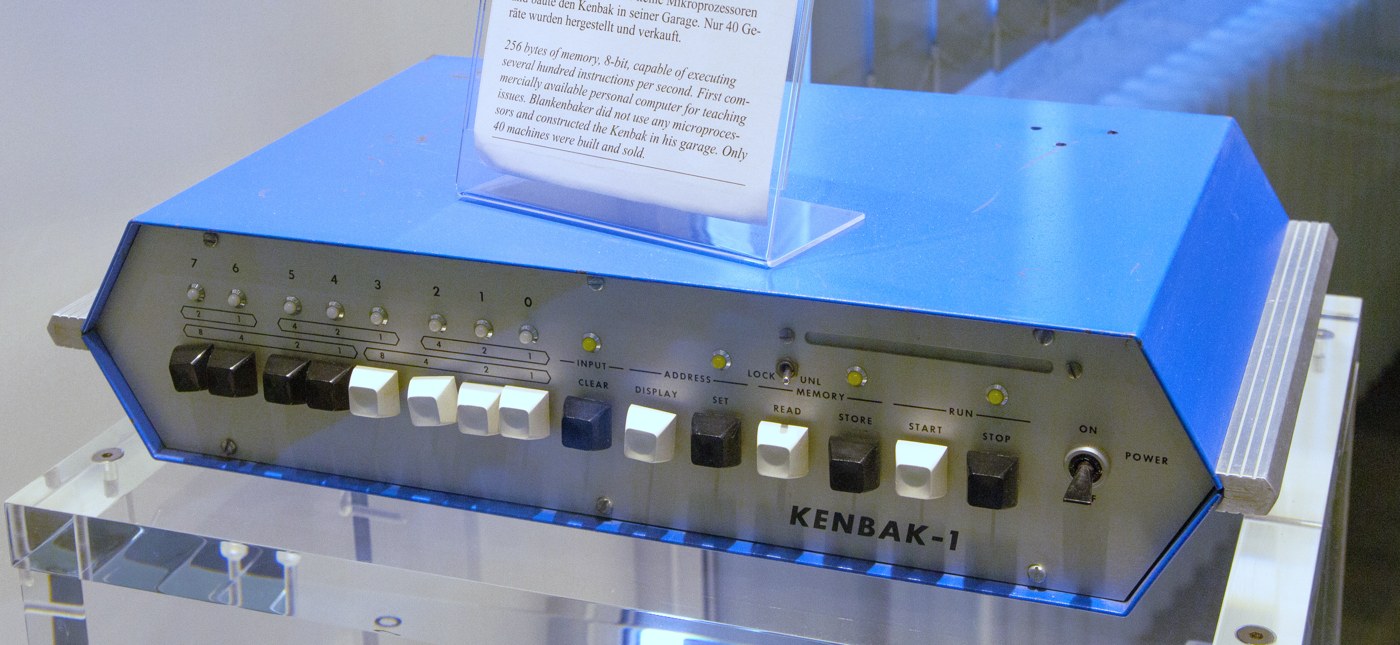
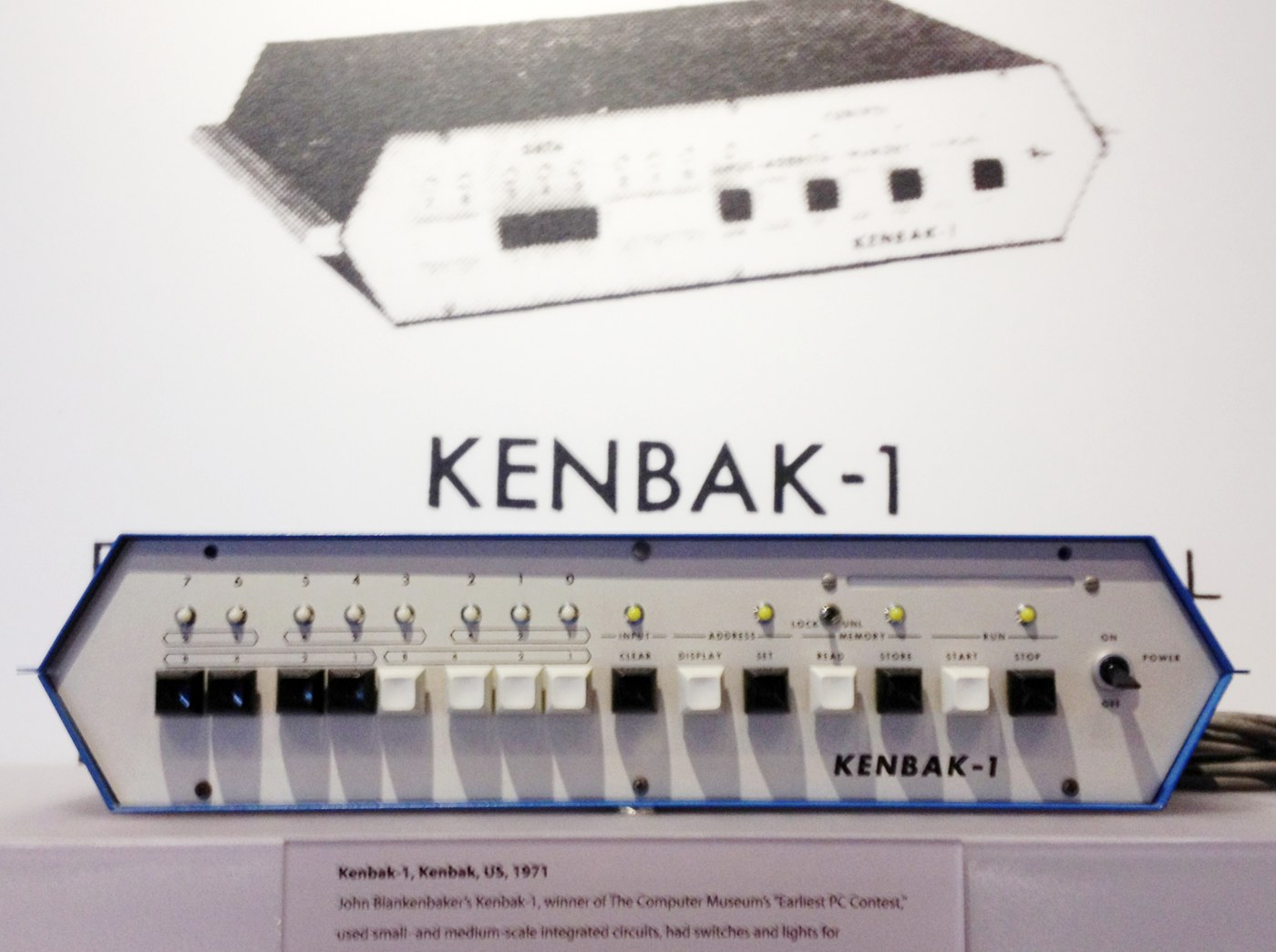
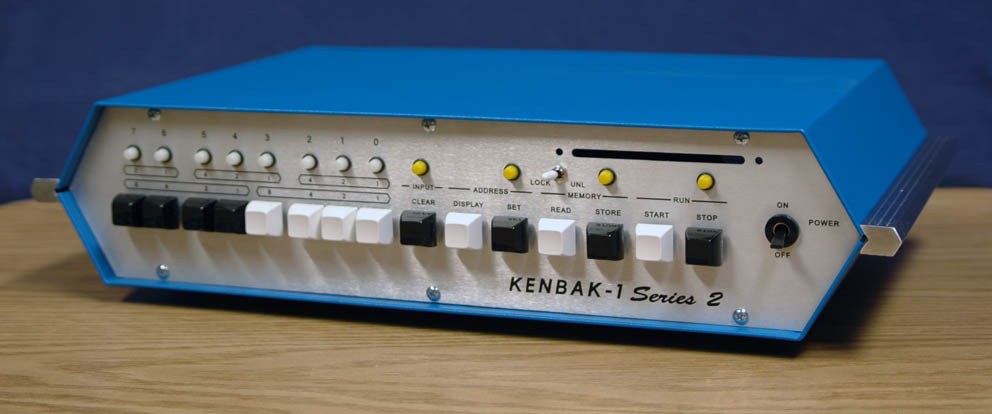
Picture a sheet-steel case painted blue, about 19 inches wide, 11 inches deep and 4¼ inches high, with brushed aluminium handles on the ends and a pale grey front panel set into a slanted face. Along the panel run fifteen square push-buttons and twelve small incandescent lamps. Eight of the buttons, on the left, are numbered 7 to 0, with a lamp above each. To their right are buttons labelled CLEAR, DISPLAY and SET (under ADDRESS), READ and STORE (under MEMORY), and START and STOP (under RUN), each group with its own lamp. At the far right is a toggle for power, and between the MEMORY lamps a small lever marked LOCK and UNL. Above the control lamps is a covered slot. On the rear panel are a fuse holder, a three-pin power cord, a fan grille and a nameplate reading “KENBAK CORPORATION, Los Angeles, Calif. USA, Kenbak-1 Digital Computer”, with a serial number and a rating of 115 volts, 60 cycles, 65 watts.
That is the whole machine. There is no keyboard, no screen, no printer, no tape. To enter a program, the user sets eight bits on the data buttons, watches them appear on the lamps above, and presses STORE; the machine writes the byte into memory and steps to the next address. To read a result, the user either watches the lamps while the program runs, or stops it and steps through memory with READ. Numbers on the panel are read and written in octal: the eight data lamps are grouped 2-3-3 under small printed brackets marked 2-1, 4-2-1 and 4-2-1, so that a byte such as 10 110 011 is read at a glance as 263.
The machine inside is a genuine stored-program, general-purpose digital computer. Its 1971 Programming Reference Manual opens by saying so in one sentence: the KENBAK-1 “is a serial stored program general purpose digital computer with a memory of 256 eight bit bytes. Internally the machine is binary two’s complement” (Programming Reference Manual, p. PR-1, dated 4/1/71). It has three working registers, A, B and X; a program counter P; overflow and carry flags; five addressing modes; a generous set of conditional jumps; instructions to set, clear and test any single bit of memory; shifts and rotates; and a skip. Its program and data share the same 256 bytes, and it can modify its own code. In the vocabulary of its day it was a very small, very slow minicomputer; in today’s vocabulary it is a toy-sized but complete CPU.
1.2.1 Registers that live in memory
One design choice makes the KENBAK-1 unusual and is worth knowing before anything else. Its registers are not separate circuits. They are memory locations. The A register is byte 000, B is 001, X is 002 and the program counter P is 003. The byte at octal 200 is the output register: whatever a running program stores there appears on the eight data lamps. Bytes 201, 202 and 203 hold the overflow and carry bits for A, B and X. The byte at 377, the last in memory, is the input register, and it always holds whatever the data buttons are set to (PRM, pp. PR-1–PR-2).
Blankenbaker chose this for teaching. Putting the registers at addresses meant that every instruction which works on memory also works on the registers, which “even permitted a few more unusual instructions, not that they were useful but they were illustrative”, as he told an interviewer in 2007. His example was subtracting A from itself: since A is register 0, “A minus A, which was register 0 minus register 0, would clear the A register”, so the machine needed no separate clear instruction (CHM oral history, 2007). A student who has understood that trick has understood something real about how computers work. Volume 6 lays out the whole instruction set and memory map; Volume 7 programs it.
1.2.2 Slow on purpose
The KENBAK-1 runs on a 1 MHz clock but executes only a few hundred instructions per second, because it is a serial machine: it moves and adds one bit at a time, and its memory is a pair of 1,024-bit MOS shift registers whose contents circulate past the read point in a fixed loop. To fetch a byte, the logic waits until that byte comes round. Blankenbaker made it that way deliberately. He wanted the cheapest machine that would still teach real programming, and he saw no merit in speed: “Even if it counted slowly, that was in essence good if the students could actually see the counting” (oral history). A program that counts in binary on the lamps is visibly counting, not blurring. Volume 3 explains the serial design and the shift-register memory in full.
1.3 Why “the First Personal Computer”?
The phrase is the KENBAK-1’s claim to fame, and it is worth being precise about what it means and who said it.
In the spring of 1985, the chairman of the ComputerLand retail chain, William Millard, toured The Computer Museum in Boston with the museum’s founding president, Gwen Bell, and noticed that its collection of personal computers had gaps. Bell, by the museum’s own account “half in jest”, suggested a contest to find the earliest ones. From October 1985 to March 1986, advertisements ran in the trade magazines of CW Communications and in Byte. Offers came in from 320 people in 13 countries; 137 machines were accepted for judging. The judges were Steve Wozniak, designer of the Apple II; David Bunnell, an early employee of MITS and by then publisher of PC World; and Oliver Strimpel, the museum’s curator (The Computer Museum Report, Fall 1986).
The museum’s report of the result is short:
We awarded the first prize to the 1971 Kenbak-1, submitted by its creator John Blankenbaker. This small machine contained an eight-bit processor built up from medium-scale and small-scale integrated circuits, and qualified as the earliest personal computer known to the judges.
— Oliver Strimpel, “The Early Model Personal Computer Contest”, The Computer Museum Report, Fall 1986
Three things about that verdict matter. First, it is a verdict on a definition. The judges excluded cardboard and plastic teaching “computers” and programmable calculators, and they were looking for a complete, commercially sold machine that one person could own and program. Second, it is a verdict on evidence: “the earliest known to the judges”. Third, it was not the only prize. The French Micral of 1973 won a prize as the first commercially available computer built around a microprocessor, and other prizes went to Don Lancaster’s TV Typewriter, Lee Felsenstein’s video display module and an Altair 8800. The KENBAK-1’s title is “first personal computer”, not “first microcomputer”. Volume 5 tells the contest in detail and sets the KENBAK-1 beside its rivals: the Datapoint 2200, the Olivetti Programma 101, the Micral and the Altair.
The verdict has held. The Computer History Museum’s own exhibition, under the heading “What Was The First PC?”, repeats it, and adds that the first personal computer using a microprocessor was the 1973 Micral (CHM, Revolution).
1.4 Who Built It, and Why
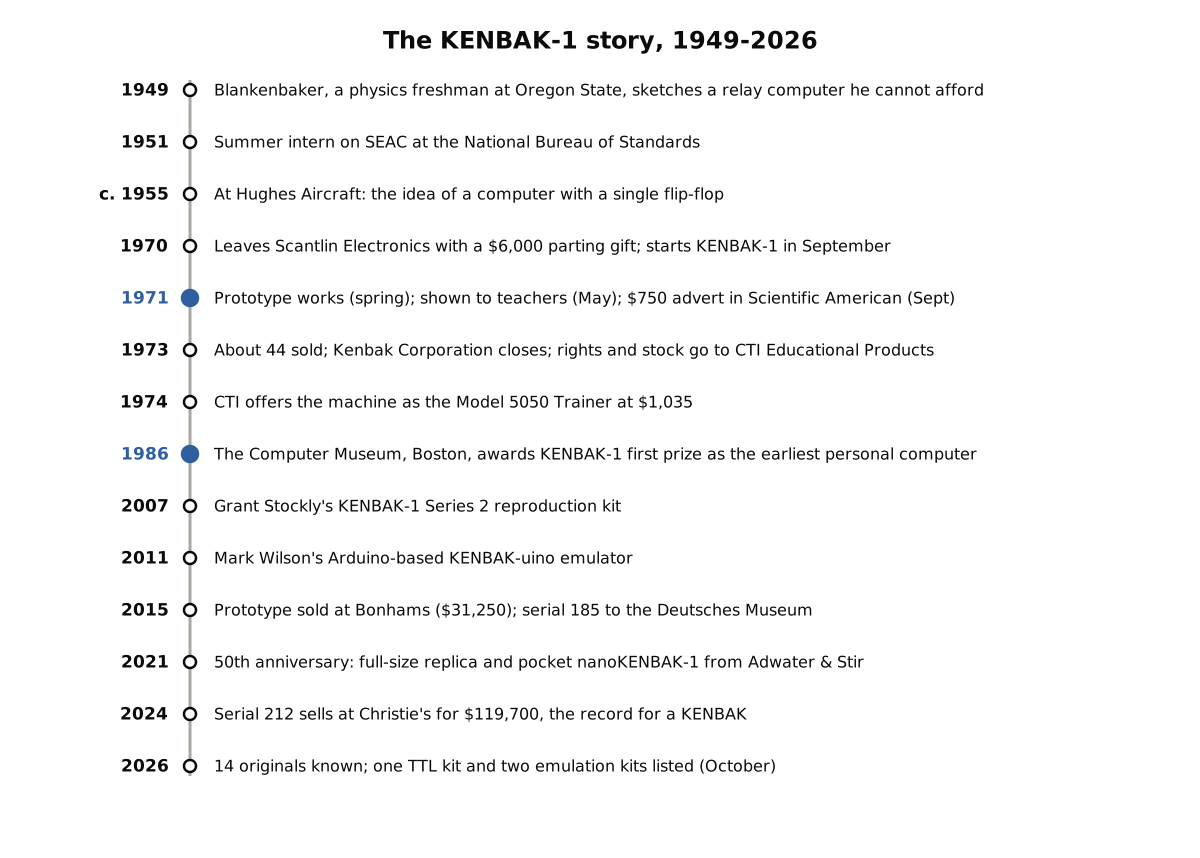
John V. Blankenbaker was born on an Oklahoma farm on 24 December 1929. He served as a Navy electronics technician after the war, studied physics at Oregon State, and in his freshman year, around 1949, read a magazine article about electronic computers and began working out on scratch paper how to build one. He could not afford the relays. In the summer of 1951 he was one of four student interns assigned to SEAC, the National Bureau of Standards computer, and from 1952 he designed arithmetic units at Hughes Aircraft. There, told that each extra flip-flop added about $500 to a computer’s price, he began asking how simple a computer could be made, and by about 1955 he had worked out a design with only one flip-flop. From 1962 to 1970 he worked on the Quotron stock-quotation system at Scantlin Electronics in Los Angeles, rising to vice president of engineering (oral history; kenbak.com biography).
In 1970 he resigned. The board gave him $6,000 as a parting gift. “So I was unemployed, $6,000 in my pocket, and a little bit of other resources, and here I had been saying for 15 years, computers can be built much more cheaply. Maybe this is the time to think about it” (oral history). He started in September 1970 at a desk in a bedroom, had a paper design within about a month, and had a working prototype in the spring of 1971. Volume 2 is his biography.
He named the machine by cutting six letters out of his own surname: blanKENBAKer. The word began and ended with a K, like Kodak, and Blankenbaker liked the parallel: George Eastman had wanted to make a camera for everyone, not just for professionals. “I said, ‘That’s exactly what I want to do’” (oral history).
1.5 What Was Inside
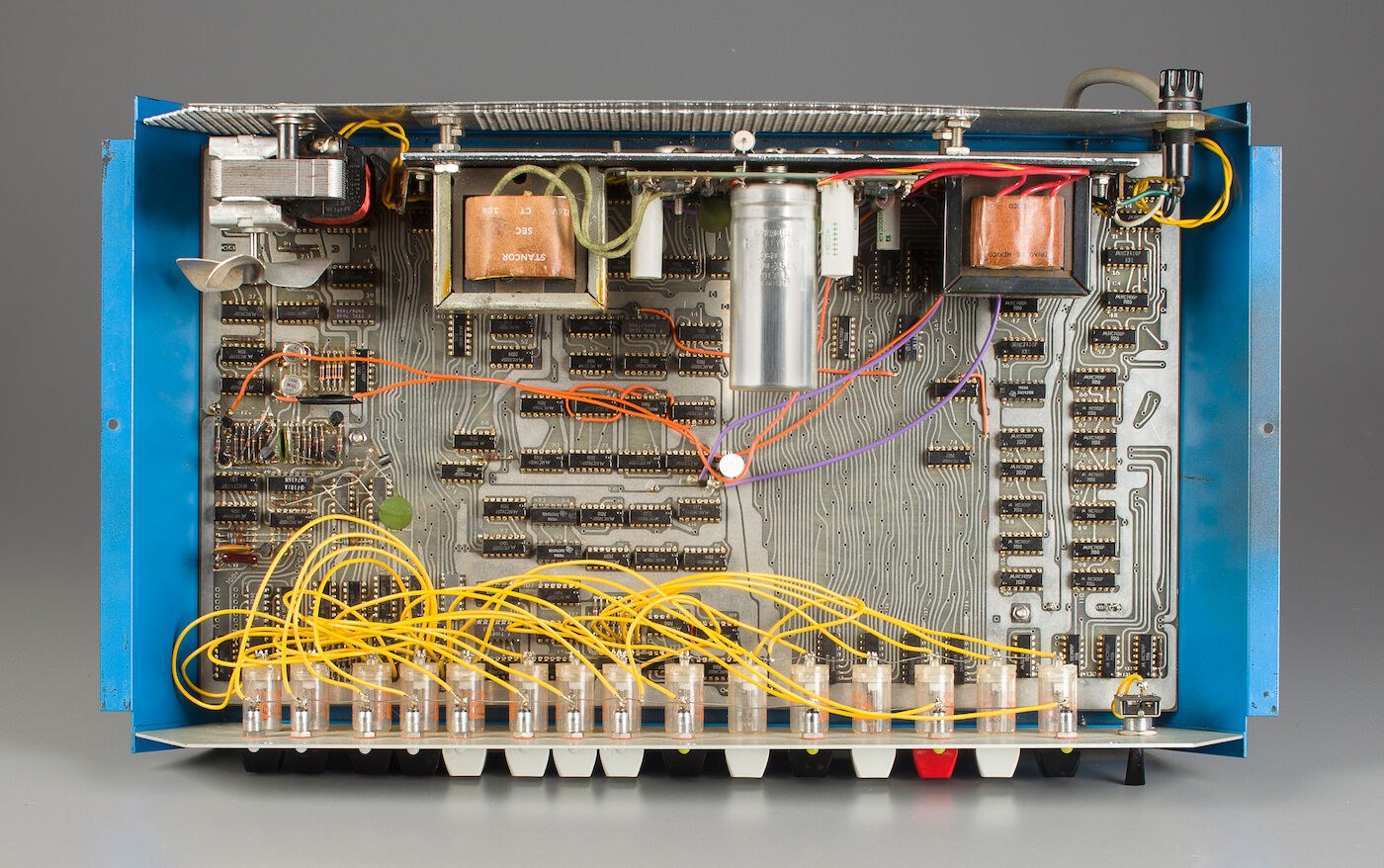
The production KENBAK-1 is one double-sided printed circuit board carrying about 130 small- and medium-scale integrated circuits from the 7400 TTL family, two MOS shift-register chips for memory, a linear power supply delivering +5 volts and −12 volts, a small fan and the front-panel switches and lamps wired to the board. Blankenbaker designed it as a set of fewer than 32 machine states — fetch the next instruction, fetch the operand, execute, and so on — and wrote the logic as equations for moving from state to state, not as schematics; the schematics came afterwards. The arithmetic unit is one bit wide. The only flip-flop in the data path, he said, was the carry (oral history).
He designed the board himself, conservatively: two layers, 50-mil traces, no traces between the 0.1-inch pin rows, about one chip per square inch. His older brother laid the tape on the mylar artwork. The first board, made in March 1971, cost “$30 or $40”. When he estimated the heat from the chips at about 60 watts he put a 60-watt light bulb in the empty cabinet overnight; it got hot, so the machine got a fan. When the first board was powered up, the bit counter that generated the clock pulses locked up in a state he had not planned for, and a single resistor-capacitor network fixed it (oral history).
The cabinet was not custom. Blankenbaker’s rule was to pay for no special tooling, so he bought several stock enclosures and chose the Bud Industries “Grand Prix” from a parts catalogue; its size fixed the size of the board (CHM, “In His Own Words”). That off-the-shelf box, with its angled ends and aluminium handles, became the KENBAK-1’s face, and every full-size replica since has had to reproduce it.
Volume 3 takes the hardware apart chip by chip.
1.6 Fifty Machines and an Advert
Blankenbaker first showed the prototype in May 1971 to a convention of high-school mathematics teachers in Anaheim. With a working machine in hand he incorporated, raised about $20,000 from five former colleagues, and in the summer of 1971 ordered parts for fifty computers at about $250 a set. The parts arrived in September 1971, the same month the KENBAK-1 was advertised in Scientific American at $750 (Bonhams lot essay, 2015; oral history).
The advert promised a machine that “even private individuals and small schools can afford”, with “easy-to-understand manuals” that “assume the reader is approaching a computer for the first time”. The manuals were a real part of the product: a Laboratory Exercises book of about 150 pages that began from nothing, a Programming Reference Manual for those who already knew computers, programming worksheets, and an Installation & Maintenance manual. A Theory of Operation manual with the full schematics existed too, and by March 1972 it was offered to hobbyists on its own for $10.
Sales were slow. Schools liked the machine but took years to find the money. Blankenbaker shipped computers on approval for a trial period, paid for advertising that mostly did not work, hired a sales manager who “made away with $3,000 and returned nothing”, rented a small factory for four months and then moved back into the garage. In February 1973 he raised the price to $850 and admitted that only about half a dozen private individuals had bought one. By mid-1973 he had sold about forty-four of the fifty, and he sold the design, the remaining stock and the rights to CTI Educational Products of South Carolina, which offered the machine as the CTI Model 5050 Trainer at $1,035 (kenbak.com biography). Kenbak Corporation simply stopped trading. Volume 4 tells the business story.
1.7 Why It Failed, and Why That Matters
The KENBAK-1 failed commercially for reasons its designer later named himself. He aimed it at schools, whose budgets moved too slowly for a company with $20,000 of capital, and he never went after the individual hobbyist who would have bought a computer for fun. “One thing is that we didn’t choose the right market,” he said in 2007. “We should have emphasized the private individual and we should have hit these popular magazines from the public” (oral history).
He also refused to sell it as a kit: “Some people thought maybe I should have made a kit, I never agreed with that, it was too difficult.” Three and a half years later, in January 1975, Popular Electronics put the MITS Altair 8800 on its cover as a kit for $397, and the hobbyist market he had passed over arrived all at once.
The timing was the other problem. The KENBAK-1 was designed in the last months before the single-chip microprocessor changed the economics. Intel announced its 4-bit 4004 in November 1971 and the 8-bit 8008 in 1972; the Micral of 1973 and the Altair of 1975 were built around Intel chips. A machine with 130 logic chips could not follow that cost curve. In that sense the KENBAK-1 is the last of something as well as the first: the last small computer whose processor was designed gate by gate by one person on a kitchen-table budget.
And yet the verdict matters because of what the KENBAK-1 proved. In 1971 a computer cost thousands of dollars; Digital Equipment Corporation’s PDP-8, the classic small machine of the 1960s, had been introduced at $18,500. Blankenbaker showed that a complete stored-program computer, with real manuals and a real instruction set, could be sold to an individual for $750. The idea of the personal computer was in the market four years before the hobbyist boom.
1.8 The Afterlife: Museums, Auctions and Replicas
Blankenbaker kept three machines in his attic: the prototype, one early production board, and one that did not work. In 1986 he sent the working one to Boston for the contest, and when he unpacked it there, it still ran. It went on display; when The Computer Museum closed, it passed to the new Computer History Museum in Mountain View, where it is on permanent exhibition today (CHM, “In His Own Words”; kenbak.com registry).
Of the roughly fifty-two machines built, counting the prototype and the few finished by CTI, fourteen are known to survive. Nine are in museums, including the Computer History Museum, the Deutsches Museum in Munich and the Computer Museum of America near Atlanta, which holds five. The rest are in private hands, and one is unaccounted for (kenbak.com registry). Their prices tell the story of the verdict’s effect. One changed hands on eBay in 2004 for $2,000. The prototype sold at Bonhams in 2015 for $31,250. Serial 185 went to the Deutsches Museum the same year for about $45,500. In September 2024 serial 212, from the collection of the late Paul G. Allen, sold at Christie’s for $119,700, the record for a KENBAK. Volume 5 lists every machine and every documented sale.
Because originals are so rare, the KENBAK-1 has been re-created many times. There are two families of replica. Reproductions rebuild the original circuit: the same TTL chips, the same Intel 1404A shift registers and a copy of the original board. Grant Stockly’s “KENBAK-1 Series 2” kit of 2007, made with Blankenbaker’s permission from a scan of an original board, was the first; in October 2026 Artem Kalinchuk sells a reproduction board, front panel and parts kit. Emulations run the KENBAK-1 instruction set on a microcontroller behind a look-alike front panel: Mark Wilson’s open-source KENBAK-uino of 2011, and the half-size µKENBAK-1 and pocket-size nanoKENBAK-1 kits built on his code by Adwater & Stir. Volume 8 surveys them all, with prices and stock as read from the vendors’ pages on 27 October 2026, and says which is which.
1.9 How to Read This Series
The volumes are written to be read in order, but each stands alone. Some conventions apply throughout.
Octal. The KENBAK-1 was programmed in octal, base eight, and its manuals give every address and instruction that way. This series does the same, and marks octal numbers where there could be doubt: “address 200 (octal)” is decimal 128. A byte is three octal digits, the first of which is never more than 3.
Names. The manufacturer’s spelling was “KENBAK-1” on the front panel and “Kenbak-1” in much of its own literature. This series uses KENBAK-1 for the machine and Kenbak Corporation for the company.
Numbers sold. Sources give “about forty”, “forty some odd” (Blankenbaker in 1986), “44” (Christie’s and his 2007 interview) and “fewer than 50”. The run of parts was for fifty, serial-numbered 167 to 216. This series says “about forty-four sold”, “fifty in the run” and “about fifty-two built” when counting the prototype and the CTI machines, and notes the source where the number matters.
Dates. The contest is sometimes dated 1985 (when it was announced), 1986 (when it was judged and the prizes given) or 1987 (in some later accounts). The museum’s own report is dated Fall 1986. This series uses 1986.
Programs. Every program in Volumes 7 and 10 is given in octal exactly as it would be keyed in on the front panel, and every one has been run on the emulator written for this series, kenbak_sim.py, with its output shown. No example is computed by hand.
Kits. Prices, contents and stock in Volume 8 are as shown on the vendors’ own pages on the date stated. They will change.
1.10 The One-Paragraph Version
The KENBAK-1 is a small stored-program computer designed by John Blankenbaker in a Los Angeles bedroom and garage in 1970–71, after fifteen years of arguing that computers could be built far more cheaply than anyone was building them. Its processor is about 130 TTL logic chips on a single board; its memory is 256 bytes in two MOS shift registers; its input is eight data buttons and seven control buttons, and its output is twelve lamps. It executes a few hundred instructions a second, deliberately slowly, from an instruction set with three registers that live at memory addresses 000 to 002, five addressing modes and bit-level operations designed to teach. Advertised at $750 in Scientific American in September 1971 and aimed at schools, it sold about forty-four copies before Kenbak Corporation closed in 1973 and passed the design to CTI Educational Products. In 1986 The Computer Museum in Boston, with Steve Wozniak on the jury, judged it the earliest personal computer known; fourteen originals survive, and one sold for $119,700 in 2024. Hobbyists have rebuilt it in real TTL and emulated it on microcontrollers, and the last three volumes of this series build one and program it. The remaining nine volumes are the long version.
Next — Volume 2: John Blankenbaker — A Computer for Everyone. A farm boy without electricity who taught himself binary from a magazine article; a summer intern allowed to run his own program on SEAC only during thunderstorms; an engineer at Hughes told that every flip-flop cost $500, who answered by designing a computer with just one; eight years building stock-quotation systems; and a $6,000 parting cheque that paid for the first personal computer.
Comments (0)