Digi-Comp · Volume 8
Digi-Comp — Volume 8 — The Reproductions — Re-making Digi-Comps in the 21st Century
Every way to get a Digi-Comp in October 2026, checked on the makers' own pages: the Minds-On Toys Digi-Comp I in laminated binder's board, now in its twentieth production run; Evil Mad Scientist's plywood Digi-Comp II and why it can no longer be bought; free files for 3D-printed copies of both machines; a four-bit redesign; and the simulators that run the programs with no plastic at all
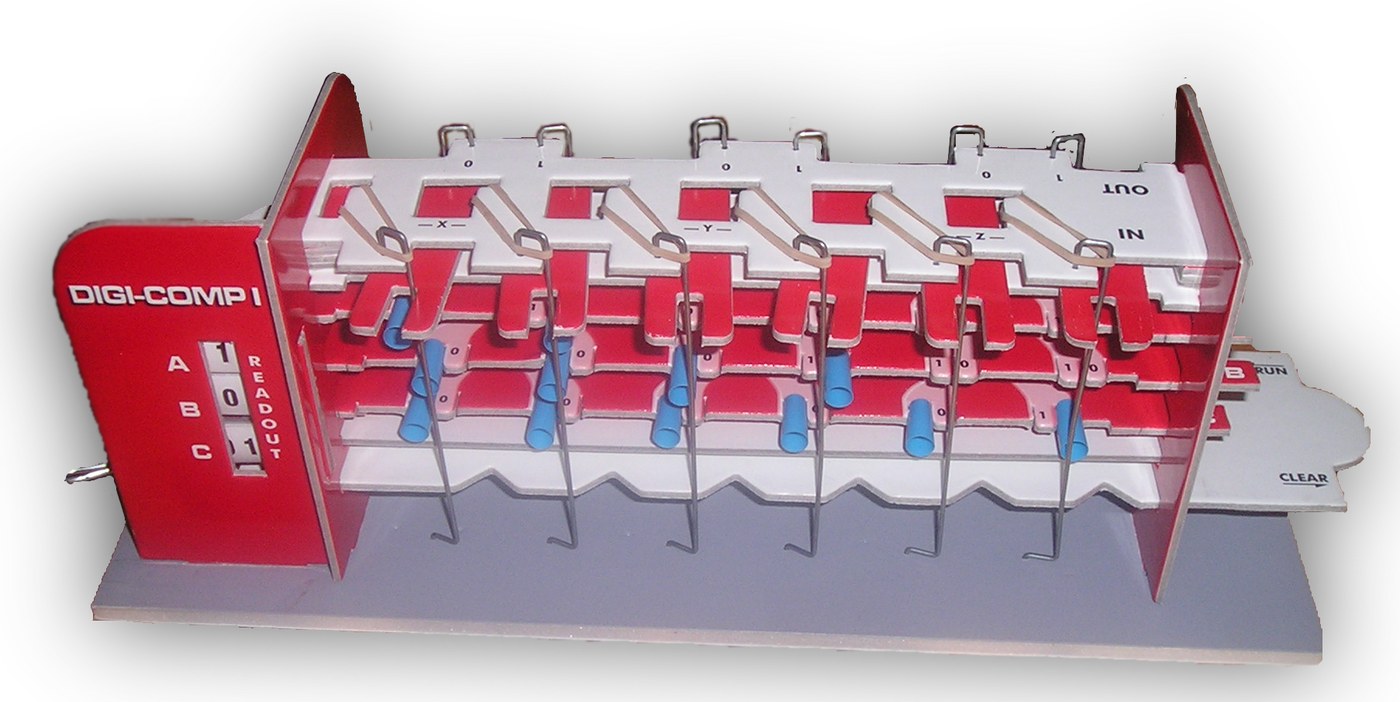
8.1 About This Volume
E.S.R. stopped making Digi-Comps in the 1970s, and original machines are now scarce. A complete Digi-Comp I with its rods unbent and its manual intact is a collector’s item; an original Digi-Comp II, with its warped Masonite and its small, breakable levers, is rarer still. Anyone who wants to operate one today almost certainly does so on a reproduction. This volume surveys them all — commercial kits, a ready-made wooden machine, free files for 3D printing, home-built variants and software — and records, for each, what it is made of, what it costs, who made it, and whether it can be obtained.
Every vendor page and file listing named here was read on 27 October 2026, and prices and stock levels are given as of that date. Things change: a kit in stock today may be sold out next month, and a discontinued one may return. The dates are given so that a later reader can tell how old the information is. Volumes 9 and 10 build one machine of each kind from the routes this volume identifies.
8.2 Where the Reproductions Came From
Every modern Digi-Comp traces back to one online community. In February 1999 a Yahoo group called FriendsOfDigiComp began collecting owners’ reminiscences, scans of manuals, flyers and assembly sheets, the two patents, part drawings and photographs. When Yahoo Groups closed, the files were moved to the Internet Archive in October 2019 (Friends of DigiComp archive) and the discussion to a list on groups.io ([email protected]). The archive includes Bill Duerig’s first-hand history of E.S.R., the Digi-Comp I assembly sheets, its basic and advanced manuals, a coding form, the Dr. Nim and Think-a-Dot manuals and the original patent. Almost every reproduction described below was made with its help, and its makers say so.
8.3 The Landscape in October 2026
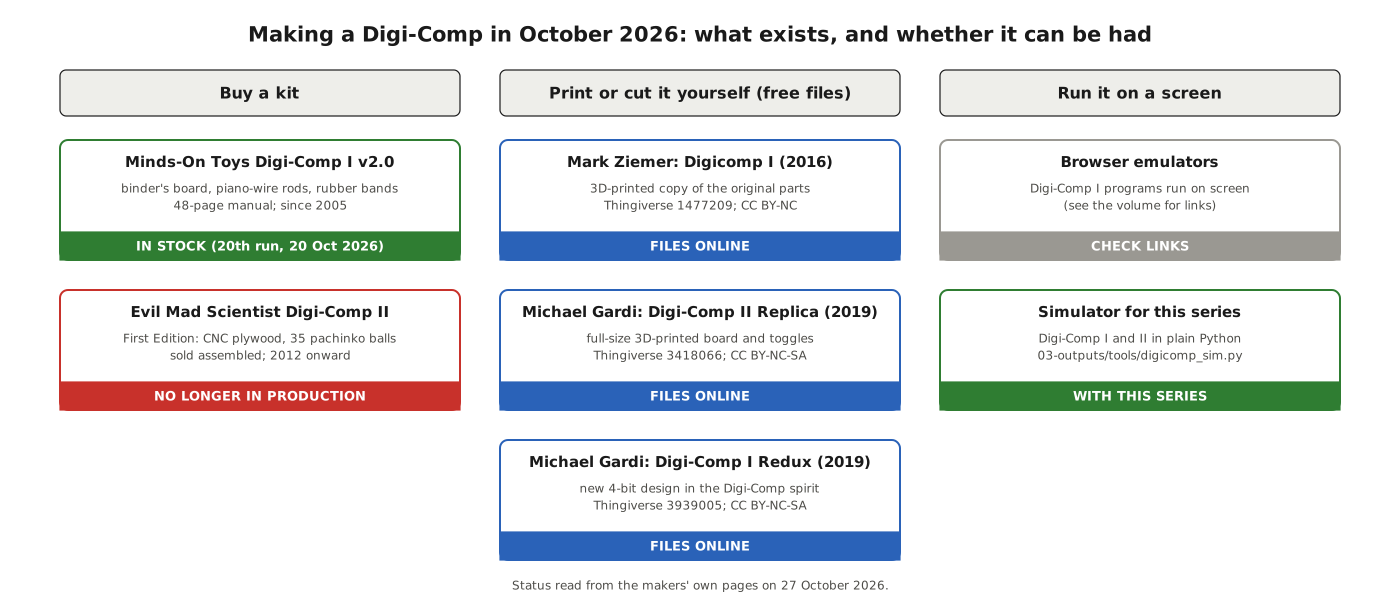
Table 1 — The Landscape in October 2026
| Reproduction | Maker | Since | Kind | Price (read 27 Oct 2026) | Status |
|---|---|---|---|---|---|
| Digi-Comp I v2.0 | Minds-On Toys (Tim Walker), New Jersey | 2005 | Kit: binder’s board, piano wire, rubber bands, straws | $55 plus about $15 US shipping on the product page; $67 flat, shipping included, on the order form | In stock: “20th production run, 53 in stock” (posted 20 Oct 2026) |
| Digi-Comp II: First Edition | Evil Mad Scientist Laboratories, California | 2012 | Assembled machine: CNC-routed plywood, 11 mm steel balls | was $279 (2013) | “No longer in production” (also the B-grade version) |
| Giant Digi-Comp II | Evil Mad Scientist | 2011 | One-off, billiard balls | not for sale | Exhibition pieces, one at MIT |
| Digicomp I (printable) | Mark Ziemer | 2016 | Free STL files, CC BY-NC 4.0 | free | Files online (Thingiverse 1477209) |
| Digicomp updated parts | Doug Burum | 2019 | Free STL files, CC BY 4.0 | free | Files online (Thingiverse 3886009) |
| Digi-Comp II Replica (printable) | Michael Gardi | 2019 | Free STL files and instructions, CC BY-NC-SA 4.0 | free | Files online (Thingiverse 3418066; Instructables) |
| Digi-Comp I Redux (new design) | Michael Gardi | 2019 | Free STL files, CC BY-NC-SA 4.0 | free | Files online (Thingiverse 3939005; Instructables) |
| Dr. Nim, Think-a-Dot (printable) | Michael Gardi | 2018 | Free STL files | free | Files online (Thingiverse 3192730, 3163286 and related) |
| Digi-Comp I and II simulator | this series | 2026 | Python | free | 03-outputs/tools/digicomp_sim.py |
8.4 Digi-Comp I v2.0 — Minds-On Toys
8.4.1 How it came about
The first modern Digi-Comp was the work of Tim Walker, a New Jersey researcher of educational toys who writes under the name Minds-On Toys. As he tells it on the kit’s introduction page, he had grown up in the 1960s without a Digi-Comp and came across it only while researching old toys, in a 1968 Childcraft catalogue from his parents’ attic, at $5.95. Originals were turning up on eBay “typically selling in the $150 range”. A listing mentioned the FriendsOfDigiComp group, and the group — “several hundred subscribers … mostly middle-aged men, it would seem”, sharing memories and “dreams of reacquiring (or maybe even remanufacturing) a certain favorite toy” — became, in his word, the turning point (Minds-On Toys, “Digi-Comp I v2.0 — Intro”). He described the project in MAKE magazine, volume 07, as “Digi-Comp Redux” (Make:, 21 August 2006).
Walker did not try to reproduce E.S.R.’s injection mouldings. He reproduced the machine in materials a small workshop could cut by hand, and in doing so returned, unknowingly or not, to the founders’ own first prototype — which Duerig said they cut overnight from “that stiff compressed paper stuff” and sprung with orthodontist’s rubber bands (Volume 2). The first run of 100 kits was offered in November 2005 to members of the FriendsOfDigiComp group; by mid-2012 more than a thousand had been sold, and the kit page now records more than 1,900 sold after that first run (Minds-On Toys, Digi-Comp I v2.0).
8.4.2 What is in the box
The kit page lists the materials:
- plates and frame of “sturdy 80 point binders board, laminated with laser-printed high-gloss Kromekote”, printed in the original red and white;
- logic rods of “custom-formed piano-wire” — since October 2013, precoated zinc music wire, stiffer than the galvanised wire used before;
- rubber bands for the springs (size 10, which the maker notes is uncommon, with a tip for making replacements);
- plastic tubes for the pegs and readout — drinking straws, which have had their own history: the Solo “Neon” straws the input-output system was engineered around disappeared from the market in 2008, white Solo straws of the same dimensions replaced them, and since 2009 the kit has used translucent straws from a US maker, which let the numeral on a tab be read through an inserted tube;
- a user guide of 48 pages, “entirely rewritten from the ground up”, with a “fully illustrated, step-by-step assembly sequence” and “over 30 experiments and challenges adapted from the best of the older material”.
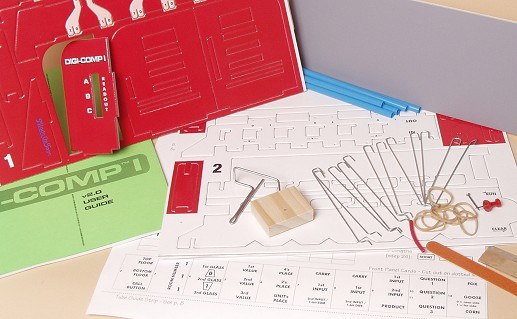
Assembly takes “a couple of hours” and needs only “a bit of white glue and a ruler”, and the kit is pitched at builders “older than 10 or so”. The v2.0 manual uses its own names for some parts; a key on page 47 translates them into the original E.S.R. nomenclature, so that the 1963 manual and later collections of problems — such as Bill Kustes’s More Fun for Digi-Comp I (revised 2008) — can be used with it.
8.4.3 Price and availability
As of 27 October 2026 the kit page reads: “10/20/2026: 20th production run, 53 in stock”. The same page gives the price as “$55 plus about $15 shipping (USPS Priority) in the US”, with payment by cheque or PayPal and shipping “also available worldwide”. The separate mail-order form quotes a flat $67 per kit including Priority shipping and insurance anywhere in the US ($70 to ZIP codes above 80000), plus New Jersey sales tax for New Jersey orders, payable to Minds-On Toys at P.O. Box 195, Long Valley, NJ 07853 (order form). The two figures come to about the same total; a buyer should confirm the current price with the maker before ordering.
The website is old-fashioned — its maker notes, with some pride, that it still uses frames — and its “news” page is a running log of twenty years of small improvements and supply problems: rubber bands that relax if left stretched, a dust cover made from overhead-projector film, the hunt for straws. It is also the best record of what keeping a small reproduction in production for two decades actually involves.
8.4.4 Variants built from it
Owners have modified the kit. Walker’s own “Chop Shop Edition”, assembled from about one and a half kits’ worth of parts, adds a fourth flip-flop and a four-bit readout, with the sliders moved to the bottom to make room. In autumn 2010 Kurt Kammeyer announced on the Yahoo group a brass “DIGICOMP IV”, a 2.5-pound steampunk version with four flip-flops (Minds-On Toys, news page). Neither is a product; both show how far a three-bit design can be pushed before it needs rethinking.
8.5 Digi-Comp II: First Edition — Evil Mad Scientist Laboratories
8.5.1 From giant to tabletop
The marble machine came back through Evil Mad Scientist Laboratories of Sunnyvale, California, which built the giant billiard-ball Digi-Comp II described in Volume 7 for the 2011 Bay Area Maker Faire, showed a tabletop prototype with half-inch steel balls at Maker Faire New York later that year, and on 6 December 2012 announced the Digi-Comp II: First Edition (Evil Mad Scientist, “Digi-Comp II: First Edition”). Some secondary sources date the product to 2011; 2011 was the year of the giant and the prototype, and the machine for sale followed in December 2012.
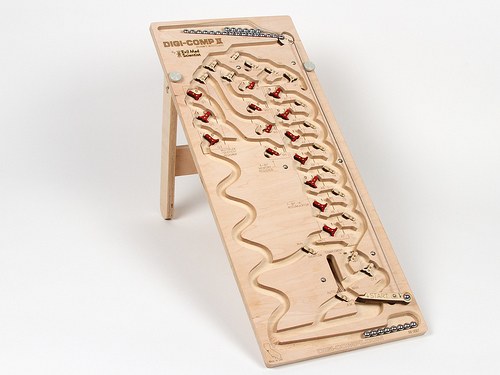
The First Edition is a slightly reduced copy of Godfrey’s board — 10 by 24 inches against the original’s 14 by 28½ — made of half-inch maple-faced, veneer-core hardwood plywood, CNC-routed into channels about three-eighths of an inch deep and then laser-engraved with the labels. Instead of half-inch marbles it uses standard 11 mm (about 7/16 in) steel pachinko balls, fed from a jam-resistant feeder that holds thirty at a time. The stand holds the playfield at 30° to the desk; reversed, it gives about 20°, for slower operation. The start lever is laser-cut poplar with a brass rivet bearing and a pachinko ball glued in as a counterweight.
In a long post on how it was made, Windell Oskay described the production: six CNC-routed plywood parts per machine (the top and lower playfields, the ball-return ramp and three stand pieces), roughly 35 to 40 minutes of routing each; 85 small laser-cut parts from quarter-inch plywood — flip-flops, switches and “clogs”; brass domed rivets or finishing nails as pivots; Delrin washers and spacers; a vacuum-formed polystyrene cradle in a laser-marked white box; and testing of each operation “a few dozen times” (Evil Mad Scientist, “The Making of the Digi-Comp II, First Edition”, 2 January 2013). He also explained why, unlike most of the company’s products, it was not published as open-source hardware: reliable plans would be a large project, and the design depended on particular materials, processes and tooling.
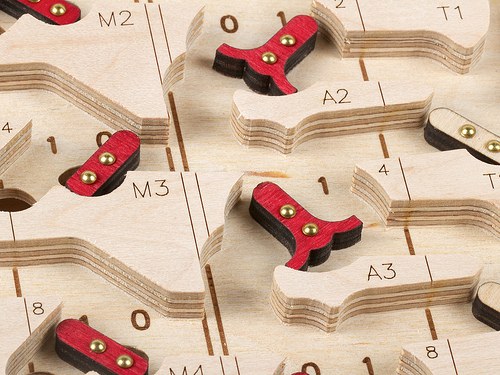
Although usually called a kit, the First Edition was sold assembled and tested. The shop’s own description lists what was in the box: “The fully assembled and tested Digi-Comp II, with its matching stand, a bag of 35 pachinko balls, a quick start guide, and carrying case.” Setting it up meant screwing on the stand with two thumbscrews and pouring in the balls. In 2013 it sold for $279 (Boing Boing, 28 June 2013). A cheaper vacuum-formed plastic version was announced as planned in 2012; no evidence was found for this volume that it was ever released.
8.5.2 Status: no longer in production
As of 27 October 2026, the shop pages for both the Digi-Comp II: First Edition and a discounted B-grade version (machines with cosmetic flaws “guaranteed to not affect operation”) carry the same notice: “No longer in production” (shop page; B-grade). No price is shown. The date production ended is not stated. In January 2024 Evil Mad Scientist was acquired by Bantam Tools, a maker of desktop CNC machines in Peekskill, New York, and its founders moved there to work on drawing machines (Evil Mad Scientist, “Bantam Tools”, January 2024). A First Edition can now be had only second-hand.
8.6 Printing Your Own
8.6.1 Digi-Comp I: Mark Ziemer’s printable copy
In April 2016 Mark Ziemer published a 3D-printable recreation of Digi-Comp I on Thingiverse, crediting the FriendsOfDigiComp group “for their help, and their preservation of details about this device” (Thingiverse 1477209, CC BY-NC 4.0). It began as a work in progress; Ziemer later bought an original on eBay and refined the parts against it. The build list is a faithful parts list for the original: a base, two end pieces, a gusset and a readout in red; three flip-flops, three readout tabs and connectors, six single sliders and a double slider; white top, slider and rod-bearing plates and two clock parts; twelve logic rods bent from 0.055-inch music wire to a printed template, a crank from 0.061-inch wire, and six number 10 rubber bands. His build notes are a useful guide to what matters: printed edges must be cleaned so the plates and rods move freely; “the rod shape has little tolerance”; and bending twelve rods in music wire is “tough work” that calls for heavy pliers, a small bolt cutter, gloves and safety glasses. He also designed small pulleys to stop the rubber bands popping off the rods.
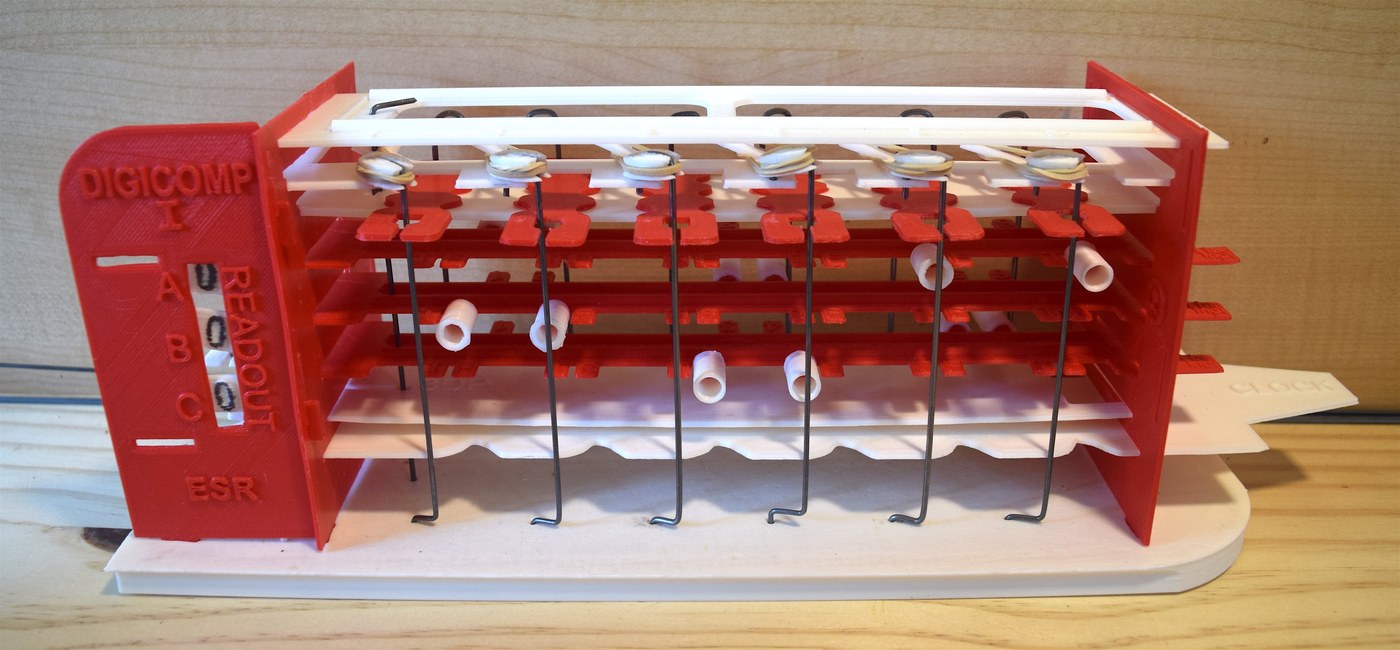
Ziemer added watermarks to the printed parts so that copies could not easily be passed off and resold on eBay (The Magnet, 1 August 2021). In September 2019 Doug Burum published updated parts for it: the main clock and the base split into two pieces each, so that they fit smaller printers (he had scaled the model to 90 %), and re-centred display tabs (Thingiverse 3886009, CC BY 4.0). Ziemer also wrote an iPhone and iPad app, Virtual DC II, simulating Digi-Comp II; its current availability was not checked for this volume.
8.6.2 Digi-Comp II: Michael Gardi’s replica
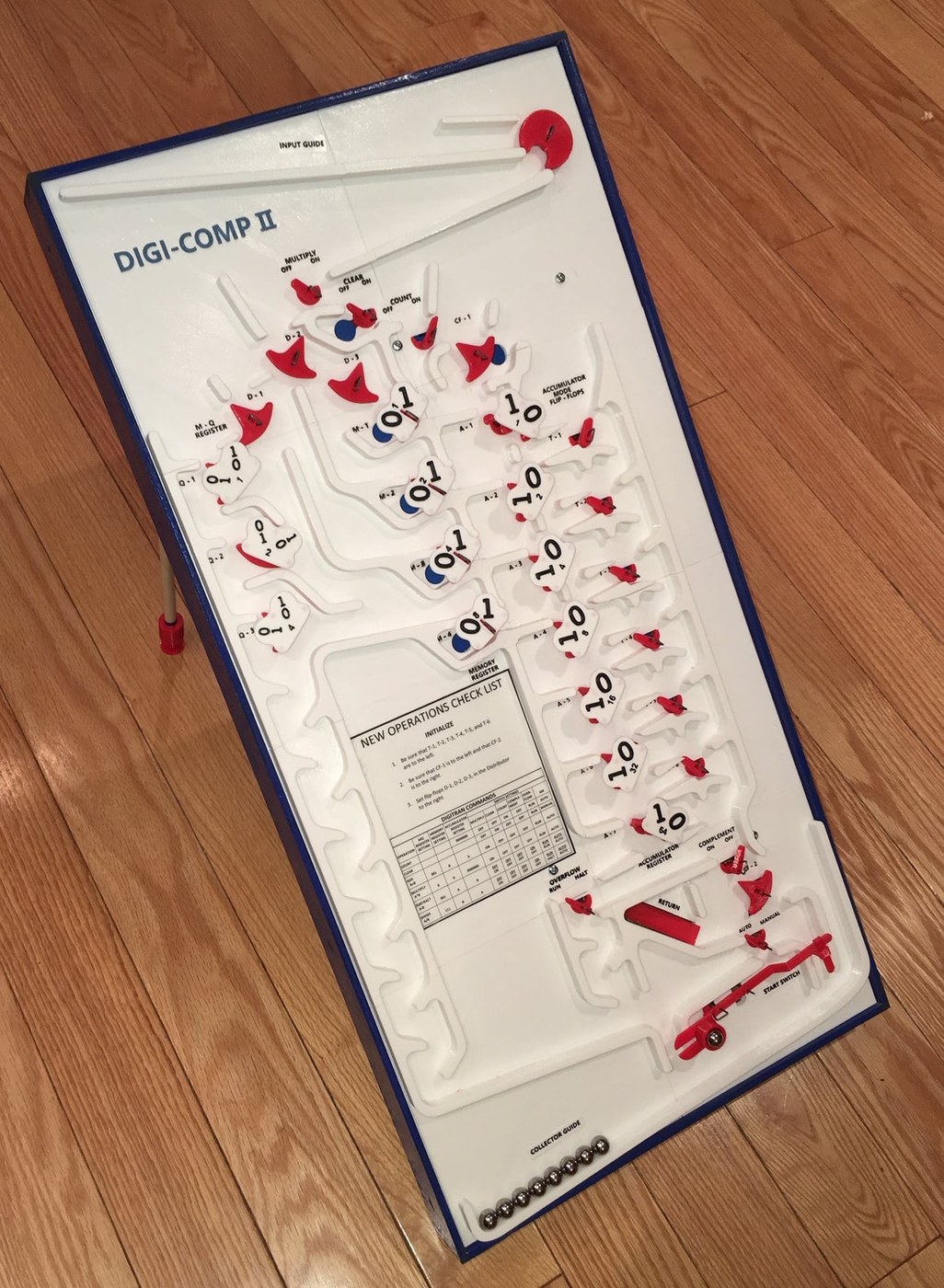
Michael Gardi, a retired software engineer in Ontario who was given a Digi-Comp I for Christmas in 1965, has made 3D-printed replicas of several of the 1960s computer toys. His Digi-Comp II Replica, published on 10 February 2019 on Thingiverse and Instructables, is a full-size working copy of the 14 by 28½-inch original (Thingiverse 3418066, CC BY-NC-SA 4.0; Instructables). Gardi points out that E.S.R.’s top and inner decks were vacuum-formed plastic on Masonite and its flip-flops and switches were injection-moulded; in the replica, decks and pieces alike are printed. He had no original to work from, and built it from images supplied by the puzzle collector Jaap Scherphuis; he modified some hidden flip-flops for reliability, and the Instructables guide warns that fine-tuning is needed to make it run reliably. Mark Ziemer supplied cut files for the top deck base, the frame and its supports, giving a laser-cutting or routing route for the large flat parts. The download includes the original Digi-Comp II manual as a PDF, which Gardi had printed and spiral-bound at a copy shop. Writing in 2019, he had not seen an original Digi-Comp II offered for sale “for quite a long time”, and noted that when one does appear it sells “for many hundreds of dollars”.
8.6.3 Digi-Comp I Redux: a new machine in the old style
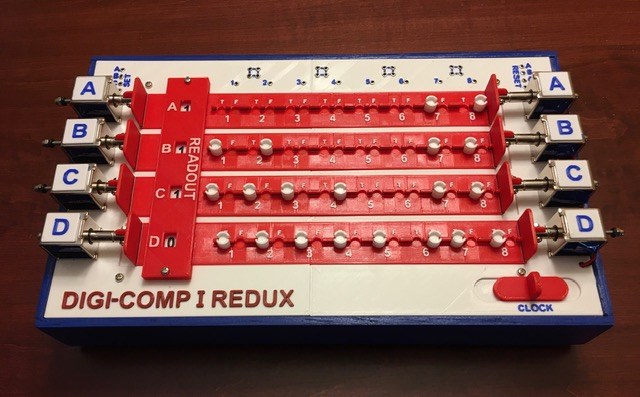
Gardi’s Digi-Comp I Redux (26 October 2019) is not a replica but, in his words, a “mashup” of 1950s and 1960s machines: the mechanics and programming model of Digi-Comp I, the look of the Digi-Comps, the patch cords of the Minivac 601, and the magnetic reed switches of his own Geniac replica (Thingiverse 3939005, CC BY-NC-SA 4.0). It has four flip-flops, and all the experiments of the original manual can be programmed on it by following the manual’s coding sheets. Gardi announced the extra bit in the spirit of the 1960s advertising: “ONE EXTRA BIT of precision, DOUBLING the numbers that can be expressed from 8 to 16!“
8.6.4 The rest of the family
Gardi has also published printable replicas of E.S.R.’s other two computers: Think-a-Dot, measured from an original with digital calipers, and The Amazing Dr. Nim, at 0.673 scale to fit common printers (about 210 × 205 mm) (Thingiverse 3192730). Builders have also recreated the machines in other media: Evil Mad Scientist noted a working Digi-Comp II built inside the video game Terraria in 2014, and a LEGO version of Digi-Comp I has been documented online by the builder nico71 (RetroCmp).
8.6.5 Licences
The printable designs are free to download and print, but most carry non-commercial Creative Commons licences: Ziemer’s Digi-Comp I is CC BY-NC 4.0 and Gardi’s designs are CC BY-NC-SA 4.0, so printed copies may not be sold. Burum’s updated parts are CC BY 4.0. Each Thingiverse page listed was checked as live on 27 October 2026.
8.7 On a Screen
Software is the cheapest reproduction of all. Web-based Digi-Comp I emulators have been published over the years — one, at digicomp-1.appspot.com, let users write, save and reload programs (RetroCmp, “Digi-Comp 1 — Introduction”) — and the System Source Computer Museum links an online emulator from its Digi-Comp I page; their current state was not checked for this volume. For Digi-Comp II there is Ziemer’s app, noted above, and the many short videos of the giant and tabletop machines in operation.
This series has its own simulator, 03-outputs/tools/digicomp_sim.py, in plain Python with no dependencies. It models Digi-Comp I’s three flip-flops, logic rods and peg positions using the manual’s programming notation, and Digi-Comp II’s toggles and balls, and it checks itself against problems and answers printed in E.S.R.’s manuals. Every worked example in Volumes 4 and 6 comes from it.
8.8 Originals
Originals do still change hands, but rarely and at collectors’ prices; no current market price is given here because none could be verified. In 2005 a used Digi-Comp I typically sold for about $150; by 2019 an original Digi-Comp II was a rarity that fetched “many hundreds of dollars”. For those who want to see one rather than own one, museums help. The Smithsonian’s National Museum of American History holds a Digi-Comp I (catalogue 1978.0067.59, not on view), the Computer History Museum holds Digi-Comp I kits and box parts, and the System Source Computer Museum in Hunt Valley, Maryland, holds all four of E.S.R.’s computers. In August 2026 Hackaday reported the restoration of a well-preserved Digi-Comp I by Chris Staecker, who replaced its rubber bands and printed a few missing parts — one more use for the files above (Hackaday, 17 August 2026).
8.9 Choosing a Route
For a Digi-Comp I, the choice in October 2026 is easy: the Minds-On Toys v2.0 kit is in stock, costs well under a hundred dollars delivered, comes with a manual written for it, and has twenty years of builders behind it. Ziemer’s printable copy is the alternative for anyone with a 3D printer and the patience to bend twelve music-wire rods, and the right choice for replacing parts on an original. Gardi’s Redux is the choice for a four-bit machine.
For a Digi-Comp II, there is no longer anything to buy new. Evil Mad Scientist’s First Edition, the only commercial reproduction, is out of production, and second-hand examples are uncommon. The practical route is to make one: Gardi’s full-size printed replica, with the large flat parts printed or cut from Ziemer’s files, or a scratch-built board in plywood or acrylic following the patent drawings and the dimensions of the original. It is a substantial project, and the published accounts agree that the toggles need careful tuning before the balls run reliably.
Volume 9 builds a Digi-Comp I and Volume 10 a Digi-Comp II, by the routes set out above.
Next — Volume 9: Building a Digi-Comp I. From a box of parts to a working three-bit computer: assembling the base, frame and flip-flop plates, fitting the logic rods and their rubber-band springs, setting the readout and the clock, and running the check-out experiment — then loading the pegs for the binary counter and stepping it, state by state, against the simulator.
Comments (0)