Digi-Comp · Volume 2
Digi-Comp — Volume 2 — E.S.R. Inc. and the Science-Toy Boom — Geniac, Brainiac and the Space Race Kitchen Table
Edmund Berkeley's electric brains by mail order, Claude Shannon's relay box, Sputnik and the scramble to teach science, and the three Kearfott engineers who turned a failed marble computer into a five-dollar plastic one and a company that sold it to Sears, Macy's and a thousand schools
2.1 About This Volume
Digi-Comp I did not appear from nowhere. By 1963 Americans had been reading about “giant brains” for fifteen years, had been able to buy a do-it-yourself “electric brain” by mail for eight, and had spent six worrying, after Sputnik, that their children were not learning enough science. This volume sets out that background — Edmund Berkeley and his books and kits, the Geniac and Brainiac, Claude Shannon’s Minivac 601, and the post-Sputnik push for science and mathematics in schools and homes — and then tells the story of E.S.R., Inc., the company three engineers from a New Jersey missile-guidance firm formed to make and sell their plastic computer.
The company’s story rests largely on one first-hand source: a letter written in March 2000 by William H. Duerig, one of the three founders, in answer to questions from a member of the FriendsOfDigiComp group, and preserved with the group’s archive (Duerig, letter of March 2000). Where the letter is the only source, the text says so. It is supplemented by the patents, E.S.R.’s own manuals and sales flyer, museum catalogue records and later accounts based on interviews with Duerig.
2.2 Giant Brains
2.2.1 Edmund Berkeley
The word “computer” entered the American living room through a handful of books and magazine articles in the late 1940s, and one of the most influential was Giant Brains, or Machines That Think (1949) by Edmund Callis Berkeley (1909–1988). Berkeley was an actuary at the Prudential Insurance Company who had become fascinated by the new calculating machines and in 1947 was one of the founders of the Association for Computing Machinery (Wikipedia, “Edmund Berkeley”; IEEE Computer Society pioneer profile). Giant Brains explained how the machines of the day worked — the relay calculators at Bell Labs and Harvard, the ENIAC, the differential analyser — and, more importantly for this story, it argued that the principles were simple enough for anyone to grasp. Berkeley later founded and edited Computers and Automation, often called the first computer magazine.
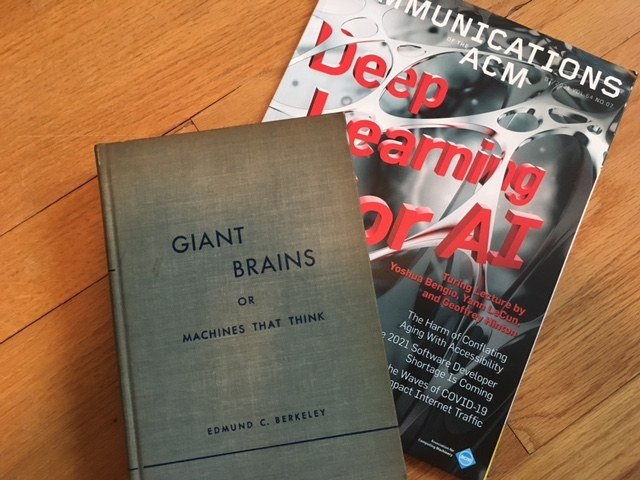
Giant Brains also described a machine of Berkeley’s own: Simon, a tiny relay computer that worked on numbers of only two bits, intended to show that a computer need not be giant at all. Construction articles appeared in Radio-Electronics in 1950 and 1951; a builder would spend about $600 on parts, and the first working model was built at Columbia University with the help of two graduate students. Simon is sometimes called the first personal computer. Whatever its claim to that title, it established a pattern that every educational computer toy of the next two decades followed: a small machine, built by its owner, whose workings could be seen and followed.
2.2.2 Geniac and Brainiac
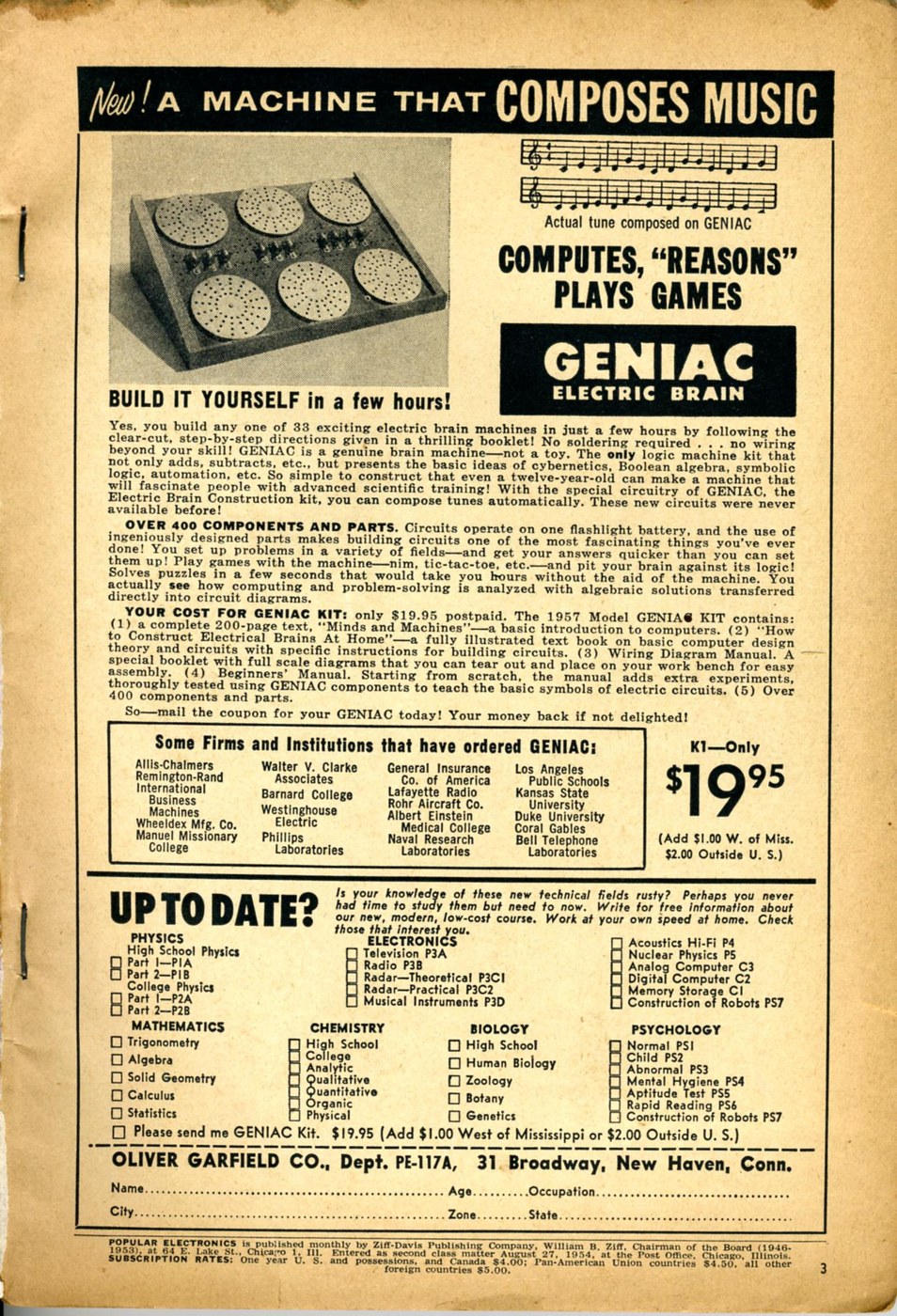
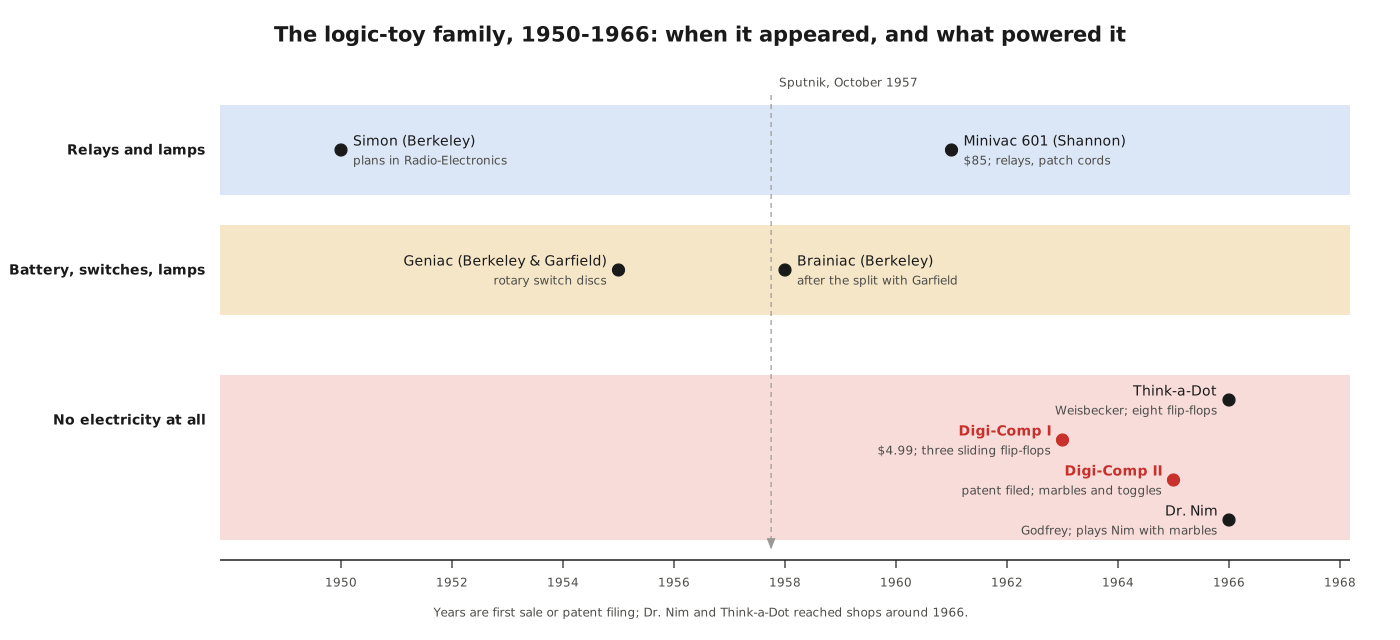
In 1955 Berkeley went further, with a kit that cost not hundreds of dollars but under twenty. The Geniac — the name is usually explained as “genius” plus ENIAC — was marketed with Oliver Garfield, whose company in New Haven, Connecticut, sold it by mail order. It came as a wedge-shaped case, a console panel and nearly four hundred other parts. Its “logic” was a set of six perforated Masonite discs that turned like rotary switches, wired behind the panel with brass jumpers and bolts, connecting a flashlight battery to a row of flashlight bulbs (Wikipedia, “Geniac”). By rewiring the jumpers, which the advertisements said took only a few minutes, an owner could set up circuits that added binary numbers, solved logic puzzles, or — in one memorable project — scored a five-question “Masculine-Feminine Testing Machine”.
The Geniac was a set of switches, not a computer in any strict sense: it had no memory and no sequencing, and the operator did all the stepping by turning the discs by hand. It was nonetheless a genuine introduction to switching logic. The kit even came with a copy of Claude Shannon’s master’s thesis on the symbolic analysis of relay and switching circuits, the founding text of the subject. Its advertisements, run for years in science-fiction and hobby magazines, promised a machine that “composes music”, “computes, ‘reasons’, plays games”.
In 1958, after a falling-out with Garfield, Berkeley began selling a nearly identical kit of his own under the name Brainiac, through Berkeley Enterprises (incorporated in 1954), while Garfield went on selling the Geniac into the 1960s. A 1959 catalogue of Berkeley’s covers 33 “Geniacs”, 13 “Tyniacs” and 155 “Brainiacs” — numbered circuits, each a small project (Online Archive of California, Edmund C. Berkeley papers). The two kits, nearly impossible to tell apart, are the immediate ancestors of the Digi-Comps in spirit, price and audience.
2.2.3 Shannon’s relay box
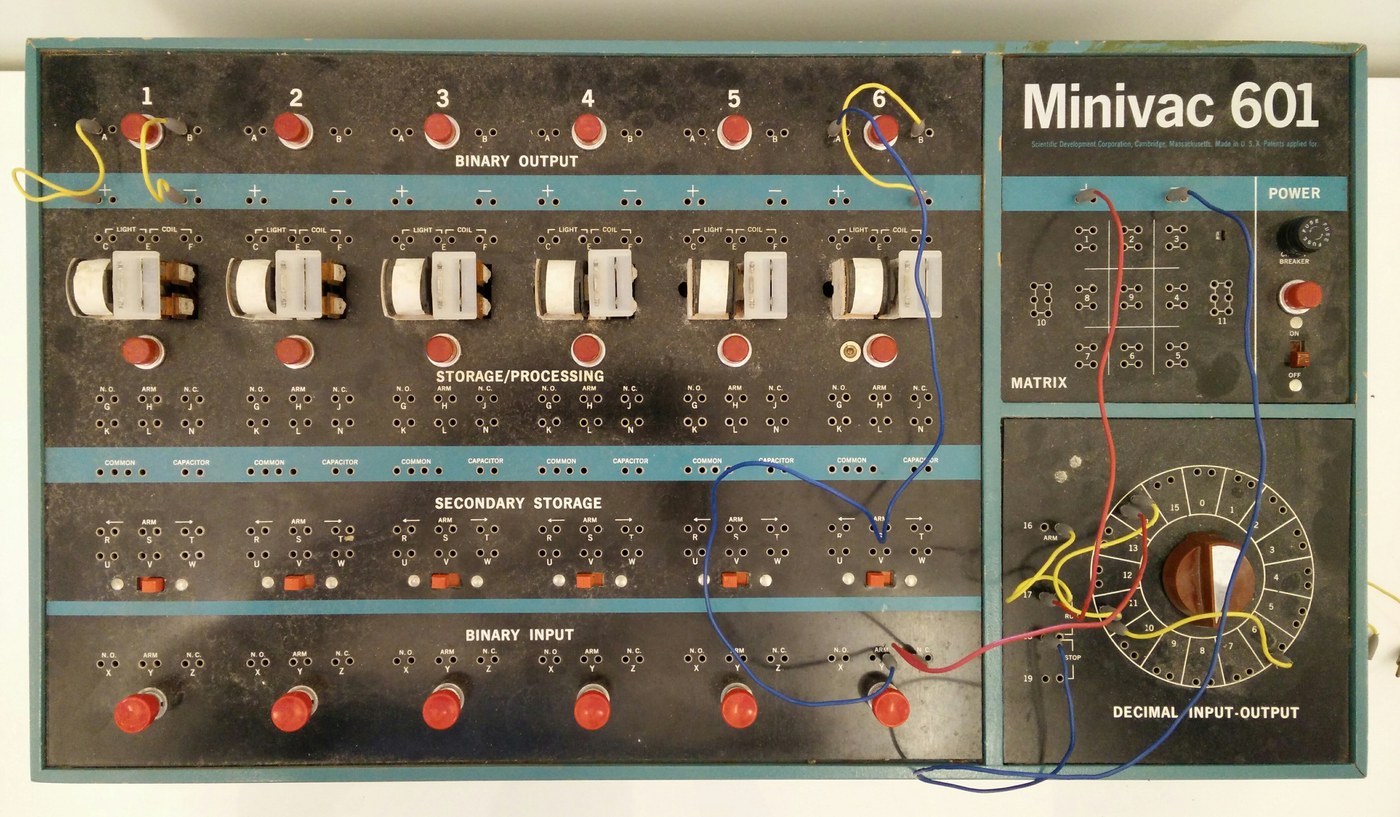
At the other end of the market sat the Minivac 601, designed by Claude Shannon himself and sold from 1961 by the Scientific Development Corporation of Cambridge, later Watertown, Massachusetts, at an introductory price of $85. It had real electromechanical relays for its logic and memory, six slide switches, six pushbuttons, six lamps and a motor-driven sixteen-position dial, all connected by patch cords; six instruction books took the owner from simple circuits to a machine that played noughts and crosses (Wikipedia, “Minivac 601”). It was a serious teaching machine, and its price kept it out of most children’s hands. A heavier-duty model, the Minivac 6010, sold better to companies than the 601 had to hobbyists.
2.3 Sputnik and the Kitchen Table
On 4 October 1957 the Soviet Union launched Sputnik 1. In the United States the shock was as much about schools as rockets: if the Soviet Union could put a satellite into orbit first, the reasoning went, American children were not being taught enough science and mathematics. The response included the National Defense Education Act of September 1958, which poured federal money into science, mathematics and foreign-language teaching; new physics, biology and mathematics curricula written by university scientists, among them the “New Math”; and a market for anything that promised to make a child scientifically minded at home.
The science toy was not new — A. C. Gilbert had sold chemistry sets and Erector sets for decades — but after Sputnik it acquired a patriotic edge. The Smithsonian’s online exhibition Mobilizing Minds: Teaching Math and Science in the Age of Sputnik gathers the evidence: textbooks and teaching aids, slide rules, Gilbert chemistry sets, anatomical models, and a Digi-Comp I. The Smithsonian files its own Digi-Comp, a gift of John Garver received in 1977, in a collection set labelled simply “Sputnik” (NMAH 1978.0067.59).
That is the world Digi-Comp I was born into, and its manual knows it. The first page tells its young owner, “You now own a DIGITAL COMPUTER!”, and explains that without computers “we would still be a long way off from launching astronauts into space, designing space craft for moon flights, being able to accurately predict the path of hurricanes”. Its experiments count down a launch “from Cape Canaveral” and check out a space capsule before re-entry (E.S.R., Digi-Comp I Instruction Manual, 1963).
2.4 Three Engineers from Kearfott
2.4.1 Missiles by day
Kearfott was one of the companies that built the guts of America’s missiles and aircraft: gyroscopes, inertial guidance platforms and the small computers that went with them. In 1961 William H. Duerig was its Director of Electronics Research at Little Falls, New Jersey, a physicist with a PhD and, in his words, “an extensive background in missile telemetry and solid state”. One of his colleagues was Irving J. Lieberman, hired to develop a guidance computer for missiles and aircraft of his own design. Duerig called him “a genius with very advanced ideas on structure and organization of computers” (Duerig, letter of March 2000).
The third founder was much younger. Duerig and his wife had an old house in Montclair with a bedroom and bath on the third floor, and they took in a student from Tulsa, Oklahoma, who was starting a mechanical-engineering degree at the Stevens Institute of Technology in Hoboken: C. David (“Dave”) Hogan.
2.4.2 A marble computer that would not work
The idea came from Lieberman, and it was not at first the Digi-Comp. As Duerig remembered it:
One day he hinted that he had an idea for a mechanical computer that worked by having marbles roll through gates. … Well I finally got Irv to reveal how he was going to make his computer and it appeared very impractical to me. With Irv’s permission I discussed it with Dave and he agreed with me. After many brainstorming sessions we came up with the idea of using mechanical planes as the connections and clock and pivoting rods interrupted by tabs to form the binary functions.
That sentence describes the Digi-Comp I in essence. The marble computer was set aside — although, as Volume 5 tells, a marble computer of a quite different design would come to E.S.R. from outside a few years later.
2.4.3 The Toy Fair and the Sears buyer
The first working machine was ambitious. It was made, Duerig wrote, “of six circular planes with the rods positioned all around”, and “the unit was about a foot in diameter”. It worked well enough that the three took a booth at the annual Toy Fair in New York — “the Annual March Toy Fair held in NYC”, in Duerig’s words — and demonstrated it. Buyers were intrigued, but “with all those planes and gates … we seemed to scare off most buyers”. Then:
Along came a buyer from Sears & Roebuck who said he would love to put it in his catalog but couldn’t we make it simpler, perhaps just a section of the unit. Wow!! We went home and that night worked through. … The next day we cut up that stiff compressed paper stuff and literally created the first Digicomp in almost hours, (by the way, Dave had found a source for Orthodontist rubber bands that he used for the springs!!) We brought it back to the show and the Sears Buyer agreed that as soon as we had a production model he would put it in his catalogue.
Lieberman, Duerig recalled, was unhappy at first — “he felt a small unit could not handle many programs” — but agreed that he could think of some good ones. The letter does not give the year of the Toy Fair. Since the patent application was filed in October 1963 and the toy was on sale that Christmas, the fair was most likely that of March 1963; one secondary account places the prototype at the 1962 fair. The overnight prototype, cut from stiff board and sprung with rubber bands, is worth remembering: forty-two years later the first modern reproduction of Digi-Comp I would be made of laminated binder’s board and rubber bands too (Volume 8).
2.4.4 Plastic, a name and a public offering
Turning a cardboard prototype into a mass-produced kit meant injection moulding. “We fortunately found a chap who was brilliant at designing plastic injection molds,” Duerig wrote, and Hogan worked closely with him; “after several months we had our first samples of the Digicomp parts. Dave also engineered the rods and eventually the wire springs so that they could be mass produced.” Hogan became the company’s expert in plastic moulding and, as general manager, ran its manufacturing; Duerig and Lieberman stayed at Kearfott throughout, having first told their bosses what they were doing and got them “to agree in writing that we were not in competition with them”. Duerig enjoyed having the company president stop him in the corridor to ask how sales were going.
The company itself was E.S.R., Inc. The founders had wanted to call it Electronic Systems Research, “but couldn’t find a name that wasn’t already taken so our attorney suggested using just the initials”. They raised the money by taking the company public themselves, without an underwriter: “most people don’t know it but you can do it yourself. In fact we found out that the SEC attorneys who judge the prospectus will help you if you ask for it!!” They rented a factory, and the company settled at 34 Label Street, Montclair, New Jersey 07042, the address printed in all its later manuals and flyers.
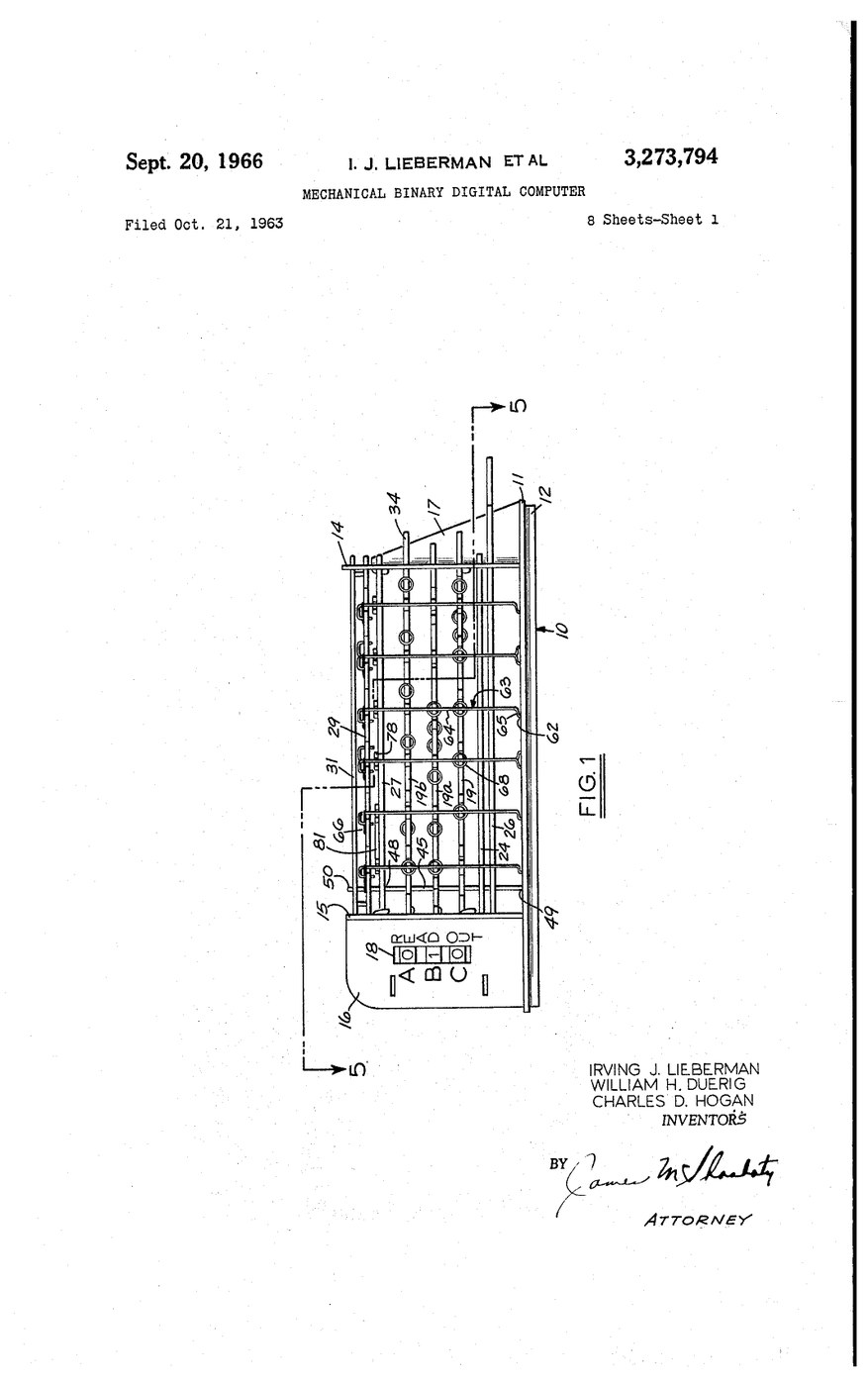
The patent application for the “Mechanical Binary Digital Computer” was filed on 21 October 1963, naming Irving J. Lieberman of West Orange and William H. Duerig and Charles D. Hogan of Montclair as inventors and E.S.R., Inc., of Orange, New Jersey, as assignee. It was granted as US 3,273,794 on 20 September 1966. Its opening paragraphs make the case the toy’s box made more breezily: computers had become important, mechanical ones had played a small role “due, in part, to the fact that no mechanical binary digital computer has been devised”, and “there has heretofore been a lack of any simple, visual device with which the operations of binary digital computers could be visually demonstrated” (US 3,273,794).
2.5 Selling a Computer for Five Dollars
2.5.1 Christmas 1963
Digi-Comp I went on sale for Christmas 1963 at $4.99. Sales “exceeded our expectations”, Duerig wrote, and he remembered “many exciting moments such as when Macy’s sold out within hours after putting the Digicomp boxes out at Christmas”. Later accounts based on his interviews put sales above 100,000 within several years (Wikipedia, “E.S.R., Inc.”); the company’s own flyer, a few years in, claimed that “tens of thousands of youngsters and adults in America and Canada” had used it and that “over a thousand public and private schools have used DIGI-COMP for classroom demonstrations” (E.S.R., “A Word About E.S.R. Inc.”). The price crept up — to $5.95 in a 1968 Childcraft catalogue and to a suggested $6.00 on E.S.R.’s own flyer — and a rebadged version was sold in Britain under the name I-Cor Systems (archive record of an I-Cor Systems Digi-Comp 1).
2.5.2 Patent of the week
On Saturday 24 September 1966, four days after the patent was granted, Stacy V. Jones’s weekly patents column in The New York Times featured the machine under the headline “Tiny Computer Finds Home in School”. Duerig recalled that Jones telephoned a few weeks later to say “that the response to our Digicomp was by far the greatest he had ever had to any patent of the week!” Two months later the Newark Sunday News put E.S.R.’s machines on its front page as “Computers for Tots: Budding Einsteins Play With Educated Marbles” — the marbles, presumably, those of Digi-Comp II and Dr. Nim.
2.5.3 Manuals and the users’ own programs
E.S.R. understood that the manual was half the product. The 1963 manual ran to 28 pages and fifteen experiments, and it ended with “Problems For You To Program”, inviting owners to send in their own. “The response was fantastic,” Duerig wrote. “We got programs from adults and many from children. I remember several that a nine year old boy sent from Tulsa that showed a very keen mind.” E.S.R. published the best of them as a separate book, Digi-Comp I Romps, and Hogan, who had been taking advanced courses at Stevens, wrote an advanced manual that developed the programs “in Boolean algebra, Venn diagrams, truth tables, etc.” It sold for a dollar. Volume 4 works through the experiments of the original manual.
2.5.4 Toys with a purpose
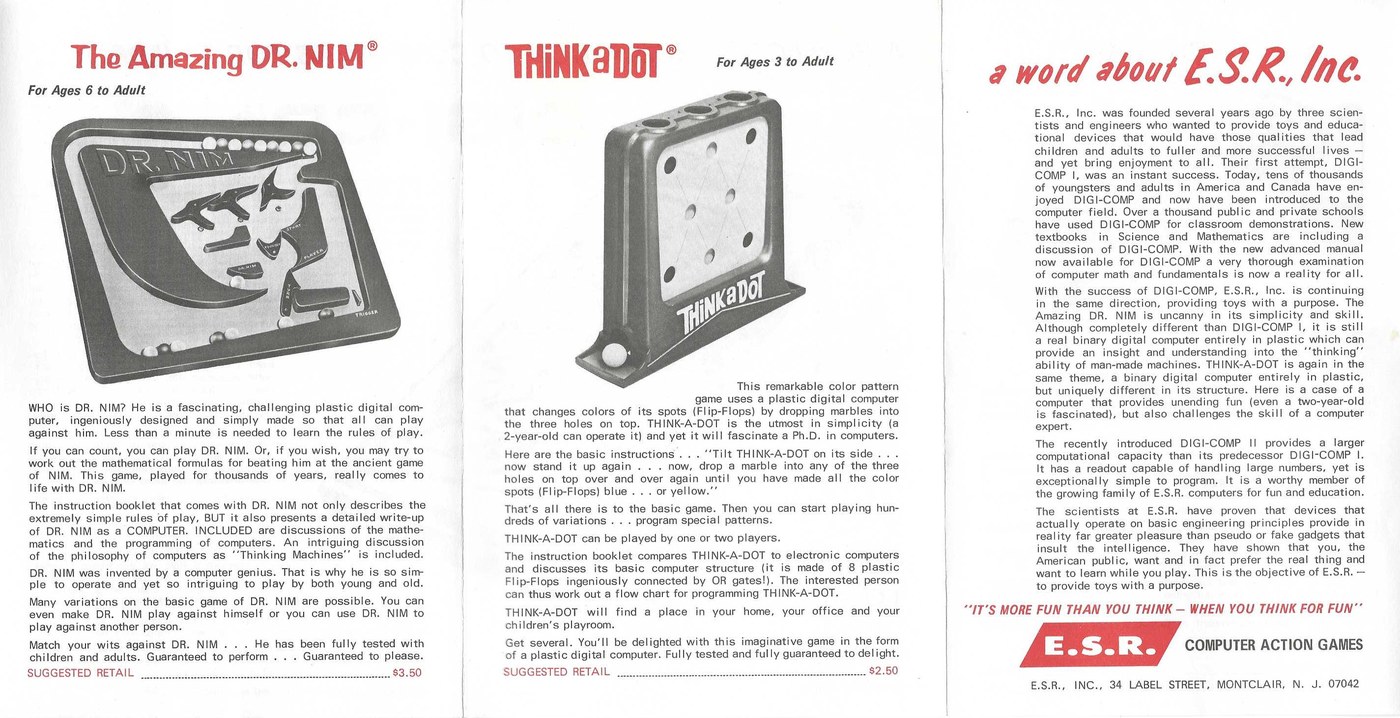
Success brought inventors to E.S.R.’s door. Shortly after Digi-Comp I reached the market, John Godfrey of General Electric telephoned Duerig — interrupting his dinner at a restaurant, through the babysitter — with two marble-driven inventions, which became The Amazing Dr. Nim and Digi-Comp II. About the same time Joseph Weisbecker of RCA, Princeton, called “for the same reason” with a marble computer of his own, which E.S.R. named Think-a-Dot. Hogan redesigned Dr. Nim and Think-a-Dot for injection moulding, and built the first Digi-Comp II models with Godfrey. Volumes 5 and 7 tell those stories.
By the later 1960s the line was complete, and the company’s trifold flyer set out its philosophy under the slogan “It’s more fun than you think — when you think for fun”:
The scientists at E.S.R. have proven that devices that actually operate on basic engineering principles provide in reality far greater pleasure than pseudo or fake gadgets that insult the intelligence. They have shown that you, the American public, want and in fact prefer the real thing and want to learn while you play. This is the objective of E.S.R. — to provide toys with a purpose.
The four products were sold as “Computer Action Games”: Dr. Nim at $3.50, Think-a-Dot at $2.50, Digi-Comp I at $6.00 and Digi-Comp II at $16.00.
2.6 The End of E.S.R.
“Eventually sales of the computers dropped off,” Duerig wrote. “Let’s face it, we were quite a bit ahead of the times.” The early 1970s brought cheap electronic calculators and electronic games, and a plastic three-bit computer with rubber-band springs could not compete with either. E.S.R. bought EduCards, a Long Island publisher of educational games, and developed games under that name “that had reasonable market acceptance”. That drew the attention of Binney & Smith, the makers of Crayola crayons, who bought E.S.R. for stock. “So all the original investors made out reasonably well when later on Binney was purchased for cash. But Binney never put the computers back on the market.” Secondary accounts place the buy-out in the mid-1970s; the US patent record for Digi-Comp II shows its rights passing to Binney & Smith in 1984 from an intermediate owner, KPB Industries (US 3,390,471, assignment record). The Computer History Museum holds a Digi-Comp kit catalogued under Edu-Cards Corporation, a trace of the EduCards period (CHM X638.85).
The founders scattered. Duerig went back to Kearfott and retired from there in 1993. Hogan moved to Arizona and set up a resort, which his widow was running in 2000; he had died about two years before Duerig’s letter. Lieberman “dropped out of sight over 25 years ago when he tried to set up a recording business in California”. Duerig kept samples of all three of E.S.R.’s computers and gave one of each to each of his three children.
2.7 What E.S.R. Got Right
Set beside the Geniac and the Minivac, E.S.R.’s achievement is easy to state. It took the idea of the build-it-yourself teaching computer — Berkeley’s idea — and removed everything that stood between a child and the idea itself: the batteries, the wiring, the soldering, and most of the price. It replaced the wires with planes and rods that moved where the child could see them, and it sold the result through the Sears catalogue and the department store rather than the back pages of science-fiction magazines. It wrote manuals that took binary arithmetic and logic seriously, and invited its customers to write programs back. And when outside inventors came to it with marble computers, it had the moulding skills to make them into products too.
The machines that resulted were limited. Digi-Comp I had three bits of memory; Digi-Comp II could not be reprogrammed; none of them stored a program or could be called a general-purpose computer. But each demonstrated, with nothing hidden, the elements that every computer is built from — the flip-flop, the logic gate, the clock, the register and the carry — and for many thousands of children in the 1960s they were the first computers they ever touched.
Next — Volume 3: How Digi-Comp I Works — Three Flip-Flops, Rods and Pegs. The machine on the bench: the base and frame, the three sliding flip-flop plates and the readout window, the clock lever and the planes it drives, the bent wire logic rods and their springs, and the plastic tubes that are the program — and how a pattern of pegs turns into a set of logic equations that move the machine from one state to the next.
Comments (0)