Digi-Comp · Volume 1
Digi-Comp — Volume 1 — Computers Made of Plastic
Two toy computers from a small New Jersey company — one of sliding plastic plates and wire rods, one of marbles and flipping toggles — what they were, how they worked in principle, why they mattered to a generation of children who had never seen a real computer, and how they came back in the twenty-first century; the orientation volume for the ten-part series
1.1 About This Volume
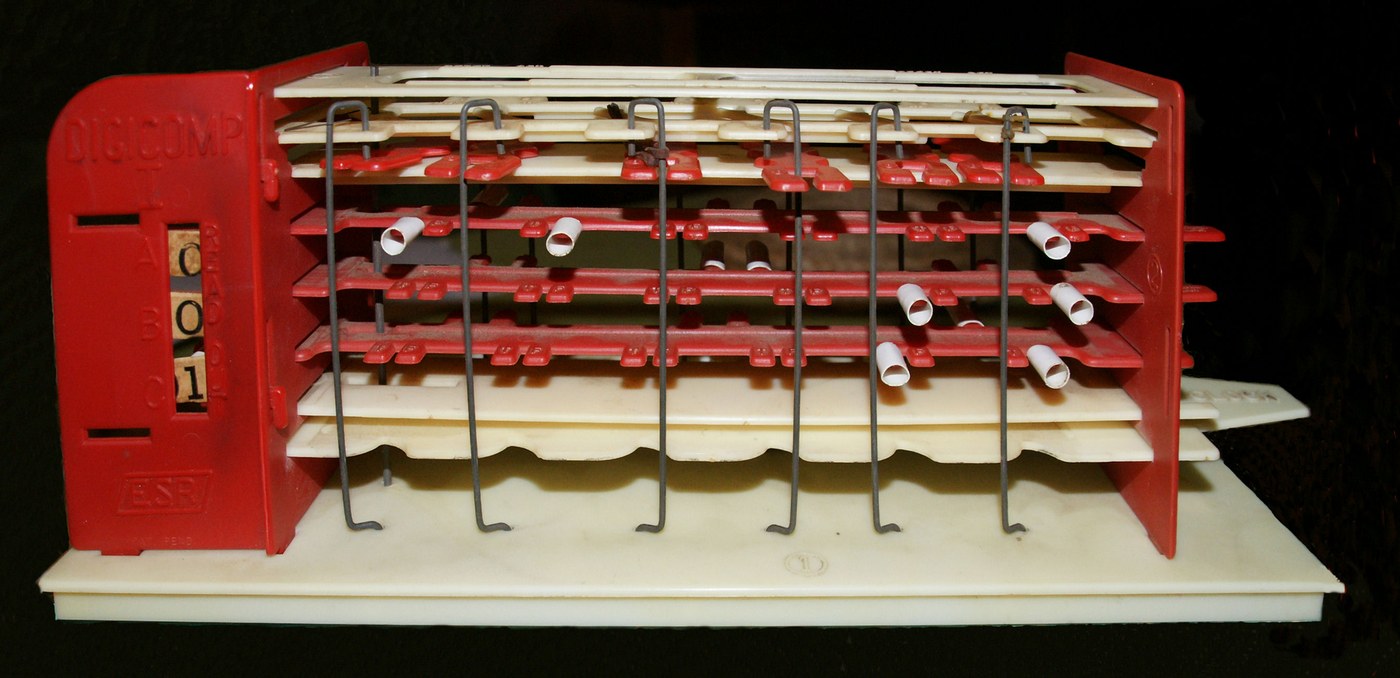
This is the entry point to a ten-volume deep dive on the Digi-Comp computers made by E.S.R., Inc. of Montclair, New Jersey, in the 1960s. There were two of them, and they had almost nothing in common except the name and the purpose. Digi-Comp I (1963) is a three-bit binary computer made of injection-moulded polystyrene, a dozen bent wire rods and a few rubber bands, which a child assembled from a kit and programmed by pressing short plastic tubes onto sliding plates. It sold for $4.99. Digi-Comp II, designed by a General Electric engineer named John T. Godfrey and patented in 1965, is a tilted board on which marbles roll down through plastic toggles; each marble reads and flips the toggles it passes, and the machine counts, adds, subtracts, multiplies and divides in binary with gravity as its only power supply.
The volume explains what each machine was and what it did, places both in the story of the American “science toy” after Sputnik, and tours the whole series in miniature. Readers who want the company’s history can go straight to Volume 2; readers who want the mechanism and the programming of Digi-Comp I can start at Volume 3; readers who want the marble machine can start at Volume 5; readers who want to own one can jump to Volumes 8 to 10. The series ends on a workbench, with a Digi-Comp I and a Digi-Comp II built from the reproductions and printable designs available in 2026.
1.1.1 The Ten-Volume Series
Table 1 — The Ten-Volume Series
| Vol | Title | Focus |
|---|---|---|
| 1 | Digi-Comp — Computers Made of Plastic (this volume) | Orientation: the two machines, how they work in principle, the whole story in miniature |
| 2 | E.S.R. Inc. and the Science-Toy Boom — Geniac, Brainiac and the Space Race Kitchen Table | Edmund Berkeley’s kits, Sputnik, three Kearfott engineers and the company they founded |
| 3 | How Digi-Comp I Works — Three Flip-Flops, Rods and Pegs | The flip-flops, the logic rods, the clock and the pegs, part by part |
| 4 | Programming Digi-Comp I — The Manual’s Problems Worked | The 1963 manual’s experiments, run on this series’ simulator |
| 5 | Digi-Comp II — Marbles, Toggles and the Story of the Rolling-Ball Computer | Jack Godfrey’s machine, its patent, its board, its manual and its fate |
| 6 | Digi-Comp II’s Arithmetic — Counting, Adding and Multiplying | How the toggles count and carry, and the manual’s arithmetic worked |
| 7 | After E.S.R. — Dr. Nim, Think-a-Dot, Turing Tumble and the Giant Digi-Comp | E.S.R.’s other marble computers and the machines that descend from them |
| 8 | The Reproductions — Re-making Digi-Comps in the 21st Century | Every kit, file set and replica, and what can actually be bought in October 2026 |
| 9 | Building a Digi-Comp I | A Digi-Comp I built and programmed, step by step |
| 10 | Building a Digi-Comp II | A Digi-Comp II built, tuned and run, step by step |
1.2 Two Machines Called Digi-Comp
1.2.1 A computer in a cardboard box
In the early 1960s almost nobody had touched a computer. The machines that existed were room-sized installations in banks, insurance companies, universities, defence contractors and government agencies, operated by specialists behind glass. What the public knew of them came from newspapers and television, and above all from the space programme, in which “electronic brains” guided rockets and tracked satellites. The Digi-Comp I manual of 1963 leans on exactly that image: its second experiment, “Final Count Down”, has the machine “automatically signal the BLAST OFF of a space ship from Cape Canaveral at the right time”, and later experiments are called “Space Ship Check Out” and “Space Capsule Re-Entry” (E.S.R., Digi-Comp I Instruction Manual, 1963).
Into that world, at Christmas 1963, came a cardboard box printed with the words “first real operating digital computer in plastic”. Inside were red and white styrene plates, wire rods, rubber bands, plastic tubes and a 28-page manual. Assembled, the machine was about a foot long and four and a half inches high. It had no batteries and no electricity of any kind. It had a three-digit readout showing 0s and 1s, a lever at one end that was pulled out and pushed in, and a row of short plastic tubes that could be moved from one position to another to change what the machine did. The Smithsonian’s National Museum of American History, which holds one, describes it plainly: “In the mid-1960s, most children had never seen an electronic computer. However, they had heard stories of the power of these giant instruments and knew that they were associated with space flight. This toy brought the mathematical principles of the digital computer into the home” (NMAH 1978.0067.59).
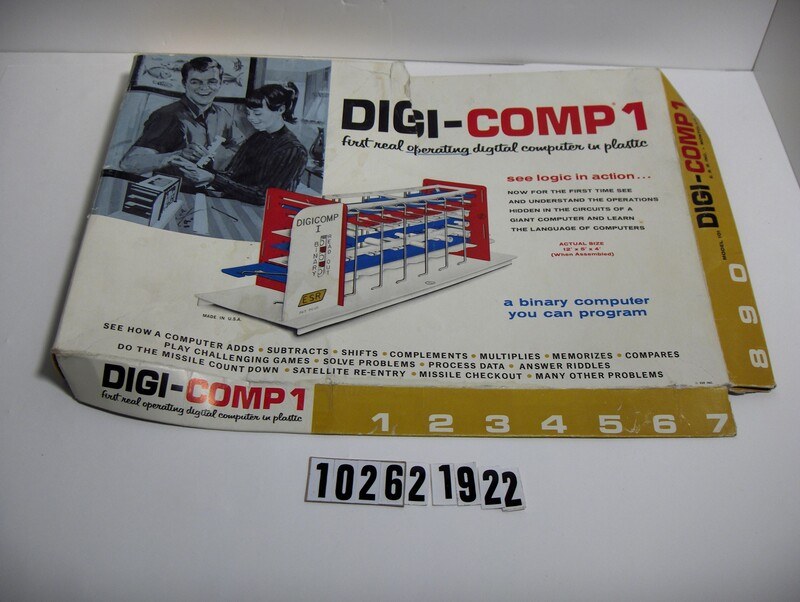
The company that made it was E.S.R., Inc., started by three men from Kearfott, a maker of missile guidance systems in Little Falls, New Jersey: the physicist William H. Duerig, the computer designer Irving J. Lieberman, and C. David Hogan, a young mechanical-engineering student at the Stevens Institute of Technology who rented a room on the Duerigs’ top floor in Montclair. The initials, by Duerig’s own account, stood for nothing at all: the founders wanted “Electronic Systems Research”, found the name taken, and took their lawyer’s advice to use just the letters (Duerig, letter of March 2000). Later packaging expanded them to “Education Science Research”. The patent on the machine, filed on 21 October 1963 and granted on 20 September 1966, names all three as inventors (US 3,273,794). Volume 2 tells the story of the company, from a twelve-inch circular prototype that frightened buyers at the New York Toy Fair to a sale to the makers of Crayola crayons.
1.2.2 A computer made of marbles
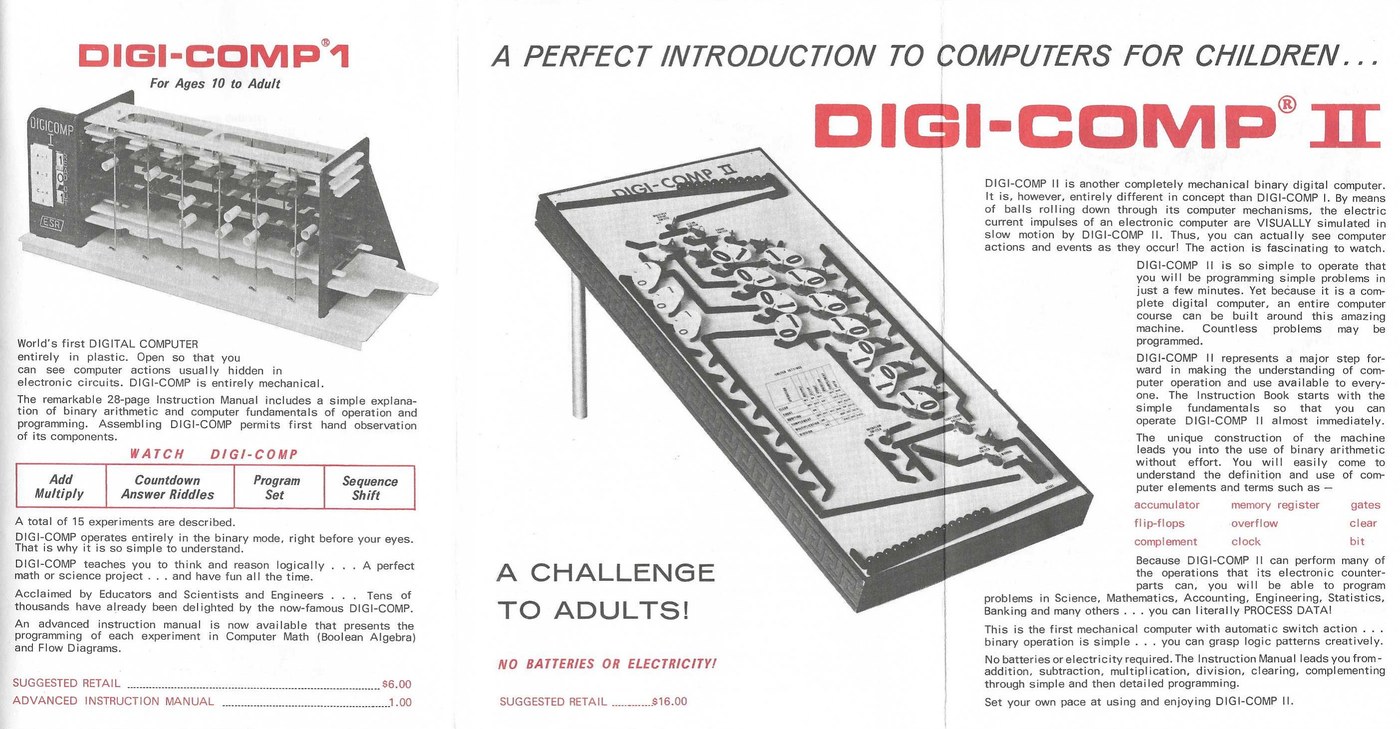
The second machine came from outside. John Thomas “Jack” Godfrey (1924–2009), an engineer at General Electric in Schenectady, New York, bought a Digi-Comp I, was “so excited”, in Duerig’s words, “to find some people who might understand his inventions” that he telephoned the founders, and came down to New Jersey with two of them. One was a marble-powered machine that played the ancient game of Nim, which E.S.R. sold as The Amazing Dr. Nim. The other was the machine that became Digi-Comp II. Godfrey filed his patent for a “binary digital computer” on 30 April 1965 (US 3,390,471), and by the time E.S.R. printed its trifold product flyer in the later 1960s, the “recently introduced DIGI-COMP II” was on sale at a suggested retail price of $16.00 (E.S.R., “A Word About E.S.R. Inc.”).
Digi-Comp II is a board about 14 by 28½ inches (36 × 72 cm), set at an angle on a stand. Half-inch marbles wait in a channel at the top. Pull the start lever and one marble is released. It rolls down a course of blue plastic guides and meets a series of red plastic levers, each of which can lean one of two ways. A marble arriving at a lever is steered left or right by it — and in passing, knocks it over to the other side. The levers are binary memory; the marbles are the pulses of current in an electronic computer; the guides are the wires. When a marble reaches the bottom it can trip a gate that releases the next marble, so that one pull of the lever sets off a cascade that continues until the operation is finished, at which point the last marble takes a by-pass route and the machine stops. Volume 5 tells its story and Volume 6 works through its arithmetic.
1.3 How They Work, in Principle
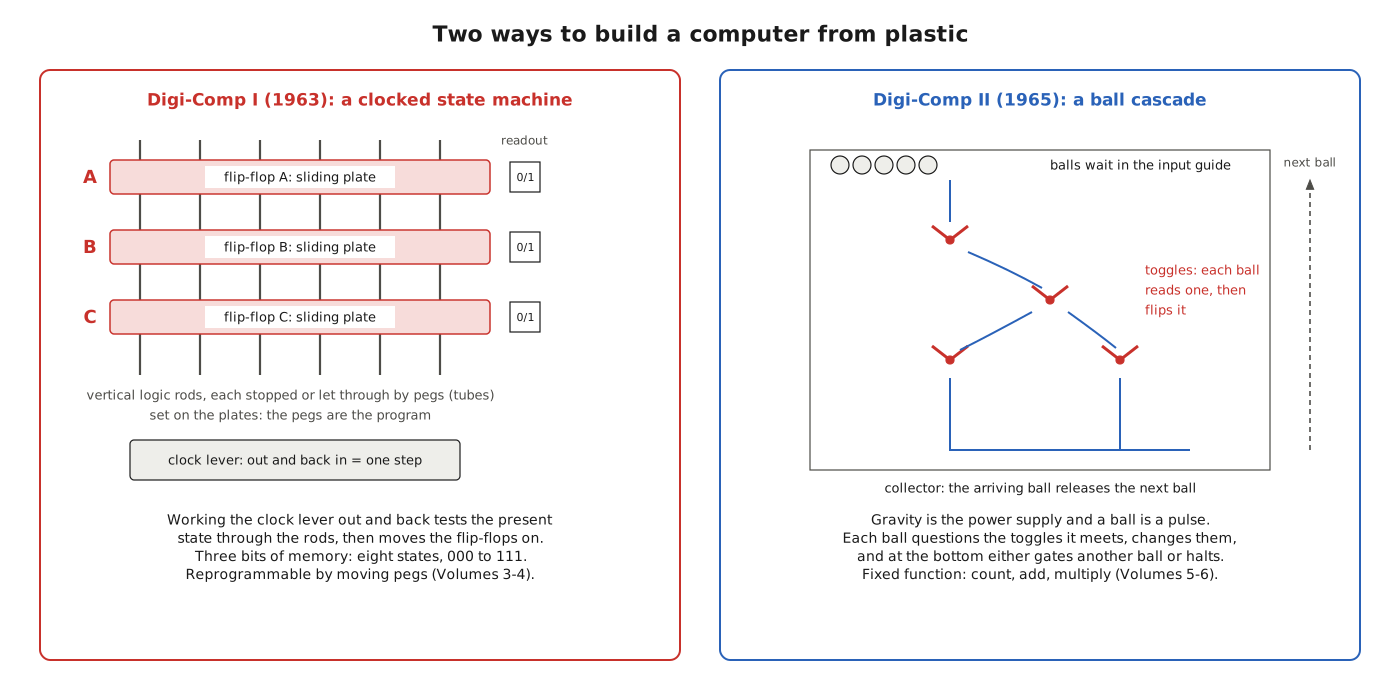
The two machines represent two quite different answers to the question of how to make computing visible. Digi-Comp I is a clocked state machine, a miniature of the way a real computer’s control logic steps from one state to the next. Digi-Comp II is an event-driven cascade, in which every pulse travels its own path and changes the memory it passes through. The detail is the business of Volumes 3 and 5; the principle fits in a few paragraphs.
1.3.1 Digi-Comp I: three flip-flops and a clock
The heart of Digi-Comp I is three horizontal plastic plates, labelled A, B and C, each of which can slide a short distance left or right. A plate in one position stands for 0, in the other for 1. Each is a flip-flop, the basic one-bit memory element of every digital computer, and a window at the end of the frame shows the three bits as a three-digit binary number. Three bits have eight possible combinations, so the whole machine has eight states, from 000 to 111.
Across the plates stand vertical logic rods: bent wires that pivot and can swing only if nothing stops them. Each plate carries rows of positions where a short plastic tube — the peg, or “logic tube” — can be pressed on, and whether a peg stands in a rod’s way depends on where its plate has slid. Working the clock lever, out and then back in, does two things in turn: it lets every rod test the present positions of the plates, and it moves the plates to their next positions according to which rods were free. In the founders’ own words, the design used “mechanical planes as the connections and clock and pivoting rods interrupted by tabs to form the binary functions” (Duerig, letter of March 2000). In effect, each rod computes the logical AND of a handful of conditions on the present state (“A is 1 and C is 0”), and the rods together decide what the next state will be. Volume 3 shows exactly how. Change the pegs and the same machine counts, adds, compares two numbers, solves a logic riddle, opens a combination lock or plays a game of Nim.
That is programming in its most physical form: a program is a pattern of pegs, written down on the manual’s coding sheet and copied onto the machine by hand. The 1963 manual offered fifteen experiments, from a binary counter to “Automatic Elevator”, “Bank Lock” and “Guess the Number”. The Digi-Comp I is not a stored-program computer, and its own promotional language — “an actual working digital computer” — overstates the case; it is more accurately a finite-state machine with a programmable next-state function. That is still a remarkable thing to have put in a child’s hands for five dollars. Volume 3 takes the machine apart, and Volume 4 runs the manual’s problems on this series’ simulator.
1.3.2 Digi-Comp II: marbles, toggles and a self-starting cascade
Digi-Comp II cannot be reprogrammed by moving parts around: its course is fixed. What the operator sets are registers — rows of toggles that hold binary numbers — and a handful of switches that select the operation. The manual names three registers: an accumulator of seven bits, where the answer builds up; a three-bit M-Q (multiplier-quotient) register; and a four-bit memory register that holds a number to be added or multiplied in (E.S.R., Digi-Comp II Instruction Manual). Switches marked MULTIPLY, CLEAR, COUNT, COMPLEMENT and OVERFLOW, and an AUTOMATIC/MANUAL selector, route the marbles through the board in different ways.
A marble entering a toggle from above “questions” it — in the manual’s own word, it interrogates it — because the path it leaves by reveals which way the toggle was set; and in leaving it flips the toggle. That single behaviour is enough to make a binary counter. When a marble passes a toggle that reads 0, it flips the toggle to 1 and leaves by a path that ends the step; when it passes a toggle that reads 1, it flips the toggle to 0 and carries on to the next toggle up the number. That is exactly the rule for adding one to a binary number, carry included. Chain such counting steps together under the control of the other registers and the machine adds, multiplies by repeated addition and shifting, takes complements and so subtracts and divides. In AUTOMATIC mode a single pull of the start lever sets the whole cascade going.
The manual is frank about the speed. Where an electronic computer of 1965 took “a few millionths of a second” to complete an operation, Digi-Comp II took “a few seconds … the speed of the electronic computer has been reduced by a factor of a million to one. This enables the person operating DIGI-COMP II to comprehend what is happening as it occurs.” The slowness was the point.
1.4 Why the Digi-Comps Matter
The Digi-Comps were not the first toy computers, and they were not the most capable. Edmund Berkeley’s Geniac kit of 1955 and its successor Brainiac used batteries and switches to light bulbs, and Claude Shannon’s Minivac 601 of 1961 used real relays; both are described in Volume 2. What set the E.S.R. machines apart were three things.
First, they were cheap and sold through ordinary shops. At $4.99, Digi-Comp I cost about what a model kit cost, and it sold through the Sears catalogue, through department stores — Duerig remembered Macy’s selling out “within hours” at its first Christmas — and later through the Childcraft catalogue at $5.95. The company claimed in its flyer that “tens of thousands” of children and adults had used one and that more than a thousand schools had used it for classroom demonstrations; later accounts based on Duerig’s interviews put sales above 100,000 within a few years.
Second, they were wholly mechanical and wholly visible. Nothing was hidden in a circuit. The flyer’s own phrase is “open so that you can see computer actions usually hidden in electronic circuits”, and the marble machine was sold on the claim that “the electric current impulses of an electronic computer are VISUALLY simulated in slow motion”. For a child, a flip-flop was no longer a word but a red plate that slid when pushed.
Third, they came with real teaching. The manuals explained binary numbers, binary addition, logic, programming and coding sheets; E.S.R. published an advanced Digi-Comp I manual, written by Dave Hogan, that presented each experiment in Boolean algebra and flow diagrams; a book of programs sent in by users followed. The Digi-Comp II manual introduced a “compiler language” called DIGI-TRAN and closed with a chapter on converting DIGI-TRAN programs into FORTRAN for the IBM 1620, 1401, 704, 7090 and other machines of the day, so that a child with access to a real computer could, the manual promised, “actually be able to insert simple problems into it with no further help required!!!”
The result was a generation of programmers and engineers who date their first computer to a plastic toy. The Smithsonian holds a Digi-Comp I in its collections, and showed one in its online exhibition Mobilizing Minds: Teaching Math and Science in the Age of Sputnik, alongside A. C. Gilbert chemistry sets and anatomical models. In 1984 Creative Computing ran an article by Nelson Winkless arguing that Digi-Comp I was “the first home computer” — a claim that depends on what “computer” means, but one that Duerig, writing in 2000, said he had been pleased to read.
1.5 The Long Silence and the Revival
E.S.R.’s computers did not survive the arrival of cheap electronics. Pocket calculators and electronic toys of the early 1970s made plastic flip-flops look quaint, and sales fell away. In Duerig’s account, E.S.R. bought a Long Island maker of educational games, EduCards, and was in turn bought by Binney & Smith, the makers of Crayola crayons, which “never put the computers back on the market”. By about the middle of the 1970s the Digi-Comps were out of production, and they stayed out for thirty years.
They were not forgotten. In February 1999 a Yahoo group called FriendsOfDigiComp began collecting reminiscences, scans of manuals and patents, drawings and photographs, and its archive — moved to the Internet Archive and to a groups.io list when Yahoo Groups closed — is the source of most of the primary documents cited in this series. Out of that group came the first reproduction: in November 2005 Tim Walker of Minds-On Toys shipped a first run of 100 kits of Digi-Comp I v2.0, a faithful working copy made of laminated binder’s board, piano wire, rubber bands and drinking straws, with a new 48-page manual. As of 20 October 2026 it is in its twentieth production run, and the maker’s page shows 53 kits in stock (Minds-On Toys).
The marble machine came back in 2011, larger than life. Evil Mad Scientist Laboratories of Sunnyvale, California, showed a giant Digi-Comp II with a top deck nearly four by eight feet, running on billiard balls, at the 2011 Bay Area Maker Faire, and a giant built by the same company was later installed in MIT’s Stata Center. In December 2012 the same company announced a tabletop Digi-Comp II: First Edition in CNC-routed hardwood plywood with steel pachinko balls; its shop page now reads “No longer in production”. Since then designers have published free files for 3D-printed copies of both machines, and the toy has inspired at least one major successor, Turing Tumble (2017), whose inventors have said they built on the Digi-Comp II’s ideas. Volume 7 follows the descendants, and Volume 8 surveys every reproduction and what can actually be bought.
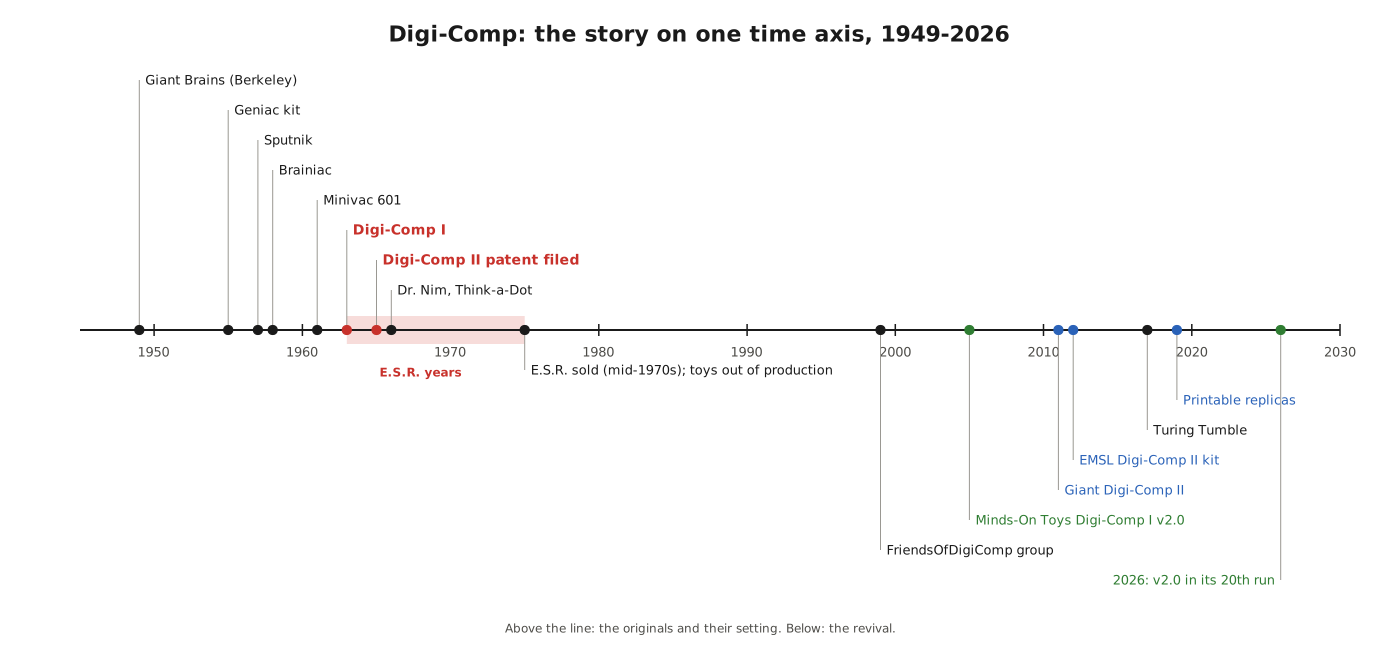
1.6 The Story in Ten Volumes
Volume 2 begins before E.S.R., with Edmund Berkeley’s Giant Brains, or Machines That Think (1949) and his Simon, Geniac and Brainiac kits; with Claude Shannon’s Minivac; and with the shock of Sputnik and the new American push for science and mathematics teaching. It then follows Duerig, Lieberman and Hogan from Kearfott’s laboratories to a stall at the Toy Fair, a Sears buyer, an injection-mould maker, a self-underwritten public offering and a factory at 34 Label Street, Montclair — and on to the end of the company.
Volume 3 opens up Digi-Comp I: the frame, the three flip-flop plates and their readout, the clock planes driven by the lever, the logic rods and their bends, the pegs and the special piece the manual uses for the logical OR. It shows how a peg pattern becomes a set of logic equations, and why the machine is a finite-state machine rather than a general computer.
Volume 4 works the manual’s experiments, from the check-out and the “Final Count Down” to the binary counter, the Nim game, the comparator, the adder and the multiplier, each run on this series’ simulator so that every state shown is a state the machine really reaches.
Volume 5 is the story of Digi-Comp II: Jack Godfrey and his patent, the board and its parts, the registers, the switches and the gate, the manual with its DIGI-TRAN language and FORTRAN chapter, the machine’s fortunes in the market and in schools, and its surprising late career in computational-complexity theory.
Volume 6 works the marble machine’s arithmetic: counting, clearing, adding, multiplying by repeated addition, complements and subtraction, and division, with examples run on the simulator.
Volume 7 follows E.S.R.’s other marble computers — Godfrey’s Dr. Nim, which never loses at Nim unless its “equalizer” is set, and Joseph Weisbecker’s Think-a-Dot, eight coloured flip-flops in a plastic frame — and then the descendants: the giant Digi-Comps, the MIT machine and Scott Aaronson’s 2014 paper on what a Digi-Comp II can compute, and Turing Tumble.
Volume 8 surveys the reproductions: the Minds-On Toys kit, the Evil Mad Scientist machines, the printable designs by Mark Ziemer and Michael Gardi, and the emulators, with what each costs and whether it can be had in October 2026.
Volumes 9 and 10 build the two machines: a Digi-Comp I from the v2.0 kit, assembled and programmed, and a Digi-Comp II from printed parts or cut sheet, assembled, tuned until the marbles run reliably, and set to count and multiply.
1.7 Reading the Series
The volumes are written to be read in order, but each stands alone. Binary numbers are written with their digits in the order the machines display them, and the manuals’ own names for parts and switches — ACCUMULATOR, M-Q REGISTER, CLEAR, COUNT — are kept in capitals where the manuals use capitals. Prices are given in the dollars of the day, with the source and date; prices for reproductions are those shown on the makers’ pages on the date stated.
Three kinds of figure appear: photographs of the machines, their boxes and the people and places in the story; scans of E.S.R.’s manuals, flyers and the patents, always identified as such; and line diagrams drawn for this series, whose generating scripts are kept with the project. Worked examples of either machine’s operation come from the series’ simulator (03-outputs/tools/digicomp_sim.py), which is checked against the problems and answers printed in the original manuals.
1.8 The One-Paragraph Version
The Digi-Comps were two plastic, purely mechanical binary computers made by E.S.R., Inc. of Montclair, New Jersey, a company founded by three engineers from the missile-guidance maker Kearfott. Digi-Comp I (1963, $4.99) has three sliding flip-flops, wire logic rods and a hand-worked clock lever; programs are patterns of plastic pegs, and with them it counts, adds, compares and plays games in three bits. Digi-Comp II (patented 1965 by GE engineer Jack Godfrey, sold for $16) is an inclined board on which marbles roll through toggles that each marble reads and flips, so that gravity-powered cascades of marbles count, add, multiply and divide in a seven-bit accumulator. Sold in their tens of thousands to the children of the space age, with manuals that taught binary, logic and programming, they disappeared in the 1970s when electronics made them obsolete. Since 2005 they have come back as a cardboard-and-wire Digi-Comp I kit, wooden and giant Digi-Comp IIs, printable designs and a family of descendants that includes Dr. Nim, Think-a-Dot and Turing Tumble. The remaining nine volumes are the long version.
Next — Volume 2: E.S.R. Inc. and the Science-Toy Boom — Geniac, Brainiac and the Space Race Kitchen Table. An actuary who wrote Giant Brains and sold build-it-yourself electric brains by mail; a falling-out that produced two nearly identical kits; Claude Shannon’s relay box; Sputnik and the scramble to teach American children science. Then three engineers from a New Jersey missile-guidance firm, a marble computer that would not work, a foot-wide prototype that scared off the buyers at the Toy Fair, a Sears buyer who asked for something simpler, and a company that went public on its own and sold out at Macy’s.
Comments (0)