Digi-Comp · Volume 7
Digi-Comp — Volume 7 — After E.S.R. — Dr. Nim, Think-a-Dot, Turing Tumble and the Giant Digi-Comp
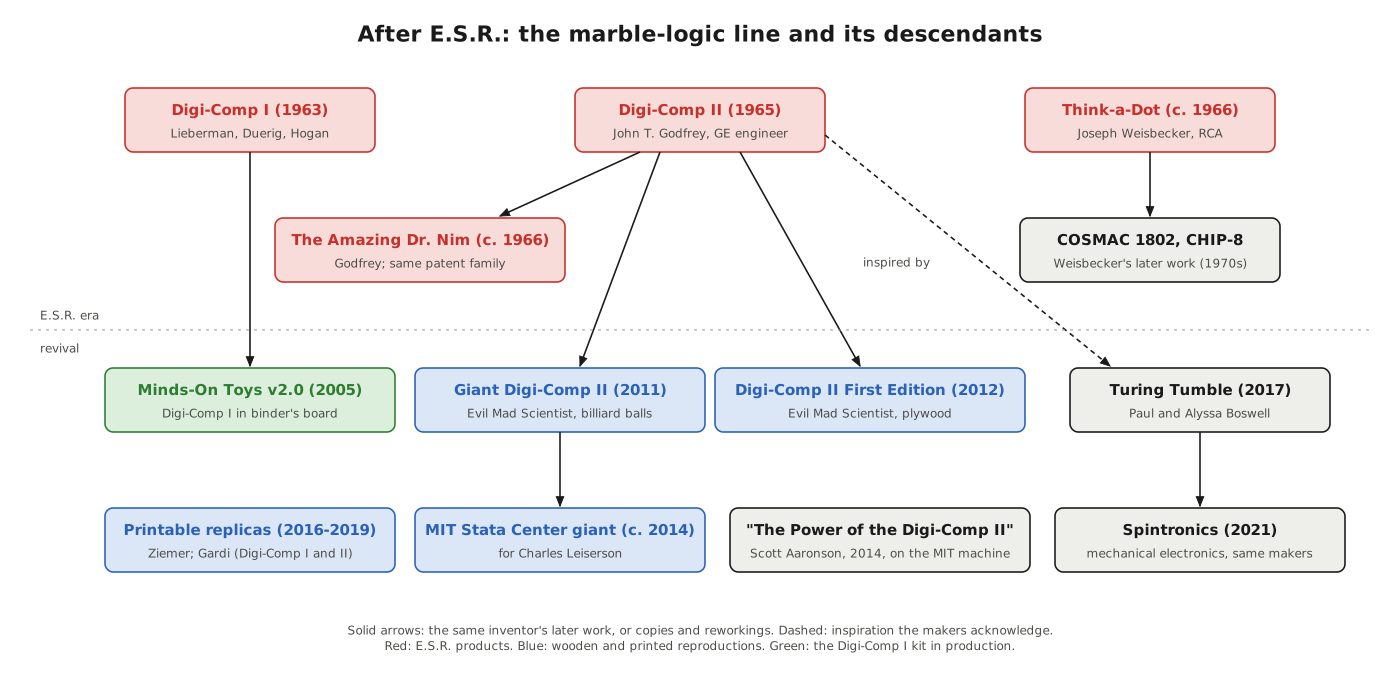
E.S.R.'s other marble computers — Jack Godfrey's unbeatable Nim player and Joseph Weisbecker's eight coloured flip-flops — and what grew from them: a Digi-Comp II big enough to need billiard balls, a giant in MIT's Stata Center and a paper on its computational power, and Turing Tumble, the marble computer of the 2010s
7.1 About This Volume
E.S.R. made four computers. Volumes 3 to 6 deal with the two Digi-Comps; this volume deals with the other two and with what came after the company. The Amazing Dr. Nim, by Digi-Comp II’s inventor Jack Godfrey, is a small red board that plays the game of Nim with marbles and almost never loses. Think-a-Dot, by Joseph Weisbecker of RCA, is an upright frame of eight coloured flip-flops that change colour as marbles drop through it — a puzzle that turned out to be a little piece of group theory. Both were sold alongside the Digi-Comps in the later 1960s, and both vanished with them.
The second half of the volume follows the revival. In 2011 Evil Mad Scientist Laboratories built a giant Digi-Comp II that ran on billiard balls; a giant from the same workshop went to MIT, where it prompted the computer scientist Scott Aaronson to work out what a Digi-Comp II can compute. And in 2017 a chemistry professor and his wife launched Turing Tumble, a reprogrammable marble computer whose inventors credit Digi-Comp II among their inspirations. The reproductions proper — kits and printable copies of the two Digi-Comps — are the subject of Volume 8.
7.2 The Amazing Dr. Nim
7.2.1 An old game
Nim is a game of taking objects from piles. Its origins are obscure; its name and its complete mathematical solution were published by the Harvard mathematician Charles L. Bouton in 1901. The simplest version uses a single pile: two players take turns removing one, two or three objects, and the player who takes the last one wins — or, in the “misère” version, loses. Because the winning strategy can be stated as an arithmetic rule, Nim has been a favourite of game-playing machines since there were machines. The Nimatron, a relay machine conceived by the physicist Edward Condon and built by Westinghouse for the 1940 New York World’s Fair, was played, Condon later said, more than 100,000 times (Wikipedia, “Nimatron”); the Nimrod, built by Ferranti for the Festival of Britain in 1951, was one of the first digital computers designed to play a game (Computer History Museum timeline, 1951).
7.2.2 A marble Nim player
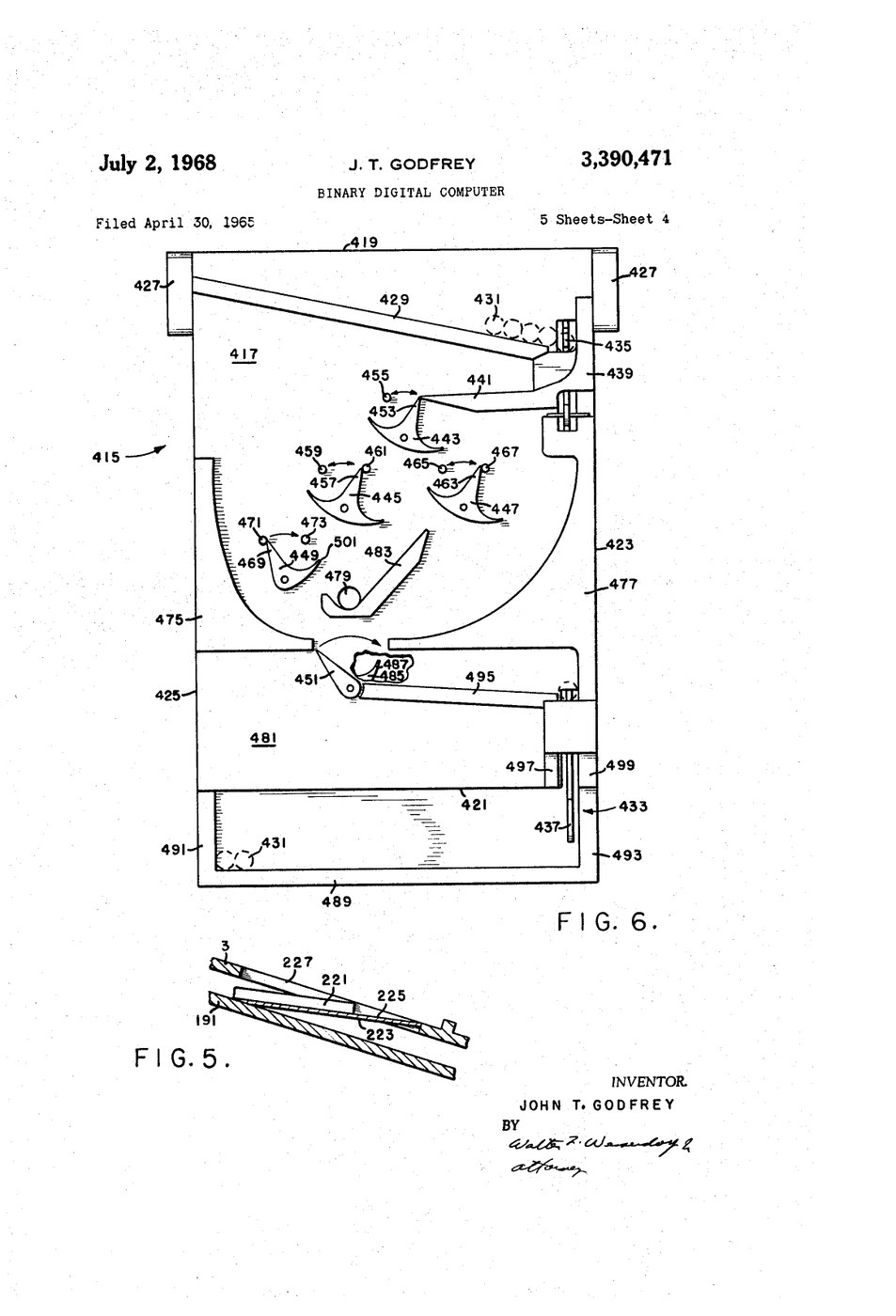
Godfrey’s Nim player reduced all that to a moulded plastic board about a foot square. It came to E.S.R. at the same time as Digi-Comp II — in the same telephone call, according to Bill Duerig — and, being the simpler of the two, went on sale first, after Dave Hogan redesigned it for injection moulding (Duerig, letter of March 2000). Its game rests on the same principle as Digi-Comp II, and Godfrey’s patent for the larger machine describes two Nim boards as further embodiments of the invention: a rack of fifteen balls; a player and the machine each “gating” one, two or three balls per turn; and “the player left with one ball to gate loses the game” (US 3,390,471).
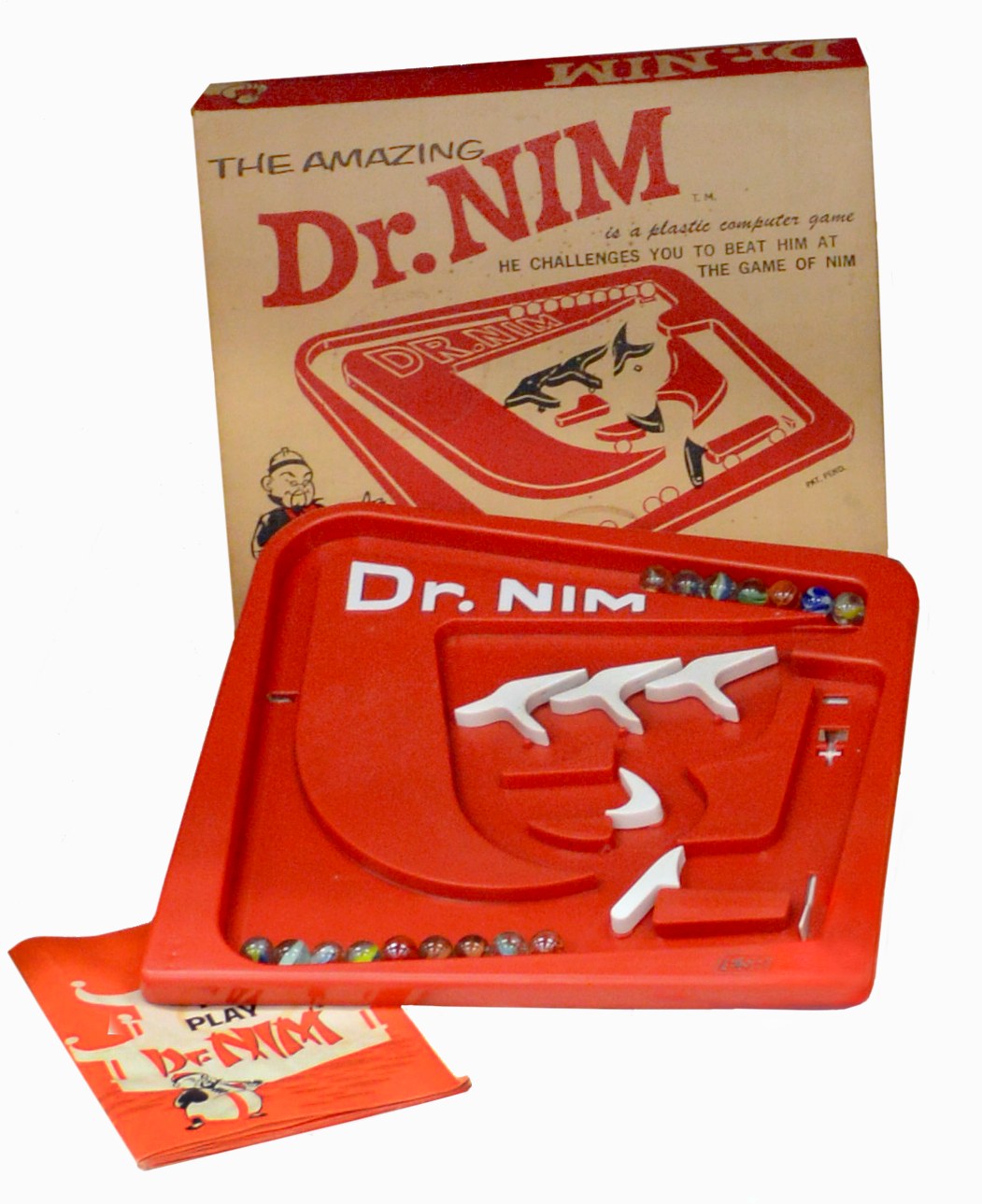
The product, sold as The Amazing Dr. Nim at a suggested $3.50 “for ages 6 to adult”, played exactly that game. Its instruction booklet sets it up in a few lines (The Amazing Dr. Nim manual):
PUT THE 15 MARBLES IN THE TOP ROW OF THE MACHINE. … You may take 1 or 2 or 3 marbles on each turn. The one who takes the LAST marble LOSES. … PUSH the TRIGGER once for each of the 1 or 2 or 3 you may want to take. After your turn, flip the TURN SWITCH to DR. NIM. Then push the TRIGGER only ONCE and Dr. Nim will take his turn. When he is finished, Dr. Nim will flip the TURN SWITCH back to PLAYER for your turn.
When the human pushes the trigger once, one marble rolls down through the machine and out of play. When it is Dr. Nim’s turn, a single push releases a marble whose path through three flip-flops either releases another marble — Dr. Nim “taking” again — or flips the turn switch back and stops. In effect the machine is a three-bit state machine that keeps count of the marbles and stops at the right moment — the same self-gating cascade as Digi-Comp II on a smaller scale. A fifth element, the equalizer, is a handicap in the player’s favour. The manual explains that Dr. Nim, “being a true gentleman, purposely makes a mistake on his first move to give the player a chance. That is what the ‘Equalizer’ is for.” Forget to set it, and in most games “no matter how you play DR. NIM will always win”.
The booklet is explicit about why the toy deserves to be called a computer. Dr. Nim, it says, can count (the marbles, with his top three logic elements); can “make logical decisions dependent upon the states of his logic elements” — whether to take another marble, whether to hand the turn back; can “alter the states of his logic elements as the game progresses to represent the state of the game”; can “remember” the state of the game between turns; and can “gate impulses in the form of marbles to continue its play as required to play a winning game”. “Counting, logical functions, altering internal states, memory, and gating impulses are all typical characteristics of a computer,” it concludes, and they “are combined in such a manner that the machine appears to play an ‘intelligent’ game of NIM.”
The manual does not stop at the rules. Like Digi-Comp’s, it includes “a detailed write-up of DR. NIM as a COMPUTER”, naming the flip-flops A, B and C, the turn switch D and the equalizer E, tabulating their states as the game proceeds, and drawing the conclusion in Boolean algebra. It notices, for example, that after his first turn Dr. Nim “stopped when there was one more than a multiple of 4 marbles”, and writes the condition for stopping as a Boolean equation in the five elements — “the basis for all digital computer operation; whether it be an elementary one like DR. NIM or a giant electronic brain.” It also includes a discussion of computers as “thinking machines”. Note that the game in the manual and in the patent is the misère game with fifteen marbles; some modern summaries describe a game of twelve marbles in which taking the last one wins, which is not what the booklet says.
Dr. Nim has had a long afterlife on the internet. In 2013 Evil Mad Scientist Laboratories wrote up a Dr. Nim found in the closet of a holiday home (Evil Mad Scientist, “Dr. Nim”, 10 July 2013); in 2016 they published video of two hand-made 1960s prototypes belonging to Andrew Beck, the second of which still worked and was close to the production design (Evil Mad Scientist, “Dr. Nim Prototypes”); and in 2018 the maker Michael Gardi published a 3D-printable model of it at two-thirds scale (Volume 8). Videos of the machine by mathematics popularisers have been watched millions of times.
7.3 Think-a-Dot
7.3.1 A marble puzzle from RCA
E.S.R.’s fourth computer came from Joseph A. Weisbecker (1932–1990), an engineer at RCA in the Princeton area. Like Godfrey, he telephoned E.S.R. after seeing Digi-Comp I, with a marble machine of his own. “We had him come up and fell in love with it,” Duerig wrote, “and named it Think-a-Dot. Again Dave redesigned it for plastic injection molding and we put it on the market.” Weisbecker filed his patent for a “Computer-type game and teaching aid” on 21 July 1966; it was granted as US 3,388,483 on 18 June 1968 (US 3,388,483).
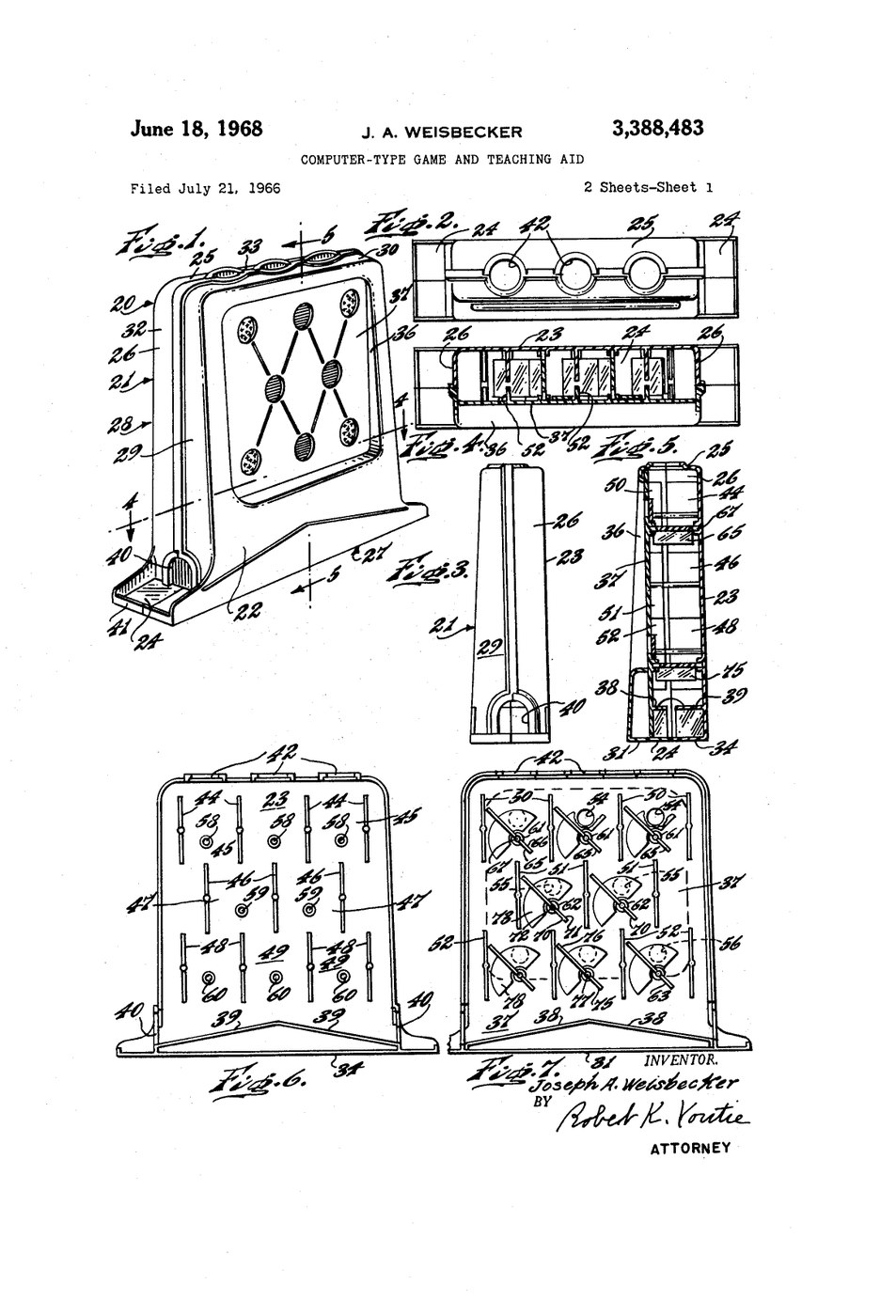
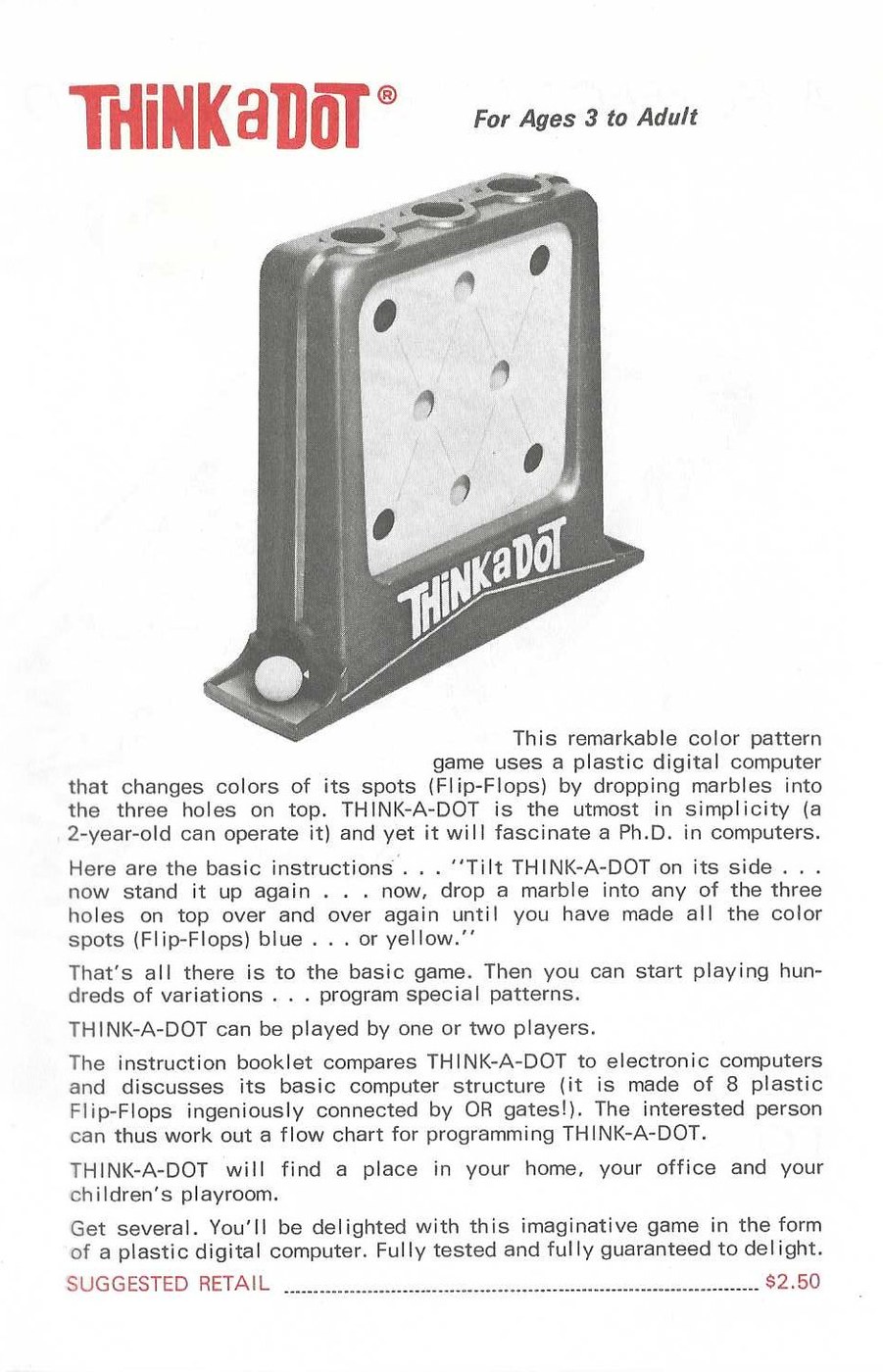
Think-a-Dot is an upright plastic frame, about the size of a paperback book, with three holes in its top edge and eight coloured spots on its face, arranged in rows of three, two and three. Each spot is the visible face of a flip-flop gate inside. A marble dropped into one of the holes falls through the frame; at each gate it meets, it is deflected left or right according to the gate’s state, and it flips the gate, changing the spot’s colour from yellow to blue or back. Tilting the frame on its side and standing it up again sets the gates to a starting pattern. The puzzle is to drop marbles into the holes until the spots show a target pattern — all blue, say, or a checkerboard — in as few drops as possible. The basic game was only the start. The flyer promised “hundreds of variations”, for one or two players, in which the owner could “program special patterns”; and “the instruction booklet compares THINK-A-DOT to electronic computers and discusses its basic computer structure”, so that “the interested person can thus work out a flow chart for programming THINK-A-DOT”. E.S.R. sold it for $2.50 “for ages 3 to adult” with the claim that “a 2-year-old can operate it and yet it will fascinate a Ph.D. in computers”, and described it, accurately, as “made of 8 plastic Flip-Flops ingeniously connected by OR gates” (E.S.R., “A Word About E.S.R. Inc.”).
7.3.2 An octal machine
The founders were surprised by what their customers found in it. Duerig had a colleague at Kearfott whose son was, in his words, “a thirteen year old genius”. “We sent him a Think-a-Dot and a few days later he came back with the advice that this was an octal based machine. So we included this in the manual that you see today.” The Think-a-Dot manual duly explains octal numbers and shows how the machine can be used to count, add and subtract in base eight: each hole’s pattern repeats after eight drops, so the number of marbles dropped into each hole matters only modulo eight (Think-a-Dot manual).
The mathematics goes further than that. Because the effect of a sequence of drops does not depend on their order, any sequence can be summarised by how many marbles went into each of the three holes. Of the 256 colour patterns the eight spots can show, only 128 can be reached from a given starting pattern, and every reachable pattern can be reached from any other in at most nine drops (Jaap Scherphuis, “Think-a-Dot”, Jaap’s Puzzle Page). Duerig recalled that two doctoral theses, one in Australia and one at Columbia, used Think-a-Dot in their development; in later decades it became a stock example in courses and papers on finite automata and group theory.
7.3.3 Weisbecker afterwards
Weisbecker’s later work is better known than his toy. In the early 1970s he designed, at home and in TTL logic, an experimental computer whose architecture became RCA’s COSMAC 1802 microprocessor; he wrote the CHIP-8 interpreted language for the COSMAC VIP and related machines; and his daughter Joyce Weisbecker, programming his prototypes, became one of the first women to design commercial video games (Wikipedia, “Joseph Weisbecker”). Think-a-Dot is a small but genuine first chapter in a career devoted to making computers simple enough for anyone to own.
7.4 The Giant Digi-Comp
7.4.1 Larger than life
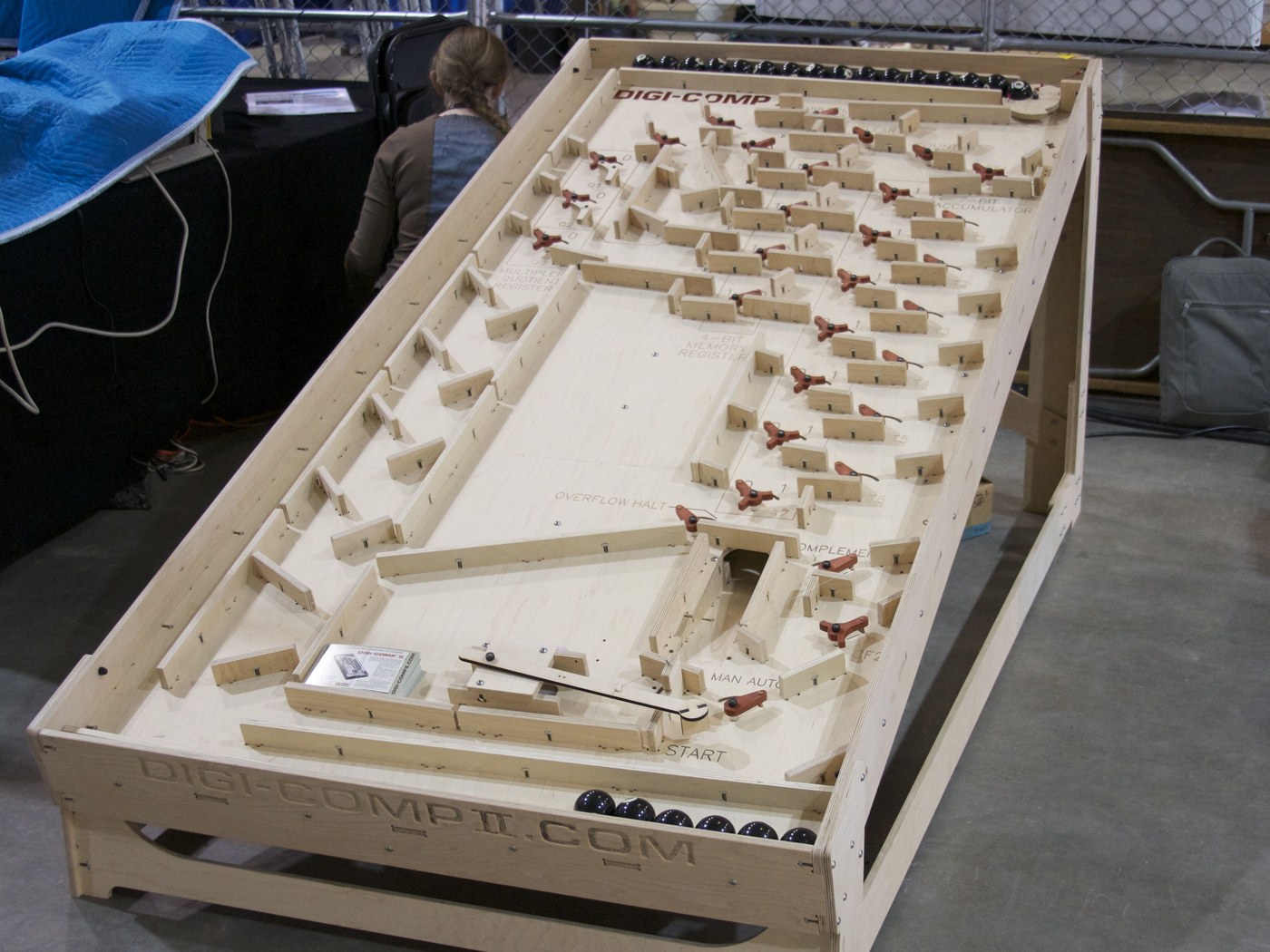
For thirty years after E.S.R. stopped selling it, Digi-Comp II survived as a collector’s item and a memory. Its revival began in Sunnyvale, California, with Evil Mad Scientist Laboratories, a small company run by Windell Oskay and Lenore Edman that made open-source electronics kits and art machines. Working from photographs, scans and documentation collected by the FriendsOfDigiComp group, they built a “larger-than-life” reproduction and showed it at the Bay Area Maker Faire in San Mateo in May 2011 — their tenth Maker Faire (Evil Mad Scientist, “Digi-Comp II and the 2011 Bay Area Maker Faire”, 21 May 2011).
The giant follows Godfrey’s layout but is scaled to 2¼-inch billiard balls — black 8-balls — in place of half-inch marbles. Its top deck, of CNC-routed plywood, is “just under 4×8 feet”. As in the original, the operator sets two numbers and the configuration switches and pulls the start lever; each ball arriving at the bottom releases the next from the top, and most calculations need many balls. Oskay wrote that it was sturdy enough that it “might make a good museum exhibit someday”.
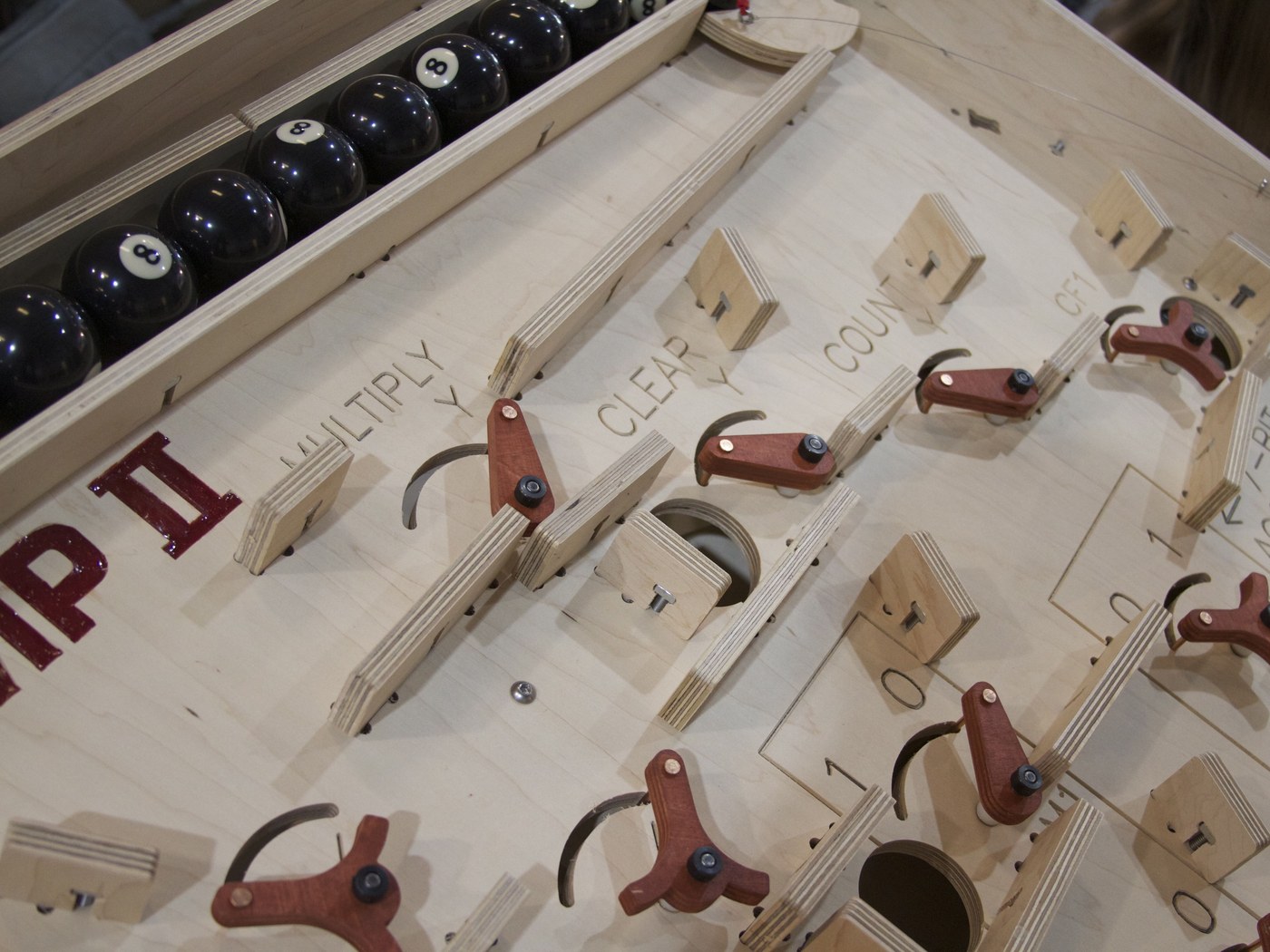
The machine was the start of a project rather than an end. At Maker Faire New York later in 2011 the company showed an all-new prototype at the original tabletop scale, running on half-inch steel balls; the giant went back to the Bay Area Maker Faire in 2012; and in December 2012 they announced a tabletop machine for sale, the Digi-Comp II: First Edition, described in Volume 8.
7.4.2 The MIT giant and the power of the Digi-Comp II
A giant Digi-Comp II made by Evil Mad Scientist now stands on “Student Street” in the Stata Center at the Massachusetts Institute of Technology, where visitors can operate it. It was given to MIT’s Computer Science and Artificial Intelligence Laboratory as part of the celebration of Charles Leiserson’s sixtieth birthday — Leiserson, co-author of the standard algorithms textbook known as CLRS, spent many hours working with the makers on it and with the laboratory on its safety (MIT CSAIL, “DigiComp II”).
It was there that Leiserson showed the machine to his colleague Scott Aaronson, and Aaronson’s post of 4 July 2014, “The Power of the Digi-Comp II: My First Conscious Paperlet”, followed (Aaronson, Shtetl-Optimized). As Volume 5 explains, he showed that predicting the behaviour of an idealised Digi-Comp II with a polynomial number of balls is a complete problem for the complexity class CC, defined by comparator circuits and containing the stable-marriage problem: powerful, but probably short of being able to simulate arbitrary circuits. Evil Mad Scientist reported the result on their own blog the same day. Later that year a player of the video game Terraria built a working Digi-Comp II inside the game, which the same blog noted on Christmas Day.
7.5 Turing Tumble
7.5.1 A reprogrammable marble computer
Digi-Comp II’s most successful descendant is not a copy of it. Paul Boswell, then a chemistry professor at the University of Minnesota, wanted a game in which, as he put it, “the program runs itself”, and while researching mechanical computers came across Digi-Comp II, which he described as a brilliant little calculator powered by marbles; he built on many of its ideas (Bethel University, “Turing Tumble”, June 2017). With his wife Alyssa Boswell he designed Turing Tumble, named after Alan Turing, and launched it on Kickstarter in 2017. The campaign’s $48,000 goal was reached in about fourteen hours; it closed at about $400,000 (University of Minnesota, “Changing Gears”, 26 May 2021).
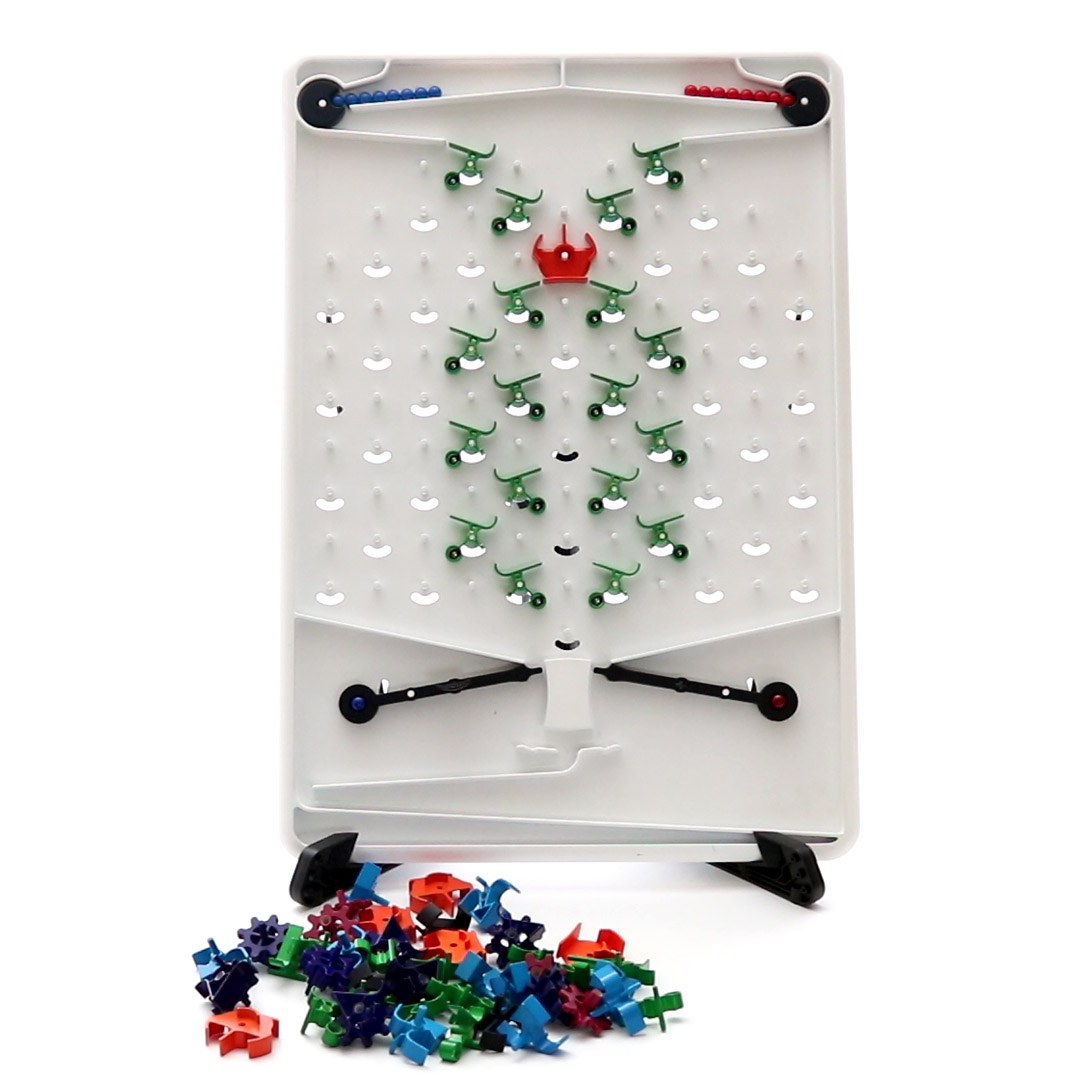
The family resemblance is plain. Turing Tumble is an upright board down which marbles roll; at the bottom, a lever triggered by the arriving marble releases the next one, blue or red according to which side it was triggered from. On the board the player places parts: ramps that send a ball one way; crossovers that let paths cross; bits, which are exactly Digi-Comp II’s toggles — a ball is deflected by a bit and flips it; gear bits, bits linked by gears so that flipping one flips its neighbours; and interceptors, which catch a ball and stop the machine (Wikipedia, “Turing Tumble”). Where Digi-Comp II’s course was fixed and only its switches could be set, Turing Tumble’s whole course is the program. Sixty puzzles, framed by a comic about an astronaut, lead the player from simple patterns to counters, adders and logic.
The gear bit gives Turing Tumble something Digi-Comp II lacked — one ball can change several bits at once — and the consequence for its computing power has been worked out in the same spirit as Aaronson’s paper. Predicting whether a marble reaches a given interceptor on a Turing Tumble board is P-complete, and PSPACE-complete if exponentially many marbles are allowed (Matthew P. Johnson, 2019); an idealised Turing Tumble with an unbounded board and unlimited parts is Turing-complete (Lenny Pitt, Theoretical Computer Science, 2023; arXiv 2110.09343). The marble computer, extended a little, became universal.
7.5.2 A commercial success
Turing Tumble did what Digi-Comp II never managed. By 2021 its makers had sold nearly 200,000 units, mostly through their own website, and it was in use in three to four thousand schools; it won a Parents’ Choice Gold Award and was named among the American Specialty Toy Retailing Association’s Best Toys of 2018. The Boswells’ company, Upper Story, followed it with Spintronics (Kickstarter, May 2021), a mechanical model of electronic circuits in which wound-up chains play the part of current; and as of October 2026 Upper Story still sells both (Upper Story, Turing Tumble). Turing Tumble is a descendant, not a reproduction; it belongs in this story because it shows what Godfrey’s toggle could do once the course itself became programmable.
7.6 What the Line Shows
Taken together, E.S.R.’s four products and their descendants show a single idea worked out several ways. A two-position lever that a moving object both reads and flips is a complete one-bit memory with built-in logic. Chained along a fixed course, such levers make Digi-Comp II’s counters and adders; cut down to three and a turn switch, they make Dr. Nim’s game strategy; arranged in a lattice under three holes, they make Think-a-Dot’s octal puzzle; made into loose parts on a peg board, they make Turing Tumble’s programmable computer. Scaled up to billiard balls, they make a museum exhibit; abstracted into a graph, they make a complexity class. The constant is visibility: in every one of these machines the state of the computation is something that can be seen, and the computation is something that can be watched.
Two other things are constant too. Every one of these toys came from an engineer or scientist with a day job — Godfrey at General Electric, Weisbecker at RCA, the Boswells at a university — who wanted to show other people how computers work. And every one of them, original or descendant, depended on a manual or puzzle book that took that teaching seriously.
Next — Volume 8: The Reproductions — Re-making Digi-Comps in the 21st Century. Where to get a Digi-Comp in October 2026: the Minds-On Toys Digi-Comp I v2.0 in laminated binder’s board and piano wire, now in its twentieth production run; Evil Mad Scientist’s plywood Digi-Comp II, and why it can no longer be bought; free files for 3D-printed copies of both machines from Mark Ziemer and Michael Gardi; Gardi’s four-bit Digi-Comp I Redux; and the emulators and simulators that run the programs without any plastic at all.
Comments (0)