SIGABA · Volume 7
SIGABA — Volume 7 — The CCM and Allied Interoperability
How the United States and Britain came to share a cipher machine without sharing the SIGABA: the Combined Cipher Machine, Donald Seiler's adapters for SIGABA and Typex, its service from 1943, the short-cycle flaw found in Dayton and the 'lobsters' found in London, and its long afterlife with the State Department and NATO
7.1 About This Volume
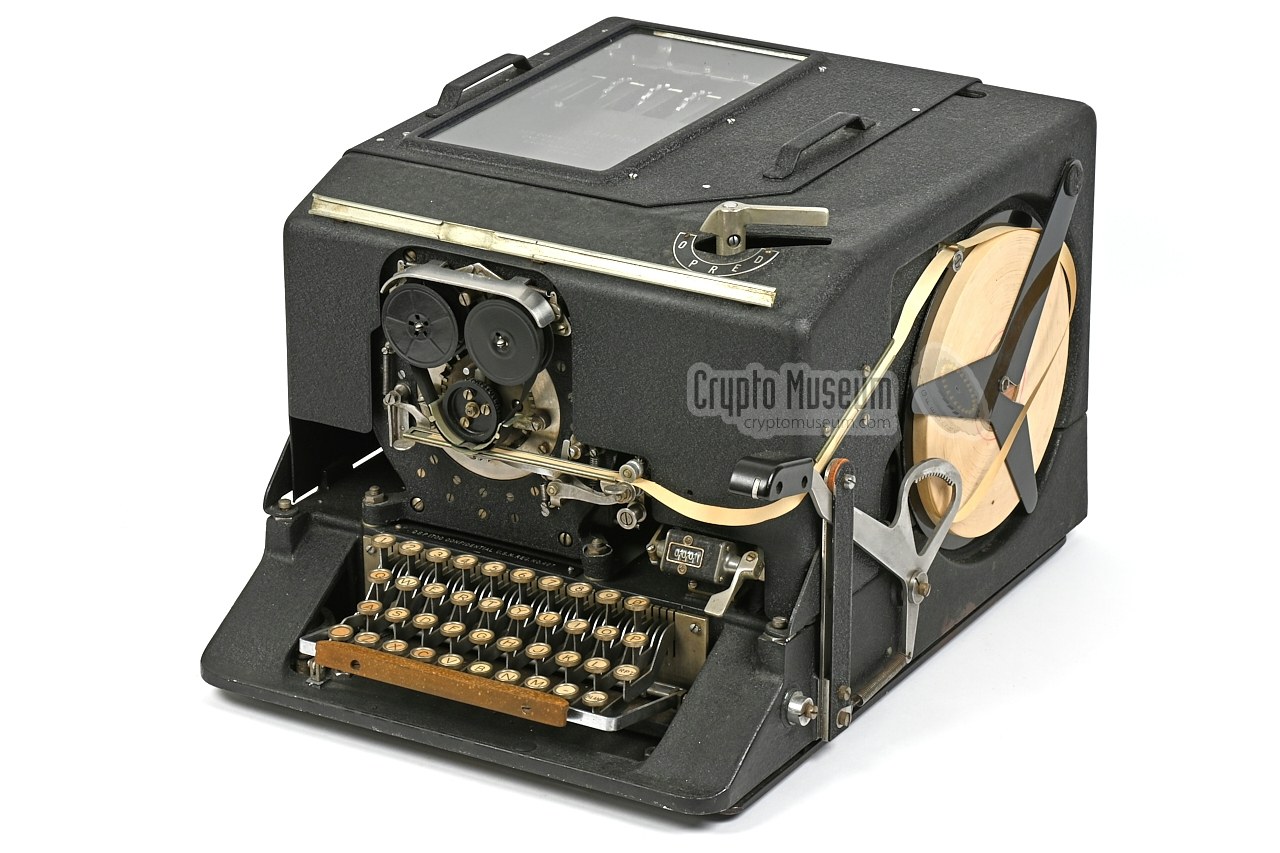
Volume 6 quoted the joint policy of June 1942 under which the United States refused to let any foreigner see the SIGABA. That policy created a problem the moment the United States entered the war, because its most important ally needed to talk to it — at sea above all, where British and American escorts shared the convoys of the North Atlantic. The British had their own high-grade machine, Typex, which the Germans never broke either, but Britain could not make enough of them to equip the US Navy. The Americans would not hand over the SIGABA. Something had to give.
The answer was the Combined Cipher Machine (CCM): not a new machine but a common cryptographic system that both nations’ existing machines could be converted to run. This volume explains how it came about, how the conversions worked, how many were made, how the CCM was used, and what was wrong with it — a design flaw that gave some keys a dangerously short period, found by the Americans in 1943 and fully understood only in 1945. It ends with the CCM’s long postwar career with the US State Department, the US Army’s attachés and NATO.
The CCM matters to the SIGABA story for two reasons. It is the clearest demonstration of how jealously the SIGABA’s own principle was guarded; and it shows, by contrast, how much of the SIGABA’s strength came from the control and index banks that the CCM left out.
7.2 Two Allies, Two Machines
7.2.1 Typex
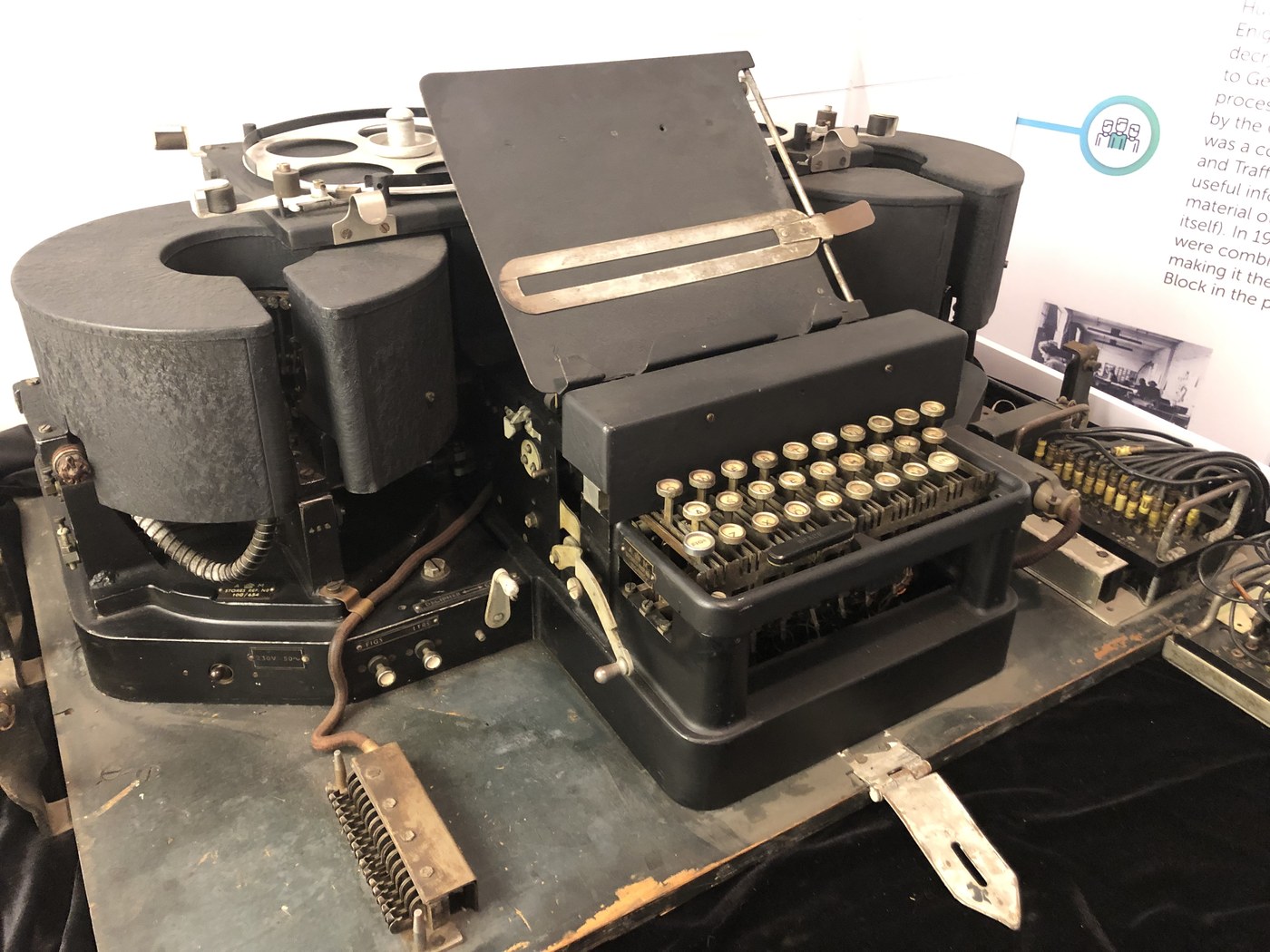
The British Typex was developed from 1934 by Wing Commander O. G. W. Lywood of the Royal Air Force as a British variant of the commercial Enigma. Production machines reached the RAF in early 1937. Like the Enigma it used a reflector, and its rotors stepped in the Enigma’s odometer fashion; unlike the Enigma it had five rotors, of which the first two were stationary, rotors with several turnover notches each, and two printers instead of a lampboard. The wartime Mark 22 added plugboards (Crypto Museum, “Typex”). The Germans looked at it and, believing it to be an improved Enigma, made no serious effort against it. The German cryptanalyst Erich Hüttenhain told his interrogators in 1945: “the British Typex is known. It was not broken, and so far as we know cannot be solved unless the wheel positions are known” (Mucklow 2015, p. 24).
7.2.2 The problem of 1942
The naval link between the two countries was, until 1943, a hand system — the Admiralty’s Naval Cypher No. 3, used as the common Anglo-American naval cipher in the Atlantic. German naval codebreakers of the B-Dienst read much of it during the worst of the convoy battles. In the 1942 negotiations over something better, the British declined the American offers of the M-138-A strip cipher and the M-209; the United States declined to release the SIGABA; and Typex, though considered secure, could not be produced in the numbers needed (Christos military and intelligence corner, “The Combined Cipher Machine — 1942–1962”).
The way out was American, and naval. In June 1942, as the historian Ralph Erskine summarised it, “in order to ensure that the United States and the United Kingdom could afford high-level protection to their naval wireless traffic, it was … agreed that adaptors should be designed for both Sigaba and Typex by the United States Navy to transform them into a common machine, the Combined Cipher Machine (CCM). The extremely ingenious adaptor for Typex for this purpose was designed by Commander Don Seiler, who also devised the related adaptor for Sigaba” (Erskine, introduction to GCCS signals of March 1945; Library copy). Donald W. Seiler was the Navy engineer who had designed the ECM Mark I and the index bank of the Mark II (Volume 2).
A prototype was demonstrated to the British in October 1942, and the Anglo-American Combined Communications Board approved the CCM the same month. Production began in December 1942 (Christos, 2025).
7.3 How the CCM Worked
7.3.1 One maze of five wheels
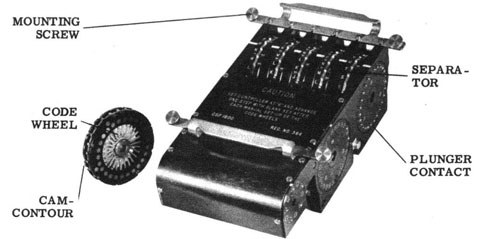
The CCM was a five-rotor machine with no separate control or index bank. The Navy’s 1944 manual describes the SIGABA conversion, which it calls the CCM Mark 1 (CSP 1600):
The Combined Cipher Machine Mark 1 (CSP 1600) is a device which converts the ECM Mark 2 to the cryptographic equivalent of the CCM. The CCM Mark 1 is a unit similar to the ECM Mark 2 Cipher Unit. All alterations and modifications are contained within the unit and no change in the ECM Mark 2 is necessary except to insert CSP 1600 into the machine in place of CSP 887.
— CSP 1100(C), para. 601
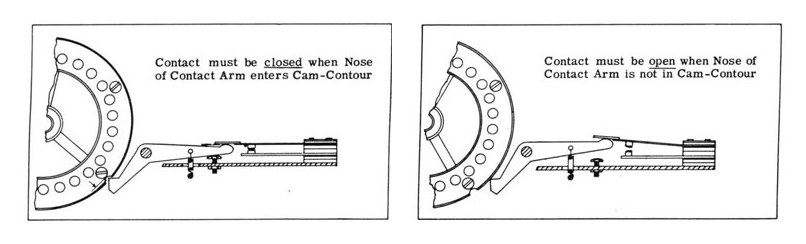
The CCM’s rotors looked like SIGABA rotors but were different in one important respect. Around the rim of each face they had cam contours — notches cut “at irregular intervals on the periphery” — and the cam lobes the SIGABA used for zeroizing were ground off (para. 602). Only five of a set of ten rotors were used at a time, and those five formed the whole of the enciphering maze. Four spring contact arms rode on the rotor rims; where a contact’s nose dropped into a notch it closed a circuit that energised a stepping magnet.
7.3.2 Stepping from the centre outward
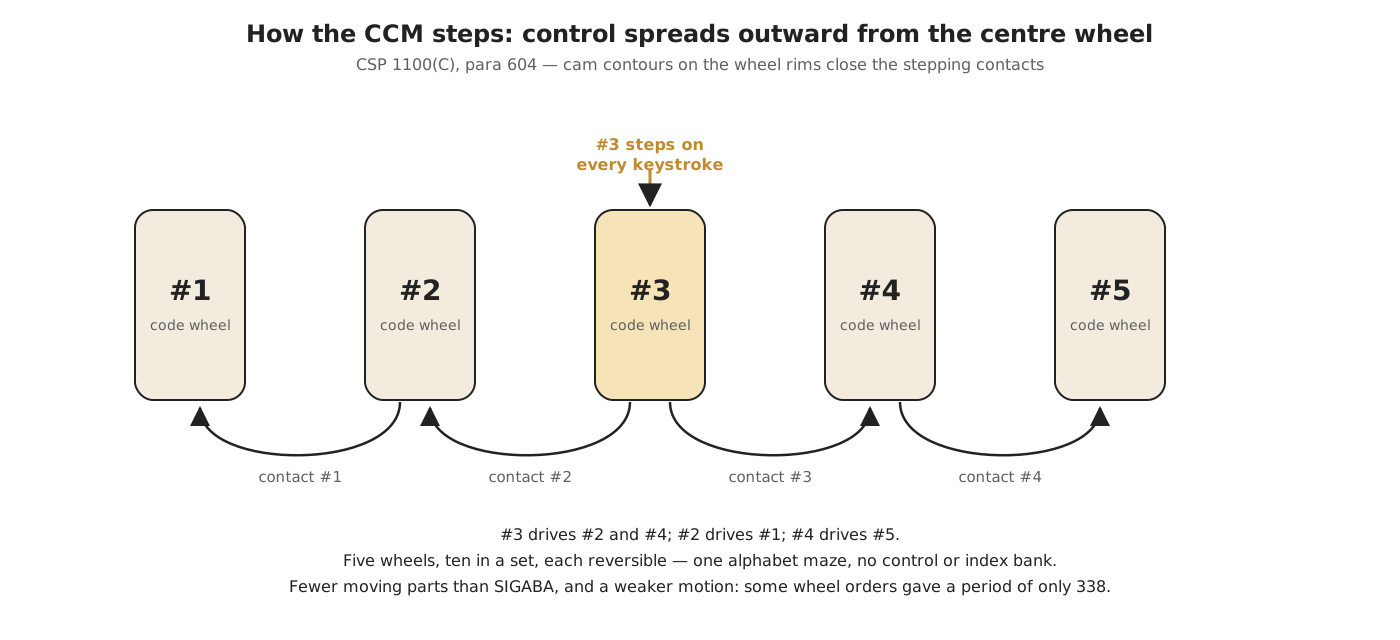
The stepping scheme was neat and simple (para. 604):
- The centre wheel, #3, stepped one position on every keystroke.
- As it turned, its notches operated two contacts: contact #2, which stepped wheel #2, and contact #3, which stepped wheel #4.
- Wheel #2’s notches operated contact #1, which stepped wheel #1; wheel #4’s notches operated contact #4, which stepped wheel #5.
“The Stepping Control thus originates with the center Code Wheel and progresses to each side.” Because the notch patterns were irregular and the wheels could be inserted either way round, the motion of the outer wheels was irregular too — but it was mechanical, determined by the wheels themselves, and in the end periodic. That is the trade the CCM made: it borrowed the SIGABA’s idea of irregular, key-dependent stepping, but generated it with cams on the cipher rotors instead of with a separate maze of control and index rotors.
One quirk follows from the CCM’s being two different machines. “The ECM Mark 2 prints and then steps whereas some machines cryptographically equivalent step and then print” — the Typex was one of these — so the SIGABA version needed an extra BLANK step after every manual alignment to keep in step with its British counterpart (para. 604(c)).
7.3.3 The three routes
The CCM existed in three physical forms, all cryptographically identical and all using the same rotors:
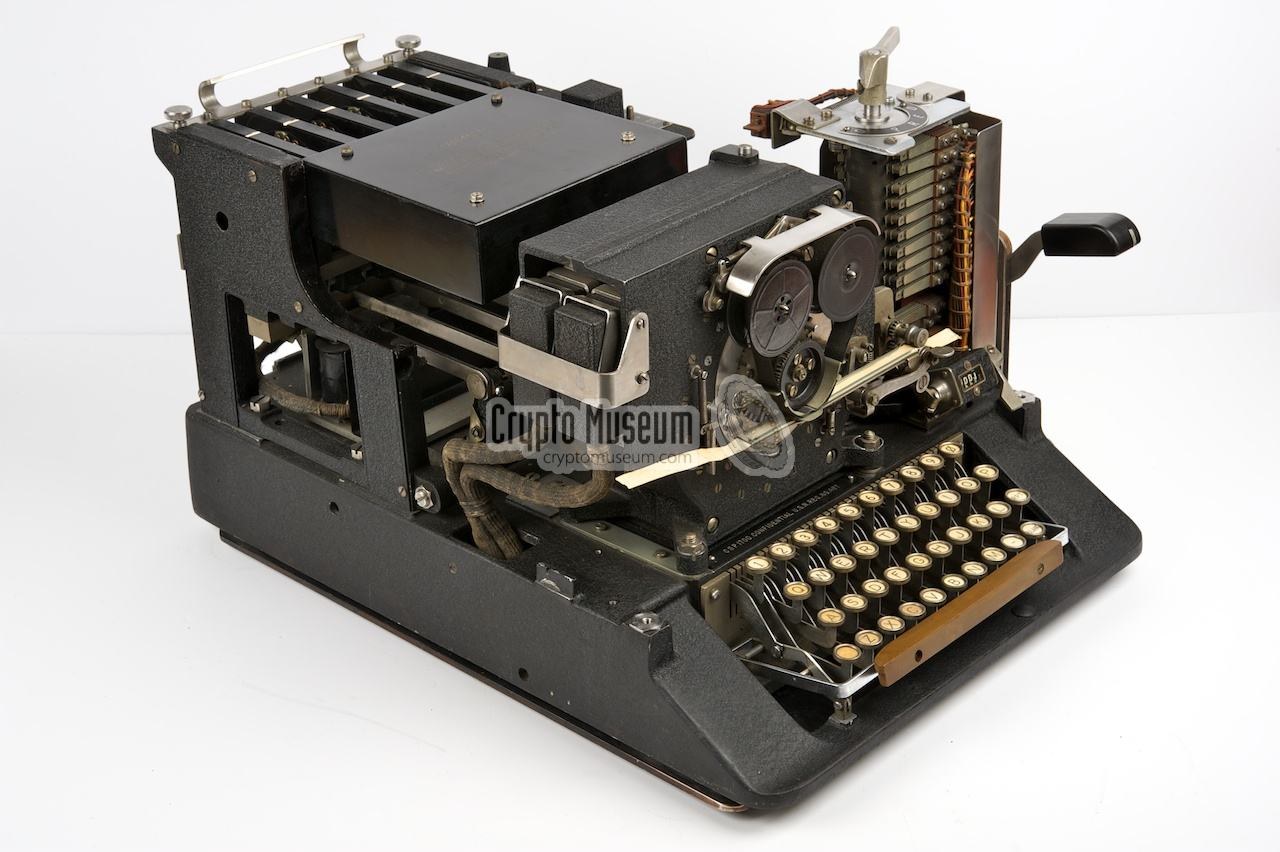
- CSP 1600, CCM Mark 1: a replacement rotor basket for an existing SIGABA. The operator unscrewed the CSP 887 cipher unit and put the CSP 1600 in its place, keeping the SIGABA unit in the CCM’s metal box while it was out. The machine could go back to being a SIGABA in minutes.
- CSP 1700, CCM Mark 2: a SIGABA chassis with a fixed CCM basket, which could not be converted back. The 1943 timeline calls it the “self-contained version”. These were the machines that could be given to allies, because they contained no SIGABA parts that mattered.
- CSP 1800, CCM Mark 3: Seiler’s adapter for the British Typex. A Typex Mark 22 modified to take it, with four mounting posts and an extra connector, became the Typex Mark 23 (British designation of the adapter, BID/08/3A).
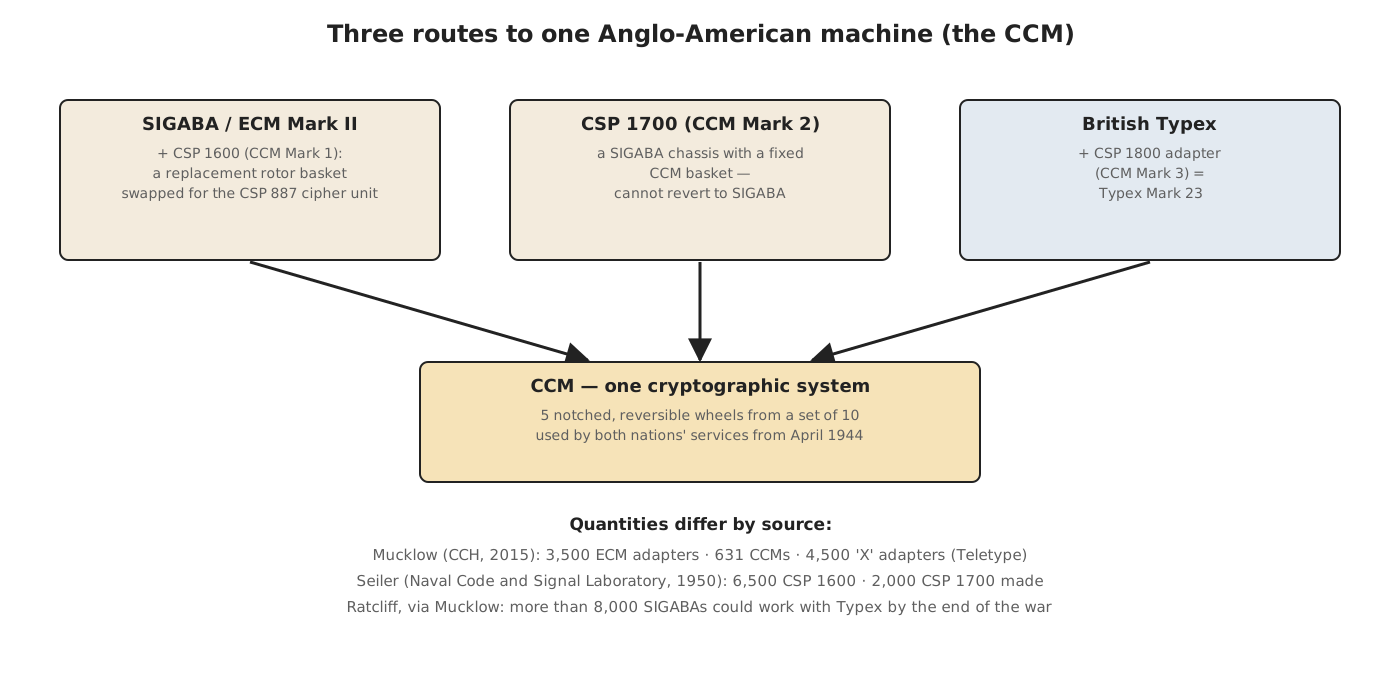
How many of each were made is not certain. Mucklow, writing for the NSA, gives three figures: 3,500 “ECM Adapters” (CSP 1600) made at the Washington Navy Yard’s ECM repair shop; 631 CCMs made at the same shop “exclusively for joint Allied communications” — “because of cost”; and 4,500 “X” adapters made by the Teletype Corporation in Chicago and sent to depot-level maintenance facilities for installation. “All three of these options used Typex-configured cipher rotors” (Mucklow 2015, p. 22). Seiler’s own 1950 history of the Naval Code and Signal Laboratory, which built most of them, says the laboratory designed the CSP 1600, 1700 and 1800 and “manufactured 2,000 CSP 1700 and 6500 CSP 1600” (Seiler 1950; Library copy). Christos’s 2025 study of the files reports that by 31 December 1943 2,200 Typex adapters and about 114,000 CCM rotors had been delivered to Britain, 1,525 CSP 1600 baskets were with the US Navy in the Atlantic, and about 500 CSP 1700s had gone to the British and Canadians, and that by the end of 1944 1,220 naval Typex machines had been converted. By the end of the war, Mucklow says, citing Ratcliff, more than 8,000 SIGABAs could interoperate with Typex, and “nearly all U.S. military communications facilities could process joint-Allied secure communications traffic”.
7.4 The CCM at Work
7.4.1 Into service
The design was finished quickly; production was not. Erskine records that “production delays prevented the CCM from entering service, except on a few minor circuits, until late 1943”. The self-contained CSP 1700s were first delivered in May 1943 and the Typex adapters in July. On 1 November 1943 there were enough machines for the North Atlantic, about 250 British and Canadian ships, and the CCM went into limited use between the Royal Navy and the US Navy; at the end of 1943 it was extended to combined naval use outside the North Atlantic. By April 1944 it was operational with all five British and American services — the two navies, the two armies and the RAF — and from mid-1944 to February 1945 it was distributed through the British Pacific Fleet (Erskine; Christos 2025).
The CCM was used where the two nations’ forces had to talk to each other: the convoy routes, the combined headquarters, the circuit between the US Navy’s OP-20-G in Washington and the British Government Code and Cypher School (GC&CS) at Bletchley Park over which naval Enigma intelligence was exchanged. Mucklow notes that joint tactical communications in the Pacific ran on Typex and, in the latter part of the war, on the CCM, and that the CCM carried traffic for the Allied coordination of joint operations (Mucklow 2015, p. 26).
7.4.2 Key lists for two nations
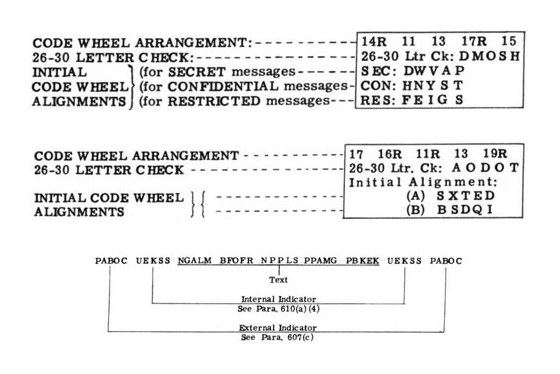
The Navy’s 1944 manual shows the CCM’s key settings in two forms. A US Navy key setting gave a code wheel arrangement of five numbers (R for reversed), a 26–30 letter check, and three initial code wheel alignments for SECRET, CONFIDENTIAL and RESTRICTED messages. A combined US–British key setting gave the arrangement, the check and two initial alignments, labelled A and B, whose classifications were defined by a footnote in the key list. The message procedure was the joint method of Volume 5: set the initial alignment, encipher five random letters to make the internal indicator, reset to the five letters and encipher the text (CSP 1100(C), paras 606–610).
The Army issued its own CCM instructions, Operating Instructions for CCM (short title SIGDUBN-1), dated 13 March 1945 (Crypto Cellar; Library copy).
7.5 The Flaw: a Period of 338
7.5.1 Found in Dayton
The CCM’s simplicity had a cost, and the Americans found it first. The period of a rotor machine is the number of letters it enciphers before every rotor is back where it started and the sequence of substitutions begins to repeat; text enciphered beyond the period is in depth with the start of the message. The CCM’s designers intended a minimum period of 4,394 letters (2 × 13³).
Experiments to test the period began in the spring of 1943 at the US Naval Computing Machine Laboratory in Dayton, Ohio — the Navy’s bombe factory, run with the National Cash Register Company. They found that with some rotors the period was only 338 letters (2 × 13²). On 4 June 1943 an order went out limiting messages on the CCM link between Dayton and OP-20-G to 100 groups. Similar restrictions do not seem to have been applied to other circuits until early 1944, and a detailed study of the period was not begun by the OP-20-G research section until 16 January 1944 — “a full six months after the short cycle defect was first discovered”, Erskine notes. On one circuit alone, keys in force between 12 February and 20 April 1944 produced the 338 period on seven days (Erskine; Library copy; OP-20-G, “The Period of the CCM”, 17 April 1944; Library copy).
In February 1944 Hugh Alexander, head of Bletchley Park’s Hut 8 (naval Enigma), was told of the problem while visiting OP-20-G; since Hut 8 was the main user of the CCM circuit to Washington, he signalled GC&CS at once to cut CCM messages to 70 groups instead of the agreed 200.
The cause lay in how the rotors were notched. Erskine summarises: “Notching was intended to hamper cryptanalysis by making the CCM’s stepping action unpredictable, but it had succeeded all too well with the rotors in question: not even the CCM’s designers had fully anticipated the results with certain rotor combinations.” Once understood, the problem was avoided by banning certain rotor combinations.
7.5.2 Lobsters
A review of CCM security preserved in the OP-20-G files found more. With some notch patterns, when the centre wheel had a stepping contour on both faces, all five wheels turned together — a “lobster” — one time in four, which helped an attacker; OP-20-G had already made a set of “anti-lobster” wheels. The indicator system had monoalphabetic features: two messages on the same day with indicators LJCAQ and XTCRQ shared the initial setting of two of the wheels. And the reviewers warned that “It is unwise to simply rewire a compromised set of wheels, without changing the cam contours. In destroying wheels to prevent capture the cam contours must be obliterated as well as the wiring” — which is why, as Volume 6 described, the Navy’s destruction orders told operators to smash CCM wheels with a hammer (OP-20-G file “CCM (1943–1945)”, NARA 2811488, via Crypto Cellar; Library copy).
The technical investigation reportedly found that from a single 1,000-group message actually sent, the wirings of the rotors could be recovered, and that an enemy holding a captured CCM and rotor set might read traffic “for an occasional day”. Against that, the number of possible rotor orders made the CCM proof against a bombe-type attack, and the fact that a letter could encipher to itself — unlike in the Enigma — prevented the accurate placing of cribs. OP-20-G concluded that “the designers of the CCM did a very good piece of work”, but doubted whether it could safely carry “Ultra dispatches of the bean-spilling variety”. It recommended rigid enforcement of the 200-group limit, a new indicator system and the avoidance of lobstering rotors (Erskine).
7.5.3 Still finding faults in 1945
The problems did not go away. In March 1945 GC&CS signalled the Army’s Signal Security Agency that a British study had found faults in the notch patterns of the rotors of an Army CCM system (CCBP 0114, CSP 1814) and of several naval nets, listing rotor by rotor how many lobsters each would produce, and identifying rotor positions in which four wheels fell into a 338 cycle. “The fact that certain rotors in positions 2 and 4 give rise to 338 cycle of four wheels is due to sum of every other group of intervals between notches equalling 13. This last was just discovered by Major Babbage here.” The next day the sender corrected himself — he had interchanged the two causes; the “famous rotor 14” was the one whose alternate notch intervals summed to 13 — and added: “Believe both these possibilities known to us last summer when we studied CCM” (GCCS signals 3293 and 3420, 10–11 March 1945, ibid.).
7.5.4 Did anyone notice?
The Germans never exploited the flaw. Erskine writes that from April 1944 “the Germans collected material on it and made counts on Hollerith punched card machines, but made no headway. The Allies had been lucky, because the CCM had a serious flaw.” Christos’s study of the German naval B-Dienst’s files traces the same effort: CCM traffic recognised in April 1944, a study of its indicators in the summer, seven messages with matching indicators found in October, and the research abandoned in January 1945. The German assessment was that the machine used non-reciprocal substitution alphabets — correct, but no more.
7.6 The CCM in the SIGABA Story
The comparison with the SIGABA is instructive. Both machines rest on the same insight: that the enemy must not be able to predict which rotors move. The SIGABA generated that motion with ten extra rotors — a control bank turning like an odometer and an index bank scrambling its outputs — so that the stepping pattern depended on wirings and settings the enemy did not know and had an effectively unlimited period. The CCM generated it with notches cut into the cipher rotors themselves. That made it cheap, compact and convertible to and from Typex, but the motion was fixed by the rotors and could be studied, and with the wrong rotors it repeated after 338 letters. None of the SIGABA’s own keys ever had such a property.
It also shows the strength of the joint policy. The United States was prepared to design, build and give away thousands of machines and more than a hundred thousand rotors to avoid showing its closest ally the control and index banks. The CSP 1700 was a SIGABA case with the secret removed.
7.7 After the War
The CCM outlived the war by nearly two decades, in more forms than it had during it.
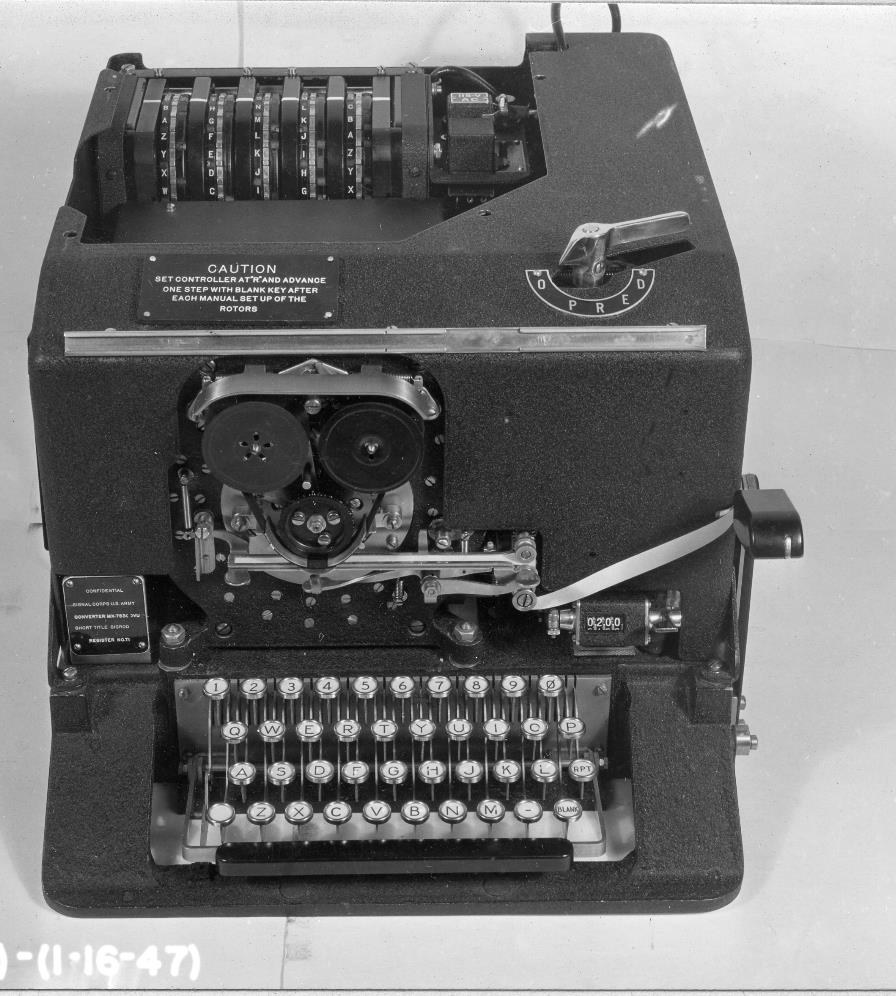
- The SIGROD. When the Army withdrew SIGABAs from places where they might be lost (Volume 6), it replaced them with the SIGROD (ASAM 5, Converter MX-783/U), a semi-portable five-rotor machine of 137 lb that resembled the SIGABA outside and was nearly identical cryptographically to the CCM and Typex inside. It ran at 50 words a minute, was considered secure up to TOP SECRET and, if lost, “would not disclose the sensitive cryptographic principles embodied in SIGABA”. About 600 were procured in September 1946, and by March 1949 52 of the 60 Army attaché offices around the world were using one (NSA CCH, “Changing Machines”, 2019; Library copy; Mucklow 2015, p. 26; Christos 2025). Naval attachés used the CSP 1700.
- The State Department. The State Department adopted the CCM in 1946 as the MCB, using the CSP 2200 — of which Seiler’s laboratory made 110 — and kept it until July 1959.
- NATO. In June 1951 the CCM was chosen as NATO’s second-level high-grade cipher, for naval, army and air commands down to divisional headquarters and for NATO warships; 943 machines were immediately available in 1952, and about 1,875 had been distributed by 1955. A 1952 modification called HERMES changed the stepping connections, doubled the reversible rotors available from 10 to 20 — raising the possible wheel orders from 967,680 to 59,535,360 — made the cam contours rotatable and tightened the procedures. NATO authorised its replacement by the KL-7 in June 1955, replaced it from 1 July 1956, kept a few for meteorological traffic and reserve, and ordered the remainder disposed of in 1962 (Christos 2025, from NATO archives). The Royal Canadian Navy replaced its Typex and CCM machines with the KL-7 in 1962 (Crypto Museum).
The cryptographic risk that had been accepted in 1943 caught up with the CCM in the Cold War. Christos reports that Soviet intelligence targeted the State Department’s MCB and the CSP 1700/SIGROD in the 1950s; the details are beyond the scope of this series. By then the CCM’s whole family was being replaced by the KL-7, the machine that also retired the SIGABA (Volume 9).
Sources
- US Navy, CSP 1100(C), Operating Instructions for ECM Mark 2 (CSP 888/889) and CCM Mark 1 (CSP 1600), 16 May 1944, Part VI, transcribed by Richard Pekelney, maritime.org.
- Ralph Erskine, introduction (1996) to “Messages from GCCS to SSA about the CCM, March 1945”, Crypto Cellar (Frode Weierud), PDF (Library copy); and the other CCM documents in the Crypto Cellar CCM collection.
- OP-20-G, “The Period of the CCM” (17 April 1944) and the file “CCM (1943–1945)” (NARA 2811488), via Crypto Cellar.
- D. W. Seiler, “U.S. Naval Code and Signal Laboratory — History of” (1950), NSA Friedman Collection, via Crypto Cellar (Library copy).
- Timothy J. Mucklow, The SIGABA / ECM II Cipher Machine: “A Beautiful Idea” (NSA CCH, 2015; Library copy), pp. 22–26, govinfo.gov PDF.
- “The Combined Cipher Machine — 1942–1962”, Christos military and intelligence corner (March 2025), blog (citing NSA Friedman Collection, UK National Archives ADM 1/27186 and NATO archives).
- War Department, Operating Instructions for CCM (SIGDUBN-1), 13 March 1945, via Crypto Cellar (Library copy).
- Crypto Museum, “Typex” and “SIGABA”, cryptomuseum.com.
- NSA CCH, “Changing Machines” (History Today, 18 March 2019).
Next — Volume 8: Why It Was Never Broken — Key Space and Modern Cryptanalysis. How big the SIGABA’s key really was, with captured rotors and without; why the attacks that broke the Enigma and Typex-style machines found nothing to grip; what the German war diary’s “work discontinued as unprofitable” meant in practice; and how, sixty years later, Stamp and Chan and then George Lasry finally showed what it takes to break the American Big Machine.
Comments (0)