SIGABA · Volume 1
SIGABA — Volume 1 — The Machine That Was Never Broken
What the SIGABA (the Navy's ECM Mark II) was, why fifteen rotors in three banks defeated every enemy that tried them, who invented it and who built ten thousand of them, how it was guarded, and how to build one today — the orientation volume for the twelve-part series
1.1 About This Volume
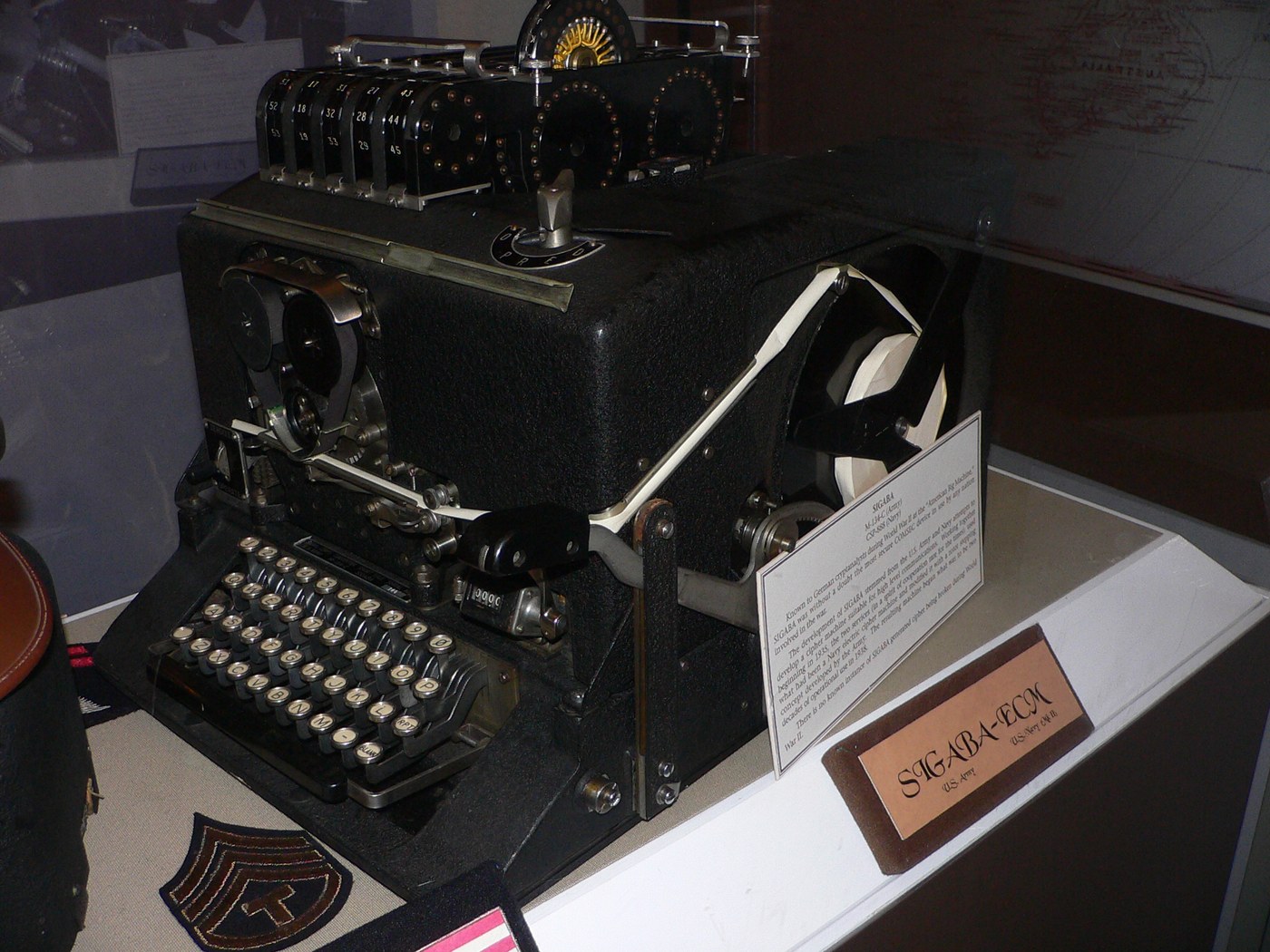
This is the entry point to a twelve-volume deep dive on the SIGABA, the electric rotor cipher machine that carried the highest-level communications of the United States Army and Navy through the Second World War and on into the 1950s. The Army called it SIGABA and, formally, Converter M-134-C. The Navy called it the Electric Cipher Machine Mark II, or ECM Mark II, and catalogued it as CSP 888 and CSP 889. German codebreakers, who never learned its name, called it the “American Big Machine”. About 10,060 were built.
It is the great exception in the history of Second World War cryptography. Every major power used rotor machines, and nearly every one of them was read by its enemies for at least part of the war. The German Enigma, the Japanese PURPLE and the Lorenz teleprinter cipher each have their own shelf in this collection, and each of those stories ends with codebreakers reading the traffic. The SIGABA story ends differently. Postwar interrogations of German and Japanese cryptanalysts, and the captured files of their agencies, show that they tried, collected material, ran statistics and gave up. There is no known instance of SIGABA traffic being read by an enemy during its service life.
This volume explains in plain terms what the machine was, why it was so much harder to attack than its contemporaries, how it was used and guarded, and why its very existence was a secret for half a century. It then tours the whole series in miniature. The origins are Volume 2; the mechanism is Volumes 3 and 4; keys and procedure are Volume 5; physical security, including the night in February 1945 when one was stolen, is Volume 6; the Combined Cipher Machine shared with the British is Volume 7; the mathematics of its strength is Volume 8; its afterlife is Volume 9. The series ends with three volumes on designing, building and running a working replica.
1.1.1 The Twelve-Volume Series
Table 1 — The Twelve-Volume Series
| Vol | Title | Focus |
|---|---|---|
| 1 | The Machine That Was Never Broken (this volume) | Orientation: what it was, how it worked, the whole story in miniature |
| 2 | From the M-134 to the ECM — Friedman, Rowlett, Safford and the Navy | The tape-driven M-134, Rowlett’s idea, the Navy’s secret development, the 1941 joint system, production |
| 3 | How It Works I — The Cipher Bank, Keyboard and Printer | Rotors, wiring, reversed rotors, the keyboard, the printer |
| 4 | How It Works II — The Control and Index Banks | The irregular stepping that made the machine unbreakable |
| 5 | Keys, Key Lists and Procedure | Daily keys, the 26–30 letter check, indicators, the operating manuals |
| 6 | Security in the Field — Guarding the Machine | Safes, armed guards, the Colmar loss of 1945, destruction drills |
| 7 | The CCM and Allied Interoperability | The Combined Cipher Machine, Typex adapters and their flaw |
| 8 | Why It Was Never Broken — Key Space and Modern Cryptanalysis | The numbers, and what modern attacks need |
| 9 | After the War — Declassification, the 2001 Patent, Survivors and Museums | Secrecy, the 56-year patent, where the machines are now |
| 10 | ⭐ Building a SIGABA I — Design | Replica options surveyed and a design chosen |
| 11 | ⭐ Building a SIGABA II — Wiring, Controller and Verification | Building it and checking it against the simulator |
| 12 | Running SIGABA — Setting a Key, a Worked Message, and an Attack Demo | A message sent in period procedure, and attacked |
1.2 A Typewriter With Fifteen Wheels on Top
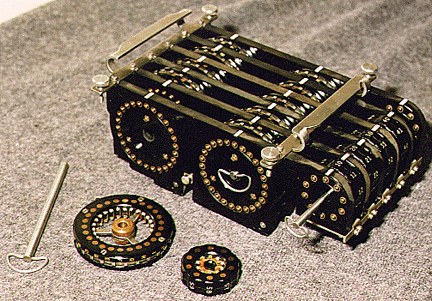
Seen in a museum case, the SIGABA looks like a heavy office machine. A black crinkle-finish box, about 15 by 19¼ by 12 inches in operation (38 × 49 × 30 cm), carries a typewriter keyboard at the front, a printing unit above the keyboard, and a reel of narrow gummed paper tape on the right-hand side. On top sits a removable rotor cage — the Army called it the cipher basket — holding fifteen wired wheels in three rows of five. In working order the machine weighed 93½ lb (about 42 kg); in its carrying case, 133½ lb; packed for long-term storage, 195 lb. It drew about 2 amperes at 120 volts and could run from 105–125 volts AC or DC, or from a 24-volt DC battery supply (Pekelney, after ASA, Historical and Cryptologic Summary of Cryptosystems, 1948).
The operator typed plain text on the keyboard and the machine printed cipher text on the tape, in groups of five letters, at a rated 45 to 50 words a minute. To decipher, the operator set the machine to the same key, switched it to decipher and typed the cipher groups; the printer produced the plain text with the word spaces restored. A five-position controller switch on the top, marked O, P, R, E and D, chose between off, plain (the machine acts as an ordinary typewriter), reset, encipher and decipher. A zeroizer switch and a counter completed the operator’s controls (CSP 1100(C), 1944, Part II).
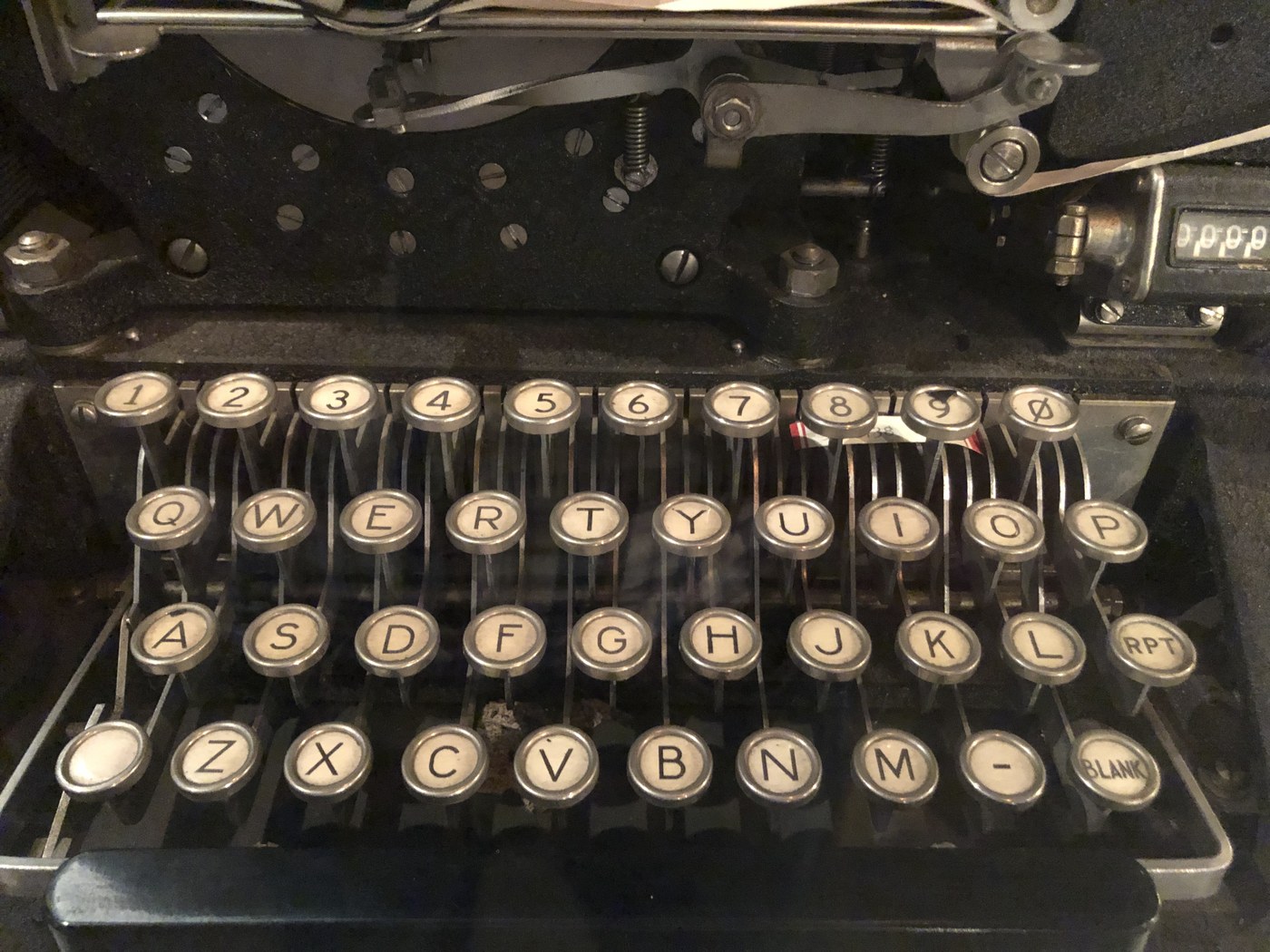
Everything about this was ordinary for 1941. The Teletype Corporation of Chicago, which engineered and built most of the machines, was the country’s leading maker of printing telegraph equipment, and the SIGABA’s keyboard, motor and printer are recognisably the products of that industry. What was not ordinary was inside the rotor cage.
1.3 How It Works, in One Keystroke
A rotor — the core element of almost every cipher machine of the period — is a disc of insulating material with 26 electrical contacts on each face, one per letter. Inside, 26 wires connect each contact on one face to a different contact on the other, in a scrambled order. A current entering the rotor at the contact for A might leave it at the contact for H. Put several rotors side by side and the current is scrambled several times over. Turn any one of them by one position and the whole substitution changes. That much was common to the Enigma, the British Typex, the Hebern machines of the 1920s and the SIGABA. Volume 3 describes the SIGABA’s rotors in detail.
What distinguished machines from each other was how the rotors moved. In the Enigma, the right-hand rotor moved one step for every letter and the others moved like the wheels of a car’s odometer, with an occasional stutter. Movements like that are regular and predictable, and predictability is what cryptanalysts exploit. The SIGABA’s designers set out to make the movement of the enciphering rotors as irregular as possible, and to make that irregularity depend on the key.
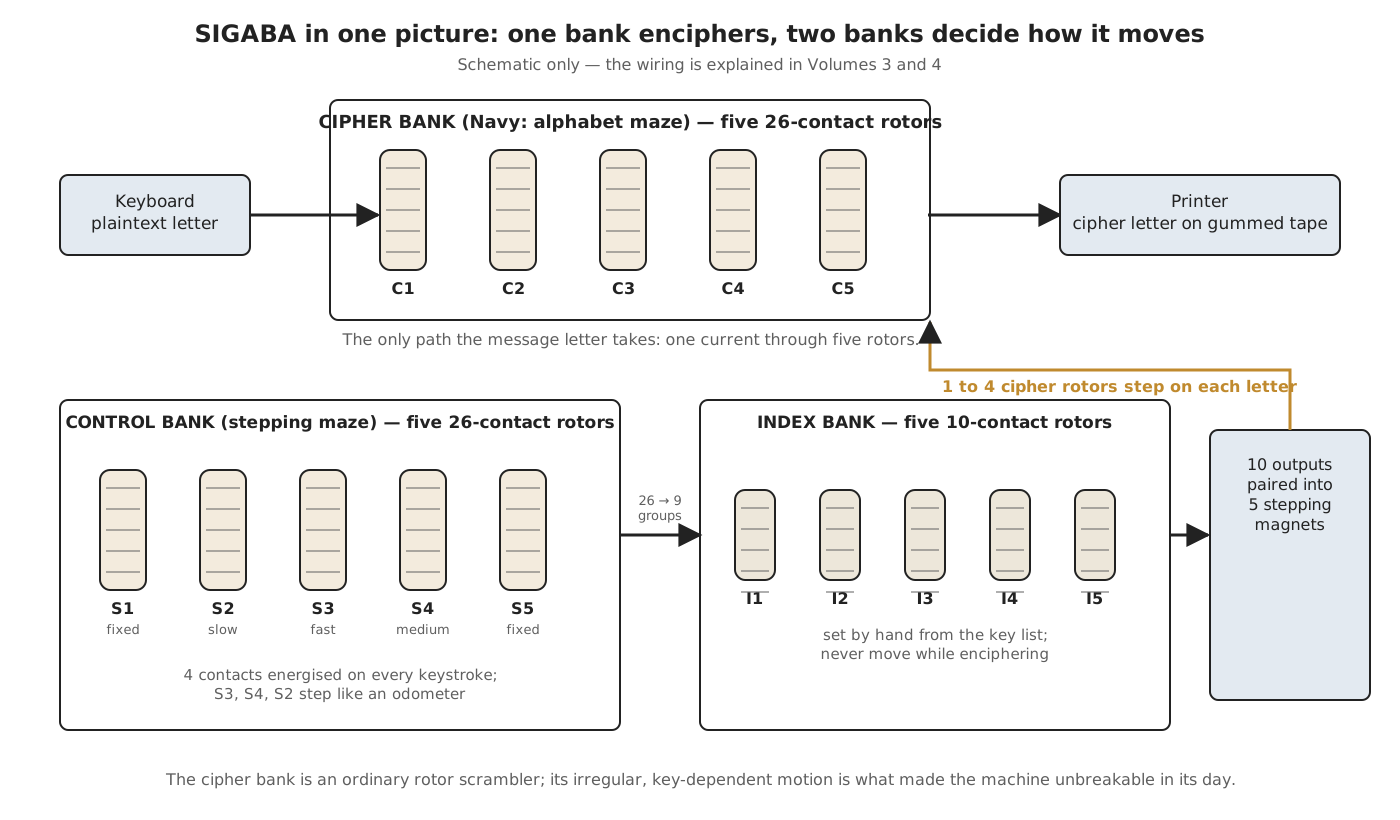
The fifteen rotors are arranged in three banks of five:
- The cipher bank (the Navy’s “alphabet maze”) is the part that enciphers. The plaintext letter from the keyboard passes through its five rotors once, and the letter that comes out is printed. On its own it is an ordinary five-rotor scrambler.
- The control bank (the “stepping maze”) never touches the message at all. Four of its input contacts are energised on every keystroke. Its middle three rotors turn in a metered way, one fast, one medium and one slow, like an odometer; the two outer rotors stay still.
- The index bank has five smaller rotors with only ten contacts each. The control bank’s 26 outputs are bundled into nine groups that feed the index bank; the index rotors are set by hand once a day and never move while a message is being enciphered. The index bank’s ten outputs are joined in pairs to five stepping magnets, one for each cipher rotor.
So on every keystroke a handful of live currents wander through the control bank and the index bank and arrive at the stepping magnets. Whichever magnets receive current step their cipher rotors by one position. The design guaranteed that at least one and at most four of the five cipher rotors moved after each letter (Pekelney; Mucklow 2015, Appendix B; Library copy). Which ones moved depended on the wiring of all fifteen rotors, on their order and orientation, and on their starting positions — that is, on the key.
Three further features added to the work an attacker faced. The ten large rotors were interchangeable: any of them could serve in the cipher bank or the control bank, in any slot. Every rotor could be inserted either way round, reversing its wiring. And each machine carried more than one set of rotors, so that a captured set did not compromise every circuit. The machine was not reciprocal — encipher and decipher were different settings of the controller — and, unlike the Enigma, a letter could encipher to itself.
The result was a machine whose cipher rotors moved in a pattern that looked random to anyone without the key, and which did not repeat in any useful period. That is the whole of the idea, and it is why the Army’s Frank Rowlett, who conceived it, and his chief William Friedman, who first doubted it and then championed it, called it “a beautiful idea”. Volume 4 follows the current through the control and index banks wire by wire.
1.4 Who Made It
The SIGABA was invented twice over, by two services that were in the habit of not telling each other things. Volume 2 tells the story in full; in outline it runs like this.
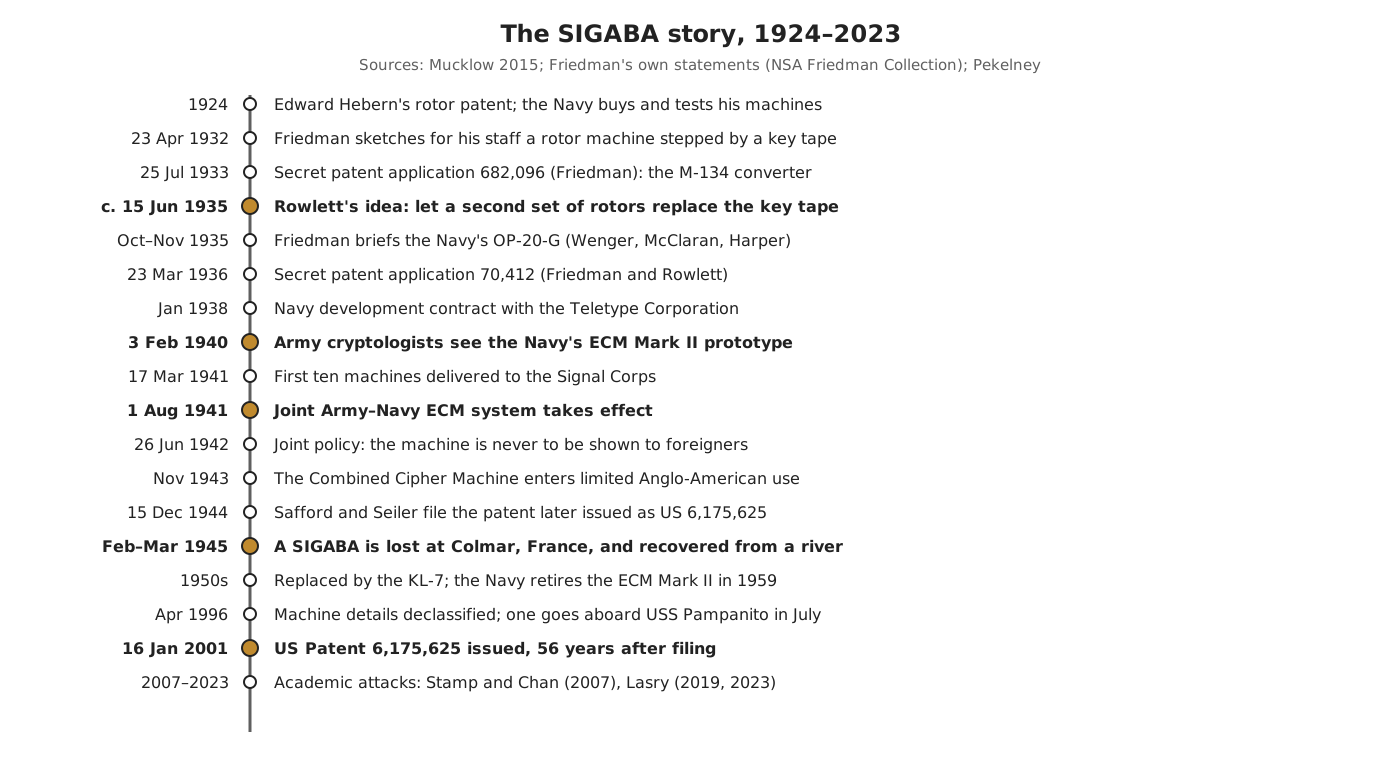
In the early 1930s the US Army’s tiny Signal Intelligence Service consisted of William F. Friedman and three junior cryptanalysts he had hired in 1930: Frank B. Rowlett, Abraham Sinkov and Solomon Kullback. Friedman had already shown, by breaking the Navy’s Hebern machines, that rotors stepping in a regular way were vulnerable. His answer, sketched to his staff on 23 April 1932 and filed as a secret patent application on 25 July 1933, was a five-rotor machine whose rotors were stepped by a punched paper key tape. It went into small production as Converter M-134; 75 were built (Friedman, statement c. 1946, NSA Friedman Collection; Library copy).
Rowlett was given the job of making the tapes, and hated it. In about June 1935 he saw that a second set of rotors, stepping regularly, could generate the stepping pattern for the cipher rotors and do away with the tape altogether. Friedman at first refused to listen — Rowlett later remembered the standoff as lasting months — and when he finally heard Rowlett out, he came in the next morning “eyes shining” and called it a “beautiful idea” (Rowlett, oral history, quoted in Mucklow 2015, p. 10). A joint secret patent application followed on 23 March 1936.
In October and November 1935, at the Navy’s request, Friedman explained the idea to officers of the Navy’s cryptologic section, OP-20-G. They seemed unimpressed. In fact Lieutenant Joseph Wenger took it to Commander Laurance F. Safford, the Navy’s senior cryptologist, who saw its value, and from January 1938 the Navy quietly paid the Teletype Corporation to engineer a machine around it. The Navy’s engineer Donald W. Seiler replaced the plugboard the Army had planned with the bank of index rotors. Nobody told the Army until March 1939. On 3 February 1940 Friedman, Rowlett, Sinkov and Kullback walked over to the Navy Building to see the prototype, and Rowlett “couldn’t keep my hands off it” (Mucklow 2015, p. 15).
From then on the two services worked together. The joint Army–Navy ECM system took effect on 1 August 1941, four months before Pearl Harbor, and for the first time the two services shared a common high-grade cipher.
1.5 Ten Thousand Machines
Production rose quickly. The Signal Corps received its first ten machines on 17 March 1941; by 31 August 1942, 373 had been delivered; by the end of the war the Army had procured 3,392 and the Navy more than that. By 1943 more than 300 a month were being delivered, and when production stopped the inventory stood at 10,060 machines with more than 450,000 rotors to go with them (Friedman c. 1946; Mucklow 2015, pp. 19–20). Each cost about $2,040, not counting rotors, spares and modifications (Pekelney); the Signal Corps’ first order, in June 1940, had been placed at $1,856.90 a machine.
The chassis came from civilian contractors, chiefly Teletype. The rotors — the secret part — did not. They were made from stock at the Washington Navy Yard and later the Naval Communications Annex on Nebraska Avenue, and wired by more than 200 women of the Navy’s WAVES; at Arlington Hall, women of the Women’s Army Corps did the same for the Army. By the middle of the war the Navy’s wirers had produced more than 150,000 rotors, reportedly without a single wiring error (Mucklow 2015, p. 20, citing Safford and Ratcliff).
1.5.1 The names
The machine collected a confusing number of names, and the series uses them as the sources do:
Table 2 — The machine collected a confusing number of names, and the series uses them as the sources do
| Name | Who used it | What it meant |
|---|---|---|
| SIGABA | US Army | Short title of Converter M-134-C (the chassis without its rotors). Army equipment names were “SIG” plus random letters |
| Converter M-134-C | US Army | Formal nomenclature; successor to the tape-driven M-134 and M-134-A |
| ECM Mark II (Mark 2) | US Navy | Electric Cipher Machine, second model |
| CSP 888 / CSP 889 | US Navy | Code and Signal Publication numbers. The first 651 machines (CSP 888) lacked the sockets for tandem operation fitted to the CSP 889 |
| CSP 887 / SIGIVI | Navy / Army | The removable cipher unit (rotor cage) |
| CSP 2900 | US Navy | Postwar modification with an added switch; about 1,196 made |
| ASAM 1 | Armed Forces Security Agency | Postwar designation, from 1949 |
| ”American Big Machine” | German cryptanalysts | The machine they knew only from its traffic |
1.6 How It Was Used
The SIGABA was a machine for headquarters, ships and fixed stations, not for the front line. The Army issued it down to division headquarters and to every important fixed headquarters at home and overseas; the Navy fitted it to warships, submarines and shore stations. Smaller units used the hand-cranked M-209 (whose own shelf in this collection describes it as the bottom of the same hierarchy) and the M-138-A strip cipher.
The SIGABA carried what mattered most. It linked Washington with the theatre commanders; it carried the war plans for the spring 1945 offensive into Germany; and wherever President Roosevelt went — Hyde Park, the presidential train, Yalta — a SIGABA went too (Friedman c. 1946). Traffic between the White House and Downing Street ran over SIGABA-based circuits. In the Battle of the Atlantic, intercepted U-boat signals were enciphered on American-operated SIGABAs in Britain, sent to Washington for the Navy’s bombes, and the resulting intelligence went back to the fleet on SIGABAs (Mucklow 2015, p. 25). In the Pacific, the submarine USS Pampanito, now a museum ship in San Francisco, received the routing of a Japanese convoy on its ECM in September 1944 — intelligence that came from broken Japanese codes and travelled under an unbroken American one (Pekelney).
1.6.1 Keys and procedure (Volume 5)
The secret was not the machine but the key. Each day’s key, printed on a monthly key list, gave the arrangement of the ten large rotors in the cipher and control banks, which way round each went, and settings for the index rotors for each class of message. Before using the machine, the operator set it up and enciphered the letter A thirty times from a standard starting position; the 26th to 30th letters had to match a five-letter check printed in the key list. For each message the operator chose five random letters to set the rotors, and sent them with the message, disguised or in the clear according to the method in force. The keys themselves were produced by machine — by rotor-based IBM equipment at Arlington Hall and the Naval Communications Annex — rather than by clerks, which removed a classic source of weakness. Volume 5 works through the key lists and the Navy and Army methods, using the 1944 Navy manual, CSP 1100(C).
1.6.2 Guarding the machine (Volume 6)
Because the machine’s principle was the asset, it was guarded as fiercely as any key. Joint Army–Navy policy of 26 June 1942 forbade placing it ashore in foreign territory without enough armed American personnel to protect it, and forbade showing it, its rotors or its manuals to anyone but authorised Americans — the British included. Ashore it lived in a two-section field safe, the CH-76, with a pair of thermite bombs ready on top; afloat it lived in a steel locker or a code room under watch. The manuals specified exactly how to destroy it, rotors first.
The rules were tested once, badly. On the night of 5–6 February 1945 a truck of the 28th Infantry Division carrying a SIGABA in its safes was parked unguarded in a street in Colmar, in Alsace, and stolen. General Eisenhower ordered a theatre-wide search. The truck turned up in woods five weeks later; the safes were fished out of a river. The thieves, it seems, had wanted the truck. Volume 6 tells the story from the Army’s own investigation.
1.6.3 The British problem (Volume 7)
The Americans would not give the SIGABA to the British, and the British could not make enough Typex machines to give to the Americans. The compromise was the Combined Cipher Machine (CCM): adapters, designed by the US Navy’s Donald Seiler, that turned either a SIGABA or a Typex into the same, simpler five-rotor machine. It came into limited use in November 1943 and was in use by all the British and American services from April 1944. It was weaker than the SIGABA — certain rotor combinations gave it a period of only 338 letters — and the story of how that flaw was found and managed, apparently before any enemy noticed, is Volume 7.
1.7 Why It Was Never Broken
The short answer is that the irregular stepping defeated the methods that broke every other rotor machine of the war. Attacks on the Enigma and its relatives relied on knowing that the fast rotor moved one step per letter and the others almost never moved, so that a long stretch of text could be treated as enciphered by a fixed set of wirings plus one moving part. In the SIGABA, between one and four cipher rotors moved after every letter in a key-dependent pattern, so no such stretch existed.
The longer answer is in Volume 8. The numbers are large. The NSA historian Timothy Mucklow estimates that, for an enemy who held captured rotors and knew their wirings, the choice of positions, orientations and starting points for all fifteen rotors gives about 2 × 10³², or roughly 2¹⁰⁷, possibilities; after the index rotors’ order was frozen in June 1945, about 2¹⁰⁰. Without the wirings the figure is astronomically larger (Mucklow 2015, Appendix A). Those figures overstate the practical difficulty — many settings are equivalent, and modern attacks work piece by piece — but they show why nothing available in the 1940s came close.
The evidence that nobody did come close is unusually good. After the war the Allied Target Intelligence Committee (TICOM) interrogated German cryptanalysts and seized their files. The war diary of a German signal intelligence group records that in March 1944 it began to study “a group of 5-letter messages from U.S.A. links presumably … enciphered with a machine of unknown type”, and in September 1944: “U.S. 5-letter traffic: Work discontinued as unprofitable at this time.” Erich Hüttenhain, the leading cryptanalyst of OKW/Chi, the German armed forces’ cipher bureau, told his interrogators that the American machine broken was “the American Hagelin” — the M-209 — and only when operators erred; he knew of “no other type of American machine” (Mucklow 2015, pp. 23–24). The Japanese did no better.
Modern cryptanalysis has caught up. In 2007 Mark Stamp and Wing On Chan described an attack on the full key space that is feasible with modern computers but far beyond anything of the 1940s; in 2023 George Lasry published a method that, by the account of its announcement, recovers a full SIGABA key in under a day on a consumer PC given about 100 letters of known plain text (Lasry, Cryptologia 47:1, 2023). Both attacks need computing power that did not exist during the machine’s service life. Volume 8 explains them and Volume 12 runs a cut-down demonstration.
1.8 After the War
The SIGABA’s principles were judged even more valuable after the war than during it. The services’ fear was not so much that an enemy might break it as that an enemy might copy the idea to protect its own traffic. SIGABAs stayed under 24-hour armed guard, were withdrawn from exposed posts and replaced there by the simpler SIGROD (a machine cryptographically close to the CCM), and stayed in service at higher headquarters through the Korean War. The KL-7 replaced them in the 1950s; the Navy retired the ECM Mark II in 1959. Most of the machines were then destroyed to protect the design.
Its makers were rewarded in private. Congress voted Friedman $100,000 in 1956 for his cryptologic inventions, Safford a similar sum in 1958, and Rowlett $100,000 in 1964, in each case because the inventions could not be patented in public. Details of the machine were declassified only in April 1996. The patent that Safford and Seiler had filed on 15 December 1944 — US 6,175,625, “Control Circuits for Electric Coding Machines” — was finally issued on 16 January 2001, 56 years later and 32 years after Friedman’s death. Volume 9 tells that story and lists the surviving machines, of which there are probably no more than a dozen.
1.9 The Simulator and the Replica
Every worked cipher example in this series comes from one program, a Python simulator of the SIGABA kept with the project at 03-outputs/tools/sigaba_sim.py. It is checked against published test vectors before any example is written; Volume 11 describes how. A replica that agrees with the simulator on a 26–30 letter check and a full message is, for practical purposes, a SIGABA.
Building one is harder than building an M-209, for two reasons. First, there are fifteen rotors to make and wire, and their wirings matter. Second, the machine is electromechanical: magnets, contacts and a motor-driven keyboard and printer. Volume 10 surveys the replica projects that already exist — from software simulators to rotor-bank models — and chooses a design that keeps the visible character of the original: real rotors, real banks and real stepping, under the control of a small microcontroller where the original used relays and cams.
1.10 Why It Matters
The SIGABA matters in the history of cryptography for three reasons.
First, it was the right idea at the right time. Every rotor machine of the period moved its rotors in a fixed pattern. Rowlett’s insight — that one set of rotors could generate the irregular stepping of another — was simple once seen, and it was the decisive difference between a machine that fell to the bombes and one that never fell to anyone. The same idea, rotors used as a key generator, ran through American machines for twenty years afterwards.
Second, it shows what communications security means as a discipline. The machine was strong, but the services did not rely on that alone. Keys were made by machine; rotor sets were duplicated and changed; procedures were written so that a careless operator could not produce a simple substitution without the 26–30 check giving him away; and the machine itself was guarded as if the war depended on it. The one serious lapse, at Colmar, is remembered precisely because it was the exception.
Third, it was a joint achievement of two services that rarely cooperated. The Army had the idea; the Navy had the money and the engineers. The result was the first common high-grade cipher system the US Army and Navy ever shared, in place before Pearl Harbor. That was the Navy’s own judgment at the time: “This use of an identical machine with interchangeable code wheels has been of great military value, particularly in the early stages of the war” (Navy history of the ECM, quoted by Friedman c. 1946).
1.11 How to Read This Series
The volumes are written to be read in order, but each stands alone. Machine designations follow the sources: the Army’s SIGABA and M-134-C, the Navy’s ECM Mark II and CSP numbers. The Navy and the Army also used different words for the same parts — the Navy’s “alphabet maze”, “stepping maze” and “code wheels” are the Army’s cipher rotors, control rotors and rotors — and quotations keep the original terms. Measurements are given as the sources give them, usually in inches.
Three kinds of figure appear: photographs of surviving machines and of the people and places in the story; scans from the original manuals and documents, labelled with their source; and line diagrams drawn for this series, whose generating scripts are kept with the project.
1.12 The One-Paragraph Version
The SIGABA, or ECM Mark II, was the US Army and Navy’s high-grade electric rotor cipher machine of the Second World War: a typewriter-like machine of about 93 lb with fifteen wired rotors in three banks. Five cipher rotors enciphered each letter; five control rotors and five index rotors decided, letter by letter, which one to four of the cipher rotors stepped, so that their motion was irregular and key-dependent. The idea was Frank Rowlett’s, in 1935, developed with William Friedman in the Army’s Signal Intelligence Service; the Navy, under Laurance Safford and Donald Seiler, engineered it with the Teletype Corporation in secret, and the two services adopted it jointly from 1 August 1941. About 10,060 were built. It carried presidential, theatre and intelligence traffic throughout the war; German and Japanese codebreakers tried and failed to read it. One was stolen at Colmar in 1945 and recovered from a river. Its adapters produced the Combined Cipher Machine shared with Britain. It was retired in the 1950s, declassified in 1996 and patented in 2001. The remaining eleven volumes are the long version, ending with a replica.
Sources
- Timothy J. Mucklow, The SIGABA / ECM II Cipher Machine: “A Beautiful Idea” (NSA Center for Cryptologic History, 2015; Library copy), govinfo.gov PDF.
- William F. Friedman, “Important Contributions to Communications Security, 1939–1945” (c. 1946), NSA Friedman Collection, REF ID A60534, nsa.gov PDF (Library copy).
- US Navy, CSP 1100(C), Operating Instructions for ECM Mark 2 (CSP 888/889) and CCM Mark 1 (CSP 1600), 16 May 1944, transcribed by Richard Pekelney, maritime.org.
- Richard Pekelney, “Electronic Cipher Machine (ECM) Mark II”, San Francisco Maritime National Park Association, maritime.org.
- John J. G. Savard and Richard S. Pekelney, “The ECM Mark II: Design, History and Cryptology”, Cryptologia 23:3 (1999), 211–228.
- Mark Stamp and Wing On Chan, “SIGABA: Cryptanalysis of the Full Keyspace”, Cryptologia 31:3 (2007).
- George Lasry, “Cracking SIGABA in less than 24 hours on a consumer PC”, Cryptologia 47:1 (2023), 1–37.
- Frank B. Rowlett, The Story of Magic: Memoirs of an American Cryptologic Pioneer (Aegean Park Press, 1998).
- Crypto Museum, “SIGABA”, cryptomuseum.com.
Next — Volume 2: From the M-134 to the ECM — Friedman, Rowlett, Safford and the Navy. A horse thief’s rotor machine that the Navy bought and Friedman broke; a punched paper tape that was supposed to make rotors unpredictable; a junior cryptanalyst so sick of punching tapes that he threatened to go over his boss’s head; a Navy lieutenant who walked across a footbridge to ask the Army for ideas; four years of silence; and the morning in February 1940 when the Army discovered that the Navy had built its machine.
Comments (0)