SIGABA · Volume 5
SIGABA — Volume 5 — Keys, Key Lists and Procedure
How the SIGABA was keyed and operated: monthly key lists made by machine, the daily rotor arrangement and index settings, the mandatory 26–30 letter check, the Navy and joint methods of setting each message, the manuals that governed them, and the operator errors the procedure was built to catch
5.1 About This Volume
Volumes 3 and 4 describe the SIGABA as a mechanism: fifteen rotors, three banks, a keyboard and a printer. This volume describes it as a cryptosystem — the combination of machine, key and procedure that actually protected a message. Richard Pekelney, who restored the machine displayed aboard USS Pampanito, put the point plainly: “If the system is well designed and implemented correctly, cipher text can only be converted back to plain text … by someone with all three elements of the system” (Pekelney).
The main source is the US Navy’s operating manual of May 1944, CSP 1100(C), Operating Instructions for ECM Mark 2 (CSP 888/889) and CCM Mark 1 (CSP 1600), which Pekelney transcribed from a declassified copy and published online with its original illustrations (maritime.org). It is supplemented by the Army’s postwar manual ASAM 1/1, Crypto-Operating Instructions for ASAM 1 (1 October 1949), the last edition of the Army’s instructions, and by Pekelney’s summary of the Army’s wartime editions. Where the manuals give sample key settings and sample messages, this volume reproduces their illustrations rather than recomputing them; the series’ simulator (Volume 11) supplies any worked example.
5.2 The Key and Who Made It
5.2.1 What the key contained
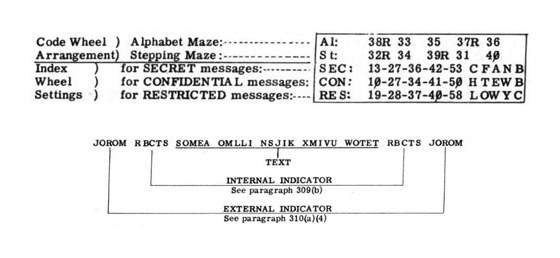
Everything that changed from day to day lived in the key; everything else was fixed in the machine. For the SIGABA a daily key setting contained three things (CSP 1100(C), para. 303):
- The code wheel arrangement: ten numbers saying which of the ten large rotors of the current set went into which slot of the cipher bank (the Navy’s “alphabet maze”, labelled AL) and the control bank (the “stepping maze”, ST), read left to right. An R after a number meant the rotor went in reversed — “with the engraved alphabet letters appearing upside down to the operator”.
- The index wheel settings, one for each classification of message — normally three, for SECRET, CONFIDENTIAL and RESTRICTED. Each was a group of five two-digit numbers, one per index rotor.
- For each index setting, the corresponding 26–30 letter check, a five-letter group used to prove that the machine had been set up correctly.
Some key lists added one or more initial code wheel alignments, used in the joint Army–Navy method of setting messages described below.
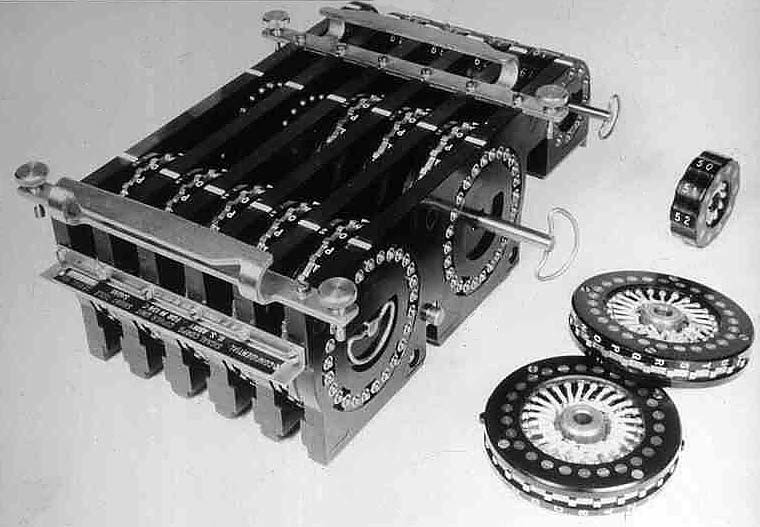
The rotors themselves were the other half of the key. The ten large rotors of a set were interchangeable and reversible; each carried a complete alphabet engraved around its rim and an identifying number stamped on it. The five small index rotors were numbered by tens: one carried the numbers 10 to 19, the next 20 to 29, and so on to 59, so that an index setting such as “10 23 31 49 50” told the operator both which rotor and which position (ASAM 1/1, 1949, para. 7). Under the Navy’s 1944 instructions the index wheels were “normally not removed from the Cipher Unit, and their arrangement normally remains the same”, though some key lists called for a different arrangement. Mucklow records that the index rotors’ order was permuted daily during most of the war and frozen from June 1945, when the Army’s revised instructions (SIGQZF-2) took effect (Mucklow 2015, Appendix A; Pekelney).
5.2.2 Made by machine
The SIGABA’s daily settings were not chosen by people. Mucklow notes that, unlike the cipher systems of the British and the Axis, they “were generated by yet another rotor-based cipher machine rather than humans”. The Navy produced its keys at the Naval Communications Annex on Nebraska Avenue in Washington, where it also ran its ECM maintenance facility; the Army produced them at Arlington Hall. Each month’s daily settings were printed on a single sheet of paper — “easy to transport, easy to use, easy to destroy, and, if necessary, easy to replace” (Mucklow 2015, p. 21 and note 55).
The importance of this is easy to miss. Many of the classic wartime breaks into other systems began with keys that were not random: Enigma keys that avoided repeating a rotor in the same position on consecutive days, indicators chosen from operators’ girlfriends’ names or keyboard patterns. A key list generated by a machine has none of those habits.
5.2.3 Sets, channels and classes
A key list belonged to a crypto-channel — the Navy’s term for the combination of machine, rotor set, key list and instructions that two or more holders needed to communicate. Two sets of code wheels were normally issued with each ECM Mark 2, “one for World Wide Crypto-Channels and the other for Area channels”, and each holder was allowed a spare cipher unit (CSP 1100(C), para. 107). The manuals’ destruction orders ranked rotor sets and key lists “in the order of greatest number distributed” — Class 3 World Wide, Class 3 Area, Class 4 and so on — with reserve-on-board material destroyed before the effective sets (para. 113). Volume 6 returns to those rules.
The rotor sets and key lists were SECRET and registered; the machine and its cipher unit, by contrast, were only CONFIDENTIAL. The classification reflected the logic of the system: the design was expected to fall into enemy hands eventually; the keys were not.
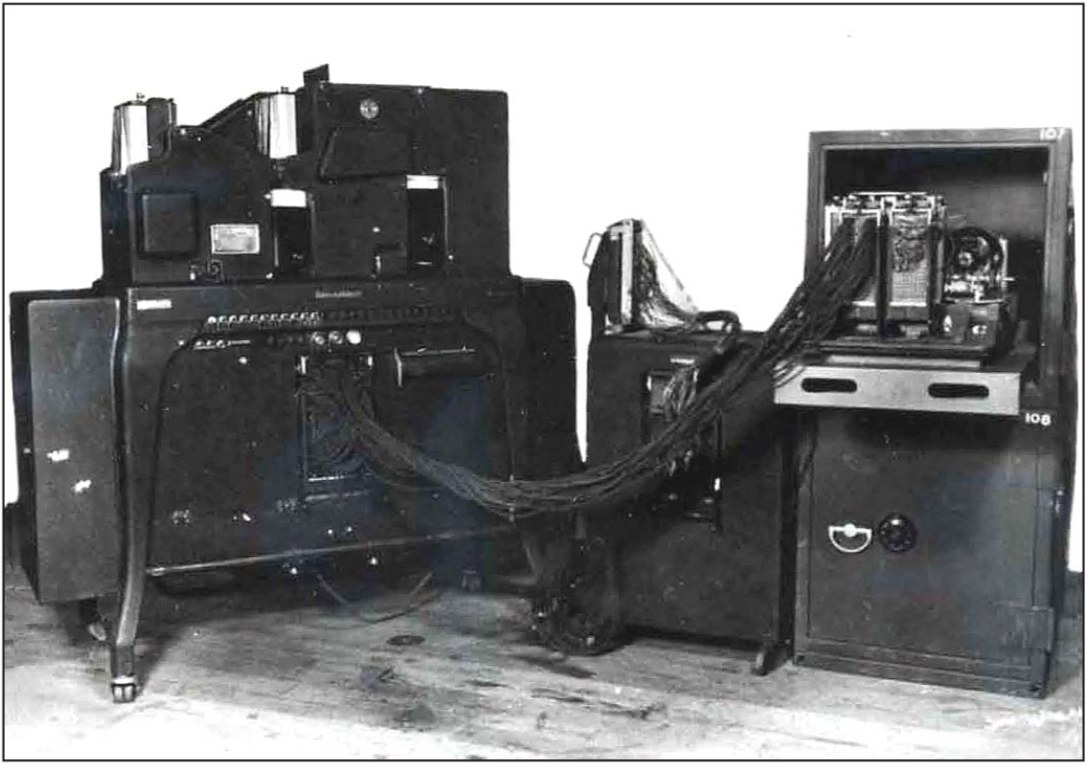
The list of equipment carried by US submarines in the Pacific in 1944, which Pekelney found in the National Archives, shows the system as a user saw it. “Channel 105” was the ECM: the machine (CSP 888/889), its instructions (CSP 1100), its code wheels (CSP 1122) and its key lists (CSP 1190), together with a printer unit, a spare-parts kit and a special safe locker built into the radio room. Before each patrol an officer and an enlisted man “armed with a machine gun” drew the cipher equipment from secure storage. For particularly dangerous patrols in shallow water — where the boat might be lost and salvaged — a second list without the ECM was used, and the boat fell back on the CSP 845 strip cipher (Pekelney).
5.3 Setting Up for the Day
Setting up the machine followed the same sequence in both services.
5.3.1 Arranging the wheels
The operator lifted off the lid, loosened four thumb-screws and lifted out the cipher unit (the Navy’s CSP 887, the Army’s SIGIVI) — “use BOTH HANDS”, the manual warns twice. He drew out the rotor spindles, slid the day’s ten rotors into the rear and middle rows in the order and orientation the key list gave, replaced the spindles and secured the unit in the machine (para. 305). Then he turned the index wheels by hand to the setting for the classification of the message he was about to send. “BE SURE THE INDEX WHEELS ARE IN EXACT ALIGNMENT,” the manual insists (para. 306), for reasons that become clear below.
5.3.2 Zeroizing
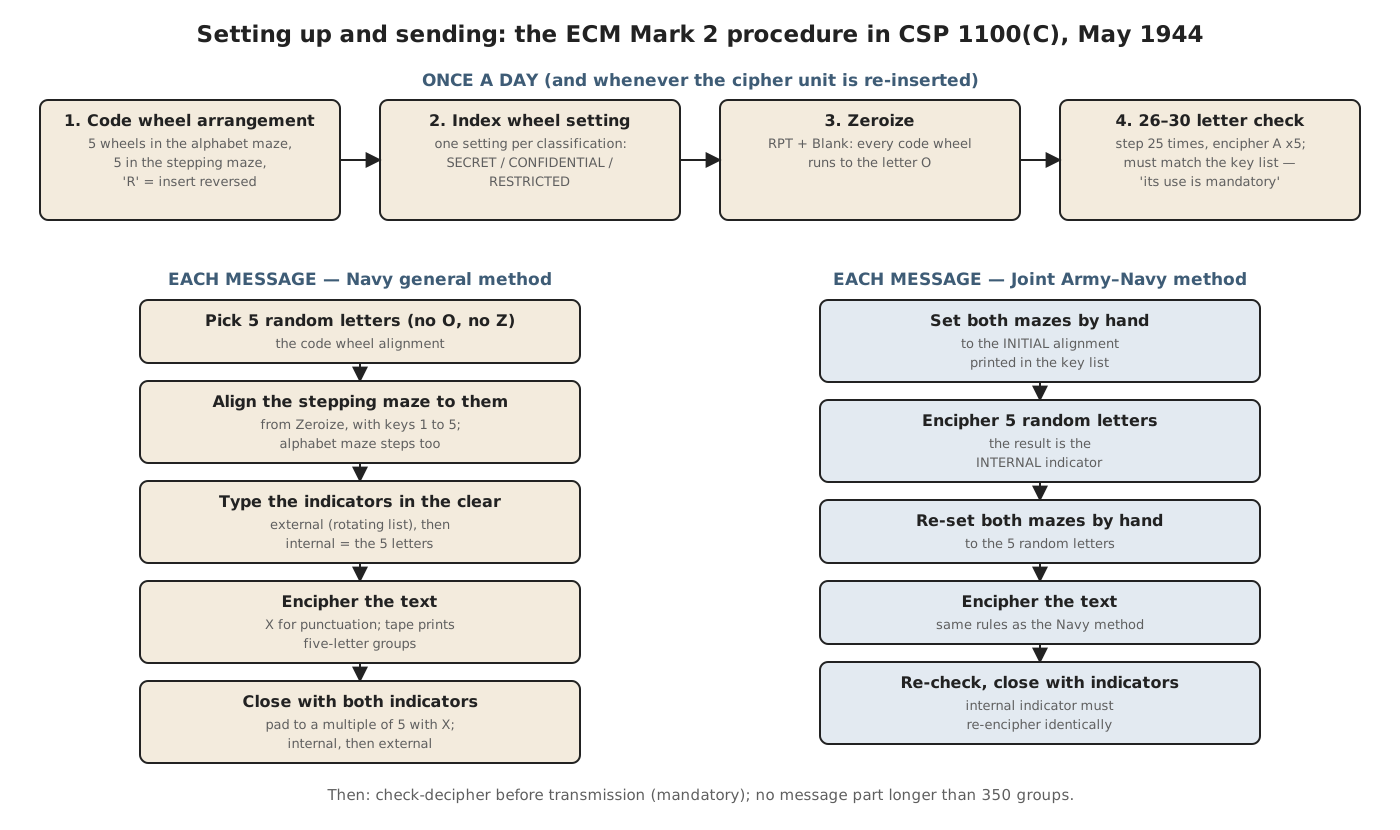
Every process started from a fixed reference point, the zeroize position, in which every large rotor showed the letter O against its white reference line. The machine could find this position by itself: with the controller at R (reset) and the zeroizer switch at “Zeroize”, the operator held down the REPEAT and BLANK keys and the rotors stepped until each one stopped at O (para. 307). The mechanism that made this possible is described in Volume 4. If a rotor did not stop where it should, the machine needed repair.
5.3.3 The 26–30 letter check
Next came the single most important procedural safeguard. With the zeroizer back at “Operate”, the controller at E (encipher) and the counter reset, the operator stepped the machine 25 times with the BLANK and REPEAT keys and then enciphered the letter A five times. The five letters printed — the encipherment of A at the 26th to 30th steps from zero — had to match the check group in the key list (para. 308). The Army’s 1949 instructions did the same thing slightly differently, holding down REPEAT and A until thirty letters had printed and comparing the last five (ASAM 1/1, para. 12).
A correct check proved three things at once: that the rotors were the right set, in the right order and orientation; that the index setting was right; and that the machine was working. The Navy’s manual was emphatic:
THE 26-30 LETTER CHECK SHALL BE MADE EACH TIME CSP 887 IS INSERTED IN THE MACHINE AND AFTER EACH CHANGE OF CODE WHEEL ARRANGEMENT OR INDEX WHEEL SETTING. ITS USE IS MANDATORY.
— CSP 1100(C), para. 303(e)(3)
If the check failed, the manual listed the usual suspects: a wrong rotor set or arrangement, a wrongly set index wheel, a dirty contact, or — rarely — a misprint in the key list, against which “four correct letters should be accepted”. One failure was never acceptable: “under no condition will the machine be used if the 26-30 Letter Check so obtained is five alike letters”. A check of five identical letters meant that the cipher rotors were not stepping at all (para. 308(d)).
An example makes the check concrete. It uses the unit’s simulator, 03-outputs/tools/sigaba_sim.py, and its demonstration key, set out as a key-list line (the wheel wirings are the simulated set every published SIGABA simulator uses, since no wartime wiring has been published; Volume 3 explains):
Table 1 — An example makes the check concrete. It uses the unit's simulator, 03-outputs/tools/sigabasim.py, and its demonstration key, set out as a key-list line (the wheel wirings are the simulated set every published SIGABA simulator uses, since no wartime wiring has been published; Volume 3 explains)
| Cip/Alp | Con/Stp | SEC index setting | 26–30 check |
|---|---|---|---|
| 0 – 1R – 2 – 3 – 4R | 5 – 6 – 7R – 8 – 9 | 18-26-33-43-51 | RNDPS |
Zeroized and set to E, the machine enciphers thirty A’s, the Army way, as
USUJO BFQPE AMPAS UJKRY OZQZP RNDPS
and the last group is the check. The Navy way, 25 BLANK strokes and then five A’s, prints only RNDPS, because BLANK steps the rotors exactly as a letter does. The same key with the index wheels set instead to 15-24-31-47-52 gives ZJRBA. With one index wheel left half-way between two positions, so that no stepping current gets through, the check comes out UUUUU: five alike letters, the failure the manual forbade.
5.4 Setting Each Message
A day’s key was used for many messages, and two messages enciphered from the same starting positions would be in depth — the condition cryptanalysts most want. So each message had its own starting position, chosen by the operator and conveyed to the recipient in an indicator. The SIGABA’s manuals describe two ways of doing this in 1944, and the Army changed its method twice more before 1949.
5.4.1 The Navy general method
In the method in general Navy use in 1944, the operator chose five letters at random — the code wheel alignment — and set the five rotors of the stepping maze to them (paras 309–313). He did so not by turning the rotors by hand but by stepping them electrically from the zeroize position: with the controller at R, each press of the numeral key 1 advanced the first control rotor by one letter, key 2 the second, and so on. While this was going on, the cipher rotors stepped too, irregularly, under the control of the stepping maze — so their starting positions depended on the key as well as on the five letters, and were not visible in the indicator.
The five letters went into the message in the clear, as the internal indicator. Ahead of them the operator typed an external indicator taken from a list of rotating indicators assigned to the channel, which told the recipient which channel and classification — and therefore which index setting — to use. The message began and ended with both: external, internal, text, internal, external. The manual’s own example, enciphered on its sample key, reads JOROM RBCTS SOMEA OMLLI NSJIK XMIVU WOTET RBCTS JOROM, with JOROM the external and RBCTS the internal indicator (para. 313).
The cautions are written in capitals, which says something about how often they were broken:
THE CODE WHEEL ALIGNMENT FOR EACH MESSAGE ENCIPHERED BY A PARTICULAR KEY SETTING MUST BE DIFFERENT. THE SELECTION OF THE LETTERS MUST BE ENTIRELY AT RANDOM, THE LETTERS “O” AND “Z” MUST NOT BE USED, AND THE LETTERS MUST NOT FOLLOW A REGULAR SYSTEM OF PROGRESSION.
— CSP 1100(C), para. 309(b)
The manual even suggested ways to get random letters: pick cipher groups at random from old messages; delete roughly one letter in ten from a cipher message and use the rest in order; draw lettered poker chips or cards; or set up a spare machine with a random wheel arrangement and type at random (para. 329). It also told the operator to look at the cipher rotors after setting the alignment: if all five were still at O, they had not stepped, and the machine was not working (para. 309(c)(4)).
5.4.2 The joint Army–Navy method
The Army did things differently, and on joint Army–Navy circuits the Army’s method was used. It differed in three ways: the rotors were aligned by hand rather than stepped from zero; the cipher rotors were aligned to the five letters as well as the control rotors; and the five letters were enciphered before being sent (paras 316–321).
The key list for a joint channel carried an extra item, the initial code wheel alignment. To send a message the operator set both mazes by hand to the initial alignment, chose five random letters — now called the message code wheel alignment — and enciphered them. The result was the internal indicator. He then set both mazes by hand to the five random letters and enciphered the text. At the end he reset to the initial alignment and enciphered the five letters again; the result had to match the first internal indicator. The recipient reversed the process: set the initial alignment, decipher the internal indicator to recover the five letters, set them, and decipher the text, then burn the strip of tape on which the five letters had been printed (“These five letters must be destroyed after use and must not appear on the delivery copy of the message”) (para. 321(e)).
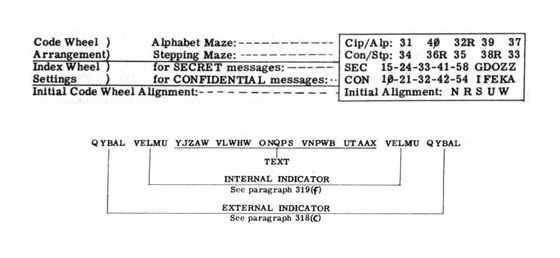
The Army also differed on the check. “The use of the 26–30 Letter Check is not mandatory in the U.S. Army,” the Navy’s manual notes, with a hint of disapproval; when a key list gave one, the Navy used it regardless (para. 317(c)).
5.4.3 Later Army methods
The Army revised its instructions in June 1945 (SIGQZF-2) and again in November 1945 (SIGQZF-3). Pekelney’s outline of the June 1945 procedure has the operator align the control and cipher rotors to an initial position for the classification, encipher his five random letters to make the external message indicator, and then align the rotors to the five plain letters before enciphering the text — the rotors were “never aligned to the external message indicator … but always to the internal message indicator”. SIGQZF-3 introduced “a totally different method of determining message indicators that eliminated the need for a daily rotor alignment of the control and cipher rotors” (Pekelney).
That later method survives in the Army’s ASAM 1/1 of 1949. There the operator picks five random letters — not a real word, and not letters chosen merely because they are close to O and save keystrokes — zeroizes, and steps the control rotors to them with the numeral keys, as in the Navy method. The message indicator is sent in the clear, after a system indicator taken from the key list that identifies the cryptosystem and classification, and is “phoneticized” for voice relay. The system indicator “is never enciphered”. Messages are “bisected” before encipherment — split and their halves exchanged, so that stereotyped openings do not sit at the start — and enciphered with variable spacing. TOP SECRET traffic used the SECRET settings, with the abbreviation TOPSEC “buried near the beginning of the plain text” (ASAM 1/1, paras 13–17).
5.5 Enciphering and Deciphering
5.5.1 Typing the text
With the starting position set, the operator switched to P (plain) to type the heading and indicators, then to E to encipher. The rules for plain text were the rules of a telegraph office. Numerals were spelled out. “The letter X shall normally be used to represent every mark of punctuation”; the only authorised abbreviations for punctuation were PAREN, PARA and QUES (para. 311). The space bar was live while enciphering, so word breaks were enciphered with the text; the machine printed cipher text automatically in five-letter groups. At the end the operator padded the last group with X to a multiple of five and closed with the indicators.
Deciphering reversed the process. With the controller at D the space bar was dead, and the operator simply typed the cipher groups without regard to their spacing. The plain text came out with word spaces restored — at the price of one small oddity, which both manuals point out: the letter Z could not appear in deciphered text, and an X was printed in its place, so that the manuals’ examples read “XERO, XEBRA, RENDEXVOUS” (CSP 1100(C), para. 315) and “ZERO will decipher as XERO, ZONE as XONE” (ASAM 1/1, para. 18). The reason lies in the way the machine carried the word space through the rotors, which Volume 3 explains.
5.5.2 Checking and long messages
Every enciphered message was check-deciphered before it went out, “preferably by another coding officer, and if possible, on a second machine using a different set of Code Wheels” — the different set catching any error in the wheels themselves. “THE CHECK-DECIPHERMENT IS MANDATORY” (para. 314). An alternative was parallel or tandem operation: two machines connected by a cable, the first enciphering and the second, set to decipher, printing the plain text back at the same time. The Navy did not recommend it except in unusual circumstances, because two machines in tandem tended to fall out of step if pushed above a modest speed (paras 322–324); the Army’s 1949 manual gives the tandem rate as 40 words a minute, against 45 to 50 for a single machine.
Long messages were broken into parts of no more than 350 five-letter groups, each with its own indicator. The Navy explained the limit honestly: it was imposed “for convenience in traffic handling and for uniformity of procedure between the services. The cryptographic security of the ECM is not involved” (para. 330).
5.5.3 Garbles
A large part of both manuals deals with what to do when a message would not decipher. A wrong key went in once, and only that letter was garbled — the SIGABA, like other rotor machines, did not propagate errors — so an operator who typed a wrong letter was told to leave it, or to encipher ERROR and carry on, rather than attempt a correction (para. 326). When a message failed entirely, the recipient was told to try the internal indicators at both ends, every index setting in the key, the previous and following days’ keys, and the substitution of Z for X in the indicator (para. 327). The Army’s 1949 list is longer and more human: a rotor stepped one turn too far and not re-zeroized; transposed indicator letters — “LEFLU aligned LEFUL … ALIFE aligned FAILE”, because an operator “is likely to exchange the position of two letters when the result forms a pronounceable group” (ASAM 1/1, para. 22).
5.6 The Error That Mattered: Simple Substitution
One operator error was far more dangerous than any garble, and the Navy gave it a paragraph of its own. If an index wheel was left half-way between two positions, or a control rotor was set by hand slightly out of alignment, the stepping circuits were broken and the cipher rotors did not move at all. The machine still produced cipher text, and the text still deciphered correctly on a machine set up the same wrong way — but every letter was enciphered with the same alphabet. The manual spelled out what that meant:
A mono-alphabetical (“simple-substitution”) cipher capable of being solved by an amateur cryptanalyst can be produced by the ECM if certain operating procedures are not faithfully followed by the operator.
— CSP 1100(C), para. 328(a)
The defences were the 26–30 letter check, which a machine in this condition could not pass, the visual check that the cipher rotors had left O, and the check-decipherment on a correctly set machine. The manual also described how the receiving station could detect such a message — by deliberately disabling the index wheels on its own machine and seeing whether the text came out — and what to do then: report it, and never relay the cipher text as received but re-encipher it with the sentences reordered, so that the enemy could not match the two versions. Its last word on the subject is unusually stern:
The seriousness of such an encipherment cannot be over-emphasized. A simple substitution can result only through carelessness of the operator. THIS CARELESSNESS IS INEXCUSABLE.
— CSP 1100(C), para. 328(g)
That paragraph is a reminder that the SIGABA’s strength was conditional. The irregular stepping that defeated the German and Japanese cryptanalysts depended on a hand-set wheel being exactly in its detent. Volume 8 shows how much of the machine’s security came from the stepping; this paragraph shows how easily it could be switched off.
5.7 Keeping Operators Honest
The services did not leave compliance to chance. Both trained operators formally, and both monitored traffic for breaches of procedure. Pekelney reproduces a Navy “Communication Improvement Item” memorandum of 27 December 1943 from the Director of Naval Communications to the commandant of the Twelfth Naval District, prompted by a single message that made “plain language reference to encrypted dispatches”. Under the slogan “THE PRICE OF SECURITY IS ETERNAL VIGILANCE” it lists the common violations: unnecessary word repetition and punctuation; plain-language replies to, or cancellations of, encrypted messages; classifications and precedences set too high; “XYX” or runs of X used as nulls; stereotyped or continuous padding; “improper set-up according to date”; using a system not held by all addressees; and sending by radio what could have gone by mail. It ends: “CARELESS COMMUNICATIONS COST LIVES” (Pekelney).
The list is a catalogue of the habits that helped break other systems. Stereotyped padding and repeated phrases gave the Bletchley Park codebreakers their cribs into Enigma; a message sent in two systems, one weak and one strong, could expose the strong one. The SIGABA was never broken, but the services behaved as though it might be, and treated each procedural lapse as an opening.
5.8 The Manuals
The SIGABA was governed by a small library of publications, each with its own short title:
Table 2 — The SIGABA was governed by a small library of publications, each with its own short title
| Short title | Title | Date | Notes |
|---|---|---|---|
| SIGBWJ, SIGLVC | Operating Instructions for Converter M-134-C | 1941 | First Army instructions |
| SIGQZF | Crypto-Operating Instructions for Converter M-134-C | July 1941 | Army keying instructions |
| SIGQZF-2 | (same) | June 1945 | Index rotors fixed; revised indicators |
| SIGQZF-3 | (same) | November 1945 | New indicator method; no daily initial alignment |
| SIGKKK, SIGKKK-2 | Maintenance Instructions for Converter M-134-C | 1942, 1945 | Repair and parts |
| SIGBRE-1 | General Instructions for Converter M-134-C | 1945 | Including physical security |
| CSP 1100(C) | Operating Instructions for ECM Mark 2 and CCM Mark 1 | 16 May 1944 | Navy; 76 pages; includes the CCM (Volume 7) |
| ASAM 1/1 | Crypto-Operating Instructions for ASAM 1 | 1 October 1949 | Army; supersedes SIGQZF-3 |
Sources: Pekelney’s reference list (maritime.org); CSP 1100(C); ASAM 1/1. The Army documents are held at the US National Archives in RG 457 (NSA Historical Collections). The copy of ASAM 1/1 that Pekelney transcribed bears a declassification stamp dated 15 April 1996 — the month in which, as Volume 9 describes, the machine’s details were released.
5.9 What the Procedure Bought
Put together, the SIGABA’s procedures closed most of the doors through which other wartime machines were entered:
- Machine-made keys removed the human patterns that helped break Enigma key lists.
- Duplicate rotor sets, changed on compromise and on a schedule, meant that a captured set was a limited loss — as the Army found out in 1945 (Volume 6).
- The 26–30 check, the visual check and the check-decipherment made it hard to send a message on a mis-set machine, and almost impossible to send one in simple substitution without being caught.
- Random message settings, enforced by repeated warnings, kept messages out of depth.
- Length limits, bisection, variable spacing and buried classifications in the later instructions reduced the stereotyped openings and closings that gave cryptanalysts their cribs.
- Monitoring and correction of operators turned each lapse into a training memo.
None of this would have saved a weak machine. But it meant that the SIGABA’s cryptographic strength was rarely undermined by the way it was used — the fate that befell the Enigma, and, in German hands, the American M-209.
Sources
- US Navy, CSP 1100(C), Operating Instructions for ECM Mark 2 (CSP 888/889) and CCM Mark 1 (CSP 1600), 16 May 1944, Parts I and III, transcribed by Richard Pekelney, maritime.org.
- Department of the Army, ASAM 1/1, Crypto-Operating Instructions for ASAM 1, 1 October 1949, transcribed by Richard Pekelney, maritime.org.
- Richard Pekelney, “Electronic Cipher Machine (ECM) Mark II”, sections “Keying (Operating) the ECM Mark II” and “Compliance with Operating Procedures”, maritime.org.
- Timothy J. Mucklow, The SIGABA / ECM II Cipher Machine: “A Beautiful Idea” (NSA CCH, 2015; Library copy), pp. 20–21 and Appendices A–B, govinfo.gov PDF.
Next — Volume 6: Security in the Field — Guarding the Machine. A steel locker with a light bulb burning inside it; a 650-lb field safe with two thermite bombs on top; a joint order that no foreigner — not even a British ally — would ever see the machine; and a February night in Colmar when a signal company parked a truck in the street without a guard, and woke to find it gone.
Comments (0)