Enigma · Volume 4
Enigma — Volume 4 — How Enigma Works II: Plugboard, Keys & Procedures
The patch panel, the printed key, and the human drill that wrapped the rotors
4.1 About This Volume
Volume 3 followed a single electrical pulse through the heart of the Enigma: in at the keyboard, across the entry plate, through three spinning rotors, into the reflector, back out through the rotors by a different path, and finally to a glowing lamp. That journey — the rotor scramble — is the machine’s beating mechanical core. But it is not the whole cipher.
A bare rotor machine, however clever, is only as secure as its wiring, and wiring can be captured. What turned Enigma from an elegant gadget into a weapon the German armed forces trusted with their most sensitive traffic was everything wrapped around the rotors: an extra layer of scrambling on the front panel, a set of adjustments reset every day, a system for distributing those settings across thousands of machines, and a disciplined human procedure for using them. This volume covers that outer shell — the plugboard, the ring settings, the daily key, the message-key indicator, and the operating drill.
These are the parts a codebreaker actually had to recover. The rotor wiring was fixed and, eventually, known; the settings changed constantly and were the real secret. Where Volume 3 explained how Enigma scrambled, this volume explains how the Germans configured and operated it. Volume 5 will then take the components assembled here and do the arithmetic — counting the staggering number of possible keys that made German cryptographers believe the system was, for all practical purposes, unbreakable.
4.2 The Plugboard — Enigma’s Front-Panel Twist
Open the lid of a commercial Enigma and you see a keyboard, lamps, and rotors. Open a military one and there is something extra bolted to the front, below the keys: the Steckerbrett, or plugboard. It is a panel of twenty-six sockets, one per letter of the alphabet, each socket a pair of holes wired into the keyboard-to-rotor circuit. Into these sockets the operator pushes double-ended patch cables, and each cable swaps two letters.
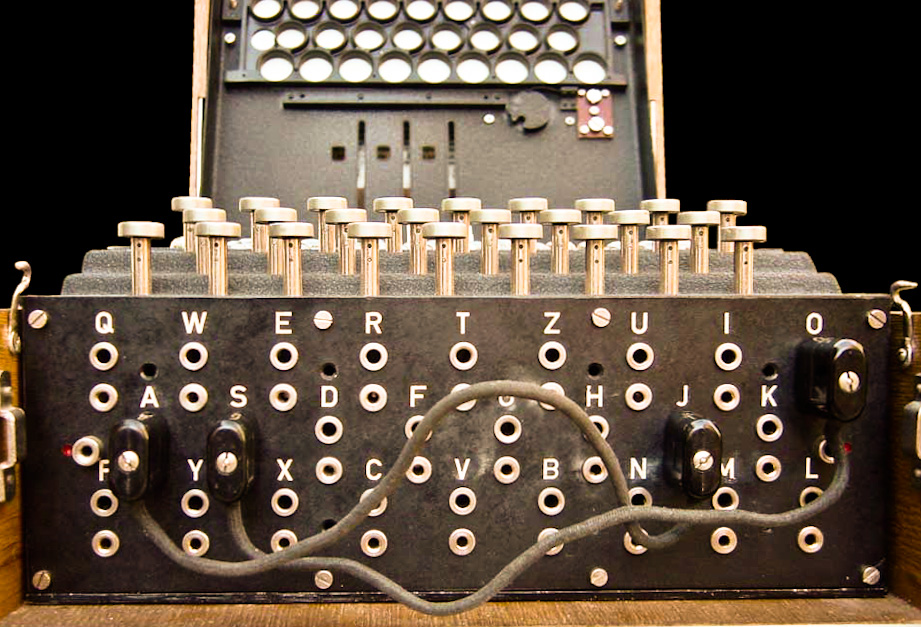
The mechanism is almost embarrassingly simple. If a cable joins the A socket to the J socket, then every time the operator presses A the current is diverted as though J had been pressed, and every time J is pressed the current behaves as A. The two letters trade identities. Crucially, a letter patched to nothing — its socket left empty — passes straight through unchanged; such a letter is said to be self-steckered.
Two properties make the plugboard fit Enigma perfectly. First, the swap is reciprocal: connecting A to J is identical to connecting J to A. There is no direction to a cable, just as there is no direction to the machine’s overall encipherment — the same setting that turns plaintext into ciphertext turns that ciphertext back into plaintext. Second, the swap is applied twice on every keystroke. When a key is pressed, the signal passes through the plugboard before it reaches the rotors; it travels through the rotors and the reflector and back; and then, on its way out to the lamp, it passes through the plugboard again. The plugboard, in other words, is a swap that brackets the entire rotor journey at both ends.
How many cables? In standard wartime German practice the operator used ten. Ten cables join ten pairs — twenty letters — leaving the remaining six letters self-steckered. The machine shipped with more than that (thirteen would have patched all twenty-six letters), and the number in use varied at times during the war, but ten was the workhorse setting the codebreakers learned to expect. Six self-steckered letters was not an oversight: partial steckering, counter-intuitively, yields more possible plugboard configurations than connecting every letter would — a point Volume 5 will quantify. For now it is enough to say that the plugboard’s contribution to the total key space is enormous, dwarfing the contribution of the rotor order and rotor positions combined.
This single panel is the headline difference between the commercial Enigma — sold openly in the 1920s, plugboard-free — and the military Enigma used by the Wehrmacht. The rotor wiring of the commercial machines was, in effect, public knowledge or recoverable; what the German military added was this cheap, front-mounted layer of substitution that multiplied the difficulty by a factor large enough to convince them the cipher was safe. The irony, explored in later volumes, is that the plugboard — for all the brute-force difficulty it added — left the rotor scramble underneath it untouched, and it was that untouched core that gave the codebreakers a foothold.
4.3 Ring Settings — Sliding the Alphabet on the Wheel
The second adjustable layer lives inside the rotors themselves, and it is the subtlest of the daily settings: the Ringstellung, or ring setting.
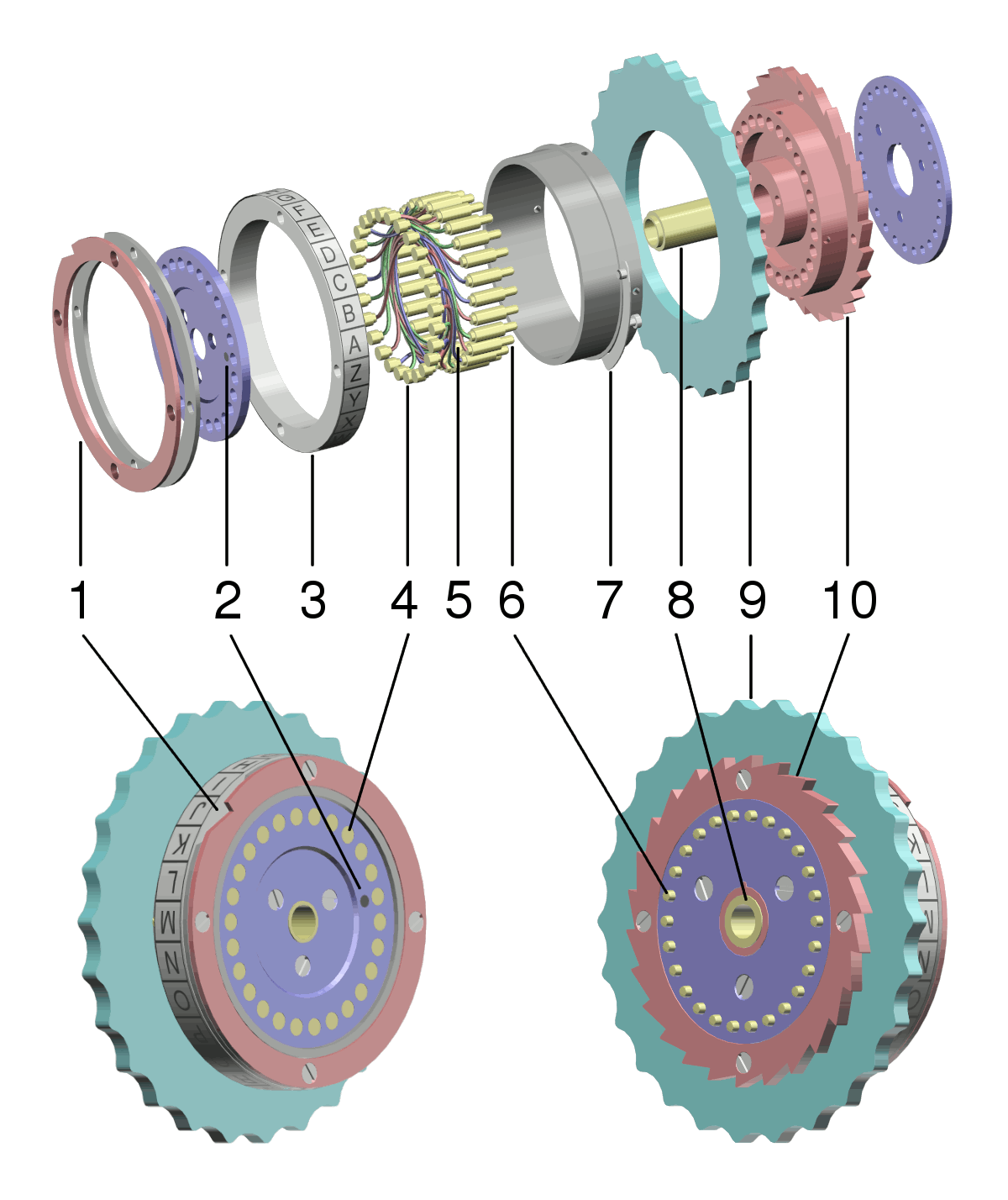
Recall from Volume 3 that each rotor is a disc with twenty-six wired contacts on each face, encoding a fixed scrambling of the alphabet. Around the rim of that disc sits a separate alphabet ring carrying the twenty-six letters (or numbers 01–26) that the operator reads through the little windows on the lid. The clever part is that this ring is not permanently fixed to the internal wiring. It can be unclipped, rotated to any of twenty-six positions relative to the wiring, and clipped back. That rotation is the ring setting.
Two consequences follow. First, the ring setting offsets the displayed letter from the internal wiring. Two operators could each turn their rotors until the window showed, say, A, and yet — if their ring settings differed — the actual wired starting point of the scramble inside would be different. The letter you see no longer tells you, by itself, the state of the wiring; it tells you the state of the wiring plus an unknown offset. To a codebreaker who has worked out a rotor’s starting position, the ring setting is a further unknown that must be peeled away before the visible window letters can be matched to the internal reality.
Second — and this depends on the model — on military Enigma rotors the turnover notch is cut into the alphabet ring, not the wired core. The notch is the trip that, once per revolution, kicks the neighbouring rotor forward one step (the “odometer” carry described in Volume 3). Because the notch rides on the ring, rotating the ring also moves the point in the rotor’s cycle at which turnover happens relative to the wiring. Setting the ring therefore does two jobs at once: it shifts the displayed-letter offset and it shifts where the stepping cascade fires. Both are part of the day’s secret.
The Ringstellung is, in practice, the least intuitive of the settings, and historically one of the harder ones for the codebreakers to nail down — precisely because its effect is entangled with the rotor starting position. It adds no new kind of complexity (it is just an offset), but it adds another coordinate the analyst must solve for, and it ensures that two machines showing identical window letters are not necessarily in identical internal states.
4.4 The Daily Key — One Configuration for a Whole Network
For an Enigma message to be readable by its intended recipient and no one else, the sending and receiving machines must be set up identically. Every adjustable element described so far — and a couple more — has to match. The bundle of all those settings, valid for a fixed period and shared across an entire communications network, is the Tagesschlüssel, the daily key.
A daily key specified, in the typical Army/Air Force scheme:
- the Walzenlage — the rotor selection and order. By the late 1930s the operator chose three rotors from a set of five and placed them in the machine left-to-right in a specified order (for example: rotors II, V, I);
- the Ringstellung — the ring setting for each of the three chosen rotors, given as three letters or numbers;
- the Steckerverbindungen — the plugboard pairings, listed as the ten letter-pairs to be patched (for example: AP BR CM …);
- the Grundstellung — the ground, or basic, setting: a three-letter starting position to which the rotors were turned as the common reference point for the indicator procedure (described below);
- the reflector choice, on models that offered more than one.
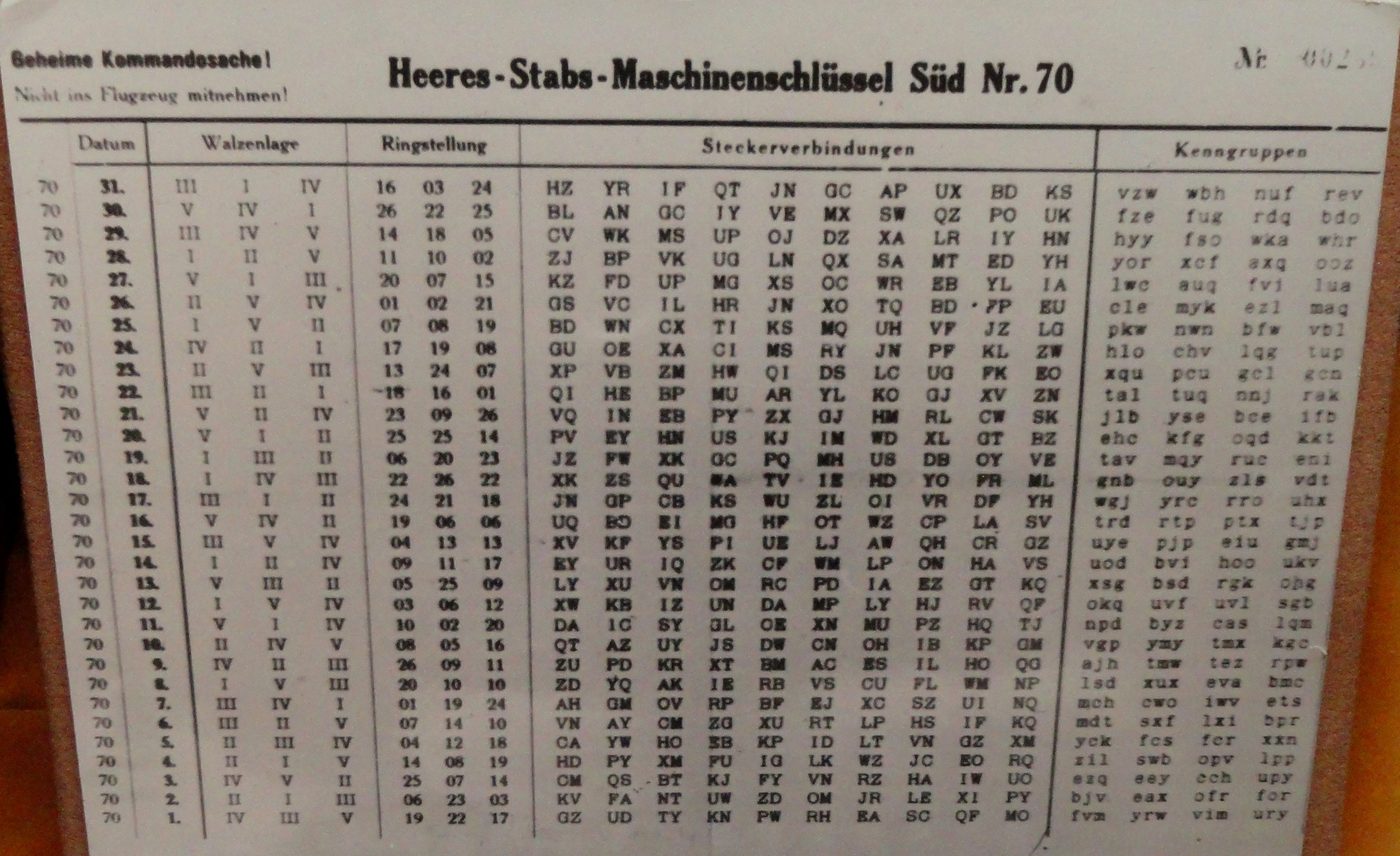
These settings were distributed in advance on printed key sheets — tables, often covering a month, with one row per day. The sheets were classified material, printed where possible on soluble or otherwise destructible paper, and held by the signals personnel of every unit on the net. To read the sheet you simply ran your finger to the current date and copied the row: this rotor order, these rings, these plugs, this ground setting. At a fixed changeover — typically midnight, the key valid for the calendar day — every operator across the network reset to the new row, and the day’s traffic could begin.
Keys generally changed daily, which is why the codebreakers’ clock reset every twenty-four hours: a solution found at 11 p.m. was worthless one minute past midnight, and the race began again. Different services ran different schedules and refinements. The Kriegsmarine (navy), and especially the U-boat arm, operated its own markedly more secure key systems — additional rotors, separate sheets, bigram tables for disguising indicators, and in some cases keys valid for longer than a single day — a hardening that made naval Enigma the toughest nut of all, and the subject of its own later volume.
4.5 The Message Key — Why Every Message Started Differently
Here is a subtle but vital point. If every operator on a network set their rotors to the day’s Grundstellung and simply started typing, then every message of the day would begin enciphering from the same rotor position. Cryptanalysts call this condition depth: many messages in the same machine state. Depth is poison to a cipher, because lining messages up against one another lets an analyst exploit the statistical regularities of ordinary language to prise the system open. A whole day’s traffic in depth would have been a catastrophe.
The Germans understood this, and their solution was the message key (Spruchschlüssel): each message would be enciphered from its own randomly chosen starting position, different from every other message. The day’s Grundstellung was used not to encipher the message itself, but only to communicate, secretly, that message’s private starting position. The recipient, decrypting the message key, moved their rotors to it and read the body. In this way thousands of messages a day could share one daily key while each ran from a different point — no two in depth.
The trouble was in the details of how the message key was announced — the indicator procedure — and it was here that the pre-war scheme contained a fatal generosity.
4.5.1 The Doubled Indicator
Under the procedure used from the 1930s up to 1940, the drill went like this. The operator first set the rotors to the day’s Grundstellung, then chose off the top of his head a three-letter message key — say WIK — to be the real starting position for the body of the message. This key had to be sent to the recipient, enciphered, and here the rules said to type it twice in a row: WIKWIK, six keystrokes, enciphered through the machine from the Grundstellung.
Because the rotors step with every keystroke, those six letters came out as six different cipher letters — perhaps BLQ TZN. This six-letter group was transmitted at the head of the message as the indicator. The receiving operator, with their rotors also at the Grundstellung, typed the six cipher letters back in, recovered WIKWIK, saw the two halves agreed, set their rotors to WIK, and read the message.
Why double it? As an error check. Radio Morse over a noisy front was error-prone; a garbled single message key would leave the recipient unable to set his machine, with no way to know it was wrong. By sending the key twice, the recipient could confirm the two copies matched and trust the setting. It was a sensible, well-intentioned safeguard.
It was also a cryptanalytic gift. Enciphering the same three letters twice from the same starting position created a fixed mathematical relationship buried in every indicator of the day: the 1st and 4th cipher letters were two encipherments of one and the same plaintext letter, as were the 2nd and 5th, and the 3rd and 6th. That hidden linkage — present in dozens or hundreds of message headers daily — was exactly the kind of regularity an analyst dreams of. The Polish Cipher Bureau seized on it: it was the structural weakness underpinning Marian Rejewski’s reconstruction of the wiring and the later sheet-and-machine methods. Volume 7 tells that story in full; the point to hold here is that the doubling itself — a procedure, not a flaw in the hardware — was the lever that first cracked Enigma open.
The Germans eventually recognised the danger. On 1 May 1940, on the eve of the Western offensive against France and the Low Countries, the Army and Air Force abolished the doubled indicator: the message key would henceforth be enciphered once only. (The date is most often given as 1 May 1940, with the great German assault opening on 10 May; some accounts cite mid-May. Either way it was a single, deliberate hardening made just as the campaign began.) At a stroke the regularity vanished, and the Polish-derived sheet method that had depended on it stopped working overnight. The codebreakers would have to find another road in — and, as later volumes recount, they did.
4.6 The Operating Drill
A cipher machine is only half the system; the other half is the human procedure for using it, and the Germans drilled theirs carefully.
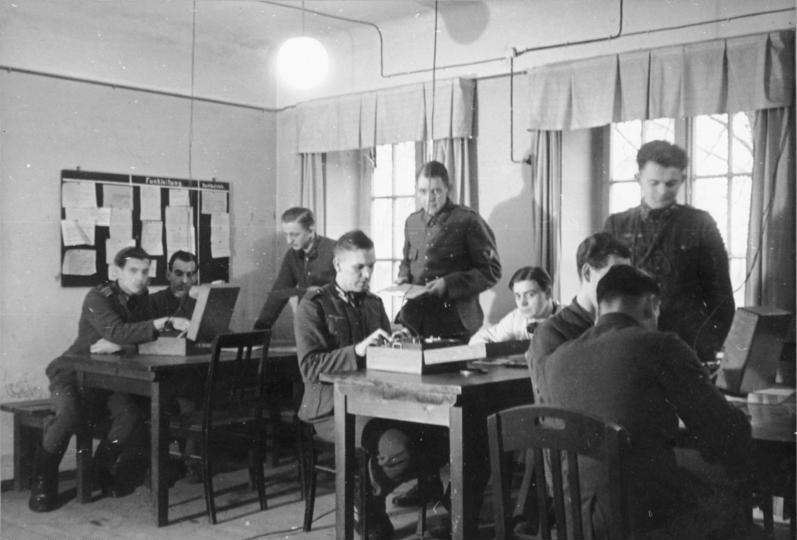
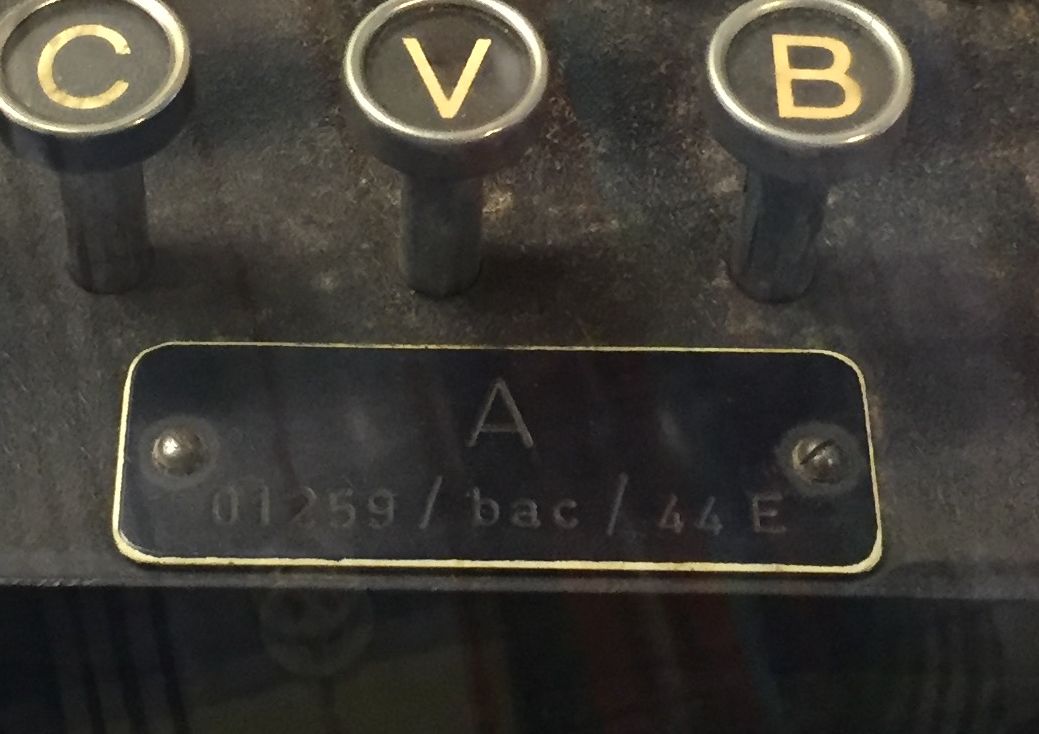
In practice, enciphering was a team task. The Enigma had no printer: pressing a key merely lit a lamp. So one man typed the plaintext letter by letter, a second watched the lampboard and called out (or wrote down) each cipher letter as it flashed, and a third tapped the result out in Morse on the radio — or, in reverse, took down incoming Morse for the first two to decrypt. One operator working alone was slow and error-prone; the division of labour kept a steady rhythm and reduced mistakes.
The transmitted text obeyed strict conventions designed both for clarity over Morse and for security:
- Five-letter groups. Ciphertext was sent in uniform blocks of five letters, a standard telegraphic format that made counting, checking and re-transmission tidy and gave an eavesdropper no clue to word boundaries.
- No spaces or punctuation. The Enigma keyboard had only the twenty-six letters — no spaces, digits, or punctuation marks. Operators substituted code conventions: an X commonly stood in for a full stop or a separator, while spelled-out forms and abbreviations handled the rest. Numbers were written out as words.
- Spelling conventions. Standard substitutions smoothed over the missing characters and reduced ambiguity — for instance writing certain fixed letter-groups for common punctuation, and consistent renderings for figures and abbreviations, so that sender and recipient shared an unwritten dictionary.
- Length limits. Operators were instructed to keep messages short — long messages were to be broken into several separately-keyed parts. A short message gives a codebreaker less material to chew on; capping the length was a deliberate, if imperfect, defence against statistical analysis.
Done by the book, this drill was formidable. The daily key was secret, the ring setting hid the offsets, the plugboard added its huge multiplier, and each message ran from its own private starting point announced by an indicator. On paper the system was watertight.
4.7 Human Factors — The Crack in the Discipline
But procedures are only as strong as the people executing them, hour after hour, under fatigue, pressure, and shellfire. The pre-war doubled indicator shows the pattern in miniature: a rule introduced for the soundest of practical reasons — guarding against transmission errors — that quietly handed the enemy a structural weakness. The system’s security depended not on any single setting but on every operator, on every net, following every rule, every time.
They did not. Tired or lazy operators chose message keys that were anything but random — three identical letters, a diagonal of the keyboard, or the same favourite trigram day after day. They reused settings, sent stereotyped openings, repeated messages verbatim on multiple nets with different keys, and committed dozens of small breaches of discipline that, individually trivial, collectively gave the codebreakers exactly the toeholds the elaborate machinery was meant to deny them. At Bletchley Park these gifts even earned a nickname — “cillies” — and they became a staple of the British attack. Those operator errors, and the methods built to exploit them, are a thread that runs through the volumes to come.
The machine and its procedures, then, were a genuinely hard problem — but a human one, and humans leak. Before we follow the codebreakers in, though, we should appreciate just how hard the problem looked from the German side. With the plugboard, the rotor choices, the ring settings, and the message keys all in play, how many possible configurations were there — and why did that number persuade an entire war machine that Enigma could not be broken?
Next — Volume 5: The Combinatorics — Why They Thought It Unbreakable.
Comments (0)