Enigma · Volume 14
Enigma — Volume 14 — Surviving Machines, Museums & Pop Culture
Where the secret weapon lives now — glass cases, auction floors, and the popular imagination
14.1 About This Volume
For most of its working life the Enigma was a state secret — first Germany’s, then, after the war, Britain’s. The Wehrmacht built well over a hundred thousand of the machines; the Allies, having broken them, kept the achievement classified for three decades so that the same techniques could be sold to newly independent nations whose own communications Whitehall wished to read. Only in 1974, with F. W. Winterbotham’s The Ultra Secret, did the full story begin to surface. Everything that follows in this volume — the museum cases, the six-figure auctions, the films and novels, the public rehabilitation of Alan Turing — flows from that long-delayed declassification. An object that had been deliberately destroyed, buried, or locked away suddenly became one of the most desirable artefacts of the twentieth century.
This volume tracks the Enigma’s afterlife. We visit the institutions that display the surviving machines; we follow the auction market from curiosity to record-breaking spectacle; we recount the strange theft of a rare Abwehr Enigma from Bletchley Park in 2000; we weigh the books and films that retold the codebreaking story, with their virtues and their distortions; and we trace the belated, hard-won recognition granted to Turing, to the Polish mathematicians, and to the women of Bletchley Park. We close by pointing toward Volume 15 and the thriving world of replicas and simulators that keep the machine hands-on for a new century.
14.2 The Surviving Machines
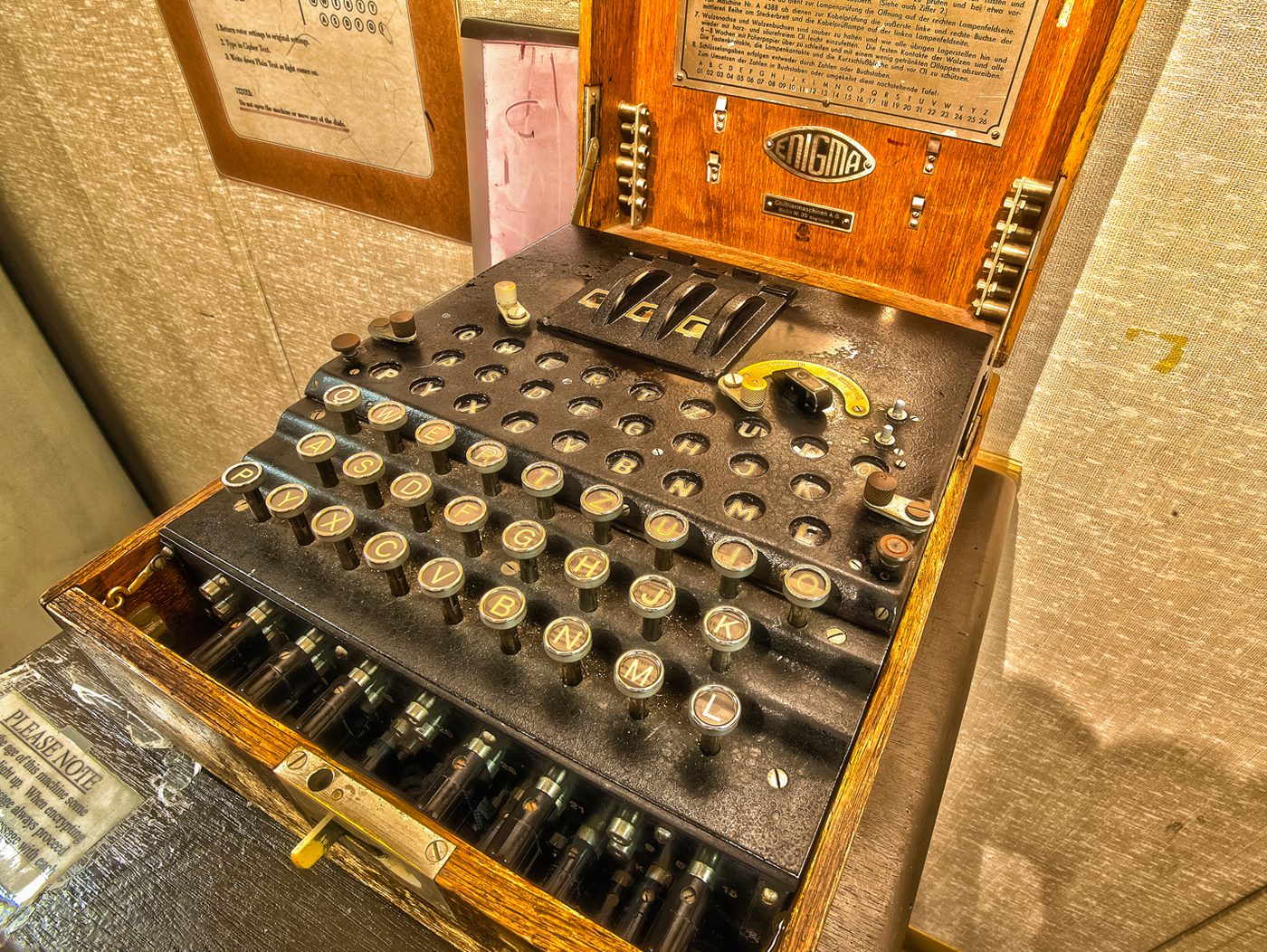
Of the roughly hundred thousand or more Enigmas manufactured across the machine’s many variants, only a few hundred genuine examples are thought to survive. The attrition was deliberate as much as accidental: as the Reich collapsed in the spring of 1945, signals units were under standing orders to destroy their cipher equipment rather than let it fall into enemy hands, and countless machines were smashed, burned, or dumped into lakes and rivers. What remains is therefore precious, scattered across a surprisingly small number of public collections.
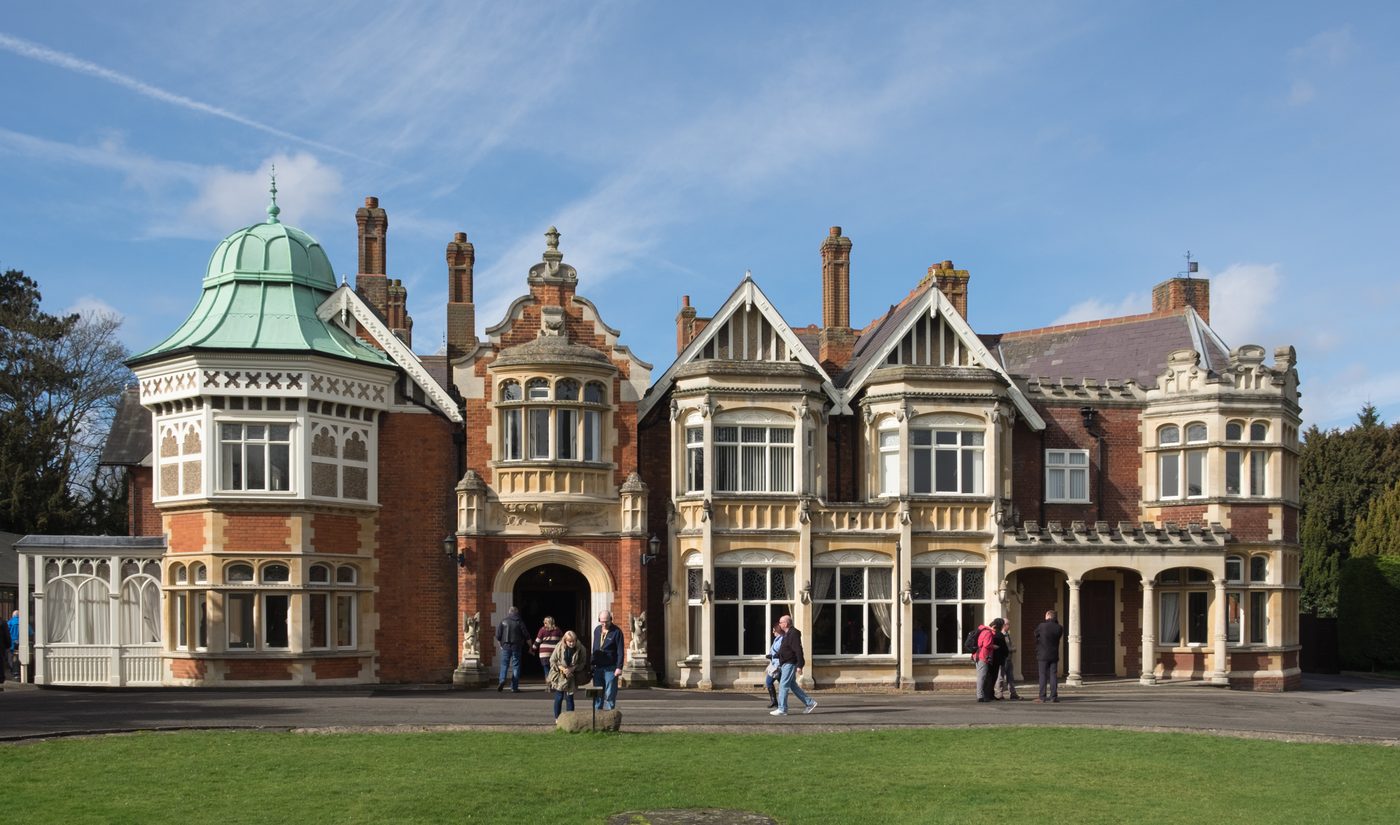
The natural place of pilgrimage is Bletchley Park itself, the Buckinghamshire estate where the British codebreaking effort was concentrated. Saved from demolition in the 1990s and now a thriving museum, it displays working and static Enigmas alongside reconstructions of the bombes and of Colossus, the wartime machines built to attack German ciphers. A short walk away, the separate National Museum of Computing holds related material. Bletchley’s collection grounds the machines in the place where they were beaten.
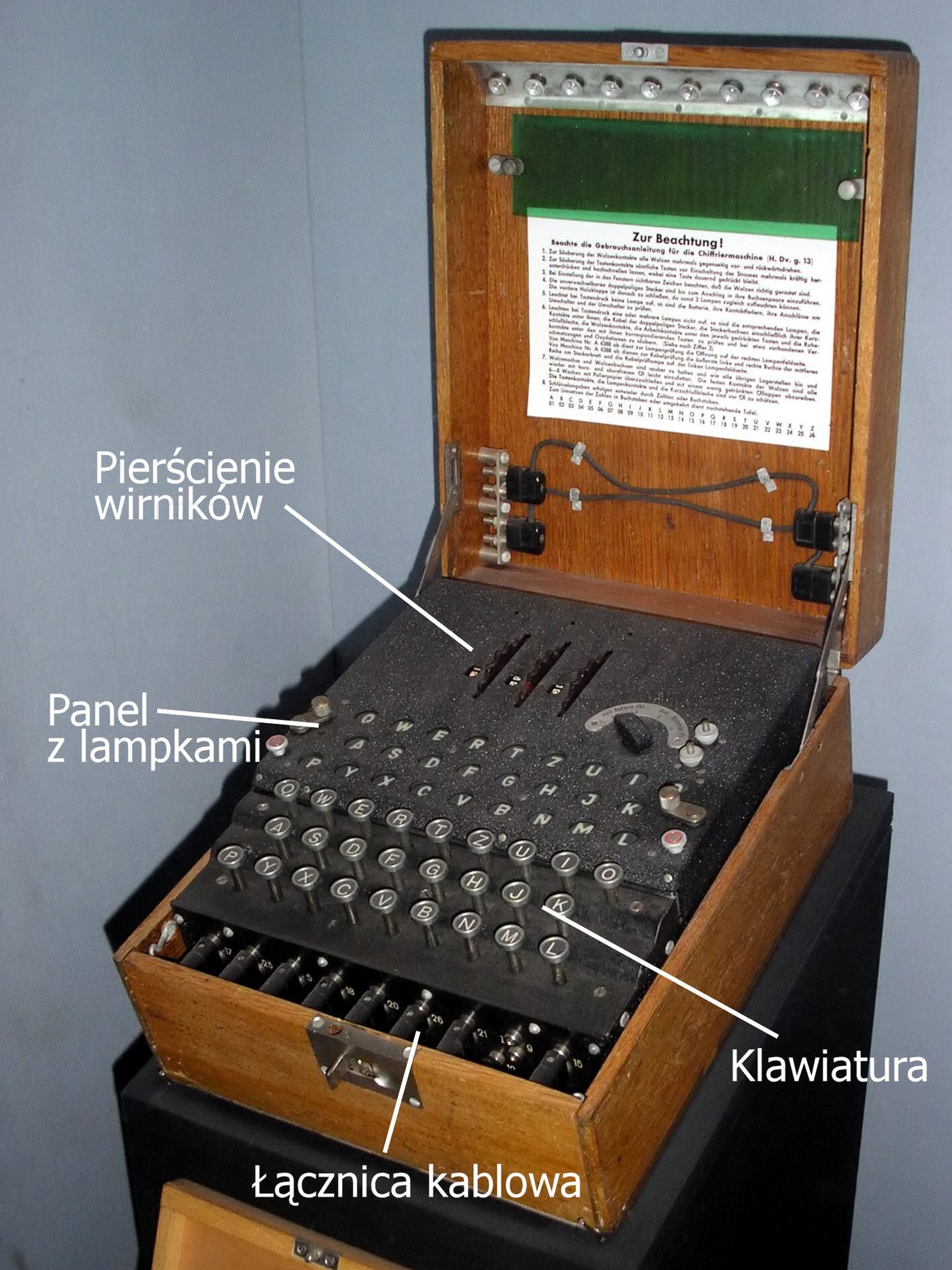
In the United States, the National Cryptologic Museum, run by the National Security Agency adjacent to Fort Meade in Maryland, holds one of the richest cryptologic collections anywhere, with multiple Enigmas, some of which visitors may operate. Washington’s International Spy Museum and the Smithsonian Institution both hold examples, as does the National WWII Museum in New Orleans. In London, the Imperial War Museum and the Science Museum both display Enigmas within their wider twentieth-century collections. On the Continent, the Deutsches Museum in Munich — the world’s largest museum of science and technology — exhibits the machine in its German homeland, where it began life in the 1920s as a commercial device for protecting banking and corporate secrets before the military adopted it.
The single most evocative machine on display in America may be the four-rotor naval Enigma at Chicago’s Museum of Science and Industry, exhibited beside the captured German submarine U-505. U-505 was taken in June 1944 by a US Navy hunter-killer group in the South Atlantic — one of the very real Enigma captures that, as we shall see, Hollywood would later transplant into a wholly fictional and Americanised story. The boat and its cipher machine sit together, a rare case of weapon and key preserved as a single tableau.
14.3 The Auction Market
For decades after the war an Enigma had effectively no open market value, because almost no one outside intelligence circles knew the machines had been broken, and surviving examples sat in classified stores. Once the Ultra secret was out and the surrounding mythology grew, that changed completely. By the 1990s genuine machines were appearing at auction; by the 2000s and 2010s they had become blue-chip collectibles, and prices climbed steeply and almost without interruption.
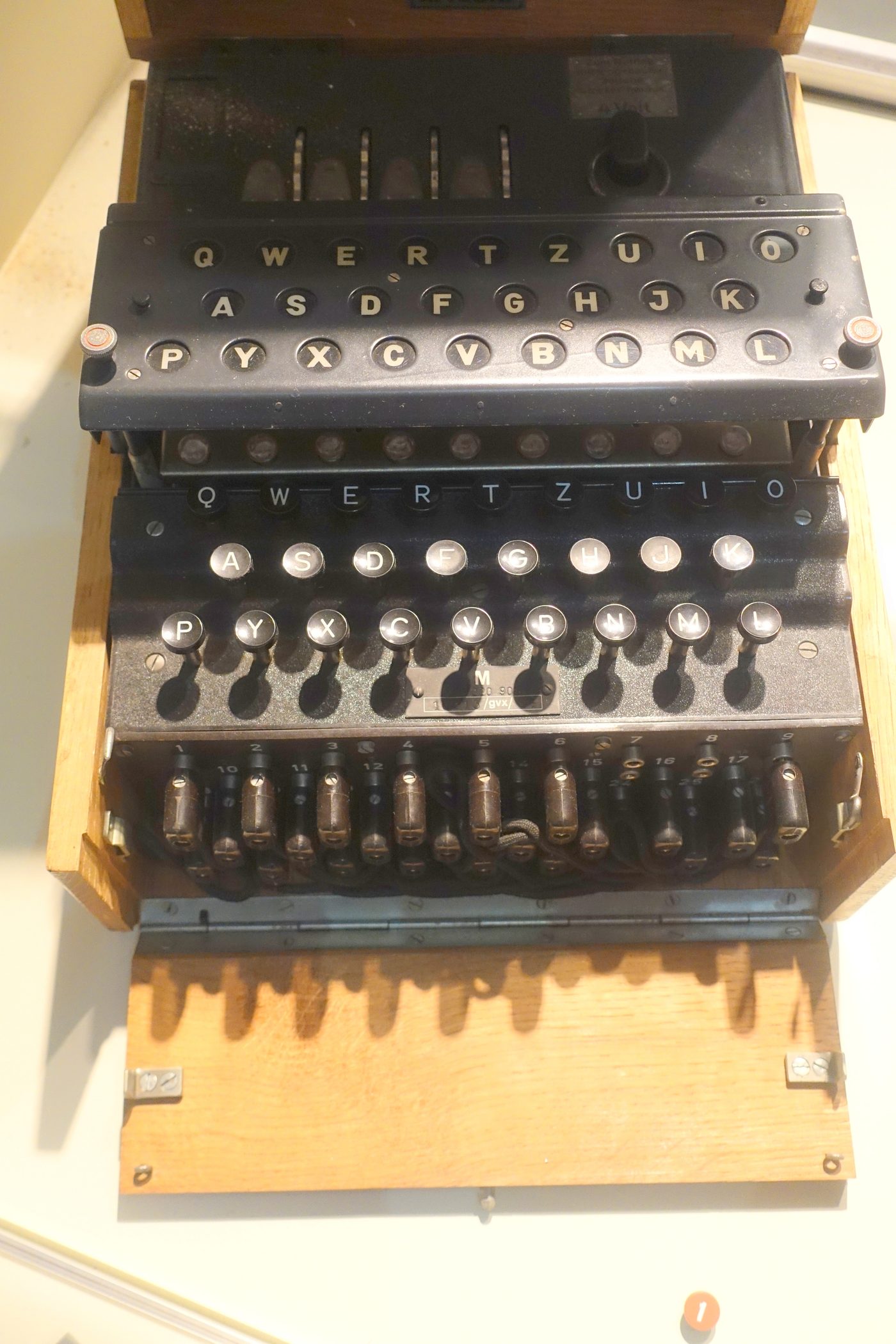
A standard three-rotor service Enigma — the workhorse of the German army and air force — now routinely sells in the low-to-mid six figures, depending on condition, completeness, and provenance. Far rarer, and far more valuable, is the four-rotor naval M4, the variant introduced for U-boat traffic in February 1942 that briefly plunged Bletchley’s Atlantic intelligence into darkness. Only around 1,600 M4s were built, of which perhaps a hundred survive, and that scarcity drives the headline prices.
The record has been broken repeatedly. A working M4 sold at a Bonhams science and technology sale in New York for $463,500, eclipsing an earlier mark of around $350,000 set in 2015. Subsequent sales pushed higher still — a four-rotor machine reaching roughly $437,000 at one 2020 auction, and another fully operational M4 reported at about $547,500. The trajectory continued into the mid-2020s: in November 2025 a four-rotor M4 sold at Christie’s in Paris for €482,600 — on the order of $550,000 — roughly double its pre-sale estimate, with the auction house billing it as one of the rarest and hardest Enigmas to decipher. Sources differ on which sale holds the absolute record, and currency conversions blur the comparisons, so these figures are best read as a range — broadly half a million dollars for a top-tier naval machine — rather than as a single definitive number. The direction of travel, however, is unmistakable: the Enigma has become one of the most coveted technological artefacts of the era.
14.4 A Notable Caper: The Bletchley Park Theft of 2000
The Enigma’s new desirability had a criminal corollary. On 1 April 2000 a rare Abwehr Enigma, the machine designated G312, was stolen from the museum at Bletchley Park. The Abwehr (German military intelligence) variant is unusual — it has no plugboard and uses a more intricate multi-notched rotor system — and only a handful survive, making G312 one of the most valuable items in the collection, then insured for a sum well into six figures.
The case turned strange. In September 2000 a man styling himself “The Master” sent a note demanding £25,000 and threatening to destroy the machine if he was not paid. Shortly afterward the Enigma was posted anonymously to the BBC broadcaster and Newsnight presenter Jeremy Paxman — arriving, oddly, with three of its rotors missing. In November an antiques dealer named Dennis Yates was arrested after telephoning The Sunday Times to broker the return of the still-missing parts. Yates maintained he had merely acted as an intermediary for the real thief, but in October 2001 he was convicted at Aylesbury Crown Court of handling stolen goods and extortion and sentenced to ten months; he served around three. The machine, eventually reunited with its rotors, was returned to Bletchley Park, where it remains. The episode reads like a plot from one of the thrillers the Enigma had by then inspired — and underlines just how far the machine’s value, and mystique, had risen.
14.5 Pop Culture: The Story’s Retellings
As the secret came out, storytellers seized on it. The Enigma saga offered everything a dramatist could want — mathematics as heroism, a desperate naval war, the moral weight of secrecy, and in Alan Turing a brilliant, tragic central figure. The retellings have done enormous good in bringing the story to millions; they have also, repeatedly, bent the history to fit the demands of narrative.
14.5.1 Books
Robert Harris’s novel Enigma (1995) set a fictional cryptanalyst, Tom Jericho, against the real backdrop of Bletchley Park during the 1943 convoy crisis, weaving a thriller of espionage and romance around recognisably accurate codebreaking. Notably, Harris kept Turing out of the story entirely, inventing a protagonist rather than fictionalising a real man. Neal Stephenson’s sprawling Cryptonomicon (1999) braided a Second World War cryptology thread — featuring a fictionalised Turing and the Allied effort to exploit Ultra without revealing it — together with a 1990s plot about data havens and digital cash, and became a touchstone for a generation of programmers. Earlier, Hugh Whitemore’s stage play Breaking the Code (1986), adapted from Andrew Hodges’s landmark biography Alan Turing: The Enigma, put Turing himself at centre stage, giving equal weight to his cryptographic genius and to the prosecution for homosexuality that destroyed him; Derek Jacobi’s performance, on stage and later on television, did much to fix Turing in the public mind decades before the films arrived.
14.5.2 Films
Harris’s novel reached the screen as Enigma (2001), scripted by Tom Stoppard and produced by Mick Jagger, who lent a genuine wartime Enigma from his own collection to the production. Faithful to the book’s invented hero, the film was praised for atmosphere but criticised in some quarters for marginalising the Polish contribution — and for a plot point that gestured uncomfortably at the real Katyn massacre.
Far more controversial was U-571 (2000). The film depicts a fictional American crew seizing an Enigma machine from a crippled U-boat — a stirring action story built on a falsehood, since the pivotal early Enigma captures were British (the seizures from U-110 by HMS Bulldog in May 1941, and material taken from weather trawlers and from U-559), with the foundational theoretical break achieved years earlier by Polish mathematicians. The film’s transplanting of British and Polish achievement onto an American crew provoked anger in the United Kingdom that reached the floor of the House of Commons. At Prime Minister’s Questions in 2000, an MP called the film an affront to the British sailors who died in those actions, and Prime Minister Tony Blair agreed that it was wrong to suggest otherwise, noting those sailors had in many cases sacrificed their lives so the country could remain free. Years later the film’s own screenwriter, David Ayer, publicly regretted the distortion, describing it as a mercenary decision to invent a parallel history for an American audience.
The most successful retelling of all, The Imitation Game (2014), starred Benedict Cumberbatch as Turing, won the Academy Award for Best Adapted Screenplay, and brought the story to a vast new audience. Its cultural impact was real and largely benign — but historians have catalogued its liberties carefully. The timeline is heavily compressed; the codebreaking is reframed as the work of a single misunderstood genius building one machine he names “Christopher,” when in truth the bombe built on Polish work and was a deeply collaborative effort that Turing led alongside Gordon Welchman and many others. Most criticised is an invented espionage subplot in which Turing discovers that the real Soviet spy John Cairncross is a traitor and is then blackmailed into silence to protect his own secret — an episode with no basis in fact (Turing and Cairncross worked in different sections and are not known to have met) that has the unfortunate effect of implying Turing himself committed treason. The film, in short, is moving and important and should be enjoyed with a historian’s footnotes close at hand.
14.6 The Rehabilitation of Turing
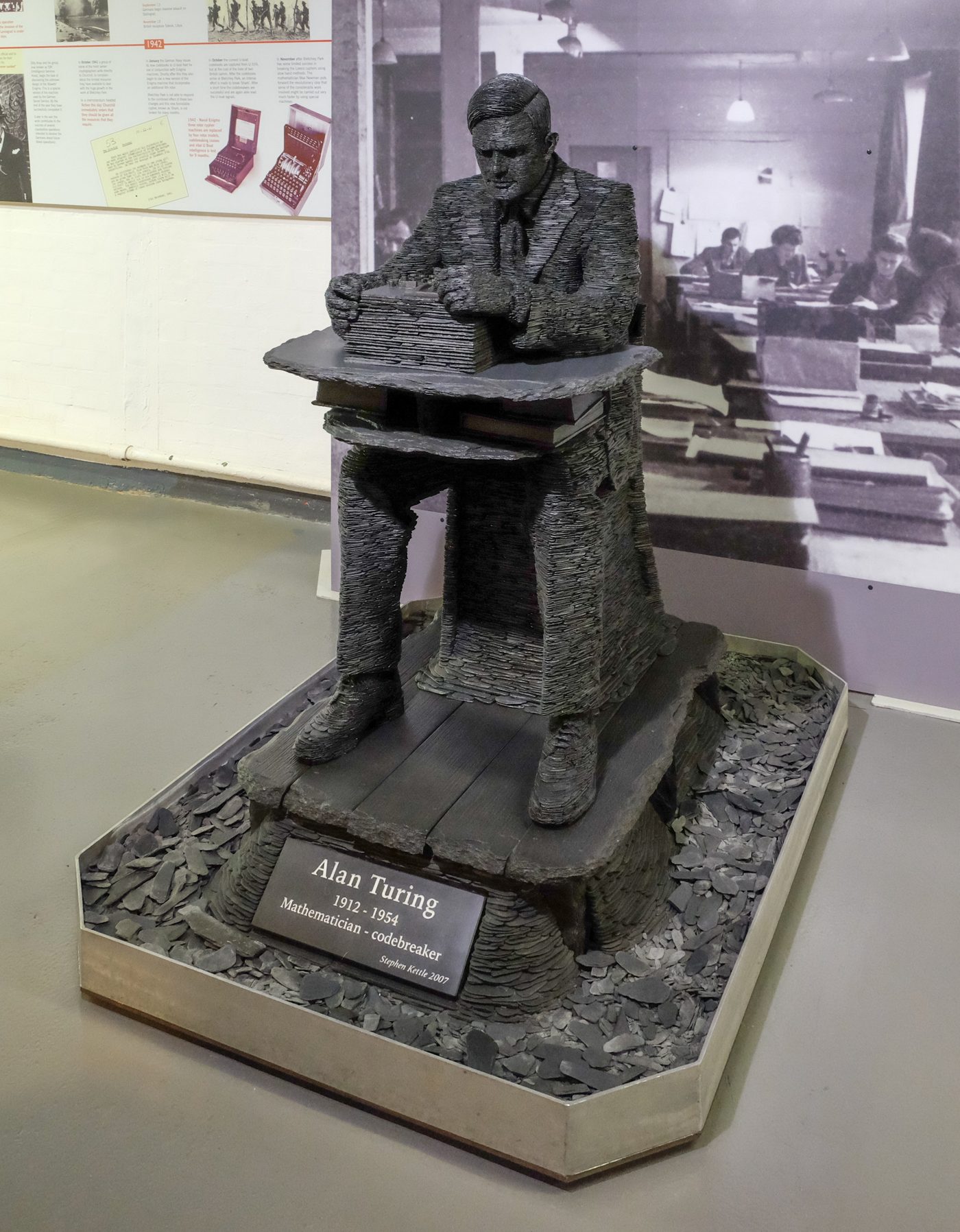
If the films distorted the codebreaking, they also helped drive one of the more remarkable acts of public contrition in modern British history. Alan Turing had been prosecuted in 1952 for “gross indecency,” stripped of his security clearance, subjected to court-ordered hormone treatment, and found dead in 1954 of cyanide poisoning, aged 41 — a verdict of suicide that some, including his mother, contested. For half a century the state that he had helped to save offered nothing.
That silence finally broke. In 2009, following a public petition, Prime Minister Gordon Brown issued an unequivocal government apology, calling the treatment of Turing “appalling” and acknowledging the debt the nation owed him. In 2013, after a sustained campaign, Queen Elizabeth II granted Turing a rare posthumous royal pardon, signed on 24 December that year. The principle was then extended: the “Alan Turing law,” enacted as part of the Policing and Crime Act 2017, posthumously pardoned tens of thousands of other men convicted under the same repealed laws criminalising homosexual acts, and offered the living a route to having such convictions formally disregarded.
The rehabilitation reached its most visible form in 2021, when the Bank of England issued a new polymer £50 note bearing Turing’s portrait, a representation of the bombe, ticker tape rendering his name in binary, and a line from a 1949 interview: “This is only a foretaste of what is to come, and only the shadow of what is going to be.” The man the state had hounded to death now looks out from its highest-denomination banknote — a quiet, extraordinary reversal.
14.7 Belated Recognition: The Poles and the Women of Bletchley
Two other groups have, more slowly, been brought back into the story. The first are the Polish mathematicians of the Biuro Szyfrów — Marian Rejewski, Jerzy Różycki, and Henryk Zygalski — who first broke the military Enigma in 1932 using the methods of pure mathematics, built the “bomba” and the perforated Zygalski sheets, and, weeks before the war, handed their results and their reconstructed machines to British and French intelligence at a secret meeting near Warsaw. Without that gift, Bletchley would have started years behind. For decades the Polish contribution was barely acknowledged in English-language accounts; it has since been honoured by memorials in Poland, at Bletchley Park, and elsewhere, by formal statements from GCHQ recognising the debt, and by joint Anglo-Polish commemorations marking the anniversaries of the original break.
The second group are the women of Bletchley Park, who at the peak made up the majority of its roughly ten thousand staff. They operated the bombes, ran the Colossus machines, staffed the intercept and indexing sections, and did much of the painstaking analytical labour on which Ultra depended — then kept silence for decades under the Official Secrets Act, often unable to tell even their families what they had done. Veterans such as the bombe operators and the Wrens of the naval sections have latterly been recognised through a commemorative badge issued by the government to surviving Bletchley staff, through the museum’s own permanent emphasis on their work, and through a wave of books, documentaries, and oral-history projects that have at last put their names to the record.
14.8 A Bridge to Volume 15
The Enigma’s afterlife is not confined to glass cases and auction catalogues. The machine is, at heart, a finite and well-documented mechanism — and that has made it irresistible to a community of enthusiasts determined to keep it not merely visible but operable. Software emulators reproduce every rotor, every plugboard wiring, every quirk of the stepping mechanism, and run in a browser or on a phone; teaching platforms such as CrypTool let students attack messages with the very techniques Bletchley pioneered; museums sell build-it-yourself paper and electronic kits; and a lively open-source hardware movement has produced faithful, fully functional replicas in wood, brass, and microcontroller. These projects do something no static exhibit can: they let a new generation turn the rotors, watch the lamps light, and feel for themselves both the elegance of the design and the fatal regularities that doomed it. How those replicas and simulators are built — and what they teach us about the original — is the subject of our final volume.
Next — Volume 15: The Open Enigma — Building the Replica.
Comments (0)