Enigma · Volume 15
Enigma — Volume 15 — The Open Enigma: Building the Replica
Fourteen volumes of theory, switched on and glowing on your own desk
15.1 About This Volume
This is the finale, and it is also a confession: every volume before this one was a description, and a description is never quite the thing. We have spent fourteen volumes circling the Enigma — its rotors and reflector, its plugboard and its stepping anomaly, the daily-key ritual, the Polish equations and the Bletchley huts, the U-boats and the Bombes and the long aftermath in which the machine that lost a war quietly fathered the computer age. We have, in other words, talked about the Enigma for a very long time. This volume turns away from the historian’s distance and toward a workbench. It is about the oldest and most honest way of understanding any machine: building one.
You cannot easily build an Enigma. The genuine articles are museum pieces now, changing hands at auction for sums well into six figures — a hundred thousand and up for a clean wartime example. But you can build something that thinks exactly like an Enigma, that lights the same lamps in the same impossible-to-predict order, that will hand a message to a real Enigma I and have it decode cleanly. That is what the Open Enigma is. It is an open-source, Arduino-powered homage that takes the abstraction of this entire series and makes it physical — a box on your desk with keys to press and lamps that glow, running the genuine cipher logic in firmware. The series that began with a machine kept secret for thirty years ends with that machine’s logic open, documented, and switched on under your own hands.
A note before we begin: this volume describes the build in general, instructive terms. Photographs of a specific, hand-assembled unit will be added later; for now the figures are reference and supporting imagery, captioned as such.
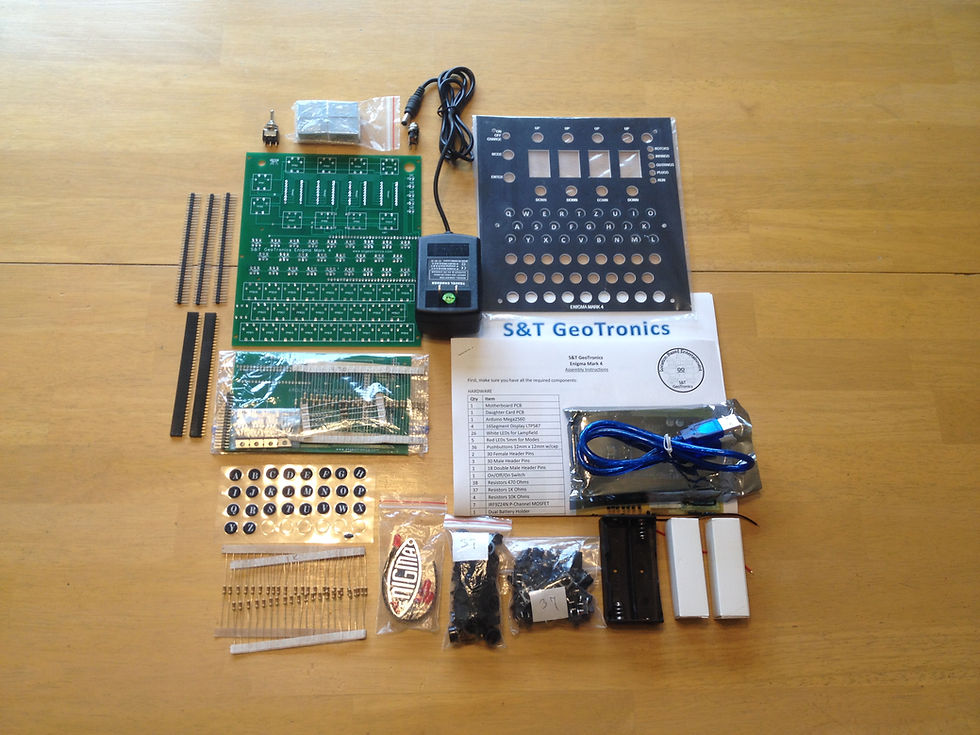
15.2 The Open Enigma Project: A Scavenger Hunt That Got Out of Hand
The Open Enigma did not begin as a commercial venture or an academic exercise. By the most-repeated account, it began with a conversation between friends about a scavenger hunt — someone wanted to encrypt the clues, and what better way than with the most famous encryption machine in history? The trouble, of course, is that a real Enigma costs as much as a house. So Marc Tessier and his business partner James Sanderson, working as S&T GeoTronics out of Columbus, Georgia, took it as a personal challenge to build their own. Tessier’s background was in network sales engineering, Sanderson’s in plant electrical and mechanical work — between them, exactly the right pair of hands for a project that is half software and half soldering iron.
They built their first working replica around 2013 and, in the spirit of the maker movement, did something the original’s creators would have found unthinkable: they published it. The hardware schematics and the source code went up on Instructables for anyone to copy. The response was enthusiastic enough that S&T GeoTronics decided to turn the one-off into a product, and in 2014 they took it to Kickstarter as “The Open Enigma Project.” The campaign asked for a modest $20,000 — and blew through it. Reports from the time describe the goal being met within days, with the campaign closing somewhere north of $60,000, comfortably past its stretch targets. The money was not for invention; the design already worked. It was for manufacturing — the jigs, boards, and parts to make kits in quantity rather than one at a time on a kitchen table.
What emerged was sold under the name Enigma Mark 4, available in several tiers: a bare-bones board set for the dedicated tinkerer, a full self-assembly kit, and a fully assembled, tested unit for those who wanted the experience without the soldering. The crucial point — the thing that makes it belong in this series rather than in a catalogue of novelties — is that all of it is open. The schematics are public; the firmware is public. Unofficial forks of the Arduino code live on GitHub to this day. After three decades in which the very existence of Enigma-breaking was a state secret, here was an Enigma whose every wire and line of code was yours to read.
15.3 What It Is, Physically
Set one on a desk and the homage is immediate. The Open Enigma reproduces the operator’s experience of a wartime Enigma with real care. There is a lampfield — the Glühlampen, the glowlamps — rendered as a grid of LEDs, one per letter, that light to show the enciphered output. There is a keyboard of push-buttons in the familiar QWERTZ-style layout, the keys you press to feed in plaintext. There are displays showing the rotor positions — the little windows that, on the original, exposed the letter rings of the spinning wheels. And there is a case that deliberately echoes the wooden-boxed silhouette of the real thing, down to the lid that closes over the keys.
Under that familiar skin, though, the machine is entirely of our century. The brain is an Arduino Mega — an ATmega-based microcontroller board — driving the whole apparatus. The electronics are a small lesson in efficient design. The lampfield’s roughly 115 LEDs are run not on 115 separate wires but through Charlieplexing, a multiplexing trick that lets a few dozen microcontroller pins address far more LEDs than there are pins, by exploiting the diode’s one-way nature. The 36 push-buttons of the keyboard are likewise read through a cleverly resistor-laddered loop and a handful of P-channel MOSFETs, so that the entire keyboard consumes only a few input pins. None of this would have meant anything to a 1940s signals operator — but the result, the press of a key and the glow of a different letter, is exactly what he would have recognised.
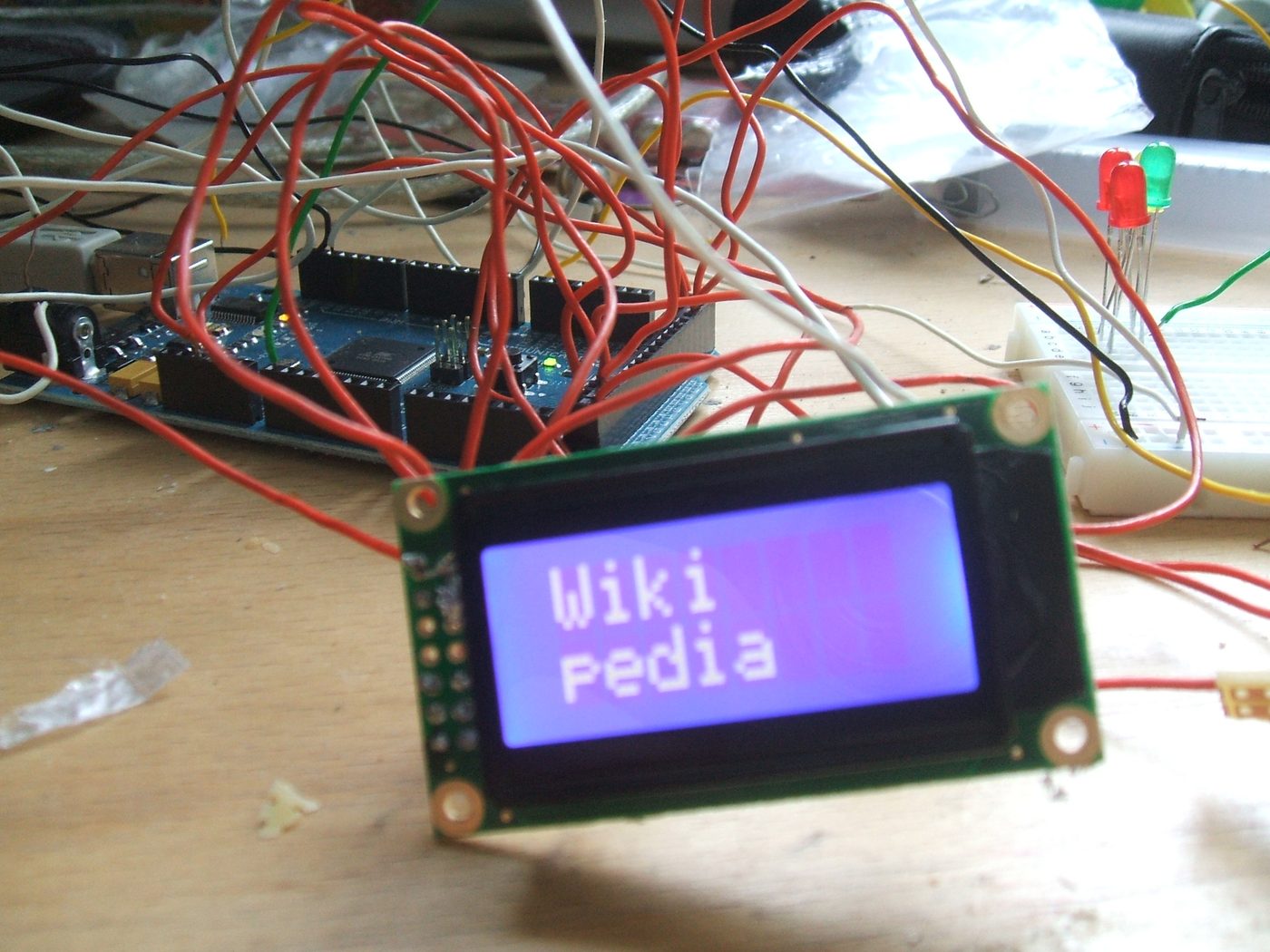
Here is the heart of the difference, and it deserves to be stated plainly. On a real Enigma, the rotors are physical objects — discs of bakelite and brass, each crossed by twenty-six insulated wires that scramble one letter to another, turning on a spindle and stepping on a pawl-and-ratchet mechanism. On the Open Enigma, the rotors do not physically exist. Their wirings, their stepping, their notch positions, the reflector, and (in most configurations) the plugboard all live as data and logic inside the firmware. The “rotors” are arrays in memory; the “stepping” is an increment in a loop. The machine performs the exact same permutation a wartime Enigma would perform — but it computes it rather than embodying it.
15.4 Faithful versus Simulated: An Honest Accounting
It would be easy to oversell the Open Enigma, and easy to dismiss it. The truth is more interesting than either, and it sits exactly on the line this series has been walking all along — between the mechanism and the mathematics it implements.
What the Open Enigma reproduces with genuine fidelity is the cipher behaviour. This is not an impression of an Enigma; it is a functionally exact one. The firmware implements the historical rotor wirings (rotors I through V and beyond, the reflectors, the ring settings), the stepping sequence — including, if it is faithful, the famous double-stepping anomaly of the middle rotor that we dissected back in Volume 4 — and the reciprocal substitution that makes the machine its own inverse. Because it gets the permutation exactly right, the Open Enigma is cipher-compatible with the real thing and with standard software simulators. You can set rotors, ring settings, and plug pairs on an Open Enigma, type a message, and decode the output on a genuine Enigma I, or in a CrypTool simulator, or on a phone app — and it comes out clean. Configured as a four-rotor machine it speaks the Kriegsmarine’s M4; dialled back to three rotors it is an Army/Air Force Enigma I. The cipher is the cipher; the Open Enigma simply runs it on silicon.
What is lost is the electromechanical truth of the original — and this matters more than a purist’s grumble. The wartime Enigma was not a metaphor for a permutation; it was a permutation, made of moving metal. When the operator pressed a key, current physically flowed out of a battery, through the plugboard’s patch cords, into the rightmost rotor, through twenty-six wires, across to the reflector, all the way back through a different path, and out to a lamp — and the rightmost rotor physically clicked forward one place before the lamp even lit, so that the next press would never repeat the last. The double-step was not a design choice in code; it was an artifact of where a notch sat on a ring and how a pawl caught it. On the Open Enigma you do not feel that. There are no wheels turning under your fingers, no ratchet resistance, no faint smell of warm contacts. The stepping is real in its logic and invisible in its body.
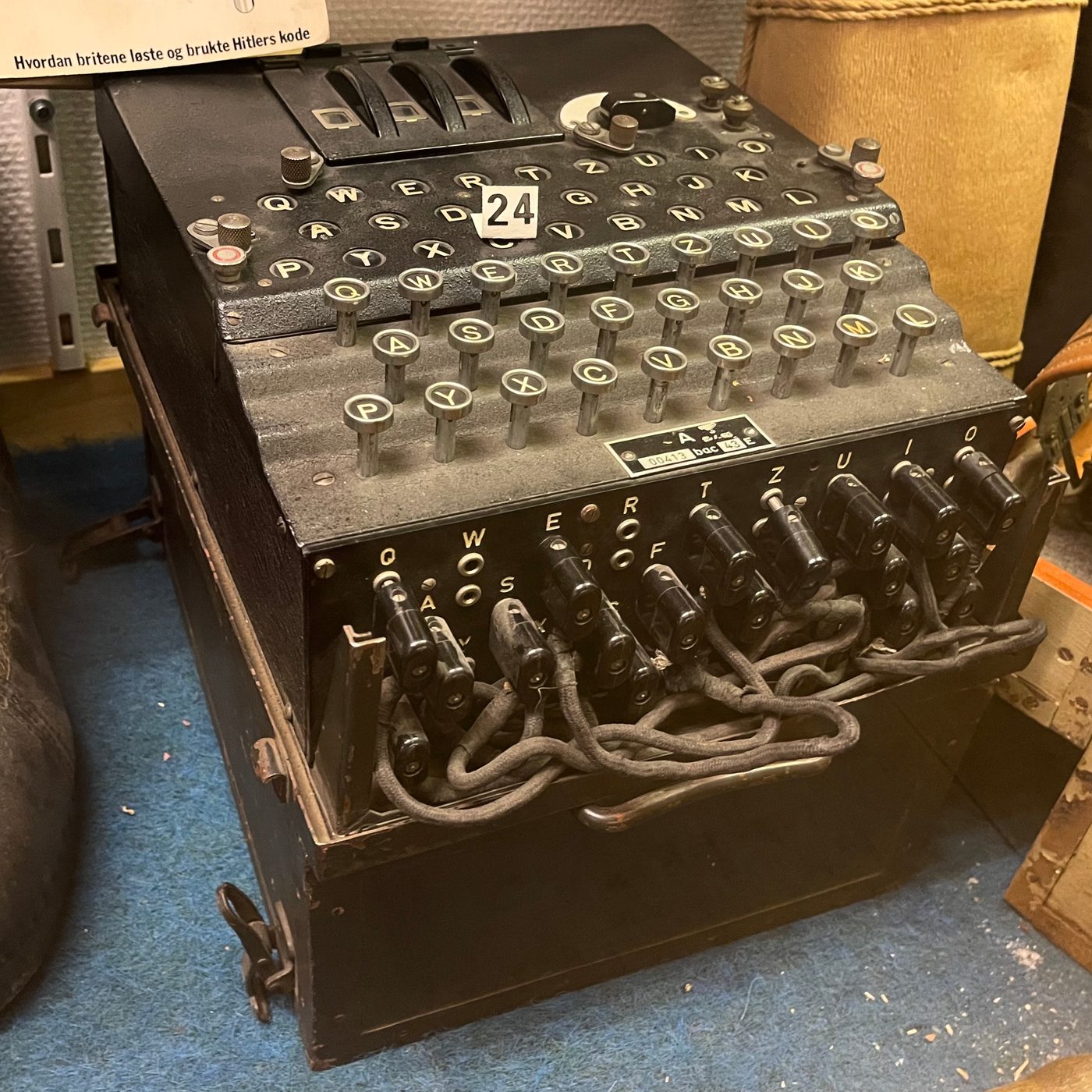
So what is gained? A great deal, and all of it in the direction this series cares about — understanding. Cost, first: a few hundred dollars against six figures, which is the difference between “a thing one reads about” and “a thing one owns.” Accessibility: no curator, no insurance, no white gloves; you can hand it to a child. Openness: every wire and every line is documented and free, the precise opposite of the original’s thirty-year secrecy. And above all hackability — because the rotors are code, you can do things no wartime operator could. You can add rotors that never existed. You can log the internal state at every keypress and watch the substitution happen. You can break it on purpose to see how a misconfigured ring setting garbles a message. The very thing that costs you the tactile electromechanical truth — the move from metal to firmware — is the thing that hands you a glass-walled, inspectable, teachable Enigma.
A reader who has come all this way through fourteen volumes and then builds one would, I think, feel a particular series of small shocks of recognition. The first time you press a key and a different letter lights, the reciprocity from Volume 3 stops being a property and becomes a fact you can see. The first time you type the same letter twice and watch two different lamps answer, the stepping from Volume 4 is suddenly real. And the first time you set the day’s rotors, ring settings, and plugs from a “key sheet” of your own before you can read a friend’s message, the daily-key ritual that decided the Battle of the Atlantic — described so many times in these pages — becomes something your own hands perform.
15.5 The Build Experience
To build one from a kit is to spend a few evenings reenacting, in miniature, the whole arc of this series: you assemble a piece of physical hardware, and then you breathe cipher logic into it.
The work begins with the boards. The Open Enigma is built around a main PCB (with, in some versions, a daughterboard) carrying the LED lampfield, the button matrix, the displays, and the supporting passives. A kit build is a through-hole soldering project of moderate ambition — resistors, the LEDs of the lampfield, the push-button switches, headers, the MOSFETs and diodes that make the Charlieplexed lamps and the resistor-ladder keyboard work. It rewards patience and a tidy iron. The LEDs in particular reward care: a lampfield with one lamp soldered backwards is a lampfield with one letter that will never light, and on a machine whose whole point is which letter lights, that is not a defect you can ignore.
With the lampfield and keys in place, the displays are wired to show rotor position, and the whole assembly is married to the Arduino Mega that drives it. Then comes the moment that has no analogue in 1940: you connect the Arduino to a computer over USB and flash the firmware — the open-source sketch that contains the rotor wirings, the stepping logic, the reflector, the plugboard. This is the step that turns a board full of lamps into an Enigma. The same hardware, flashed with different code, could be anything; flashed with this code, it becomes a cipher machine that the Kriegsmarine would recognise. The schematics and the firmware are public, so a builder can read exactly what they are loading — and, if they like, change it before they do.
Finally the boards go into the enclosure — the case that gives the thing its Enigma silhouette — and you reach the payoff that every kit-builder knows and that this one earns more than most: first power-on. You set the rotors to a starting position. You set the ring settings. You patch a plug pair or two, if your configuration has a plugboard. And then you press a key — and somewhere across the lampfield, a different letter glows. Press it again: a different answer. Type your own name and watch it come out as nonsense; type the nonsense back into a second machine set the same way and watch your name reappear. Fourteen volumes of permutation groups and notched rings and daily keys, all of it suddenly compressed into the small, undeniable fact of a lamp lighting under your finger. The abstraction has become an object.
15.6 The Wider Ecosystem: Where the Open Enigma Sits
The Open Enigma is one answer to the question “how do I get my hands on an Enigma,” and it is worth knowing the others, because the choice between them is really a choice about what kind of understanding you want.
At the most accessible end sit the software simulators. There are dozens — browser-based pages, phone apps, and the venerable CrypTool, an open educational platform for cryptography that includes faithful Enigma models and lets you watch the internal wiring light up as you type. These cost nothing, run anywhere, and are superb for understanding the logic. What they cannot give you is a thing on a desk; they are an Enigma you look at through glass.
A step toward the physical is the Enigma-E, the educational electronic kit documented and sold through the Crypto Museum in the Netherlands. Like the Open Enigma it is an electronic build — a soldering kit with a lamp display and keyboard, optionally housed in a handsome oak case scaled to echo the original — and it is explicitly designed as a teaching object, accurate to the cipher and rich in documentation. It predates the Open Enigma and shares its essential philosophy: reproduce the behaviour in electronics, make it buildable, make it teach.
At the most ambitious end are two very different purist routes. FPGA implementations render the Enigma in reconfigurable logic gates — closer to “hardware” than a microcontroller sketch, beloved of digital-design students who want the cipher expressed as a circuit rather than a program. And at the far extreme, a growing community of makers builds fully-mechanical 3D-printed replicas that do physically spin wired rotors — discs with real contact paths, real stepping, real reciprocal wiring — chasing precisely the electromechanical truth that the firmware machines set aside. These are the closest a hobbyist can come to the genuine tactile article, and the most demanding to build.
The Open Enigma’s place in this landscape is the accessible, open-source, Arduino-based middle path. It is more physical and more satisfying than a simulator on a screen, more affordable and more hackable than a mechanical replica, and — because its cipher lives in editable, documented firmware on a ubiquitous microcontroller — uniquely suited to learning. It is the version you can take apart, instrument, modify, and put back together. For a reader of this series, that is exactly the right trade: not the last word in mechanical authenticity, but the best available teacher.
15.7 A Closing Reflection
We began, fifteen volumes ago, with a machine the Germans believed unbreakable and the Allies kept secret for a generation — “the machine that lost a war.” We traced its gears and its mathematics, the people who built it and the people who broke it, the convoys it doomed and the computers it helped to summon. Along the way the Enigma was, by turns, a marvel, a weapon, a puzzle, and a ghost. It was almost never a thing you could simply hold.
Building a replica closes that distance, and it does so in the oldest way human beings have ever understood a machine: by making one. There is a kind of knowledge that no description can carry — the knowledge in your hands when you have soldered the lamp and flashed the code and set the day’s key and watched the letter light. Every secret this series has spent so long explaining is, on the Open Enigma, simply true in front of you: the reciprocity, the stepping, the daily ritual, the glow.
And so the arc completes itself. The machine that began as the most closely guarded secret of the twentieth century ends as an open kit on a hobbyist’s bench — its wiring published, its code free, its lamps lighting under the hands of anyone curious enough to build it. No longer a weapon, no longer a secret. Just a machine, switched on and glowing on your own desk, finally able to do the one thing it was never allowed to do for thirty years: teach.
Comments (0)