Enigma · Volume 2
Enigma — Volume 2 — Origins: Scherbius and the Rotor-Machine Era
How a Berlin engineer, three rival inventors, and a wheel that rewired itself gave the twentieth century its defining cipher
2.1 About This Volume
Volume 1 introduced Enigma as the machine that helped lose a war and founded a science. This volume goes back before the war, before Bletchley, before the German Navy ever bolted one into a U-boat — to the workshop and the patent office. It is the story of where the rotor cipher came from: of Arthur Scherbius, the engineer who turned the idea into a product called Enigma; of the strange fact that four inventors on two continents reached for the same idea within a couple of years; and of how a commercial flop, sold to almost nobody, became — after one decisive modification by the German military — the most trusted cipher in Europe. Readers who want the inner mechanism can jump ahead to Volume 3; this volume is about people, patents, and the market that almost wasn’t.
2.2 A Lesson Written in Plaintext
To understand why anyone wanted a cipher machine in 1918, it helps to remember how cryptography had just embarrassed an empire. For centuries, secret writing had been done by hand: clerks looking up words in codebooks, or shifting letters by rules memorised from a key. Hand ciphers are slow, error-prone, and — crucially — leaky. The patterns of a language survive most simple substitutions, and a patient analyst with enough intercepted traffic can tease them apart. The First World War had been, among other things, an enormous and largely one-sided cryptographic contest, and everyone drew the same lesson from it: encrypted radio is only as safe as the cipher, and the old ciphers were not safe.
The single most famous demonstration came in January 1917. British naval intelligence — the legendary “Room 40” — intercepted and decrypted a telegram from the German Foreign Secretary, Arthur Zimmermann, proposing a military alliance with Mexico against the United States, with the prize of recovered American territory dangled as bait. The decrypted Zimmermann Telegram, handed to Washington, helped push a reluctant America into the war. It was a catastrophe of cryptographic hygiene: a message of the highest possible secrecy, enciphered by hand methods the enemy could read. The episode taught governments and, eventually, businesses a blunt lesson. Radio made communication instantaneous and global; it also made eavesdropping effortless. Anyone broadcasting secrets into the air needed scrambling machinery far stronger — and far faster — than anything a tired clerk could manage with a pencil. Into that gap stepped the rotor.
2.3 The Idea Whose Time Had Come — Four Times Over
One of the most arresting facts in the whole history of cryptography is that nobody can quite say who invented the rotor machine, because it was invented, more or less independently, by four different people in the space of about two years. Historians of the subject routinely credit the same quartet: Edward Hebern in the United States, Arthur Scherbius in Germany, Hugo Koch in the Netherlands, and Arvid Damm in Sweden. The patent record lays them out almost like a relay: Hebern is generally reckoned to have filed first, in the United States around 1917; Scherbius filed in Germany on 23 February 1918; and Damm in Sweden and Koch in the Netherlands both filed in the second week of October 1919.
The shared idea was deceptively simple, and it is worth stating plainly because everything that follows depends on it. Take a disc — a rotor — with twenty-six electrical contacts on each face, one per letter. Wire the contacts on one face to those on the other in a scrambled order, so that current entering at the “A” position emerges, say, at the “K” position: a fixed substitution. By itself that is nothing special; a fixed substitution is a child’s cipher. The magic is that the disc turns. After each letter is enciphered, the rotor advances one step, so the substitution it performs differs for the next letter, and the next, and the next. Stack several such rotors in series, each stepping at its own rate like the wheels of an odometer, and you have a machine that runs through an astronomically long sequence of distinct alphabets before it ever repeats. The cipher changes with every keystroke, automatically, mechanically, faster than any human could ever manage by hand. That is the rotor principle, and four people saw it at once.
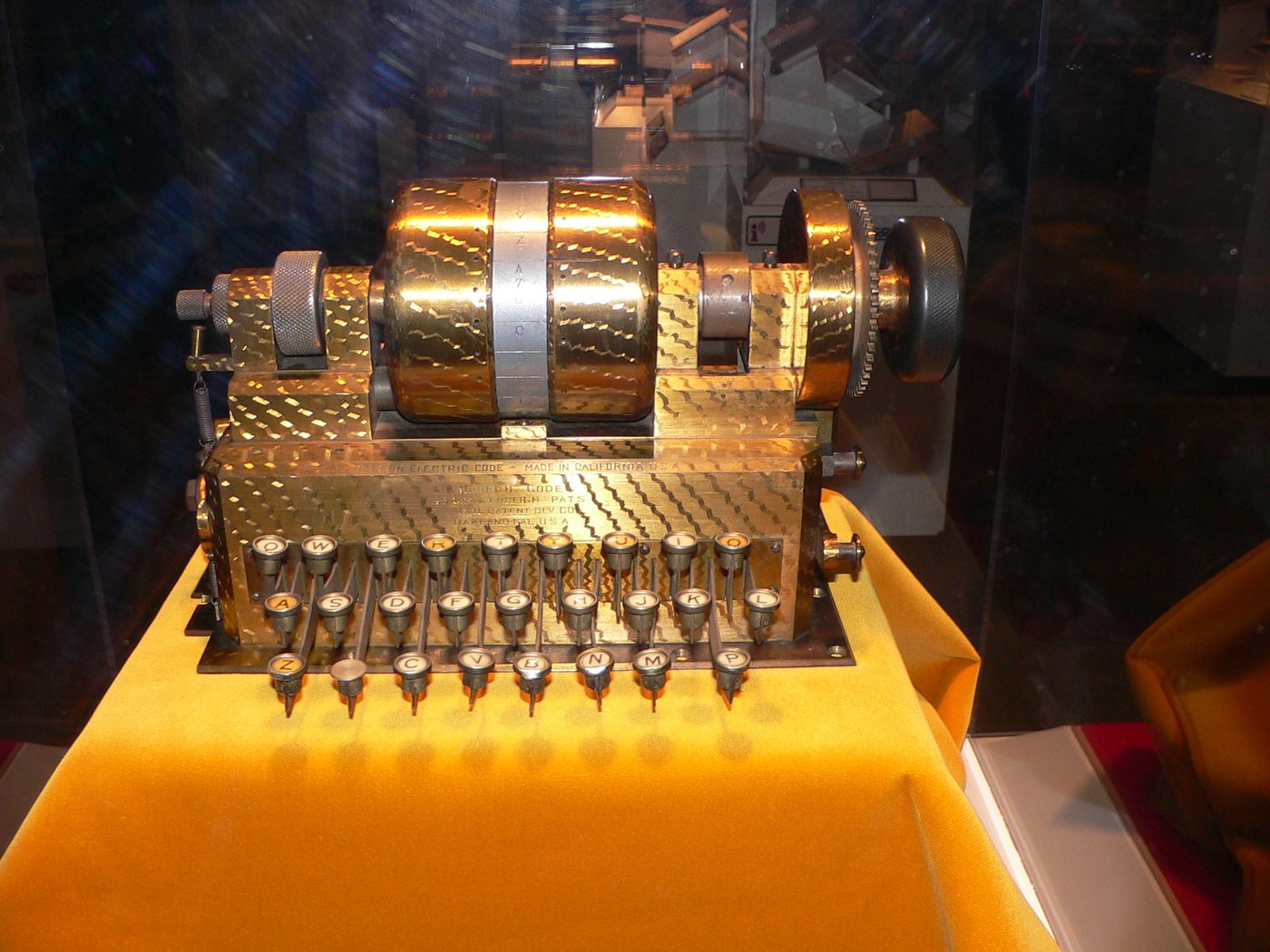
Why the convergence? Partly because the necessary parts had all just become ordinary. Cheap electromagnets, reliable batteries, telephone-style wiring, and precision machining were the common stock of any 1910s electrical workshop, and the rotor is, at bottom, an electrical adaptation of a very old cryptographic dream — the polyalphabetic cipher, in which the substitution alphabet keeps changing. The theory had existed since the Renaissance; what the four inventors independently realised was that electricity could now automate it. Their fates diverged sharply. Hebern’s company collapsed amid a stock scandal, and the U.S. Navy adopted his designs only fitfully. Damm’s Swedish firm, Aktiebolaget Cryptograph, struggled too — but it was later taken over and transformed by Boris Hagelin into a commercial triumph, the only one of the four lineages to make its founder’s successor genuinely rich. Koch, a Dutch businessman, appears never to have built a working machine at all; in 1927 he assigned his rotor patent rights to Scherbius, who already held his own. (A footnote that surfaced only in 2003 complicates even this tidy list: two Dutch naval officers, Theo van Hengel and R. P. C. Spengler, seem to have built a rotor cipher as early as 1915, but never patented it — so the “four inventors” may really be a “first four to file.”) Of the quartet, it is the German whose name the world remembers, because only his machine acquired the name Enigma.
2.4 Arthur Scherbius
Arthur Scherbius was born in Frankfurt am Main on 30 October 1878, the son of a small businessman. He trained as an electrical engineer — studying in Munich and then taking a doctorate in Hannover — and spent his early career in the ordinary, productive way of a competent German engineer of the Wilhelmine era: working for electrical firms, accumulating patents on motors, ceramics, and electrical instruments. He was, in other words, an inventor by temperament and trade long before he turned to secrecy. The cipher machine was one idea among many, but the one he chose to build a company around.
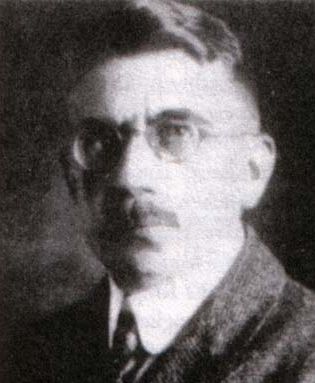
With a partner, Richard Ritter, he formed the engineering firm Scherbius & Ritter. The cipher-machine patent of February 1918 was the seed; what it needed was capital and a corporate vehicle. The patent rights passed to an outfit called Gewerkschaft Securitas, and from that, on 9 July 1923, emerged the company that would carry the machine through the rest of the decade: Chiffriermaschinen Aktiengesellschaft — the Cipher Machines Stock Corporation — based in Berlin, with Scherbius and Ritter on its board. The name borne by the product was already chosen, and it was inspired: Enigma, from the Greek for “riddle.” It was a trademark as much as a description, and it stuck so completely that today the word means this machine first and a puzzle only second.
There is a melancholy to Scherbius’s place in his own story. He built the firm, designed the early machines, exhibited them, marketed them, and shepherded the enterprise through the worst economic weather imaginable — and then died, on 13 May 1929, of injuries from a horse-carriage accident near his home in the Berlin suburb of Wannsee, where he had lived since 1924. He was fifty. He did not live to see his machine adopted wholesale by the German armed forces, did not see it become the backbone of Wehrmacht communications, and certainly did not see it broken. The man who gave the twentieth century its emblematic cipher missed the entire drama that made it famous.
2.5 Building the Product: Models A Through D
Scherbius did not bring a single finished machine to market; he iterated, as engineers do, through a family of models across the 1920s, each smaller, cheaper, and more practical than the last. The lineage is usually drawn through four letters.
Model A, the first, was unveiled to the world at the 1923 Congress of the International Postal Union in Bern, Switzerland. It was a brute: roughly the size and weight of a cash register — accounts put it near fifty kilograms — and, unlike the famous later machines, it printed its output onto paper using a built-in typewriter mechanism. It was secure, in its way, but also heavy, complicated, and expensive — the kind of machine that impresses at an exhibition and terrifies a procurement officer. Model B, which followed in late 1924, was of broadly similar construction — still a printing machine, still substantial.
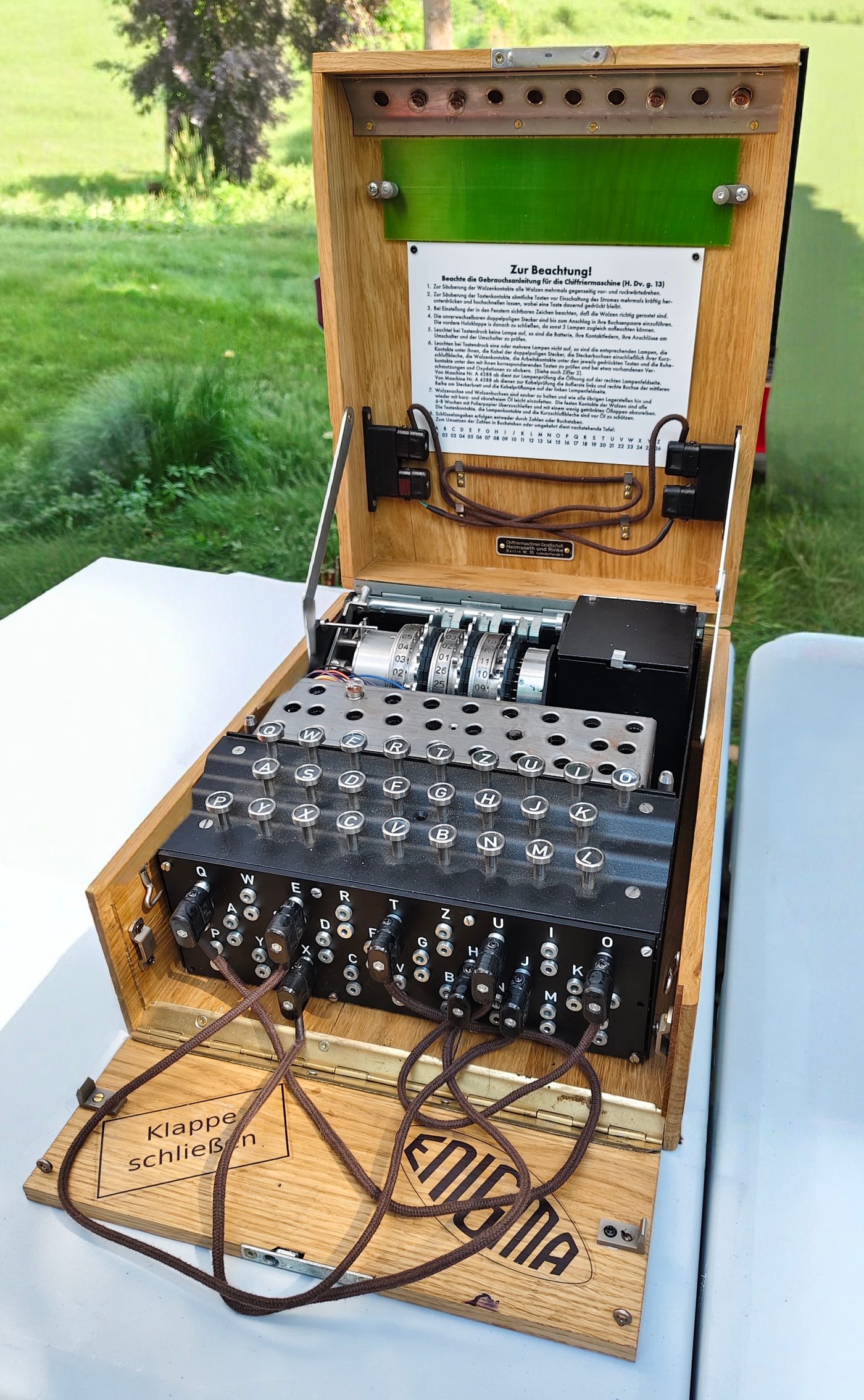
The decisive change of direction came with the glowlamp machines. Scherbius’s colleague Willi Korn contributed an idea that would define every Enigma thereafter — the reflector (Umkehrwalze), a fixed rotor at the end of the stack that sent the current back through the wheels a second time, an innovation Volume 3 examines in detail. And the printing mechanism was abandoned in favour of a panel of small lamps: the operator pressed a key, a bulb lit beneath one of twenty-six letters, and an assistant simply read it off. This was the Glühlampenmaschine, the glowlamp Enigma, and the first of the breed was Model C, which appeared in the mid-1920s. Dropping the typewriter made the machine dramatically lighter and smaller — portable in a way Models A and B never were — at the modest cost of needing two people to operate comfortably. Every Enigma the world pictures, with its lamp panel glowing above the keys, descends from this decision.
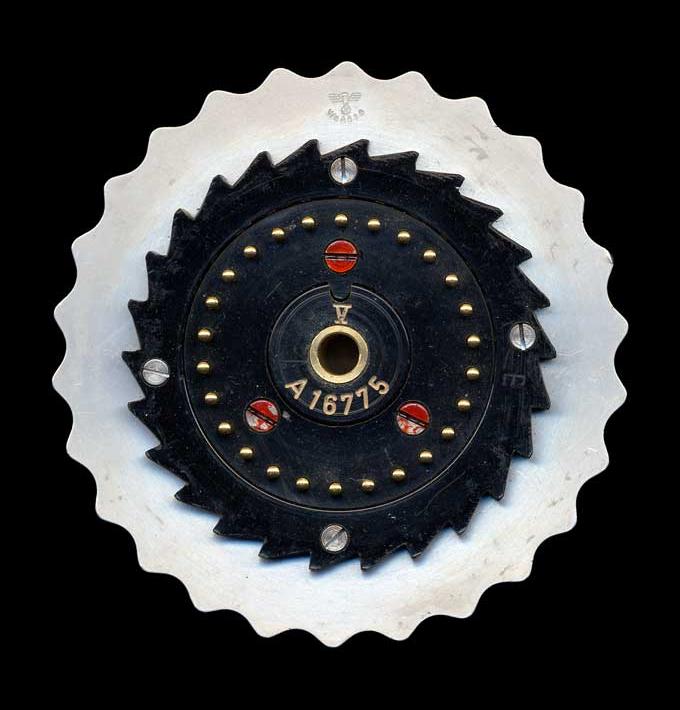
Then came the machine that actually sold. Model D, introduced in 1927, was the commercially successful, widely exported Enigma — the version that went out across Europe and beyond. Contemporary accounts record shipments to a striking range of countries: Sweden, the Netherlands, the United Kingdom, Japan, Italy, Spain, the United States, Poland. Enigma D set the physical template that the later military machines would inherit almost unchanged: the glowlamp panel, the three removable rotors with their reflector, the keyboard, the whole compact wooden-cased arrangement that, once seen, is never mistaken for anything else. If you want to point at the moment the Enigma became the Enigma we recognise, point at Model D.
2.6 A Brilliant Machine Nobody Wanted
Here the story takes its sharpest irony. The commercial Enigma — the product Scherbius had built his company to sell — was, by almost any measure, a flop.
The pitch was sound on paper. Scherbius marketed the machine to the natural buyers of secrecy in peacetime: banks, large corporations, railways, anyone who sent confidential information over telegraph or radio and feared a competitor reading it. Secrecy for business, in effect, sold as an off-the-shelf appliance. But the customers did not come. The reasons were a mix of the practical and the psychological. The machines were expensive. They were, by the standards of a bank clerk, complicated and a little intimidating. And — most tellingly — most commercial firms simply did not believe their telegrams were worth stealing, or could not picture the adversary who would bother. The cryptographic strength Scherbius was so proud of was precisely the thing his customers could not see the need for. A machine that defends against a threat the buyer does not feel is a hard sell in any era.
The timing could hardly have been worse, either. The machine’s development years coincided with the German hyperinflation of the early 1920s, when the currency collapsed so completely that savings evaporated and ordinary commerce became a daily emergency. It was no moment to be selling German businesses premium secrecy hardware. Chiffriermaschinen AG struggled to stay solvent; by some accounts the enterprise had to be reorganised more than once, and it was only around 1928 that the firm found any real stability. Scherbius spent the decade keeping a brilliant product alive in a market that had no appetite for it — and died, the next year, just as a very different kind of customer was beginning to take an interest.
2.7 The Customer Who Mattered: The German Military
That different customer was the German state, and its interest changed everything. A military, unlike a bank, has no trouble imagining the enemy who wants to read its mail — that enemy is the entire reason it exists. After the cryptographic humiliations of the First World War, the German armed forces of the Weimar Republic were exactly the buyers Scherbius had needed and never found in the commercial world.
The Reichsmarine, the navy, moved first, adopting a version of the commercial Enigma around 1926. The Reichswehr, the army, followed roughly two years later, around 1928. These were the existing glowlamp machines, militarised in detail but not yet in essence — recognisably the same device Scherbius had been trying to sell to bankers. Had the story stopped there, the military Enigma would have been only a sturdier commercial Enigma, and this series might be a great deal shorter, because the commercial machine’s security, while real, was not beyond a determined state cryptanalyst.
But the military did one thing the commercial designers never had. Around 1930 — the machine reworked into the form generally designated Enigma I by about June of that year — the German army added a component that had no equivalent on any commercial model: the plugboard, the Steckerbrett. It sat on the front of the machine, a panel of twenty-six sockets into which an operator could plug a set of double-ended cables, swapping pairs of letters before and after they ran through the rotors. Mechanically it was almost trivial — a patch panel, the kind of thing a telephone exchange used by the thousand. Cryptographically it was transformative.
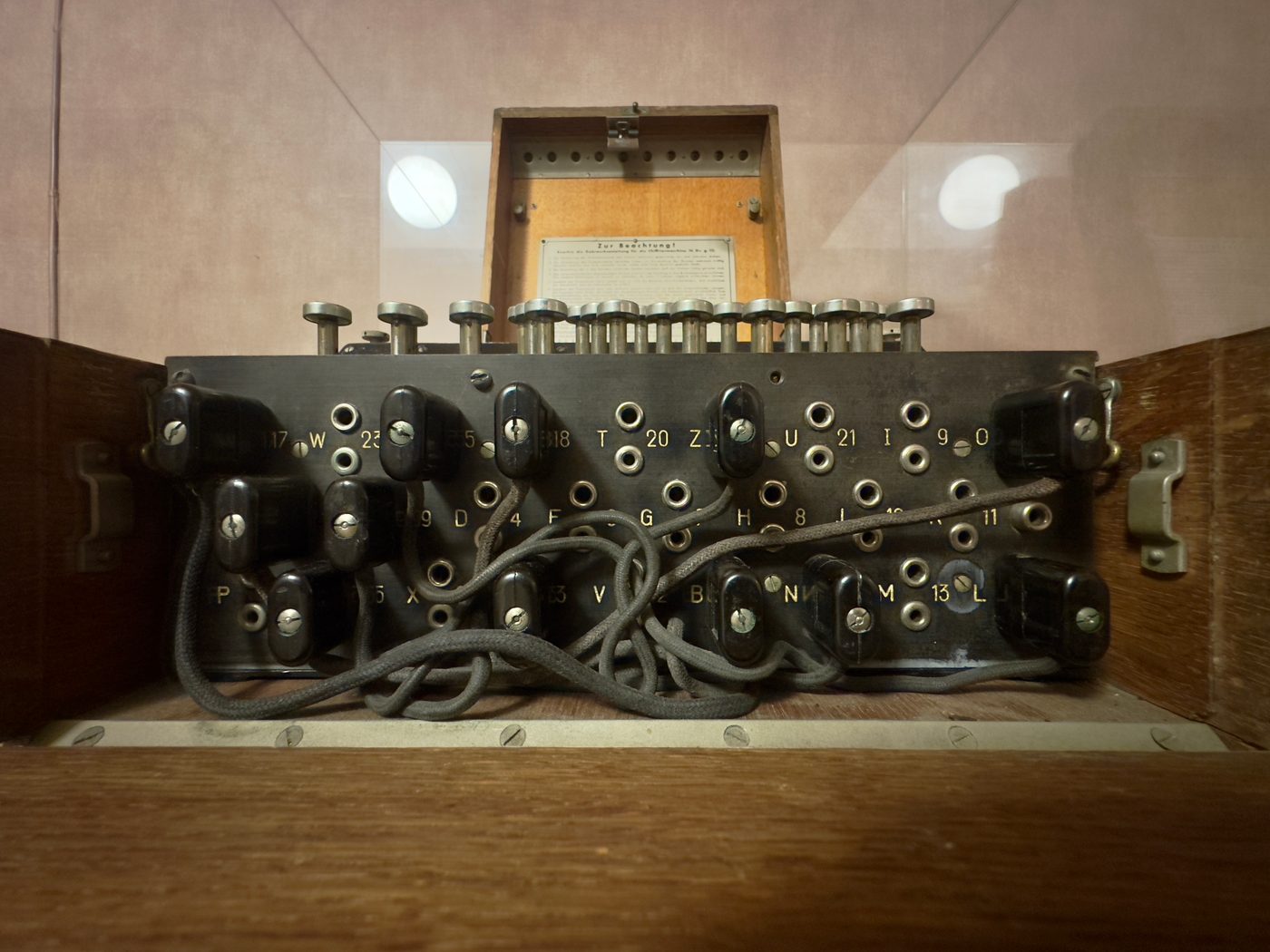
The reason is arithmetic, and Volume 5 walks through it properly, but the shape of it can be stated now. The plugboard multiplied the number of possible machine settings by a staggering factor — the swaps alone contributed more additional combinations than adding a whole extra rotor would have. By choosing, say, ten cable connections out of the twenty-six letters, an operator selected from billions upon billions of arrangements, and that number multiplied against the already large count of rotor positions and orderings. To the German cryptographic authorities, the plugboard was the bolt that locked the door for good: it took a machine that was merely very strong and made it, by their confident reckoning, simply unbreakable. Volume 4 examines exactly how the plugboard worked and how operators used it day to day; Volume 5 explains why the immense number it produced gave such false comfort. For now, the point is historical rather than mathematical. The commercial Enigma and the military Enigma look almost identical, share a common ancestor, and descend from the same patents — but the plugboard is the difference between a clever business appliance and the cipher that an entire war would be fought to read.
2.8 What Scherbius Left Behind
Arthur Scherbius died believing, as far as we can tell, that he had built a fine machine that the world had largely declined to buy. He was right about the world and wrong about the machine’s future. Within a year of his death the army was reworking his glowlamp design into the plugboard-equipped Enigma I; within a few more years that machine would be standard issue across the German military; and within a decade it would be carrying the secret orders of a regime he never lived to see take power.
It is worth holding both halves of the irony together. The rotor principle was not Scherbius’s alone — Hebern, Damm, and Koch reached for it at nearly the same instant, and the convergence tells us the idea was simply ready, waiting for the electrical technology to catch up with a Renaissance dream. And the feature that made the German Enigma uniquely formidable, the plugboard, was not Scherbius’s contribution at all but the military’s. What Scherbius supplied was the thing that, in the end, mattered most: a manufacturable, refinable, exportable machine — and a name. He turned a patent into a product line, and a product line into an institution robust enough that the armed forces could adopt it off the shelf and harden it for war. The codebreakers of the 1930s and 1940s would spend their careers, and stake their nations’ survival, on cracking a box that began life as a commercial disappointment marketed to indifferent bankers.
How that box actually turns a keystroke into a riddle — the current’s path through keyboard, rotors, reflector, and back to the lamps, and the odometer-like stepping that changes the cipher with every letter — is the subject of the next volume.
Next — Volume 3: How Enigma Works I — The Rotor Cipher. We open the lid and follow the electric current from a pressed key, through the stepping rotors and the reflector Willi Korn devised, and back out to a glowing lamp — the elegant, self-scrambling mechanism at the heart of every machine in this series.
Comments (0)