The Codebreakers · Volume 1
The Codebreakers — Volume 1 — The School on Constitution Avenue
Who broke PURPLE and invented SIGABA, how a handful of teachers, linguists and mathematicians in two temporary buildings on the Washington Mall turned codebreaking into a taught science, and why the methods they worked out are still studied — the orientation volume for the twelve-part series
1.1 About This Volume
This is the entry point to a twelve-volume deep dive on the people and the methods behind two famous machines: PURPLE, the Japanese Foreign Ministry’s diplomatic cipher machine that the U.S. Army reconstructed from intercepts in 1940 without ever seeing one, and SIGABA, the American rotor machine that no enemy is known to have broken. The machines themselves have their own series on this site — the PURPLE unit narrates the break of 1939–1940 and the intelligence it produced, and the SIGABA unit describes how SIGABA worked. This series is about something those units can only touch on: who these codebreakers were, what they learned, how they taught it to one another, how they turned it into machines, and why it is still studied a century later.
The central claim of the series is that the Americans who broke PURPLE and designed SIGABA were not a collection of lone geniuses but a school — in two senses. They were a school of thought, sharing a set of ideas about what cryptanalysis is: a branch of applied statistics rather than an art of inspired guessing; a craft that has to be taught from written texts and graded problems; and a discipline whose first duty is the security of one’s own communications. And they were, quite literally, a school: almost everyone in this story was taught by someone else in it, in a chain that runs from a private laboratory in Illinois in 1916 to the National Security Agency’s own college, founded in 1965.
The volume sets the scene, introduces the cast and the two rival institutions they worked in, sketches what they achieved and what it cost them, and maps the series. Volumes 2–5 and 9 follow the people; Volumes 6–8, 10 and 11 work through the techniques with code; Volume 12 asks why any of it still matters.
1.1.1 The Twelve-Volume Series
Table 1 — The Twelve-Volume Series
| Vol | Title | Focus |
|---|---|---|
| 1 | The School on Constitution Avenue (this volume) | Orientation: the cast, the two services, what they did, what it cost |
| 2 | Riverbank — William and Elizebeth Friedman and the Index of Coincidence | Fabyan’s laboratory, the Bacon cipher hunt, the first American cryptology courses, the Riverbank Publications, Elizebeth’s Coast Guard war on the rum-runners |
| 3 | 1930: Rowlett, Sinkov, Kullback and Hurt — Building the Signal Intelligence Service | The four hires of 1930, the Black Chamber vault, Friedman’s training regime, the Army’s textbooks and extension courses |
| 4 | The Navy’s Codebreakers — Safford, Driscoll, Rochefort and OP-20-G | The Research Desk, “Miss Aggie”, the On-the-Roof Gang, the fleet exercises, and the Army–Navy rivalry over MAGIC |
| 5 | The Purple Team — Grotjan, Rosen, Ferner, Rowlett and the Women of the SIS | The second generation of 1936–1939, who did what on PURPLE, and the women whose part the records nearly lost |
| 6 | Statistics as a Weapon — Coincidence, Kappa, Chi and Phi, Worked | The statistical tests the school taught, computed in code |
| 7 | Cribs, Stereotypes, Isomorphs and Homologs — Reading a Machine Through Its Traffic | How known text and repeated patterns open a machine |
| 8 | Reconstructing a Machine Never Seen — From Patterns to Wiring to the Analog | The PURPLE reconstruction as a method, step by step |
| 9 | Inventing SIGABA — The Lessons Turned Inward | Hebern, the key tape, Rowlett’s stepping maze, the Navy’s index rotors, secret patents and who got the credit |
| 10 | The Mathematics of Irregular Stepping — Why SIGABA Held | Key space, stepping statistics and modern attacks |
| 11 | Mechanising Cryptanalysis — Sorters, Tabulators and the Road to Computers | From IBM punched cards to NSA’s first computers |
| 12 | Why We Still Study Them — From Military Cryptanalysis to Modern Ciphers and NSA | Statistics, design lessons, training texts, women in the record, and Pearl Harbor |
1.2 A Photograph in Front of a Vault
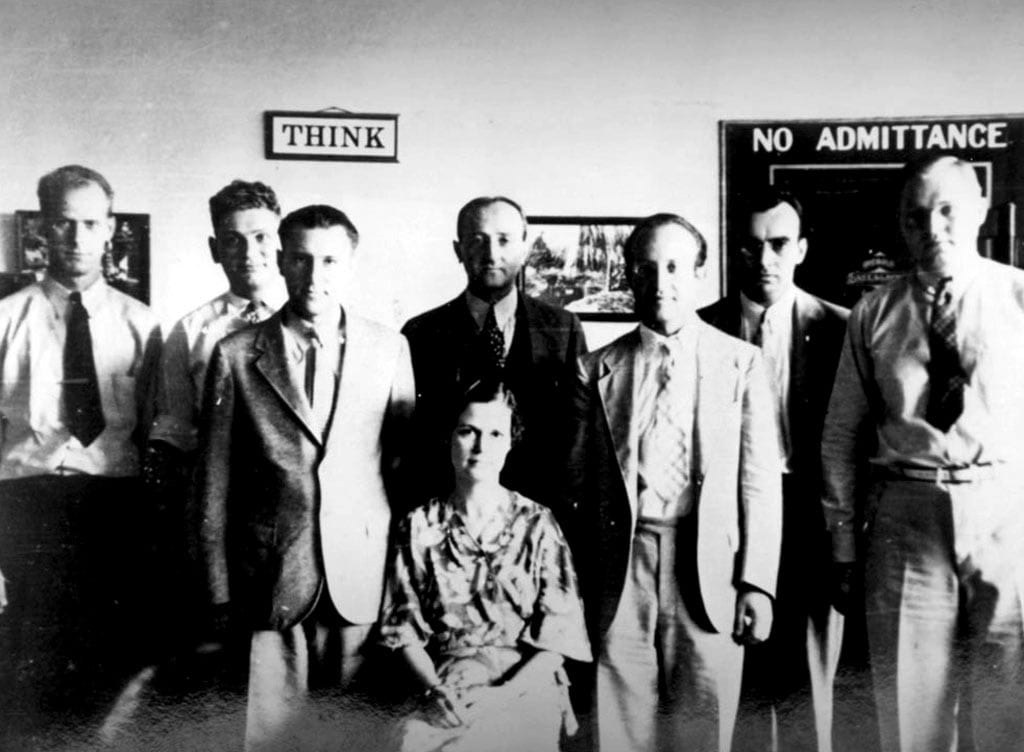
The photograph at the head of this volume was taken in about 1935 in the Munitions Building, a long, temporary office block thrown up on the Washington Mall during the First World War, beside the Navy’s equally temporary “Main Navy” building on what is now Constitution Avenue. It shows nearly the whole of the U.S. Army’s codebreaking organisation. There are eight people in it. Behind them is the door of the vault where they kept their work at night; above it is a sign reading NO ADMITTANCE; on the wall is another that reads THINK.
Three of the men in the photograph — Frank Rowlett, Abraham Sinkov and Solomon Kullback — had been schoolteachers five years earlier. They had answered a civil-service examination for “junior mathematicians”, had been hired in April 1930 at $2,000 a year as “junior cryptanalysts”, and had arrived not knowing what the word meant. Rowlett, the first to report, could not find it in his dictionary; he guessed, he said later, that he would be doing statistical work on crypts. The man in the middle, William F. Friedman, told him on his first morning that the War Department had officially adopted the words cryptanalyst and cryptanalysis only a few weeks before, although Friedman had been using them for years, and that Rowlett had “the honor of being the first individual to be employed by the U.S. Government as a Junior Cryptanalyst” (Hannah, “Frank B. Rowlett — A Personal Profile”, p. 6; Library copy).
Ten years later this small group — enlarged to about nineteen people in 1939 — broke the most difficult cipher machine any of them had seen. Fifteen years later its members were running large parts of the Armed Forces Security Agency, and then the National Security Agency. The photograph is a portrait of the founding faculty of American cryptology.
1.3 Why “a School”?
Most popular histories of codebreaking are histories of breaks: Enigma at Bletchley Park, PURPLE in Washington, JN-25 in Hawaii. They tend to have heroes and a moment — a Friday afternoon, a pattern on a worksheet, a cry of “That’s it!” The PURPLE unit of this site tells its own story in that way, because that is how it happened. This series steps back from the moment to ask a different set of questions.
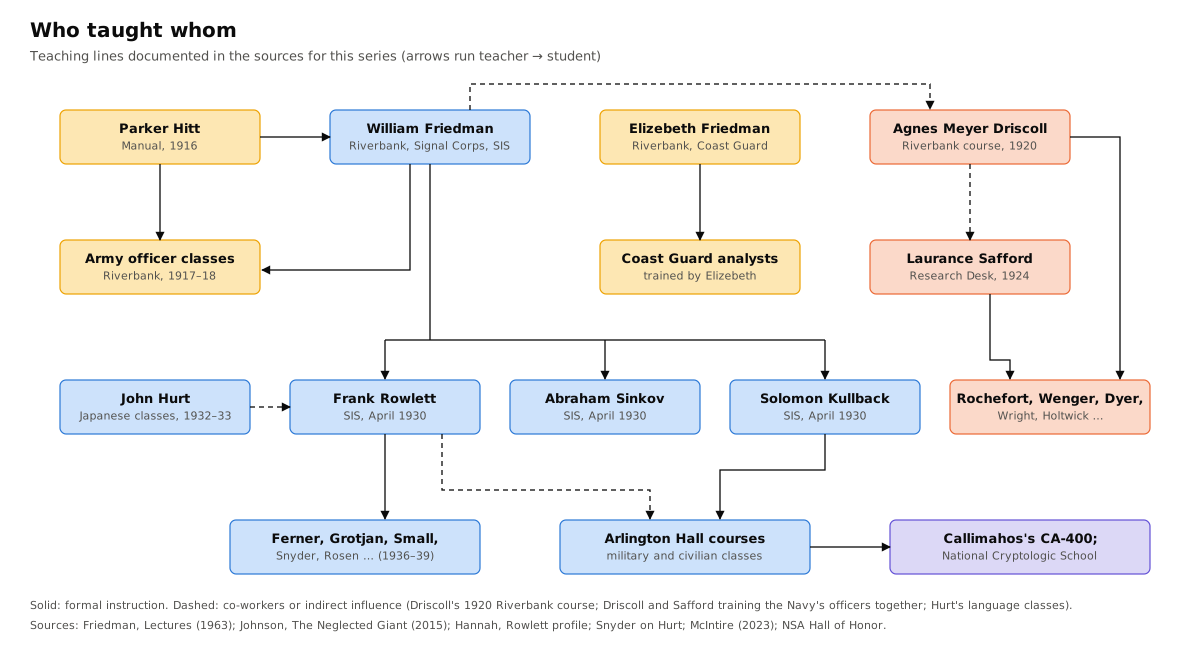
Where did the ideas come from? The analysts who broke PURPLE in 1940 were applying methods that had been worked out, written down and taught over the previous twenty years — methods for measuring whether two messages share a key, for reconstructing an unknown alphabet from its traces, for laying messages “in depth”, for exploiting repeated phrases. Most of them had a single source: a series of pamphlets printed between 1917 and 1922 at a private estate in Illinois called Riverbank (Volume 2).
How were they taught? Friedman put his first employees through roughly two years of study before giving them real work, using texts and problems he had written himself; he then wrote the texts that taught the next generation, and the Army’s correspondence courses that taught its reserve officers (Volume 3). The U.S. Navy built a parallel system, through a correspondence course, short courses in Washington, puzzles printed in its communications bulletin and a radio school on the roof of its headquarters (Volume 4).
How were they mechanised? The school’s members were unusually quick to build machines — the stepping-switch “six-buster” and the PURPLE analog in 1939–1940, punched-card tabulators from the mid-1930s, and eventually some of the first electronic computers. Volume 11 follows that thread.
What did they do with what they learned? The same people who broke foreign cipher machines designed their own country’s — and the lessons of the one went straight into the other. SIGABA was designed by men who had spent a decade learning exactly how rotor machines with regular stepping could be broken (Volume 9).
Why are they still studied? Because the statistical methods they pioneered became part of the foundations of modern statistics and information theory; because their design principles are still the principles of sound cryptography; because their textbooks remained in classified use for decades and are still in print; because the recovery of their names — especially the women’s — is a live project of historians today; and because the intelligence failure of 7 December 1941, which their work exposed rather than caused, is still a standard case in how not to organise intelligence (Volume 12).
1.4 Three Ideas That Made the School
1.4.1 Cryptanalysis is a science
Before 1920 codebreaking in the United States, as almost everywhere, was a matter of individual skill: knowing languages, spotting words, guessing keys. William Friedman, trained as a geneticist at Cornell, brought to it the habit of counting. His pamphlet The Index of Coincidence and Its Applications in Cryptography, written in 1920 and printed in 1922, showed that one could measure, with simple arithmetic on letter counts, whether a stretch of ciphertext was enciphered with one alphabet or many, and whether two messages had been enciphered with the same key at the same point. David Kahn called it “the most important single publication in cryptology”; Lambros Callimahos, Friedman’s long-time collaborator, called it “the pioneer paper in cryptomathematics” (The Friedman Legacy, pp. 188, 198; Library copy). Everything statistical in this series descends from it, and Solomon Kullback, one of Friedman’s first hires, carried the idea far beyond cryptology into the mainstream of mathematical statistics (Volumes 6 and 12).
1.4.2 It has to be taught
The second idea is that a skill which had always depended on rare individuals could be reproduced by teaching. Friedman was a teacher before he was anything else in cryptology: he and Elizebeth Smith Friedman ran courses for Army officers at Riverbank in 1917 and 1918, and he spent the next forty years writing training texts. NSA’s own Hall of Honor judges that perhaps his greatest achievements were “introducing mathematical and scientific methods into cryptology and producing training materials used by several generations of pupils” (NSA Hall of Honor, William F. Friedman). Safford and Agnes Meyer Driscoll did the same for the Navy; Elizebeth Friedman taught the analysts of the Coast Guard unit she founded. When Friedman closed his 1940 report on the PURPLE break, the thing he chose to celebrate was “the demonstration, by his assistants, of their grasp of the cryptanalytic techniques taught them” (Friedman 1940).
1.4.3 The first duty is your own security
The third idea is the least obvious and the most important. The Army’s Signal Intelligence Service (SIS) was set up in 1930 with two missions, and the reading of foreign messages was officially the second. Friedman told his first recruits that “the first and more important objective was to insure that U.S. military codes and ciphers were the best and most secure that could be devised” (Hannah, p. 9). Fifty years later Rowlett put it even more strongly:
In my experience most people have assumed that the production of intelligence is the primary purpose of the cryptologic effort. I disagree. It’s important but it’s not paramount. The most important goal of the cryptanalyst is to use his knowledge of foreign cryptography to improve our own cryptographic security.
— Frank B. Rowlett, quoted in Hannah, p. 10
That conviction is the hinge of this series. The people who learned to break PURPLE were, at the same time, designing the machine that would protect the Americans’ own most secret messages, and they designed it specifically against the weaknesses they had learned to exploit (Volume 9). Breaking and making were two halves of one profession.
1.5 The Cast
The table lists the people who carry most of the weight in this series. Many more appear in the individual volumes.
Table 2 — The Cast
| Person | Years | Service | Role in this story | Vol |
|---|---|---|---|---|
| William F. Friedman | 1891–1969 | Riverbank; Army | Founder of the SIS, author of its texts, co-inventor of SIGABA’s principle | 2, 3, 9 |
| Elizebeth Smith Friedman | 1892–1980 | Riverbank; Navy; Coast Guard; Treasury | Co-founder of American cryptanalysis; broke rum-runner and spy-ring traffic | 2 |
| Frank B. Rowlett | 1908–1998 | Army | First junior cryptanalyst; led RED and PURPLE work; conceived SIGABA’s stepping maze | 3, 5, 9 |
| Abraham Sinkov | 1907–1998 | Army | One of the first three; led the 1941 mission to Bletchley Park and the U.S. contingent of MacArthur’s Central Bureau | 3 |
| Solomon Kullback | 1907–1994 | Army | One of the first three; statistician of the SIS; later chief of NSA research | 3, 12 |
| John B. Hurt | — | Army | The SIS’s Japanese linguist from 1930 to 1963 | 3, 5 |
| Laurance F. Safford | 1893–1973 | Navy | Founder of the Navy’s cryptologic organisation; developer of the ECM | 4, 9 |
| Agnes Meyer Driscoll | 1889–1971 | Navy | The Navy’s leading cryptanalyst between the wars; teacher of its officers | 4 |
| Joseph J. Rochefort | 1900–1976 | Navy | Cryptanalyst and linguist; commander of Station HYPO at Midway | 4 |
| Robert O. Ferner | 1915–1982 | Army | Co-director with Rowlett of the PURPLE attack | 5 |
| Genevieve Grotjan (Feinstein) | 1913–2006 | Army | Found the decisive patterns in PURPLE (1940) and in VENONA (1940s) | 5 |
| Leo Rosen | 1916–1991 | Army | Engineer of the six-buster and the PURPLE analog | 5, 11 |
Birth years follow the NSA’s Hall of Honor biographies except where noted in the research notes; Safford’s is sometimes given as 1890 and Rochefort’s as 1898.
1.6 Two Services, One Problem
The United States had two codebreaking organisations between the wars, and much of this series is about the friction between them.
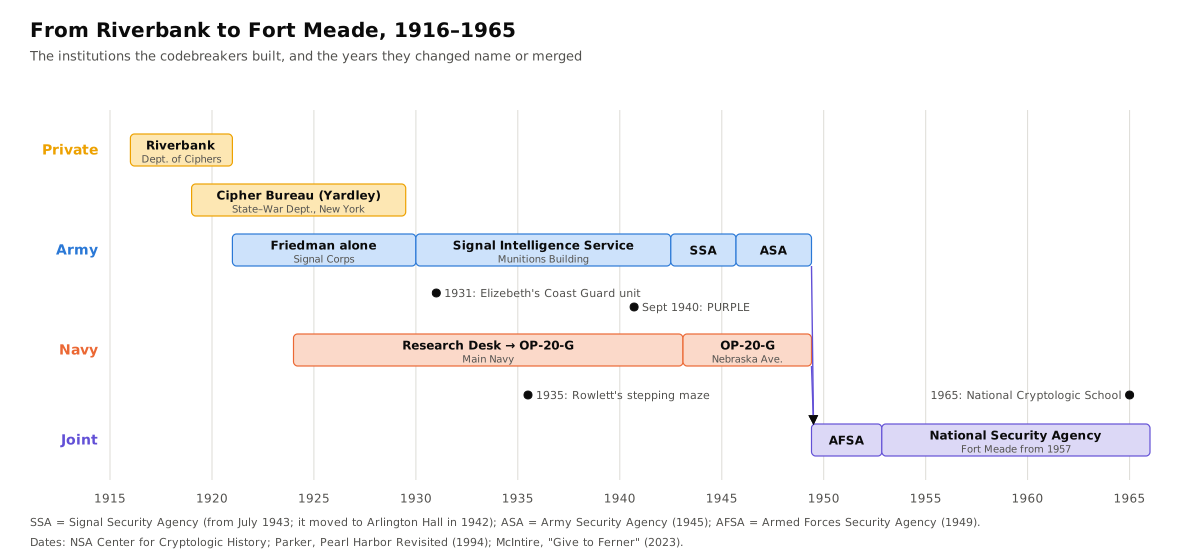
The Army’s began, in its modern form, in April 1930. The State Department and the Army’s intelligence division had jointly funded Herbert Yardley’s “Black Chamber” in New York until Secretary of State Henry Stimson closed it in 1929 (the PURPLE unit’s Volume 2 tells that story). The Army’s intelligence chief then offered the money to the Chief Signal Officer to train “a small group of young men who would be trained in cryptology, and who hopefully would become the cadre of an effective cryptanalytic organization” (Hannah, p. 9). The new Signal Intelligence Service was placed inside the Signal Corps rather than Military Intelligence so that, if the State Department ever found out, it could be defended as part of the Signal Corps’ duty to make the Army’s codes.
The Navy’s was older and more scattered. In January 1924 the Director of Naval Communications set up a “Research Desk” in the Code and Signal Section with one officer, Lieutenant Laurance Safford, and one civilian, Agnes Meyer, soon to be Agnes Meyer Driscoll (Parker, Pearl Harbor Revisited, p. 8; Library copy). It became the section known by its office code, OP-20-G, and over the next seventeen years it built a network of intercept stations across the Pacific, trained a cadre of officers in cryptanalysis and Japanese, and concentrated — as a navy would — on the Imperial Japanese Navy’s codes.
Both services read Japanese diplomatic traffic, both built PURPLE analogs, and both needed new cipher machines. They cooperated — the SIS’s PURPLE analog was built in a Navy Yard workshop by courtesy of Safford, and SIGABA was developed by the Navy from an Army idea — and they competed, sometimes absurdly. In 1941 the two services divided the reading of Japanese diplomatic messages by the day of the month, the Army taking even days and the Navy odd; at times they also alternated, month by month, the right to deliver the results to the President (Volume 4). Their rivalry did not cause Pearl Harbor, but it was one of the reasons nobody in Washington was responsible for reading the whole flow of intelligence and saying what it meant.
1.7 What They Achieved
In barely more than a decade, a few dozen people produced a remarkable list of results. The most important are set out below; each has its own volume here or in a sister unit.
Table 3 — What They Achieved
| Year | Achievement | Where told |
|---|---|---|
| 1916–1922 | The Riverbank Publications: the first American textbooks of cryptanalysis, including the index of coincidence | Vol 2 |
| 1924 | Friedman’s solution of the Hebern rotor machine for the Navy — the first known solution of a wired-rotor machine | Vols 2, 9 |
| 1927–1937 | Elizebeth Friedman’s attack on rum-runner and drug-ring codes; some 12,000 messages in her first three years | Vol 2 |
| 1930–1933 | The Navy’s breaks into the Japanese naval RED BOOK and BLUE BOOK codes | Vol 4; PURPLE Vol 2 |
| 1935 | Driscoll’s solution of the Japanese naval attaché machine | Vol 4 |
| 1935–1936 | Rowlett’s stepping-maze idea; the Friedman–Rowlett patent application | Vol 9 |
| 1936 | The break of RED, the Japanese Foreign Ministry’s first cipher machine | Vol 3; PURPLE Vol 3 |
| 1940 | The break of PURPLE and the construction of the analog | Vol 5; PURPLE Vol 5 |
| 1941 | The joint Army–Navy adoption of SIGABA (ECM Mark II); the Sinkov mission to Bletchley Park | Vol 9; PURPLE Vol 6 |
| 1942 | Station HYPO’s reading of JN-25 before Midway | Vol 4 |
| 1943 onward | Grotjan’s recognition of reused key in Soviet traffic, the start of VENONA’s success | Vol 5 |
Friedman’s own judgement, in a memorandum of 1943, was that PURPLE was “by far the most difficult cryptanalytic problem successfully handled and solved by any signal intelligence organization in the world” (Friedman to Corderman, 27 Sept 1943, NSA REF ID A41411; Library copy). The claim is arguable — Bletchley Park’s work on Enigma and on the Lorenz teleprinter cipher has its own advocates — but it was made by someone who knew both.
1.8 How They Learned: A Loop
The school’s method can be summed up as a loop, and the loop explains both PURPLE and SIGABA.
- Solve other people’s machines. From 1931 Friedman’s trainees attacked every commercial cipher device they could lay hands on — the Kryha, Damm’s B-211, the AT&T printing telegraph, the Hebern rotor machine. “We solved them for our own amazement or amusement,” Kullback recalled, but the exercise kept the government from buying insecure machines, and “these three never found one they couldn’t solve” (NSA Hall of Honor, Solomon Kullback).
- Write down why they fell. Each solution became a technical paper and then teaching material for the next class.
- Design against the weakness. The commonest weakness in the machines they broke was regular, predictable stepping of the cipher wheels. Friedman spent years looking for irregular stepping controlled by a key kept outside the machine; Rowlett found a way to make the machine generate its own irregular stepping; the Navy refined it into SIGABA (Volume 9).
- Attack your own design. SIS and OP-20-G tested their own systems as hard as they tested anyone else’s. The Navy’s records show it abandoning or modifying machines on the strength of Friedman’s solutions of their test messages.
- Apply the method to the next unknown. When a new Japanese machine appeared in 1939, the team that attacked it had spent a decade solving machines and designing them. Their first hypotheses about it came from the machines they knew — Hebern’s, the Enigma, their own Army converter — and when those hypotheses failed, it was the habit of systematic recording, counting and comparison, not any one machine, that carried them through (Volumes 5 and 8).
1.9 What It Cost
The school’s success had costs that the official histories long played down.
The work was secret, so its successes could not be acknowledged. Friedman’s patents were held in secret files for decades; the patent covering SIGABA’s control circuits, filed in 1944, was not issued until 16 January 2001 (U.S. Patent 6,175,625; Library copy). Congress compensated Friedman, Safford and Rowlett for their secret inventions with awards of $100,000 each, in 1956, 1958 and 1964.
The work was exhausting. Friedman entered Walter Reed Army Hospital in the winter of 1940–41, after eighteen months of pressure on PURPLE, and suffered recurring depression for the rest of his life (the PURPLE unit’s Volume 5). “There was pressure, great pressure,” Rowlett wrote; Kullback thought Friedman simply “drained of phys[ical] & mental energy”.
The work was divided, and credit was divided unevenly. Driscoll, whose contributions to the Navy’s breaks between the wars were second to none, was moved off the Japanese problem before Pearl Harbor and largely forgotten; an NSA historian titled his 2015 study of her The Neglected Giant. Friedman’s own 1940 report on PURPLE deliberately spread the credit across the team and did not say that it was Genevieve Grotjan who found the decisive pattern. Robert Ferner, who co-directed the PURPLE attack, was so thoroughly forgotten that the NSA’s Center for Cryptologic History published a booklet in 2023 to “reinstate the pivotal role” of a man most accounts had dropped (McIntire, “Give to Ferner”, p. 10; Library copy). And the institutional rivalry between the Army and the Navy, which the people in this story did much to soften, ended careers: Safford was removed from OP-20-G in February 1942, and Rochefort from Hawaii later the same year, in Navy reorganisations that had more to do with turf than with results (Volume 4).
1.10 Afterwards
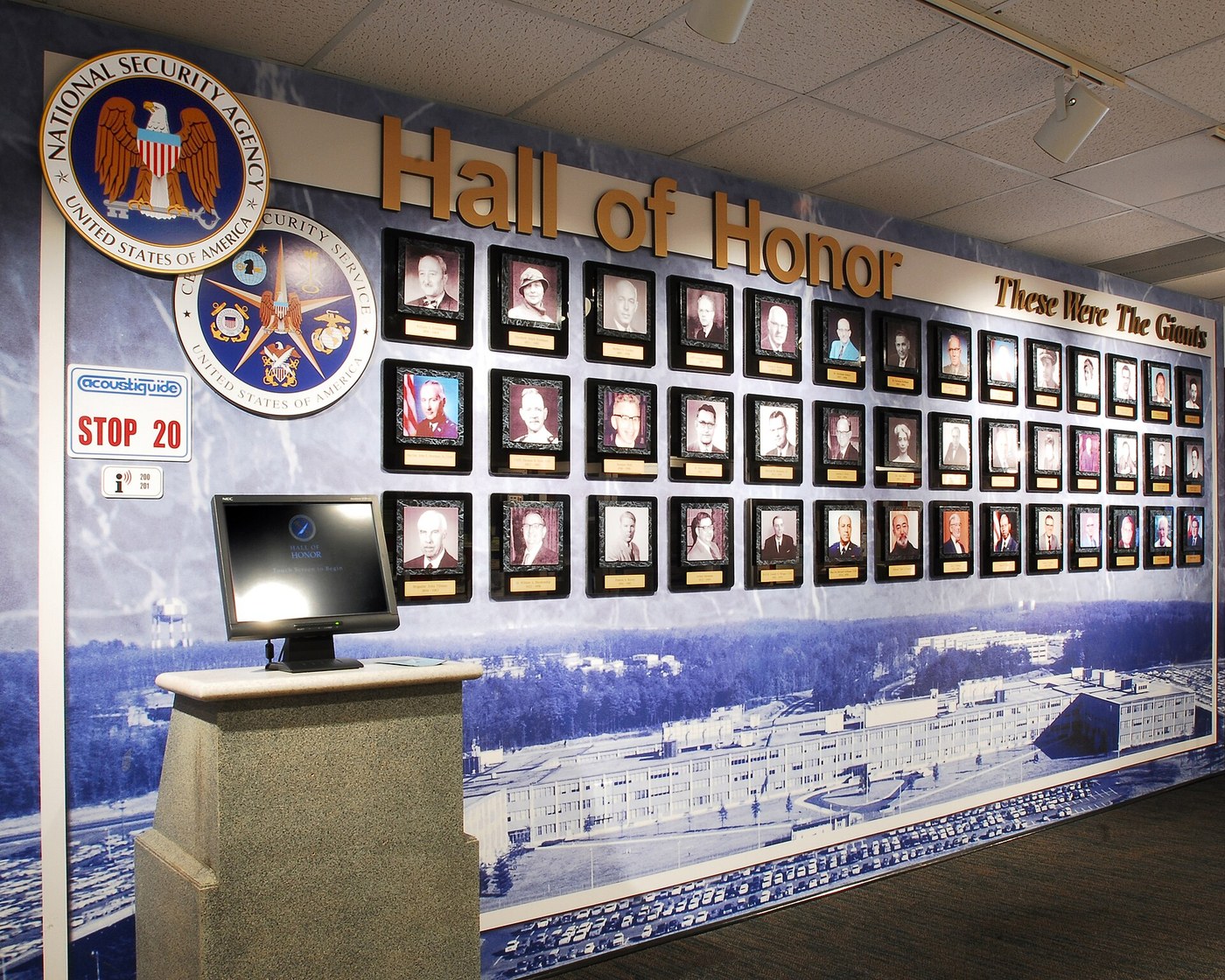
The people who appear in the 1935 photograph went on to run American cryptology. In 1949 the Army’s and Navy’s organisations were merged into the Armed Forces Security Agency, and in 1952 into the National Security Agency. In the new agency Rowlett, Sinkov and Kullback held senior posts — at one point chief of cryptanalysis, chief of communications security, and chief of research and development respectively — and Friedman served as a consultant and adviser until his death in 1969. In 1965 Rowlett became commandant of the National Cryptologic School, the agency’s training college, closing the circle that began with Friedman’s Riverbank classes. When NSA founded its Cryptologic Hall of Honor in 1999, the first inductees included William and Elizebeth Friedman, Rowlett, Sinkov, Kullback and Safford; Driscoll and Rochefort followed in 2000, Grotjan and Rosen in 2010, and Ferner in 2022.
1.11 Sources and Conventions
The series rests mainly on documents written by the people in it or by the NSA’s own historians, most of them now public:
- Friedman’s own writing: the Riverbank Publications (1917–1922); the Preliminary Historical Report on the Solution of the “B” Machine (14 October 1940; Library copy); the 1963 lectures published by the NSA as The Friedman Legacy (1992); his correspondence and memoranda in the William F. Friedman Collection, released by the NSA in 2015 (more than 7,600 documents and 52,000 pages).
- Rowlett’s recollections: his memoir The Story of Magic (1998), the NSA profile built from his notes (Hannah), and his 1974 oral history as quoted by NSA historians.
- Safford’s histories: A Brief History of Communications Intelligence in the United States (SRH-149, 1952) and his history of the Mark II ECM.
- NSA Center for Cryptologic History monographs: Parker on Navy communications intelligence (1994), Wilcox on women in cryptology (1998), Johnson on Driscoll (2015), Mucklow on SIGABA (2015), Sherman on the 1941 Bletchley mission (2016), McIntire on Ferner (2023), and the Hall of Honor biographies.
- Books: David Kahn, The Codebreakers (1967); Ronald Clark, The Man Who Broke Purple (1977); Liza Mundy, Code Girls (2017); Jason Fagone, The Woman Who Smashed Codes (2017).
Where these sources disagree — and they often do, especially on dates and on who deserves credit — the text says so. Elizebeth Friedman spelled her name with an e in the middle, as her mother insisted. “SIS” means the Army’s Signal Intelligence Service throughout, not the British Secret Intelligence Service.
Next — Volume 2: Riverbank — William and Elizebeth Friedman and the Index of Coincidence. A millionaire’s estate on the Fox River, a woman hired to prove that Francis Bacon wrote Shakespeare, a geneticist who fell for the woman and the ciphers, six-week courses for Army officers in 1917, eight pamphlets that founded American cryptanalysis — and the woman who went on to break the codes of Prohibition’s biggest smuggling ring.
Comments (0)