The Codebreakers · Volume 5
The Codebreakers — Volume 5 — The Purple Team — Grotjan, Rosen, Ferner, Rowlett and the Women of the SIS
The second generation of the Signal Intelligence Service, hired between 1936 and 1939 and trained by the first; who each of them was, what each contributed to PURPLE and to the problems that followed, how women moved from the typing pool to the worksheets, and how the credit for the most famous American break of the war was recorded, divided and lost
5.1 About This Volume
The PURPLE unit on this site tells the story of the break: the eighteen months against a machine nobody had seen, the fall of the sixes, the long wall of the twenties, the six messages in indicator 59173, and Genevieve Grotjan’s discovery on the afternoon of 20 September 1940 (PURPLE Volume 5). This volume does not retell it. It asks a different question: who were the people at those desks, and how did they come to be capable of it?
Most of them were the SIS’s second generation, hired between 1936 and 1939 and trained by the first four (Volume 3). Several were women, at a time when the official histories rarely recorded women’s work as anything but clerical. The volume introduces them one by one, sets out what the documents say each contributed — using Friedman’s own credit lists of 1940 and 1943 — and follows them into the problems that came after PURPLE. It ends with the history of the credit itself: who was named, who was left out, and how recently some names have been restored. The cryptanalytic methods they used — distribution tables, homologs, isomorphs, the reconstruction of switch wirings — are the subject of Volumes 7 and 8.
5.2 Six Years Without Hiring
From 1930 to 1936 the SIS had no authority to hire another junior cryptanalyst. The first four did the training, the code-making and the intercept work themselves, with a handful of clerks. The chance to grow came only when someone left: in early 1936 Sinkov was sent to Panama, and “as a result, Friedman gained permission to hire a junior cryptanalyst to fill Sinkov’s position in Washington” (McIntire, “Give to Ferner”, p. 3; Library copy).
From then on the SIS grew in small steps: Robert Ferner in July 1936, Samuel Snyder in August, Delia Ann Taylor by 1938, and in 1939 a larger cadre that included Genevieve Grotjan and Albert Small, while Leo Rosen came in from the reserves. By 1939 the organisation had about nineteen people at its centre. They were hired by the same means as the first four — the civil-service examination lists and Friedman’s personal judgement — and trained, as Rowlett put it, by the first generation passing on what it had learned, with Hurt teaching Japanese in-house (McIntire, p. 6). Friedman had built a self-reproducing school; this was its first new class.
5.3 The People
5.3.1 Robert O. Ferner
Robert Orestes Ferner was born at Clear Spring, Iowa, on 15 May 1915, the son of an educator, and was a recent physics graduate from Alliance, Ohio, when Friedman hired him. He reported to the SIS on 1 July 1936, aged 21, at exactly the $2,000 the first three had been paid six years before. By February 1938 he was described as “a cryptanalyst of considerable ability” (McIntire, pp. 3–7).
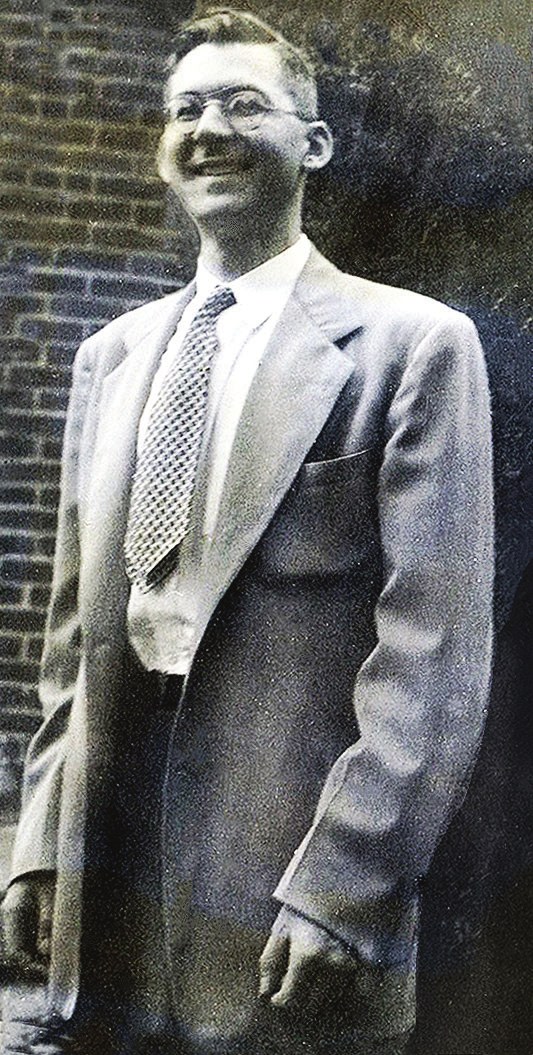
On PURPLE, Friedman’s own report of October 1940 put Ferner’s name next to Rowlett’s at the head of the credits:
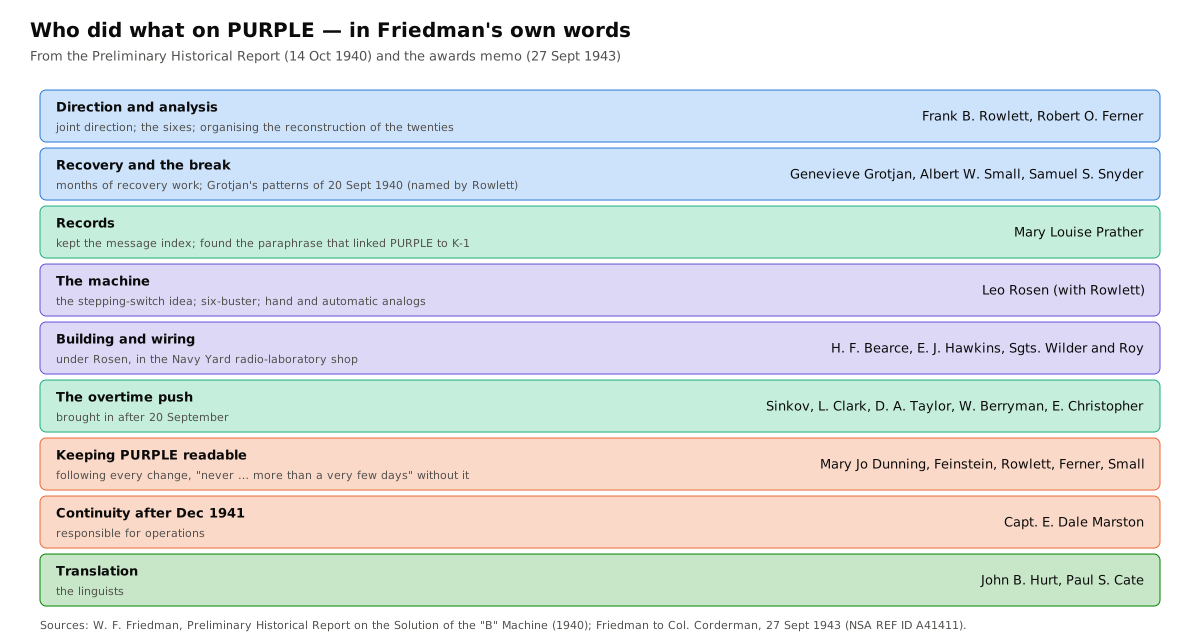
The specific direction and coordination of all studies on this project was the joint work of Cryptanalyst Frank B. Rowlett and Assistant Cryptanalyst Robert O. Ferner. Their indefatigable labors and brilliant analytical work testify and are a credit to their cryptanalytic skill, training and experience. To their joint direction and efforts are due the extremely fruitful analysis of the cryptographic mechanics underlying the operation of the B-machine as a whole, the theory of its operation, and the development and solution of the “6’s” at [an] early date in these studies. They were also extremely active in pushing the solution to a successful conclusion by organizing and directing the reconstruction of the developments or wirings of the switches for the “20’s.”
— W. F. Friedman, Preliminary Historical Report on the Solution of the “B” Machine (1940; Library copy), quoted in McIntire, p. 10
After PURPLE, Ferner went with Rowlett and Small to the next Japanese problem: a new diplomatic code introduced on 1 July 1941 — five years to the day after he had joined — superenciphered by a transposition through matrices of variable width with blank cells whose pattern changed every ten days. Friedman at first called it “impregnable”. The Navy obtained photographs of the code and the transposition matrices and passed them to the SIS, which could then read current traffic; Ferner and Small took the research side, working out the system so completely that the SIS could, to its Navy colleagues’ astonishment, predict future keys. To mechanise the drudgery of “anagramming” the transposed columns, Small devised a way of using the IBM equipment for which the trio, though not authorised to alter IBM’s machines, modified them anyway; the result was formally the Electromechanagrammer and to Rowlett always the “GeeWhizzer”. The system stayed readable until the Japanese withdrew it in July 1943. Rowlett described the partnership: Small “lived with the machines and he … was the new idea man”, while “Ferner was just a doggone good cryptanalyst and mathematician and he could take Small’s … brilliant glimpses and … make them real” (McIntire, pp. 12–15).
In the war Ferner ran the special-problems and research staff of the cryptanalytic branch, working on German machines, Hagelin systems and anything that defeated the operational sections; one veteran remembered that when a message was too short for anyone else, the instruction was “Give to Ferner. … He was the only one that could solve them.” Asthma forced him to leave the Washington climate in 1948. Friedman’s reference for him, written in 1950, called him “one of the most outstanding technical workers of the Army Security Agency”, “a modest and retiring man” of whom “professional jealousy … was unknown”. He took an engineering degree at Boulder, worked at Sandia and then in California, was called back briefly in 1952 to consult on a difficult problem, and died on 8 August 1982 (McIntire, pp. 26–32). Most published histories of PURPLE do not mention him. The NSA inducted him into its Hall of Honor in 2022, and its historian Brenda McIntire concluded her study in 2023: “Future accounts of the Purple success should reinstate the pivotal role of Robert Ferner.”
5.3.2 Genevieve Grotjan
Genevieve Grotjan was born in Buffalo, New York, in 1913, took a mathematics degree at the University at Buffalo in 1936, and was working for the federal Railroad Retirement Board when a high score in a civil-service mathematics examination brought her to Friedman’s notice; he hired her in 1939 (NSA Hall of Honor, Genevieve Grotjan Feinstein). On PURPLE she worked, in Friedman’s words, with Small and Snyder on “most excellent work in recovering the ‘6’s’ during many months of apparently hopeless effort” — and on 20 September 1940 it was she who walked into the room where Rowlett, Ferner and Small were conferring and laid out the worksheets that showed the cycles in the twenties. Rowlett’s account of the moment is quoted in the PURPLE unit’s Volume 5.
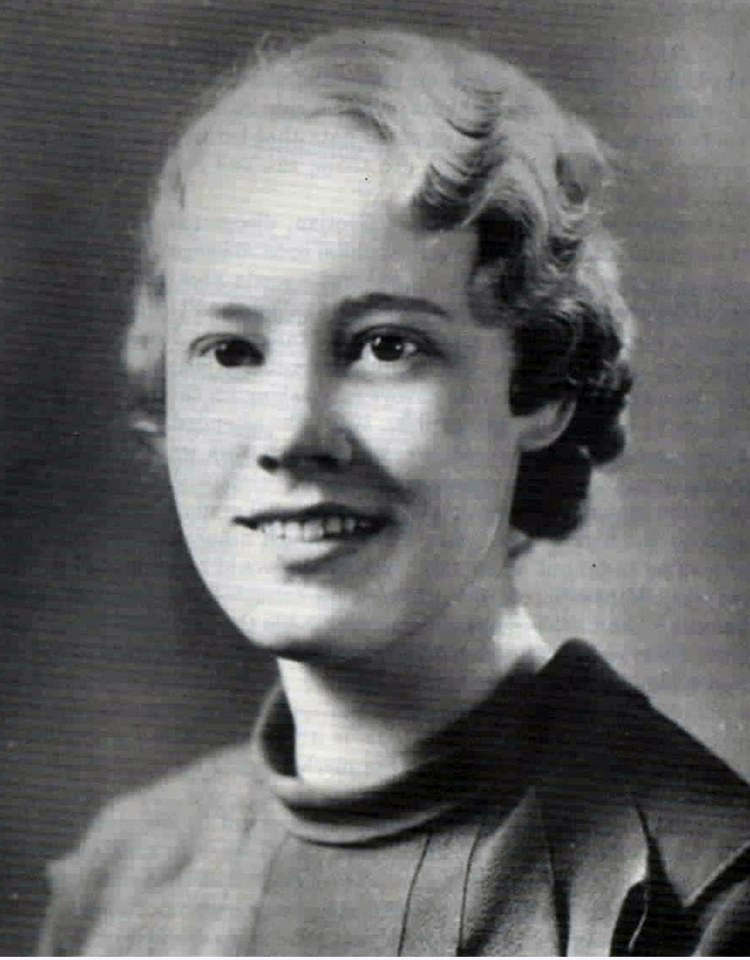
What is less often told is that she did it twice. In October 1943 she was assigned to the Soviet problem — the project later known as VENONA — and “devised a process for recognizing the re-use of key, which, in turn, permitted the decryption of Russian KGB messages”. The discovery was later described as “the most important single cryptanalytic break in the whole history of Venona” (NSA Hall of Honor). Both of her breakthroughs were of the same kind: seeing a structure in tables of data that more senior people had been staring at without seeing. Both depended on the school’s discipline of recording everything in a form that could be compared.
She married Hyman Feinstein, a chemist at the National Bureau of Standards, in 1943, and resigned from government service on 4 May 1947. She later taught mathematics at George Mason University, where her husband endowed an award in cryptology in her honour. She died in 2006 and was inducted into the Hall of Honor in 2010.
5.3.3 Albert W. Small
Albert Small joined the SIS in the cadre of autumn 1939 and worked on PURPLE from his arrival. Friedman’s 1940 report credits him with Grotjan and Snyder for the long recovery work, and his 1943 memorandum lists him again among those who kept PURPLE readable as its keying changed. Rowlett remembered his reaction to Grotjan’s discovery — dashing round the room “with hands clasped above his head like a victorious prizefighter” — and his gift for machines: he was the inventor behind the GeeWhizzer, and until 15 March 1943 he directed the Army’s attack on the Japanese Army’s own systems, whose first successes Friedman judged “will undoubtedly prove to be of the utmost importance” (Friedman to Corderman, 27 Sept 1943, NSA REF ID A41411; Library copy). After the war he moved into communications security (McIntire, p. 26).
5.3.4 Samuel S. Snyder
Samuel Snyder, hired in August 1936, worked on the PURPLE recovery and then, with Frank Lewis, took the major share of credit for solving the Japanese military attaché system of 1941–43, after the initial break by John Tiltman of Bletchley Park — which Friedman ranked next in importance to PURPLE itself (A41411). After the war Snyder became one of the pioneers of NSA’s computers, and wrote their history; Volume 11 relies on him. He is also the author of the tribute to John Hurt quoted in Volume 3. He is in the Hall of Honor.
5.3.5 Leo Rosen
Leo Rosen, an electrical engineering graduate of the Massachusetts Institute of Technology and a reserve officer through ROTC, was called to active duty with the SIS in 1939. He was not a cryptanalyst by training but an engineer, and he brought to the SIS something the school lacked: the ability to turn a cryptanalyst’s model of a machine into a working device. He proposed using six-level, 25-point telephone selector switches to mechanise the PURPLE sixes, built the “six-buster” in about two weeks, and then laid out and supervised the construction of the hand-operated and automatic PURPLE analogs. Friedman’s 1943 memorandum gave “the major share of credit” for the construction of the first and later models to “Mr. (now Major) Leo Rosen and Mr. (now Major) Frank B. Rowlett” — noting that it was done “without the benefit of any information whatsoever in the way of captured or pilfered drawings, blueprints, etc., but solely from an understanding of the cryptographic principles underlying the system” (A41411).
Rosen sailed with Sinkov to Bletchley Park in 1941, partly so that the analog could be repaired if it failed (the PURPLE unit’s Volume 6), and came back with an engineer’s understanding of the British bombe. In 1943 he designed the “plugboard code wheel” adopted for SIGABA’s Army field use (Volume 9). After the war he became assistant director of research and chief engineer of the Army Security Agency and then of NSA, and worked under Kullback on the development of new processing machines (Volume 11). He was inducted into the Hall of Honor in 2010.
5.3.6 Mary Louise Prather and Mary Jo Dunning
Two women in Friedman’s credit lists show how much of codebreaking was organisation.
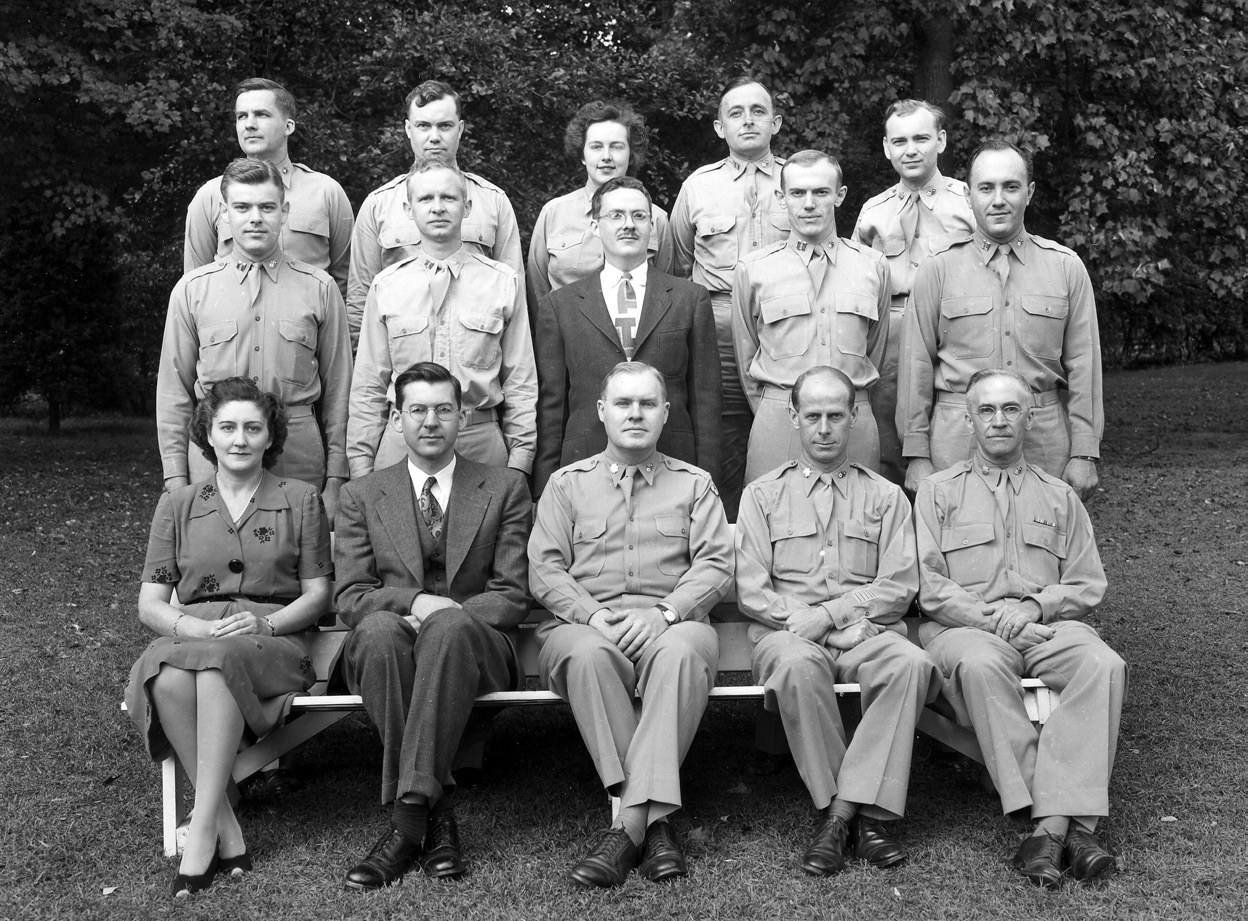
Mary Louise Prather was the section’s records clerk. Friedman credited her in 1940, and again in 1943, “for the careful keeping of the records and the index of all messages”, adding that “it was as a result of her painstaking attention to detail that a paraphrased message was found which formed a very important link in the solution” — a PURPLE message that was a paraphrase of one sent in the K-1 code. In a field where plaintext is the most valuable commodity, the person who can find the one message in a thousand that duplicates another is a cryptanalyst in all but title. She was still with the branch at Arlington Hall, in the front row of the B Branch photograph at the head of this volume.
Mary Jo Dunning appears in no popular history of PURPLE, but Friedman’s 1943 memo gives her first place in one of its most important lines of credit:
The Purple System has undergone some changes since its inception. For keeping abreast of those changes and following them cryptanalytically step by step, so that we have never been without the ability to read Purple messages for more than a very few days at any time, the major share of credit belongs to Miss Mary Jo Dunning, and to Mrs. Feinstein, as well as to Major Rowlett, and Messrs. Ferner and Small.
— Friedman to Corderman, 27 September 1943 (NSA REF ID A41411)
The break of 1940 is the famous moment; keeping a broken system readable for five years, through new indicators, new rules and new classes of traffic, is the work that produced the intelligence. Dunning led it.
5.3.7 Delia Ann Taylor, Wilma Berryman and the overtime of September 1940
When the first glimmer came on 20 September 1940, Friedman brought in staff from other sections for the final push, some on voluntary overtime: Abraham Sinkov, Lawrence Clark, Delia Ann Taylor, Wilma Berryman and Edward Christopher (Friedman 1940). Taylor, a junior cryptanalyst at the SIS since 1938, married Sinkov; as “Mrs. Delia Sinkov” she appears in Friedman’s 1943 memo among the principal assistants on the German diplomatic “Floradora” system and on the first breaks into Japanese Army systems. Berryman was later known as Wilma Z. Davis. Neither woman has a full-length published biography.
5.3.8 The linguists
Every PURPLE solution ended in Japanese — often in the Foreign Ministry’s abbreviation code, which looked, as Friedman wrote, “more like code or a random assortment of letters than plain text”. The SIS’s linguists were John Hurt (Volume 3) and Paul S. Cate, and they were the bottleneck: Friedman complained in 1940 that they could give the B machine only “a small part of the time when the traffic for the daily ‘Bulletin’ permitted, which was quite seldom”. Only they could tell a right reconstruction from a wrong one.
5.4 How the Team Worked
The PURPLE attack was organised in a way that reflected the school’s training. Three features stand out in the records.
A division of labour by skill, not rank. Rowlett and Ferner directed and analysed; Grotjan, Small and Snyder did recovery; Prather kept the index; Rosen built; Hurt and Cate translated; IBM machine operators produced frequency counts and sorted cards. Friedman supervised from August 1939 while keeping other duties. Everyone knew what everyone else was doing: the section’s watchword, as Rowlett remembered it, was to make no mistakes, record all findings, identify the source of every recovery and keep the team informed.
Records as instruments. The school taught that the analyst’s paper is a scientific record, not a scratchpad. Distribution tables, development charts and indexes were kept in standard forms precisely so that one person’s tables could be compared with another’s, and with the next day’s. Grotjan’s discovery came from such tables; so did Prather’s paraphrase.
Building as a way of thinking. The team built machines at every stage: the six-buster to decipher the sixes, the hand-operated B machine to test their understanding, the automatic analogs to read traffic. Each machine was a hypothesis made physical. When an analog printed correct Japanese, the reconstruction was proved.
The team also cooperated with the Navy’s OP-20-G throughout — daily consultation, shared files, an agreement to pass on any significant discovery at once — and drew on its workshop to build the first analog (Volume 4).
5.5 The Women of the SIS
The PURPLE team’s women were early representatives of a change that the war made enormous. The NSA historian Jennifer Wilcox observes that “unlike many occupations women entered during the war, cryptology was never a traditionally male job. Since the beginning of permanent cipher bureaus following World War I, women civilians had worked in the Army and Navy code rooms” (Wilcox, Sharing the Burden, p. 11; Library copy). The SIS’s first employee in 1930 had been a woman, Louise Newkirk; Elizebeth Friedman had built and led the Coast Guard’s unit; Agnes Driscoll was the Navy’s leading cryptanalyst. What changed between 1939 and 1945 was scale.
At the time of Pearl Harbor the Army’s SIS had 331 people. By the end of the war the Army’s Signal Security Agency at Arlington Hall employed thousands, many of them women — civilians recruited from colleges and schools across the country and, from 1942, members of the Women’s Army Auxiliary Corps (later the Women’s Army Corps). The Navy’s codebreaking organisation grew in the same way; by February 1944 nearly 3,000 WAVES worked at the Naval Communications Annex alone (Wilcox, pp. 3, 13).
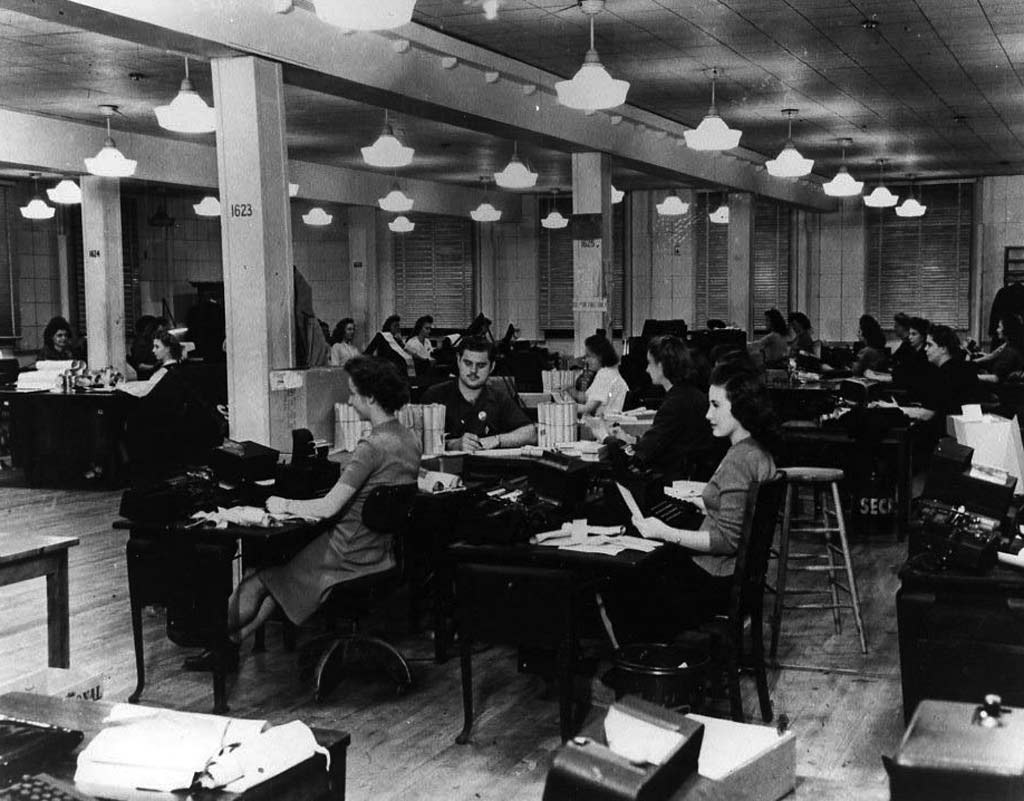
The training that made this possible was the school of Volume 3 scaled up. The Army “handpicked the men and women enrolled in their cryptographic course”, first at Fort Monmouth and then at Vint Hill Farms Station; students who showed the necessary skills in the first six weeks of cryptanalysis went on to learn “cryptographic security, Army and staff organization from a signal intelligence viewpoint, elementary and advanced cryptography, IBM theory and operation, code compilation, and the preparation of cryptanalytic work sheets”, with languages for the advanced students. Arlington Hall ran its own courses, Rowlett heading the training programme from November 1942, and Ferner and others designed a course on machine cipher systems that ranged from Enigma variants to RED and PURPLE (McIntire, p. 17). The Navy, before the war, had arranged secret cryptology classes at women’s colleges — at Goucher College in Baltimore an English professor, Ola Winslow, taught them in a locked room on the top floor — and later trained WAVES at Smith College and Mount Holyoke (Wilcox, pp. 5–6).
Recruiting emphasised character before skill. Safford’s view, in a memorandum on recruiting women for OP-20-G, was that “it is essential that all personnel be especially selected for integrity. Individual qualifications are of secondary concern” — skills could be taught, loyalty could not (Wilcox, p. 3).
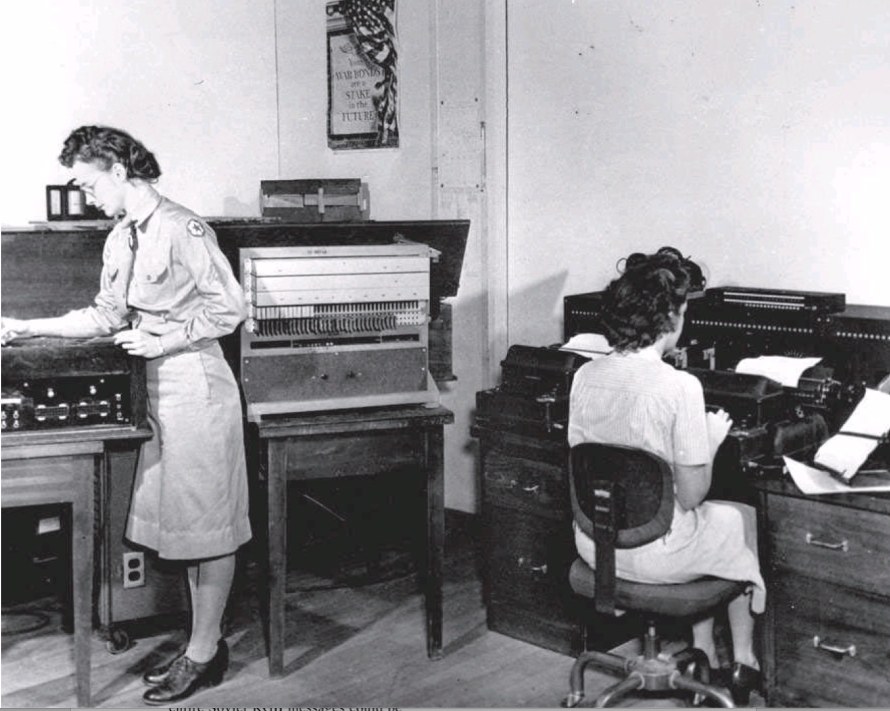
Some of the women who joined in this period rose to the top of the profession. Ann Caracristi, who joined the SIS on 8 June 1942 and worked on Japanese Army systems at Arlington Hall, became NSA’s Deputy Director in 1980. Juanita Morris (later Moody) began in the German diplomatic section at Arlington Hall and had a long career at NSA. But most of the wartime women went home in 1945 and, bound by secrecy, said nothing about their work for decades. Their recovery as historical figures is one of the subjects of Volume 12.
5.6 The Credit
The PURPLE break has been told, retold and argued over since 1945, and much of the argument has been about credit. The documents allow the history of the credit itself to be traced.
October 1940. Friedman’s Preliminary Historical Report was written “to record credit as well as method”. It insisted that “the name of no one person can be selected as deserving of the major portion of credit”, credited Rowlett and Ferner jointly with direction, and credited Grotjan, Small and Snyder together with the recovery work. It did not say who found the pattern on 20 September.
September 1943. Friedman’s memorandum recommending wartime awards repeated the team names — “the accomplishment was by no means the work of one or two people but the result of the cooperative labors of a competent team working under my direction for a period of over 18 months” — added Rosen and Rowlett for the machine and Dunning and the others for continuity, and listed Prather by name (A41411).
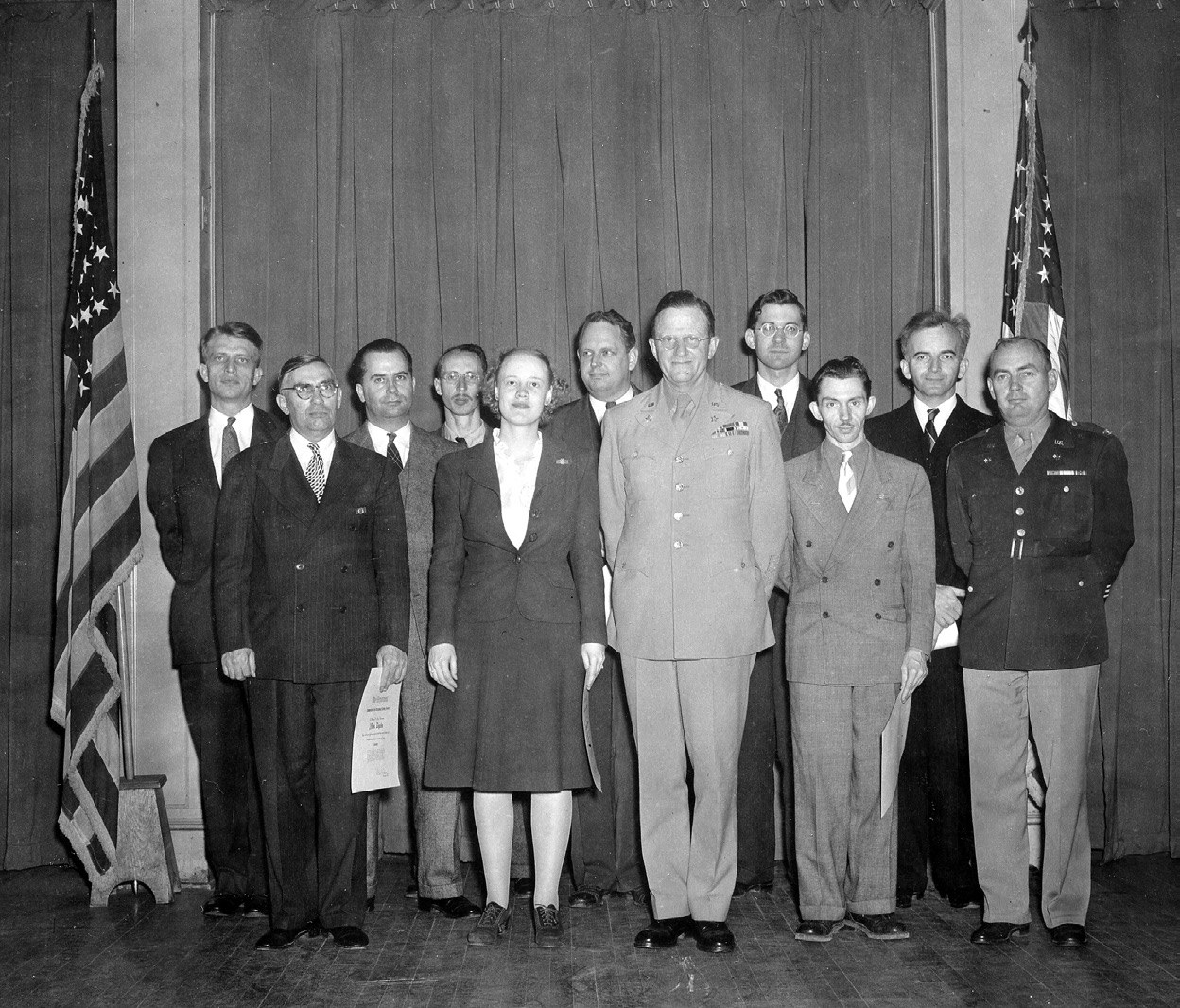
May 1946. At Arlington Hall the Army presented Commendations for Exceptional Civilian Service. The photograph of the ceremony shows, in the front row, Mark Rhoads, Genevieve Feinstein and Brigadier General P. E. Peabody, and in the second row Albert Small and Robert Ferner among others — the PURPLE team’s second generation, recognised in private for work that could not be made public.
1945–1970s. When PURPLE became public through the Congressional Pearl Harbor investigation, the name everyone knew was Friedman’s; Ronald Clark’s 1977 biography was called The Man Who Broke Purple. Friedman was the only member of the team whose name the public knew, and the secrecy rules prevented the others from correcting it.
1980s–1990s. Rowlett’s recollections, first in the NSA’s internal profile and then in The Story of Magic (1998), named Grotjan as the finder of the pattern and gave a vivid account of the team. They also made Rowlett, inevitably, the central figure of his own story; Ferner, who had died in 1982, appears in them as “the quiet one”.
1999–2023. The NSA’s Hall of Honor inducted Rowlett, Sinkov and Kullback in 1999, Grotjan and Rosen in 2010, and Ferner in 2022. Wilcox’s Sharing the Burden (1998) opened its history of women in cryptology with Grotjan’s discovery. McIntire’s 2023 study restored Ferner. The lists of names in Friedman’s own memoranda, declassified with the Friedman Collection in 2013–2015, are more generous than any published account before them.
The pattern is a familiar one in the history of science and engineering: team work is remembered as the work of one or two people, usually the most senior or the one who wrote the account. What makes the PURPLE case unusual is that the original documents survive, and that the person in charge took care, at the time, to spread the credit.
Next — Volume 6: Statistics as a Weapon. The tests the school taught its students, computed in code: Friedman’s index of coincidence, Kullback’s phi and chi tests and the kappa values for English and random text, applied to real problems — period finding, alignment of messages in depth, matching alphabets — with the arithmetic shown.
Comments (0)