The Codebreakers · Volume 9
The Codebreakers — Volume 9 — Inventing SIGABA — The Lessons Turned Inward
How the people who learned to break rotor machines designed one that could not be broken: the lesson of the Hebern solution, Friedman's key tape, Rowlett's stepping maze, the Navy's index rotors, a decade of secrecy between two services that built the same machine, secret patents, and the long argument over who invented what
9.1 About This Volume
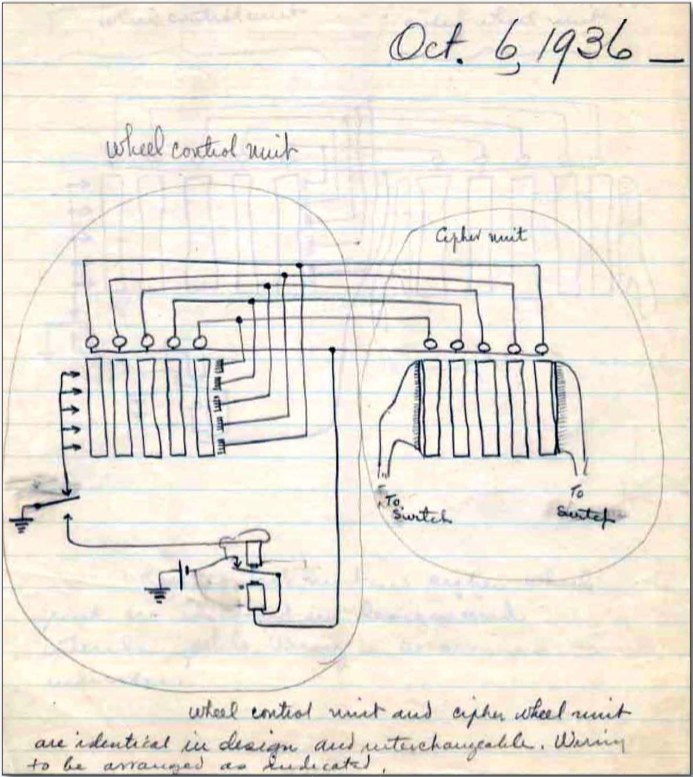
SIGABA — the Army’s Converter M-134-C, the Navy’s Electric Cipher Machine Mark II — was the most secure cipher machine of the Second World War. No evidence has ever emerged that the Germans or the Japanese read a word of it. How the machine worked, how it was keyed and guarded, how it was adapted for Allied use, and what modern cryptanalysts make of it are told in the SIGABA unit of this site, whose Volume 2 narrates the machine’s origins in detail.
This volume asks a narrower question, the one this series is built around: how did what the codebreakers learned as attackers become what they built as defenders? SIGABA was invented by people who had spent a decade breaking other people’s machines, and it embodies, one by one, the lessons they drew. The volume traces those lessons; follows the idea from Friedman to Rowlett to the Navy and back; shows how two services built the same machine while forbidden to tell each other; and examines the credit, which was disputed for half a century and settled, in part, by a patent issued in 2001. The mathematics of why SIGABA’s stepping held is Volume 10.
9.2 The Doctrine: Break to Build
Both American schools began from the same premise: that the first purpose of studying foreign cryptography is to improve one’s own. Friedman told his first recruits in 1930 that the SIS’s “first and more important objective was to insure that U.S. military codes and ciphers were the best and most secure that could be devised”; Rowlett said fifty years later that “the most important goal of the cryptanalyst is to use his knowledge of foreign cryptography to improve our own cryptographic security” (Volume 1). The Navy’s Research Desk was founded, in Parker’s words, “to develop cryptographic systems for the U.S. Navy which would avoid the weaknesses observed in the cryptographic techniques employed by foreign governments” (Volume 4).
This doctrine produced a habit that is the real origin of SIGABA. Every cipher system the Americans considered adopting was handed to the cryptanalysts first. Commercial machines were bought and broken in training (Volume 3). The Navy gave Friedman test messages for the Hebern machine in 1924 and again in 1932. And every solution was written up as a lesson about what not to build.
9.3 Lesson One: Regular Stepping Is the Weakness
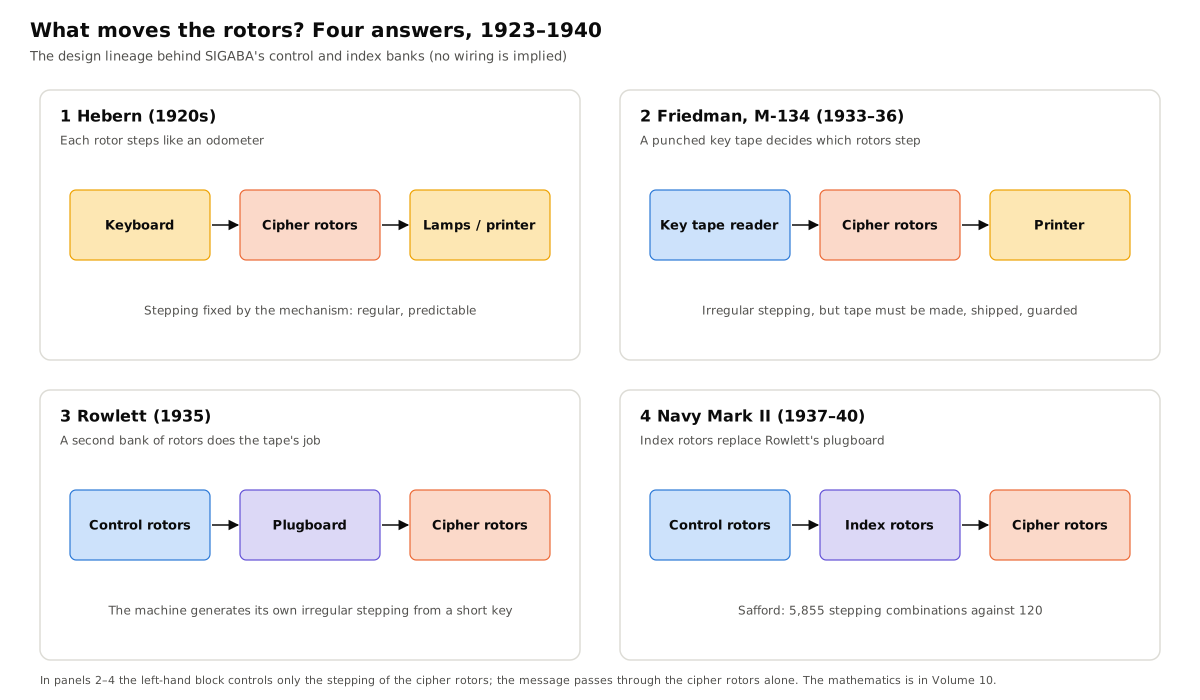
The Hebern machine was the first wired-rotor machine the Americans met, and its solution taught the lesson on which everything else turned. Friedman’s 1924 attack, made from ten test messages, treated the machine as “only two unknowns, the cipher wheel … and the rest of the machine”: because the rotors stepped regularly and predictably, like the wheels of an odometer, the rest of the machine could be treated as constant for long stretches, and the parts could be analysed one at a time (Mucklow, The SIGABA / ECM II Cipher Machine, p. 3). The statistical tool was the index of coincidence (Volume 2).
Safford, who was on the receiving end, recorded three consequences. The solutions “showed the weaknesses of the meter action of the 1923 HCM and of 6 of the 30 optional stepping actions of the 1930 HCM”; the 1924 solution “was the basis of further analysis by the Navy which disclosed stepping actions that would block analytical solutions or short-cut solutions based on possession of the code wheels” — “Friedman arrived at similar conclusions, independently”; and “otherwise, we would have had to abandon the Electric Cipher Machine as being deficient in inherent security” (Safford, history of the Mark II ECM, NSA REF ID A60492, p. 11; Library copy). The Navy responded by adding irregular stepping adapters to its Hebern-derived machines and, under Safford and the engineer Donald Seiler, building the ECM Mark I, its main cipher machine from 1936 to 1942.
The lesson both services drew was the same: predictable motion of the cipher elements is what an analyst exploits. The Enigma’s regular, odometer-like stepping of its rightmost rotors was exactly this weakness, and it was one of the levers the Polish and British cryptanalysts used. PURPLE’s stepping switches moved in a fixed fast–medium–slow order, which the SIS recovered in 1940 (Volume 8). The goal became a machine in which the motion of the cipher rotors could not be predicted from the machine itself.
9.4 Lesson Two: Keep the Key Out of the Machine
Friedman’s first remedy came, Mucklow writes, around 1926, and was “conceptually simple and the technology proven”: let a punched paper tape, like a telegrapher’s tape, decide which rotors step at each keystroke. Holes in a five-level tape would close contacts that fired the stepping magnets of one or more cipher rotors, producing apparently random stepping; tapes could be produced in secure facilities, distributed and changed on a schedule. On 23 April 1932 he explained the idea and sketched a machine with a “key tape transmitter” to his three junior cryptanalysts, Rowlett, Kullback and Sinkov (Mucklow, pp. 3–5).
The principle behind it was one that Auguste Kerckhoffs had stated in 1883: the security of a system should rest on an easily changed key, not on the secrecy of the mechanism. Friedman put it in his own words to the Patent Office, which kept rejecting his application on the ground that it was anticipated by Hebern:
In Hebern the movements or displacements of the code wheels are purely mechanical; these movements are regular or periodic in character, and controlled by ratchet mechanisms internal to the device itself. In the present invention, these movements are controlled by the cipher key transmitter in an aperiodic manner… It will be recognized that the Hebern structure has the inherent weakness of all such devices where the keying mechanism is a part of the device itself. Periodical recurrence of movements is a natural characteristic of all such mechanisms and the predictable factor thus introduced defeats the essential purpose.
— Friedman to the Patent Office, 3 April 1934, quoted in Mucklow, p. 6
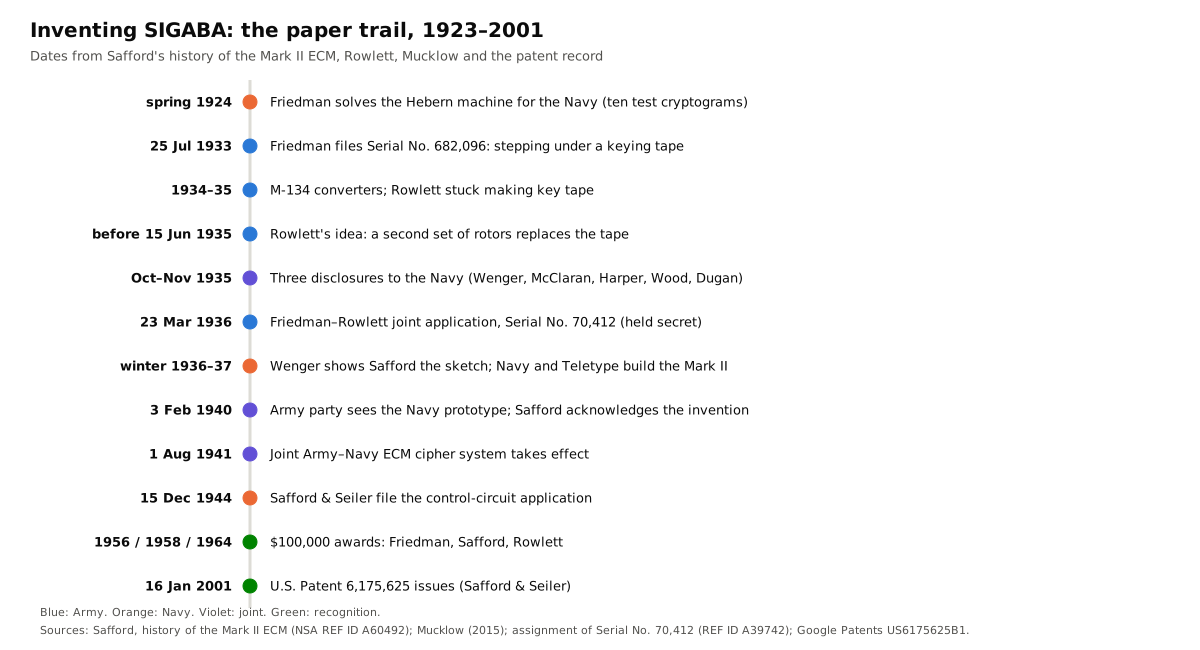
The application, Serial No. 682,096, was filed on Friedman’s behalf by the Chief Signal Officer on 25 July 1933, “covering a cryptographic system and machine in which the stepping of the code wheels was very irregular and under the control of a keying tape. Electric control thus made its first appearance!”, as Safford put it. Friedman assigned it entirely to the War Department, and the machines built on it — the Converter M-134 and M-134-A — were in service between the War Department and the overseas commanders by 1938 (Safford, A60492, p. 11).
9.5 Lesson Three: Logistics Is Security
The key tape solved the cryptanalytic problem and created a logistical one, and the person who discovered the logistical problem was the one given the job of making tape. In 1934, Rowlett recalled, “I got stuck with the job of making the tapes because I had a little bit more practice in mechanical things than the rest of the group and I think they were smarter than I because they didn’t let it be known” (Mucklow, p. 7, from Rowlett’s 1974 oral history).
What he found, making random tape by the yard on a temperamental machine, was a list of failure modes that every modern key-management engineer would recognise. Producing genuinely random tape was laborious and probably “rife with vulnerabilities”. Operators under stress would tear tapes or misuse them. They would be tempted to reuse tapes and starting places. Every station on a network would need the same large inventory of tape, and “the distribution of and the accountability for tape alone would entail untold manpower and resources, not to mention acquiring secure facilities for its storage” (Mucklow, pp. 7–8). The school had spent years exploiting other people’s key-handling errors — reused indicators, stereotyped messages, keys sent in the system they protected. Rowlett could see the same errors coming in his own Army.
His remedy came from a daydream about getting out of the job:
I thought it would be a helluva good idea if we replaced these key tapes with a second set of rotors which in effect would generate five screens of impulses equivalent to the holes and no holes in the five levels of the tape and use this assembly of five additional rotors instead of the tapes.
— Rowlett, oral history 1974, quoted in Mucklow, p. 8
That is the stepping maze: a second bank of rotors, set by a short daily key, through which current is passed to generate the irregular pattern of stepping that the tape had supplied. The cipher rotors still step irregularly; but the irregularity now comes from a key that is a handful of rotor positions, not miles of tape. Safford, who would build it, later dated the idea to “shortly before 15 June 1935” and described it as “the principle of sending an electrical impulse through the circuits of a code-wheel maze to generate a long, irregular sequence of events which could then be used for various purposes, such as keying” (A60492, p. 11).
9.5.1 “A beautiful idea”
Rowlett’s account of how Friedman received the idea is the most retold episode in SIGABA’s history, and the SIGABA unit’s Volume 2 tells it in full. In outline: Friedman, attached to the key tape that embodied his own principle, at first refused to believe a machine could safely generate its own stepping — it seemed to violate the very rule he had been defending to the Patent Office — and dismissed Rowlett; after a strained period, he came in one morning, in Rowlett’s words, “eyes shining, just all excited and he says, we’re going to do this”, called it “a beautiful idea”, and told Rowlett to start drafting patent specifications at once (Mucklow, pp. 9–10). The story comes from Rowlett, decades later, and the details of its timing are uncertain. What the documents confirm is the outcome: the two men worked the idea into practical circuits together, and on 23 March 1936 the Chief Signal Officer filed a patent application on their behalf as joint inventors, Serial No. 70,412, for “certain improvements in Cryptographs”. On 2 April 1936 they assigned all rights in it to the United States for one dollar (assignment, NSA REF ID A39742; Library copy; Safford, A60492, p. 11). The application was held in secret status; Safford recorded in the 1940s that nearly all of its 39 claims had been allowed. It appears never to have issued as a patent.
The episode is a lesson in itself, and the school taught it as one. The inventor of a principle is the worst-placed person to see its replacement; the junior who has to operate the system day to day sees its failures first. Friedman’s real contribution at this point was not the stepping maze but the willingness, after a night’s reflection, to abandon his own design for a subordinate’s. Rowlett said that from then on Friedman accepted him “as a professional cryptanalyst rather than as a student”.
9.6 Lesson Four: A Good Idea Needs a Builder
The Army could not build the machine. The Depression had exhausted the Signal Corps’ research budget on the M-134, and the Chief Signal Officer, committed to the M-134-A then in manufacture, would not change the design “despite Friedman’s urgent recommendations”. The Army spent what little it had on an add-on, the SIGGOO (M-229), which gave some of the M-134s a small rotor maze in place of their tape; the rest stayed on tape (Mucklow, p. 11; Safford, A60492, p. 11).
The builder turned out to be the Navy. In October 1935 Lieutenant Joseph Wenger, acting head of OP-20-G, walked across the footbridge from Main Navy to the Munitions Building and told Friedman that the Navy was dissatisfied with its machines and had development money but no ideas — “for goodness sakes did the Army have something … any good ideas at all.” Friedman obtained permission to disclose the Friedman–Rowlett application, and the details were shown to Navy officers at three conferences in his office in late October and on 1 November 1935. The Navy officers were politely unenthusiastic, and Friedman and Rowlett were told that the principles were “of no interest to the Navy at that time — which was the truth of the matter”, Safford later wrote (A60492, p. 12; Mucklow, pp. 12–13).
What happened next is the strangest episode in the story, and it is a direct product of the service rivalry of Volume 4. In the winter of 1936–37, when Safford was back in Washington and preparing specifications for a new machine, Wenger took from his safe “a single sheet of cross-section paper containing three elementary wiring-diagrams by means of which electric control of an ECM could be achieved through an ECM maze”, signed by Friedman and Rowlett and by Wenger and two other Navy officers. Safford saw at once that “electric control gave us the answer to many of our unsolved problems and therefore had to be incorporated in the new machine”. But he was under orders — the order of 1934–35, provoked by the printing of Friedman’s Hebern analyses — “not to discuss or show either the Mark I ECM or the Mark II ECM to the Signal Corps”, and so “adopted electric control and further developed the basic idea without the knowledge of the original inventors” (A60492, p. 12).
From late 1936 to 1940 the Navy and its contractor, the Teletype Corporation, built a series of prototypes. Seiler and Safford made two substantial changes. They replaced the plugboard in the Friedman–Rowlett design with a third bank of small rotors, the index maze, which “accomplished the same cryptographic result as the plugboard but was much more convenient to the operator”; and they grouped the contacts at the ends of the stepping maze so that, with the ten paths through the index maze, there were “49 times as many stepping combinations as was possible with the Friedman-Rowlett invention (5,855 against 120)” (A60492, p. 13). The Navy’s own engineers had considered plugboards and rejected them: they were inconvenient, had not prevented the initial solution of six different machines the Navy had tested, and plugging errors had led directly to compromises of keys (Mucklow, note 39). The Navy’s Code and Signal Laboratory, in a history written by Seiler in 1950, went further and claimed that the Navy had itself proposed using a rotor maze to control rotor stepping on 21 June 1932; no other source corroborates that claim, and Safford’s own wartime history credits the stepping maze to Rowlett.
9.6.1 Finding out
Rowlett found out by accident. In 1939, working with the Navy’s Lieutenant Commander Wesley “Ham” Wright on PURPLE, he heard Wright remark that perhaps the Japanese were using “something like what we’re planning to use in our new Navy cipher machine”, and then sketch its circuits — Rowlett’s own invention, which Wright believed was Wenger’s idea. Rowlett went straight to his chief, Major William Reeder, and found that Reeder already knew (Mucklow, pp. 14–15, from The Story of Magic). The Navy’s order was lifted in January 1940, when the Mark II was offered to the War Department for joint use.
On 3 February 1940 Admiral Noyes, the Director of Naval Communications, invited the Chief Signal Officer, General Mauborgne, Friedman and other Signal Corps representatives to inspect a pilot model. “On that occasion,” Safford wrote, “I acknowledged to Mr. Friedman, in the presence of General Mauborgne and Admiral Noyes, our use of his invention.” At a technical conference with Teletype’s engineers that followed, Friedman pointed out that the underlying principles of the control circuits were those he and Rowlett had disclosed in 1935, “and this was confirmed by me”. The index maze and the end-contact groupings were retained; at Friedman’s urging the Navy’s subdivision of the stepping maze was abandoned and its stepping order changed. “With these exceptions the Mark II ECM, as developed by the Navy and Teletype using the Friedman-Rowlett ‘Stepping Maze’, was satisfactory to and accepted by the Army” (A60492, p. 13). Rowlett remembered the day differently, as love at first sight: “it was the most beautiful thing to look at from where I stood and I couldn’t keep my hands off it” (Mucklow, p. 15).
9.6.2 Safford’s verdict
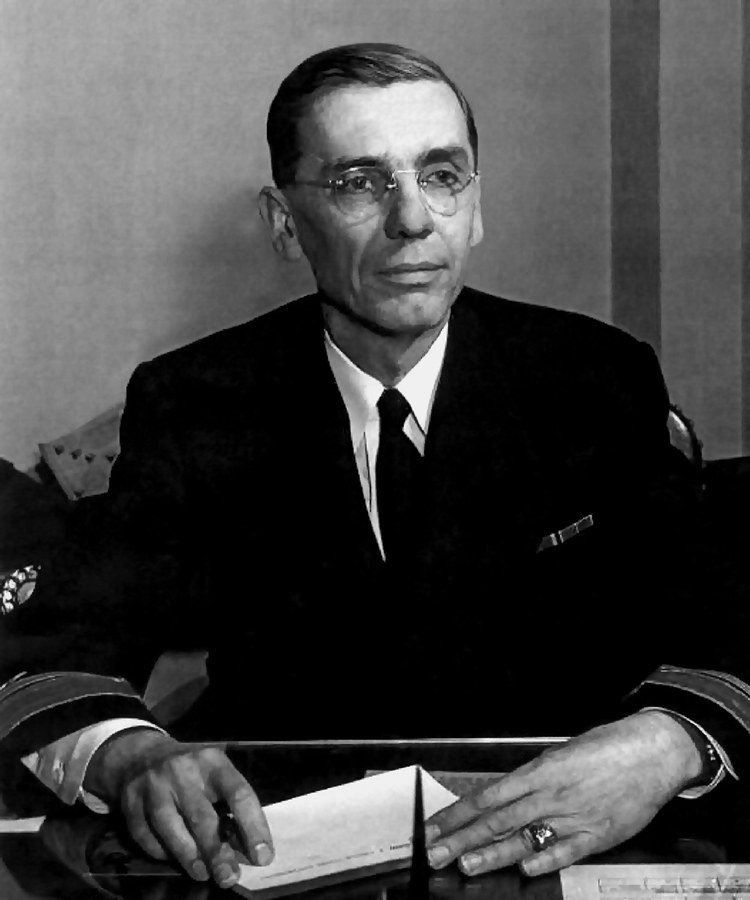
Safford’s own history of the Mark II, written during the war for the Navy’s files, contains the most generous acknowledgement in the whole story, and it comes from the man who might have claimed the most:
Electric control of the ECM by means of the Friedman-Rowlett “Stepping Maze” is the essential feature that places the Mark II ECM in a class by itself as regards security… Although the “Stepping Maze” appears obvious, now that it is in use, no one in the Navy thought of it in a period of 15 years, and no foreign machine employs it… Rowlett is entitled to full credit for his discovery of the principle of the key generator as embodied in the “Stepping Maze,” which adds so much to the excellence of the Mark II ECM, and Friedman and Rowlett jointly are entitled to full credit for their joint invention of methods of applying and reducing the principle to practical form.
— L. F. Safford, history of the Mark II ECM (NSA REF ID A60492), p. 14
He also set out what the Navy would have had without it: a machine with mechanical irregular stepping that would “defy attempts at solution until such time as machine and code wheels were captured”, after which “a trial-and-error solution would be within the range of possibility”. “We could not make the flat statement, as we do for the Mark II ECM, that solution would be utterly impossible.”
9.7 Lesson Five: One Machine for Both Services
The Joint Army–Navy ECM cipher system took effect on 1 August 1941, and both services agreed to share nothing about it with anyone else. Its first great value, Safford wrote, was simply that the two services had the same machine:
This use of an identical machine with interchangeable code wheels has been of great military value, particularly in the early stages of the war when the distribution of machines and code wheels was incomplete. In the Philippines, Java, Australia, and even in North Africa, Navy wheels have been used in Army ECMs, Army wheels in Navy ECMs; machines have been borrowed back and forth between the two services.
— Safford, A60492, p. 14
It was a lesson the rivalry of Volume 4 had obscured: interoperability is itself a security property, because systems that cannot talk to each other get bypassed. The Army added one contribution of its own after the machine was in service: Leo Rosen’s “plugboard code wheel” of 1943, developed for field use where capture was more likely than at sea, and adopted for joint use at the Army’s request (A60492, p. 13).
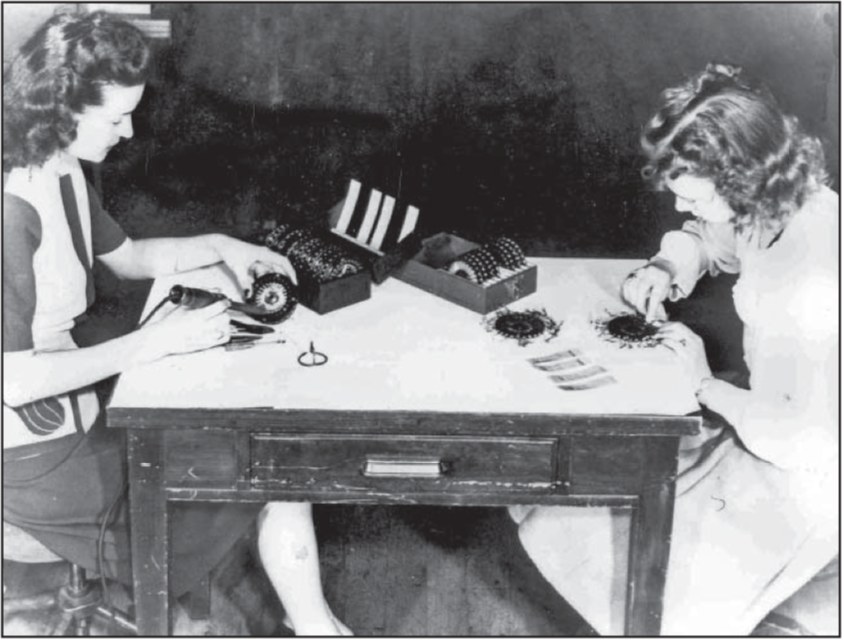
Keying, too, reflected the school’s lessons. SIGABA’s daily settings were generated by other machines rather than chosen by people, printed a month at a time on a single sheet that was “easy to transport, easy to use, easy to destroy, and, if necessary, easy to replace” (Mucklow, p. 21). Rowlett, who had once been asked to supply an Army’s worth of paper tape, summed up the change: “all the cipher clerk needed was a box of rotors and a little pamphlet that told him how to use the rotors.” The rotors themselves were wired in government hands, by WAVES at the Washington Navy Yard and WACs at Arlington Hall, never by contractors; the SIGABA unit’s Volume 5 describes the key system and its Volume 6 the custody rules, including the machine lost — and recovered — at Colmar in February 1945.
9.8 The Test: Attack It Yourself, Then Ask the Enemy
A machine designed by codebreakers was also attacked by them. The Army and Navy’s own analysts studied SIGABA throughout the war, and after V-E Day the Allied Target Intelligence Committee (TICOM) asked the German cryptanalysts directly. The answers, summarised by Mucklow and in the SIGABA unit, were consistent: the Germans had identified a five-letter American system, called it the “American Big Machine”, made no progress, and in September 1944 recorded “Work discontinued as unprofitable at this time” (Mucklow, pp. 23–24). The Germans had read lower-level American systems when operators were careless; SIGABA, used as instructed, was beyond them. For the school, this was the final examination of its doctrine: the same people who had broken the Hebern machine, RED and PURPLE had built a machine that the best enemy cryptanalysts of the war could not touch.
9.9 The Credit
The credit for SIGABA was settled slowly, and in public only after most of the people involved were dead.
The patents. Because the invention was secret, its patent applications were held in secret files for decades. Whether Friedman’s 1933 key-tape application or the Friedman–Rowlett application of 1936 ever issued is unclear: a 2003 post to a cryptography mailing list reported that formerly secret Friedman applications of 1933 and 1936 had been issued to the NSA in 2000, but no such patents have been identified for this series, and the joint application appears never to have issued. The Navy filed its own application on 15 December 1944 for “Control circuits for electric coding machines”, naming Laurance F. Safford and Donald W. Seiler as inventors and covering the Mark II’s arrangement of control and index wheels. It was issued, assigned to the National Security Agency, on 16 January 2001 as U.S. Patent 6,175,625 (Library copy) — fifty-six years after filing, thirty-one years after Friedman’s death and two and a half years after Rowlett’s. Some accounts describe it loosely as “the SIGABA patent” of Friedman and Rowlett; the inventors on the document are Safford and Seiler.
The awards. Congress, unable to pay royalties on secret inventions the government owned, compensated the inventors by special act: $100,000 to Friedman in 1956 “for his contribution to SIGABA and for other cryptologic achievements”, a similar sum to Safford in 1958, and $100,000 to Rowlett in 1964 “as partial compensation for his classified cryptologic inventions” (Mucklow, p. 27; NSA Hall of Honor, Rowlett).
The histories. The NSA’s Hall of Honor says that Friedman and Rowlett, “working with the U.S. Navy, … helped design the SIGABA”, and that Safford “collaborated with the Army’s Frank Rowlett in the invention of the SIGABA”. Both are true. The documents show a chain of contributions: Friedman’s principle of irregular stepping under a key kept outside the cipher mechanism (1932–33); Rowlett’s idea of generating that stepping with a second rotor maze (1935); their joint reduction of it to circuits (1935–36); and Safford’s and Seiler’s engineering of it, with the index maze, into a machine that could be made by the thousand and used by sailors and soldiers (1936–41). Remove any link and there is no SIGABA.
9.10 What the Episode Teaches
The invention of SIGABA is studied, inside and outside NSA, for lessons that go well beyond one machine.
Design against the attack you know. Every feature of SIGABA’s stepping answered a weakness the designers had exploited in someone else’s machine. The general principle — that cipher designers should be cryptanalysts, and should attack their own designs — is now a commonplace of the field.
Keep the key small and the machine public in principle. Rowlett’s maze turned a bulky, error-prone key into a few rotor settings, and made the machine’s security rest on those settings and the rotor wirings rather than on the secrecy of the mechanism. The Army and Navy still guarded SIGABA’s design intensely — after the war, their worry was less that an enemy might read it than that an enemy might copy its principles for its own use — but the security did not depend on that secrecy (Mucklow, p. 26).
Usability is security. Tape that tears gets reused; plugboards that get misplugged compromise keys. Both SIGABA’s designers chose the option that operators would use correctly, and the Navy explicitly rejected plugboards for that reason.
Institutions can lose good ideas. The stepping maze sat in a safe for a year and was developed for three more without its inventors’ knowledge, because of a quarrel over a printing order. That it was built at all owed much to individual goodwill — Wenger’s visit, Friedman’s disclosure, Safford’s later acknowledgement. Volume 12 returns to the institutional lessons, which shaped the unification of American cryptology after the war.
Next — Volume 10: The Mathematics of Irregular Stepping. The key space of SIGABA counted honestly; how the control and index banks produce between one and four cipher-rotor steps per letter; why Friedman’s and Rowlett’s attacks on Hebern and Enigma fail against it; and what modern cryptanalysts, with computers the codebreakers never imagined, have managed to do — computed in code.
Comments (0)